


Parent–Child Conflict and Psychological Adjustment: The Serial Mediating Roles of Psychological Control and Basic Psychological Needs


Abstract
1. Introduction
1.1. Parent–Child Conflict Frequency and Psychological Adjustment
1.2. The Mediating Role of Parental Psychological Control
1.3. The Mediating Role of Basic Psychological Needs
1.4. The Serial Mediating Effect of Parental Psychological Control and Basic Psychological Needs
1.5. School Stage Differences
1.6. The Present Study
2. Method
2.1. Participants
2.2. Measures
2.2.1. Frequency of Parent–Child Conflicts
2.2.2. Parental Psychological Control
2.2.3. Basic Psychological Needs
2.2.4. Psychological Adjustment
2.3. Data Analysis
3. Results
3.1. Common Method Bias
3.2. Descriptive Statistics and Correlations
3.3. Measurement Invariance Testing
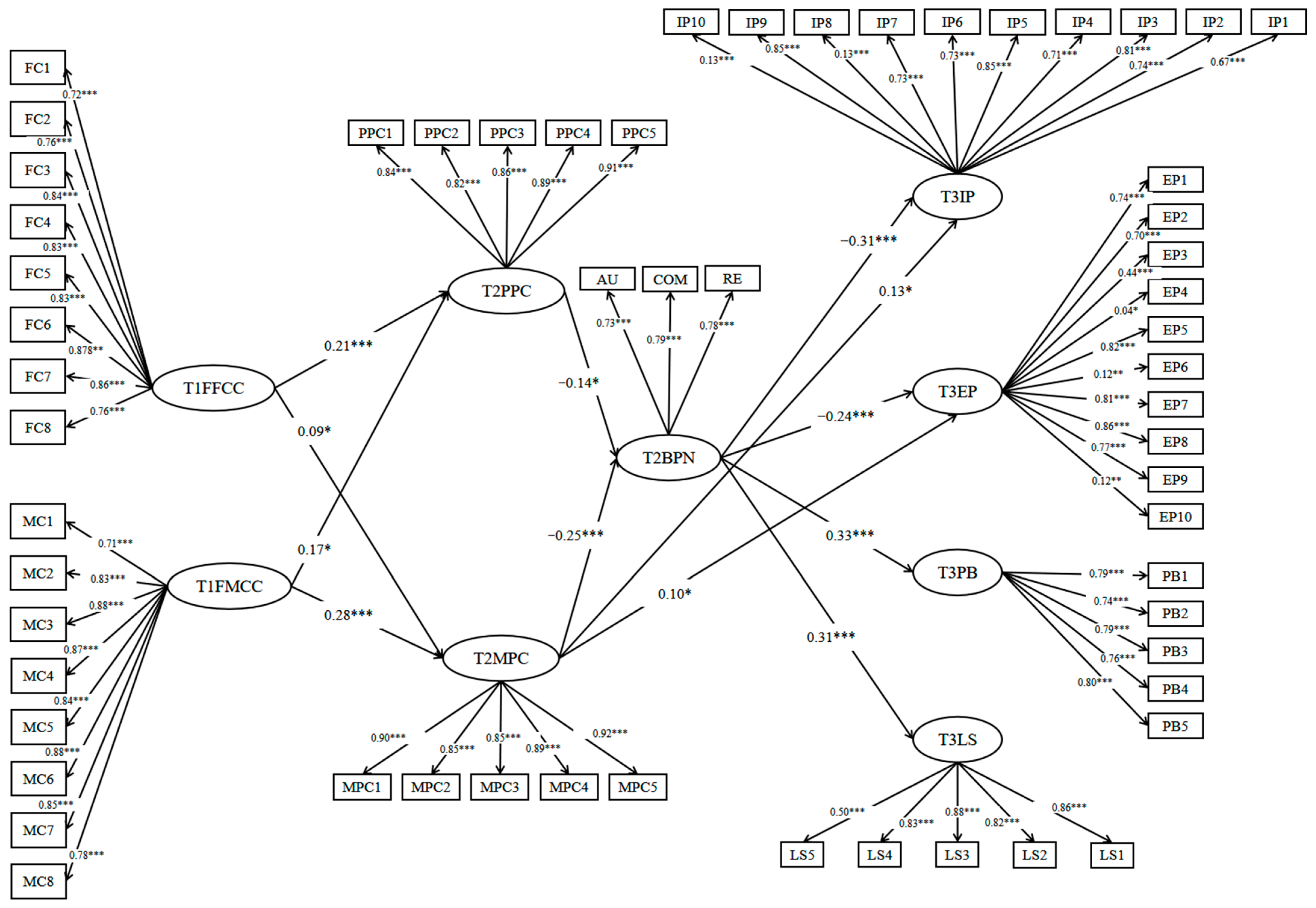
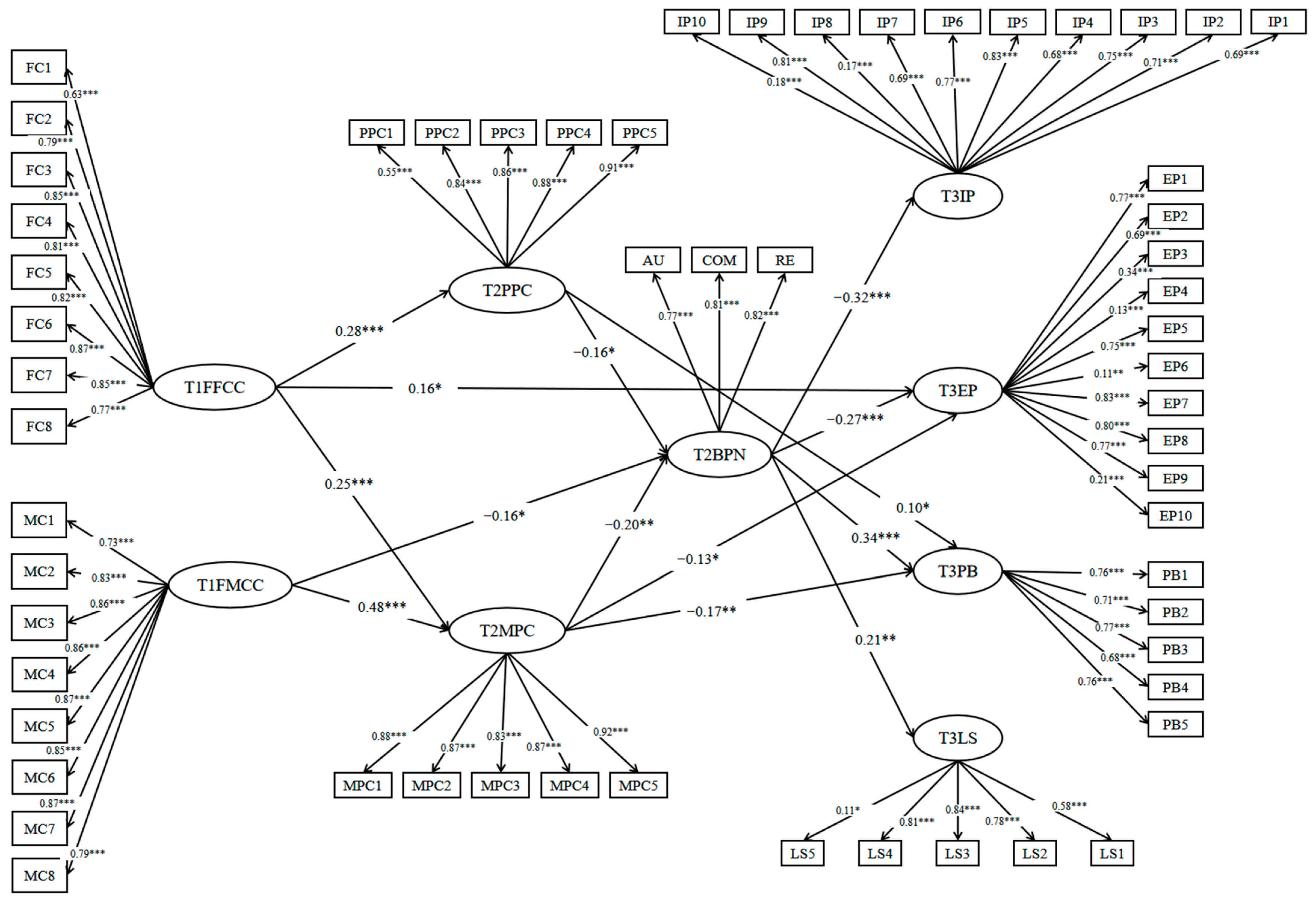
3.4. Model Analyses
4. Discussion
4.1. The Mediating Role of Parental Psychological Control
4.2. The Mediating Role of Basic Psychological Needs
4.3. The Serial Mediating Role of Parental Psychological Control and Basic Psychological Needs
4.3.1. Serial Mediation Pathways in Primary School
4.3.2. Serial Mediation Pathways in Secondary School
4.4. The Practical Significance of Small Indirect Effects
4.5. Significance, Practical Implications, and Limitations
5. Conclusions
- (1)
- Parental psychological control and basic psychological need served as important independent mediators, with pronounced stage-specific patterns. In primary school, maternal psychological control was the core mediator; in secondary school, basic psychological need emerged as a comprehensive mediator, and the independent mediating role of paternal psychological control was substantially strengthened, reflecting a developmental shift from indirect influence to direct effect.
- (2)
- The serial mediation pathway “parent–child conflict frequency → parental psychological control → basic psychological needs → psychological adjustment” was robustly established across both school stages. This indicates that parent–child conflict, as a distal stressor, contributes to adjustment difficulties only through the successive transmission of maladaptive parenting behaviors and the erosion of psychological resources.
Author Contributions
Funding
Institutional Review Board Statement
Informed Consent Statement
Data Availability Statement
Acknowledgments
Conflicts of Interest
References
- Abelson, R. P. (1985). A variance explanation paradox: When a little is a lot. Psychological Bulletin, 97(1), 129–133. [Google Scholar] [CrossRef]
- Barber, B. K., Stolz, H. E., Olsen, J. A., Collins, W. A., & Burchinal, M. (2005). Parental support, psychological control, and behavioral control: Assessing relevance across time, culture, and method. Monographs of the Society for Research in Child Development, 70(4), 1–137. [Google Scholar]
- Barber, B. K., Xia, M., Olsen, J. A., McNeely, C. A., & Bose, K. (2012). Feeling disrespected by parents: Refining the measurement and understanding of psychological control. Journal of Adolescence, 35(2), 273–287. [Google Scholar] [PubMed]
- Bardach, L., Yanagida, T., Goetz, T., Jach, H., & Pekrun, R. (2023). Self-regulated and externally regulated learning in adolescence: Developmental trajectories and relations with teacher behavior, parent behavior, and academic achievement. Developmental Psychology, 59(7), 1327. [Google Scholar] [CrossRef] [PubMed]
- Carlo, G., White, R. M. B., Streit, C., Knight, G. P., & Zeiders, K. H. (2018). Longitudinal relations among parenting styles, prosocial behaviors, and academic outcomes in U.S. Mexican adolescents. Child Development, 89(2), 577–592. [Google Scholar] [CrossRef] [PubMed]
- Chapleski, E. E., & Gresham, F. M. (2023). Gender differences in internalizing and externalizing problems among youth. School Psychology Review, 52(2), 145–160. [Google Scholar]
- Chen, F. F. (2007). Sensitivity of goodness of fit indexes to lack of measurement invariance. Structural Equation Modeling, 14(3), 464–504. [Google Scholar] [CrossRef]
- Cheung, G. W., & Rensvold, R. B. (2002). Evaluating goodness-of-fit indexes for testing measurement invariance. Structural Equation Modeling, 9(2), 233–255. [Google Scholar] [CrossRef]
- Cicchetti, D., & Rogosch, F. A. (2002). A developmental psychopathology perspective on adolescence. Journal of Consulting and Clinical Psychology, 70(1), 6–20. [Google Scholar] [CrossRef]
- Conger, R. D., & Conger, K. J. (2008). Understanding the processes through which economic hardship influences families and children. In D. R. Crane, & T. B. Heaton (Eds.), Handbook of families and poverty (pp. 64–81). Sage. [Google Scholar]
- Connell, J. P., & Wellborn, J. G. (1991). Competence, autonomy, and relatedness: A motivational analysis of self-system processes. In M. R. Gunnar, & L. A. Sroufe (Eds.), Self processes and development: The Minnesota symposia on child psychology (Vol. 23, pp. 43–77). Lawrence Erlbaum Associates. [Google Scholar]
- Costa, S., Sireno, S., Larcan, R., & Cuzzocrea, F. (2019). The six dimensions of parenting and adolescent psychological adjustment: The mediating role of psychological needs. Scandinavian Journal of Psychology, 60(2), 128–137. [Google Scholar] [PubMed]
- Cox, M. J., & Paley, B. (1997). Families as systems. Annual Review of Psychology, 48, 243–267. [Google Scholar] [CrossRef] [PubMed]
- Cummings, E. M., & Davies, P. T. (2010). Marital conflict and children: An emotional security perspective. Guilford Press. [Google Scholar]
- Deci, E. L., & Ryan, R. M. (2000). The “what” and “why” of goal pursuits: Human needs and the self-determination of behavior. Psychological Inquiry, 11(4), 227–268. [Google Scholar] [CrossRef]
- Diener, E. D., Emmons, R. A., Larsen, R. J., & Griffin, S. (1985). The satisfaction with life scale. Journal of Personality Assessment, 49(1), 71–75. [Google Scholar] [CrossRef] [PubMed]
- Fang, X., & Dong, Q. (1998). Parent-child conflicts during early adolescence. Journal of Psychological Science, 21(02), 122–125. [Google Scholar]
- Gagné, M. (2003). The role of autonomy support and autonomy orientation in prosocial behavior engagement. Motivation and Emotion, 27(3), 199–223. [Google Scholar] [CrossRef]
- Goodman, R. (1997). The strengths and difficulties questionnaire: A research note. Journal of Child Psychology and Psychiatry, 38(5), 581–586. [Google Scholar] [CrossRef]
- Görges, F., Oehler, C., von Hirschhausen, E., Hegerl, U., & Rummel-Kluge, C. (2020). GET. HAPPY2–user perspectives on an internet-based self-management positive psychology intervention among persons with and without depression: Results from a retrospective survey. Journal of Clinical Psychology, 76(6), 1030–1046. [Google Scholar] [PubMed]
- Götz, F. M., Gosling, S. D., & Rentfrow, P. J. (2022). Small effects: The indispensable foundation for a cumulative psychological science. Perspectives on Psychological Science, 17(1), 205–215. [Google Scholar] [PubMed]
- Grolnick, W. S. (2003). The psychology of parental control: How well-meant parenting backfires. Lawrence Erlbaum Associates. [Google Scholar]
- Guyer, A. E., Silk, J. S., & Nelson, E. E. (2016). The neurobiology of the emotional adolescent: From the inside out. Neuroscience & Biobehavioral Reviews, 70, 74–85. [Google Scholar] [CrossRef]
- Hardt, J., & Rutter, M. (2004). Validity of adult retrospective reports of adverse childhood experiences: Review of the evidence. Journal of Child Psychology and Psychiatry, 45(2), 260–273. [Google Scholar] [CrossRef] [PubMed]
- Hogye, S. I., Lucassen, N., Jansen, P. W., Schuurmans, I. K., & Keizer, R. (2022). Cumulative risk and internalizing and externalizing problems in early childhood: Compensatory and buffering roles of family functioning and family regularity. Adversity and Resilience Science, 3(2), 149–167. [Google Scholar] [CrossRef]
- Hu, J., & Zhou, T. (2025). Parent-and adolescent-driven effects in emotion-related communication and longitudinal relationships with depressive symptoms in adolescents. Journal of Youth and Adolescence, 54(2), 310–325. [Google Scholar]
- Hu, L. T., & Bentler, P. M. (1999). Cutoff criteria for fit indexes in covariance structure analysis: Conventional criteria versus new alternatives. Structural Equation Modeling: A Multidisciplinary Journal, 6(1), 1–55. [Google Scholar] [CrossRef]
- Jhang, F. H. (2025). Coparenting conflict and externalizing problems among early adolescents: A longitudinal moderated mediation model. Current Psychology, 44, 5003–5015. [Google Scholar] [CrossRef]
- Kline, R. B. (2016). Principles and practice of structural equation modeling (4th ed.). Guilford Press. [Google Scholar]
- La Guardia, J. G., & Patrick, H. (2008). Self-determination theory as a fundamental theory of close relationships. Canadian Psychology, 49(3), 201–209. [Google Scholar] [CrossRef]
- Lamb, M. E., & Lewis, C. (2013). Father-child relationships. In N. J. Cabrera, & C. S. Tamis-LeMonda (Eds.), Handbook of father involvement: Multidisciplinary perspectives (2nd ed., pp. 119–135). Routledge. [Google Scholar]
- Lansford, J. E., Laird, R. D., Pettit, G. S., Bates, J. E., & Dodge, K. A. (2014). Mothers’ and fathers’ autonomy-relevant parenting: Longitudinal links with adolescents’ externalizing and internalizing behavior. Journal of Youth and Adolescence, 43(11), 1877–1889. [Google Scholar] [CrossRef] [PubMed]
- Levitt, M. R., Grolnick, W. S., Raftery-Helmer, J. N., & Caruso, A. J. (2020). Fathers’ and mothers’ parenting involvement and children’s social and academic adjustment: Moderating effects of child age. Journal of Child and Family Studies, 29, 2143–2155. [Google Scholar] [CrossRef]
- Li, W., Guo, F., & Chen, Z. (2019). The effect of social support on adolescents’ prosocial behavior: A serial mediation model. Chinese Journal of Clinical Psychology, 27(4), 817–821. [Google Scholar]
- Mabbe, E., Soenens, B., Vansteenkiste, M., van der Kaap-Deeder, J., & Mouratidis, A. (2018). Day-to-day variation in autonomy-supportive and psychologically controlling parenting: The role of parents’ daily experiences of need satisfaction and need frustration. Parenting, 18(2), 86–109. [Google Scholar] [CrossRef]
- Martela, F., & Ryan, R. M. (2016). The benefits of benevolence: Basic psychological needs, beneficence, and the enhancement of well-being. Journal of Personality, 84(6), 750–764. [Google Scholar] [PubMed]
- McCartney, K., & Rosenthal, R. (2000). Effect size, practical importance, and social policy for children. Child Development, 71(1), 173–180. [Google Scholar] [CrossRef]
- Moed, A., Gershoff, E. T., Eisenberg, N., Hofer, C., Losoya, S., Spinrad, T. L., & Maxon, E. (2015). Parent-adolescent conflict as sequences of reciprocal negative emotion: Links with conflict resolution and adolescents’ behavior problems. Journal of Youth and Adolescence, 44(8), 1607–1622. [Google Scholar] [PubMed]
- Nie, M. (2018). Relations between perceived parental psychological control and autonomy support, and future planning in college students: The mediating roleof dual autonomy [Master’s thesis, East China Normal University]. [Google Scholar]
- Patterson, G. R. (2002). The early development of coercive family process. In J. B. Reid, G. R. Patterson, & J. Snyder (Eds.), Antisocial behavior in children and adolescents: A developmental analysis and model for intervention (pp. 25–44). American Psychological Association. [Google Scholar]
- Pettitt, A. K., Nelson, B. W., Forman-Hoffman, V. L., Goldin, P. R., & Peiper, N. C. (2024). Longitudinal outcomes of a therapist-supported digital mental health intervention for depression and anxiety symptoms: A retrospective cohort study. Psychology and Psychotherapy: Theory, Research and Practice, 97(2), 288–300. [Google Scholar] [CrossRef]
- Piotrowska, P. J., Stride, C. B., Croft, S. E., & Rowe, R. (2016). Socioeconomic status and antisocial behaviour among children and adolescents: A systematic review and meta-analysis. Clinical Psychology Review, 35, 47–55. [Google Scholar]
- Podsakoff, P. M., MacKenzie, S. B., Lee, J. Y., & Podsakoff, N. P. (2003). Common method biases in behavioral research: A critical review of the literature and recommended remedies. Journal of Applied Psychology, 88(5), 879–903. [Google Scholar] [CrossRef]
- Preacher, K. J., & Kelley, K. (2011). Effect size measures for mediation models: Quantitative strategies for communicating indirect effects. Psychological Methods, 16(2), 93–115. [Google Scholar] [CrossRef] [PubMed]
- Rodriguez, A., Reise, S. P., & Haviland, M. G. (2016). Evaluating bifactor models: Calculating and interpreting statistical indices. Psychological Methods, 21(2), 137–150. [Google Scholar] [CrossRef]
- Ryan, R. M., & Deci, E. L. (2000). Self-Determination Theory and the facilitation of intrinsic motivation, social development, and well-being. The American Psychologist, 5(1), 68–78. [Google Scholar] [CrossRef]
- Shek, D. T. (2007). A longitudinal study of perceived differences in parental control and parent-child relational qualities in Chinese adolescents in Hong Kong. Journal of Adolescent Research, 22(2), 156–188. [Google Scholar] [CrossRef]
- Smetana, J. G., Campione-Barr, N., & Metzger, A. (2006). Adolescent development in interpersonal and societal contexts. Annual Review of Psychology, 57, 255–284. [Google Scholar] [CrossRef]
- Soenens, B., & Vansteenkiste, M. (2010). A theoretical upgrade of the concept of parental psychological control: Proposing new insights on the basis of self-determination theory. Developmental Review, 30(1), 74–99. [Google Scholar] [CrossRef]
- Steinberg, L. (2014). Age of opportunity: Lessons from the new science of adolescence. Houghton Mifflin Harcourt. [Google Scholar]
- Suldo, S. M., & Huebner, E. S. (2004). Does life satisfaction moderate the effects of stressful life events on psychopathological behavior during adolescence? School Psychology Quarterly, 19(2), 93–105. [Google Scholar] [CrossRef]
- Sun, L., Ju, J., Kang, L., & Bian, Y. (2021). “More control, more conflicts?” Clarifying the longitudinal relations between parental psychological control and parent-adolescent conflict by disentangling between-family effects from within-family effects. Journal of Adolescence, 93, 212–221. [Google Scholar] [CrossRef] [PubMed]
- Sun, P., Yang, Z., Pan, M., & Chen, S. (2022). The effects of dual filial piety on life satisfaction among adolescents: The mediating role of basic psychological need satisfaction. Chinese Journal of Clinical Psychology, 30(3), 588–594. [Google Scholar]
- Vansteenkiste, M., & Ryan, R. M. (2013). On psychological growth and vulnerability: Basic psychological need satisfaction and need frustration as a unifying principle. Journal of Psychotherapy Integration, 23(3), 263–280. [Google Scholar] [CrossRef]
- Wang, L., Guo, M., & Wang, X. (2023). Development and validation of the academic parenting scale for Chinese parents of primary school students. Current Psychology, 42(36), 31864–31879. [Google Scholar]
- Wang, Q., Pomerantz, E. M., & Chen, H. (2007). The role of parents’ control in early adolescents’ psychological functioning: A longitudinal investigation in the United States and China. Child Development, 78(5), 1592–1610. [Google Scholar] [CrossRef]
- Wu, W., Xie, R.-B., Ding, W., Wang, D., & Li, W.-J. (2022). The longitudinal relationship between parental psychological control and problem behaviors of middle childhood children: The mediating roles of paternal-and maternal-attachment. Journal of Psychological Science, 45(2), 364–371. [Google Scholar]
- Xie, R., Chen, M., Wen, K., Ji, H., Wenren, S., Ding, W., & Chen, Y. (2026). Parents stretched thin, children anxious? The impact of parental work-family conflict on Chinese pupils’ academic efficacy. Journal of Applied Developmental Psychology, 103, 101930. [Google Scholar] [CrossRef]
- Xie, R., Wang, X., Ding, Y., Chen, Y., & Ding, W. (2024). The impact of parental autonomy support on family adaptation in the context of “double reduction”: The mediating role of parent–child communication and cohesion. Behavioral Sciences, 14(7), 534. [Google Scholar] [CrossRef]
- You, Z., Guo, Y., Zhang, L., & Li, X. (2025). The relationship between interparental conflict and prosocial behavior in adolescents: The role of interpersonal trust and empathy. Psychological Development and Education, 1, 51–59. [Google Scholar]
- Zhang, W., Yu, G., Fu, W., & Li, R. (2022). Parental psychological control and children’s prosocial behavior: The mediating role of social anxiety and the moderating role of socioeconomic status. International Journal of Environmental Research and Public Health, 19(18), 11691. [Google Scholar] [CrossRef] [PubMed]
- Zhou, J., Zheng, X., & Gong, X. (2025). Developmental trajectories of parental psychological control and supportive parenting in Chinese early adolescents: Relations to internalizing and externalizing problems. Journal of Youth and Adolescence, 54(9), 2222–2235. [Google Scholar] [CrossRef] [PubMed]
- Zhu, Y., Zhang, S., & Zhang, X. (2020). The relationship between interparental conflicts and adolescents’ life satisfaction: The mediating effect of adolescents’ behavioral response. Studies of Psychology and Behavior, 18(5), 645651. [Google Scholar]
- Zimmermann, P., & Iwanski, A. (2014). Emotion regulation from early adolescence to emerging adulthood and middle adulthood: Age differences, gender differences, and emotion-specific developmental variations. International Journal of Behavioral Development, 38(2), 182–194. [Google Scholar] [CrossRef]

| M ± SD | t | 1 | 2 | 3 | 4 | 5 | 6 | 7 | 8 | 9 | ||
|---|---|---|---|---|---|---|---|---|---|---|---|---|
| Primary School | Secondary School | |||||||||||
| 1. T1FFCC | 2.39 ± 1.04 | 2.28 ± 1.02 | 2.72 ** | 1 | 0.84 *** | 0.35 *** | 0.32 *** | −0.19 *** | 0.17 *** | 0.16 *** | −0.13 *** | −0.08 * |
| 2. T1FMCC | 2.34 ± 1.07 | 2.27 ± 1.05 | 1.45 | 0.87 *** | 1 | 0.32 *** | 0.39 *** | −0.24 *** | 0.18 *** | 0.18 *** | −0.13 *** | −0.13 *** |
| 3. T2PPC | 2.53 ± 1.02 | 2.57 ± 1.03 | −0.96 | 0.41 *** | 0.40 *** | 1 | 0.76 *** | −0.31 *** | 0.21 *** | 0.16 *** | −0.16 *** | −0.08 * |
| 4. T2MPC | 2.48 ± 1.04 | 2.47 ± 1.02 | 0.34 | 0.39 *** | 0.42 *** | 0.82 *** | 1 | −0.35 *** | 0.26 *** | 0.22 *** | −0.20 *** | −0.11 ** |
| 5. T2BPN | 3.31 ± 0.53 | 3.24 ± 0.56 | 2.86 ** | −0.28 *** | −0.29 *** | −0.34 *** | −0.36 *** | 1 | −0.41 *** | −0.32 *** | 0.32 *** | 0.15 *** |
| 6. T3IP | 1.56 ± 0.38 | 1.67 ± 0.41 | −6.64 *** | 0.21 *** | 0.24 *** | 0.26 *** | 0.28 *** | −0.34 *** | 1 | 0.52 *** | −0.42 *** | −0.09 ** |
| 7. T3EP | 1.61 ± 0.36 | 1.67 ± 0.34 | −4.25 *** | 0.26 *** | 0.28 *** | 0.29 *** | 0.31 *** | −0.36 *** | 0.78 *** | 1 | −0.38 *** | −0.13 *** |
| 8. T3PB | 2.40 ± 0.46 | 2.34 ± 0.45 | 2.51 *** | −0.13 *** | −0.12 *** | −0.14 *** | −0.17 *** | 0.29 *** | −0.31 *** | −0.45 *** | 1 | 0.28 *** |
| 9. T3LS | 4.71 ± 1.12 | 4.29 ± 1.03 | 9.41 *** | −0.08 * | −0.07 *** | −0.09 ** | −0.11 *** | 0.25 *** | −0.13 *** | −0.23 *** | 0.36 *** | 1 |
| Model | χ2 (df) | CFI | TLI | RMSEA | Comparison | ∆CFI | ∆RMSEA | |
|---|---|---|---|---|---|---|---|---|
| FFCC | M1 | 419.13 (54) | 0.972 | 0.971 | 0.079 | |||
| M2 | 436.24 (55) | 0.971 | 0.971 | 0.080 | M2–M1 | −0.001 | 0.001 | |
| M3 | 480.11 (63) | 0.968 | 0.972 | 0.078 | M3–M2 | −0.003 | −0.002 | |
| FMCC | M1 | 419.55 (52) | 0.976 | 0.974 | 0.080 | |||
| M2 | 439.67 (53) | 0.974 | 0.973 | 0.082 | M2–M1 | −0.002 | 0.002 | |
| M3 | 472.31 (61) | 0.973 | 0.975 | 0.079 | M3–M2 | −0.001 | −0.003 | |
| PPC | M1 | 65.62 (10) | 0.994 | 0.988 | 0.071 | |||
| M2 | 66.70 (11) | 0.994 | 0.988 | 0.070 | M2–M1 | 0.000 | −0.001 | |
| M3 | 76.06 (13) | 0.993 | 0.989 | 0.067 | M3–M2 | −0.001 | −0.003 | |
| MPC | M1 | 103.93 (14) | 0.991 | 0.988 | 0.077 | |||
| M2 | 108.50 (15) | 0.991 | 0.987 | 0.076 | M2–M1 | 0.000 | −0.001 | |
| M3 | 138.40 (19) | 0.989 | 0.988 | 0.076 | M3–M2 | −0.002 | 0.000 | |
| BPN | M1 | 414.03 (60) | 0.946 | 0.936 | 0.074 | |||
| M2 | 451.83 (62) | 0.941 | 0.931 | 0.076 | M2–M1 | −0.005 | 0.002 | |
| M3 | 474.83 (71) | 0.939 | 0.938 | 0.072 | M3–M2 | −0.002 | −0.004 | |
| IP | M1 | 536.60 (76) | 0.960 | 0.953 | 0.075 | |||
| M2 | 572.07 (78) | 0.957 | 0.951 | 0.076 | M2–M1 | −0.003 | 0.001 | |
| M3 | 633.33 (88) | 0.953 | 0.952 | 0.075 | M3–M2 | −0.004 | −0.001 | |
| EP | M1 | 609.15 (76) | 0.941 | 0.930 | 0.080 | |||
| M2 | 650.26 (78) | 0.936 | 0.926 | 0.082 | M2–M1 | −0.005 | 0.002 | |
| M3 | 705.24 (88) | 0.931 | 0.930 | 0.080 | M3–M2 | −0.005 | −0.002 | |
| PB | M1 | 48.12 (10) | 0.993 | 0.985 | 0.059 | |||
| M2 | 71.59 (12) | 0.988 | 0.981 | 0.067 | M2–M1 | −0.005 | 0.008 | |
| M3 | 95.07 (17) | 0.985 | 0.982 | 0.065 | M3–M2 | −0.003 | −0.002 | |
| LS | M1 | 49.91 (10) | 0.989 | 0.987 | 0.052 | |||
| M2 | 69.77 (14) | 0.985 | 0.986 | 0.058 | M2–M1 | −0.004 | 0.006 | |
| M3 | 95.18 (18) | 0.979 | 0.953 | 0.063 | M3–M2 | −0.006 | 0.005 |
| Educational Stage | Paths | β | 95% CI |
|---|---|---|---|
| primary school | FMCC → MPC → IP | 0.04 | [0.010, 0.088] |
| FFCC → MPC → EP | 0.01 | [0.001, 0.034] | |
| FMCC → MPC → EP | 0.03 | [0.007, 0.081] | |
| FFCC → MPC → BPN → IP | 0.01 | [0.001, 0.016] | |
| FFCC → PPC → BPN → IP | 0.01 | [0.001, 0.019] | |
| FMCC → MPC → BPN → IP | 0.02 | [0.009, 0.039] | |
| FMCC → MPC → BPN → EP | 0.02 | [0.009, 0.031] | |
| FFCC → PPC → BPN → EP | 0.01 | [0.001, 0.017] | |
| FFCC → MPC → BPN → EP | 0.01 | [0.001, 0.016] | |
| FFCC → PPC → BPN → LS | −0.01 | [−0.016, −0.001] | |
| FMCC → MPC → BPN → LS | −0.02 | [−0.045, −0.011] | |
| FFCC → PPC → BPN → PB | −0.01 | [−0.021, −0.001] | |
| FMCC → MPC → BPN → PB | −0.02 | [−0.043, −0.001] | |
| secondary school | FMCC → BPN → IP | 0.05 | [0.002, 0.098] |
| FMCC → BPN → EP | 0.04 | [0.002, 0.080] | |
| FMCC → BPN → PB | −0.05 | [−0.085, −0.013] | |
| FMCC → BPN → LS | −0.03 | [−0.073, −0.003] | |
| FFCC → PPC → PB | 0.03 | [0.001, 0.065] | |
| FMCC → MPC → PB | −0.09 | [−0.142, −0.045] | |
| FFCC → PPC → BPN → IP | 0.01 | [0.002, 0.034] | |
| FFCC → MPC → BPN → IP | 0.02 | [0.013, 0.046] | |
| FFCC → PPC → BPN → EP | 0.01 | [0.002, 0.027] | |
| FMCC → MPC → BPN → EP | 0.03 | [0.007, 0.048] | |
| FMCC → MPC → BPN → LS | −0.02 | [−0.056, −0.010] | |
| FFCC → PPC → BPN → PB | −0.02 | [−0.034, −0.002] | |
| FMCC → MPC → BPN → PB | −0.03 | [−0.048, −0.014] |
Disclaimer/Publisher’s Note: The statements, opinions and data contained in all publications are solely those of the individual author(s) and contributor(s) and not of MDPI and/or the editor(s). MDPI and/or the editor(s) disclaim responsibility for any injury to people or property resulting from any ideas, methods, instructions or products referred to in the content. |
© 2026 by the authors. Licensee MDPI, Basel, Switzerland. This article is an open access article distributed under the terms and conditions of the Creative Commons Attribution (CC BY) license.
Share and Cite
Chen, M.; Ding, W.; Liu, J.; Su, N. Parent–Child Conflict and Psychological Adjustment: The Serial Mediating Roles of Psychological Control and Basic Psychological Needs. Behav. Sci. 2026, 16, 1055. https://doi.org/10.3390/bs16071055
Chen M, Ding W, Liu J, Su N. Parent–Child Conflict and Psychological Adjustment: The Serial Mediating Roles of Psychological Control and Basic Psychological Needs. Behavioral Sciences. 2026; 16(7):1055. https://doi.org/10.3390/bs16071055
Chicago/Turabian StyleChen, Mingshu, Wan Ding, Jingning Liu, and Ningxin Su. 2026. "Parent–Child Conflict and Psychological Adjustment: The Serial Mediating Roles of Psychological Control and Basic Psychological Needs" Behavioral Sciences 16, no. 7: 1055. https://doi.org/10.3390/bs16071055
APA StyleChen, M., Ding, W., Liu, J., & Su, N. (2026). Parent–Child Conflict and Psychological Adjustment: The Serial Mediating Roles of Psychological Control and Basic Psychological Needs. Behavioral Sciences, 16(7), 1055. https://doi.org/10.3390/bs16071055

