Article

Revaluating the Dimensionality of Academic Engagement: A Bifactor Analysis of the UWES in Higher Education


by
Alejandro Vega-Muñoz
1,2,
Beatriz Sora
3,
Joan Boada-Grau
3,
David Chavez-Herting
2,* and
Natalia Salas-Guzmán
4,*
1
Facultad de Ciencias Empresariales, Universidad Arturo Prat, Santiago 8340232, Chile
2
Facultad de Medicina y Ciencias de la Salud, Universidad Central de Chile, Santiago 8330507, Chile
3
Faculty of Education Sciences and Psychology, University Rovira i Virgili, 43007 Tarragona, Spain
4
Facultad de Educación y Ciencias Sociales, Universidad Finis Terrae, Santiago 7501015, Chile
*
Authors to whom correspondence should be addressed.
Behav. Sci. 2026, 16(7), 1045; https://doi.org/10.3390/bs16071045
Submission received: 26 May 2026 / Revised: 17 June 2026 / Accepted: 18 June 2026 / Published: 23 June 2026

Abstract

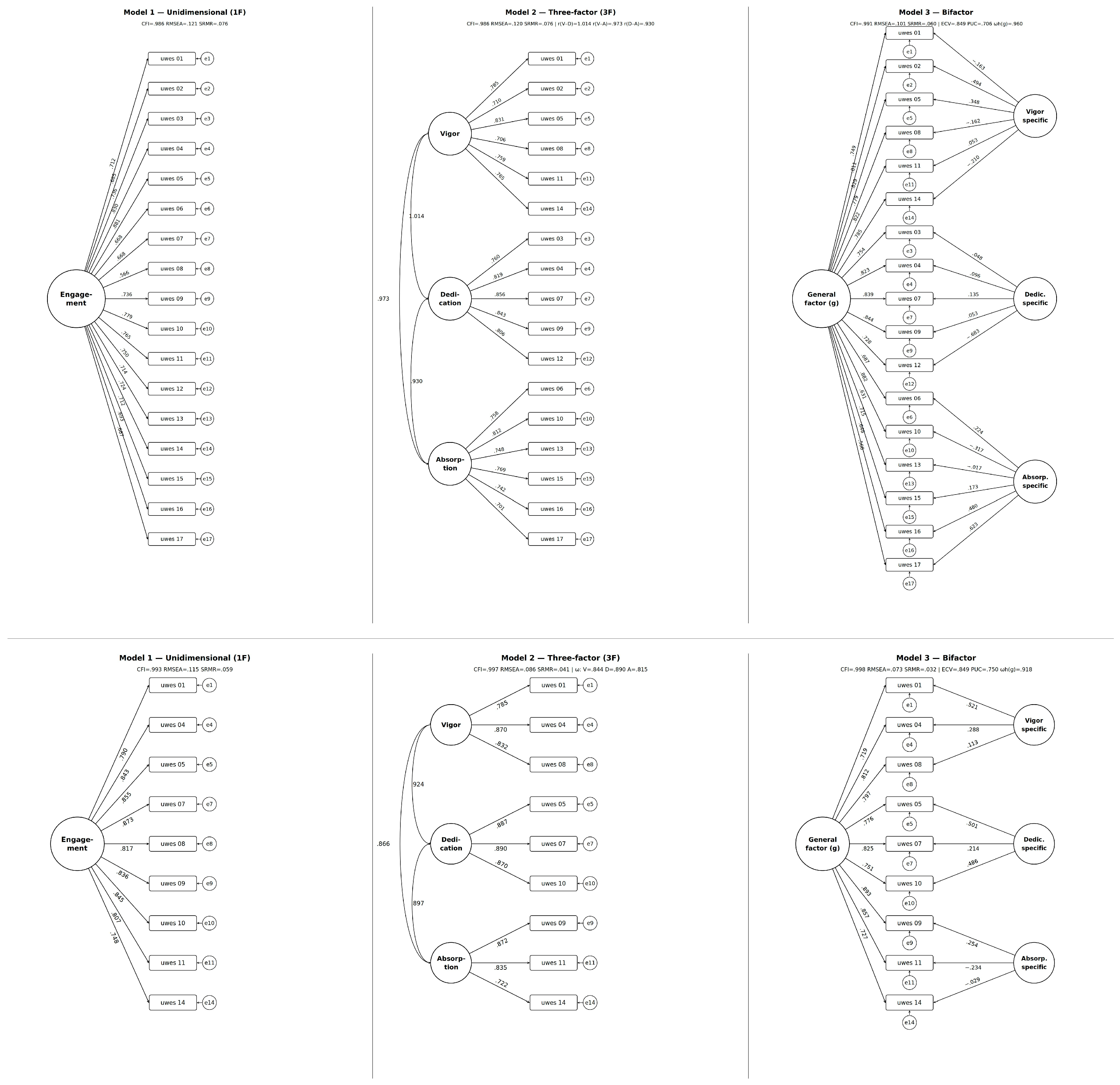
The factor structure of the Utrecht Work Engagement Scale (UWES) has been debated, with studies alternately supporting unidimensional and three-factor solutions. This inconsistency may reflect a methodological limitation: conventional confirmatory factor analysis (CFA) cannot always separate general from dimension-specific variance, producing similar fit indices across competing models when a dominant general factor is present. We examined the dimensionality of the UWES-17 and UWES-9 in a sample of 755 Chilean university students, comparing unidimensional, three-factor, second-order, and bifactor models using weighted least squares mean and variance adjusted (WLSMV) estimation appropriate for ordinal data. Bifactor indices, explained common variance (ECV), percent of uncontaminated correlations (PUC), and hierarchical omega (ωh), were computed to evaluate essential unidimensionality. Results indicated that a general engagement factor explained approximately 85% of common item variance in both versions (ECV ≈ 0.85; ωh > 0.90), while specific factors for vigor, dedication, and absorption retained negligible reliable variance, particularly absorption (ωh ≈ 0.00). Measurement invariance by sex was supported for the UWES-9 at the metric level, whereas classical UWES-17 solutions showed instability, including factor collapse and non-convergence of the second-order model. Taken together, findings suggest that the apparent multidimensionality of the UWES may be, at least partly, an artifact of conventional CFA modeling rather than a substantive property of the construct in this student sample. For applied monitoring of student well-being, the UWES-9 total score appears to be the most pragmatic and psychometrically defensible approach for assessing general academic engagement in this Chilean university sample, while institutional well-being monitoring would ideally be further supported by criterion-related, predictive, and sensitivity-to-change evidence.
Keywords: Utrecht Work Engagement Scale; student well-being monitoring; university students; Chile; bifactor analysis Utrecht Work Engagement Scale; student well-being monitoring; university students; Chile; bifactor analysis