1. Introduction
Game-based learning (GBL) has emerged as a transformative pedagogical approach, integrating game mechanics and dynamics into educational settings to enhance learner engagement and facilitate the acquisition of complex knowledge and skills (
Lin et al., 2020;
Thompson & Gillern, 2020;
Yu et al., 2020). This domain encompasses a broad spectrum of applications, including serious games designed explicitly for educational purposes (
Krath et al., 2021;
Wang & Huang, 2021), and gamified systems that overlay elements such as points and badges onto traditional learning contexts (
Kim & Castelli, 2021;
Meng et al., 2024). Unlike purely entertainment-focused media, the defining characteristic of GBL is the structured fusion of gameplay with explicit learning objectives (
Alaswad & Nadolny, 2015;
Shi & Shih, 2015). While the motivational benefits of GBL are well documented, recent research has increasingly focused on understanding how GBL facilitates students’ metacognitive abilities that are critical for learning in these environments.
The theory of self-regulated learning (SRL) provides a critical opportunity to understand students’ metacognitive abilities in learning contexts. According to SRL theory, metacognitive abilities refer to students’ ability to plan, monitor, and evaluate their cognitive processes (
Winne & Hadwin, 1998). SRL theory conceptualizes learning as a cyclical process. As modeled by
Zimmerman (
2002), in the forethought phase, students prepare for learning tasks by setting objectives and selecting strategies. Then, they shift focus to self-monitoring and strategy use during the performance phase and then evaluate performance, reflect on outcomes, and adjust future strategies based on successes or challenges in the self-reflection phase. Every phase of the SRL cycle requires students to utilize metacognitive abilities to control the learning processes and the quality of learning products (
Winne & Hadwin, 1998). For example, students use metacognitive skills to ensure their goals are appropriate and achievable. While learning, students constantly monitor and evaluate their learning outcomes and adjust actions based on real-time internal feedback. Finally, students reflect on outcomes, evaluate successes or failures, and refine strategies for future tasks.
Metacognitive learning exhibits distinct developmental trajectories across age groups, and the primary and junior middle school years represent a critical window for their foundational formation. Children aged 7–12 show steady improvements in metacognitive abilities, including planning, monitoring, and control skills (
Van Loon & Roebers, 2024;
Okada, 2021). Research also finds that a marked decline in metacognitive competencies often occurs during the transition from primary to secondary school (
Katsantonis, 2024;
Mok et al., 2007), driven largely by a decline in intrinsic motivation and mastery goals rather than by a loss of cognitive capacity (
Bouffard et al., 1998). This developmental pattern highlights the urgency of supporting metacognitive growth during early and middle childhood (
Leutwyler, 2009), before motivational and contextual disruptions impede further development. However, traditional classroom practices often struggle to engage students in active metacognitive activities (
Van Loon & Roebers, 2024;
Zepeda et al., 2019). Therefore, GBL, with its interactive and iterative nature, offers a promising avenue to address this challenge by embedding metacognitive practice within motivating, student-centered contexts (
Amzalag et al., 2024;
Checa-Romero & Giménez-Lozano, 2025). These learning strategies are supported by theoretically sound game design features such as explicit goal-setting prompts, progress visualization, in-game logs, and performance summaries, which stimulate learners to engage in metacognitive planning, monitoring, and evaluation strategies (
Amara et al., 2024;
Gurbuz & Celik, 2022;
Luo, 2021).
Although existing findings are encouraging, the current literature remains fragmented (
Braad et al., 2020;
Ricker & Richert, 2021;
Stephanou & Karamountzos, 2020). While prior reviews have separately investigated game-based learning and metacognition, no review has specifically focused on the intersection of GBL and metacognitive learning strategies within primary and junior middle school contexts. Therefore, this scoping review aims to synthesize and analyze current evidence regarding the influence of GBL on students’ metacognitive learning, specifically among primary and junior middle school students. As justified previously, primary and junior middle school students represent a crucial stage for developing metacognitive skills, laying a foundation for our motivation in this study. Second, GBL is particularly engaging for this age group, aligning with their developmental needs. Additionally, limited research exists on GBL’s impact on metacognitive learning in this population, making them an ideal focus for addressing this gap. The review aims to systematically explore the core connections between GBL and metacognitive learning by identifying the specific types of design features integrated into GBL that can facilitate learners’ metacognitive planning, monitoring, and evaluation. To address these objectives, the following research questions (RQs) have been formulated to guide the review process:
RQ1: What are the theoretical foundations for the design of GBL in the selected studies?
RQ2: What are the design features of the selected studies?
RQ3: What is the impact of GBL features on students’ metacognitive learning in the selected studies?
By systematically reviewing effective game design features and valid assessment approaches, this review offers clear guidance for teachers and game designers seeking interventions that cultivate deep and transferable metacognitive competence, and recommends directions for future empirical research on how digital games may promote broader academic growth.
The following sections present the theoretical background, methodology employing the PRISMA workflow, and results with discussions addressing the research questions.
3. Methodology
This scoping review was conducted and reported in strict compliance with the relevant requirements of the Report Specification for Systematic Review and Meta-analysis (PRISMA 2020), as proposed by
Page et al. (
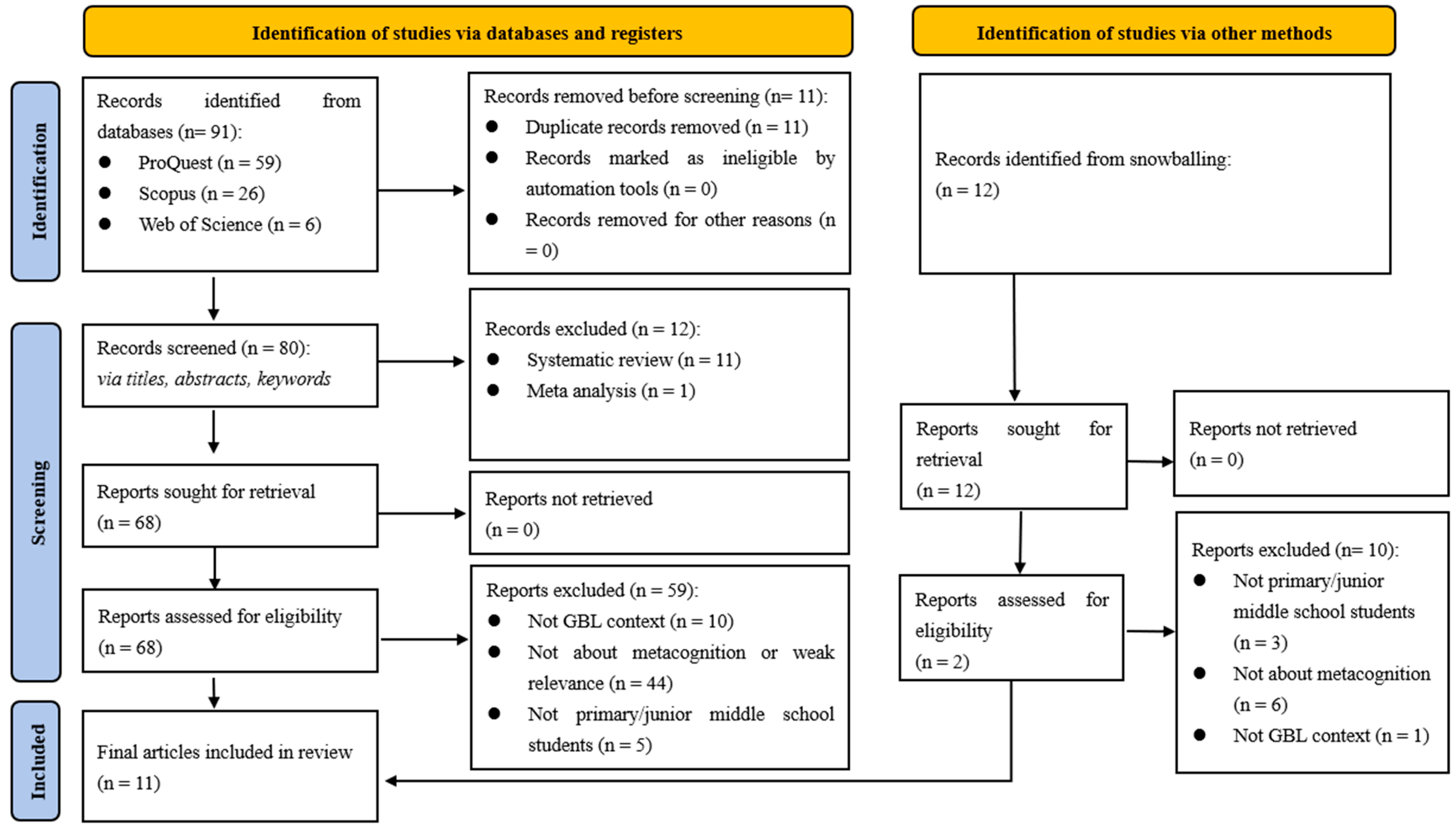
2021). To ensure the transparency and repeatability of the research process, we conducted the research according to its 27-item checklist and used a flow chart to illustrate the three stages of research selection (see
Figure 1). The identification and screening of related articles were completed under clearly defined inclusion and exclusion criteria.
3.1. Identification
This study selected three core academic databases for literature search: Web of Science, Scopus, and ProQuest. These databases contain a wide range of high-quality, peer-reviewed educational literature that can effectively support the literature base of this review. All searches were completed in one week to ensure the consistency and timeliness of the search results.
We formulated the search strategy for each database based on three fundamental keywords: game-based learning, metacognition, and primary and junior secondary education. Synonyms and alternate spellings of the concepts were included in the search strategy, and Boolean operators were used to combine them (“OR” within groups and “AND” between groups).
Table 1 presents the specific search terms. When searching, we applied the criteria to include the literature. First, the study should be written in English. Second, it should be a journal article published between 2015 and 2025 in a peer-reviewed academic journal. Third, full papers should be accessible for download. The database search was limited to the title, abstract, and keyword fields to enhance relevance and avoid a large number of irrelevant results that may be introduced by full-text field retrieval. Consequently, 91 articles were identified from the three databases.
3.2. Screening
The screening process was divided into two stages. First, we imported the identified articles into Zotero (version 7.0.32), a reference management system, to detect duplicates, which left 80. Next, we screened the titles and abstracts of the 80 articles against the inclusion and exclusion criteria (
Table 2) and removed 71 that were illegible. Finally, nine articles were retained from the three databases. To expand retrieval coverage, we also adopted the snowballing strategy. By checking the reference lists of the above nine qualified documents, 12 potential related studies were identified. After reading the full text, it was confirmed that two of them met all the inclusion criteria. Therefore, 11 studies (nine from the database search and two from snowballing) were finally retained.
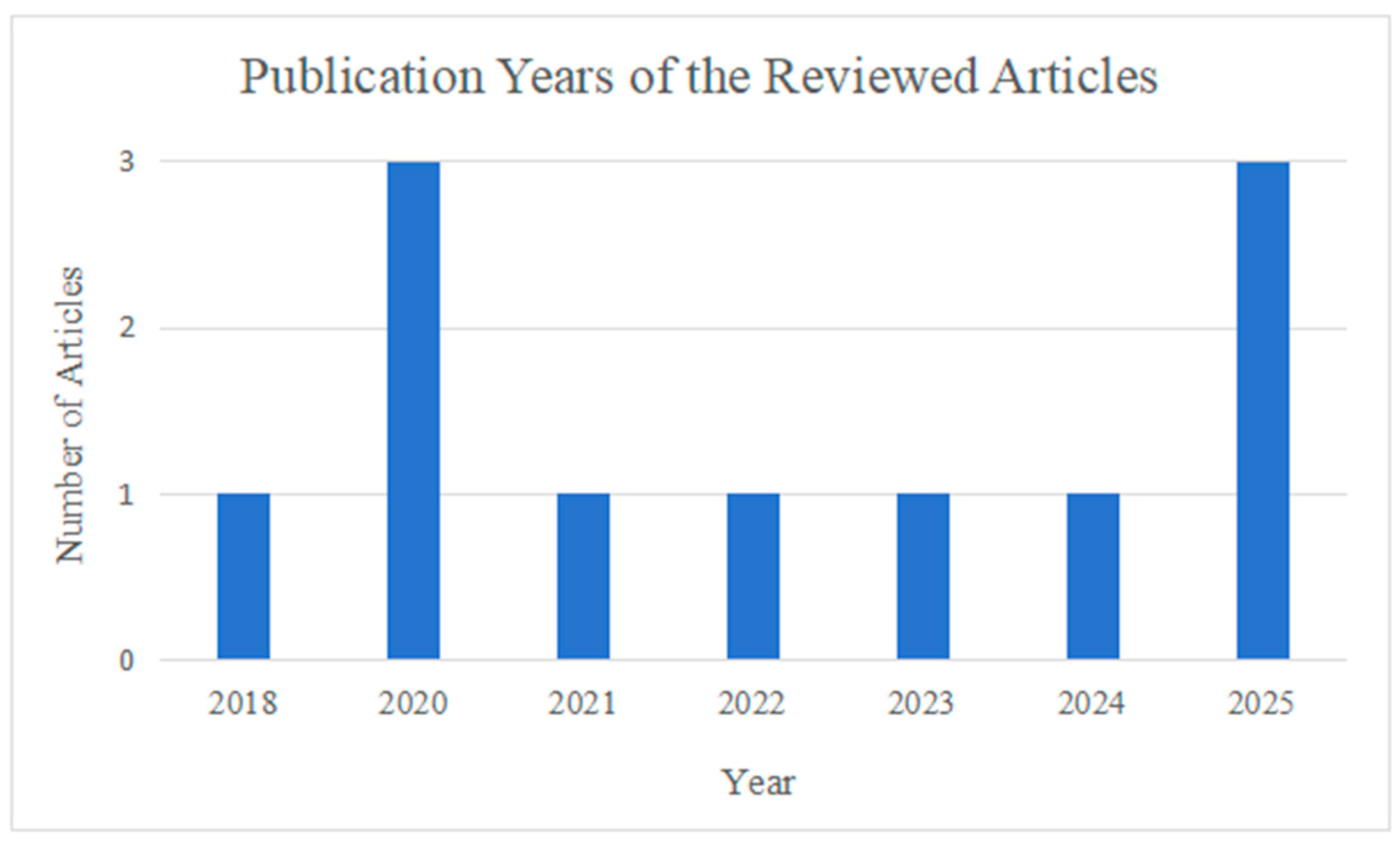
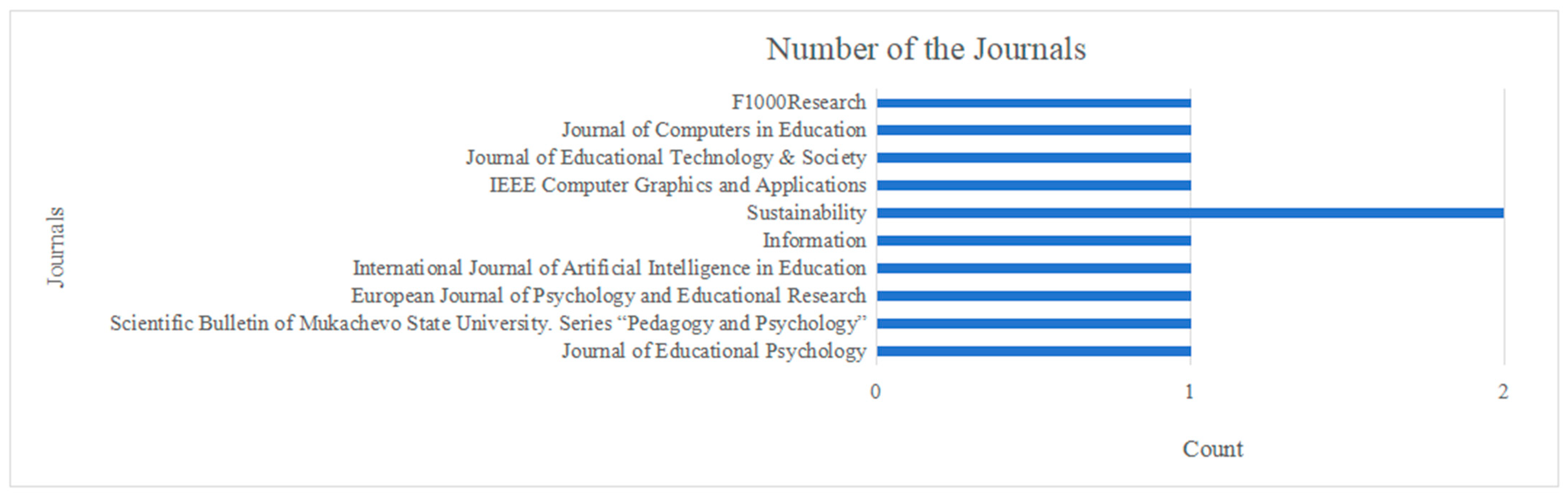
Appendix A lists the titles, authors, publication years, and journal names of these 11 studies. To facilitate citation and statistical analysis, we assigned a unique study ID to each study.
3.3. Coding Process
We adopt a structured coding process to extract and synthesize data from the included literature systematically. Referring to the two-stage method proposed by
Webster and Watson (
2002), the author-centered analysis was carried out first, and then the standardized data extraction table was developed to align with each research question (See
Table 3). For example, to address RQ1, the types of games used in GBL (i.e., serious games and gamified systems) are analyzed. The analysis further identifies specific design mechanics related to metacognitive strategies, including planning (e.g., goal-setting and task description), monitoring (e.g., real-time feedback and progress bars), and evaluation (e.g., performance analysis and explanatory feedback on errors).
To ensure inter-coder reliability, an iterative coding and revision process was adopted. Firstly, the author developed a preliminary coding scheme based on a relevant literature review. Then, the three authors independently coded the same subset of three selected studies to calibrate the application of the scheme. By comparing and discussing the results, the coding scheme was preliminarily optimized. After calibration, the remaining studies were divided equally and coded independently by the three authors. Upon completion, each author’s coding results were reviewed by the other two in a paired-review process. All discrepancies identified during these reviews were resolved through collective discussion until a consensus was reached. This process of independent coding, paired review, and consensus discussion promoted the continuous iterative optimization of the coding scheme. The scheme had been repeatedly adjusted to improve its clarity and accuracy until a stable final version was established and applied to all studies.
5. Discussions
5.1. Key Findings
This scoping review synthesized recent empirical evidence on how game-based learning (GBL) supports metacognitive learning strategies among primary and junior middle school students. Based on the 11 reviewed studies, we find that GBL can support metacognitive learning when game-based environments are intentionally designed to scaffold planning, monitoring, and evaluation, with the strongest and most consistent support observed for monitoring-related processes through immediate feedback, progress visualization, and interactive task guidance. At the same time, the review shows that the evidence base remains methodologically uneven, developmentally imbalanced, and theoretically under-specified in important respects.
A first important finding is that the metacognitive value of GBL appears to depend less on whether an intervention is labeled a “serious game” or a “gamified system” and more on whether it embeds explicit regulatory scaffolds into gameplay. In the reviewed studies, planning was commonly supported through explicit goal-setting, mission briefings, strategy menus, and resource allocation structures, whereas monitoring was most frequently supported through real-time feedback and progress displays, and evaluation through explanatory error feedback, end-of-level summaries, and performance analytics. This pattern is theoretically coherent with cyclical SRL theory, in which effective learning requires learners to anticipate metacognitive activities. The present review, therefore, extends prior work that has broadly associated GBL with improved engagement and learning by showing more precisely which design mechanics are linked to specific metacognitive phases. This distinction is important because previous reviews have often treated game-based features as a relatively undifferentiated set of motivational affordances rather than as targeted supports for metacognitive regulation (
Meng et al., 2024). Our review suggests that the educational value of GBL for metacognitive learning lies not in gamefulness per se, but in the alignment between mechanics and regulatory functions.
A second key finding concerns the especially prominent role of monitoring support. Among the identified mechanics, real-time feedback and progress visualization were the most frequently implemented, and they were also the most consistently associated with improved metacognitive awareness and strategy adjustment. This prominence is not surprising. Monitoring is the most externally observable component of metacognition and the easiest to operationalize within digital environments, where learner actions can be continuously tracked and mirrored back to the learner through dashboards, prompts, and status indicators. From the perspective of SRL theory, such features reduce the latency between action and consequence, thereby making the regulation process more visible and actionable for younger learners who may not yet spontaneously monitor their cognition in abstract ways. This interpretation is also consistent with work showing that computer-based prompts and metacognitive supports are most effective when they are timely, explicit, and tightly coupled to task performance rather than delivered as decontextualized advice (
Guo, 2022;
Dignath & Veenman, 2021). At the same time, the relative dominance of monitoring features reveals a gap in current design practice: planning and especially evaluation were scaffolded less comprehensively and often less deeply than monitoring. This imbalance may limit the extent to which GBL fosters fully cyclical SRL rather than short-term performance adjustment alone.
5.2. Implications
The review also highlights a developmental and contextual imbalance in the literature. Most included studies focused on primary school students, while junior middle school students were markedly underrepresented. This is a consequential gap rather than a simple sampling bias. Developmental research indicates that childhood and the transition into adolescence are critical periods for the formation, reorganization, and potential disruption of metacognitive self-regulation, especially as motivational profiles and learning demands shift across school stages (
Katsantonis, 2024;
Okada, 2021;
Van Loon & Roebers, 2024). The predominance of primary-school evidence means that current conclusions about GBL-supported metacognitive learning are strongest for younger learners and should not be generalized uncritically to junior middle school settings, where motivational decline, increased academic pressure, and subject specialization may alter both the need for and responsiveness to metacognitive scaffolds. A similar caution applies to disciplinary distribution. The evidence was concentrated in STEM and language learning, with very limited representation from other educational domains. This concentration may reflect the relative ease with which task progression, correctness, and feedback can be formalized in STEM or language platforms, but it also narrows our understanding of how GBL might support metacognitive learning in less-structured domains that demand interpretation, argumentation, and perspective-taking. Accordingly, the field now needs designs that test whether the metacognitive benefits identified here are transferable across age groups and knowledge domains rather than domain-bound to highly structured digital tasks.
Another major contribution of this review is the identification of a methodological shift toward multimodal assessment, especially the growing use of digital trace and behavioral log data alongside questionnaires and scales. This is one of the most promising developments in the literature. Self-report measures remain highly prevalent because they are practical and scalable, but they are vulnerable to overestimation, limited introspective accuracy, and developmental constraints, particularly among younger learners (
Craig et al., 2020). By contrast, digital trace data allow researchers to infer metacognitive processes from time-stamped interactions, such as planning-tool use, help-seeking sequences, navigation paths, and revision patterns. In principle, this offers a more process-sensitive and less reactive view of regulation in action. However, the present review also suggests that the field has not yet fully resolved the validity problem. Many studies collected trace data, but fewer clearly articulated how specific behavioral indicators mapped onto theoretically grounded constructs of planning, monitoring, or evaluation. In other words, the field is moving toward richer measurement, but not always toward stronger construct validity. This gap highlights a critical need for researchers to more explicitly define the relationships between observable actions and the underlying cognitive processes they aim to measure. Without this alignment, the validity of conclusions drawn from trace data remains uncertain, potentially limiting its usefulness in understanding metacognitive learning. Future research would therefore benefit from more explicit triangulation across self-report, trace data, reflective artifacts, and observational or verbal protocols.
The review further shows that theoretical grounding remains inconsistent across the literature. Although SRL-related models were the most common frameworks, nearly half of the studies did not clearly specify a guiding theory. This matters because theory is not simply an interpretive add-on; it determines how game features are selected, how metacognitive processes are defined, and how outcomes are measured. When GBL interventions are not anchored in a clear model of regulation, there is a risk that design features such as points, leaderboards, or rewards are used primarily to stimulate engagement without clarifying how they are expected to improve metacognitive functioning. This may help explain why the literature often reports positive effects on motivation, participation, or self-efficacy, but less consistently demonstrates how those effects translate into durable gains in planning, monitoring, or evaluation. Earlier reviews have similarly noted that the game-based learning field is theoretically heterogeneous, with uneven integration of educational psychology into design decisions (
Krath et al., 2021;
Wang & Huang, 2021). Our review sharpens this concern in the specific context of metacognitive learning: if the goal is to cultivate transferable metacognitive engagement rather than merely increase participation, then design must be explicitly theory-driven. In practice, this means integrating mechanics that correspond to SRL phases, sequencing supports so that learners progressively internalize them, and measuring outcomes in ways that distinguish metacognitive regulation from adjacent constructs such as motivation or behavioral engagement.
Several implications follow for educational practice and design. For teachers and designers, the evidence suggests that effective GBL for metacognitive development should combine clear goal structures, in-task monitoring supports, and post-task reflection opportunities rather than relying on isolated gamification elements. Immediate feedback and progress indicators are useful entry points, but they should be complemented by mechanisms that prompt learners to formulate plans before action and evaluate strategy effectiveness after action. For younger learners in particular, externalized supports may be necessary at first, but the ultimate design goal should be gradual internalization of regulatory routines. Collaborative structures may also be beneficial when they generate peer explanation, joint planning, and shared reflection, although the current evidence does not yet allow strong conclusions about when collaboration outperforms individual play. For researchers, the findings point to three priorities: stronger theoretical specification, more balanced attention to all three metacognitive phases, and more rigorous multimethod assessment. These priorities are especially important if the field intends to move beyond documenting short-term in-game effects toward demonstrating broader transfer to classroom learning.
5.3. Limitations and Future Research
This review also has limitations that should shape interpretation. As a scoping review, its purpose was to map the field rather than quantify pooled effect sizes, so the conclusions concern patterns of evidence rather than causal magnitude. The corpus was small, the intervention durations were highly heterogeneous, and some studies lacked detailed reporting of design logic or measurement procedures. Thus, this review does not allow for drawing generalizable and firm conclusions about effectiveness, but rather establishes a “snapshot” of the current state of research and points out existing gaps.
The restriction to English-language, peer-reviewed, open-access articles from 2015 to 2025 may also have excluded relevant work. In addition, because many studies combined metacognitive outcomes with broader constructs such as motivation, self-efficacy, or academic performance, the boundaries of what counted as metacognitive improvement were not always equally strict across the literature. Additionally, we did not conduct an assessment of methodological quality or risk of bias, which is typically conducted in systematic/meta-analysis reviews to evaluate the rigor of included studies. Thus, conclusions should be interpreted with caution. However, given that this is a scoping review, the primary aim is to map the available evidence, explore trends, and identify gaps in the literature rather than critically appraising study quality.
Nevertheless, these limitations do not weaken the main conclusion; rather, they clarify the field’s current maturity. The evidence is already sufficient to support the claim that GBL can promote metacognitive learning in primary and junior middle school education when its mechanics are intentionally aligned with regulatory processes. What remains insufficient is a more developmentally balanced, theoretically coherent, and methodologically robust body of evidence capable of explaining not only whether GBL works, but also for whom, under what design conditions, and to what degree transfer occurs beyond the game environment.
6. Conclusions
In conclusion, this scoping review demonstrates that game-based learning (GBL) has clear potential to support metacognitive learning, especially in terms of planning, monitoring, and evaluation, among primary and junior middle school students. Across the reviewed studies, the most effective support appeared in game environments that intentionally embedded metacognitive scaffolds, particularly explicit goal-setting, real-time feedback, progress visualization, and post-task reflection. These findings indicate that the contribution of GBL to metacognitive learning depends less on the mere presence of game elements and more on whether game mechanics are deliberately aligned with the cyclical processes of self-regulated learning. In addition, this review offers practical and conceptual guidance for both researchers and practitioners. For educators and designers, it highlights the importance of building GBL environments that scaffold learners’ planning before action, monitoring during action, and evaluation after action. For researchers, it underscores the need for stronger theory-driven design, more developmentally balanced samples, and more rigorous multimethod assessment of metacognitive processes. As GBL continues to develop, its educational value will depend on whether future work can move beyond engagement alone and more systematically demonstrate how game design can cultivate transferable metacognitive competence in school learning.