When and How Ingratiation Boosts Coworker-Directed Cooperative Behavior

Abstract
1. Introduction
2. Theory and Hypothesis Development
2.1. Moral Cleansing Theory
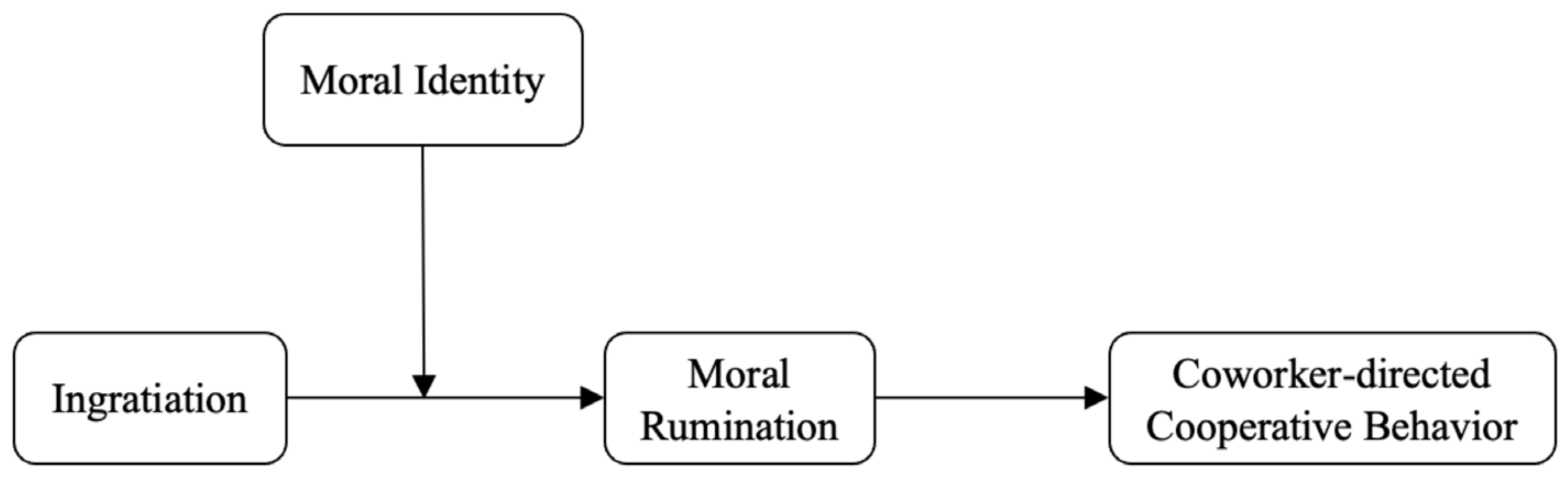
2.2. Ingratiation and Moral Rumination
2.3. The Mediating Role of Moral Rumination
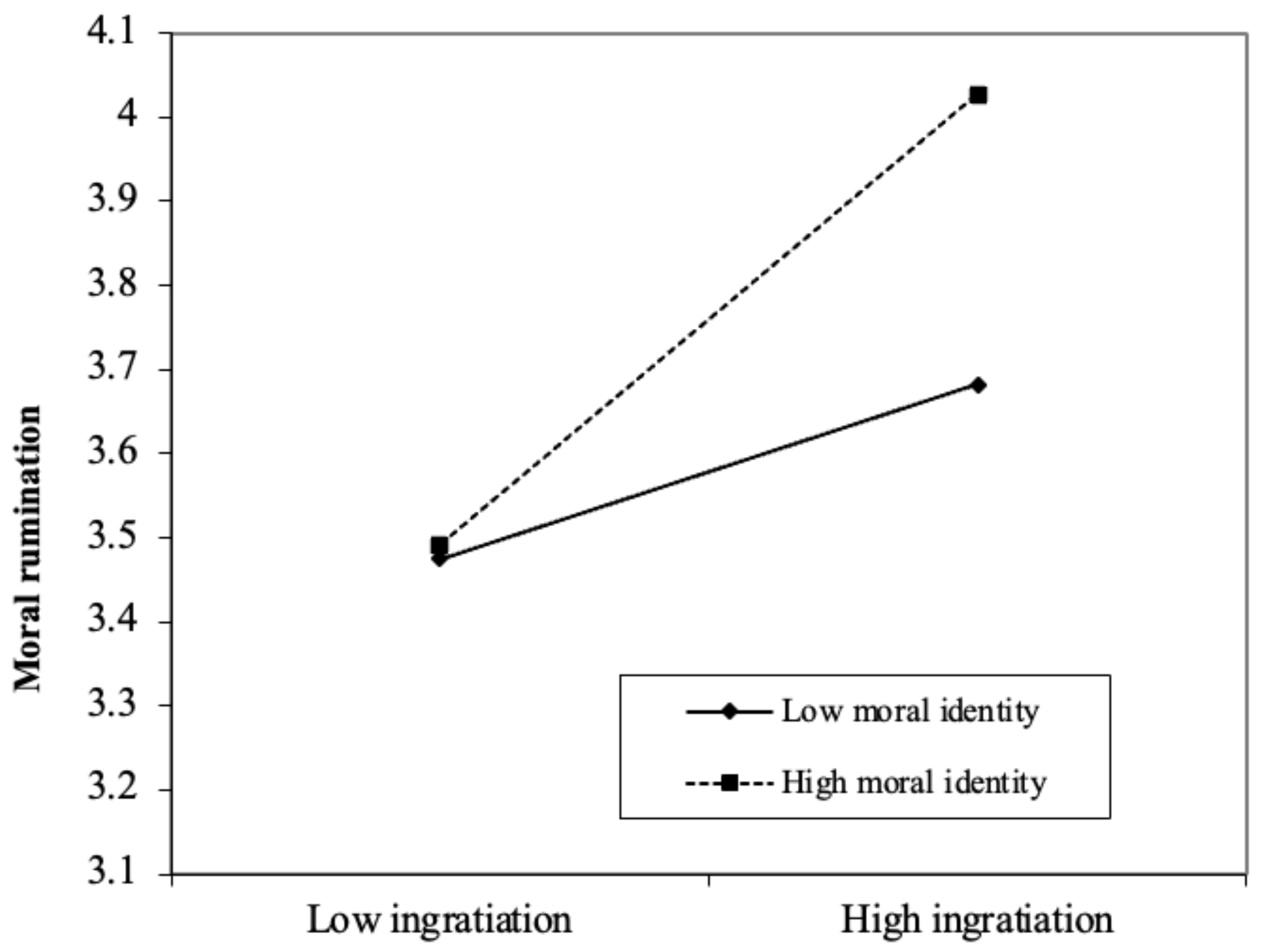
2.4. The Moderating Role of Moral Identity
3. Method
3.1. Sample and Procedures
3.2. Measures
3.2.1. Ingratiation Behavior
3.2.2. Moral Rumination
3.2.3. Coworker-Directed Cooperative Behavior
3.2.4. Moral Identity
3.2.5. Control Variables
4. Results
5. Discussion
5.1. Theoretical Implications
5.2. Managerial Implications
5.3. Limitations and Future Research
Author Contributions
Funding
Institutional Review Board Statement
Informed Consent Statement
Data Availability Statement
Conflicts of Interest
Appendix A. All Measurement Items
- I praise my supervisor at work for his/her achievements so that he/she thinks I am a good person.
- I do personal favors for my supervisor at work to show that I am friendly.
- I compliment my supervisor at work to make him/her think I am likable.
- I take an interest in my supervisor’s personal life to show that I am friendly.
- Being a person who has these characteristics would make me feel good.
- These characteristics are an important part of who I am.
- I would feel proud to have these characteristics.
- Having these characteristics is very important to me.
- I strongly desire to have these characteristics.
- I ruminate about the morality of my ingratiation behaviors.
- I spend a great amount of time thinking about whether my ingratiation behavior at work is moral or not.
- I ruminate or dwell on whether I did the right or wrong thing when engaging in ingratiation at work.
- I share work reports and documents with my colleagues in my daily work.
- I share work experiences or tips with my colleagues in my daily work.
- I keep my colleagues informed of news that I know in my daily work.
- I share my professional skills with my colleagues in my daily work.
| 1 | We also evaluated the relationship between the primary variables without control variables (see Becker, 2005), and all hypotheses remained supported. Ingratiation was significantly related to moral rumination (b = 0.22, p < 0.05). Moral rumination was significantly related to cooperative behavior (b = 0.10, p < 0.05). |
| 2 | We removed control variables and evaluated the indirect effect of ingratiation on cooperative behavior via moral rumination was significant (estimate = 0.02, 95% CI = [0.001, 0.052]). |
| 3 | The interaction term between ingratiation and moral identity in predicting moral rumination (b = 0.29, p < 0.05) remained significant. |
| 4 | We further removed control variables and evaluated the indirect effect of ingratiation on cooperative behavior via moral rumination was significant at high moral identity (b = 0.04, 95% CI [0.002, 0.084], not including 0), but not at low moral identity (b = −0.0004, 95% CI [−0.042, 0.026]). contains 0) and the difference between them is significant (b = 0.02, 95% CI [0.001, 0.081] does not contain 0). |
References
- Antonakis, J., Bendahan, S., Jacquart, P., & Lalive, R. (2010). On making causal claims: A review and recommendations. The Leadership Quarterly, 21(6), 1086–1120. [Google Scholar] [CrossRef]
- Aquino, K., Freeman, D., Reed, A., Felps, W., & Lim, V. K. (2009). Testing a social-cognitive model of moral behavior: The interactive influence of situations and moral identity centrality. Journal of Personality and Social Psychology, 97, 123–141. [Google Scholar] [CrossRef]
- Aquino, K., & Reed, A. (2002). The self-importance of moral identity. Journal of Personality and Social Psychology, 83(6), 1423–1440. [Google Scholar] [CrossRef]
- Asadullah, M. A., Siddiquei, A., Musaddiq, M., & Amin, R. (2023). Ingratiating with bosses for favourable performance ratings: A serial mediation mechanism. Personnel Review, 52(4), 955–971. [Google Scholar] [CrossRef]
- Azeem, S., Zafar, M. A., & Khan, A. K. (2023). The grapes are sour: An envier’s attributional perspective of coworker impression management. Journal of Management & Organization, 29(2), 287–303. [Google Scholar]
- Bande, B., Jaramillo, F., Fernández-Ferrín, P., & Varela, J. A. (2019). Salesperson coping with work-family conflict: The joint effects of ingratiation and self-promotion. Journal of Business Research, 95, 143–155. [Google Scholar] [CrossRef]
- Barkan, R., Ayal, S., & Ariely, D. (2015). Ethical dissonance, justifications, and moral behavior. Current Opinion in Psychology, 6(12), 157–161. [Google Scholar] [CrossRef]
- Bazerman, M. H., Tenbrunsel, A. E., & Wade-Benzoni, K. (1998). Negotiating with yourself and losing: Making decisions with competing internal preferences. Academy of Management Review, 23(2), 225–241. [Google Scholar] [CrossRef] [PubMed]
- Becker, T. E. (2005). Potential problems in the statistical control of variables in organizational research: A qualitative analysis with recommendations. Organizational Research Methods, 8(3), 274–289. [Google Scholar] [CrossRef]
- Bolino, M., Long, D., & Turnley, W. (2016). Impression management in organizations: Critical questions, answers, and areas for future research. Annual Review of Organizational Psychology and Organizational Behavior, 3(1), 377–406. [Google Scholar] [CrossRef]
- Bolino, M., & Turnley, W. (1999). Measuring impression management in organizations: A scale development based on the Jones and Pittman taxonomy. Organizational Research Methods, 2(2), 187–206. [Google Scholar] [CrossRef]
- Brislin, R. W. (1980). Cross-cultural research methods: Strategies, problems, applications. In Environment and culture (pp. 47–82). Springer US. [Google Scholar]
- Brosschot, J. F., Gerin, W., & Thayer, J. F. (2006). The perseverative cognition hypothesis: A review of worry, prolonged stress-related physiological activation, and health. Journal of Psychosomatic Research, 60, 113–124. [Google Scholar] [CrossRef]
- Castañer, X., & Oliveira, N. (2020). Collaboration, coordination, and cooperation among organizations: Establishing the distinctive meanings of these terms through a systematic literature review. Journal of Management, 46(6), 965–1001. [Google Scholar] [CrossRef]
- Chang, J. W., Chow, R. M., & Woolley, A. W. (2017). Effects of inter-group status on the pursuit of intra-group status. Organizational Behavior and Human Decision Processes, 139, 1–17. [Google Scholar] [CrossRef]
- Cheng, B., Guo, G., Tian, J., & Kong, Y. (2024). ‘I disdain the company of flatterers!’: How and when observed ingratiation predicts employees’ ostracism toward their ingratiating colleagues. Human Relations, 77(8), 1071–1107. [Google Scholar] [CrossRef]
- De Clercq, D., Fatima, T., & Jahanzeb, S. (2021). Ingratiating with despotic leaders to gain status: The role of power distance orientation and self-enhancement motive. Journal of Business Ethics, 171, 157–174. [Google Scholar] [CrossRef]
- Fletcher, C. (1992). Ethical issues in the selection interview. Journal of Business Ethics, 11, 361–367. [Google Scholar] [CrossRef]
- Friedlander, M. L., & Schwartz, G. S. (1985). Toward a theory of strategic self-presentation in counseling and psychotherapy. Journal of Counseling Psychology, 32(4), 483–501. [Google Scholar] [CrossRef]
- Harvey, J.-F. (2025). Self-promotion in entrepreneurship: A driver for proactive adaptation. Journal of Applied Psychology, 110(6), 859–875. [Google Scholar] [CrossRef]
- Jennings, P. L., Mitchell, M. S., & Hannah, S. T. (2015). The moral self: A review and integration of the literature. Journal of Organizational Behavior, 36(S1), S104–S168. [Google Scholar] [CrossRef]
- Jones, E. E., & Pittman, T. S. (1982). Toward a general theory of strategic self-presentation. Psychological Perspectives on the Self, 1(1), 231–262. [Google Scholar]
- Keeves, G. D., Westphal, J. D., & McDonald, M. L. (2017). Those closest wield the sharpest knife: How ingratiation leads to resentment and social undermining of the CEO. Administrative Science Quarterly, 62(3), 484–523. [Google Scholar] [CrossRef]
- Kim, J. K., Lepine, J. A., & Chun, J. U. (2018). Stuck between a rock and a hard place: Contrasting upward and downward effects of leaders’ ingratiation. Personnel Psychology, 71(4), 495–518. [Google Scholar] [CrossRef]
- Kingsford, J. M., Hawes, D. J., & de Rosnay, M. (2018). The moral self and moral identity: Developmental questions and conceptual challenges. British Journal of Developmental Psychology, 36(4), 652–666. [Google Scholar] [CrossRef] [PubMed]
- Kundro, T. G. (2023). The benefits and burdens of work moralization on creativity. Academy of Management Journal, 66(4), 1183–1208. [Google Scholar] [CrossRef]
- Leary, M. R. (1995). Self-presentation: Impression management and interpersonal behavior. Brown and Benchmark. [Google Scholar]
- Li, Z., & Cui, D. (2026). Catching up with brown-nosers in teams: Why and when an ingratiation climate leads to unethical pro-supervisor behavior? Baltic Journal of Management, 21(1), 89–108. [Google Scholar] [CrossRef]
- Liao, Z., Yam, K. C., Johnson, R. E., Liu, W., & Song, Z. (2018). Cleansing my abuse: A reparative response model of perpetrating abusive supervisor behavior. Journal of Applied Psychology, 103(9), 1039–1056. [Google Scholar] [CrossRef]
- Long, D. M. (2021). Tacticality, authenticity, or both? The ethical paradox of actor ingratiation and target trust reactions. Journal of Business Ethics, 168(4), 847–860. [Google Scholar] [CrossRef]
- Martens, A., Kosloff, S., & Jackson, L. E. (2010). Evidence that initial obedient killing fuels subsequent volitional killing beyond effects of practice. Social Psychological and Personality Science, 1(3), 268–273. [Google Scholar] [CrossRef]
- Mazar, N., Amir, O., & Ariely, D. (2008). The dishonesty of honest people: A theory of self-concept maintenance. Journal of Marketing Research, 45(6), 633–644. [Google Scholar] [CrossRef]
- Monin, B., & Jordan, A. H. (2009). The dynamic moral self: A social psychological perspective. In Personality, identity, and character: Explorations in moral psychology (pp. 341–354). Cambridge University Press. [Google Scholar]
- National Health Commission of the People’s Republic of China, Ministry of Education, Ministry of Science and Technology & National Administration of Traditional Chinese Medicine. (2023). Measures for ethical review of life sciences and medical research involving human subjects (No. 4). Available online: https://www.gov.cn/zhengce/zhengceku/2023-02/28/content_5743658.htm (accessed on 2 April 2026).
- Pan, W., Lua, E., Yang, Z., & Su, Y. (2024). When and how knowledge hiding motivates perpetrators’ organizational citizenship behavior. Journal of Business Ethics, 193(2), 325–344. [Google Scholar] [CrossRef]
- Parks, C. D., Sanna, L. J., & Posey, D. C. (2003). Retrospection in social dilemmas: How thinking about the past affects future cooperation. Journal of Personality and Social Psychology, 84(5), 988–996. [Google Scholar] [CrossRef]
- Perkins, B. G., Podsakoff, N. P., & Welsh, D. T. (2024). Variance in virtue: An integrative review of intraindividual (un) ethical behavior research. Academy of Management Annals, 18(1), 210–250. [Google Scholar] [CrossRef]
- Ployhart, R. E., & Vandenberg, R. J. (2010). Longitudinal research: The theory, design, and analysis of change. Journal of Management, 36(1), 94–120. [Google Scholar] [CrossRef]
- Podsakoff, P. M., MacKenzie, S. B., & Podsakoff, N. P. (2012). Sources of method bias in social science research and recommendations on how to control it. Annual Review of Psychology, 63(1), 539–569. [Google Scholar] [CrossRef]
- Proost, K., Schreurs, B., De Witte, K., & Derous, E. (2010). Ingratiation and self-promotion in the selection interview: The effects of using single tactics or a combination of tactics on interviewer judgments. Journal of Applied Social Psychology, 40(9), 2155–2169. [Google Scholar] [CrossRef]
- Rosenfeld, P. (1997). Impression management, fairness, and the employment interview. Journal of Business Ethics, 16, 801–808. [Google Scholar] [CrossRef]
- Ruedy, N. E., Moore, C., Gino, F., & Schweitzer, M. E. (2013). The cheater’s high: The unexpected affective benefits of unethical behavior. Journal of Personality and Social Psychology, 105(4), 531–548. [Google Scholar] [CrossRef] [PubMed]
- Sachdeva, S., Iliev, R., & Medin, D. L. (2009). Sinning saints and saintly sinners: The paradox of moral self-regulation. Psychological Science, 20(4), 523–528. [Google Scholar] [CrossRef]
- Sanders, K., & Schyns, B. (2006). Trust, conflict and cooperative behaviour: Considering reciprocity within organizations. Personnel Review, 35(5), 508–518. [Google Scholar] [CrossRef]
- Sharma, N., & Dhar, R. L. (2022). From curse to cure of workplace ostracism: A systematic review and future research agenda. Human Resource Management Review, 32(3), 100836. [Google Scholar] [CrossRef]
- Sibunruang, H., Garcia, P. R. J. M., & Tolentino, L. R. (2016). Ingratiation as an adapting strategy: Its relationship with career adaptability, career sponsorship, and promotability. Journal of Vocational Behavior, 92, 135–144. [Google Scholar] [CrossRef]
- Simbrunner, P., & Schlegelmilch, B. B. (2017). Moral licensing: A culture-moderated meta-analysis. Management Review Quarterly, 67, 201–225. [Google Scholar] [CrossRef]
- Simpson, B., & Willer, R. (2015). Beyond altruism: Sociological foundations of cooperation and prosocial behavior. Annual Review of Sociology, 41(1), 43–63. [Google Scholar] [CrossRef]
- Tofighi, D., & MacKinnon, D. P. (2016). Monte Carlo confidence intervals for complex functions of indirect effects. Structural Equation Modeling: A Multidisciplinary Journal, 23(2), 194–205. [Google Scholar] [CrossRef]
- Trapnell, P. D., & Campbell, J. D. (1999). Private self-consciousness and the five-factor model of personality: Distinguishing rumination from reflection. Journal of Personality and Social Psychology, 76(2), 284–304. [Google Scholar] [CrossRef] [PubMed]
- Tsang, K. K. (2016). A theoretical analysis of Chinese ingratiation. Journal of Social Sciences, 12(1), 55–63. [Google Scholar] [CrossRef]
- Turnley, W. H., Klotz, A. C., & Bolino, M. C. (2013). Crafting an image at another’s expense: Understanding unethical impression management in organizations. In Handbook of unethical work behavior: Implications for well-being (pp. 123–139). Armonk. [Google Scholar]
- Walumbwa, F. O., Muchiri, M. K., Misati, E., Wu, C., & Meiliani, M. (2018). Inspired to perform: A multilevel investigation of antecedents and consequences of thriving at work. Journal of Organizational Behavior, 39(3), 249–261. [Google Scholar] [CrossRef]
- Wang, Y., Xiao, S., & Ren, R. (2022). A moral cleansing process: How and when does unethical pro-organizational behavior increase prohibitive and promotive voice. Journal of Business Ethics, 176(1), 1–19. [Google Scholar] [CrossRef]
- West, C., & Zhong, C. B. (2015). Moral cleansing. Current Opinion in Psychology, 6, 221–225. [Google Scholar] [CrossRef]
- Wu, S., Zheng, M. X., Ni, D., Chen, C., Wang, M., Wu, W., & Zhai, H. (2025). Flattering or embarrassing your boss? An integrated perspective on newcomers’ ingratiation, supervisors’ responses, and work outcomes. Journal of Organizational Behavior, 46(3), 421–447. [Google Scholar] [CrossRef]
- Xu, X., Li, M., Kwan, H. K., & Zhang, X. (2023). The antecedents of moral identity: A meta-analytic review. Asia Pacific Journal of Management, 41, 1697–1728. [Google Scholar] [CrossRef]
- Yan, M., Xie, Y. P., Zhao, J., Zhang, Y. J., Bashir, M., & Liu, Y. (2020). How ingratiation links to counterproductive work behaviors: The roles of emotional exhaustion and power distance orientation. Frontiers in Psychology, 11, 2238. [Google Scholar] [CrossRef] [PubMed]
- Yang, C., Chen, Y., & Gao, J. (2024). How and when can employees with status motivation attain their status in a team? The roles of ingratiation, OCBI, and procedural justice climate. Group & Organization Management, 49(4), 801–859. [Google Scholar]
- Youniss, J., & Yates, M. (1999). Youth service and moral-civic identity: A case for everyday morality. Educational Psychology Review, 11(4), 361–376. [Google Scholar] [CrossRef]
- Yuan, Z., Barnes, C. M., & Li, Y. (2018). Bad behavior keeps you up at night: Counterproductive work behaviors and insomnia. Journal of Applied Psychology, 103(4), 383–398. [Google Scholar] [CrossRef]
- Zakaria, Z., Rahman, A., & Aman, Z. (2020). Factors that influence a cooperatives performance: A systematic literature review. International Journal of Innovation, Creativity and Change, 14(1), 326–348. [Google Scholar]
- Zhong, C. B., & Liljenquist, K. (2006). Washing away your sins: Threatened morality and physical cleansing. Science, 313(5792), 1451–1452. [Google Scholar] [CrossRef]


| Models | χ2 | df | χ2/df | CFI | TLI | RMSEA | SRMR |
|---|---|---|---|---|---|---|---|
| Ingratiation, Moral Rumination, Cooperative Behavior, Moral Identity | 198.97 | 98 | 2.03 | 0.965 | 0.957 | 0.062 | 0.035 |
| Ingratiation + Moral Rumination, Cooperative Behavior, Moral Identity | 572.20 | 101 | 5.67 | 0.837 | 0.806 | 0.131 | 0.109 |
| Ingratiation + Moral Rumination, Cooperative Behavior + Moral Identity | 1243.64 | 103 | 12.07 | 0.606 | 0.541 | 0.202 | 0.169 |
| Ingratiation + Moral Rumination + Cooperative Behavior + Moral Identity | 2064.55 | 104 | 19.85 | 0.322 | 0.218 | 0.263 | 0.218 |
| Mean | SD | 1 | 2 | 3 | 4 | 5 | 6 | 7 | |
|---|---|---|---|---|---|---|---|---|---|
| 1. Gender | 0.58 | 0.49 | |||||||
| 2. Age | 35.78 | 8.52 | −0.33 ** | ||||||
| 3. Education | 15.31 | 2.49 | 0.13 * | −0.24 ** | |||||
| 4. Job tenure | 6.64 | 6.99 | −0.21 ** | 0.61 ** | −0.13 * | ||||
| 5. Ingratiation | 3.88 | 0.57 | −0.13 * | 0.05 | −0.02 | 0.03 | |||
| 6. Moral Rumination | 3.51 | 0.89 | −0.03 | 0.04 | −0.03 | 0.02 | 0.14 * | ||
| 7. Cooperative Behavior | 3.71 | 0.77 | −0.09 | 0.04 | 0.09 | 0.002 | 0.62 ** | 0.20 ** | |
| 8. Moral Identity | 4.26 | 0.64 | −0.03 | 0.17 ** | −0.09 | 0.07 | 0.24 ** | 0.14 * | 0.26 ** |
| Variable | Moral Rumination | Cooperative Behavior | |||
|---|---|---|---|---|---|
| Model 1 | Model 2 | Model 3 | Model 4 | Model 5 | |
| Gender | −0.03 (0.12) | −0.002 (0.12) | −0.01 (0.12) | −0.15 (0.10) | −0.14 (0.10) |
| Age | 0.004 (0.01) | 0.004 (0.01) | 0.001 (0.01) | 0.01 (0.01) | 0.01 (0.01) |
| Education | −0.01 (0.02) | −0.01 (0.02) | −0.01 (0.02) | 0.03 (0.02) | 0.04 (0.02) |
| Tenure | −0.001 (0.01) | −0.001 (0.01) | −0.001 (0.01) | −0.01 (0.01) | −0.004 (0.01) |
| Ingratiation | 0.21 * (0.10) | 0.18 0.10) | 0.57 *** (09) | ||
| Moral Identity | 0.18 * (0.09) | ||||
| Ingratiation × Moral Identity | 0.29 * (0.14) | ||||
| Moral Rumination | 0.17 ** (0.05) | ||||
| Intercept | 3.53 *** (0.50) | 2.69 *** (0.62) | 3.58 *** (0.67) | 3.11 *** (0.43) | 2.51 *** (0.46) |
| R2 | 0.003 | 0.02 * | 0.05 | 0.02 | 0.06 |
| Adjusted R2 | −0.01 | 0.002 | 0.02 | 0.01 | 0.04 |
| F | 0.17 | 1.13 | 1.81 | 1.43 | 3.34 ** |
| Moderator Variable | Indirect Effect | 95% Confidence Interval |
|---|---|---|
| Ingratiation → Moral Rumination → Cooperative Behavior | ||
| High moral identity | 0.04 | [0.002, 0.084] |
| Low moral identity | −0.0004 | [−0.042, 0.026] |
| Index | 0.02 | [0.001, 0.081] |
Disclaimer/Publisher’s Note: The statements, opinions and data contained in all publications are solely those of the individual author(s) and contributor(s) and not of MDPI and/or the editor(s). MDPI and/or the editor(s) disclaim responsibility for any injury to people or property resulting from any ideas, methods, instructions or products referred to in the content. |
© 2026 by the authors. Licensee MDPI, Basel, Switzerland. This article is an open access article distributed under the terms and conditions of the Creative Commons Attribution (CC BY) license.
Share and Cite
Chen, Y.; Cui, M. When and How Ingratiation Boosts Coworker-Directed Cooperative Behavior. Behav. Sci. 2026, 16, 978. https://doi.org/10.3390/bs16060978
Chen Y, Cui M. When and How Ingratiation Boosts Coworker-Directed Cooperative Behavior. Behavioral Sciences. 2026; 16(6):978. https://doi.org/10.3390/bs16060978
Chicago/Turabian StyleChen, Yun, and Min Cui. 2026. "When and How Ingratiation Boosts Coworker-Directed Cooperative Behavior" Behavioral Sciences 16, no. 6: 978. https://doi.org/10.3390/bs16060978
APA StyleChen, Y., & Cui, M. (2026). When and How Ingratiation Boosts Coworker-Directed Cooperative Behavior. Behavioral Sciences, 16(6), 978. https://doi.org/10.3390/bs16060978