The Impact of Anthropomorphic Eco-Friendly Logos on Consumers’ Green Purchase Intention: A Moderated Mediation Model


Abstract
1. Introduction
1.1. Eco-Friendly Logos and Anthropomorphic Design
1.2. Perceived Love and Perceived Hope
1.3. Environmental Attitude
1.4. Research Gaps and Contributions
2. Materials and Methods
2.1. Participants
2.2. Power Analysis
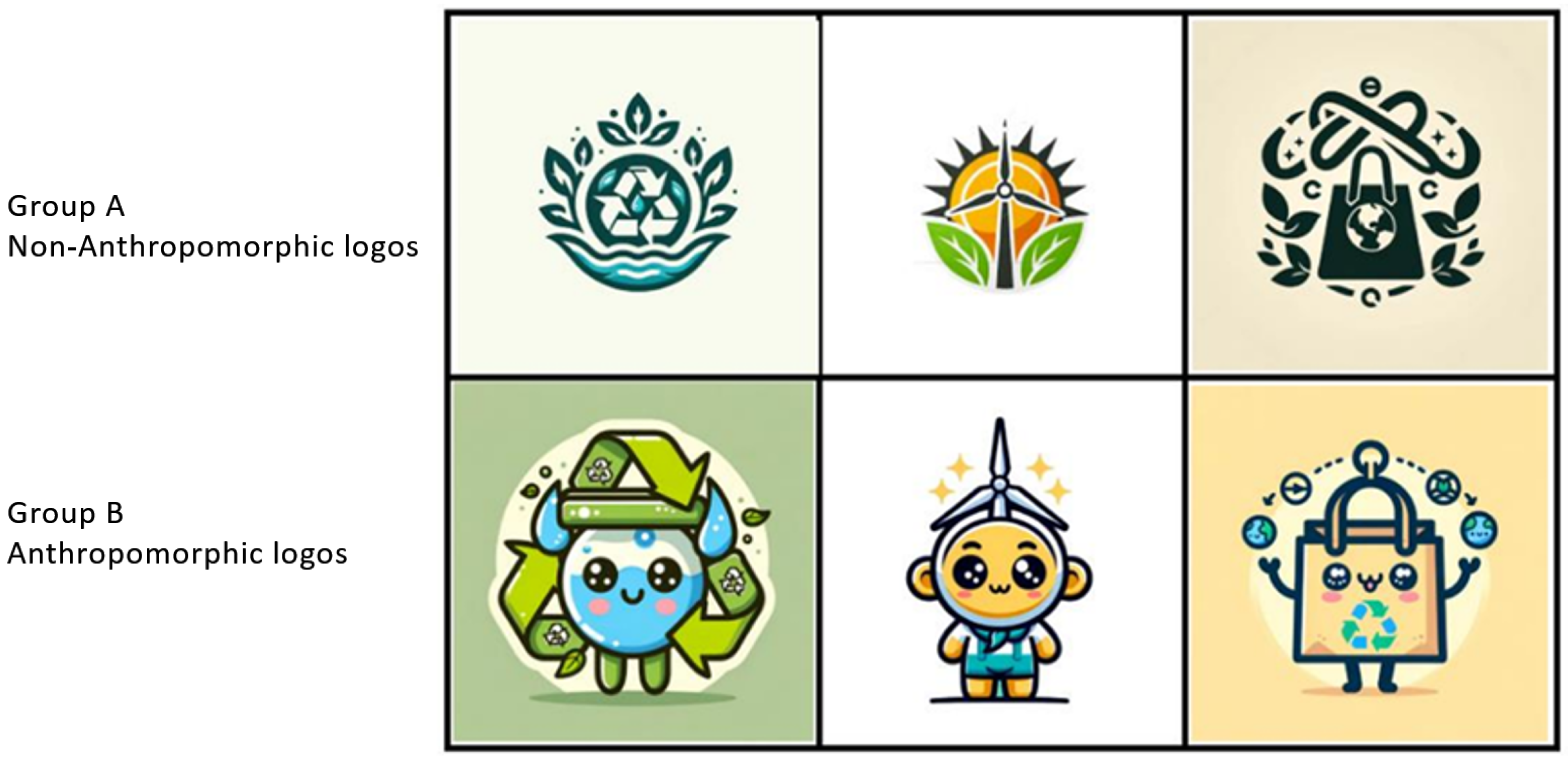
2.3. Research Design and Stimuli
2.4. Measures
2.4.1. Green Purchase Intention (GPI)
2.4.2. Revised New Ecological Paradigm Scale (NEP-R)
2.4.3. Attribution of Mental States (AMS-Q)
2.5. Common Method Bias Test
3. Results
3.1. Descriptive Statistics and Correlation Analysis
3.2. Mediation Effect Test
3.3. Moderated Mediation Effect Test
4. Discussion
4.1. Green Consumption and Purchase Intention
4.2. The Mediating Roles of Perceived Love and Perceived Hope
4.3. The Moderating Role of Environmental Attitude
4.4. Limitations and Future Research Directions
5. Conclusions
Author Contributions
Funding
Institutional Review Board Statement
Informed Consent Statement
Data Availability Statement
Conflicts of Interest
Abbreviations
| GPI | Green Purchase Intention |
| NEP-R | Revised New Ecological Paradigm Scale |
| AMS-Q | Attribution of Mental States Questionnaire |
| SD | Standard Deviation |
| SE | Standard Error |
| CI | Confidence Interval |
| LLCI | Lower-Limit Confidence Interval |
| ULCI | Upper-Limit Confidence Interval |
Appendix A

| Questionnaire Name | Scale Items | Reference |
|---|---|---|
| GPI |
| R. Y. K. Chan (2001) |
| NEP-R |
| Dunlap et al. (2000) |
| AMS-Q |
| Di Dio et al. (2025) |
References
- Atkinson, L., & Rosenthal, S. (2014). Signaling the green sell: The influence of eco-label source, argument specificity, and product involvement on consumer trust. Journal of Advertising, 43(1), 33–45. [Google Scholar] [CrossRef] [Scilit]
- Behe, B. K., Bae, M., Huddleston, P. T., & Sage, L. (2015). The effect of involvement on visual attention and product choice. Journal of Retailing and Consumer Services, 24, 10–21. [Google Scholar] [CrossRef] [Scilit]
- Borgi, M., Cogliati-Dezza, I., Brelsford, V., Meints, K., & Cirulli, F. (2014). Baby schema in human and animal faces induces cuteness perception and gaze allocation in children. Frontiers in Psychology, 5, 411. [Google Scholar] [CrossRef] [Scilit]
- Bossel, V., Geyskens, K., & Goukens, C. (2019). Facing a trend of brand logo simplicity: The impact of brand logo design on consumption. Food Quality and Preference, 71, 129–135. [Google Scholar] [CrossRef] [Scilit]
- Cavanaugh, L. A., Bettman, J. R., & Luce, M. F. (2015). Feeling love and doing more for distant others: Specific positive emotions differentially affect prosocial consumption. Journal of Marketing Research, 52(5), 657–673. [Google Scholar] [CrossRef] [Scilit]
- Chan, E. Y. (2021). Saving Mr. Water: Anthropomorphizing water promotes water conservation. Resources, Conservation and Recycling, 174, 105814. [Google Scholar] [CrossRef] [Scilit]
- Chan, R. Y. K. (2001). Determinants of Chinese consumers’ green purchase behavior. Psychology & Marketing, 18(4), 389–413. [Google Scholar] [CrossRef] [Scilit]
- Chen, Y.-S., & Chang, C.-H. (2013). Greenwash and green trust: The mediation effects of green consumer confusion and green perceived risk. Journal of Business Ethics, 114(3), 489–500. [Google Scholar] [CrossRef] [Scilit]
- Cyr, D., Head, M., Lim, E., & Stibe, A. (2018). Using the elaboration likelihood model to examine online persuasion through website design. Information & Management, 55(7), 807–821. [Google Scholar] [CrossRef] [Scilit]
- Di Dio, C., Ardizzi, M., Schieppati, S. V., Massaro, D., Gilli, G., Gallese, V., & Marchetti, A. (2025). Art made by artificial intelligence: The effect of authorship on aesthetic judgments. Psychology of Aesthetics, Creativity, and the Arts, 19(5), 1164–1176. [Google Scholar] [CrossRef] [Scilit]
- Di Dio, C., Manzi, F., Itakura, S., Kanda, T., Ishiguro, H., Massaro, D., & Marchetti, A. (2020). It does not matter who you are: Fairness in pre-schoolers interacting with human and robotic partners. International Journal of Social Robotics, 12(5), 1045–1059. [Google Scholar] [CrossRef] [Scilit]
- Ding, Z., Sun, J., Wang, Y., Jiang, X., Liu, R., Sun, W., Mou, Y., Wang, D., & Liu, M. (2021). Research on the influence of anthropomorphic design on the consumers’ express packaging recycling willingness: The moderating effect of psychological ownership. Resources, Conservation and Recycling, 168, 105269. [Google Scholar] [CrossRef] [Scilit]
- Dorward, L., Ibbett, H., Dwiyahreni, A. A., Kohi, E. M., Prayitno, K., Sankeni, S., Kaduma, J. F., Mawenya, R., Mchomvu, J., Sabiladiyni, H., Saputra, A. W., Supriatna, J., Trywidiarini, T., & St. John, F. A. V. (2024). Cross-cultural applications of the New Ecological Paradigm in protected area contexts. Environment and Behavior, 56(1–2), 120–151. [Google Scholar] [CrossRef] [Scilit]
- Dunlap, R. E., Van Liere, K. D., Mertig, A. G., & Jones, R. E. (2000). New trends in measuring environmental attitudes: Measuring endorsement of the new ecological paradigm: A revised NEP scale. Journal of Social Issues, 56(3), 425–442. [Google Scholar] [CrossRef] [Scilit]
- Epley, N., Waytz, A., & Cacioppo, J. T. (2007). On seeing human: A three-factor theory of anthropomorphism. Psychological Review, 114(4), 864–886. [Google Scholar] [CrossRef] [Scilit]
- Gao, Y. L., & Mattila, A. S. (2016). The impact of option popularity, social inclusion/exclusion, and self-affirmation on consumers’ propensity to choose green hotels. Journal of Business Ethics, 136, 575–585. [Google Scholar] [CrossRef] [Scilit]
- Glocker, M. L., Langleben, D. D., Ruparel, K., Loughead, J. W., Gur, R. C., & Sachser, N. (2009). Baby schema in infant faces induces cuteness perception and motivation for caretaking in adults. Ethology, 115(3), 257–263. [Google Scholar] [CrossRef] [Scilit]
- Gupta, T., & Hagtvedt, H. (2021). Safe together, vulnerable apart: How interstitial space in text logos impacts brand attitudes in tight versus loose cultures. Journal of Consumer Research, 48(3), 474–491. [Google Scholar] [CrossRef] [Scilit]
- Hayes, A. F. (2017). Introduction to mediation, moderation, and conditional process analysis: A regression-based approach (2nd ed.). Guilford Press. [Google Scholar]
- Karimi, S., Liobikienė, G., & Alitavakoli, F. (2022). The effect of religiosity on pro-environmental behavior based on the theory of planned behavior: A cross-sectional study among Iranian rural female facilitators. Frontiers in Psychology, 13, 745019. [Google Scholar] [CrossRef] [Scilit]
- Laksmidewi, D., Susianto, H., & Afiff, A. Z. (2017). Anthropomorphism in advertising: The effect of anthropomorphic product demonstration on consumer purchase intention. Asian Academy of Management Journal, 22(1), 1–25. [Google Scholar] [CrossRef] [Scilit]
- Leonidou, C. N., & Skarmeas, D. (2017). Gray shades of green: Causes and consequences of green skepticism. Journal of Business Ethics, 144(2), 401–415. [Google Scholar] [CrossRef] [Scilit]
- Li, B., Nan, Y., & Yao, R. (2022). Warmth or competence? The effects of cool and cuteness on the perceived quality of digital products. Asia Pacific Journal of Marketing and Logistics, 34(9), 1880–1904. [Google Scholar] [CrossRef] [Scilit]
- Li, H., Xu, J., Fang, M., Tang, L., & Pan, Y. (2023). A study and analysis of the relationship between visual-auditory logos and consumer behavior. Behavioral Sciences, 13(7), 613. [Google Scholar] [CrossRef] [Scilit]
- Lin, Z., & Fung, H. H. (2026). Age differences in pro-environmental behaviors: Is it about me or future generations? European Journal of Ageing, 23, 22. [Google Scholar] [CrossRef] [Scilit]
- Lu, Y., Liu, Y., Tao, L., & Ye, S. (2021). Cuteness or coolness—How does different anthropomorphic brand image accelerate consumers’ willingness to buy green products? Frontiers in Psychology, 12, 599385. [Google Scholar] [CrossRef] [Scilit]
- MacInnis, D. J., & De Mello, G. E. (2005). The concept of hope and its relevance to product evaluation and choice. Journal of Marketing, 69(1), 1–14. [Google Scholar] [CrossRef] [Scilit]
- Manzi, F., Massaro, D., Di Lernia, D., Maggioni, M. A., Riva, G., & Marchetti, A. (2021). Robots are not all the same: Young adults’ expectations, attitudes, and mental attribution to two humanoid social robots. Cyberpsychology, Behavior, and Social Networking, 24(5), 307–314. [Google Scholar] [CrossRef] [Scilit]
- Manzi, F., Peretti, G., Di Dio, C., Cangelosi, A., Itakura, S., Kanda, T., Ishiguro, H., Massaro, D., & Marchetti, A. (2020). A robot is not worth another: Exploring children’s mental state attribution to different humanoid robots. Frontiers in Psychology, 11, 2011. [Google Scholar] [CrossRef] [Scilit]
- Mark, P., Glavee-Geo, R., Kachurovska, O., & Ariatmaja, I. G. (2023). The influence of involvement and attribute importance on purchase intentions for green products. In S. M. F. Grimstad, L. M. Ottosen, & N. A. James (Eds.), Marine plastics: Innovative solutions to tackling waste (pp. 243–254). Springer Nature. [Google Scholar] [CrossRef] [Scilit]
- Mazar, N., & Zhong, C. B. (2010). Do green products make us better people? Psychological Science, 21(4), 494–498. [Google Scholar] [CrossRef] [Scilit]
- Miraglia, L., Peretti, G., Manzi, F., Di Dio, C., Massaro, D., & Marchetti, A. (2023). Development and validation of the Attribution of Mental States Questionnaire (AMS-Q): A reference tool for assessing anthropomorphism. Frontiers in Psychology, 14, 999921. [Google Scholar] [CrossRef] [Scilit]
- Oliver, J. D., & Lee, S. (2010). Hybrid car purchase intentions: A cross-cultural analysis. Journal of Consumer Marketing, 27(2), 96–103. [Google Scholar] [CrossRef] [Scilit]
- Pirchio, S., Passiatore, Y., Panno, A., Cipparone, M., & Carrus, G. (2021). The effects of contact with nature during outdoor environmental education on students’ wellbeing, connectedness to nature and pro-sociality. Frontiers in Psychology, 12, 648458. [Google Scholar] [CrossRef] [Scilit]
- Schmuck, D., Matthes, J., & Naderer, B. (2018). Misleading consumers with green advertising? An affect–reason–involvement account of greenwashing effects in environmental advertising. Journal of Advertising, 47(2), 127–145. [Google Scholar] [CrossRef] [Scilit]
- Schoemann, A. M., Boulton, A. J., & Short, S. D. (2017). Determining power and sample size for simple and complex mediation models. Social Psychological and Personality Science, 8(4), 379–386. [Google Scholar] [CrossRef] [Scilit]
- Schultz, P. W. (2002). Inclusion with nature: The psychology of human-nature relations. In P. Schmuck, & W. P. Schultz (Eds.), Psychology of sustainable development (pp. 61–78). Springer US. [Google Scholar]
- Septianto, F., & Paramita, W. (2021). Cute brand logo enhances favorable brand attitude: The moderating role of hope. Journal of Retailing and Consumer Services, 63, 102734. [Google Scholar] [CrossRef] [Scilit]
- Shabbir, M. S., Sulaiman, M. A. B. A., Al-Kumaim, N. H., Mahmood, A., & Abbas, M. (2020). Green marketing approaches and their impact on consumer behavior towards the environment—A study from the UAE. Sustainability, 12(21), 8977. [Google Scholar] [CrossRef] [Scilit]
- Sockhill, N. J., Dean, A. J., Oh, R. R. Y., & Fuller, R. A. (2022). Beyond the ecocentric: Diverse values and attitudes influence engagement in pro-environmental behaviours. People and Nature, 4(6), 1500–1512. [Google Scholar] [CrossRef] [Scilit]
- Sörqvist, P., Haga, A., Holmgren, M., & Hansla, A. (2015). An eco-label effect in the built environment: Performance and comfort effects of labeling a light source environmentally friendly. Journal of Environmental Psychology, 42, 123–127. [Google Scholar] [CrossRef] [Scilit]
- Steinnes, K. K., Blomster, J. K., Seibt, B., Zickfeld, J. H., & Fiske, A. P. (2019). Too cute for words: Cuteness evokes the heartwarming emotion of kama muta. Frontiers in Psychology, 10, 387. [Google Scholar] [CrossRef] [Scilit]
- Sundar, A., & Kellaris, J. J. (2017). How logo colors influence shoppers’ judgments of retailer ethicality: The mediating role of perceived eco-friendliness. Journal of Business Ethics, 146(3), 685–701. [Google Scholar] [CrossRef] [Scilit]
- Tam, K.-P. (2019). Anthropomorphism of nature, environmental guilt, and pro-environmental behavior. Sustainability, 11(19), 5430. [Google Scholar] [CrossRef] [Scilit]
- Teng, L., Xie, C., Liu, T., Wang, F., & Foti, L. (2021). The effects of uppercase vs. lowercase letters on consumers’ perceptions and brand attitudes. Journal of Business Research, 136, 164–175. [Google Scholar] [CrossRef] [Scilit]
- Tong, Z., Liu, D., Ma, F., & Xu, X. (2021). Good news or bad news? How message framing influences consumers’ willingness to buy green products. Frontiers in Psychology, 11, 568586. [Google Scholar] [CrossRef] [Scilit]
- Wang, H., Shen, M., Song, Y. A., & Phau, I. (2020). Do up-displayed eco-friendly products always perform better? The moderating role of psychological distance. Journal of Business Research, 114, 198–212. [Google Scholar] [CrossRef] [Scilit]
- Wang, T., Mukhopadhyay, A., & Patrick, V. M. (2017). Getting consumers to recycle NOW! When and why cuteness appeals influence prosocial and sustainable behavior. Journal of Public Policy & Marketing, 36(2), 269–283. [Google Scholar] [CrossRef] [Scilit]
- Wang, X., Ming, M., & Zhang, Y. (2020). Are “people” or “animals” more attractive? Anthropomorphic images in green-product advertising. Journal of Cleaner Production, 276, 122719. [Google Scholar] [CrossRef] [Scilit]
- Whitmarsh, L., & O’Neill, S. (2010). Green identity, green living? The role of pro-environmental self-identity in determining consistency across diverse pro-environmental behaviours. Journal of Environmental Psychology, 30(3), 305–314. [Google Scholar] [CrossRef] [Scilit]
- Wiedmann, K. P., Hennigs, N., Behrens, S. H., & Klarmann, C. (2014). Tasting green: An experimental design for investigating consumer perception of organic wine. British Food Journal, 116(2), 197–211. [Google Scholar] [CrossRef] [Scilit]
- Winterich, K. P., & Haws, K. L. (2011). Helpful hopefulness: The effect of future positive emotions on consumption. Journal of Consumer Research, 38(3), 505–524. [Google Scholar] [CrossRef] [Scilit]
- Yang, D., Lu, Y., Zhu, W., & Su, C. (2015). Going green: How different advertising appeals impact green consumption behavior. Journal of Business Research, 68(12), 2663–2675. [Google Scholar] [CrossRef] [Scilit]
- Yang, Y., Sun, L., Han, B., & Liu, P. (2023). The trajectory of anthropomorphism and pro-environmental behavior: A serial mediation model. International Journal of Environmental Research and Public Health, 20(3), 2393. [Google Scholar] [CrossRef] [Scilit] [PubMed]
- Zarei, I., Ehsani, M., Moghimehfar, F., & Aroufzad, S. (2020). Predicting mountain hikers’ pro-environmental behavioral intention: An extension to the theory of planned behavior. Journal of Park and Recreation Administration, 38(4), 57–72. [Google Scholar] [CrossRef] [Scilit]
- Zhou, H., & Long, L.-R. (2004). Statistical remedies for common method biases. Advances in Psychological Science, 12(6), 942–950. [Google Scholar]


| M | SD | 1 | 2 | 3 | 4 | 5 | |
|---|---|---|---|---|---|---|---|
| 1. Logo Type | - | - | - | ||||
| 2. Perceived Love | 3.33 | 1.35 | 0.39 ** | - | |||
| 3. Perceived Hope | 3.35 | 1.36 | 0.34 ** | 0.69 ** | - | - | |
| 4. Environmental Attitude | 4.27 | 0.35 | 0.03 | −0.11 * | −0.05 | - | |
| 5. Green Purchase Intention | 4.79 | 1.02 | 0.35 ** | 0.47 ** | 0.49 ** | 0.12 ** | - |
| Perceived Love | Perceived Hope | Green Purchase Intention | |||||||
|---|---|---|---|---|---|---|---|---|---|
| B | SE | t | B | SE | t | B | SE | t | |
| Constant | 1.74 | 0.16 | 10.78 *** | 0.82 | 0.14 | 5.89 *** | 3.04 | 0.13 | 24.23 *** |
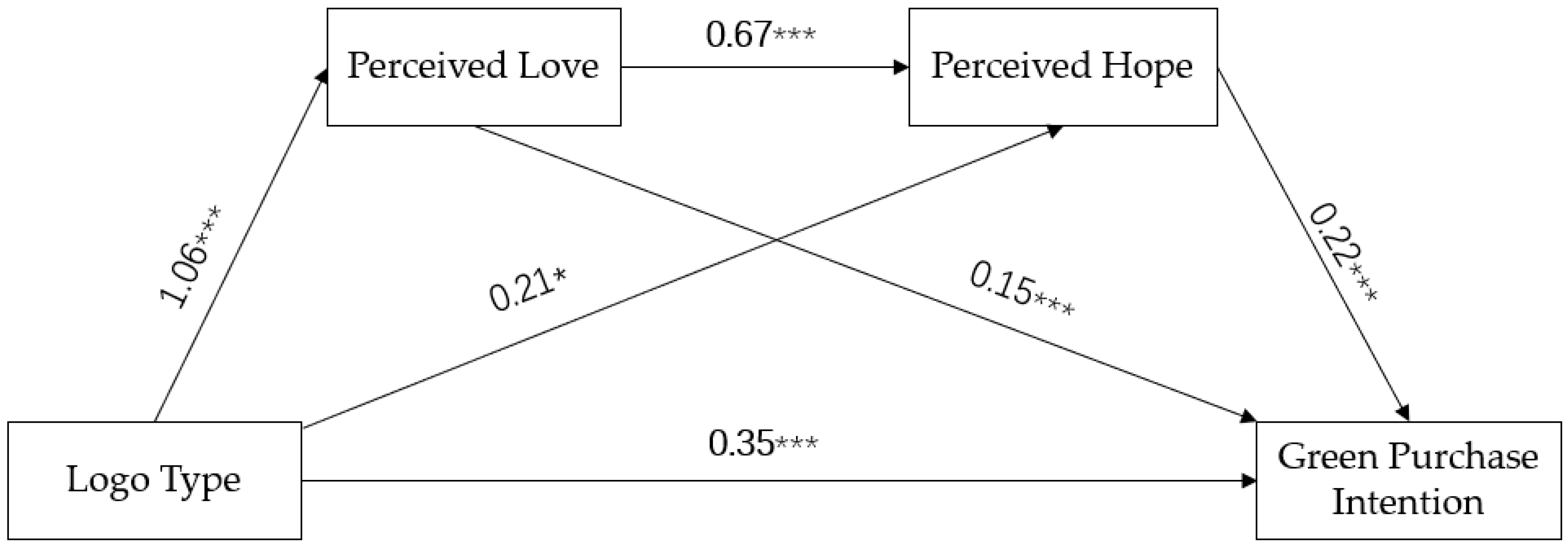
| Logo Type | 1.06 | 0.10 | 10.37 *** | 0.21 | 0.09 | 2.38 * | 0.35 | 0.08 | 4.53 *** |
| Perceived Love | 0.67 | 0.03 | 20.69 *** | 0.15 | 0.04 | 4.15 *** | |||
| Perceived Hope | 0.22 | 0.04 | 5.99 *** | ||||||
| R2 | 0.15 | 0.48 | 0.29 | ||||||
| F | 107.61 | 278.96 | 82.58 | ||||||
| Effect | Boot SE | Boot LLCI | Boot ULCI | Relative Mediation Effect | |
|---|---|---|---|---|---|
| TOTAL | 0.36 | 0.05 | 0.26 | 0.47 | |
| Ind1: Logo type→Perceived love→ Green purchase intention | 0.16 | 0.04 | 0.09 | 0.25 | 45.31% |
| Ind2: Logo type→Perceived hope→ Green purchase intention | 0.04 | 0.02 | 0.01 | 0.09 | 12.44% |
| Ind3: Logo type→Perceived love→ Perceived hope→Green purchase intention | 0.15 | 0.03 | 0.10 | 0.22 | 42.25% |
| Perceived Love | Perceived Hope | Green Purchase Intention | |||||||
|---|---|---|---|---|---|---|---|---|---|
| B | SE | t | B | SE | t | B | SE | t | |
| Constant | 3.33 | 0.05 | 65.95 *** | 1.13 | 0.11 | 9.86 *** | 3.56 | 0.11 | 32.83 *** |
| Logo Type | 1.06 | 0.10 | 10.49 *** | 0.21 | 0.09 | 2.38 * | 0.35 | 0.08 | 4.53 *** |
| Perceived Love | 0.67 | 0.03 | 20.70 *** | 0.15 | 0.04 | 4.15 *** | |||
| Perceived Hope | 0.22 | 0.04 | 5.99 *** | ||||||
| Environmental Attitude | −0.42 | 0.14 | −2.94 ** | ||||||
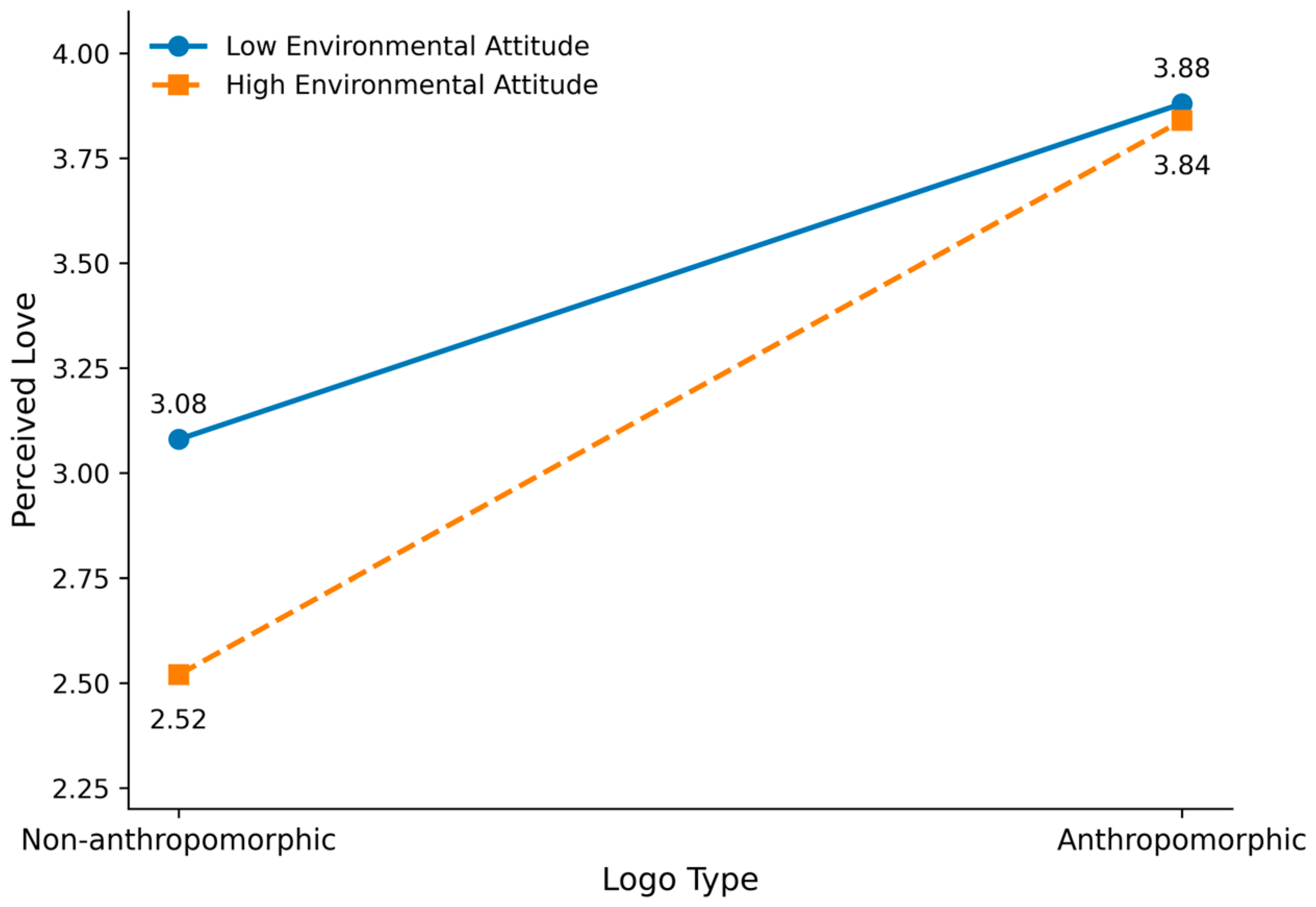
| Logo Type × Environmental Attitude | 0.75 | 0.29 | 2.61 ** | ||||||
| R2 | 0.17 | 0.48 | 0.29 | ||||||
| F | 41.84 | 278.96 | 80.58 | ||||||
| Moderator | Boot Indirect Effect | Boot SE | BC 95% CI | |
|---|---|---|---|---|
| Lower | Upper | |||
| −1 SD | 0.1143 | 0.0290 | 0.0619 | 0.1749 |
| +1 SD | 0.1901 | 0.0408 | 0.1184 | 0.2789 |
| Hypothesis | Hypothesized Relationship | Result |
|---|---|---|
| H1 | Anthropomorphic design of eco-friendly logos increases consumers’ green purchase intention. | Supported |
| H2 | Perceived love mediates the positive effect of anthropomorphic eco-friendly logos on green purchase intention. | Supported |
| H3 | Perceived hope mediates the positive effect of anthropomorphic eco-friendly logos on green purchase intention. | Supported |
| H4 | Perceived love and perceived hope sequentially mediate the effect of anthropomorphic eco-friendly logos on green purchase intention. | Supported |
| H5 | Environmental attitude positively moderates the relationship between anthropomorphic eco-friendly logos and perceived love. | Supported |
Disclaimer/Publisher’s Note: The statements, opinions and data contained in all publications are solely those of the individual author(s) and contributor(s) and not of MDPI and/or the editor(s). MDPI and/or the editor(s) disclaim responsibility for any injury to people or property resulting from any ideas, methods, instructions or products referred to in the content. |
© 2026 by the authors. Licensee MDPI, Basel, Switzerland. This article is an open access article distributed under the terms and conditions of the Creative Commons Attribution (CC BY) license.
Share and Cite
An, Y.; Xu, J.; Luh, D.; Xia, T.; Chen, Y. The Impact of Anthropomorphic Eco-Friendly Logos on Consumers’ Green Purchase Intention: A Moderated Mediation Model. Behav. Sci. 2026, 16, 965. https://doi.org/10.3390/bs16060965
An Y, Xu J, Luh D, Xia T, Chen Y. The Impact of Anthropomorphic Eco-Friendly Logos on Consumers’ Green Purchase Intention: A Moderated Mediation Model. Behavioral Sciences. 2026; 16(6):965. https://doi.org/10.3390/bs16060965
Chicago/Turabian StyleAn, Yi, Ji Xu, Dingbang Luh, Tiansheng Xia, and Yibing Chen. 2026. "The Impact of Anthropomorphic Eco-Friendly Logos on Consumers’ Green Purchase Intention: A Moderated Mediation Model" Behavioral Sciences 16, no. 6: 965. https://doi.org/10.3390/bs16060965
APA StyleAn, Y., Xu, J., Luh, D., Xia, T., & Chen, Y. (2026). The Impact of Anthropomorphic Eco-Friendly Logos on Consumers’ Green Purchase Intention: A Moderated Mediation Model. Behavioral Sciences, 16(6), 965. https://doi.org/10.3390/bs16060965