Supportive University Climate and AI Dependence Among Undergraduates: The Sequential Mediating Role of Academic Self-Efficacy and Self-Control

Abstract
1. Introduction
2. Literature Review and Research Hypothesis
2.1. Supportive University Climate and AI Dependence Among Undergraduates
2.2. The Mediating Role of Academic Self-Efficacy
2.3. The Mediating Role of Self-Control
2.4. The Sequential Mediation Effect of Academic Self-Efficacy and Self-Control
3. Research Methods
3.1. Research Sample and Data Sources
3.2. Scale Revision and Validation
3.3. Measurement Instruments
3.3.1. Supportive University Climate Scale
3.3.2. Academic Self-Efficacy Scale
3.3.3. Self-Control Scale
3.3.4. AI Dependence Scale
3.4. Data Analysis
4. Results
4.1. Common Method Bias Test
4.2. Descriptive Statistics and Correlation Analysis
4.3. Testing for Mediating Effects
- (1)
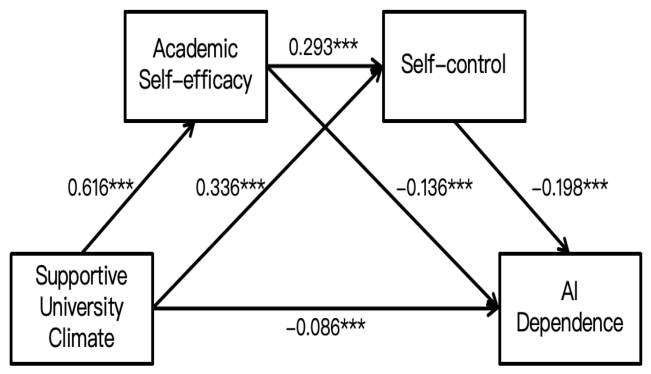
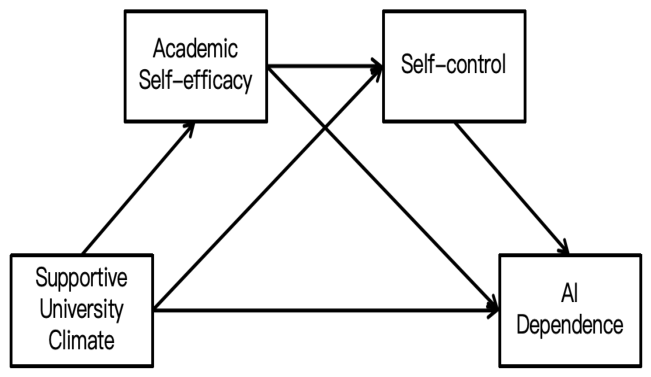
- The indirect effect of supportive university climate → academic self-efficacy → AI dependence was −0.084 (Boot CI = [−0.11, −0.06]), accounting for 30.88% of the total indirect effect. As the CI does not include zero, the mediating effect of academic self-efficacy is significant, supporting Hypothesis 2.
- (2)
- The indirect effect of supportive university climate → self-control → AI dependence was −0.067 (Boot CI = [−0.08, −0.05]), making up 24.63% of the total indirect effect. The CI excludes zero, indicating a significant mediating effect of self-control, consistent with Hypothesis 3.
- (3)
- The sequential mediation effect of supportive university climate → academic self-efficacy → self-control → AI dependence was −0.036 (Boot CI = [−0.05, −0.03]), representing 13.24% of the total indirect effect. The CI excludes zero, indicating that the sequential mediation effect is significant, supporting Hypothesis 4.
5. Discussion
5.1. Supportive University Climate and Undergraduates’ AI Dependence
5.2. The Mediating Role of Academic Self-Efficacy
5.3. The Mediating Role of Self-Control
5.4. The Sequential Mediation Effect of Academic Self-Efficacy and Self-Control
5.5. Theoretical Implications
5.6. Practical Implications
6. Limitations and Future Directions
7. Conclusions
Author Contributions
Funding
Institutional Review Board Statement
Informed Consent Statement
Data Availability Statement
Conflicts of Interest
Appendix A
- Supportive university climate:
- Faculty members care about my academic and personal development.
- I can receive effective guidance from faculty when encountering academic difficulties.
- Faculty members attend to and affirm my academic progress.
- Faculty encouragement strengthens my academic confidence.
- I have opportunities to participate in discussions about classroom rules or instructional arrangements.
- Faculty members consider students’ interests and needs in their teaching.
- Students have room for autonomous decision-making in course tasks or activities.
- I can express my views on class or course-related matters.
- Students respect each other and maintain harmonious relationships.
- I can receive academic or personal help from classmates when needed.
- I rarely experience malicious conflict or exclusion among classmates around me.
- I trust my classmates and am willing to collaborate with them on academic tasks.
- Academic self-efficacy:
- I believe that as long as I study diligently, I can pass my major course exams.
- I can persist in and achieve my academic goals in my major.
- I can remain calm during exams because I believe I can answer the questions well.
- If I work hard enough, I can generally solve challenging problems in my major courses.
- In my studies, I feel that “if others can do it, I can too.”
- Self-control:
- I can effectively resist entertainment temptations and prioritize completing academic tasks. (R)
- I can proactively overcome bad habits such as procrastination and staying up late. (R)
- I can control myself from overindulging in entertaining but unproductive activities. (R)
- I can firmly refuse things that are detrimental to my studies or health. (R)
- When I realize my behavior is inappropriate, I can stop promptly. (R)
- Before making important decisions, I fully consider the pros and cons of various options. (R)
- I can maintain a diligent and focused state in daily study and life.
- I can speak and act prudently in class or group discussions.
- I am satisfied with my current self-discipline ability.
- In the eyes of my classmates, I am a highly self-disciplined person.
- I can manage my time effectively and avoid letting entertainment interfere with important matters.
- I can maintain concentration for extended periods while studying.
- I can make plans for long-term goals and execute them effectively.
- AI dependence:
- I am accustomed to depending on AI tools (e.g., DeepSeek) to complete academic tasks.
- When encountering academic problems, I turn to AI first rather than engaging in deep thinking on my own.
- I often rely on AI suggestions to make academic or daily decisions.
- Without access to AI, completing certain academic tasks becomes difficult for me.
- I often spend more time using AI than originally planned.
- After frequent AI use, I feel that my willingness or ability to think independently has declined.
- I use AI to relieve negative emotions.
- When feeling lonely, I turn to AI for companionship.
- When communicating with AI, I feel understood.
- I confide in AI about personal matters I am unwilling to share with others.
- When unable to access AI, I feel empty or uneasy.
- Interacting with AI has become one of my daily relaxation habits.
References
- Acosta-Enriquez, B. G., Ballesteros, M. A. A., Guzman Valle, M. d. l. A., Angaspilco, J. E. M., Aquino Lalupú, J. d. R., Jaico, J. L. B., Germán Reyes, N. C., Alarcón García, R. E., & Castillo, W. E. J. (2025). The mediating role of academic stress, critical thinking and performance expectations in the influence of academic self-efficacy on AI dependence: Case study in college students. Computers and Education: Artificial Intelligence, 8, 100381. [Google Scholar] [CrossRef]
- Al Mashagbeh, M., Alsharqawi, M., Tudevdagva, U., & Khasawneh, H. J. (2025). Student engagement with artificial intelligence tools in academia: A survey of Jordanian universities. Frontiers in Education, 10, 1550147. [Google Scholar] [CrossRef]
- Almassaad, A., Alajlan, H., & Alebaikan, R. (2024). Student perceptions of generative artificial intelligence: Investigating utilization, benefits, and challenges in higher education. Systems, 12(10), 385. [Google Scholar] [CrossRef]
- Alshowkan, A., Shdaifat, E., Alnass, F., & Al-Dhafeeri, F. (2026). Academic atmosphere, academic self-perception, and student self-efficacy: A structural model. BMC Nursing, 25(1), 257. [Google Scholar] [CrossRef]
- Anderson, C. S. (1982). The search for school climate: A review of the research. Review of Educational Research, 52(3), 368–420. [Google Scholar] [CrossRef]
- Arowosegbe, A., Alqahtani, J. S., & Oyelade, T. (2024). Perception of generative AI use in UK higher education. Frontiers in Education, 9, 1463208. [Google Scholar] [CrossRef]
- Bandura, A. (1977). Self-efficacy: Toward a unifying theory of behavioral change. Psychological Review, 84(2), 191–215. [Google Scholar] [CrossRef]
- Bandura, A. (1989). Human agency in social cognitive theory. American Psychologist, 44(9), 1175–1184. [Google Scholar] [CrossRef]
- Bandura, A. (1991). Social cognitive theory of self-regulation. Organizational Behavior and Human Decision Processes, 50(2), 248–287. [Google Scholar] [CrossRef]
- Bandura, A., Freeman, W. H., & Lightsey, R. (1999). Self-efficacy: The exercise of control. Journal of Cognitive Psychotherapy, 13(2), 158–166. [Google Scholar] [CrossRef]
- Berhanu, K. Z., & Sewagegn, A. A. (2024). The role of perceived campus climate in students’ academic achievements as mediated by students’ engagement in higher education institutions. Cogent Education, 11(1), 2377839. [Google Scholar] [CrossRef]
- Besalti, M. (2025). Harnessing self-control and AI: Understanding ChatGPT’s impact on academic wellbeing. Behavioral Sciences, 15(9), 1181. [Google Scholar] [CrossRef]
- Błachnio, A., Przepiorka, A., Cudo, A., Angeluci, A., Ben-Ezra, M., Durak, M., Kaniasty, K., Mazzoni, E., Senol-Durak, E., Hou, W. K., & Benvenuti, M. (2023). Self-control and digital media addiction: The mediating role of media multitasking and time style. Psychology Research and Behavior Management, 16, 2283–2296. [Google Scholar] [CrossRef]
- Bronfenbrenner, U. (1977). Toward an experimental ecology of human development. American Psychologist, 32(7), 513–531. [Google Scholar] [CrossRef]
- Chan, C. K. Y., & Hu, W. (2023). Students’ voices on generative AI: Perceptions, benefits, and challenges in higher education. International Journal of Educational Technology in Higher Education, 20(1), 43. [Google Scholar] [CrossRef]
- Chen, X., Cui, M., Sun, P., Xu, X., Ma, K., & Yan, L. (2026). Unpacking the relationship between self-control and academic engagement: The mediating role of meaning in life and the moderating role of GenAI dependence. BMC Psychology, 14(1), 168. [Google Scholar] [CrossRef] [PubMed]
- Chen, Y., Wang, M., Yuan, S., & Zhao, Y. (2025). Development and validation of the conversational AI dependence scale for Chinese college students. Frontiers in Psychology, 16, 1621540. [Google Scholar] [CrossRef]
- Chin, W. W., Thatcher, J. B., & Wright, R. T. (2012). Assessing common method bias: Problems with the ULMC technique. MIS Quarterly, 36, 1003–1019. [Google Scholar] [CrossRef]
- Coetzee, T., Pryce-Jones, K., Grant, L., & Tindle, R. (2022). Hope moderates the relationship between students’ sense of belonging and academic misconduct. International Journal for Educational Integrity, 18(1), 28. [Google Scholar] [CrossRef]
- Cohen, J., McCabe, E. M., Michelli, N. M., & Pickeral, T. (2009). School climate: Research, policy, practice, and teacher education. Teachers College Record, 111(1), 180–213. [Google Scholar] [CrossRef]
- Cui, Y., Liu, Z., Sun, Z., & Jin, J. (2023). Campus learning environment, the influence of psychological emotions during learning on self-learning efficacy. In Proceedings of the 2023 8th international conference on distance education and learning (pp. 226–230). ACM. [Google Scholar] [CrossRef]
- Darner, R. (2009). Self-determination theory as a guide to fostering environmental motivation. The Journal of Environmental Education, 40(2), 39–49. [Google Scholar] [CrossRef]
- Demir, S., & Kuşcu Karatepe, H. (2025). The effect of academic procrastination on life satisfaction among nursing and midwifery students: The serial mediation role of academic self-efficacy and self-control. Behavioral Sciences, 15(11), 1434. [Google Scholar] [CrossRef]
- Duckworth, A. L., Taxer, J. L., Eskreis-Winkler, L., Galla, B. M., & Gross, J. J. (2019). Self-control and academic achievement. Annual Review of Psychology, 70(1), 373–399. [Google Scholar] [CrossRef] [PubMed]
- Edman, J. L., & Brazil, B. (2008). Perceptions of campus climate, academic efficacy and academic success among community college students: An ethnic comparison. Social Psychology of Education, 12(3), 371–383. [Google Scholar] [CrossRef]
- Estrada-Araoz, E. G., Mamani-Roque, M., Quispe-Aquise, J., Manrique-Jaramillo, Y. V., & Cruz-Laricano, E. O. (2025). Academic self-efficacy and dependence on artificial intelligence in a sample of university students. Sapienza: International Journal of Interdisciplinary Studies, 6(1), e25008. [Google Scholar] [CrossRef]
- Fan, Z., Chen, M., & Lin, Y. (2022). Self-control and problematic internet use in college students: The chain mediating effect of rejection sensitivity and loneliness. Psychology Research and Behavior Management, 15, 459–470. [Google Scholar] [CrossRef] [PubMed]
- Fang, Z., Fu, Y., Liu, D., & Chen, C. (2025). The impact of school climate on college students’ socio-emotional competence: The mediating role of psychological resilience and emotion regulation. BMC Psychology, 13(1), 682. [Google Scholar] [CrossRef] [PubMed]
- Farshad, F., Kheirkhah, M., Virtanen, J., & Hessari, H. (2023). Role of the educational atmosphere on self-efficacy among dental students. Strides in Development of Medical Education, 20(1), 137–144. [Google Scholar] [CrossRef]
- Feng, L., & Zhang, L. (2022). Perceived teacher support, peer relationship, and university students’ mental health: The mediation of reality and Internet altruistic behaviors. Frontiers in Psychology, 13, 999524. [Google Scholar] [CrossRef]
- Feng, S., & Zhou, H. (2025). Heterogeneous patterns of generative AI use among Chinese university students: Application depth, benefits, and dependency. Exploring Education Development, 45(21), 1–10. [Google Scholar] [CrossRef]
- Fieldhouse, R. (2025). AI is saving time and money in research—But at what cost? Nature, 649(8096), 272–273. [Google Scholar] [CrossRef]
- Gerlich, M. (2025). AI tools in society: Impacts on cognitive offloading and the future of critical thinking. Societies, 15(1), 6. [Google Scholar] [CrossRef]
- Hayes, A. F. (2012). PROCESS: A versatile computational tool for observed variable mediation, moderation, and conditional process modeling. The Guilford Press. [Google Scholar]
- Herman, J., & Lara-Steidel, H. (2025). Artificial intelligence on campus: Revisiting understanding as an aim of higher education. Educational Theory, 75(4), 603–625. [Google Scholar] [CrossRef]
- Hobfoll, S. E. (1989). Conservation of resources: A new attempt at conceptualizing stress. American Psychologist, 44(3), 513–524. [Google Scholar] [CrossRef]
- Hoy, W. K. (1990). Organizational climate and culture: A conceptual analysis of the school workplace. Journal of Educational and Psychological Consultation, 1(2), 149–168. [Google Scholar] [CrossRef] [PubMed]
- Huang, L., & Wang, D. (2023). Teacher support, academic self-efficacy, student engagement, and academic achievement in emergency online learning. Behavioral Sciences, 13(9), 704. [Google Scholar] [CrossRef]
- Husna, R., Ramadhani, S., & A’yun, Q. (2024). The role of self-control in overcoming ethical challenges in the development of artificial intelligence. BICC Proceedings, 2, 165–169. [Google Scholar] [CrossRef]
- Irshad, M., Qureshi, M. A., Saraih, U. N., & Ahmad, S. F. (2023). Impact of institutional climate on the student’s engagement and learning outcomes in private sector universities of Karachi. International Journal of Management in Education, 17(3), 297–322. [Google Scholar] [CrossRef]
- Jia, W., Pan, L., & Neary, S. (2025). Effect of GenAI dependency on university students’ academic achievement: The mediating role of self-efficacy and moderating role of perceived teacher caring. Behavioral Sciences, 15(10), 1348. [Google Scholar] [CrossRef]
- Jia, Y., Way, N., Ling, G., Yoshikawa, H., Chen, X., Hughes, D., Ke, X., & Lu, Z. (2009). The influence of student perceptions of school climate on socioemotional and academic adjustment: A comparison of Chinese and American adolescents. Child Development, 80(5), 1514–1530. [Google Scholar] [CrossRef]
- Kang, X., Liu, M., & Wu, S. (2025). How the university campus climate promotes the development of social-emotional competence in pre-service teachers: A mediation of professional identity and moderation of relative deprivation? Journal of Educational Science of Hunan Normal University, 24(4), 104–114. [Google Scholar] [CrossRef]
- Kong, L., Zhao, M., Huang, W., Zhang, W., & Liu, J. (2025). The impact of academic anxiety on smartphone addiction among college students: The mediating role of self-regulatory fatigue and the moderating role of mindfulness. BMC Psychology, 13(1), 354. [Google Scholar] [CrossRef]
- Li, C. (2025). Do teacher-training college students become more engaged in their studies because of commitment? The mediating role of self-control and the moderating role of core self-evaluation. Frontiers in Psychology, 16, 1569871. [Google Scholar] [CrossRef]
- Li, L., Wang, T., Wang, Y., Wang, Y., & Zeng, X. (2026). Development and validation of the conversational AI dependence scale (CAID): A dual-dimensional measure of instrumental and emotional dependence. International Journal of Human Computer Interaction, 1–21. [Google Scholar] [CrossRef]
- Li, W., Lu, J., Cao, L., & Xiao, M. (2026). University organizational support and engineering identity among engineering post-graduates: The sequential mediating role of major satisfaction and engineering belonging. Behavioral Sciences, 16(2), 199. [Google Scholar] [CrossRef]
- Liang, J., Yin, X., Wei, X., Yang, X., & Ji, Y. (2026). Perceived stress and mobile phone addiction among Chinese undergraduate nursing students: The mediating role of organizational caring climate and self-control. Frontiers in Psychology, 17, 1634642. [Google Scholar] [CrossRef] [PubMed]
- Liu, B. (2026). How does self-regulated learning resist AI dependence? A mediating effect study based on college students who frequently use AIGC tools. Sage Open, 16(1), 21582440261420068. [Google Scholar] [CrossRef]
- Liu, X., Liu, Y., Dai, Y., & Fu, J. (2026). Academic stress and university students’ dependency on generative artificial intelligence: A multiple mediation model using PLS-SEM. BMC Psychology, 14(1), 216. [Google Scholar] [CrossRef] [PubMed]
- Ma, Y., Su, Y., Li, M., Zhang, Y., Chai, W., Huang, A., & Zhao, X. (2025). Preparing students for an AI-driven world: Generative AI and curriculum reform in higher education. Frontiers of Digital Education, 2(4), 30. [Google Scholar] [CrossRef]
- Meier, A., Reinecke, L., & Meltzer, C. E. (2016). “Facebocrastination”? Predictors of using Facebook for procrastination and its effects on students’ well-being. Computers in Human Behavior, 64, 65–76. [Google Scholar] [CrossRef]
- Moilanen, K. L., DeLong, K. L., Spears, S. K., Gentzler, A. L., & Turiano, N. A. (2021). Predictors of initial status and change in self-control during the college transition. Journal of Applied Developmental Psychology, 73, 101235. [Google Scholar] [CrossRef]
- Muraven, M., & Baumeister, R. F. (2000). Self-regulation and depletion of limited resources: Does self-control resemble a muscle? Psychological Bulletin, 126(2), 247–259. [Google Scholar] [CrossRef]
- Nakata, Y., & Gao, X. (2025). Why classroom climate matters: Exploring Japanese university students’ motivational regulation within a classroom ecology. Language Teaching Research, 13621688241310498. [Google Scholar] [CrossRef]
- Nilsen, F. A., Bang, H., Boe, O., Martinsen, Ø. L., Lang-Ree, O. C., & Røysamb, E. (2020). The multidimensional self-control scale (MSCS): Development and validation. Psychological Assessment, 32(11), 1057–1074. [Google Scholar] [CrossRef]
- OECD. (2026). OECD digital education outlook 2026: Exploring effective uses of generative AI in education. OECD Publishing. [Google Scholar] [CrossRef]
- Pamuk, M. (2026). Investigation of the serial mediation roles of social media craving and self-control in the relationship between social media addiction and psychological adjustment problems of university students. Current Psychology, 45(3), 312. [Google Scholar] [CrossRef]
- Pan, X. (2020). Technology acceptance, technological self-efficacy, and attitude toward technology-based self-directed learning: Learning motivation as a mediator. Frontiers in Psychology, 11, 564294. [Google Scholar] [CrossRef] [PubMed]
- Rodríguez-Ruiz, J., Marín-López, I., & Espejo-Siles, R. (2024). Is artificial intelligence use related to self-control, self-esteem and self-efficacy among university students? Education and Information Technologies, 30(2), 2507–2524. [Google Scholar] [CrossRef]
- Schunk, D. H., & Pajares, F. (2002). The development of academic self-efficacy. In A. Wigfield, & J. S. Eccles (Eds.), Development of achievement motivation (pp. 15–31). Academic Press. [Google Scholar] [CrossRef]
- Schutte, N. S., & Li, H. (2025). The role of self-efficacy and curiosity in student use of artificial intelligence (AI). International Journal of Educational Technology in Higher Education, 22(1), 73. [Google Scholar] [CrossRef]
- Shi, Y., Hui, X., Li, G., Ouyang, M., & Yang, C. (2025). Boredom proneness and Chinese vocational college students’ academic disengagement: Mediating role of academic self-efficacy and moderating role of self-control. Frontiers in Psychology, 16, 1687667. [Google Scholar] [CrossRef]
- Shi, Y., & Ko, Y. C. (2023). A study on the influence of family and school psychological environment on academic self-efficacy and self-identity of English education major university students. Participatory Educational Research, 10(1), 106–121. [Google Scholar] [CrossRef]
- Shukla, A., & Arora, V. (2023). A holistic approach to student empowerment and assessment of its impact on educational outcomes through psychological ownership. Studies in Higher Education, 48(8), 1315–1332. [Google Scholar] [CrossRef]
- Singer-Freeman, K. E., Verbeke, K., & Barre, B. (2025). Generative AI use among university students depends on academic level and task. Higher Learning Research Communications, 15(2), 8. [Google Scholar] [CrossRef]
- Sun, P., Li, J., Chen, X., Cui, M., & Yan, L. (2026). The impact of maladaptive perfectionism on AI dependence among college students: The mediating role of self-control and the moderating role of academic engagement. Acta Psychologica, 263, 106294. [Google Scholar] [CrossRef]
- Tamrin, S. I., Omar, N. F., Kamaruzaman, K. N., Zaghlol, A. K., & Abdul Aziz, M. R. (2024). Evaluating the impact of AI dependency on cognitive ability among Generation Z in higher educational institutions: A conceptual framework. Information Management and Business Review, 16(3), 1027–1033. [Google Scholar] [CrossRef]
- Tangney, J. P., Baumeister, R. F., & Boone, A. L. (2004). High self-control predicts good adjustment, less pathology, better grades, and interpersonal success. Journal of Personality, 72(2), 271–324. [Google Scholar] [CrossRef]
- Thomas, A. R. (1976). The organizational climate of schools. International Review of Education, 22(4), 441–463. [Google Scholar] [CrossRef]
- Usher, E. L., & Pajares, F. (2008). Sources of self-efficacy in school: Critical review of the literature and future directions. Review of Educational Research, 78(4), 751–796. [Google Scholar] [CrossRef]
- Uyar, A., Karafil, B., & Karakuyu, A. (2026). Artificial intelligence dependency among educators: A scale development and validation study. Education and Information Technologies, 31, 2369–2398. [Google Scholar] [CrossRef]
- van Zyl, L. E., Klibert, J., Shankland, R., See-To, E. W. K., & Rothmann, S. (2022). The general academic self-efficacy scale: Psychometric properties, longitudinal invariance, and criterion validity. Journal of Psychoeducational Assessment, 40(6), 777–789. [Google Scholar] [CrossRef]
- Vieriu, A. M., & Petrea, G. (2025). The impact of artificial intelligence (AI) on students’ academic development. Education Sciences, 15(3), 343. [Google Scholar] [CrossRef]
- Von Garrel, J., & Mayer, J. (2023). Artificial Intelligence in studies—Use of ChatGPT and AI-based tools among students in Germany. Humanities and Social Sciences Communications, 10(1), 799. [Google Scholar] [CrossRef]
- Wang, Q., Lee, K. C. S., & Hoque, K. E. (2020). The effect of classroom climate on academic motivation mediated by academic self-efficacy in a higher education institute in China. International Journal of Learning, Teaching and Educational Research, 19(8), 194–213. [Google Scholar] [CrossRef]
- Wang, S., & Huang, Y. (2024). Promote or inhibit: The impact of generative artificial intelligence on the creativity of college students. China Higher Education Research, 2024(11), 29–36. [Google Scholar] [CrossRef]
- Wang, Y., Wang, L., Yang, L., & Wang, W. (2024). Influence of perceived social support and academic self-efficacy on teacher-student relationships and learning engagement for enhanced didactical outcomes. Scientific Reports, 14(1), 28396. [Google Scholar] [CrossRef]
- Wang, Y., & Xu, S. (2026). Relationship between artificial intelligence tool usage experience and academic stress among college students: Mediating role of loneliness and moderating role of academic self-efficacy. Acta Psychologica, 263, 106220. [Google Scholar] [CrossRef]
- Wei, B., Zhuo, Y., Zeng, H., Hong, H., & Liu, H. (2025). Determinants of university students’ attitudes towards smart devices in the smart campus environment. Humanities and Social Sciences Communications, 12(1), 1543. [Google Scholar] [CrossRef]
- Wood, R., & Bandura, A. (1989). Social cognitive theory of organizational management. The Academy of Management Review, 14(3), 361–384. [Google Scholar] [CrossRef]
- Xu, J., Tian, M., & Hu, D. (2026). Development and application of the generative artificial intelligence dependency scale for teachers. Journal of Distance Education, 44(1), 92–102+112. [Google Scholar] [CrossRef]
- Yang, Y.-D., Zhou, C.-L., & Wang, Z.-Q. (2024). The relationship between self-control and learning engagement among Chinese college students: The chain mediating roles of resilience and positive emotions. Frontiers in Psychology, 15, 1331691. [Google Scholar] [CrossRef] [PubMed]
- Yang, Z., Deng, H., & Jiang, N. (2025). The impact mechanism of artificial intelligence dependence on college students’ innovation capability: An empirical study from China. Frontiers in Psychology, 16, 1732837. [Google Scholar] [CrossRef]
- Yildiz Durak, H., Yahşi Sari, H., Dilmaç, B., & Durak, A. (2026). Social anxiety and self-control desire for social media users: The mediating roles of resilience and social media usage. Journal of Rational-Emotive & Cognitive Behavior Therapy, 44(1), 6. [Google Scholar] [CrossRef]
- Yue, H., Li, C., Liu, M., Jin, R., & Bao, H. (2020). Validity test of the theory of planned behavior in college students’ withdrawal from smartphone dependence. Current Psychology, 41(8), 5524–5531. [Google Scholar] [CrossRef]
- Zhang, H., & Pan, J. (2026). Generative AI dependence in higher education: A PLS-SEM examination of Chinese and Malaysian teachers through the I-PACE model. Acta Psychologica, 264, 106480. [Google Scholar] [CrossRef]
- Zhang, L., & Xu, J. (2025). The paradox of self-efficacy and technological dependence: Unraveling generative AI’s impact on university students’ task completion. The Internet and Higher Education, 65, 100978. [Google Scholar] [CrossRef]
- Zhang, S., Zhao, X., Zhou, T., & Kim, J. H. (2024). Do you have AI dependency? The roles of academic self-efficacy, academic stress, and performance expectations on problematic AI usage behavior. International Journal of Educational Technology in Higher Education, 21(1), 34. [Google Scholar] [CrossRef]
- Zhao, L., Huang, W., Han, B., & Wu, X. (2026). Classroom climate dimensions, self-efficacy, and music aesthetic literacy: A mediation study with Chinese non-music major college students. Frontiers in Psychology, 16, 1716470. [Google Scholar] [CrossRef]
- Zhao, X., Wang, H., Ma, Z., Zhang, L., & Chang, T. (2025). Smartphone addiction and academic procrastination among college students: A serial mediation model of self-control and academic self-efficacy. Frontiers in Psychiatry, 16, 1572963. [Google Scholar] [CrossRef] [PubMed]
- Zhou, S., Qin, L., Deng, J., Zhe, J., Jiang, D., Long, S., & Wu, Y. (2025). How classroom climate is linked to prosocial behavior in undergraduate students: A multilevel moderated mediation model of feedback expectation and self-monitoring. BMC Psychology, 14(1), 15. [Google Scholar] [CrossRef]


| Variable | Classification | Number (n) | Percentage (%) |
|---|---|---|---|
| Gender | Male | 544 | 47.64% |
| Female | 598 | 52.36% | |
| Grade | Freshman | 268 | 23.47% |
| Sophomore | 318 | 27.85% | |
| Junior | 291 | 25.48% | |
| Senior | 265 | 23.20% | |
| School type | Non-double first-class | 602 | 52.71% |
| Double first-class | 540 | 47.29% | |
| Major type | Natural sciences | 408 | 35.73% |
| Humanities | 377 | 33.01% | |
| Social sciences | 357 | 31.26% |
| Variable | M | SD | 1 | 2 | 3 | 4 |
|---|---|---|---|---|---|---|
| 1. Supportive university climate | 3.12 | 0.83 | 1 | |||
| 2. Academic self-efficacy | 3.10 | 0.91 | 0.562 ** | 1 | ||
| 3. Self-control | 3.15 | 0.81 | 0.528 ** | 0.523 ** | 1 | |
| 4. AI dependence | 3.66 | 0.56 | −0.402 ** | −0.442 ** | −0.468 ** | 1 |
| Outcome Variable | Predictor Variables | R2 | F | β | SE | t | p |
|---|---|---|---|---|---|---|---|
| Academic self-efficacy | Constant | 0.319 | 106.430 *** | 0.966 | 0.15 | 6.47 | 0.00 |
| Gender | 0.015 | 0.04 | 0.32 | 0.75 | |||
| Grade | 0.020 | 0.02 | 0.98 | 0.33 | |||
| School type | 0.031 | 0.04 | 0.68 | 0.50 | |||
| Major type | 0.047 | 0.03 | 1.72 | 0.09 | |||
| Supportive university climate | 0.616 *** | 0.03 | 22.93 | 0.00 | |||
| Self-control | Constant | 0.356 | 104.666 *** | 1.058 | 0.13 | 8.04 | 0.00 |
| Gender | −0.006 | 0.04 | −0.16 | 0.87 | |||
| Grade | 0.028 | 0.02 | 1.55 | 0.12 | |||
| School type | 0.056 | 0.04 | 1.44 | 0.15 | |||
| Major type | 0.001 | 0.02 | 0.02 | 0.99 | |||
| Supportive university climate | 0.336 *** | 0.03 | 11.94 | 0.00 | |||
| Academic self-efficacy | 0.293 *** | 0.03 | 11.40 | 0.00 | |||
| AI dependence | Constant | 0.283 | 63.907 *** | 4.959 | 0.10 | 50.07 | 0.00 |
| Gender | −0.012 | 0.03 | −0.44 | 0.66 | |||
| Grade | −0.002 | 0.01 | −0.16 | 0.88 | |||
| School type | 0.030 | 0.03 | 1.06 | 0.29 | |||
| Major type | −0.002 | 0.02 | −0.12 | 0.91 | |||
| Supportive university climate | −0.086 *** | 0.02 | −3.93 | 0.00 | |||
| Academic self-efficacy | −0.136 *** | 0.02 | −6.87 | 0.00 | |||
| Self-control | −0.198 *** | 0.02 | −9.12 | 0.00 |
| Effect | Boot SE | Boot LLCI | Boot ULCI | Effect Rate | |
|---|---|---|---|---|---|
| Total effect | −0.272 | 0.02 | −0.31 | −0.24 | 100% |
| Direct effect | −0.086 | 0.02 | −0.13 | −0.04 | 31.62% |
| Total mediation effect | −0.186 | 0.02 | −0.22 | −0.15 | 68.38% |
| Supportive university climate → Academic self-efficacy → AI dependence | −0.084 | 0.01 | −0.11 | −0.06 | 30.88% |
| Supportive university climate → Self-control → AI dependence | −0.067 | 0.01 | −0.08 | −0.05 | 24.63% |
| Supportive university climate → Academic self-efficacy → Self-control → AI dependence | −0.036 | 0.01 | −0.05 | −0.03 | 13.24% |
Disclaimer/Publisher’s Note: The statements, opinions and data contained in all publications are solely those of the individual author(s) and contributor(s) and not of MDPI and/or the editor(s). MDPI and/or the editor(s) disclaim responsibility for any injury to people or property resulting from any ideas, methods, instructions or products referred to in the content. |
© 2026 by the authors. Licensee MDPI, Basel, Switzerland. This article is an open access article distributed under the terms and conditions of the Creative Commons Attribution (CC BY) license.
Share and Cite
Lu, J.; Li, W.; Mo, Y.; Ge, M. Supportive University Climate and AI Dependence Among Undergraduates: The Sequential Mediating Role of Academic Self-Efficacy and Self-Control. Behav. Sci. 2026, 16, 902. https://doi.org/10.3390/bs16060902
Lu J, Li W, Mo Y, Ge M. Supportive University Climate and AI Dependence Among Undergraduates: The Sequential Mediating Role of Academic Self-Efficacy and Self-Control. Behavioral Sciences. 2026; 16(6):902. https://doi.org/10.3390/bs16060902
Chicago/Turabian StyleLu, Jinfeng, Weiwei Li, Yangyang Mo, and Min Ge. 2026. "Supportive University Climate and AI Dependence Among Undergraduates: The Sequential Mediating Role of Academic Self-Efficacy and Self-Control" Behavioral Sciences 16, no. 6: 902. https://doi.org/10.3390/bs16060902
APA StyleLu, J., Li, W., Mo, Y., & Ge, M. (2026). Supportive University Climate and AI Dependence Among Undergraduates: The Sequential Mediating Role of Academic Self-Efficacy and Self-Control. Behavioral Sciences, 16(6), 902. https://doi.org/10.3390/bs16060902