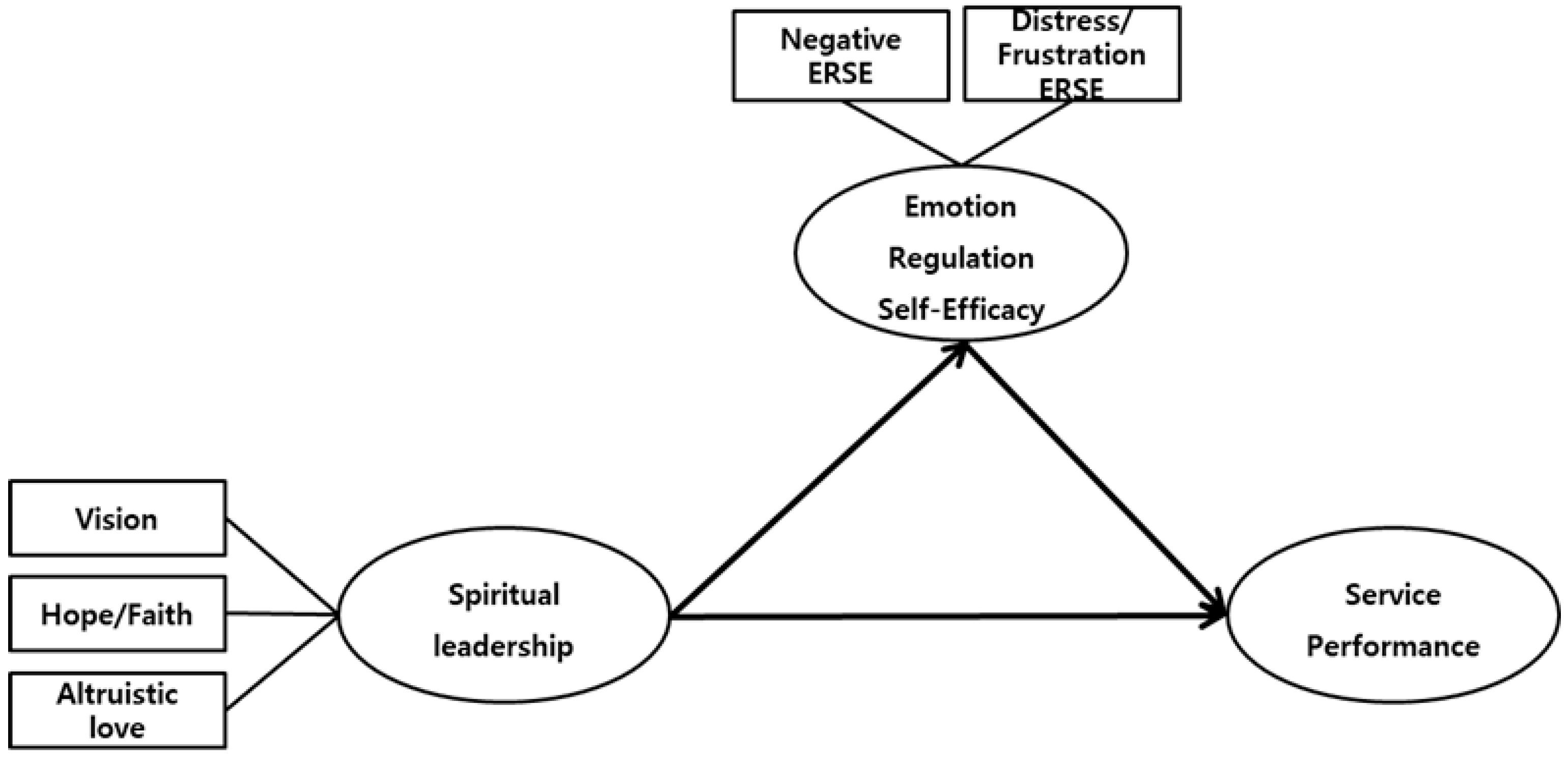
Spiritual Leadership in Hotels and Service Performance Under Emotional Demands: The Mediating Role of Emotion Regulation Self-Efficacy


Abstract
1. Introduction
2. Theoretical Background
2.1. Spiritual Leadership
2.2. Emotion Regulation Self-Efficacy
2.3. Service Performance
2.4. Correlation Among Variables
3. Materials & Methods
3.1. Data Collection and Method
3.2. Measurement
4. Results
4.1. Demographics of the Participants
4.2. Reliability and Validity
4.2.1. Confirmatory Factor Analysis
4.2.2. Discriminant Validity
4.2.3. Common Method Bias
4.3. Hypothesis Testing
5. Discussion and Conclusions
5.1. Theoretical Implications
5.2. Practical Implications
5.3. Limitations and Future Research
5.4. Conclusions
Author Contributions
Funding
Institutional Review Board Statement
Informed Consent Statement
Data Availability Statement
Conflicts of Interest
References
- Abuelhassan, A. E., & AlGassim, A. (2022). How organizational justice in the hospitality industry influences proactive customer service performance through general self-efficacy. International Journal of Contemporary Hospitality Management, 34(7), 2579–2596. [Google Scholar] [CrossRef]
- Ahearne, M., Mathieu, J., & Rapp, A. (2005). To empower or not to empower your sales force? An empirical examination of the influence of leadership empowerment behavior on customer satisfaction and performance. Journal of Applied Psychology, 90(5), 945–955. [Google Scholar] [CrossRef]
- Alessandri, G., Luengo Kanacri, B. P., Eisenberg, N., Zuffianò, A., Milioni, M., Vecchione, M., & Caprara, G. V. (2014). Prosociality during the transition from late adolescence to young adulthood: The role of effortful control and ego-resiliency. Personality and Social Psychology Bulletin, 40(11), 1451–1465. [Google Scholar] [CrossRef]
- Anderson, J. C., & Gerbing, D. W. (1988). Structural equation modeling in practice: A review and recommended two-step approach. Psychological Bulletin, 103(3), 411. [Google Scholar] [CrossRef]
- Ashfaq, F., Abid, G., & Ilyas, S. (2021). Impact of ethical leadership on employee engagement: Role of self-efficacy and organizational commitment. European Journal of Investigation in Health, Psychology and Education, 11(3), 962–974. [Google Scholar] [CrossRef] [PubMed]
- Ashtar, S., Yom-Tov, G. B., Akiva, N., & Rafaeli, A. (2021). When do service employees smile? Response-dependent emotion regulation in emotional labor. Journal of Organizational Behavior, 42(9), 1202–1227. [Google Scholar] [CrossRef]
- Babakus, E., Yavas, U., & Ashill, N. J. (2009). The role of customer orientation as a moderator of the job demand–burnout–performance relationship: A surface-level trait perspective. Journal of Retailing, 85(4), 480–492. [Google Scholar] [CrossRef]
- Bandura, A. (1982). Self-efficacy mechanism in human agency. American Psychologist, 37(2), 122–147. [Google Scholar] [CrossRef]
- Bandura, A. (1997). Self-efficacy: The exercise of control. WH Freeman/Times Books/Henry Holt & Co. [Google Scholar]
- Bandura, A. (2006). Guide for constructing self-efficacy scales. In F. Pajares, & T. Urdan (Eds.), Self-efficacy beliefs of adolescents (pp. 307–337). Information Age Publishing. [Google Scholar] [CrossRef]
- Bandura, A., Caprara, G. V., Barbaranelli, C., Gerbino, M., & Pastorelli, C. (2003). Role of affective self-regulatory efficacy in diverse spheres of psychosocial functioning. Child Development, 74(3), 769–782. [Google Scholar] [CrossRef]
- Bani-Melhem, S., Mohd. Shamsudin, F., Mazen Abukhait, R., & Quratulain, S. (2021). Paranoid personality and frontline employee’s proactive work behaviours: A moderated mediation model of empathetic leadership and perceived psychological safety. Journal of Service Theory and Practice, 31(1), 113–135. [Google Scholar] [CrossRef]
- Bayighomog, S. W., & Araslı, H. (2019). Workplace spirituality–customer engagement Nexus: The mediated role of spiritual leadership on customer–oriented boundary–spanning behaviors. The Service Industries Journal, 39(7–8), 637–661. [Google Scholar] [CrossRef]
- Becker, G. K. (2007). The competitive edge of moral leadership. International Management Review, 3(1), 50–71. [Google Scholar]
- Bordin, C., Bartram, T., & Casimir, G. (2006). The antecedents and consequences of psychological empowerment among Singaporean IT employees. Management Research News, 30(1), 34–46. [Google Scholar] [CrossRef]
- Brady, M. K., & Cronin, J. J., Jr. (2001). Some new thoughts on conceptualizing perceived service quality: A hierarchical approach. Journal of Marketing, 65(3), 34–49. [Google Scholar] [CrossRef]
- Bryant, F. B., Smart, C. M., & King, S. P. (2005). Using the past to enhance the present: Boosting happiness through positive reminiscence. Journal of Happiness Studies, 6(3), 227–260. [Google Scholar] [CrossRef]
- Caprara, G. V., Di Giunta, L., Eisenberg, N., Gerbino, M., Pastorelli, C., & Tramontano, C. (2008). Assessing regulatory emotional self-efficay in three countries. Psychological Assessment, 20, 227–237. [Google Scholar] [CrossRef]
- Caprara, G. V., Steca, P., Gerbino, M., Paciello, M., & Vecchio, G. M. (2006). Looking for adolescents’ well-being: Self-efficacy beliefs as determinants of positive thinking and happiness. Epidemiology and Psychiatric Sciences, 15(1), 30–43. [Google Scholar] [CrossRef] [PubMed]
- Cardoso, R. C. G., & de Andrade Baptista, J. A. (2015). Modelos organizacionais: Um estudo da gestão horizontal. South American Development Society Journal, 1(3), 68–84. [Google Scholar]
- Carstensen, L. L., Isaacowitz, D. M., & Charles, S. T. (1999). Taking time seriously: A theory of socioemotional selectivity. American Psychologist, 54(3), 165–181. [Google Scholar] [CrossRef]
- Chen, C. Y., & Li, C. I. (2013). Assessing the spiritual leadership effectiveness: The contribution of follower’s self-concept and preliminary tests for moderation of culture and managerial position. The Leadership Quarterly, 24(1), 240–255. [Google Scholar] [CrossRef]
- Chen, C. Y., & Yang, C. F. (2012). The impact of spiritual leadership on organizational citizenship behavior: A multi-sample analysis. Journal of Business Ethics, 105(1), 107–114. [Google Scholar] [CrossRef]
- Churchill, G. A., Ford, N. M., Walker, O. C., Johnston, M. W., & Tanner, J. F. (1993). Sales force management. Irwin. [Google Scholar]
- Cui, X. (2023). The relationship between transformational leadership and preschool teachers’ job burnout: The chain mediating effect of regulatory emotional self-efficacy and work engagement. Advances in Educational Technology and Psychology, 7(5), 40–49. [Google Scholar] [CrossRef]
- Dacre Pool, L., & Qualter, P. (2012). The dimensional structure of the emotional self-efficacy scale (ESES). Australian Journal of Psychology, 64(3), 147–154. [Google Scholar] [CrossRef]
- De Jong, A., De Ruyter, K., & Lemmink, J. (2004). Antecedents and consequences of the service climate in boundary-spanning self-managing service teams. Journal of Marketing, 68(2), 18–35. [Google Scholar] [CrossRef]
- DiLiello, T. C., & Houghton, J. D. (2006). Maximizing organizational leadership capacity for the future: Toward a model of self-leadership, innovation and creativity. Journal of Managerial Psychology, 21(4), 319–337. [Google Scholar] [CrossRef]
- Duchon, D., & Plowman, D. A. (2005). Nurturing the spirit at work: Impact on work unit performance. The Leadership Quarterly, 16(5), 807–833. [Google Scholar] [CrossRef]
- Elkins, D. N., Hedstrom, L. J., Hughes, L. L., Leaf, J. A., & Saunders, C. (1988). Toward a humanistic-phenomenological spirituality: Definition, description, and measurement. Journal of Humanistic Psychology, 28(4), 5–18. [Google Scholar] [CrossRef]
- Etehadi, B., & Karatepe, O. M. (2019). The impact of job insecurity on critical hotel employee outcomes: The mediating role of self-efficacy. Journal of Hospitality Marketing & Management, 28(6), 665–689. [Google Scholar] [CrossRef]
- Fornell, C., & Larcker, D. F. (1981). Evaluating structural equation models with unobservable variables and measurement error. Journal of Marketing Research, 18(1), 39–50. [Google Scholar] [CrossRef]
- Fry, L., & Kriger, M. (2009). Towards a theory of being-centered leadership: Multiple levels of being as context for effective leadership. Human Relations, 62(11), 1667–1696. [Google Scholar] [CrossRef]
- Fry, L. W. (2003). Toward a theory of spiritual leadership. The Leadership Quarterly, 14(6), 693–727. [Google Scholar] [CrossRef]
- Galla, B. M., & Wood, J. J. (2012). Emotional self-efficacy moderates anxiety-related impairments in math performance in elementary school-age youth. Personality and Individual Differences, 52(2), 118–122. [Google Scholar] [CrossRef]
- George, G., Sleeth, R. G., & Siders, M. A. (1999). Organizing culture: Leader roles, behaviors, and reinforcement mechanisms. Journal of Business and Psychology, 13(4), 545–560. [Google Scholar] [CrossRef]
- Giacalone, R. A., & Jurkiewicz, C. L. (Eds.). (2003). Handbook of workplace spirituality and organizational performance. Me Sharpe. [Google Scholar]
- Göçen, A., & Şen, S. (2021). Spiritual leadership and organizational citizenship behavior: A meta-analysis. Sage Open, 11(3), 21582440211040777. [Google Scholar] [CrossRef]
- Gross, J. J. (2008). Emotion regulation. Handbook of emotions, 3(3), 497–513. [Google Scholar]
- Gumah, B., Wenbin, L., & Aziabah, M. A. (2021). Supervisors’ leadership styles’ influence on foreign teachers’ self-efficacy in a cross-cultural work setting: A moderated mediation analysis. Sage Open, 11(1), 2158244021994546. [Google Scholar] [CrossRef]
- Gündüz, Ş. (2017). The relationship between spiritual leadership and organizational cynicism: The moderating effect of emotional intelligence. Doğuş Üniversitesi Dergisi, 18(2), 117–132. [Google Scholar] [CrossRef]
- Hallowell, R., Schlesinger, L. A., & Zornitsky, J. (1996). Internal service quality, customer and job satisfaction: Linkages and implications for management. Human Resource Planning, 19(2), 206–231. [Google Scholar]
- Hartline, M. D., & Ferrell, O. C. (1996). The management of customer-contact service employees: An empirical investigation. Journal of Marketing, 60(4), 52–70. [Google Scholar] [CrossRef]
- Haver, A., Akerjordet, K., & Furunes, T. (2013). Emotion regulation and its implications for leadership: An integrative review and future research agenda. Journal of Leadership & Organizational Studies, 20(3), 287–303. [Google Scholar] [CrossRef]
- Hobfoll, S. E. (1989). Conservation of resources: A new attempt at conceptualizing stress. American Psychologist, 44(3), 513–524. [Google Scholar] [CrossRef]
- Huang, Y. (2022). Spiritual leadership and job engagement: The mediating role of emotion regulation. Frontiers in Psychology, 13, 844991. [Google Scholar] [CrossRef]
- Hughes, D., Rodriguez, J., Smith, E. P., Johnson, D. J., Stevenson, H. C., & Spicer, P. (2006). Parents’ ethnic-racial socialization practices: A review of research and directions for future study. Developmental Psychology, 42(5), 747–770. [Google Scholar] [CrossRef] [PubMed]
- Jeon, K. S., & Choi, B. K. (2020). A multidimensional analysis of spiritual leadership, affective commitment and employees’ creativity in South Korea. Leadership & Organization Development Journal, 41(8), 1035–1052. [Google Scholar] [CrossRef]
- Jeon, K. S., & Choi, B. K. (2021). Workplace spirituality, organizational commitment and life satisfaction: The moderating role of religious affiliation. Journal of Organizational Change Management, 34(5), 1125–1143. [Google Scholar] [CrossRef]
- Jiang, J., Ye, Z., Liu, J., Shah, W. U. H., & Shafait, Z. (2023). From “doing alone” to “working together”—Research on the influence of spiritual leadership on employee morale. Frontiers in Psychology, 14, 992910. [Google Scholar] [CrossRef]
- Junaidi, J. (2026). Spiritual leadership as a model of employee performance: The mediated role of self-efficacy and knowledge sharing. International Journal of Social Economics, 53(6), 974–987. [Google Scholar] [CrossRef]
- Karatepe, O. M., Arasli, H., & Khan, A. (2007). The impact of self-efficacy on job outcomes of hotel employees: Evidence from Northern Cyprus. International Journal of Hospitality & Tourism Administration, 8(4), 23–46. [Google Scholar] [CrossRef]
- Kelley, S. W. (1992). Developing customer orientation among service employees. Journal of the Academy of Marketing Science, 20(1), 27–36. [Google Scholar] [CrossRef]
- Kirk, B. A., Schutte, N. S., & Hine, D. W. (2008). Development and preliminary validation of an emotional self-efficacy scale. Personality and Individual Differences, 45(5), 432–436. [Google Scholar] [CrossRef]
- Kock, N. (2015). Common method bias in PLS-SEM: A full collinearity assessment approach. International Journal of e-Collaboration (ijec), 11(4), 1–10. [Google Scholar] [CrossRef]
- Kohli, A. K., & Jaworski, B. J. (1990). Market orientation: The construct, research propositions, and managerial implications. Journal of Marketing, 54(2), 1–18. [Google Scholar] [CrossRef]
- Kumar, R. (2017). Spiritual leadership and its impact on organizational performance. Journal of Commerce and Trade, 12(2), 98–105. [Google Scholar] [CrossRef]
- Lam, M., O’Donnell, M., & Robertson, D. (2015). Achieving employee commitment for continuous improvement initiatives. International Journal of Operations & Production Management, 35(2), 201–215. [Google Scholar] [CrossRef]
- Lee, J., & Ok, C. (2015). Examination of factors affecting hotel employees’ service orientation: An emotional labor perspective. Journal of Hospitality & Tourism Research, 39(4), 437–468. [Google Scholar] [CrossRef]
- Liao, H., & Chuang, A. (2004). A multilevel investigation of factors influencing employee service performance and customer outcomes. Academy of Management Journal, 47(1), 41–58. [Google Scholar] [CrossRef]
- Ma, G., Wu, W., Liu, C., Ji, J., & Gao, X. (2024). Empathetic leadership and employees’ innovative behavior: Examining the roles of career adaptability and uncertainty avoidance. Frontiers in Psychology, 15, 1371936. [Google Scholar] [CrossRef]
- MacArthur, J. (1998). In the footsteps of faith: Lessons from the lives of great men and women of the Bible. Crossway Books. [Google Scholar]
- McLaughlin, C. (2005). Spirituality and ethics in business. European Business Review, 17(1), 94–101. [Google Scholar] [CrossRef][Green Version]
- Meng, Y. (2016). Spiritual leadership at the workplace: Perspectives and theories. Biomedical Reports, 5(4), 408–412. [Google Scholar] [CrossRef]
- Miller, K. D. (2013). Correlation-based models of neural development. In Neuroscience and connectionist theory (pp. 267–353). Psychology Press. [Google Scholar]
- Milliman, J., Ferguson, J., Trickett, D., & Condemi, B. (1999). Spirit and community at Southwest Airlines: An investigation of a spiritual values-based model. Journal of Organizational Change Management, 12(3), 221–233. [Google Scholar] [CrossRef]
- Moxley, R. S. (2000). Leadership and spirit. Jossy-Bass. [Google Scholar]
- Osman, U. S. L. U. (2016, December 15–17). The associations among emotional intelligence, job satisfaction and job performance. Proceedings of the Fifth European Academic Research Conference on Global Business, Economics, Finance and Banking (EAR16Turkey Conference) (pp. 15–17), Istanbul, Turkey. [Google Scholar]
- Podsakoff, P. M., MacKenzie, S. B., Lee, J. Y., & Podsakoff, N. P. (2003). Common method biases in behavioral research: A critical review of the literature and recommended remedies. Journal of Applied Psychology, 88(5), 879–903. [Google Scholar] [CrossRef] [PubMed]
- Reave, L. (2005). Spiritual values and practices related to leadership effectiveness. The Leadership Quarterly, 16(5), 655–687. [Google Scholar] [CrossRef]
- Rego, A., & Pina e Cunha, M. (2008). Workplace spirituality and organizational commitment: An empirical study. Journal of Organizational Change Management, 21(1), 53–75. [Google Scholar] [CrossRef]
- Ribeiro, N., Duarte, P., & Fidalgo, J. (2020). Authentic leadership’s effect on customer orientation and turnover intention among Portuguese hospitality employees: The mediating role of affective commitment. International Journal of Contemporary Hospitality Management, 32(6), 2097–2116. [Google Scholar] [CrossRef]
- Salehzadeh, R., Khazaei Pool, J., Kia Lashaki, J., Dolati, H., & Balouei Jamkhaneh, H. (2015). Studying the effect of spiritual leadership on organizational performance: An empirical study in hotel industry. International Journal of Culture, Tourism and Hospitality Research, 9(3), 346–359. [Google Scholar] [CrossRef]
- Sarstedt, M., Ringle, C. M., & Hair, J. F. (2021). Partial least squares structural equation modeling. In Handbook of market research (pp. 587–632). Springer International Publishing. [Google Scholar]
- Schaubroeck, J., & Merritt, D. E. (1997). Divergent effects of job control on coping with work stressors: The key role of self-efficacy. Academy of Management Journal, 40(3), 738–754. [Google Scholar] [CrossRef]
- Snipes, R. L., Oswald, S. L., LaTour, M., & Armenakis, A. A. (2005). The effects of specific job satisfaction facets on customer perceptions of service quality: An employee-level analysis. Journal of Business Research, 58(10), 1330–1339. [Google Scholar] [CrossRef]
- Supriyanto, A. S., Ekowati, V. M., & Maghfuroh, U. (2020). Do organizational citizenship behavior and work satisfaction mediate the relationship between spiritual leadership and employee performance. Management Science Letters, 10(5), 1107–1114. [Google Scholar] [CrossRef]
- Urry, H. L., & Gross, J. J. (2010). Emotion regulation in older age. Current Directions in Psychological Science, 19(6), 352–357. [Google Scholar] [CrossRef]
- Wagner-Marsh, F., & Conley, J. (1999). The fourth wave: The spiritually-based firm. Journal of Organizational Change Management, 12(4), 292–302. [Google Scholar] [CrossRef]
- Wang, M., Guo, T., Ni, Y., Shang, S., & Tang, Z. (2019). The effect of spiritual leadership on employee effectiveness: An intrinsic motivation perspective. Frontiers in Psychology, 9, 2627. [Google Scholar] [CrossRef] [PubMed]
- Wang, Q. (2019). The servant leadership and how it stimulates employee service performance in public sectors [Doctoral dissertation, National Institute of Development Administration]. [Google Scholar]
- Wong, C. S., & Law, K. S. (2017). The effects of leader and follower emotional intelligence on performance and attitude: An exploratory study. In Leadership perspectives (pp. 97–128). Routledge. [Google Scholar]
- Xanthopoulou, D., Bakker, A. B., Demerouti, E., & Schaufeli, W. B. (2007). The role of personal resources in the job demands-resources model. International Journal of Stress Management, 14(2), 121–141. [Google Scholar] [CrossRef]
- Yang, J., Chang, M., Chen, Z., Zhou, L., & Zhang, J. (2021). The chain mediation effect of spiritual leadership on employees’ innovative behavior. Leadership & Organization Development Journal, 42(1), 114–129. [Google Scholar] [CrossRef]
- Yasin, R., Yang, S., Huseynova, A., & Atif, M. (2023). Spiritual leadership and intellectual capital: Mediating role of psychological safety and knowledge sharing. Journal of Intellectual Capital, 24(4), 1025–1046. [Google Scholar] [CrossRef]
- Yukl, G., & Michel, J. W. (2006). Proactive influence tactics and leader member exchange. In Power and influence in organizations (pp. 87–103). Information Age Publishing. [Google Scholar]


| Demographic Factors | Category | Number of Participants | Percentage (%) |
|---|---|---|---|
| Gender | Male | 234 | 67.4 |
| Female | 113 | 32.6 | |
| Age | 20 s | 139 | 40.1 |
| 30 s | 128 | 36.9 | |
| 40 s | 66 | 19 | |
| 50 years and older | 14 | 4 | |
| Education | High school diploma or less | 32 | 9.2 |
| Associate degree | 208 | 59.9 | |
| Bachelor’s degree (4-year university) | 91 | 26.2 | |
| Graduate degree or higher | 16 | 4.6 | |
| Working period | Less than 5 years old | 153 | 44.1 |
| Between 5 and 10 years | 80 | 23.1 | |
| Between 10 and 15 years | 53 | 15.3 | |
| Between 15 and 20 years | 41 | 11.8 | |
| More than 20 years | 20 | 5.8 | |
| Employment type | Permanent employee | 282 | 81.3 |
| Non-regular employee | 65 | 18.7 | |
| Total | 347 | 100 | |
| Factor and Variable | Standardized Loading | S.E | C.R | AVE | Composite Construct Reliability (CCR) | Cronbach’s α | |
|---|---|---|---|---|---|---|---|
| Spiritual Leadership | Vision | 0.843 | - | - | 0.883 | 0.958 | 0.895 |
| Hope/Faith | 0.88 | 0.042 | 23.324 *** | ||||
| Altruistic love | 0.843 | 0.042 | 24.149 *** | ||||
| Emotion Regulation Self-Efficacy | Negative ERSE | 0.861 | - | - | 0.881 | 0.937 | 0.834 |
| Distress/Frustration ERSE | 0.831 | 0.05 | 19.784 *** | ||||
| Service Performance | SP1 | 0.811 | - | - | 0.746 | 0.921 | 0.897 |
| SP2 | 0.824 | 0.044 | 20.819 *** | ||||
| SP3 | 0.837 | 0.04 | 21.248 *** | ||||
| SP4 | 0.852 | 0.042 | 21.740 *** | ||||
| Factor | Spiritual Leadership | Emotion Regulation Self-Efficacy | Service Performance |
|---|---|---|---|
| Spiritual leadership | 0.827 (1) | 0.549 (3) | 0.315 |
| Emotion regulation Self-Efficacy | 0.741 (2) | 0.791 | 0.407 |
| Service performance | 0.562 | 0.638 | 0.718 |
| Estimate | t-Value | p-Value | Indirect Effect | Decision | |||
|---|---|---|---|---|---|---|---|
| Process (Hypothesis) | Estimate | p | |||||
| H1 | Spiritual leadership → Emotion regulation self-efficacy | 0.741 | 12.062 *** | 0 | Supported | ||
| H2 | Emotion regulation self-efficacy → Service performance | 0.492 | 5.161 *** | 0 | Supported | ||
| H3 | Spiritual leadership → Service performance | 0.197 | 2.232 ** | 0.026 | Supported | ||
| H4 | Spiritual Leadership → Service Performance (mediating effects of Emotion Regulation Self-Efficacy) | 0.197 | 2.232 ** | 0.026 | 0.364 ** | 0.004 | Supported |
Disclaimer/Publisher’s Note: The statements, opinions and data contained in all publications are solely those of the individual author(s) and contributor(s) and not of MDPI and/or the editor(s). MDPI and/or the editor(s) disclaim responsibility for any injury to people or property resulting from any ideas, methods, instructions or products referred to in the content. |
© 2026 by the authors. Licensee MDPI, Basel, Switzerland. This article is an open access article distributed under the terms and conditions of the Creative Commons Attribution (CC BY) license.
Share and Cite
Shin, J.; Shin, H. Spiritual Leadership in Hotels and Service Performance Under Emotional Demands: The Mediating Role of Emotion Regulation Self-Efficacy. Behav. Sci. 2026, 16, 888. https://doi.org/10.3390/bs16060888
Shin J, Shin H. Spiritual Leadership in Hotels and Service Performance Under Emotional Demands: The Mediating Role of Emotion Regulation Self-Efficacy. Behavioral Sciences. 2026; 16(6):888. https://doi.org/10.3390/bs16060888
Chicago/Turabian StyleShin, JaeWon, and HyoungChul Shin. 2026. "Spiritual Leadership in Hotels and Service Performance Under Emotional Demands: The Mediating Role of Emotion Regulation Self-Efficacy" Behavioral Sciences 16, no. 6: 888. https://doi.org/10.3390/bs16060888
APA StyleShin, J., & Shin, H. (2026). Spiritual Leadership in Hotels and Service Performance Under Emotional Demands: The Mediating Role of Emotion Regulation Self-Efficacy. Behavioral Sciences, 16(6), 888. https://doi.org/10.3390/bs16060888