

Ethical Decision-Making in Chilean University Students: Behavioral and Electroencephalographic Evidence from Professional Ethical Dilemmas


Abstract
1. Introduction
1.1. Dual-Process Theory and Neurophysiological Interpretation
1.2. EEG and Behavioral Dynamics in Ethical Decision-Making
2. Materials and Methods
2.1. Design Research
2.2. Participants
2.3. Instruments
2.3.1. Experimental Stimuli
2.3.2. EEG Recording
2.4. Procedure
- Admission, informed consent, and EEG preparation.
- Task instructions and a brief calibration trial to ensure comprehension and response accuracy.
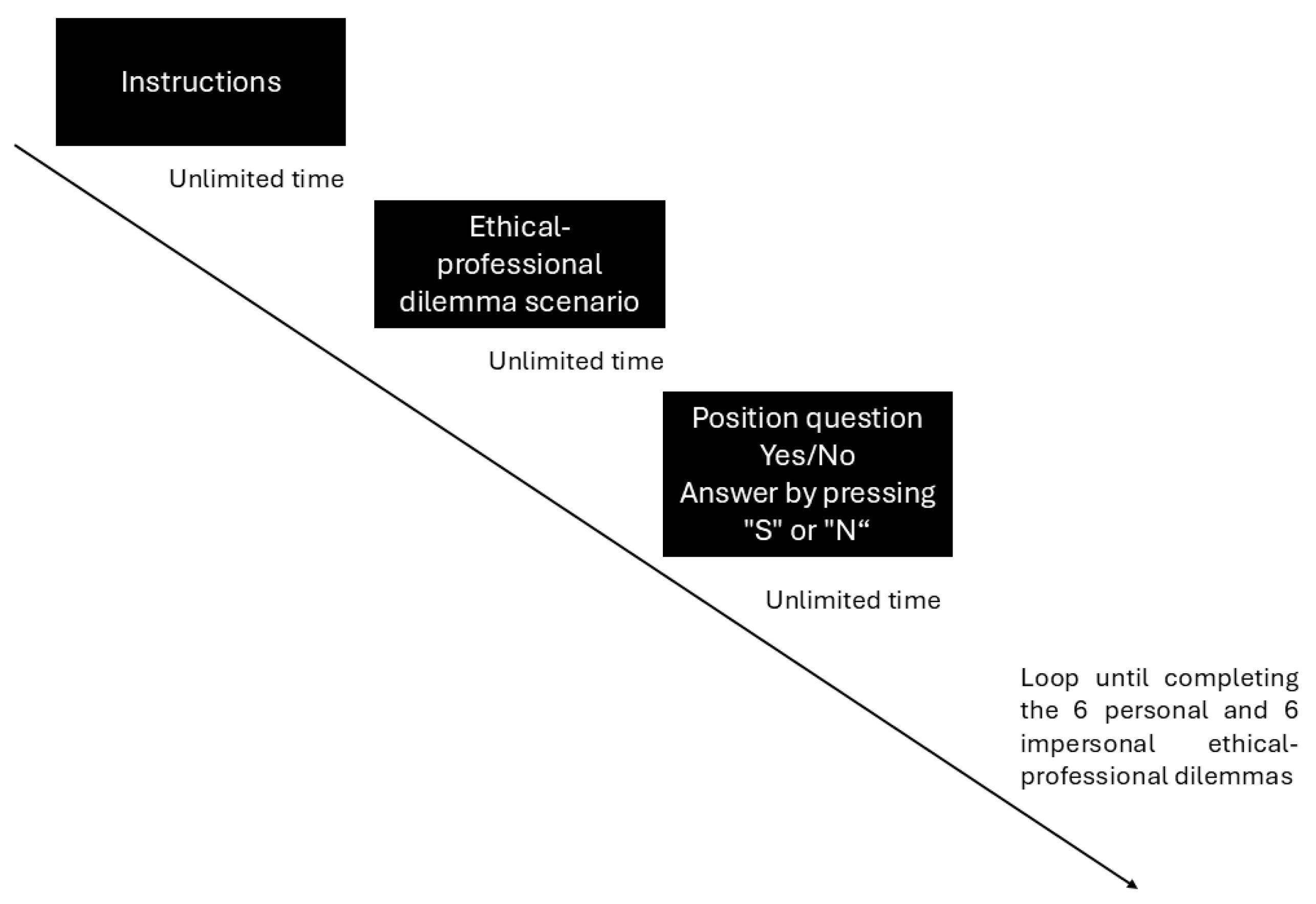
- Presentation of 12 ethical–professional dilemmas in randomized order:
- Each dilemma was presented on screen with unlimited viewing time; participants advanced to the next screen by pressing the space bar once they had finished reading.
- A minimal inter-stimulus interval (ISI) corresponding to a single screen refresh (~16 ms at 60 Hz) was introduced before the decision prompt, providing temporal separation between stimulus events and their associated EEG markers. This brief ISI was implemented to provide a discrete event marker separating the dilemma reading phase from the decision prompt onset, ensuring that the EEG epoch time-locked to the decision question was not contaminated by stimulus-offset activity from the preceding screen. We acknowledge, however, that this minimal interval does not allow full EEG baseline recovery between phases; future designs should incorporate longer fixed intervals (e.g., 500–1000 ms jittered ISI) to achieve cleaner temporal separation.
- The decision question was then displayed, and participants responded by pressing “Yes” or “No” on the keyboard. Reaction time was recorded from the onset of the decision question.
- The total task duration was approximately 12–15 min.
- At the end of the task, EEG electrodes were removed, and a brief debriefing session was conducted.
- Stimulus presentation and event control were implemented in PsychoPy Builder, which sent synchronized event markers to the EEG recording system to ensure precise alignment between behavioral responses and neural data.
2.5. Data Analyses
2.5.1. EEG Preprocessing
2.5.2. Trial-Level EEG and Behavioral Measures
2.5.3. Statistical Analyses
3. Results
3.1. Behavioral Performance
3.2. Behavioral–EEG Association: Trial-Level Mixed-Effects Models
4. Discussion
4.1. Implications for Ethics Education and Professional Training
4.2. Limitations and Future Directions
5. Conclusions
Author Contributions
Funding
Institutional Review Board Statement
Informed Consent Statement
Data Availability Statement
Conflicts of Interest
References
- Bago, B., Bonnefon, J.-F., & De Neys, W. (2021). Intuition rather than deliberation determines selfish and prosocial choices. Journal of Experimental Psychology: General, 150(5), 1081–1094. [Google Scholar] [CrossRef] [Scilit]
- Bago, B., & De Neys, W. (2019). The intuitive greater good: Testing the corrective dual process model of moral cognition. Journal of Experimental Psychology: General, 148(9), 1782–1801. [Google Scholar] [CrossRef] [Scilit]
- Cavanagh, J. F., & Frank, M. J. (2014). Frontal theta as a mechanism for cognitive control. Trends in Cognitive Sciences, 18(8), 414–421. [Google Scholar] [CrossRef] [Scilit] [PubMed]
- Clairis, N., & Lopez-Persem, A. (2023). Debates on the dorsomedial prefrontal/dorsal anterior cingulate cortex: Insights for future research. Brain, 146(12), 4826–4844. [Google Scholar] [CrossRef] [Scilit] [PubMed]
- Contreras, B. P., Hoffmann, A. N., & Slocum, T. A. (2021). Ethical behavior analysis: Evidence-based practice as a framework for ethical decision making. Behavior Analysis in Practice, 15(3), 619–634. [Google Scholar] [CrossRef] [Scilit]
- Cui, S., & Nakano, T. (2024). Interoceptive brain processing influences moral decision making. Human Brain Mapping, 45(12), e70108. [Google Scholar] [CrossRef] [Scilit]
- Cushman, F. (2013). Action, outcome, and value: A dual-system framework for morality. Personality and Social Psychology Review, 17(3), 273–292. [Google Scholar] [CrossRef] [Scilit]
- Evans, J. S. B. T., & Stanovich, K. E. (2013). Dual-process theories of higher cognition: Advancing the debate. Perspectives on Psychological Science, 8(3), 223–241. [Google Scholar] [CrossRef] [Scilit] [PubMed]
- Everett, J. A. C., & Kahane, G. (2020). Switching tracks? Towards a multidimensional model of utilitarian psychology. Trends in Cognitive Sciences, 24(2), 124–134. [Google Scholar] [CrossRef] [Scilit]
- Fronda, G., Angioletti, L., & Balconi, M. (2024). EEG correlates of moral decision-making: Effect of choices and offers types. AJOB Neuroscience, 15(3), 191–205. [Google Scholar] [CrossRef] [Scilit]
- Greene, J. D., Nystrom, L. E., Engell, A. D., Darley, J. M., & Cohen, J. D. (2004). The neural bases of cognitive conflict and control in moral judgment. Neuron, 44(2), 389–400. [Google Scholar] [CrossRef] [Scilit]
- Greene, J. D., Sommerville, R. B., Nystrom, L. E., Darley, J. M., & Cohen, J. D. (2001). An fMRI investigation of emotional engagement in moral judgment. Science, 293(5537), 2105–2108. [Google Scholar] [CrossRef] [Scilit]
- Gui, D. Y., Gan, T., & Liu, C. (2016). Neural evidence for moral intuition and the temporal dynamics of interactions between emotional processes and moral cognition. Social Neuroscience, 11(4), 380–394. [Google Scholar] [CrossRef] [Scilit]
- Hughes, J. C., & Gallant, T. B. (2015). Infusing ethics and ethical decision making into the curriculum. In T. Bretag (Ed.), Handbook of academic integrity (pp. 1–15). Springer. [Google Scholar] [CrossRef] [Scilit]
- Hunt, L. T., & Hayden, B. Y. (2017). A distributed, hierarchical and recurrent framework for reward-based choice. Nature Reviews Neuroscience, 18(3), 172–182. [Google Scholar] [CrossRef] [Scilit]
- Huster, R. J., Enriquez-Geppert, S., Lavallee, C. F., Falkenstein, M., & Herrmann, C. S. (2013). Electroencephalography of response inhibition tasks: Functional networks and cognitive contributions. International Journal of Psychophysiology, 87(3), 217–233. [Google Scholar] [CrossRef] [Scilit] [PubMed]
- Jiang, Q., Zhuo, L., Wang, Q., & Lin, W. (2022). The neural basis of moral judgement for self and for others: Evidence from event-related potentials. Frontiers in Human Neuroscience, 16, 919499. [Google Scholar] [CrossRef] [Scilit] [PubMed]
- Johnson, M. K., Weeks, S. N., Peacock, G. G., & Domenech Rodríguez, M. M. (2022). Ethical decision-making models: A taxonomy of models and review of issues. Ethics & Behavior, 32(3), 195–209. [Google Scholar] [CrossRef] [Scilit]
- Keren, G., & Schul, Y. (2009). Two is not always better than one: A critical evaluation of two-system theories. Perspectives on Psychological Science, 4(6), 533–550. [Google Scholar] [CrossRef] [Scilit]
- Langenberg, B., Janczyk, M., Koob, V., Kliegl, R., & Mayer, A. (2023). A tutorial on using the paired t test for power calculations in repeated measures ANOVA with interactions. Behavior Research Methods, 55(5), 2467–2484. [Google Scholar] [CrossRef] [Scilit]
- Leng, Y., Zhang, J., Zhang, Y., & Yang, X. (2021). Action modulates the conscious reasoning process of moral judgment: Evidence from behavior and neurophysiology. Frontiers in Behavioral Neuroscience, 14, 577252. [Google Scholar] [CrossRef] [Scilit]
- Levy, A., Enisman, M., Perry, A., & Kleiman, T. (2023). Midfrontal theta as an index of conflict strength in approach–approach vs. avoidance–avoidance conflicts. Social Cognitive and Affective Neuroscience, 18(1), nsad038. [Google Scholar] [CrossRef] [Scilit]
- Loewinger, G., Brockmeier, A. J., & Cunningham, J. P. (2024). A statistical framework for analysis of trial-level neural data using functional linear mixed models. eLife, 13, e95802. [Google Scholar] [CrossRef] [Scilit]
- London, D., Pourfar, M. H., & Mogilner, A. Y. (2019). Deep brain stimulation of the subthalamic nucleus induces impulsive responses to bursts of sensory evidence. Frontiers in Neuroscience, 13, 270. [Google Scholar] [CrossRef] [Scilit] [PubMed]
- Luck, S. J. (2014). An introduction to the event-related potential technique (2nd ed.). MIT Press. [Google Scholar]
- Melnikoff, D. E., & Bargh, J. A. (2018). The mythical number two. Trends in Cognitive Sciences, 22(4), 280–293. [Google Scholar] [CrossRef] [Scilit]
- Nakatani, H., Kawasaki, M., Kitajo, K., & Yamaguchi, Y. (2021). Frequency-dependent effects of EEG phase resetting on reaction time. Neuroscience Research, 172, 51–62. [Google Scholar] [CrossRef] [Scilit]
- Narvaez, D., & Rest, J. (1995). The four components of acting morally. In W. Kurtines, & J. Gewirtz (Eds.), Moral behavior and moral development: An introduction (pp. 385–400). McGraw-Hill. [Google Scholar]
- O’Connell, R. G., Dockree, P. M., & Kelly, S. P. (2012). A supramodal accumulation-to-bound signal that determines perceptual decisions in humans. Nature Neuroscience, 15(12), 1729–1735. [Google Scholar] [CrossRef] [Scilit]
- Perugini, A., Gambarota, F., Toffalini, E., Lakens, D., Pastore, M., Finos, L., Psicostat Core Team & Altoè, G. (2025). The benefits of reporting critical-effect-size values. Advances in Methods and Practices in Psychological Science, 8, 25152459251335298. [Google Scholar] [CrossRef] [Scilit]
- Pierrieau, E., Kessouri, S., Lepage, J. F., & Bernier, P.-M. (2022). Theta but not beta activity is modulated by freedom of choice during action selection. Scientific Reports, 12, 9115. [Google Scholar] [CrossRef] [Scilit]
- Pisauro, M. A., Fouragnan, E., Retzler, C., & Philiastides, M. G. (2017). Neural correlates of evidence accumulation during value-based decisions revealed via simultaneous EEG-fMRI. Nature Communications, 8, 15808. [Google Scholar] [CrossRef] [Scilit]
- Steinemann, N. A., O’Connell, R. G., & Kelly, S. P. (2018). Decisions are expedited through multiple neural adjustments spanning the sensorimotor hierarchy. Nature Communications, 9, 3627. [Google Scholar] [CrossRef] [Scilit] [PubMed]
- Sun, S., Xie, T., Chen, Y., Wang, J., Li, X., Yu, R., Brunner, P., Willie, J. T., Wang, S., & Yu, H. (2025). Neural correlates of evidence accumulation in social-affective decision-making under perceptual ambiguity. bioRxiv. [Google Scholar] [CrossRef] [Scilit]
- Suter, R. S., & Hertwig, R. (2011). Time and moral judgment. Cognition, 119(3), 454–458. [Google Scholar] [CrossRef] [Scilit]
- Tremel, J. J., Laurent, P. A., Wolk, D. A., Wheeler, M. E., & Fiez, J. A. (2016). Neural signatures of experience-based improvements in deterministic decision-making. Behavioural Brain Research, 312, 51–65. [Google Scholar] [CrossRef] [Scilit]
- Turner, B. M., Forstmann, B. U., Love, B. C., Palmeri, T. J., & Van Maanen, L. (2017). Approaches to analysis in model-based cognitive neuroscience. Journal of Mathematical Psychology, 76, 65–79. [Google Scholar] [CrossRef] [Scilit]
- Turner, B. M., Forstmann, B. U., Wagenmakers, E.-J., Brown, S. D., Sederberg, P. B., & Steyvers, M. (2018). A Bayesian framework for simultaneously modeling neural and behavioral data. NeuroImage, 72, 193–206. [Google Scholar] [CrossRef] [Scilit]
- Weindel, G., Borst, J. P., & van Maanen, L. (2025). Decision-making components and times revealed by the single-trial electroencephalogram. eLife, 14, RP108049. [Google Scholar] [CrossRef] [Scilit]
- Yoder, K. J., & Decety, J. (2014). Spatiotemporal neural dynamics of moral judgment: A high-density ERP study. Neuropsychologia, 60, 39–45. [Google Scholar] [CrossRef] [Scilit]
- Yoder, K. J., & Decety, J. (2018). The neuroscience of morality and social decision-making. Psychology, Crime & Law, 24(3), 279–295. [Google Scholar] [CrossRef] [Scilit]


| Dilemmas Name | Description |
|---|---|
| 1. Ethics of the Greater Good vs. Professional Truthfulness | An educational psychologist is pressured to alter special educational needs (SEN) diagnostic scores to maximize overall well-being. |
| 2. To Continue or to Refer? The Practitioner’s Conflict of Responsibility | A psychology student in clinical practice believes his approach will not achieve the therapeutic goals and requests a change of patient. However, his supervisor advises that maintaining the therapeutic relationship is key to patient adherence. |
| 3. Confidentiality vs. Protection of Third Parties | A patient expresses intentions to harm a coworker. The psychologist must decide whether to maintain confidentiality or intervene to prevent potential harm to others. |
| 4. To Discharge or to Persist? The Weight of the Relationship in Decision-Making | A patient stops attending therapy, and the protocol dictates discharging them, but the student fears harming a vulnerable patient and feels emotionally responsible for attempting to contact them again. |
| 5. The Dilemma of Therapeutic Continuity in Clinical Training | After four sessions, a student requests a change of patient, indicating that the approach he is proficient in does not allow him to progress. However, his coordinator reminds him that such a change could negatively affect the therapeutic process. |
| 6. To Interfere or to Report: Ethics in the Face of Protocol Activation | A professional close to the family of a student accused of bullying withdraws from the case to avoid a conflict of interest but then meets with the family to inform them of institutional protocol, thereby compromising impartiality. |
| 7. Confidentiality vs. Protection against Imminent Risk | A patient, in a state of intense emotional distress, states that “something serious could happen soon.” Without a clear plan, the psychologist must decide whether to respect confidentiality or act to prevent immediate harm. |
| 8. Deciding When to Stop vs. Continue Attending to a Patient | A student is seeing a vulnerable patient who stops attending sessions. Although the protocol dictates closing the case, the student wants to persist to prevent the patient from being left without psychological support. |
| 9. The Dilemma of Confidentiality in Therapy with Adolescents | A teenager reveals intimate issues and asks the psychologist not to share them with their parents. The professional must decide whether to protect confidentiality or involve the family in the treatment. |
| 10. The Dilemma of Scientific Integrity in the Face of Pressure to Publish | A researcher reflects on excluding “outliers” that render their study’s results insignificant, even at the risk of compromising scientific ethics to advance their academic career. |
| 11. Helping Without Harm: The Dilemma of Professional Competence in an Emergency | After an earthquake, an educational psychologist is asked to provide psychological first aid, but the professional lacks the necessary training. They must decide whether to assist in the crisis or refrain from intervention due to concerns about potential consequences. |
| 12. Ethical Integrity vs. Institutional Pressure in Intervention Reports | A supervisor suggests that students modify narrative fragments or “adjust” examples in reports to demonstrate the program’s impact. |
| Condition | RT Means | RT SD | % Yes Responses | t (p) | Hedges’ g | Cohen’s d |
|---|---|---|---|---|---|---|
| Impersonal | 0.45 | 0.21 | 59.90 | 24.92 (p < 0.001) | 0.56 | 0.57 |
| Personal | 0.33 | 0.20 | 22.40 |
| ROI | β | SE | Z | p | pFWE | pFDR | r | IC | R2m |
|---|---|---|---|---|---|---|---|---|---|
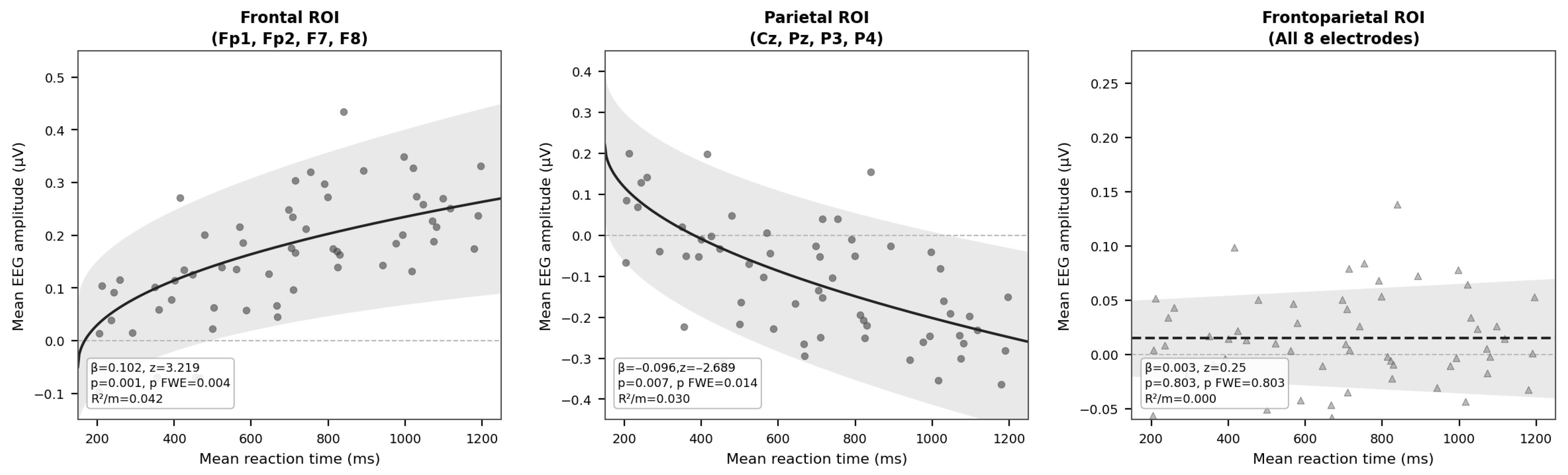
| Frontal | 0.102 | 0.03 | 3.219 | 0.001 | 0.004 | 0.004 | 0.57 | [0.04, 0.16] | 0.042 |
| Parietal | −0.096 | 0.04 | −2.689 | 0.007 | 0.014 | 0.011 | −0.48 | [−0.17, −0.03] | 0.030 |
| Frontoparietal | 0.003 | 0.01 | 0.250 | 0.803 | 0.803 | 0.803 | 0.04 | [−0.03, 0.03] | 0.000 |
Disclaimer/Publisher’s Note: The statements, opinions and data contained in all publications are solely those of the individual author(s) and contributor(s) and not of MDPI and/or the editor(s). MDPI and/or the editor(s) disclaim responsibility for any injury to people or property resulting from any ideas, methods, instructions or products referred to in the content. |
© 2026 by the authors. Licensee MDPI, Basel, Switzerland. This article is an open access article distributed under the terms and conditions of the Creative Commons Attribution (CC BY) license.
Share and Cite
Vergara-Morales, J.; Matamala, B.; Retamal, B.; Gantiva, C. Ethical Decision-Making in Chilean University Students: Behavioral and Electroencephalographic Evidence from Professional Ethical Dilemmas. Behav. Sci. 2026, 16, 815. https://doi.org/10.3390/bs16050815
Vergara-Morales J, Matamala B, Retamal B, Gantiva C. Ethical Decision-Making in Chilean University Students: Behavioral and Electroencephalographic Evidence from Professional Ethical Dilemmas. Behavioral Sciences. 2026; 16(5):815. https://doi.org/10.3390/bs16050815
Chicago/Turabian StyleVergara-Morales, Jorge, Brian Matamala, Bastián Retamal, and Carlos Gantiva. 2026. "Ethical Decision-Making in Chilean University Students: Behavioral and Electroencephalographic Evidence from Professional Ethical Dilemmas" Behavioral Sciences 16, no. 5: 815. https://doi.org/10.3390/bs16050815
APA StyleVergara-Morales, J., Matamala, B., Retamal, B., & Gantiva, C. (2026). Ethical Decision-Making in Chilean University Students: Behavioral and Electroencephalographic Evidence from Professional Ethical Dilemmas. Behavioral Sciences, 16(5), 815. https://doi.org/10.3390/bs16050815