When Fear Meets Joy: Cultural Differences in the Impact of Decision Uncertainty on Fear of Better Options and Ditto Consumption


Abstract
1. Introduction
2. Literature Review
2.1. Decision Uncertainty
2.2. Fear of Better Options
2.3. Ditto Consumption
2.4. Emotional State
2.5. Cultural Differences
3. Research Methodology
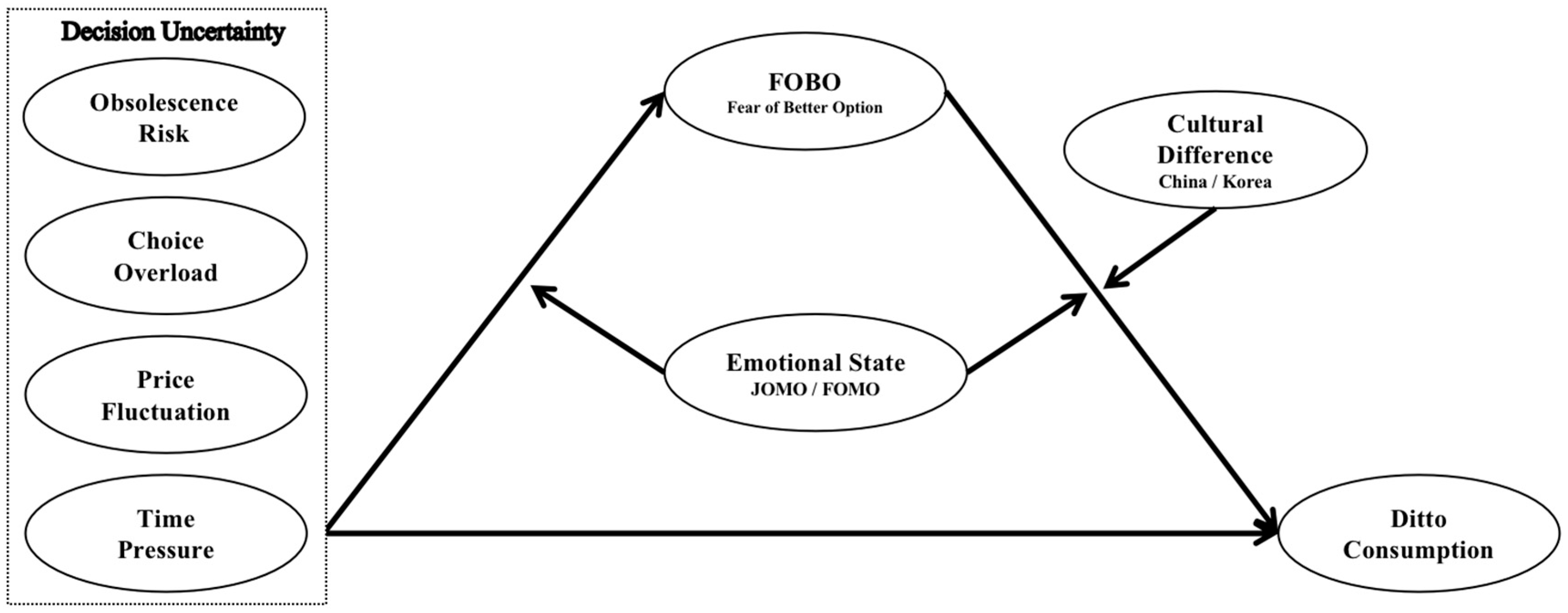
3.1. Research Model
3.2. Procedure
3.3. Measures
3.4. Participants
4. Results
4.1. Common Method Bias Test
4.2. Measurement Model Analysis and Measurement Invariance Testing
4.3. Hypothesis Testing
4.3.1. Direct Path Effect Analysis
4.3.2. Mediation Analysis
4.3.3. Moderation Analysis
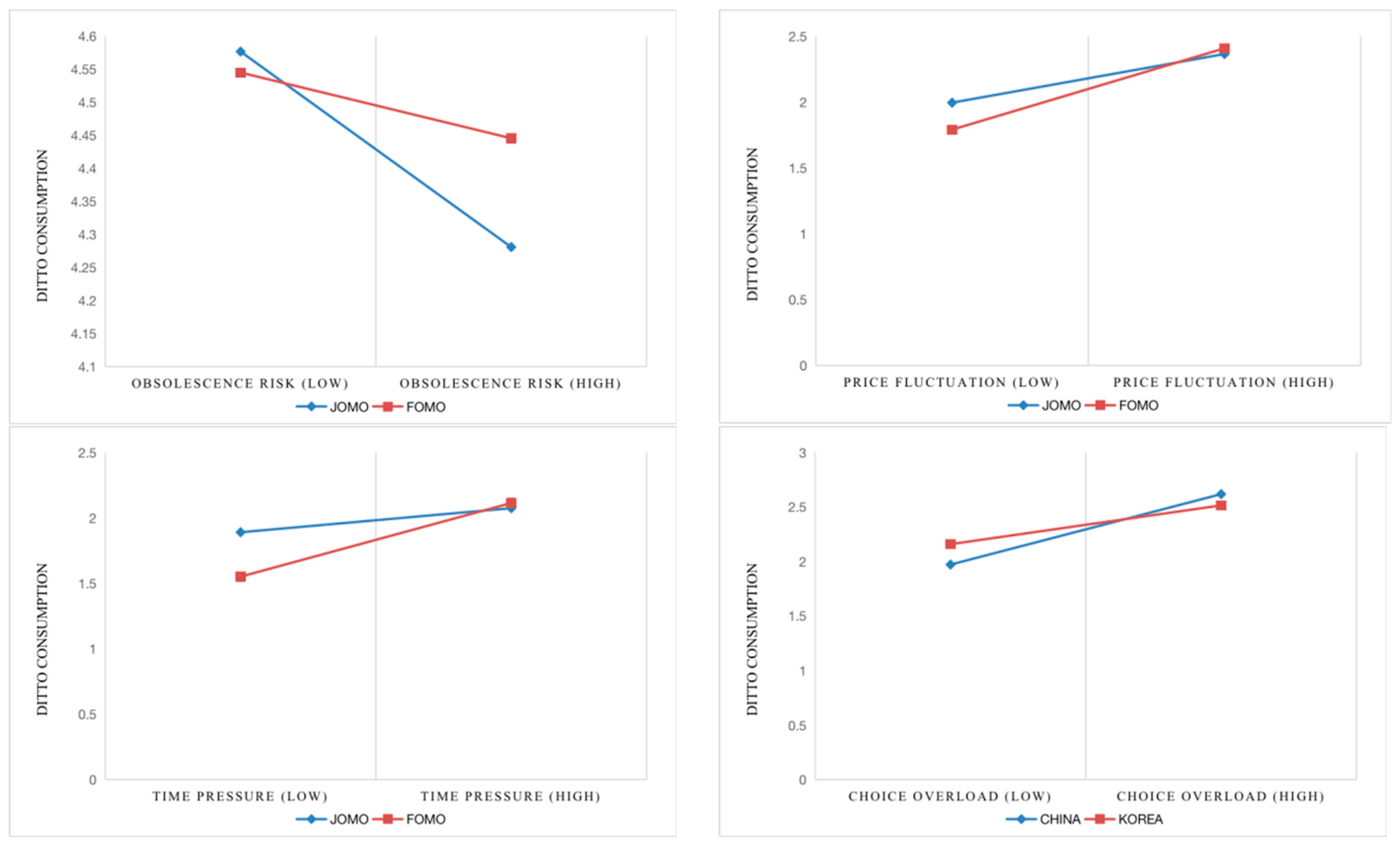
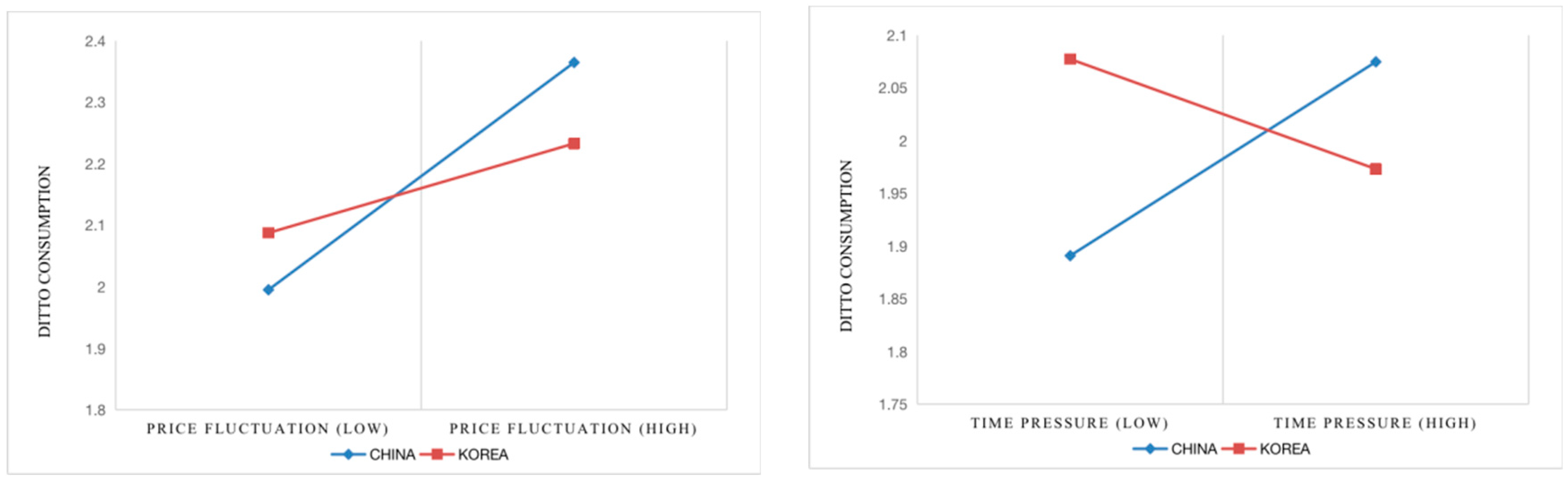
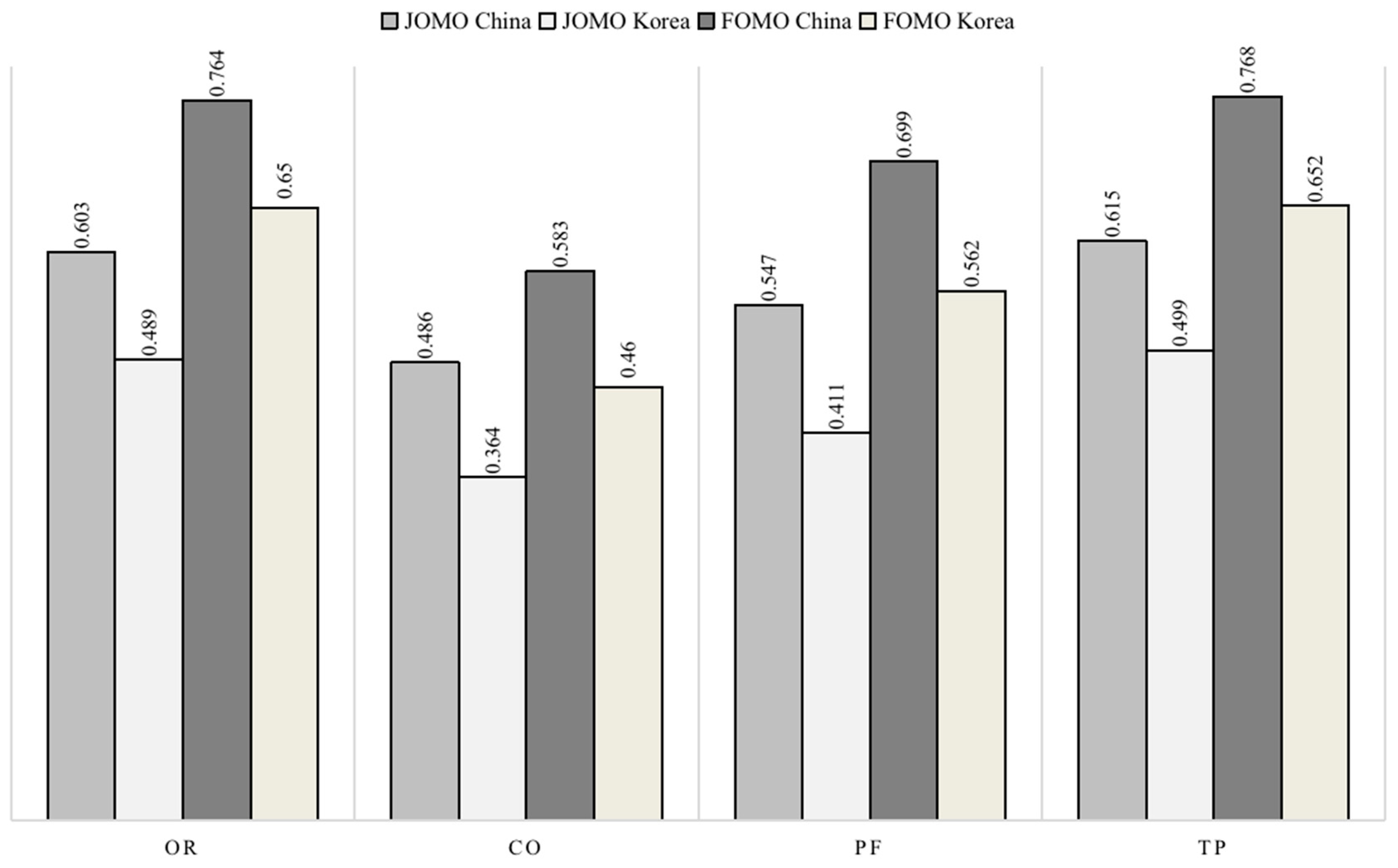
4.3.4. Conditional Effects Analysis
5. Discussion and Conclusions
5.1. Discussion
5.2. Theoretical Implications
5.3. Managerial Implications
5.4. Limitations and Future Research
Author Contributions
Funding
Institutional Review Board Statement
Informed Consent Statement
Data Availability Statement
Conflicts of Interest
References
- Acikgoz, F., Borulu, B., & Bölen, M. C. (2025). How does obsolescence risk influence consumer resistance to smartwatches? Information Technology & People, 38(7), 2684–2709. [Google Scholar] [CrossRef] [Scilit]
- Adriatico, J. M., Cruz, A., Tiong, R. C., & Racho-Sabugo, C. R. (2022). An analysis on the impact of choice overload to consumer decision paralysis. Journal of Economics, Finance and Accounting Studies, 4(1), 55–75. [Google Scholar] [CrossRef] [Scilit]
- Al-Ansi, A., Olya, H., Dalir, S., Lee, H. Y., & Abdul Rahim, A. (2024). Consumer emotions and behaviors: Double moderation of sign value and source market. Cross Cultural & Strategic Management, 31(4), 513–535. [Google Scholar] [CrossRef] [Scilit]
- Al Mubarak, A., & Giouvris, E. (2024). National culture and corporate investment: Does uncertainty matter? Cross Cultural & Strategic Management, 31(3), 485–509. [Google Scholar] [CrossRef] [Scilit]
- Alnes, P. K., & Haugom, E. (2024). The effects of price framing and magnitude of price differences on perceived fairness when switching from static to variable pricing. Journal of Retailing and Consumer Services, 81, 103952. [Google Scholar] [CrossRef] [Scilit]
- Bai, H. Y., Bao, Y. W., & Kim, J. H. (2024). Effects of app icon familiarity and authority on app icon image fit and usage intention. Asia Pacific Journal of Marketing and Logistics, 36(10), 2672–2688. [Google Scholar] [CrossRef] [Scilit]
- Bai, H. Y., & Kim, J. H. (2024). Unveiling the power of private label charm in distribution: How cues shape Korean and Chinese consumers’ consumption value and repurchase intentions. Journal of Distribution Science, 22(8), 87–98. [Google Scholar] [CrossRef]
- Barry, C. T., Smith, E. E., Murphy, M. B., Halter, B. M., & Briggs, J. (2023). JOMO: Joy of missing out and its association with social media use, self-perception, and mental health. Telematics and Informatics Reports, 10, 100054. [Google Scholar] [CrossRef] [Scilit]
- Becher, S. I., & Sibony, A. L. (2021). Confronting product obsolescence. Columbia Journal of European Law, 27, 97. [Google Scholar]
- Begho, T., & Liu, S. (2024). Does social proof and herd behaviour drive food choices of consumers? British Food Journal, 126(3), 1050–1064. [Google Scholar] [CrossRef] [Scilit]
- Bobadilla-Suarez, S., & Love, B. C. (2018). Fast or frugal, but not both: Decision heuristics under time pressure. Journal of Experimental Psychology: Learning, Memory, and Cognition, 44(1), 24–33. [Google Scholar] [CrossRef] [Scilit] [PubMed]
- Chan, S. S., Van Solt, M., Cruz, R. E., Philp, M., Bahl, S., Serin, N., Amaral, N. B., Schindler, R., Bartosiak, A., & Kumar, S. (2022). Social media and mindfulness: FOMO to JOMO. Journal of Consumer Affairs, 56(3), 1312–1331. [Google Scholar] [CrossRef] [Scilit]
- Chernev, A., Böckenholt, U., & Goodman, J. (2015). Choice overload: A conceptual review and meta-analysis. Journal of Consumer Psychology, 25(2), 333–358, (Erratum in 2016, Journal of Consumer Psychology, 26, 312. https://doi.org/10.1016/j.jcps.2015.07.001). [Google Scholar] [CrossRef] [Scilit]
- Demirel, E. S. (2025). Planned obsolescence and sustainability in the context of corporate communication strategies: A qualitative study on consumers. Erciyes İletişim Dergisi, 4, 1–22. [Google Scholar] [CrossRef] [Scilit]
- Deng, J., & Gao, Z. (2025). Positive emotions, negative emotions and cultural consumption——Empirical analysis based on the hyperbolic discounting model. Current Psychology, 44, 18747–18761. [Google Scholar] [CrossRef] [Scilit]
- Eitan, T., & Gazit, T. (2024). The here and now effect: JoMO, FoMO and the well-being of social media users. Online Information Review, 48(5), 1002–1024. [Google Scholar] [CrossRef] [Scilit]
- Escobar-Miranda, S., & Ballesteros-Sánchez, L. (2025). Social cognitive skills in electric vehicle sales: Understanding empathy, trust, and decision-making in sustainable mobility markets. Behavioral Sciences, 15(12), 1681. [Google Scholar] [CrossRef] [Scilit]
- Fennell, P. B., Niedrich, R. W., & Rice, D. H. (2025). The dual role of price on consumer purchase intentions: A cost-benefit decomposition of indirect effects. Journal of Consumer Behaviour, 24(6), 2951–2969. [Google Scholar] [CrossRef] [Scilit]
- Flecha Ortiz, J. A., Santos Corrada, M., Perez, S., Dones, V., & Rodriguez, L. H. (2024). Exploring the influence of uncontrolled social media use, fear of missing out, fear of better options, and fear of doing anything on consumer purchase intent. International Journal of Consumer Studies, 48(1), 12990. [Google Scholar] [CrossRef] [Scilit]
- Gaur, V., Osadchiy, N., Seshadri, S., & Subrahmanyam, M. G. (2023). Sourcing for online marketplaces with demand and price uncertainty. Production and Operations Management, 32(10), 3062–3080. [Google Scholar] [CrossRef] [Scilit]
- Gross, J. J. (2015). Emotion regulation: Current status and future prospects. Psychological Inquiry, 26(1), 1–26. [Google Scholar] [CrossRef] [Scilit]
- Guillard, V., Le Nagard, E., & de Campos Ribeiro, G. (2023). A typology of consumers regarding perceived obsolescence: The paradox of eco-conscious consumers. Journal of Cleaner Production, 412, 137202. [Google Scholar] [CrossRef] [Scilit]
- Hassen, M. Z. (2024). The paradox of choice: The intersection of freedom and anxiety. International Journal of Philosophy, 12(4), 75–83. [Google Scholar] [CrossRef] [Scilit]
- He, X., Li, M., & Liu, Y. (2026). Will I regret not buying? Unpacking the dual pathways of anticipated regret that influence online impulsive buying. Information & Management, 63(3), 104323. [Google Scholar] [CrossRef] [Scilit]
- Hunter, G. L., Taylor, S. A., & Kallen, P. H. (2024). Shoppers’ susceptibility to information overload. Journal of Marketing Theory and Practice, 32(1), 94–113. [Google Scholar] [CrossRef] [Scilit]
- Jacob, B. M., Thomas, S., & Joseph, J. (2024). Over two decades of research on choice overload. International Journal of Consumer Studies, 48(2), 13029. [Google Scholar] [CrossRef] [Scilit]
- Jeong, J. Y., Crompton, J. L., & Hyun, S. S. (2019). What makes you select a higher price option? Price–quality heuristics, cultures, and travel group compositions. International Journal of Tourism Research, 21(1), 1–10. [Google Scholar] [CrossRef] [Scilit]
- Kahneman, D., & Tversky, A. (2013). Prospect theory: An analysis of decision under risk. World Scientific. [Google Scholar]
- Kang, I., He, X., & Shin, M. M. (2020). Chinese consumers’ herd consumption behavior related to Korean luxury cosmetics: The mediating role of fear of missing out. Frontiers in Psychology, 11, 121. [Google Scholar] [CrossRef] [Scilit] [PubMed]
- Kim, N. (2023). Trend Korea 2024. Miraeui Chang. [Google Scholar]
- Lee, H., Choi, H. S., & Travaglino, G. A. (2022). The combined role of independence in self-concept and a collectivistic value orientation in group-focused enmity in Korea. International Journal of Conflict and Violence, 16, 1–16. [Google Scholar] [CrossRef]
- Li, Y., & Han, E. (2025). From Anxiety to Contentment: The Role of Multiple Mediations and Privacy Concerns in the Transition from the FOMO to the JOMO Among Dating App Users. Behavioral Sciences, 15(2), 168. [Google Scholar] [CrossRef] [Scilit] [PubMed]
- Liu, X. S., Shi, Y., Xue, N. I., & Shen, H. (2022). The impact of time pressure on impulsive buying. Tourism Management, 91, 104505. [Google Scholar] [CrossRef] [Scilit]
- Ma, M., Guo, K., Li, Z., Xie, C., Wang, D., & Zhang, L. (2023). The relationship between perfectionism and maximization tendency mediating roles of achievement motivations. Journal of Individual Differences, 44(4), 254–262. [Google Scholar] [CrossRef] [Scilit]
- Mai, X., Zhang, J., Long, J., & Xu, J. (2026). “Countdown to buy” the impact of perceived competition and bandwagon effect on impulse behavior in live streaming commerce. Journal of Sensory Studies, 41(1), e70107. [Google Scholar] [CrossRef] [Scilit]
- Park, I. Y., & Kim, H. M. (2025). The impact of FoMO and FoBO on YouTube summary video consumption. Telecommunications Policy, 49(2), 102909. [Google Scholar] [CrossRef] [Scilit]
- Podsakoff, P. M., MacKenzie, S. B., Lee, J. Y., & Podsakoff, N. P. (2003). Common method biases in behavioral research: A critical review of the literature and recommended remedies. Journal of Applied Psychology, 88(5), 879–903. [Google Scholar] [CrossRef] [Scilit]
- Preacher, K. J., & Hayes, A. F. (2004). SPSS and SAS procedures for estimating indirect effects in simple mediation models. Behavior Research Methods, Instruments, & Computers, 36(4), 717–731. [Google Scholar] [CrossRef] [Scilit]
- Rautela, S., & Sharma, S. (2022). Fear of missing out (FOMO) to the joy of missing out (JOMO): Shifting dunes of problematic usage of the internet among social media users. Journal of Information, Communication and Ethics in Society, 20(4), 461–479. [Google Scholar] [CrossRef] [Scilit]
- Scheibehenne, B., Greifeneder, R., & Todd, P. M. (2010). Can there ever be too many options? Journal of Consumer Research, 37(3), 409–425. [Google Scholar] [CrossRef] [Scilit]
- Sharon, S., Ashok, K., Zhang, J., & Carlos, J. (2008). The horizontal/vertical distinction in cross-cultural consumer research. Journal of Consumer Psychology, 16(4), 325–342. [Google Scholar] [CrossRef] [Scilit]
- Shin, J. (2025). Emotion beliefs structure and emotion regulation in the Korean population. Current Psychology, 44, 9037–9052. [Google Scholar] [CrossRef] [Scilit]
- Tan, P. L., Tjiptono, F., & Tan, S. Z. (2025). Fear more or fear no more: Examining the emotional and behavioral consequences of FOMO and JOMO. Asia Pacific Journal of Marketing and Logistics, 37(6), 1627–1648. [Google Scholar] [CrossRef] [Scilit]
- Truong, V. (2025). Examining gender and cultural influences on customer emotions. Journal of Consumer Behaviour, 24(6), 2793–2822. [Google Scholar] [CrossRef] [Scilit]
- Trupia, M. G., & Shaddy, F. (2025). “No time to buy”: Asking consumers to spend time to save money is perceived as fairer than asking them to spend money to save time. Journal of Consumer Psychology, 35(3), 450–462. [Google Scholar] [CrossRef] [Scilit]
- Wang, F., Wang, M., Zheng, Y., Jin, J., & Pan, Y. (2021). Consumer vigilance and choice overload in online shopping. International Journal of Electronic Commerce, 25(3), 364–390. [Google Scholar] [CrossRef] [Scilit]
- Wang, J., Xue, Y., & Liu, T. (2023). Consumer motivation for organic food consumption. Frontiers in Public Health, 10, 1042535. [Google Scholar] [CrossRef] [Scilit]
- Wibowo, A., & Safaria, T. (2025). The role of FOMO on psychological well-being with nomophobia as a mediator among college students. Current Psychology, 44, 6092–6101. [Google Scholar] [CrossRef] [Scilit]
- Wu, Z., Gong, Y., Huang, R., & Chen, Z. (2025). When time runs out, what do they let go? Time pressure, ad type, and psychological resilience in ad avoidance. Journal of Retailing and Consumer Services, 87, 104380. [Google Scholar] [CrossRef] [Scilit]
- Xue, Y., Zhu, C., & Lu, Y. (2025). Research on the influence mechanism of new energy vehicle promotion policy. Sustainability, 17(8), 3699. [Google Scholar] [CrossRef] [Scilit]
- Yang, S., Isa, S. M., & Ramayah, T. (2021). Uncertainty avoidance as a moderating factor to the self-congruity concept. SAGE Open, 11(1), 21582440211001860. [Google Scholar] [CrossRef] [Scilit]
- Zhang, M., Xu, P., & Ye, Y. (2022). Trust in social media brands and perceived media values: A survey study in China. Computers in Human Behavior, 127, 107024. [Google Scholar] [CrossRef] [Scilit]
- Zhao, X., Ma, Y., Shao, S., & Ma, T. (2022). What determines consumers’ acceptance of electric vehicles? Energy Economics, 108, 105805. [Google Scholar] [CrossRef] [Scilit]



| Variables | Unstd. | S.E. | t-Value | FL | CR | AVE | Cronbach’s α | |
|---|---|---|---|---|---|---|---|---|
| OR | OR1 | 1 | 0.894 | 0.954 | 0.839 | 0.937 | ||
| OR2 | 1.092 | 0.038 | 28.461 *** | 0.898 | ||||
| OR3 | 1.200 | 0.035 | 33.994 *** | 0.940 | ||||
| OR4 | 1.165 | 0.036 | 32.610 *** | 0.930 | ||||
| CO | CO1 | 1 | 0.839 | 0.892 | 0.673 | 0.903 | ||
| CO2 | 1.088 | 0.042 | 25.893 *** | 0.841 | ||||
| CO3 | 1.094 | 0.045 | 24.316 *** | 0.827 | ||||
| CO4 | 1.017 | 0.041 | 24.548 *** | 0.773 | ||||
| PF | PF1 | 1 | 0.830 | 0.891 | 0.671 | 0.875 | ||
| PF2 | 1.022 | 0.05 | 20.513 *** | 0.811 | ||||
| PF3 | 1.078 | 0.05 | 21.586 *** | 0.827 | ||||
| PF4 | 1.039 | 0.049 | 21.163 *** | 0.808 | ||||
| TP | TP1 | 1 | 0.924 | 0.957 | 0.848 | 0.942 | ||
| TP2 | 1.192 | 0.035 | 34.303 *** | 0.915 | ||||
| TP3 | 1.087 | 0.030 | 36.101 *** | 0.929 | ||||
| TP4 | 1.056 | 0.032 | 33.483 *** | 0.915 | ||||
| FB | FB1 | 1 | 0.798 | 0.864 | 0.615 | 0.893 | ||
| FB2 | 1.253 | 0.048 | 26.065 *** | 0.774 | ||||
| FB3 | 1.215 | 0.044 | 27.734 *** | 0.825 | ||||
| FB4 | 0.905 | 0.04 | 22.496 *** | 0.739 | ||||
| DC | DC1 | 1 | 0.755 | 0.865 | 0.616 | 0.896 | ||
| DC2 | 1.014 | 0.038 | 26.359 *** | 0.804 | ||||
| DC3 | 1.057 | 0.044 | 23.974 *** | 0.805 | ||||
| DC4 | 1.151 | 0.046 | 24.765 *** | 0.775 | ||||
| AVE | DC | FB | TP | PF | CO | OR | |
|---|---|---|---|---|---|---|---|
| DC | 0.616 | 0.785 | |||||
| FB | 0.615 | 0.701 | 0.784 | ||||
| TP | 0.848 | 0.033 | −0.094 | 0.921 | |||
| PF | 0.671 | 0.465 | 0.460 | 0.065 | 0.819 | ||
| CO | 0.673 | 0.622 | 0.568 | −0.041 | 0.411 | 0.820 | |
| OR | 0.839 | −0.009 | 0.004 | 0.136 | 0.021 | 0.010 | 0.916 |
| Hypothesis | Hypothesis Path | β | S.E. | C.R. | p | Results |
|---|---|---|---|---|---|---|
| H1a | OR→FB | 0.006 | 0.030 | 0.195 | 0.845 | Reject |
| H1b | CO→FB | 0.397 | 0.034 | 11.794 | *** | Accept |
| H1c | PF→FB | 0.373 | 0.047 | 7.947 | *** | Accept |
| H1d | TP→FB | −0.080 | 0.029 | −2.797 | 0.005 | Reject |
| H2a | OR→DC | −0.025 | 0.027 | −0.941 | 0.347 | Reject |
| H2b | CO→DC | 0.272 | 0.034 | 8.021 | *** | Accept |
| H2c | PF→DC | 0.159 | 0.044 | 3.643 | *** | Accept |
| H2d | TP→DC | 0.074 | 0.026 | 2.882 | 0.004 | Accept |
| H3 | FB→DC | 0.496 | 0.046 | 10.819 | *** | Accept |
| Hypothesis | Effects | MV | β | S.E. | LLCI | ULCI | Results | ||
|---|---|---|---|---|---|---|---|---|---|
| H4a | OR→FB→DC | Direct | −0.012 | 0.026 | −0.063 | 0.039 | Reject | ||
| Indirect | JOMO | China | −0.025 | 0.035 | −0.093 | 0.044 | |||
| JOMO | Korea | −0.020 | 0.028 | −0.076 | 0.036 | ||||
| FOMO | China | 0.031 | 0.031 | −0.030 | 0.092 | ||||
| FOMO | Korea | 0.026 | 0.027 | −0.026 | 0.078 | ||||
| H4b | CO→FB→DC | Direct | 0.272 | 0.029 | 0.215 | 0.330 | Partial mediation | ||
| Indirect | JOMO | China | 0.223 | 0.036 | 0.157 | 0.297 | |||
| JOMO | Korea | 0.167 | 0.034 | 0.107 | 0.241 | ||||
| FOMO | China | 0.276 | 0.031 | 0.215 | 0.335 | ||||
| FOMO | Korea | 0.218 | 0.033 | 0.155 | 0.284 | ||||
| H4c | PF→FB→DC | Direct | 0.225 | 0.041 | 0.144 | 0.306 | Partial mediation | ||
| Indirect | JOMO | China | 0.333 | 0.048 | 0.247 | 0.434 | |||
| JOMO | Korea | 0.250 | 0.045 | 0.168 | 0.348 | ||||
| FOMO | China | 0.356 | 0.048 | 0.262 | 0.453 | ||||
| FOMO | Korea | 0.286 | 0.048 | 0.198 | 0.386 | ||||
| H4d | TP→FB→DC | Direct | 0.074 | 0.025 | 0.025 | 0.124 | Partial mediation | ||
| Indirect | JOMO | China | −0.076 | 0.031 | −0.139 | −0.017 | |||
| JOMO | Korea | −0.062 | 0.026 | −0.116 | −0.014 | ||||
| FOMO | China | −0.023 | 0.034 | −0.089 | 0.042 | Reject | |||
| FOMO | Korea | −0.019 | 0.028 | −0.074 | 0.038 | ||||
| Hypothesis | DV | β | S.E. | t-Value | p | LLCI | ULCI | Results | |
|---|---|---|---|---|---|---|---|---|---|
| H5a | OR*ES | FOBO | 0.081 | 0.068 | 1.182 | 0.238 | −0.053 | 0.215 | Reject |
| H5b | CO*ES | FOBO | 0.015 | 0.061 | 0.241 | 0.809 | −0.105 | 0.135 | Reject |
| H5c | PF*ES | FOBO | −0.100 | 0.093 | −1.082 | 0.280 | −0.282 | 0.082 | Reject |
| H5d | TP*ES | FOBO | 0.094 | 0.067 | 1.396 | 0.163 | −0.038 | 0.226 | Reject |
| H6a | OR(FB*ES) | DC | 0.161 | 0.059 | 2.729 | 0.007 | 0.045 | 0.277 | Accept |
| H6b | CO(FB*ES) | DC | 0.096 | 0.056 | 1.718 | 0.086 | −0.014 | 0.206 | Reject |
| H6c | PF(FB*ES) | DC | −0.839 | 0.269 | −3.113 | 0.002 | −1.368 | −0.310 | Accept |
| H6d | TP(FB*ES) | DC | 0.153 | 0.059 | 2.601 | 0.010 | 0.037 | 0.268 | Accept |
| H7a | OR(FB*CD) | DC | −0.114 | 0.059 | −1.929 | 0.054 | −0.230 | 0.002 | Reject |
| H7b | CO(FB*CD) | DC | −0.122 | 0.056 | −2.201 | 0.028 | −0.232 | −0.013 | Accept |
| H7c | PF(FB*CD) | DC | −0.137 | 0.058 | −2.359 | 0.019 | −0.251 | −0.023 | Accept |
| H7d | TP(FB*CD) | DC | −0.116 | 0.059 | −1.977 | 0.048 | −0.231 | −0.001 | Accept |
| DV | IV | Moderating Variable | Effects | S.E. | t-Value | p | LLCI | ULCI | |
|---|---|---|---|---|---|---|---|---|---|
| DC | OR | JOMO | China | 0.603 | 0.054 | 11.253 | 0.000 | 0.498 | 0.708 |
| JOMO | Korea | 0.489 | 0.048 | 10.179 | 0.000 | 0.395 | 0.583 | ||
| FOMO | China | 0.764 | 0.047 | 16.297 | 0.000 | 0.672 | 0.856 | ||
| FOMO | Korea | 0.650 | 0.055 | 11.904 | 0.000 | 0.543 | 0.757 | ||
| CO | JOMO | China | 0.486 | 0.052 | 9.367 | 0.000 | 0.384 | 0.588 | |
| JOMO | Korea | 0.364 | 0.047 | 7.720 | 0.000 | 0.271 | 0.457 | ||
| FOMO | China | 0.583 | 0.048 | 12.076 | 0.000 | 0.488 | 0.677 | ||
| FOMO | Korea | 0.460 | 0.055 | 8.338 | 0.000 | 0.352 | 0.569 | ||
| PF | JOMO | China | 0.547 | 0.053 | 10.253 | 0.000 | 0.443 | 0.652 | |
| JOMO | Korea | 0.411 | 0.049 | 8.358 | 0.000 | 0.314 | 0.507 | ||
| FOMO | China | 0.699 | 0.047 | 14.724 | 0.000 | 0.605 | 0.792 | ||
| FOMO | Korea | 0.562 | 0.056 | 10.083 | 0.000 | 0.452 | 0.671 | ||
| TP | JOMO | China | 0.615 | 0.053 | 11.538 | 0.000 | 0.510 | 0.720 | |
| JOMO | Korea | 0.499 | 0.048 | 10.426 | 0.000 | 0.405 | 0.593 | ||
| FOMO | China | 0.768 | 0.047 | 16.468 | 0.000 | 0.676 | 0.859 | ||
| FOMO | Korea | 0.652 | 0.054 | 12.018 | 0.000 | 0.545 | 0.758 | ||
Disclaimer/Publisher’s Note: The statements, opinions and data contained in all publications are solely those of the individual author(s) and contributor(s) and not of MDPI and/or the editor(s). MDPI and/or the editor(s) disclaim responsibility for any injury to people or property resulting from any ideas, methods, instructions or products referred to in the content. |
© 2026 by the authors. Licensee MDPI, Basel, Switzerland. This article is an open access article distributed under the terms and conditions of the Creative Commons Attribution (CC BY) license.
Share and Cite
Bai, H.; Kim, J.; Park, S. When Fear Meets Joy: Cultural Differences in the Impact of Decision Uncertainty on Fear of Better Options and Ditto Consumption. Behav. Sci. 2026, 16, 849. https://doi.org/10.3390/bs16060849
Bai H, Kim J, Park S. When Fear Meets Joy: Cultural Differences in the Impact of Decision Uncertainty on Fear of Better Options and Ditto Consumption. Behavioral Sciences. 2026; 16(6):849. https://doi.org/10.3390/bs16060849
Chicago/Turabian StyleBai, Haoyue, Junghee Kim, and Seolwoo Park. 2026. "When Fear Meets Joy: Cultural Differences in the Impact of Decision Uncertainty on Fear of Better Options and Ditto Consumption" Behavioral Sciences 16, no. 6: 849. https://doi.org/10.3390/bs16060849
APA StyleBai, H., Kim, J., & Park, S. (2026). When Fear Meets Joy: Cultural Differences in the Impact of Decision Uncertainty on Fear of Better Options and Ditto Consumption. Behavioral Sciences, 16(6), 849. https://doi.org/10.3390/bs16060849