
Culturally Responsive Pediatric Rehabilitation Interventions: A Scoping Review
 and
and
Abstract
1. Introduction
2. Materials and Method
2.1. Information Sources and Search Strategies
2.2. Eligibility Criteria
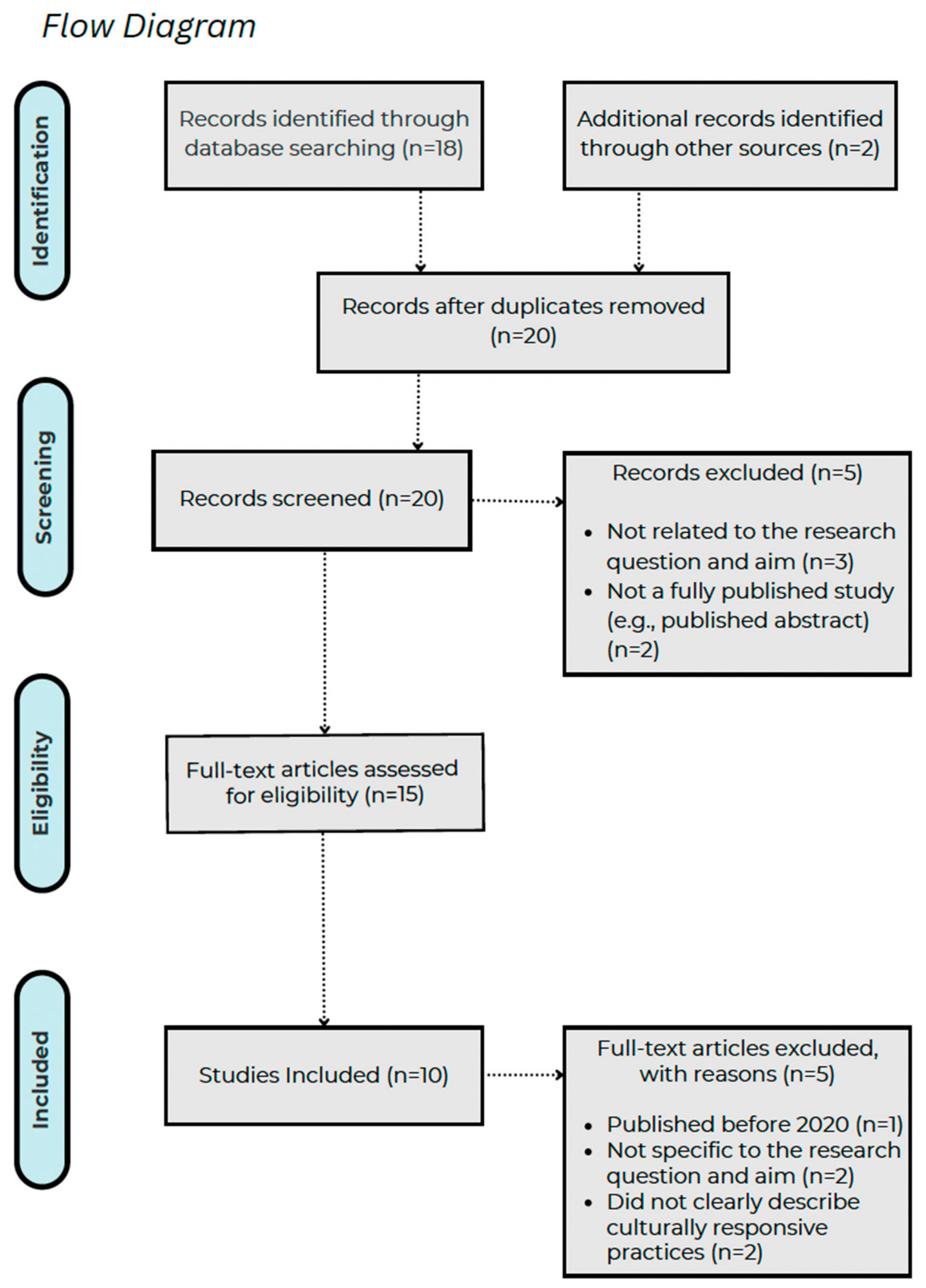
2.3. Study Selection
2.4. Study Extraction and Charting
3. Results
3.1. Barriers to Use of Culturally Responsive Interventions
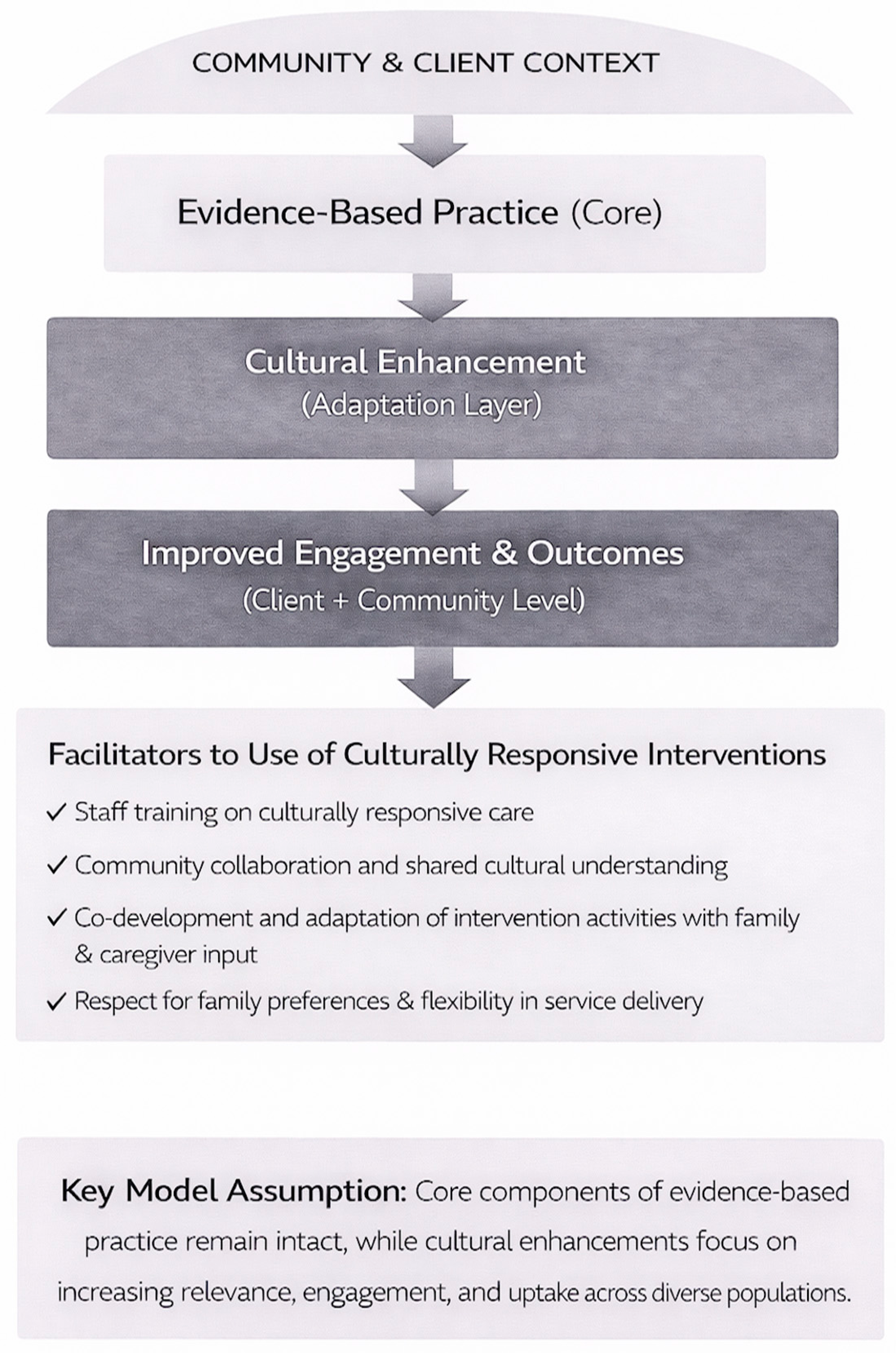
3.2. Facilitators to Use of Culturally Responsive Interventions
4. Discussion
5. Implications for Practice
6. Conclusions
7. Limitations
Author Contributions
Funding
Institutional Review Board Statement
Informed Consent Statement
Data Availability Statement
Conflicts of Interest
References
- Banks, T. M., & Carames-Foley, C. (2025). Promoting culturally effective care for Hispanic families in occupational therapy: A curriculum pilot study. American Journal of Occupational Therapy, 79(2), 7902180130. [Google Scholar] [CrossRef] [PubMed]
- Centers for Disease Control and Prevention (CDC). (2023). Cultural humility and community engagement. Centers for Disease Control and Prevention. Available online: https://www.cdc.gov/globalhealth/equity/guide/cultural-humility-and-community-engagement.html (accessed on 20 May 2025).
- Central Vancouver Island Multicultural Society. (2004). Cultural competence self-assessment checklist. Central Vancouver Island Multicultural Society. [Google Scholar]
- Dumont, R. L., Rios-Vega, L., Barrett, A., Sivori, T. T., Knell, E., Njoroge, J., Cannady, L., & Schaaf, R. C. (2025). Culturally adapting an occupational therapy intervention for Black American autistic communities. American Journal of Occupational Therapy, 79(2), 7902180140. [Google Scholar] [CrossRef] [PubMed]
- Fan, S. J. S., & Chen, S.-P. (2024). Does culture play a role? A pilot study on Western services for a Chinese-Canadian family with children with autism spectrum disorder. Disability and Rehabilitation, 46(12), 2584–2592. [Google Scholar] [CrossRef] [PubMed]
- Fritter, J., & Shihabuddin, B. (2024). Utilizing cultural humility as a tool to support diversity in clinical research. Clinical Researcher, 38(1), 9–12. [Google Scholar] [PubMed]
- Golos, A., Mor, R., Fisher, O., & Finkelstein, A. (2021). Clinicians’ views on the need for cultural adaptation of intervention for children with ADHD from the Ultraorthodox community. Occupational Therapy International, 2021, 5564364. [Google Scholar] [CrossRef] [PubMed]
- Grandpierre, V., Milloy, V., Sikora, L., Fitzpatrick, E., Thomas, R., & Potter, B. (2018). Barriers and facilitators to cultural competence in rehabilitation services: A scoping review. BMC Health Services Research, 18(1), 23. [Google Scholar] [CrossRef] [PubMed]
- Greene-Monton, E., & Minkler, M. (2019). Cultural competence or cultural humility? Moving beyond the debate. Health Promotion Practice, 21(1), 142–145. [Google Scholar] [CrossRef] [PubMed]
- Hailey, E., Carlene, D., Sally, S., Jaris, S., Chantal, C., & Stacey, L. (2025). Family, culture, community: A northern First Nations community-directed needs assessment for paediatric rehabilitation care. International Journal of Circumpolar Health, 84(1), 2531656. [Google Scholar] [CrossRef] [PubMed]
- Halsall, K., Ward, K., & Jarvis, K. (2024). Understanding occupational therapy perinatal mental health practice in mothers from ethnic minorities: A qualitative study of practitioner perceived barriers and enablers. British Journal of Occupational Therapy, 88(3), 166–176. [Google Scholar] [CrossRef] [PubMed]
- Lim, N., & Nakamura, B. J. (2022). Barriers to culturally responsive care in pediatric rehabilitation: The role of language and communication. Journal of Pediatric Rehabilitation Medicine, 15(4), 567–576. [Google Scholar] [CrossRef]
- National Heart, Lung, and Blood Institute. (2014). Quality assessment tool for observational cohort and cross-sectional studies. U.S. Department of Health and Human Services, National Institutes of Health. Available online: https://www.nhlbi.nih.gov/health-topics/study-quality-assessment-tools (accessed on 20 May 2025).
- Okoniewski, W., Sundaram, M., Chaves-Gnecco, D., McAnany, K., Cowden, J. D., & Ragavan, M. (2022). Culturally sensitive interventions in pediatric primary care settings: A systematic review. Pediatrics, 149(2), e2021052162. [Google Scholar] [CrossRef] [PubMed]
- Rakic, M., Hengartner, H., Lüer, S., Scheinemann, K., Elger, B. S., & Rost, M. (2022). A national survey of Swiss paediatric oncology care providers’ cross-cultural competences. Swiss Medical Weekly, 152, w30223. [Google Scholar] [CrossRef] [PubMed]
- Shanmugarajah, K., Rosenbaum, P., & Di Rezze, B. (2022). Exploring autism, culture, and immigrant experiences: Lessons from Sri Lankan Tamil mothers. Canadian Journal of Occupational Therapy, 89(2), 170–179. [Google Scholar] [CrossRef] [PubMed]
- Shin, J., Bekmuratova, S., Nesbit, J., Han, I., Tung, A., Ortiz, J., Wright, T., Chamoun, S., & Bergjord, J. (2025). Measuring cultural effectiveness in occupational therapy and physical therapy: A scoping review. American Journal of Occupational Therapy, 79(6), 7906205130. [Google Scholar] [CrossRef] [PubMed]
- Terol, A. K., Meadan, H., Gómez, L. R., & Magaña, S. (2024). Cultural adaptation of an intervention for caregivers of young autistic children: Community members’ perspectives. Family Process, 63(2), 691–710. [Google Scholar] [CrossRef] [PubMed]
- Tricco, A. C., Lillie, E., Zarin, W., O’Brien, K. K., Colquhoun, H., Levac, D., Moher, D., Peters, M. D. J., Horsley, T., Weeks, L., Hempel, S., Akl, E. A., Chang, C., McGowan, J., Stewart, L., Hartling, L., Aldcroft, A., Wilson, M. G., Garritty, C., … Straus, S. E. (2018). PRISMA extension for scoping reviews (PRISMA-ScR): Checklist and explanation. Annals of Internal Medicine, 169(7), 467–473. [Google Scholar] [CrossRef] [PubMed]
- U.S. Department of Health and Human Services, Office of Minority Health. (2018). National standards for culturally and linguistically appropriate services (CLAS) in health and health care. U.S. Department of Health and Human Services, Office of Minority Health.
- Walker, S. C., & Bruns, E. J. (2013). The cultural enhancement model for evidence-based practice (Innovation Brief). University of Washington, Division of Public Behavioral Health & Justice Policy. [Google Scholar]
- Xu, Y., Chen, F., Mirza, M., & Magaña, S. (2023). Culturally adapting a parent psychoeducational intervention for Chinese immigrant families of young children with autism spectrum disorder. Journal of Policy and Practice in Intellectual Disabilities, 20(1), 58–72. [Google Scholar] [CrossRef]
- Yu, A. P., Suarez-Balcazar, Y., Errisuriz, V. L., Parra-Medina, D., Mirza, M., Zhang, M., Lee, P. C., Zeng, W., Brown-Hollie, J. P., Yespica Mendoza, E., Brown, S., Vanegas, S. B., Heydarian, N. M., & Magaña, S. (2025). PODER Familiar: A culturally tailored health intervention for Latino families of children with intellectual and developmental disabilities. Journal of Applied Research in Intellectual Disabilities, 38(2), e70048. [Google Scholar] [CrossRef] [PubMed]



| Evidence Table | |||||
|---|---|---|---|---|---|
| Author/Year | Level of Evidence Study Design Risk of Bias | Participants Inclusion Criteria Study Setting | Intervention and Control Groups | Outcome Measures | Results |
| Participants: | Cultural Competence Self-Assessment Checklist–Revised (CCSACR) (Central Vancouver Island Multicultural Society, 2004) administered pre- and post- intervention as well as a qualitative questionnaire on self-perceived changes |
| |||
| LOE: Level IV Study Design: | 30 occupational therapy mater’s students, 28 female, 2 male | Intervention: 2 h cognitive–behavioral-based | |||
| Mixed Methods, | Inclusion Criteria: | intervention | |||
| (Banks & Carames-Foley, 2025) | pre–post | occupational therapy | module on | ||
| interventional | master’s students enrolled | culturally | |||
| study | in a pediatric course | effective care for | |||
| ROB: M | Study Setting: an entry-level occupational | Hispanic families | |||
| therapy master’s program | |||||
| (Dumont et al., 2025) | LOE: Level V Study Design: Qualitative study w/focus groups and interviews ROB: Qualitative Study | Participants, 12: 4 parents/caregivers, 2 cultural experts, 6 OTPs Inclusion Criteria: Of Black American [BA] ethnicity and/or directly work/care for with BA Autistic children and/or culture Study Setting: Virtual focus groups and interviews via Zoom platform | A caregiver-mediated, sensory–behavioral approach Using Sensory Integration [OT-SI] framework and related caregiver coaching models | Brief description of method and process of analysis: Interview and focus group discussions Key Themes relevant: BA Families of Autistic Children report facing many challenges, biases, and lack of support in receiving therapy. |
|
| (Fan & Chen, 2024) | LOE: Level V Study Design: pilot, single-case, qualitative semi-structured interviews with parents, grandparents, as well as service providers | Participants: one Chinese Canadian family receiving intervention services for 2 children with ASD, set in Canada | A pilot single case study using a modified standard parent-mediated, clinic-based therapeutic approaches to better align with the family’s cultural values, beliefs, and caregiving practices. | Methods: Exploratory case study involving 6 stages; pilot investigation, single case study design Key themes: “three major themes in the form of tensions: (1) tensions within the family; (2) tensions within the therapeutic relationship, and (3) tensions when addressing culture in therapy” |
|
| (Golos et al., 2021) | LOE: Level IV Study Design: Mixed-method questionnaires ROB: M | Participants: 28 OTPs Inclusion Criteria: certified to use Cog-Fun intervention protocol for children 5 to 10 and experienced with the protocol for children from the UltraOrthodox (UO) Community. | Cog-Fun Interventions with UO Children with ADHD. | 30-min questionnaire that examine the UO participant perception, professional and personal experience, and cultural relevance |
|
| (Halsall et al., 2024) | LOE: Level V Study Design: Qualitative study using non-probability sampling and interview for data collection ROB: Qualitative study where a small sample was explored from a specific population where resources and time were limited | Participants: 8 total, recruited via social media platform, X. Inclusion: respondents invited to participate if registered with UK regulatory body (Health and Care Professions Council); members of their professional body (Royal College of Occupational Therapists); and employed by NHS and working in an NHS community perinatal mental health service | Qualitative interviews with practitioners who described how they adapt their approaches in practice to better meet the cultural, social, and contextual needs of these populations. | 8 introductory questions to collect participant demographics and info about employment and training 8 open-ended questions about participants’ experiences working with mothers from ethnic minorities, enablers and barriers that affect treatment, and the support they believed was required to improve their practice |
|
| (Rakic et al., 2022) | LOE: Level III Study Design: Cross-sectional study ROB: Social desirability minimized by anonymity. 7 of 9 Swiss Pediatric Oncology Group (SPOG) stations participated, however largest SPOG station did not participate which could represent bias | Participants: All Swiss pediatric oncology care providers caring for pediatric (0–18 years) cancer patients. Included all occupational groups in direct contact with patients (e.g., nurses, physicians, psycho-oncologists, social workers, or rehabilitation specialists such, as physiotherapists) at 7 SPOG stations | Examination of healthcare providers’ self-reported cross-cultural competencies, experiences, and perceived challenges in delivering care to culturally diverse pediatric oncology populations. | Cross-Cultural Competence of Healthcare Professionals (CCCHP) questionnaire, 27 items |
|
| (Shanmugarajah et al., 2022) | LOE: Level V Study Design: Qualitative study with semi-structured interviews and content analysis ROB: Small sample size used in qualitative study. Language barriers due to questions being asked in English (not native language) | Participants: 8 mothers of children with ASD who immigrated to Canada from Sri Lanka. All children were 16–23 yo Inclusion criteria: parents of children diagnosed with ASD, identified as an immigrant or first-generation Canadian from South Asian region, and people who could communicate in English with interviewer Setting: private room at Autism Centre | Examination of how cultural beliefs, immigration experiences, and systemic factors shape mothers’ understanding of autism and their engagement with services. | In-person interviews from 30–60 min each. Interviews were transcribed and coded using rigorous analysis to create meaning units including the creation of themes: facilitators and barriers for occupational therapy interventions within the Canadian Healthcare system. |
|
| (Terol et al., 2024) | LOE: Level IV Study Design: Qualitative study w/questionnaires, focus groups, and interviews ROB: Qualitative Study | Participants: 13 caregivers, 6 autistic individuals, and 9 professionals Inclusion Criteria: caregivers of individuals with autism, professionals who work with young children (0–8 years old) with autism, or self-identified autistic individuals, must be 18 years of age or older, and must live in Paraguay Setting: Paraguay | Cultural adaptation of a caregiver-mediated intervention for families of young autistic children, guided by input from community members. | Methods: Online demographic questionnaires were completed in Spanish. Focus groups and interviews were held over zoom in Spanish. All groups and interviews were recorded and transcribed in Spanish, then translated to English by one of the authors and verified by a separate author. Summaries were generated and sent to participants to review and confirm, clarify, or make modifications. |
|
| (Xu et al., 2023) | LOE: Level V Study Design: Qualitative study with interviews or focus group discussions with stakeholders (snowball sampling) | Participants: parents and/or primary caregiver of children or adults with ASD, the child under care is over 10 years old, identifying as Chinese and was foreign-born, and fluent in Mandarin or Cantonese, set in the United States | Cultural adaptation of a parent psychoeducational intervention designed for Chinese immigrant families of young children with autism spectrum disorder (ASD). | Methods: Interviews and focus groups with families following Parents Taking Action (PTA) intervention |
|
| (Yu et al., 2025) | LOE: Level III Study Design: Mixed methods, single group, pre–post pilot study ROB: time constraints of intervention efficacy, small sample size, self-selected (highly motivated), self-reported assessments | Participants: 30 caregivers and their children with IDD Inclusion criteria: adult (18+) female caregiver self-identified as Latino/a/x or of Latin American decent and had a child with IDD Setting: recording of telephone or video chat for pre–post test. Interventions given virtually individually. Group sessions were planned 3 in-person, but switched to virtual after 2 sessions. | 10 individual virtual sessions and 3 group sessions led by trained promotoras for education about nutrition, physical activity, stress management, and self-efficacy. | Psychosocial Outcomes:
|
|
| Risk of Bias for Before–After (Pre–Post) Studies with No Control Group (One Group Design) | ||||||||||||
|---|---|---|---|---|---|---|---|---|---|---|---|---|
| Citation | Study Question or Objective Clear | Eligibility or Selection Criteria Clearly Described | Participants Representative of Real-World Patients | All Eligible Participants Enrolled | Sample Size Appropriate for Confidence in Findings | Intervention Clearly Described and Delivered Consistently | Outcome Measures Pre-Specified, Defined, Valid/Reliable, and Assessed Consistently | Assessors Blinded to Participant Exposure to Intervention | Loss to Follow-Up After Baseline 20% or Less | Statistical Methods Examine Changes in Outcome Measures from Before to After Intervention | Outcome Measures Were Collected Multiple Times Before and After Intervention | Overall Risk of Bias Assessment (Low, Moderate, High Risk) |
| (Banks & Carames-Foley, 2025) | Y | Y | Y | Y | Y | N | Y | N | NR | Y | N | M |
| (Golos et al., 2021) | Y | Y | Y | Y | Y | N | Y | N | NR | N | N | M |
| (Terol et al., 2024) | Y | Y | Y | Y | Y | N | Y | N | NR | N | N | M |
| (Yu et al., 2025) | Y | Y | Y | NR | NR | Y | Y | N | NR | Y | N | L |
| Study (Year) | Design & Evidence Level | Population/Sample | Key Barriers Identified | Implications |
|---|---|---|---|---|
| Fan and Chen (2024) | Qualitative, single-case pilot study Level V | One Chinese family (grandparents, parents, and two sons with ASD) immigrants and three service providers in Canada. | Lack of collaboration between providers and families for goal-setting and services. | Providers benefit from training in culturally responsive communication and collaborative goal setting. Future studies should explore cultural sensitivity with larger sample sizes and diverse perspectives. |
| Golos et al. (2021) | Mixed methods questionnaire Level IV | 28 Pediatric occupational therapists treating ADHD in the UO community in Israel. | Parental knowledge and perceptions of ADHD, communication, and adapting intervention protocols to the lifestyle of UO families. | Providers should expand knowledge acquisition, knowledge transfer, and application of knowledge for interventions with diverse populations. |
| Rakic et al. (2022) | Cross-sectional national survey Level III | 183 Pediatric oncology care providers (OTs, nurses, physicians, social workers, PTs) in Switzerland. | Language barriers, differing cultural values, varying levels of illness understanding across families additionally variability of cross-cultural competence across providers. | Profession-specific cultural competence training is beneficial and can increase use of professional interpreters, and incorporation of cultural mediators to improve equitable care. |
| Shanmugarajah et al. (2022) | Qualitative study with semi-structured interviews Level V | Eight Sri Lankan Tamil immigrant mothers of children with ASD in Canada. | Mothers underreporting cultural practices due to fear of misunderstandings and language barriers in healthcare and school settings. | Institutional support is needed to enhance provider communication skills to foster cultural safety. This should include inviting families to share cultural values during intervention planning. |
| Xu et al. (2023) | Qualitative study with interviews and focus groups Level V | Six Chinese immigrant parents of children with ASD and six providers in a US Midwestern city. | Language barriers, lack of resources in native languages, and cultural norms discouraging disagreement with providers. | Multilingual resources are important to support provider awareness of cultural power dynamics to reduce disparities in care. |
| Study (Year) | Design & Evidence Level | Population/Sample | Key Facilitators Identified | Implications |
|---|---|---|---|---|
| Banks and Carames-Foley (2025) | Mixed-methods pre–post interventional study Level IV | 30 occupational therapy master’s students enrolled in a pediatric course in New York City | A 2-h cognitive–behavioral-based intervention module on culturally effective care for Hispanic families demonstrated self-reported improvement of cultural awareness, skills and readiness for culturally effective care. | Early workforce training may effectively create culturally responsive, family-centered practices. |
| Dumont et al. (2025) | Qualitative study with focus groups and interviews Level V | Four parents and caregivers of Black American autistic children, six occupational therapists, and two cultural experts in the United States | Access to additional resources, improved cultural humility and client-centered practices, improved use of therapeutic principles, parent and caregiver preferences and support building, changes at legislative and professional levels, increased autism/training, and improved service delivery access. | Community collaboration supports cultural adaptation of interventions to improve local relevance, community trust, and service accessibility. |
| Halsall et al. (2024) | Qualitative study with semi-structured interviews Level V | Eight occupational therapists providing care for ethnic minority perinatal mothers in the United Kingdom | Increase diversity of occupational therapy workforce and foster greater cultural sensitivity in practice to improve quality of interventions to address themes of cultural barriers, personal trauma or shame of mental illness, and the experience of using interpreters. | There is a need for practitioner self-reflection on cultural identity and advocacy for workforce diversity to provide culturally responsive mental health interventions. |
| Terol et al. (2024) | Qualitative study with semi-structured interviews Level IV | 28 caregivers, autistic individuals, and professionals in Paraguay | Adapting language in materials to local nomenclature and concepts, inter-professional teams of healthcare providers and caregivers to lead trainings, making content accessible with local resources, hybrid delivery models, use local government metrics for milestone tracking, providing space for social supports through storytelling, and adjusting interventions or advocacy depending on regional government systems. | Interventions can be adapted through community-led processes to improve acceptability, relevance, and sustainability of pediatric interventions. |
| Yu et al. (2025) | Mixed-method, single group, pre–post pilot study Level III | 30 Latino/a/x families with a child diagnosed with IDD in Texas and Illinois | Trained community healthcare workers with similar cultural backgrounds leading individual and group sessions effectively supports intervention outcomes. Co-development of programs with families and community stakeholders ensured cost-effective, family-centered, culturally relevant care. | Intervention models should emphasize co-creation of services with culturally relevant stakeholders and supports evidence-based practice for community-led models of care. |
Disclaimer/Publisher’s Note: The statements, opinions and data contained in all publications are solely those of the individual author(s) and contributor(s) and not of MDPI and/or the editor(s). MDPI and/or the editor(s) disclaim responsibility for any injury to people or property resulting from any ideas, methods, instructions or products referred to in the content. |
© 2026 by the authors. Licensee MDPI, Basel, Switzerland. This article is an open access article distributed under the terms and conditions of the Creative Commons Attribution (CC BY) license.
Share and Cite
Albores, A.; Jump, A.; Rupnow, H.; Schorlig, C.; Coker-Bolt, P.C.; Hart, E. Culturally Responsive Pediatric Rehabilitation Interventions: A Scoping Review. Behav. Sci. 2026, 16, 1031. https://doi.org/10.3390/bs16061031
Albores A, Jump A, Rupnow H, Schorlig C, Coker-Bolt PC, Hart E. Culturally Responsive Pediatric Rehabilitation Interventions: A Scoping Review. Behavioral Sciences. 2026; 16(6):1031. https://doi.org/10.3390/bs16061031
Chicago/Turabian StyleAlbores, Ashley, Annamarie Jump, Hana Rupnow, Cheyenne Schorlig, Patricia C. Coker-Bolt, and Emerson Hart. 2026. "Culturally Responsive Pediatric Rehabilitation Interventions: A Scoping Review" Behavioral Sciences 16, no. 6: 1031. https://doi.org/10.3390/bs16061031
APA StyleAlbores, A., Jump, A., Rupnow, H., Schorlig, C., Coker-Bolt, P. C., & Hart, E. (2026). Culturally Responsive Pediatric Rehabilitation Interventions: A Scoping Review. Behavioral Sciences, 16(6), 1031. https://doi.org/10.3390/bs16061031