Bilingual and Bicultural: Executive Function in Korean and American Children
Abstract
1. Introduction
1.1. Bilingualism and Executive Function
1.2. Disentangling Bilingualism and Biculturalism
1.3. Current Study
2. Materials and Methods
2.1. Participants
2.2. Procedures
2.3. Measures
2.3.1. Questionnaires
2.3.2. Behavioral Assessments
3. Results
3.1. Descriptive Analyses
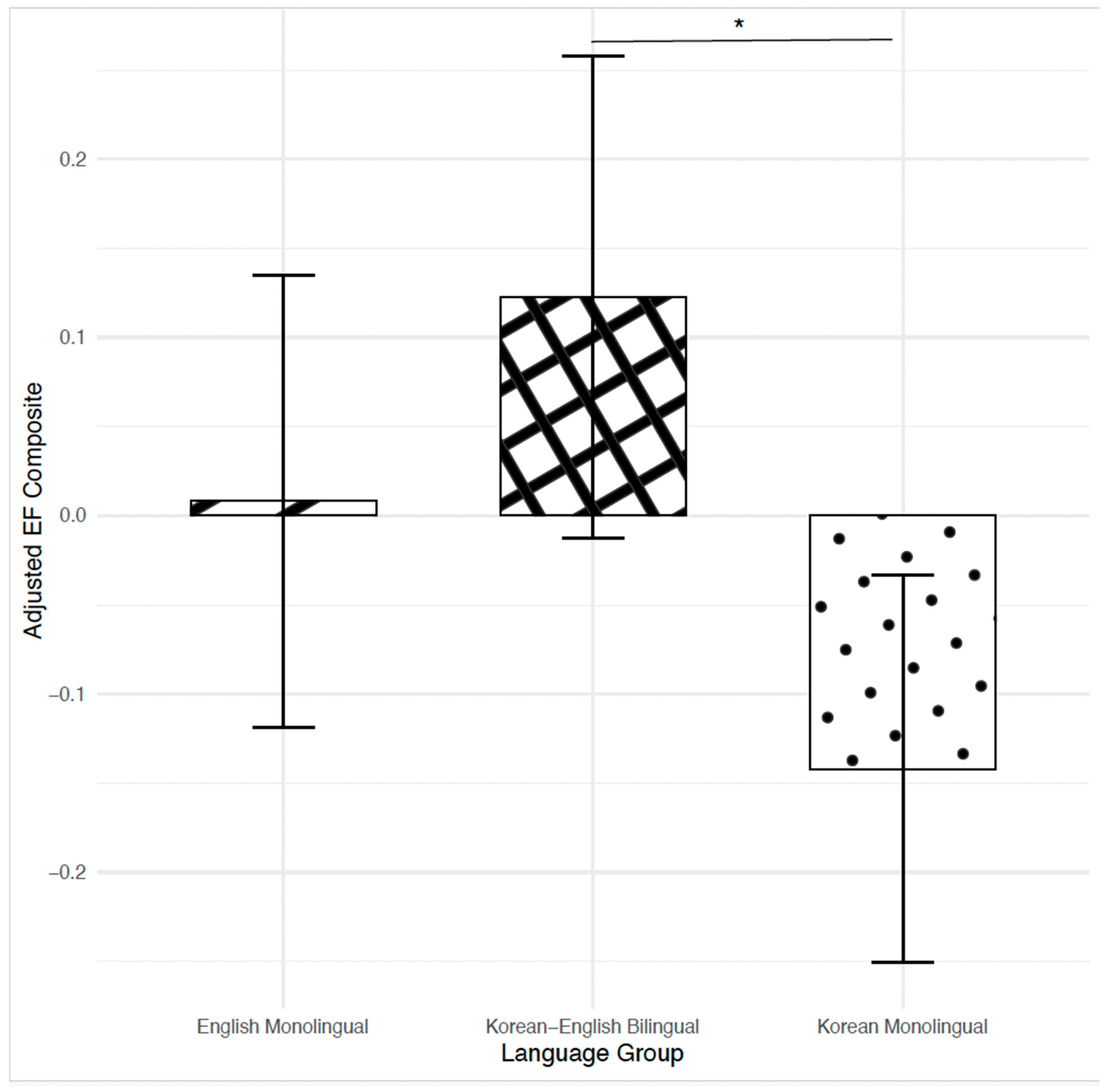
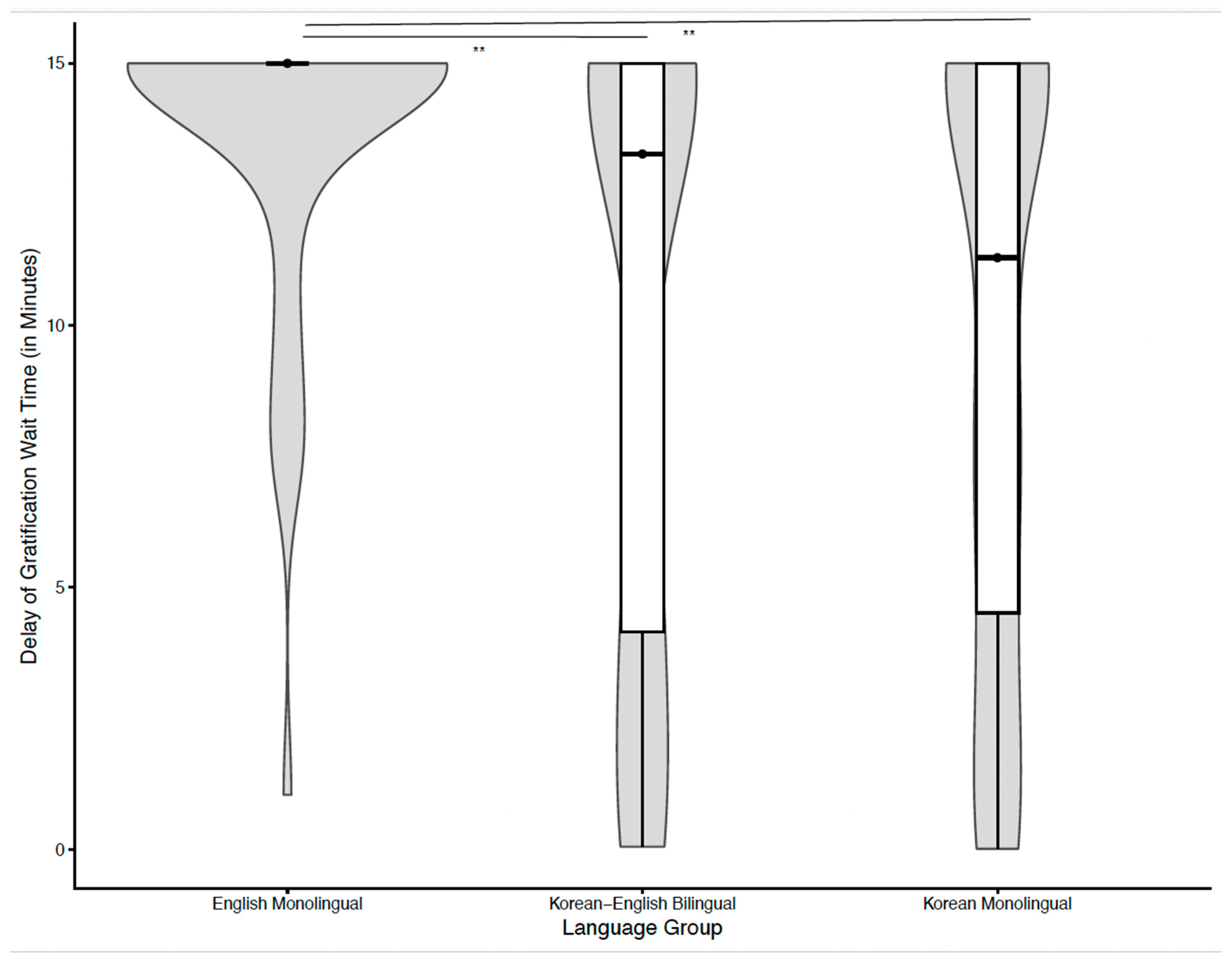
3.2. Main Analyses
4. Discussion
4.1. Language Status
4.2. Country of Residence
4.3. Strengths and Limitations
5. Conclusions
Author Contributions
Funding
Institutional Review Board Statement
Informed Consent Statement
Data Availability Statement
Acknowledgments
Conflicts of Interest
References
- Adesope, O. O., Lavin, T., Thompson, T., & Ungerleider, C. (2010). A Systematic review and meta-analysis of the cognitive correlates of bilingualism. Review of Educational Research, 80(2), 207–245. [Google Scholar] [CrossRef]
- Benjamini, Y., & Hochberg, Y. (1995). Controlling the false discovery rate: A practical and powerful approach to multiple testing. Journal of the Royal Statistical Society: Series B (Methodological), 57(1), 289–300. [Google Scholar] [CrossRef]
- Bialystok, E. (1999). Cognitive complexity and attentional control in the bilingual mind. Child Development, 70(3), 636–644. [Google Scholar] [CrossRef]
- Bialystok, E. (2015). Bilingualism and the development of executive function: The role of attention. Child Development Perspectives, 9(2), 117–121. [Google Scholar] [CrossRef] [PubMed]
- Bialystok, E. (2017). The bilingual adaptation: How minds accommodate experience. Psychological Bulletin, 143(3), 233–262. [Google Scholar] [CrossRef] [PubMed]
- Bialystok, E., & Craik, F. I. M. (2022). How does bilingualism modify cognitive function? Attention to the mechanism. Psychonomic Bulletin & Review, 29(4), 1246–1269. [Google Scholar] [CrossRef] [PubMed]
- Bialystok, E., Luk, G., Peets, K. F., & Yang, S. (2010). Receptive vocabulary differences in monolingual and bilingual children. Bilingualism: Language and Cognition, 13(4), 525–531. [Google Scholar] [CrossRef] [PubMed]
- Bialystok, E., & Martin, M. M. (2004). Attention and inhibition in bilingual children: Evidence from the dimensional change card sort task. Developmental Science, 7(3), 325–339. [Google Scholar] [CrossRef] [PubMed]
- Bialystok, E., & Senman, L. (2004). Executive processes in Appearance–Reality Tasks: The role of inhibition of attention and symbolic representation. Child Development, 75(2), 562–579. [Google Scholar] [CrossRef] [PubMed]
- Bialystok, E., & Viswanathan, M. (2009). Components of executive control with advantages for bilingual children in two cultures. Cognition, 112(3), 494–500. [Google Scholar] [CrossRef] [PubMed]
- Carlson, S. M. (2023). Let me choose: The role of choice in the development of executive function skills. Current Directions in Psychological Science, 32(3), 220–227. [Google Scholar] [CrossRef]
- Carlson, S. M., & Meltzoff, A. N. (2008). Bilingual experience and executive functioning in young children. Developmental Science, 11(2), 282–298. [Google Scholar] [CrossRef] [PubMed]
- Cho, I., Park, J., Song, H., & Morton, J. B. (2021). Disentangling language status and country-of-origin explanations of the bilingual advantage in preschoolers. Journal of Experimental Child Psychology, 212, 105235. [Google Scholar] [CrossRef] [PubMed]
- Choi, T.-H. (2023). English fever: Educational policies in globalised Korea, 1981–2018. History of Education, 52(4), 670–686. [Google Scholar] [CrossRef]
- DeNavas-Walt, C., Proctor, B. D., & Smith, J. C. (2009). U.S. census bureau, current population reports, P60-236, income, poverty, and health insurance coverage in the United States: 2008. U.S. Government Printing Office.
- Diamond, A. (2013). Executive functions. Annual review of psychology, 64(1), 135–168. [Google Scholar] [CrossRef] [PubMed]
- Diamond, A., & Ling, D. S. (2016). Conclusions about interventions, programs, and approaches for improving executive functions that appear justified and those that, despite much hype, do not. Developmental Cognitive Neuroscience, 18, 34–48. [Google Scholar] [CrossRef] [PubMed]
- Dick, A. S., Garcia, N. L., Pruden, S. M., Thompson, W. K., Hawes, S. W., Sutherland, M. T., Riedel, M. C., Laird, A. R., & Gonzalez, R. (2019). No evidence for a bilingual executive function advantage in the ABCD study. Nature Human Behaviour, 3(7), 692–701. [Google Scholar] [CrossRef] [PubMed]
- Distefano, R., Galinsky, E., McClelland, M. M., Zelazo, P. D., & Carlson, S. M. (2018). Autonomy-supportive parenting and associations with child and parent executive function. Journal of Applied Developmental Psychology, 58, 77–85. [Google Scholar] [CrossRef]
- Dittrich, K., & Neuhaus, D.-A. (2023). Korea’s ‘education fever’ from the late nineteenth to the early twenty-first century. History of Education, 52(4), 539–552. [Google Scholar] [CrossRef]
- Dunn, L. M., & Dunn, L. M. (1997). Peabody Picture Vocabulary Test--Third Edition (PPVT-III) [Database record]. APA PsycTests. [Google Scholar]
- Fuhs, M. W., & Day, J. D. (2011). Verbal ability and executive functioning development in preschoolers at head start. Developmental Psychology, 47(2), 404–416. [Google Scholar] [CrossRef] [PubMed]
- Grosjean, F. (1998). Studying bilinguals: Methodological and conceptual issues. Bilingualism: Language and Cognition, 1(2), 131–149. [Google Scholar] [CrossRef]
- Gunnerud, H. L., ten Braak, D., Reikerås, E. K. L., Donolato, E., & Melby-Lervåg, M. (2020). Is bilingualism related to a cognitive advantage in children? A systematic review and meta-analysis. Psychological Bulletin, 146(12), 1059–1083. [Google Scholar] [CrossRef] [PubMed]
- Hackman, D. A., Gallop, R., Evans, G. W., & Farah, M. J. (2015). Socioeconomic status and executive function: Developmental trajectories and mediation. Developmental Science, 18(5), 686–702. [Google Scholar] [CrossRef] [PubMed]
- Hammill, D. D., Pearson, N. A., & Wiederholt, J. L. (1997). Comprehensive test of nonverbal intelligence—(CTONI). Pro-Ed. [Google Scholar]
- Korea Institute for Health and Social Affairs. (2023). 가구의 연간 평균 소득 [Data set]. Korean Statistical Information Service. Available online: https://kosis.kr/statHtml/statHtml.do?orgId=331&tblId=DT_33109_A108&conn_path=I2 (accessed on 17 May 2026).
- Kuhn, L. J., Willoughby, M. T., Vernon-Feagans, L., & Blair, C. B. (2016). The contribution of children’s time-specific and longitudinal expressive language skills on developmental trajectories of executive function. Journal of Experimental Child Psychology, 148, 20–34. [Google Scholar] [CrossRef] [PubMed]
- Lawson, G. M., Hook, C. J., & Farah, M. J. (2018). A meta-analysis of the relationship between socioeconomic status and executive function performance among children. Developmental Science, 21(2), e12529. [Google Scholar] [CrossRef]
- Lee, S., & Park, M. (2025). The age seven exam: South Korea’s paradox of early english fever in the AI era: Early English learning, anxiety, and inequality in the age of AI (pp. 1–6). English Today. [Google Scholar] [CrossRef]
- Lowe, C. J., Cho, I., Goldsmith, S. F., & Morton, J. B. (2021). The bilingual advantage in children’s executive functioning is not related to language status: A meta-analytic review. Psychological Science, 32(7), 1115–1146. [Google Scholar] [CrossRef] [PubMed]
- Merz, E. C., Wiltshire, C. A., & Noble, K. G. (2019). Socioeconomic inequality and the developing brain: Spotlight on language and executive function. Child Development Perspectives, 13(1), 15–20. [Google Scholar] [CrossRef]
- Mischel, W., Shoda, Y., & Rodriguez, M. I. (1989). Delay of gratification in children. Science, 244(4907), 933–938. [Google Scholar] [CrossRef] [PubMed]
- Miyake, A., Friedman, N. P., Emerson, M. J., Witzki, A. H., Howerter, A., & Wager, T. D. (2000). The unity and diversity of executive functions and their contributions to complex “frontal lobe” tasks: A latent variable analysis. Cognitive Psychology, 41(1), 49–100. [Google Scholar] [CrossRef] [PubMed]
- Morales, J., Calvo, A., & Bialystok, E. (2013). Working memory development in monolingual and bilingual children. Journal of Experimental Child Psychology, 114(2), 187–202. [Google Scholar] [CrossRef] [PubMed]
- Oh, S., & Lewis, C. (2008). Korean preschoolers’ advanced inhibitory control and its relation to other executive skills and mental state understanding. Child Development, 79(1), 80–99. [Google Scholar] [CrossRef] [PubMed]
- Paap, K. R., Johnson, H. A., & Sawi, O. (2015). Bilingual advantages in executive functioning either do not exist or are restricted to very specific and undetermined circumstances. Cortex, 69, 265–278. [Google Scholar] [CrossRef] [PubMed]
- Papastergiou, A., Sanoudaki, E., Tamburelli, M., & Chondrogianni, V. (2023). A study on the executive functioning skills of Greek–English bilingual children—A nearest neighbour approach. Bilingualism: Language and Cognition, 26(1), 78–94. [Google Scholar] [CrossRef]
- Peal, E., & Lambert, W. E. (1962). The relation of bilingualism to intelligence. Psychological Monographs: General and Applied, 76(27), 1–23. [Google Scholar] [CrossRef]
- Psychology Software Tools, Inc. (2001). E-Prime (Version 1.0) [Computer software]. Psychology Software Tools, Inc.
- Riggs, N. R., Shin, H.-S., Unger, J. B., Spruijt-Metz, D., & Pentz, M. A. (2014). Prospective associations between bilingualism and executive function in Latino children: Sustained effects while controlling for biculturalism. Journal of Immigrant and Minority Health, 16(5), 914–921. [Google Scholar] [CrossRef] [PubMed]
- Ross, J., & Melinger, A. (2017). Bilingual advantage, bidialectal advantage or neither? Comparing performance across three tests of executive function in middle childhood. Developmental Science, 20(4), e12405. [Google Scholar] [CrossRef]
- Rueda, M. R., Fan, J., McCandliss, B. D., Halparin, J. D., Gruber, D. B., Lercari, L. P., & Posner, M. I. (2004). Development of attentional networks in childhood. Neuropsychologia, 42(8), 1029–1040. [Google Scholar] [CrossRef] [PubMed]
- Sabbagh, M. A., Xu, F., Carlson, S. M., Moses, L. J., & Lee, K. (2006). The development of executive functioning and theory of mind. A comparison of Chinese and U.S. preschoolers. Psychological Science, 17(1), 74–81. [Google Scholar] [CrossRef] [PubMed]
- Samuel, S., Roehr-Brackin, K., Pak, H., & Kim, H. (2018). Cultural effects rather than a bilingual advantage in cognition: A review and an empirical study. Cognitive Science, 42(7), 2313–2341. [Google Scholar] [CrossRef] [PubMed]
- Sethi, A., Mischel, W., Aber, J. L., Shoda, Y., & Rodriguez, M. L. (2000). The role of strategic attention deployment in development of self-regulation: Predicting preschoolers’ delay of gratification from mother–toddler interactions. Developmental Psychology, 36(6), 767–777. [Google Scholar] [CrossRef]
- Skene, K., O’Farrelly, C. M., Byrne, E. M., Kirby, N., Stevens, E. C., & Ramchandani, P. G. (2022). Can guidance during play enhance children’s learning and development in educational contexts? A systematic review and meta-analysis. Child Development, 93(4), 1162–1180. [Google Scholar] [CrossRef] [PubMed]
- Spiegler, O., & Leyendecker, B. (2017). Balanced cultural identities promote cognitive flexibility among immigrant children. Frontiers in Psychology, 8, 1579. [Google Scholar] [CrossRef] [PubMed]
- Stocco, A., Yamasaki, B., Natalenko, R., & Prat, C. S. (2014). Bilingual brain training: A neurobiological framework of how bilingual experience improves executive function. International Journal of Bilingualism, 18(1), 67–92. [Google Scholar] [CrossRef]
- Tran, C. D., Arredondo, M. M., & Yoshida, H. (2019). Early executive function: The influence of culture and bilingualism. Bilingualism: Language and Cognition, 22(04), 714–732. [Google Scholar] [CrossRef]
- Woody-Ramsey, J., & Miller, P. H. (1988). The facilitation of selective attention in preschoolers. Child Development, 59(6), 1497–1503. [Google Scholar] [CrossRef]
- Xie, W., Altarriba, J., & Ng, B. C. (2022). Bilingualism, culture, and executive functions: Is there a relationship? Languages, 7(4), 247. [Google Scholar] [CrossRef]
- Xie, W., & Ng, B. C. (2025). Does the frequency of cultural switching modulate bilinguals’ performance on Executive Functions tasks? A study of highly proficient bicultural-bilinguals. International Journal of Bilingualism, 29(6), 1577–1602. [Google Scholar] [CrossRef]
- Xu, C., Ellefson, M. R., Ng, F. F.-Y., Wang, Q., & Hughes, C. (2020). An East–West contrast in executive function: Measurement invariance of computerized tasks in school-aged children and adolescents. Journal of Experimental Child Psychology, 199, 104929. [Google Scholar] [CrossRef] [PubMed]
- Yanaoka, K., Michaelson, L. E., Guild, R. M., Dostart, G., Yonehiro, J., Saito, S., & Munakata, Y. (2022). Cultures crossing: The power of habit in delaying gratification. Psychological Science, 33, 1172–1181. [Google Scholar] [CrossRef] [PubMed]
- Yang, Q., Liu, Y., Zhang, H., & Sun, M. (2026). Acute academic stress impairs inhibitory control in early primary school children. Journal of Experimental Child Psychology, 263, 106415. [Google Scholar] [CrossRef] [PubMed]
- Yang, S., Yang, H., & Lust, B. (2011). Early childhood bilingualism leads to advances in executive attention: Dissociating culture and language. Bilingualism: Language and Cognition, 14(3), 412–422. [Google Scholar] [CrossRef]
- Zelazo, P. D. (2006). The Dimensional Change Card Sort (DCCS): A method of assessing executive function in children. Nature Protocols, 1(1), 297–301. [Google Scholar] [CrossRef] [PubMed]
- Zelazo, P. D., & Carlson, S. M. (2012). Hot and cool executive function in childhood and adolescence: Development and plasticity. Child Development Perspectives, 6(4), 354–360. [Google Scholar] [CrossRef]
- Zelazo, P. D., & Carlson, S. M. (2020). The neurodevelopment of executive function skills: Implications for academic achievement gaps. Psychology & Neuroscience, 13(3), 273–298. [Google Scholar] [CrossRef]
- Zelazo, P. D., Forston, J. L., Masten, A. S., & Carlson, S. M. (2018). Mindfulness plus reflection training: Effects on executive function in early childhood. Frontiers in Psychology, 9, 208. [Google Scholar] [CrossRef] [PubMed]
- Zelazo, P. D., Jacques, S., Burack, J. A., & Frye, D. (2002). The relation between theory of mind and rule use: Evidence from persons with autism-spectrum disorders. Infant and Child Development, 11(2), 171–195. [Google Scholar] [CrossRef]



| English Monolingual | Korean Monolingual | Korean-English Bilingual | |||||||||||||
|---|---|---|---|---|---|---|---|---|---|---|---|---|---|---|---|
| Variable | n | M | SD | Min | Max | n | M | SD | Min | Max | n | M | SD | Min | Max |
| Age in Months | 53 | 70.34 | 11.65 | 50 | 89 | 69 | 72.49 | 10.39 | 54 | 92 | 67 | 71.31 | 12.97 | 47 | 95 |
| Korean PPVT (raw scores) | - | - | - | - | - | 69 | 76.07 | 18.66 | 32 | 104 | 65 | 31.77 | 16.6 | 9 | 85 |
| English PPVT (raw scores) | 53 | 131.45 | 18.79 | 85 | 161 | - | - | - | - | - | 66 | 85.8 | 29.8 | 7 | 144 |
| C-TONI | 52 | 17.21 | 5.47 | 4 | 30 | 69 | 17.91 | 5.72 | 4 | 30 | 65 | 17.74 | 5.31 | 6 | 30 |
| DCCS | 53 | 19.7 | 2.21 | 16 | 24 | 69 | 19.07 | 3.44 | 6 | 24 | 54 | 18.04 | 4.08 | 6 | 24 |
| MSAT | 52 | 2.83 | 1.32 | 1 | 6 | 69 | 2.7 | 1.53 | 0 | 6 | 59 | 2.08 | 1.24 | 0 | 5 |
| VCR | 53 | 5.55 | 2.08 | 2 | 10 | 69 | 5.9 | 2.24 | 0 | 10 | 60 | 5.22 | 2.28 | 1 | 10 |
| ANT | 39 | −0.02 | 0.05 | −0.18 | 0.12 | 59 | −0.06 | 0.16 | −0.95 | 0.05 | 65 | −0.13 | 0.25 | −0.99 | 0.12 |
| DoG | 53 | 13.72 | 2.84 | 1.05 | 15 | 69 | 9.63 | 5.73 | 0.02 | 15 | 63 | 9.8 | 5.98 | 0.06 | 15 |
| EF Composite | 53 | 0.18 | 0.44 | −0.86 | 1.2 | 69 | 0.04 | 0.56 | −1.34 | 0.98 | 67 | −0.2 | 0.62 | −1.95 | 0.8 |
| Variable | 1 | 2 | 3 | 4 | 5 | 6 | 7 | 8 | |
|---|---|---|---|---|---|---|---|---|---|
| 1. | Age in months | ||||||||
| 2. | PPVT | 0.07 | |||||||
| 3. | C-TONI | .44 ** | .17 * | ||||||
| 4. | DCCS | .29 ** | .38 ** | .29 ** | |||||
| 5. | MSAT | .24 ** | .26 ** | 0.11 | .22 ** | ||||
| 6. | VCR | .45 ** | .21 ** | .29 ** | 0.13 | .21 ** | |||
| 7. | ANT | .20 * | .31 ** | 0.09 | .27 ** | 0.01 | 0.06 | ||
| 8. | DoG | .19 * | .27 ** | .24 ** | .25 ** | .17 * | 0.14 | .20 * | |
| 9. | EF Composite | .52 ** | .46 ** | .60 ** | .65 ** | .52 ** | .56 ** | .50 ** | .60 ** |
| ANCOVA | Pairwise Comparisons | |||||
|---|---|---|---|---|---|---|
| Measure | Parameter | F | df | Mean Difference | SE | p |
| ANT | Language Group | 5.18 ** | 2, 158 | |||
| English Monolingual vs. Korean-English Bilingual | 0.01 | 0.05 | 0.826 | |||
| English Monolingual vs. Korean Monolingual | 0.02 | 0.04 | 0.826 | |||
| Korean-English Bilingual vs. Korean Monolingual | 0.01 | 0.05 | 0.777 | |||
| DCCS | Language Group | 4.28 * | 2, 171 | |||
| English Monolingual vs. Korean-English Bilingual | −0.76 | 0.79 | 0.342 | |||
| English Monolingual vs. Korean Monolingual | 0.59 | 0.55 | 0.342 | |||
| Korean-English Bilingual vs. Korean Monolingual | 1.35 | 0.73 | 0.203 | |||
| MSAT | Language Group | 5.13 ** | 2, 175 | |||
| English Monolingual vs. Korean-English Bilingual | 0.40 | 0.35 | 0.496 | |||
| English Monolingual vs. Korean Monolingual | 0.17 | 0.25 | 0.496 | |||
| Korean-English Bilingual vs. Korean Monolingual | −0.23 | 0.32 | 0.496 | |||
| C-TONI | Language Group | 0.33 | 2, 181 | |||
| English Monolingual vs. Korean-English Bilingual | −3.42 | 1.24 | 0.02 * | |||
| English Monolingual vs. Korean Monolingual | −0.58 | 0.88 | 0.51 | |||
| Korean-English Bilingual vs. Korean Monolingual | 2.84 | 1.15 | 0.02 * | |||
| VCR | Language Group | 1.98 | 2, 177 | |||
| English Monolingual vs. Korean-English Bilingual | −0.42 | 0.51 | 0.71 | |||
| English Monolingual vs. Korean Monolingual | −0.24 | 0.36 | 0.71 | |||
| Korean-English Bilingual vs. Korean Monolingual | 0.179 | 0.47 | 0.71 | |||
Disclaimer/Publisher’s Note: The statements, opinions and data contained in all publications are solely those of the individual author(s) and contributor(s) and not of MDPI and/or the editor(s). MDPI and/or the editor(s) disclaim responsibility for any injury to people or property resulting from any ideas, methods, instructions or products referred to in the content. |
© 2026 by the authors. Licensee MDPI, Basel, Switzerland. This article is an open access article distributed under the terms and conditions of the Creative Commons Attribution (CC BY) license.
Share and Cite
Ernst, J.R.; Kim, S.; Schaefer, C.; Park Choi, H.; Carlson, S.M. Bilingual and Bicultural: Executive Function in Korean and American Children. Behav. Sci. 2026, 16, 1032. https://doi.org/10.3390/bs16061032
Ernst JR, Kim S, Schaefer C, Park Choi H, Carlson SM. Bilingual and Bicultural: Executive Function in Korean and American Children. Behavioral Sciences. 2026; 16(6):1032. https://doi.org/10.3390/bs16061032
Chicago/Turabian StyleErnst, Jasmine R., Seokyung Kim, Catherine Schaefer, Hyewon Park Choi, and Stephanie M. Carlson. 2026. "Bilingual and Bicultural: Executive Function in Korean and American Children" Behavioral Sciences 16, no. 6: 1032. https://doi.org/10.3390/bs16061032
APA StyleErnst, J. R., Kim, S., Schaefer, C., Park Choi, H., & Carlson, S. M. (2026). Bilingual and Bicultural: Executive Function in Korean and American Children. Behavioral Sciences, 16(6), 1032. https://doi.org/10.3390/bs16061032