The General Mechanism of Status: The Impact of Perceptual and Knowledge-Based Social Status on Selective Attention

Abstract
1. Introduction
2. Materials and Methods
2.1. Participants
2.2. Apparatus and Stimuli
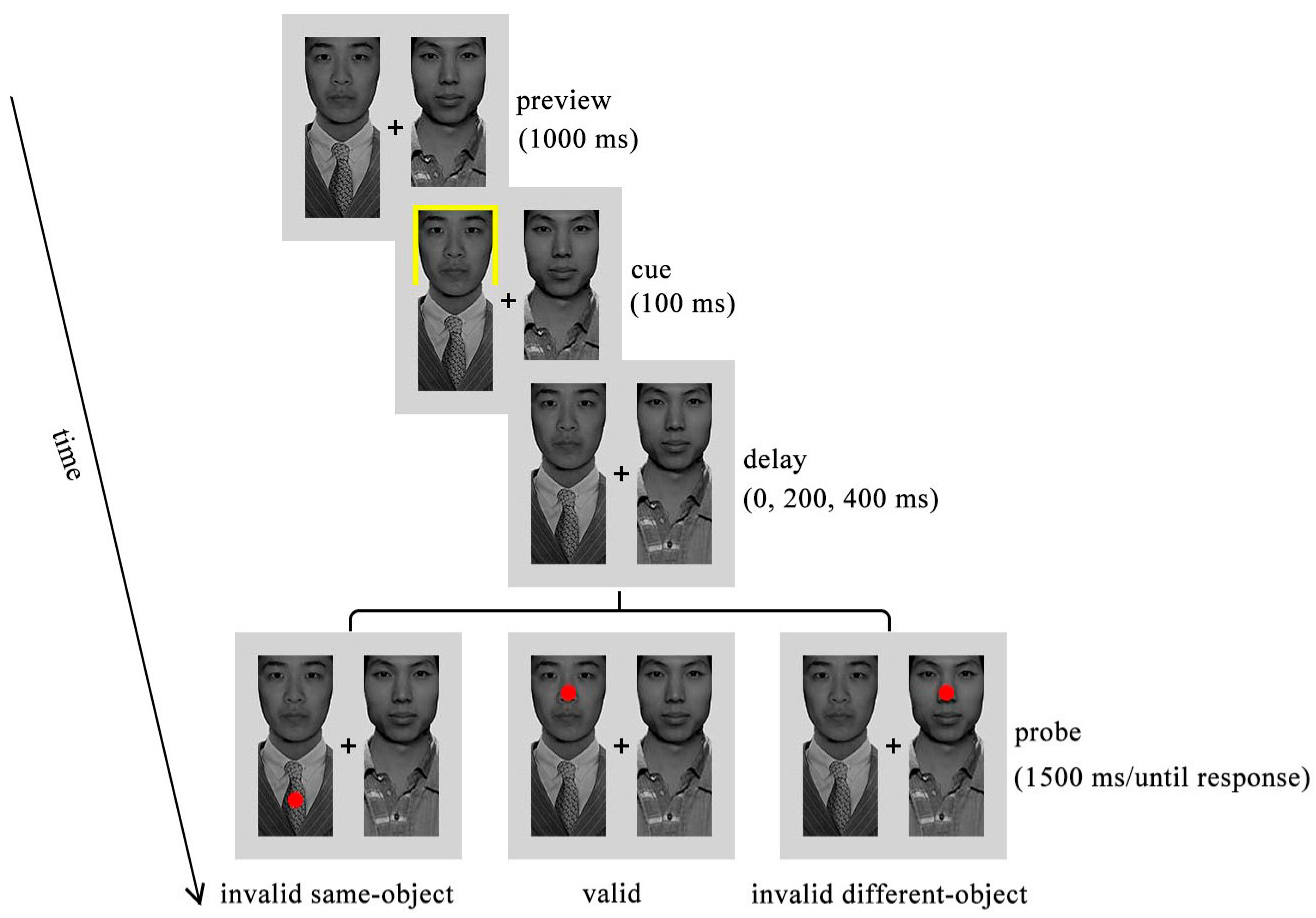
2.3. Procedure and Design
3. Results
3.1. Status Manipulation Check
3.2. Analysis of RTs
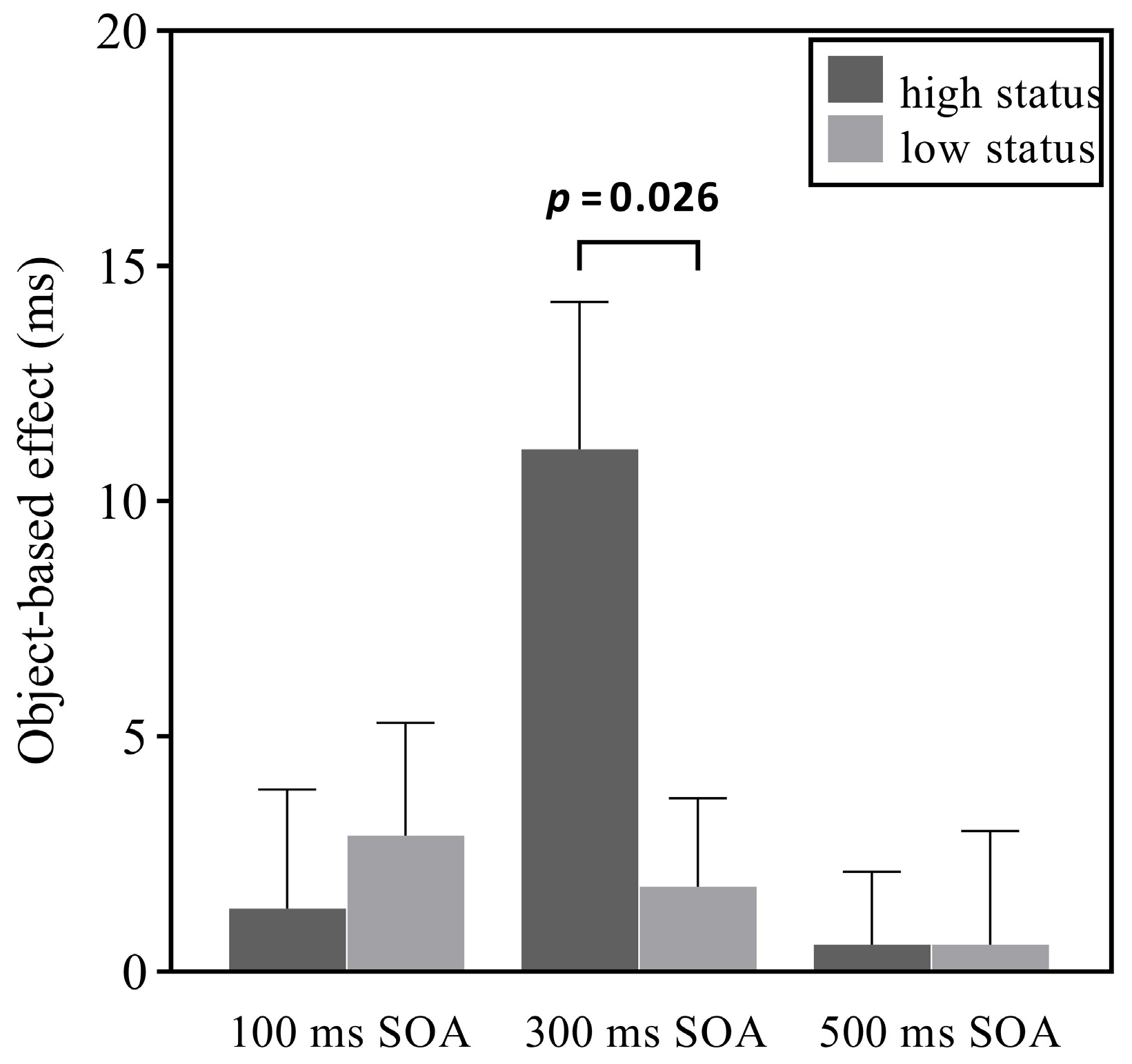
3.2.1. Experiment 1
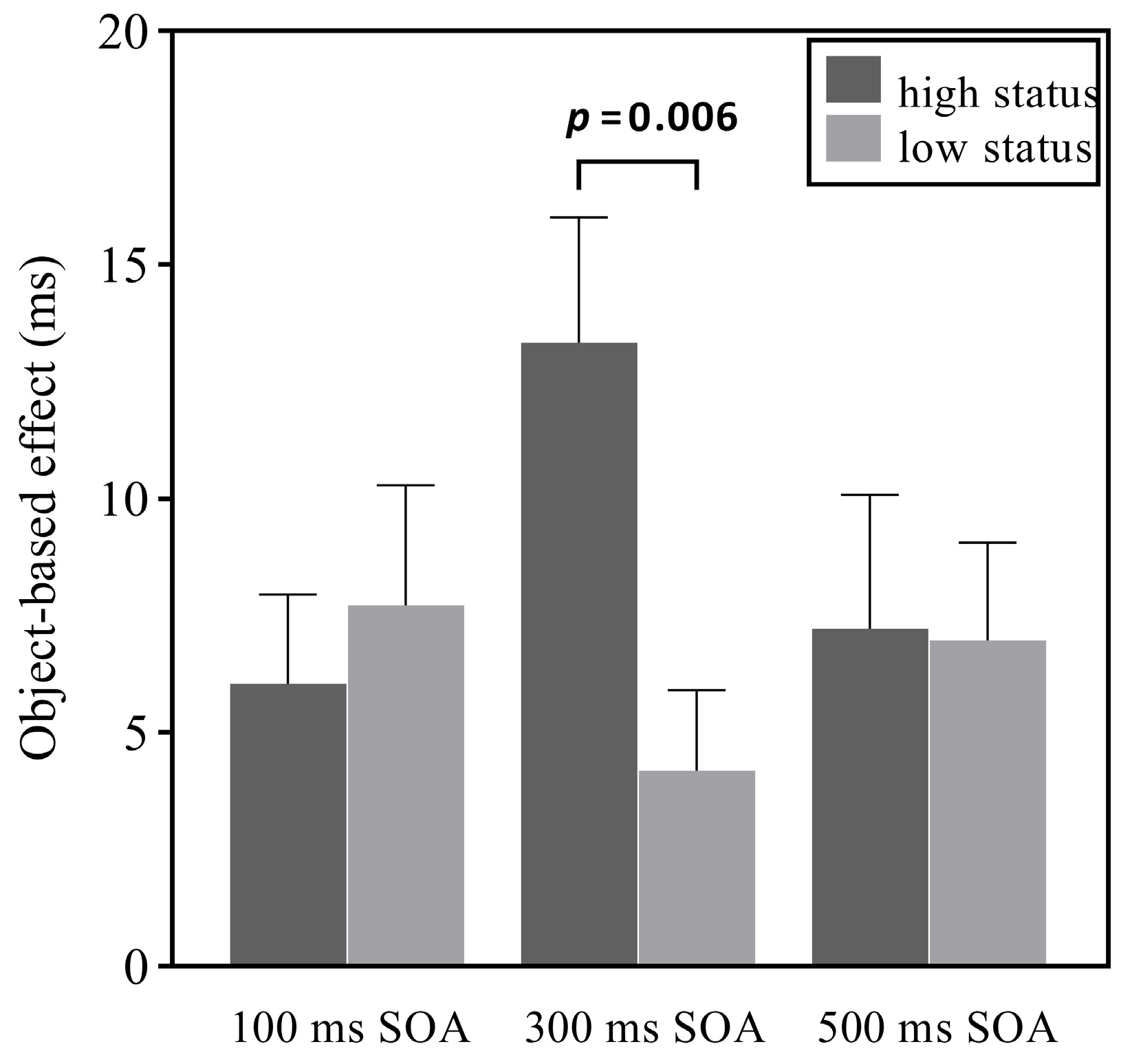
3.2.2. Experiment 2
3.2.3. Cross-Experimental Analysis
4. Discussion
5. Conclusions
Supplementary Materials
Author Contributions
Funding
Institutional Review Board Statement
Informed Consent Statement
Data Availability Statement
Conflicts of Interest
References
- Ames, D. L., & Fiske, S. T. (2013). Outcome dependency alters the neural substrates of impression formation. NeuroImage, 83, 599–608. [Google Scholar] [CrossRef]
- Anderson, C., Hildreth, J. A. D., & Howland, L. (2015). Is the desire for status a fundamental human motive? A review of the empirical literature. Psychological Bulletin, 141(3), 574–601. [Google Scholar] [CrossRef]
- Bjornsdottir, R. T., & Beacon, E. (2024). Stereotypes bias social class perception from faces: The roles of race, gender, affect, and attractiveness. Quarterly Journal of Experimental Psychology, 77(11), 2339–2353. [Google Scholar] [CrossRef]
- Bjornsdottir, R. T., & Rule, N. O. (2017). The visibility of social class from facial cues. Journal of Personality and Social Psychology, 113(4), 530–546. [Google Scholar] [CrossRef] [PubMed]
- Breton, A., Jerbi, K., Henaff, M. A., Cheylus, A., Baudouin, J. Y., Schmitz, C., Krolak-Salmon, P., & Van der Henst, J. B. (2014). Face the hierarchy: ERP and oscillatory brain responses in social rank processing. PLoS ONE, 9(3), e91451. [Google Scholar] [CrossRef] [PubMed]
- Campbell, J. I. D., & Thompson, V. A. (2012). MorePower 6.0 for ANOVA with relational confidence intervals and Bayesian analysis. Behavior Research Methods, 44(4), 1255–1265. [Google Scholar] [CrossRef]
- Catak, E. N., Özkan, M., Kafaligonul, H., & Stoner, G. R. (2022). Behavioral and ERP evidence that object-based attention utilizes fine-grained spatial mechanisms. Cortex, 151, 89–104. [Google Scholar] [CrossRef] [PubMed]
- Cavanagh, P., Caplovitz, G. P., Lytchenko, T. K., Maechler, M. R., Tse, P. U., & Sheinberg, D. L. (2023). The architecture of object-based attention. Psychonomic Bulletin & Review, 30(5), 1643–1667. [Google Scholar] [CrossRef]
- Cloutier, J., Ambady, N., Meagher, T., & Gabrieli, J. D. E. (2012). The neural substrates of person perception: Spontaneous use of financial and moral status knowledge. Neuropsychologia, 50(9), 2371–2376. [Google Scholar] [CrossRef]
- Cosmides, L., & Tooby, J. (1994). Beyond intuition and instinct blindness: Toward an evolutionarily rigorous cognitive science. Cognition, 50(1–3), 41–77. [Google Scholar] [CrossRef]
- Côté, S. (2011). How social class shapes thoughts and actions in organizations. Research in Organizational Behavior, 31, 43–71. [Google Scholar] [CrossRef]
- Craik, F. I., & Lockhart, R. S. (1972). Levels of processing: A framework for memory research. Journal of Verbal Learning and Verbal Behavior, 11(6), 671–684. [Google Scholar] [CrossRef]
- Craik, F. I. M., & Tulving, E. (1975). Depth of processing and the retention of words in episodic memory. Journal of Experimental Psychology: General, 104, 268–294. [Google Scholar] [CrossRef]
- Dalmaso, M., Galfano, G., Coricelli, C., & Castelli, L. (2014). Temporal dynamics underlying the modulation of social status on social attention. PLoS ONE, 9(3), e93139. [Google Scholar] [CrossRef]
- Dalmaso, M., Pavan, G., Castelli, L., & Galfano, G. (2012). Social status gates social attention in humans. Biology Letters, 8(3), 450–452. [Google Scholar] [CrossRef] [PubMed]
- Durante, F., Tablante, C. B., & Fiske, S. T. (2017). Poor but warm, rich but cold (and competent): Social classes in the stereotype content model. Journal of Social Issues, 73(1), 138–157. [Google Scholar] [CrossRef]
- Egly, R., Driver, J., & Rafal, R. D. (1994). Shifting visual attention between objects and locations: Evidence from normal and parietal lesion subjects. Journal of Experimental Psychology: General, 123(2), 161–177. [Google Scholar] [CrossRef] [PubMed]
- Fiske, S. T., Cuddy, A. J. C., Glick, P., & Xu, J. (2002). A model of (often mixed) stereotype content: Competence and warmth respectively follow from perceived status and competition. Journal of Personality and Social Psychology, 82(6), 878–902. [Google Scholar] [CrossRef]
- Freeman, J. B., & Ambady, N. (2011). A dynamic interactive theory of person construal. Psychological Review, 118(2), 247–279. [Google Scholar] [CrossRef]
- Freeman, J. B., & Johnson, K. L. (2016). More than meets the eye: Split-second social perception. Trends in Cognitive Sciences, 20(5), 362–374. [Google Scholar] [CrossRef]
- Freeman, J. B., Ma, Y. N., Han, S. H., & Ambady, N. (2013). Influences of culture and visual context on real-time social categorization. Journal of Experimental Social Psychology, 49(2), 206–210. [Google Scholar] [CrossRef]
- Freeman, J. B., Penner, A. M., Saperstein, A., Scheutz, M., & Ambady, N. (2011). Looking the part: Social status cues shape race perception. PLoS ONE, 6(9), e25107. [Google Scholar] [CrossRef]
- Freeman, J. B., Stolier, R. M., & Brooks, J. A. (2020). Dynamic interactive theory as a domain-general account of social perception. Advances in Experimental Social Psychology, 61, 237–287. [Google Scholar] [CrossRef]
- Gong, X., Huang, Y., Wang, Y., & Luo, Y. (2011). Revision of the Chinese facial affective picture system. Chinese Mental Health Journal, 25(1), 40–46. [Google Scholar] [CrossRef]
- Grignolio, D., Acunzo, D. J., & Hickey, C. (2024). Object-based attention is accentuated by object reward association. Journal of Experimental Psychology: Human Perception and Performance, 50(3), 280–294. [Google Scholar] [CrossRef] [PubMed]
- Griskevicius, V., Tybur, J. M., & Van den Bergh, B. (2010). Going geen to be seen: Status, reputation, and conspicuous conservation. Journal of Personality and Social Psychology, 98(3), 392–404. [Google Scholar] [CrossRef] [PubMed]
- Haaker, J., Molapour, T., & Olsson, A. (2016). Conditioned social dominance threat: Observation of others’ social dominance biases threat learning. Social Cognitive and Affective Neuroscience, 11(10), 1627–1637. [Google Scholar] [CrossRef] [PubMed]
- Han, Y. J., Nunes, J. C., & Drèze, X. (2010). Signaling status with luxury goods: The role of brand prominence. Journal of Marketing, 74(4), 15–30. [Google Scholar] [CrossRef]
- He, X., Fan, S. L., Zhou, K., & Chen, L. (2004). Cue validity and object-based attention. Journal of Cognitive Neuroscience, 16(6), 1085–1097. [Google Scholar] [CrossRef]
- He, X., Humphreys, G., Fan, S. L., Chen, L., & Han, S. H. (2008). Differentiating spatial and object-based effects on attention: An event-related brain potential study-with peripheral cueing. Brain Research, 1245, 116–125. [Google Scholar] [CrossRef]
- Hu, S., Zhang, T., Wang, Y., Song, F., Zhao, J., & Wang, Y. (2021). The modulation of object-based attentional selection by facial expressions. Quarterly Journal of Experimental Psychology, 74(7), 1244–1256. [Google Scholar] [CrossRef]
- Hu, S. S., Liu, D. W., Gao, Y. F., Xiong, L. J., Yao, D. Y., Zhao, J. J., & Wang, Y. H. (2023). The impact of semantic matching on the additive effects of object-based attentional selection. Current Psychology, 42(21), 17985–17994. [Google Scholar] [CrossRef]
- Hu, S. S., Liu, D. W., Song, F. X., Wang, Y. H., & Zhao, J. J. (2020). The influence of object similarity on real object-based attention: The disassociation of perceptual and semantic similarity. Acta Psychologica, 205, 103046. [Google Scholar] [CrossRef] [PubMed]
- Jeurissen, D., Self, M. W., & Roelfsema, P. R. (2016). Serial grouping of 2D-image regions with object-based attention in humans. Elife, 5, e14320. [Google Scholar] [CrossRef]
- Jung, M. H., Smeets, P., Stoop, J., & Vosgerau, J. (2023). Social status and unethical behavior: Two replications of the field studies in Piff et al. (2012). Journal of Experimental Psychology: General, 152(5), 1368–1378. [Google Scholar] [CrossRef] [PubMed]
- Kenrick, D. T., Maner, J. K., Butner, J., Li, N. P., Becker, D. V., & Schaller, M. (2002). Dynamical evolutionary psychology: Mapping the domains of the new interactionist paradigm. Personality and Social Psychology Review, 6(4), 347–356. [Google Scholar] [CrossRef]
- Kraus, M. W., & Keltner, D. (2009). Signs of socioeconomic status: A thin-slicing approach. Psychological Science, 20(1), 99–106. [Google Scholar] [CrossRef]
- Kraus, M. W., Park, J. W., & Tan, J. J. X. (2017). Signs of social class: The experience of economic inequality in everyday life. Perspectives on Psychological Science, 12(3), 422–435. [Google Scholar] [CrossRef]
- Kuppens, T., Spears, R., Manstead, A. S. R., Spruyt, B., & Easterbrook, M. J. (2018). Educationism and the irony of meritocracy: Negative attitudes of higher educated people towards the less educated. Journal of Experimental Social Psychology, 76, 429–447. [Google Scholar] [CrossRef]
- Kurzban, R., & Leary, M. R. (2001). Evolutionary origins of stigmatization: The functions of social exclusion. Psychological Bulletin, 127(2), 187–208. [Google Scholar] [CrossRef]
- Lee, S., Baumgartner, H., & Winterich, K. P. (2018). Did they earn it? Observing unearned luxury consumption decreases brand attitude when observers value fairness. Journal of Consumer Psychology, 28(3), 412–436. [Google Scholar] [CrossRef]
- Levy, D. J., & Glimcher, P. W. (2012). The root of all value: A neural common currency for choice. Current Opinion in Neurobiology, 22(6), 1027–1038. [Google Scholar] [CrossRef] [PubMed]
- Li, Z. Y., Chen, J., Zhang, Q. M., & Liu, L. (2025). Unraveling the mechanism of semantic object-based attention: The role of top-down search strategies. Psychonomic Bulletin & Review, 32(1), 352–362. [Google Scholar] [CrossRef]
- Magee, J. C., & Galinsky, A. D. (2008). Social hierarchy: The self-reinforcing nature of power and status. Academy of Management Annals, 2(1), 351–398. [Google Scholar] [CrossRef]
- Mattan, B. D., & Kubota, J. T. (2020). Status beyond what meets the eye. Nature Human Behaviour, 4(3), 233–234. [Google Scholar] [CrossRef]
- Mattan, B. D., Kubota, J. T., & Cloutier, J. (2017). How social status shapes person perception and evaluation: A social neuroscience perspective. Perspectives on Psychological Science, 12(3), 468–507. [Google Scholar] [CrossRef]
- Mattan, B. D., Kubota, J. T., Li, T. Y., Venezia, S. A., & Cloutier, J. (2019). Implicit evaluative biases toward targets varying in race and socioeconomic status. Personality and Social Psychology Bulletin, 45(10), 1512–1527. [Google Scholar] [CrossRef]
- Oh, D., Shafir, E., & Todorov, A. (2020). Economic status cues from clothes affect perceived competence from faces. Nature Human Behaviour, 4(3), 287–293. [Google Scholar] [CrossRef]
- Rahal, D., Fales, M. R., Haselton, M. G., Slavich, G. M., & Robles, T. F. (2021). Cues of social status: Associations between attractiveness, dominance, and status. Evolutionary Psychology, 19(4), 1–15. [Google Scholar] [CrossRef]
- Ratcliff, N. J., Hugenberg, K., Shriver, E. R., & Bernstein, M. J. (2011). The allure of status: High-status targets are privileged in face processing and memory. Personality and Social Psychology Bulletin, 37(8), 1003–1015. [Google Scholar] [CrossRef]
- Schwartz, L., & Yovel, G. (2016). The roles of perceptual and conceptual information in face recognition. Journal of Experimental Psychology: General, 145(11), 1493–1511. [Google Scholar] [CrossRef] [PubMed]
- Sescousse, G., Li, Y., & Dreher, J. C. (2015). A common currency for the computation of motivational values in the human striatum. Social Cognitive and Affective Neuroscience, 10(4), 467–473. [Google Scholar] [CrossRef] [PubMed]
- Sheehy-Skeffington, J. (2020). The effects of low socioeconomic status on decision-making processes. Current Opinion in Psychology, 33, 183–188. [Google Scholar] [CrossRef] [PubMed]
- Song, F., Zhou, S., Gao, Y., Hu, S., Kong, F., & Zhao, J. (2020). Different temporal dynamics of object-based attentional allocation for reward and non-reward objects. Journal of Vision, 20(9), 17. [Google Scholar] [CrossRef]
- Song, F., Zhou, S., Gao, Y., Hu, S., Zhang, T., Kong, F., & Zhao, J. (2021). Are you looking at me? Impact of eye contact on object-based attention. Journal of Experimental Psychology: Human Perception and Performance, 47(6), 765–773. [Google Scholar] [CrossRef]
- Yan, C., Gao, Y. F., Hu, S. S., Song, F. X., Wang, Y. H., & Zhao, J. J. (2022). The impact and mechanism of gaze cues on object-based attention. Acta Psychologica Sinica, 54(7), 748–760. [Google Scholar] [CrossRef]
- Zhang, X. L., Mlynaryk, N., Japee, S., & Ungerleider, L. G. (2017). Attentional selection of multiple objects in the human visual system. NeuroImage, 163, 231–243. [Google Scholar] [CrossRef]
- Zhao, J., Song, F., Zhou, S., Hu, S., Liu, D., Wang, Y., & Kong, F. (2020). The impact of monetary stimuli on object-based attention. British Journal of Psychology, 111(3), 460–472. [Google Scholar] [CrossRef]
- Zink, C. F., Tong, Y., Chen, Q., Bassett, D. S., Stein, J. L., & Meyer-Lindenberg, A. (2008). Know your place: Neural processing of social hierarchy in humans. Neuron, 58(2), 273–283. [Google Scholar] [CrossRef]



| Status | M ± SD | One-Sample t | Paired-Samples t | |
|---|---|---|---|---|
| pair 1 | high status | 6.63 ± 0.96 | 9.28 *** | 8.86 *** |
| low status | 4.17 ± 0.87 | 5.22 *** | ||
| pair 2 | high status | 6.80 ± 1.00 | 9.89 *** | 9.16 *** |
| low status | 4.03 ± 1.25 | 4.25 *** |
| Status | M ± SD | One-Sample t | Paired-Samples t | |
|---|---|---|---|---|
| pair 1 | high status | 7.33 ± 1.16 | 11.07 *** | 16.35 *** |
| low status | 3.23 ± 0.82 | 11.84 *** | ||
| pair 2 | high status | 7.33 ± 1.21 | 10.54 *** | 18.68 *** |
| low status | 3.57 ± 0.73 | 10.79 *** |
Disclaimer/Publisher’s Note: The statements, opinions and data contained in all publications are solely those of the individual author(s) and contributor(s) and not of MDPI and/or the editor(s). MDPI and/or the editor(s) disclaim responsibility for any injury to people or property resulting from any ideas, methods, instructions or products referred to in the content. |
© 2026 by the authors. Licensee MDPI, Basel, Switzerland. This article is an open access article distributed under the terms and conditions of the Creative Commons Attribution (CC BY) license.
Share and Cite
Gao, Y.; Zhou, S.; Zhao, J.; Wang, Y. The General Mechanism of Status: The Impact of Perceptual and Knowledge-Based Social Status on Selective Attention. Behav. Sci. 2026, 16, 807. https://doi.org/10.3390/bs16050807
Gao Y, Zhou S, Zhao J, Wang Y. The General Mechanism of Status: The Impact of Perceptual and Knowledge-Based Social Status on Selective Attention. Behavioral Sciences. 2026; 16(5):807. https://doi.org/10.3390/bs16050807
Chicago/Turabian StyleGao, Yunfei, Sicen Zhou, Jingjing Zhao, and Yonghui Wang. 2026. "The General Mechanism of Status: The Impact of Perceptual and Knowledge-Based Social Status on Selective Attention" Behavioral Sciences 16, no. 5: 807. https://doi.org/10.3390/bs16050807
APA StyleGao, Y., Zhou, S., Zhao, J., & Wang, Y. (2026). The General Mechanism of Status: The Impact of Perceptual and Knowledge-Based Social Status on Selective Attention. Behavioral Sciences, 16(5), 807. https://doi.org/10.3390/bs16050807