


Characterising the Influence of Parasocial Experience on the Media Figures’ Audiences: A Scoping Review

Abstract
1. Introduction
1.1. Aims and Review Questions
- Which aspects of PSE influence audience behaviours?
- What are the main features of these influences?
1.2. Conceptual Distinction Between PSI, PSRs, and PSA
2. Method
2.1. Defining and Measuring PSE
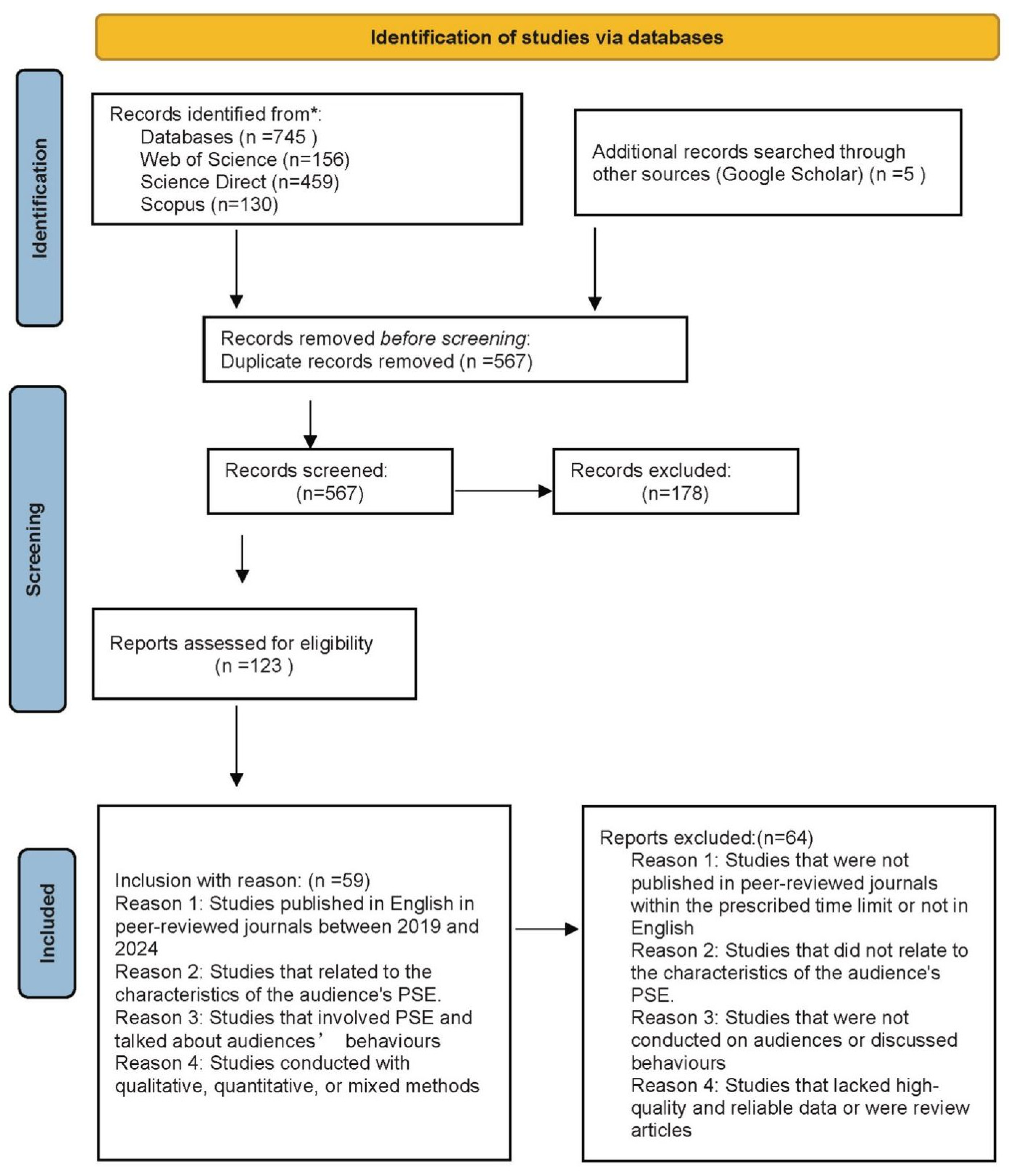
2.2. Search Strategy
- Peer-reviewed and open-access;
- Published between 2019 and 2024;
- Focused on PSI, PSR, or PSA and their impact on audience behaviours.
3. Results
3.1. Publication Year
3.2. Type of Media Figures
3.3. Type of PSE Categories
4. Discussion
4.1. Parasocial Relationship
4.1.1. Personality Type
4.1.2. Compensation Needs
4.2. Parasocial Interaction
4.2.1. Cognitive
4.2.2. Affective
4.2.3. Behavioural
4.3. Parasocial Attachment
4.4. Parasocial Experience as Parasocial Contact
4.5. Limitations of Research
5. Conclusions and Directions for Future Research
Author Contributions
Funding
Institutional Review Board Statement
Informed Consent Statement
Data Availability Statement
Conflicts of Interest
References
- Arksey, H., & O’Malley, L. (2005). Scoping studies: Towards a methodological framework. International Journal of Social Research Methodology, 8(1), 19–32. [Google Scholar] [CrossRef] [Scilit]
- Aw, E. C. X., & Chuah, S. H. W. (2021). “Stop the unattainable ideal for an ordinary me!” Fostering parasocial relationships with social media influencers: The role of self-discrepancy. Journal of Business Research, 132, 146–157. [Google Scholar] [CrossRef] [Scilit]
- Bai, K., & Tan, K. H. (2024). The influence of online social and physical presences on user consumption decisions in TikTok livestreaming: A scoping review. Cyberpsychology, Behavior, and Social Networking, 27(7), 452–466. [Google Scholar] [CrossRef] [Scilit]
- Balaban, D. C., Szambolics, J., & Chirică, M. (2022). Parasocial relations and social media influencers’ persuasive power: Exploring the moderating role of product involvement. Acta Psychologica, 230, 103731. [Google Scholar] [CrossRef] [Scilit] [PubMed]
- Bingaman, J. (2022). “Dude I’ve never felt this way towards a celebrity death”: Parasocial grieving and the collective mourning of Kobe Bryant on Reddit. OMEGA–Journal of Death and Dying, 86(2), 364–381. [Google Scholar] [CrossRef] [Scilit]
- Bond, B. J. (2021). The development and influence of parasocial relationships with television characters: A longitudinal experimental test of prejudice reduction through parasocial contact. Communication Research, 48(4), 573–593. [Google Scholar] [CrossRef] [Scilit]
- Bond, B. J., & Miller, B. (2021). YouTube as my space: The relationships between YouTube, social connectedness, and (collective) self-esteem among LGBTQ individuals. New Media & Society, 26(1), 513–533. [Google Scholar]
- Bonifacio, R., Hair, L., & Wohn, D. Y. (2023). Beyond fans: The relational labor and communication practices of creators on Patreon. New Media & Society, 25(10), 2684–2703. [Google Scholar]
- Bonus, J. A., Matthews, N. L., & Wulf, T. (2021). The impact of moral expectancy violations on audiences’ parasocial relationships with movie heroes and villains. Communication Research, 48(4), 550–572. [Google Scholar] [CrossRef] [Scilit]
- Bowlby, J. (1982). Attachment and loss: Retrospect and prospect. American Journal of Orthopsychiatry, 52(4), 664–678. [Google Scholar] [CrossRef] [Scilit]
- Brooks, S. K. (2021). FANatics: Systematic literature review of factors associated with celebrity worship, and suggested directions for future research. Current Psychology, 40(2), 864–886. [Google Scholar] [CrossRef] [Scilit]
- Burnasheva, R., & Suh, Y. G. (2022). The moderating role of parasocial relationships in the associations between celebrity endorser’s credibility and emotion-based responses. Journal of Marketing Communications, 28(4), 343–359. [Google Scholar] [CrossRef] [Scilit]
- Chen, T. Y., Yeh, T. L., & Lee, F. Y. (2021). The impact of internet celebrity characteristics on followers’ impulse purchase behavior: The mediation of attachment and parasocial interaction. Journal of Research in Interactive Marketing, 15(3), 483–501. [Google Scholar] [CrossRef] [Scilit]
- Deng, Z., Benckendorff, P., & Wang, J. (2022). From interaction to relationship: Rethinking parasocial phenomena in travel live streaming. Tourism Management, 93, 104583. [Google Scholar] [CrossRef] [Scilit]
- Donabedian, T. (2021). “They’re worth my investment”: Cultivating intimacy through fan-lead financial and support initiatives among BTS fans. Asia Marketing Journal, 22(4), 6. [Google Scholar] [CrossRef] [Scilit]
- Drenten, J., & Psarras, E. (2023). Digital ventriloquism and celebrity access: Cameo and the emergence of paid puppeteering on digital platforms. New Media & Society, 25(12), 3350–3369. [Google Scholar]
- Gerace, A. (2024). When TV neighbours become good friends: Understanding neighbours fans’ feelings of grief and loss at the end of the series. PLoS ONE, 19(6), e0302160. [Google Scholar] [CrossRef] [Scilit] [PubMed]
- Gong, A. D., & Huang, Y. T. (2023). Finding love in online games: Social interaction, parasocial phenomenon, and in-game purchase intention of female game players. Computers in Human Behavior, 143, 107681. [Google Scholar] [CrossRef] [Scilit]
- Gong, M., Bao, X., & Wagner, C. (2023). Why viewers send paid gifts: The role of social influence on massively multiplayer online games live streaming. Information Processing & Management, 60(4), 103371. [Google Scholar] [CrossRef] [Scilit]
- Gong, W., & Li, X. (2019). Microblogging reactions to celebrity endorsement: Effects of parasocial relationship and source factors. Chinese Journal of Communication, 12(2), 185–203. [Google Scholar] [CrossRef] [Scilit]
- Groszman, R. (2020). Revisiting parasocial theory in fan studies: Pathological or (path) illogical? Transformative Works and Cultures, 34, 1. [Google Scholar] [CrossRef] [Scilit]
- Hartmann, T., & Goldhoorn, C. (2011). Horton and Wohl revisited: Exploring viewers’ experience of parasocial interaction. Journal of Communication, 61(6), 1104–1121. [Google Scholar] [CrossRef] [Scilit]
- He, Y., & Sun, Y. (2022). Breaking up with my idol: A qualitative study of the psychological adaptation process of renouncing fanship. Frontiers in Psychology, 13, 1030470. [Google Scholar] [CrossRef] [Scilit]
- Hoewe, J., & Sherrill, L. A. (2019). The influence of female lead characters in political TV shows: Links to political engagement. Journal of Broadcasting & Electronic Media, 63(1), 59–76. [Google Scholar] [CrossRef] [Scilit]
- Hoffner, C. A., & Bond, B. J. (2022). Parasocial relationships, social media, & well-being. Current Opinion in Psychology, 45, 101306. [Google Scholar] [CrossRef] [Scilit]
- Horton, D., & Wohl, R. (1956). Mass communication and para-social interaction: Observations on intimacy at a distance. Psychiatry, 19(3), 215–229. [Google Scholar] [CrossRef] [Scilit]
- Hu, J., Wang, H., Li, L., & Guo, L. (2024). How travel vlog audience members become tourists: Exploring audience involvement and travel intention. Computers in Human Behavior, 152, 108045. [Google Scholar] [CrossRef] [Scilit]
- Jenol, N. A. M., & Pazil, N. H. A. (2020). Escapism and motivation: Understanding K-pop fans well-being and identity. Geografia, 16(4), 336–347. [Google Scholar]
- Jones, S., Cronin, J., & Piacentini, M. G. (2022). Celebrity brand break-up: Fan experiences of para-loveshock. Journal of Business Research, 145, 720–731. [Google Scholar] [CrossRef] [Scilit]
- Kelly, S., Goke, R., McCall, M., & Dowell, S. G. (2020). Parasocial relationships with president trump as a predictor of COVID-19 information seeking. Frontiers in Communication, 5, 596663. [Google Scholar] [CrossRef] [Scilit]
- Kim, J., & Sintas, J. L. (2021). Social TV viewers symbolic parasocial interactions with media characters: A topic modelling analysis of viewers comments. Social Sciences & Humanities Open, 3(1), 100129. [Google Scholar] [CrossRef] [Scilit]
- Kim, M., & Kim, J. (2020). How does a celebrity make fans happy? Interaction between celebrities and fans in the social media context. Computers in Human Behavior, 111, 106419. [Google Scholar] [CrossRef] [Scilit]
- Klostermann, J., Meißner, M., Max, A., & Decker, R. (2023). Presentation of celebrities private life through visual social media. Journal of Business Research, 156, 113524. [Google Scholar] [CrossRef] [Scilit]
- Knupfer, H., Neureiter, A., & Matthes, J. (2023). From social media diet to public riot? Engagement with “greenfluencers” and young social media users’ environmental activism. Computers in Human Behavior, 139, 107527. [Google Scholar] [CrossRef] [Scilit]
- Koay, K. Y., Lim, W. M., Kaur, S., Soh, K., & Poon, W. C. (2023). How and when social media influencers’ intimate self-disclosure fosters purchase intentions: The roles of congruency and parasocial relationships. Marketing Intelligence & Planning, 41(6), 790–809. [Google Scholar] [CrossRef] [Scilit]
- Kreissl, J., Possler, D., & Klimmt, C. (2021). Engagement with the gurus of gaming culture: Parasocial relationships to let’s players. Games and Culture, 16(8), 1021–1043. [Google Scholar] [CrossRef] [Scilit]
- Kuswati, R., Soepatini, S., Kussudyarsana, K., & Zakiyah, S. (2024). Parasocial interactions of indonesian beauty vloggers in the digital age: Do they impact purchases by millennial netizens. WSEAS Transactions on Information Science and Applications, 21, 196–207. [Google Scholar] [CrossRef] [Scilit]
- Lacalle, C., Gómez-Morales, B. M., & Narvaiza, S. (2021). Friends or just fans? Parasocial relationships in online television fiction communities. Communication & Society, 34(3), 61–76. [Google Scholar] [CrossRef] [Scilit]
- Ma, Z., Song, L., Zhou, J., Chong, W., & Xiong, W. (2022). How do comeback Korean pop performers acquire audience empathetic attachment and sustained loyalty? Parasocial interactions through live stream shows. Frontiers in Psychology, 13, 865698. [Google Scholar] [CrossRef] [Scilit]
- MacNeill, A. L., & DiTommaso, E. (2022). An attachment perspective on favorite media figures. Psychological Reports, 125(3), 1457–1468. [Google Scholar] [CrossRef] [Scilit]
- Miller, P. R., Flores, A. R., Haider-Markel, D. P., Lewis, D. C., Tadlock, B., & Taylor, J. K. (2020). The politics of being Cait: Caitlyn Jenner, transphobia, and parasocial contact effects on transgender-related political attitudes. American Politics Research, 48(5), 622–634. [Google Scholar] [CrossRef] [Scilit]
- Mohamed Shaffril, H. A., Samsuddin, S. F., & Abu Samah, A. (2021). The ABC of systematic literature review: The basic methodological guidance for beginners. Quality & Quantity, 55, 1319–1346. [Google Scholar]
- Myers, I., & Myers, P. (2010). Gifts differing: Understanding personality type. Nicholas Brealey Publishing. [Google Scholar]
- Nisbett, G., & Schartel Dunn, S. (2021). Reputation matters: Parasocial attachment, narrative engagement, and the 2018 Taylor Swift political endorsement. Atlantic Journal of Communication, 29(1), 26–38. [Google Scholar] [CrossRef] [Scilit]
- Osterman, L. L., & Hecmanczuk, T. A. (2020). Parasocial forgiveness: The roles of parasocial closeness and offense perceptions. Journal of Social and Personal Relationships, 37(3), 800–820. [Google Scholar] [CrossRef] [Scilit]
- Page, M. J., McKenzie, J. E., Bossuyt, P. M., Boutron, I., Hoffmann, T. C., Mulrow, C. D., Shamseer, L., Tetzlaff, J. M., Akl, E., Brennan, S. E., Chou, R., Glanville, J., Grimshaw, J., Hróbjartsson, A., Lalu, M. M., Li, T., Loder, E. W., Mayo-Wildon, E., Mcdonald, S., … Moher, D. (2021). The PRISMA 2020 statement: An updated guideline for reporting systematic reviews. BMJ, 372, n71. [Google Scholar] [CrossRef] [Scilit]
- Peters, M. D., Marnie, C., Tricco, A. C., Pollock, D., Munn, Z., Alexander, L., McInerney, P., Godfrey, C. M., & Khalil, H. (2020). Updated methodological guidance for the conduct of scoping reviews. JBI Evidence Synthesis, 18(10), 2119–2126. [Google Scholar] [CrossRef] [Scilit]
- Pope, L., & Rose, K. L. (2024). “It’s all just f*cking impossible:” The influence of Taylor Swift on fans’ body image, disordered eating, and rejection of diet culture. Social Science & Medicine, 355, 117100. [Google Scholar]
- Rihl, A., & Wegener, C. (2019). YouTube celebrities and parasocial interaction: Using feedback channels in mediatized relationships. Convergence, 25(3), 554–566. [Google Scholar] [CrossRef] [Scilit]
- Rungruangjit, W. (2022). What drives Taobao live streaming commerce? The role of parasocial relationships, congruence and source credibility in Chinese consumers purchase intentions. Heliyon, 8(6), e09676. [Google Scholar] [CrossRef] [Scilit] [PubMed]
- Sakib, M. N., Zolfagharian, M., & Yazdanparast, A. (2020). Does parasocial interaction with weight loss vloggers affect compliance? The role of vlogger characteristics, consumer readiness, and health consciousness. Journal of Retailing and Consumer Services, 52, 101733. [Google Scholar] [CrossRef] [Scilit]
- Scherer, H., Diaz, S., Iannone, N., McCarty, M., Branch, S., & Kelly, J. (2022). “Leave Britney alone!”: Parasocial relationships and empathy. The Journal of Social Psychology, 162(1), 128–142. [Google Scholar] [CrossRef] [Scilit]
- Schiappa, E., Gregg, P. B., & Hewes, D. E. (2005). The parasocial contact hypothesis. Communication Monographs, 72(1), 92–115. [Google Scholar] [CrossRef] [Scilit]
- Schramm, H., & Hartmann, T. (2008). The PSI-process scales. A new measure to assess the intensity and breadth of parasocial processes. Communications, 33(4), 385–401. [Google Scholar] [CrossRef] [Scilit]
- Shabahang, R., Kim, S., Chen, X., Aruguete, M. S., & Zsila, Á. (2024). Downloading appetite? Investigating the role of parasocial relationship with favorite social media food influencer in followers’ disordered eating behaviors. Eating and Weight Disorders-Studies on Anorexia, Bulimia and Obesity, 29(1), 28. [Google Scholar] [CrossRef] [Scilit]
- Sharon, T., & John, N. A. (2024). “It’s between me and myself”: Inverse parasocial relationships in addressing (imagined) podcast listeners. New Media & Society, 28, 250–269. [Google Scholar] [CrossRef] [Scilit]
- Shen, H., Zhao, C., Fan, D. X., & Buhalis, D. (2022). The effect of hotel livestreaming on viewers purchase intention: Exploring the role of parasocial interaction and emotional engagement. International Journal of Hospitality Management, 107, 103348. [Google Scholar] [CrossRef] [Scilit]
- Sokolova, K., & Perez, C. (2021). You follow fitness influencers on YouTube. But do you actually exercise? How parasocial relationships, and watching fitness influencers, relate to intentions to exercise. Journal of Retailing and Consumer Services, 58, 102276. [Google Scholar] [CrossRef] [Scilit]
- Stein, J. P., Liebers, N., & Faiss, M. (2024). Feeling better… But also less lonely? An experimental comparison of how parasocial and social relationships affect people’s well-being. Mass Communication and Society, 27(3), 576–598. [Google Scholar] [CrossRef] [Scilit]
- Stever, G. S. (2013). Mediated vs. parasocial relationships: An attachment perspective. Journal of Media Psychology, 13(3), 131. [Google Scholar]
- Tolbert, A. N., & Drogos, K. L. (2019). Tweens wishful identification and parasocial relationships with YouTubers. Frontiers in Psychology, 10, 2781. [Google Scholar] [CrossRef] [Scilit]
- Tukachinsky, R., & Sangalang, A. (2016). The effect of relational and interactive aspects of parasocial experiences on attitudes and message resistance. Communication Reports, 29(3), 175–188. [Google Scholar] [CrossRef] [Scilit]
- Tukachinsky, R., & Stever, G. (2019). Theorizing development of parasocial engagement. Communication Theory, 29(3), 297–318. [Google Scholar] [CrossRef] [Scilit]
- Van den Bulck, H., & Larsson, A. O. (2019). ‘There’sa Starman waiting in the sky’: Mourning David# Bowie on Twitter. Convergence, 25(2), 307–323. [Google Scholar]
- Wang, J., Mann, F., Lloyd-Evans, B., Ma, R., & Johnson, S. (2018). Associations between loneliness and perceived social support and outcomes of mental health problems: A systematic review. BMC Psychiatry, 18(1), 156. [Google Scholar] [CrossRef] [Scilit]
- Xu, H., Law, R., Lovett, J., Luo, J. M., & Liu, L. (2024). Tourist acceptance of ChatGPT in travel services: The mediating role of parasocial interaction. Journal of Travel & Tourism Marketing, 41(7), 955–972. [Google Scholar] [CrossRef] [Scilit]
- Xu, Z., Islam, T., Liang, X., Akhtar, N., & Shahzad, M. (2021). ‘I’m like you, and I like what you like’ sustainable food purchase influenced by vloggers: A moderated serial-mediation model. Journal of Retailing and Consumer Services, 63, 102737. [Google Scholar] [CrossRef] [Scilit]
- Yan, Q., & Yang, F. (2021). From parasocial to parakin: Co-creating idols on social media. New Media & Society, 23(9), 2593–2615. [Google Scholar]
- Yang, A., & Shim, K. (2020). Antecedents of microblogging users’ purchase intention toward celebrities’ merchandise: Perspectives of virtual community and fan economy. Journal of Psychological Research, 2(2), 11–26. [Google Scholar] [CrossRef] [Scilit]
- Yang, J., Tang, J., & Zhang, L. (2022). How nostalgic taste on the screen stimulates the consumption of time-honoured restaurants: The mediation role of parasocial interaction. Frontiers in Psychology, 13, 1062315. [Google Scholar] [CrossRef] [Scilit] [PubMed]
- Yin, Y. (2020). An emergent algorithmic culture: The data-ization of online fandom in China. International Journal of Cultural Studies, 23(4), 475–492. [Google Scholar] [CrossRef] [Scilit]
- Yin, Y. (2021). “My baby should feel no wronged!”: Digital fandoms and emotional capitalism in China. Global Media and China, 6(4), 460–475. [Google Scholar] [CrossRef] [Scilit]
- You, Z., Wang, M., & Shamu, Y. (2023). The impact of network social presence on live streaming viewers social support willingness: A moderated mediation model. Humanities and Social Sciences Communications, 10(1), 385. [Google Scholar] [CrossRef] [Scilit]
- Yuan, S., & Lou, C. (2020). How social media influencers foster relationships with followers: The roles of source credibility and fairness in parasocial relationship and product interest. Journal of Interactive Advertising, 20(2), 133–147. [Google Scholar] [CrossRef] [Scilit]
- Zhang, A. L., & Lu, H. (2022). Behind the lab coat: How scientists self-disclosure on Twitter influences source perceptions, tweet engagement, and scientific attitudes through social presence. New Media & Society, 26(10), 5784–5801. [Google Scholar] [CrossRef] [Scilit]
- Zhang, H., Xu, H., & Gursoy, D. (2020). The effect of celebrity endorsement on destination brand love: A comparison of previous visitors and potential tourists. Journal of Destination Marketing & Management, 17, 100454. [Google Scholar] [CrossRef] [Scilit]
- Zhang, Z. (2023). Para-kin relationship between fans and idols: A qualitative analysis of fans’ motivations for purchasing idol-dolls. Online Media and Global Communication, 2(3), 404–421. [Google Scholar] [CrossRef] [Scilit]
- Zhao, C., Shen, H., & Zhang, Y. (2022). The study on the impact of short video tourism vloggers at social media platform on online sharing intention. Frontiers in Psychology, 13, 905002. [Google Scholar] [CrossRef] [Scilit] [PubMed]
- Zhou, X., Huang, Y., & Inoue, Y. (2024). Parasocial interactions and parasocial relationships on Instagram: An in-depth analysis of fashion and beauty influencers. Heliyon, 10(21), e39708. [Google Scholar] [CrossRef] [Scilit]

| Response | Process | Item Example |
|---|---|---|
| Cognitive | Attention allocation | I carefully followed the behaviour of PERSONA. |
| Comprehension of persona’s action and situation | I hardly thought about why PERSONA did certain things. s/he didi. (inverted) | |
| Activation of prior media and life experience | I kept wondering if I knew persons that are similar to PERSONA. | |
| Evaluations of persona and life experience | I became aware of aspects of PERSONA that I really liked or disliked. | |
| Anticipatory observation | I kept asking myself how things would evolve around PERSONA. | |
| Construction of relations between persona and self | Occasionally, I wondered if PERSONA was similar to me or not. | |
| Affective | Sympathy/antipathy | Sometimes I really loved PERSONA for what s/he did. |
| Empathy/counter empathy | If PERSONA felt bad, I felt bad (Inverted). | |
| Emotion/counter empathy | PERSONA left me rather sober and unaffected. (inverted) | |
| Behavioural | Nonverbal behaviour (e.g., mimics, gestures) | Occasionally, I said something to PERSONA on impulse. |
| Behavioural intentions | Sometimes I felt like speaking out on PERSONA. |
| While watching the clip, I had the feeling that [name]. |
| 1. was aware of me. 2. knew I was there. 3. knew I was aware of him/her. 4. knew I paid attention to him/her. 5. knew that I reacted to him/her. 6. reacted to what I said or did. |
| Tittle | Authors, Year | Location | Study Design & Sample | Instrument | Type of Relationship | Category |
|---|---|---|---|---|---|---|
| YouTube celebrities and parasocial interaction: Using feedback channels in mediatized relationships | Rihl and Wegener (2019) | Europe | Quantitative n = 174 | Online survey | YouTube user and SMI | PSR -Compensation needs -SMIs make friends with their followers |
| Parasocial forgiveness: The roles of parasocial closeness and offence perceptions | Osterman and Hecmanczuk (2020) | USA | Quantitative n = 185 | Online survey | Participants and actor | PSR -Personality type (dreamers) -Friendship makes it positive for fans to forgive celebrities who make mistakes |
| Reputation matters: parasocial attachment, narrative engagement, and the 2018 Taylor Swift political endorsement | Nisbett and Schartel Dunn (2021) | USA | Quantitative n = 153 | Online survey | Undergraduate students and singer | PSA - |
| Microblogging reactions to celebrity endorsement: effects of parasocial relationship and source factors | W. Gong and Li (2019) | China | Quantitative n = 862 | Questionnaire | Weibo users and actor | PSR -Compensation needs -Feel actor likes friend |
| Tweens’ Wishful Identification and Parasocial Relationships with YouTubers | Tolbert and Drogos (2019) | USA | Quantitative n = 161 | Survey | Tweens and SMI | PSR -Compensation needs -Tweens’ attachment to celebrities |
| ‘There’s a Starman waiting in the sky’: Mourning David #Bowie on Twitter | Van den Bulck and Larsson (2019) | / | Mixed n = 252,318 | Content analysis and thematic analysis | Twitter users and singer | PSR -Compensation needs -Fans mourn a celebrity’s death like losing a relative |
| The Impact of Moral Expectancy Violations on Audiences’ Parasocial Relationships with Movie Heroes and Villains | Bonus et al. (2021) | USA | Quantitative n = 441 | Online survey | Participants and movie character | PSR -Compensation needs -The audience cares about the character’s sense of morality |
| The Influence of Female Lead Characters in Political TV Shows: Links to Political Engagement | Hoewe and Sherrill (2019) | Malaysia | Quantitative n = 28 | Online survey | Fans and television character | PSR -Compensation needs -Characters make friends with their audiences |
| Antecedents of Microblogging Users’ Purchase Intention Toward Celebrities’ Merchandise: Perspectives of Virtual Community and Fan Economy | A. Yang and Shim (2020) | China | Quantitative n = 297 | Online survey | Fans and / | PSR -Personality type -Purchases reflect long-term fan–celebrity relationships |
| “They’re Worth My Investment”: Cultivating Intimacy through Fan-lead Financial and Support Initiatives among BTS Fans | Donabedian (2021) | Korean | Qualitative n = 22 | Semi-structured interview | Fans and singer | PSR -Personality type -Purchases reflect long-term fan–celebrity relationships |
| The moderating role of parasocial relationships in the associations between celebrity endorser’s credibility and emotion-based responses | Burnasheva and Suh (2022) | Korean | Quantitative n = 299 | Online survey | Millennials fans and singer | PSR -Personality type -Fans purchase intention related to celebritiy |
| Escapism and motivation: Understanding K-pop fans well-being and identity | Jenol and Pazil (2020) | Malaysia | Qualitative n = 8 | Semi-structured interview | Fans and singer | PSR -Compensation needs -Fans use their relationship with idols |
| How does a celebrity make fans happy? Interaction between celebrities and fans in the social media context | M. Kim and Kim (2020) | USA | Quantitative n = 642 | Questionnaire | Fans and / | PSI (Affective) -Feeling of intimacy -Defining self as fan -Purchase intention |
| Does parasocial interaction with weight loss vloggers affect compliance? The role of vlogger characteristics, consumer readiness, and health consciousness | Sakib et al. (2020) | USA | Quantitative n = 378 | Online survey | Undergraduate students and SMI | PSI (Behavioural) -Change self because of figure -Alter appearance |
| The Development and Influence of Parasocial Relationships with Television Characters: A Longitudinal Experimental Test of Prejudice Reduction Through Parasocial Contact | Bond (2021) | USA | Quantitative n = 146 | Questionnaire | Undergraduate students and television character | PSR -Compensation needs -Outgroup characters ease viewers’ emotional gaps and biases through media exposure |
| An emergent algorithmic culture: The data-ization of online fandom in China | Yin (2020) | China | Qualitative n = 30 | Semi-structured interviews | Fans and / | PSI (Affective) -Feeling of intimacy -Defining self as fan -Purchase intention |
| How Social Media Influencers Foster Relationships with Followers: The Roles of Source Credibility and Fairness in Parasocial Relationship and Product Interest | Yuan and Lou (2020) | / | Quantitative n = 355 | Online survey | Followers and SMI | PSR -Personality type -Consumers may trust influencers as much as friends |
| Parasocial Relationships with President Trump as a Predictor of COVID-19 Information Seeking | Kelly et al. (2020) | USA | Quantitative n = 529 | Online questionnaire | Participants and politicians | PSR -Compensation needs -The audience alleviates discomfort by identifying with a character or brand |
| The effect of celebrity endorsement on destination brand love: A comparison of previous visitors and potential tourists | H. Zhang et al. (2020) | China | Quantitative n = 1044 | Questionnaire | Consumers and actor | PSI (Behavioural) -Change self because of figure -Travel destination |
| The Politics of Being “Cait”: Caitlyn Jenner, Transphobia, and Parasocial Contact Effects on Transgender-Related Political Attitudes | Miller et al. (2020) | USA | Quantitative n = 1940 | Online survey | American adults and reality show star | PSI (Affective) -The character makes one feel better |
| “Dude I’ve Never Felt This Way Towards a Celebrity Death”: Parasocial Grieving and the Collective Mourning of Kobe Bryant on Reddit | Bingaman (2022) | / | Quantitative n = 268 | Content analysis | Riddit users and athletes | PSR -Personality type -Fans feel the same grief for celebrities as they do for friends |
| Engagement With the Gurus of Gaming Culture: Parasocial Relationships to Let’s Play | Kreissl et al. (2021) | Europe | Quantitative n = 859 | Online survey | Fans and SMI | PSR -Personality type -Fans emotional connection and cultural identity with players |
| My baby should feel no wronged!”: Digital fandoms and emotional capitalism in China | Yin (2021) | China | Qualitative n = 20 | Participated observation and Semi-structured interview | ACG Fans and / | PSI (Affective) -Feeling of intimacy -Defining self as fan -Purchase intention |
| “Stop the unattainable ideal for an ordinary me!” fostering parasocial relationships with social media influencers: The role of self-discrepancy | Aw and Chuah (2021) | / | Quantitative n = 361 | Online survey | Fans and SMI | PSR -Compensation needs -Effect fans purchase intention |
| From parasocial to parakin: Co-creating idols on social media | Yan and Yang (2021) | China | Qualitative n = 36 | In depth interview | Fans and idol | PSR -Personality type -Fans’ emotional needs and identification with their idols |
| Social TV viewers’ symbolic parasocial interactions with media characters: A topic modelling analysis of viewers’ comments | J. Kim and Sintas (2021) | / | Quantitative n = 214,632 | Content analysis | Viewers and television character | PSI (Cognitive) -Sense of knowing the figure well |
| Friend or just fans? Parasocial relationships in online television fiction communities | Lacalle et al. (2021) | Europe | Mixed n = 100 | Content analysis | Viewers and television character | PSR -Personality type -Participants’ emotional connection with and identification of the character |
| The impact of Internet celebrity characteristics on followers’ impulse purchase behavior: the mediation of attachment and parasocial interaction | Chen et al. (2021) | China | Quantitative n = 500 | Online survey | Follower and SMI | PSI (Cognitive) -Sense of knowing the figure well -Impulse purchase behaviour |
| Beyond fans: The relational labor and communication practices of creators on Patreon | Bonifacio et al. (2023) | USA | Qualitative n = 21 | Semi-structured interviews | Creators and SMI | PSR -Personality type -Sponsors see creators as friends rather than as commodities |
| Digital ventriloquism and celebrity access: Cameo and the emergence of paid puppeteering on digital platforms | Drenten and Psarras (2023) | USA | Qualitative n = 69 | Content analysis | Fans and Reality stars | PSR -Compensation needs -Effect fans purchase intention |
| YouTube as my space: The relationships between YouTube, social connectedness, and (collective) self-esteem among LGBTQ individuals | Bond and Miller (2021) | USA | Quantitative n = 482 | Online questionnaire | LGBTQ and SMI | PSR -Compensation needs -LGBT individuals use social media to meet their need for emotional and social support |
| ‘I’m like you, and I like what you like’ sustainable food purchase influenced by vloggers: A moderated serial-mediation model | Z. Xu et al. (2021) | China | Quantitative n = 382 | Questionnaire | TikTok user and SMI | PSI (Behavioural) -Change self because of figure -Purchase intention |
| You follow fitness influencers on YouTube. But do you actually exercise? How parasocial relationships, and watching fitness influencers, relate to intentions to exercise | Sokolova and Perez (2021) | Europe | Quantitative n = 300 | Questionnaire | Millennial generation and SMI | PSR -Compensation needs -Compensate for behavioural or emotional deficiencies |
| An Attachment Perspective on Favorite Media Figures | MacNeill and DiTommaso (2022) | Canada and USA | Quantitative n = 200 | Online survey | Audiences and television character | PSR -Personality type -Individual’s attachment style and the characteristics of the media figure they choose |
| Breaking up with my idol: A qualitative study of the psychological adaptation process of renouncing fanship | He and Sun (2022) | China | Qualitative n = 8 | In depth interview | Fans and idol | PSR -Compensation needs -Fans’ psychological adjustment process to make up for the emotional loss PSI (Cognitive) -Less critical in the event of a scandal/transgression |
| Parasocial relations and social media influencers’ persuasive power. Exploring the moderating role of product involvement | Balaban et al. (2022) | Europe | Quantitative n = 190 | Online survey | Female users and SMI | PSR -Personality type -The psychological process of forming relationships with influencers on social media |
| Celebrity brand break-up: Fan experiences of para-loveshock | Jones et al. (2022) | USA | Qualitative n = 15 | In depth interview | Fans and actor | PSR -Personality type -The emotional processes and practices that fans engage in following a perceived loss |
| What drives Taobao live streaming commerce? The role of parasocial relationships, congruence and source credibility in Chinese consumers’ purchase intentions | Rungruangjit (2022) | Thailand | Quantitative n = 454 | Questionnaire | Consumers and SMI | PSR -Compensation needs -Effect fans purchase behaviours |
| The effect of hotel livestreaming on viewers’ purchase intention: Exploring the role of parasocial interaction and emotional engagement | Shen et al. (2022) | China | Quantitative n = 348 | Questionnaire | Audiences and SMI | PSI (Affective) -Feeling of intimacy |
| From interaction to relationship: Rethinking parasocial phenomena in travel live streaming | Deng et al. (2022) | China | Qualitative n = 18 | Netnography and interviews | Users and SMI | PSR -Personality type -Viewers end to rely on emotional resonance and personal relationship building PSI (Cognitive) -Sense of knowing the figure well |
| “Leave Britney alone!”: parasocial relationships and empathy | Scherer et al. (2022) | USA | Quantitative n = 122 | Online survey | Fans and singer | PSR -Personality type -Individuals’ empathy and perspectives. |
| Behind the lab coat: How scientists’ self-disclosure on Twitter influences source perceptions, tweet engagement, and scientific attitudes through social presence | A. L. Zhang and Lu (2022) | USA | Quantitative n = 1458 | Online questionnaire | Participants and SMI | PSR -Compensation needs -Various self-presentation methods are used to balance public perceptions. PSI (Cognitive) -Sense of knowing the figure well |
| The study on the impact of short video tourism Vloggers at social media platform on online sharing intention | Zhao et al. (2022) | China | Quantitative n = 588 | Questionnaire | Tourists and SMI | PSR -Compensation needs -People interact with fitness bloggers to compensate for behavioural or emotional deficiencies. |
| How nostalgic taste on the screen stimulates the consumption of time-honoured restaurants: The mediation role of parasocial interaction | J. Yang et al. (2022) | China | Quantitative | Online survey | Consumers and SMI | PSI (Affective) -Feeling of intimacy -Purchase intention |
| How Do Comeback Korean Pop Performers Acquire Audience Empathetic Attachment and Sustained Loyalty? Parasocial Interactions Through Live Stream Shows | Ma et al. (2022) | China and Korea | Quantitative n = 288 | Questionnaire | K-pop fans (China and Korean) and Singer | PSI (Affective) -Feeling of intimacy -Purchase intention |
| Finding love in online games: Social interaction, parasocial phenomenon, and in-game purchase intention of female game players | A. D. Gong and Huang (2023) | China | Quantitative n = 615 | Online questionnaire | Female game user and game character | PSI (Affective) -The character makes one feel better -Feeling of intimacy -Purchase intention |
| Presentation of celebrities’ private life through visual social media | Klostermann et al. (2023) | Europe | Quantitative n = 1437 | Content analysis | Male European soccer players & / | PSR -Compensation needs -Celebrities compensate for the lack of professional content through private sharing |
| How and when social media influencers’ intimate self-disclosure fosters purchase intentions: the roles of congruency and parasocial relationships | Koay et al. (2023) | Malaysia | Quantitative n = 232 | Questionnaire | Followers and SMI | PSR -Compensation needs -Psychological and emotional needs of consumers in purchase intention |
| Why viewers send paid gifts: The role of social influence on massively multiplayer online games live streaming | M. Gong et al. (2023) | China | Quantitative n = 988,829 | Self-reported survey | Viewers and SMI | PSR -Compensation needs -Psychological or social needs by forming a bond with the host or game content |
| From social media diet to public riot? Engagement with “greenfluencers” and young social media users’ environmental activism | Knupfer et al. (2023) | Europe | Quantitative n = 865 | Questionnaire | Young Germans and socialist | PSR -Compensation needs -People make up for their lack of action on the environment |
| Para-kin relationship between fans and idols: a qualitative analysis of fans’ motivations for purchasing idol-dolls | Z. Zhang (2023) | China | Qualitative n = 13 | In depth interview | Gen Z fans and idol | PSR -Compensation needs -Individuals compensate for emotional deficiencies or deficits by interacting with idol dolls -Purchase behaviour |
| Downloading appetite? Investigating the role of parasocial relationship with favorite social media food influencer in followers’ disordered eating behaviors | Shabahang et al. (2024) | Iran | Quantitative n = 405 | Online survey | Users and SMI | PSR -Compensation needs -Admiration for celebrities can influence unhealthy eating habits |
| Tourist acceptance of ChatGPT in travel services: the mediating role of parasocial interaction | H. Xu et al. (2024) | China | Quantitative n = 331 | Online questionnaire | ChatGPT user and AI chatbot ChatGPT | PSI (Cognitive) -Sense of knowing the figure well |
| When TV neighbours become good friends: Understanding Neighbours fans’ feelings of grief and loss at the end of the series | Gerace (2024) | Australia | Quantitative n = 1289 | Online questionnaire | Fans and Television Characters | PSR -Personality type -Fans feelings of closeness, similarity, and empathy toward favourite characters |
| “It’s All Just F*cking Impossible:” The influence of Taylor Swift on fans’ body image, disordered eating, and rejection of diet culture | Pope and Rose (2024) | USA | Qualitative n = 200 | Content analysis | Fans and singer | PSR -Compensation needs -Personal experience disclosure inspires fans |
| “It’s between me and myself”: Inverse parasocial relationships in addressing (imagined) podcast listeners | Sharon and John (2024) | Israel | Qualitative n = 12 | In depth interview | Audience and SMI | PSR -Personality type -Audiences feelings of closeness |
| Parasocial Interactions of Indonesian Beauty Vloggers in the Digital Age: Do they Impact Purchases by Millennial Netizens? | Kuswati et al. (2024) | Indonesia | Quantitative n = 450 | Online questionnaire | Millennial fans and SMI | PSI (Affective) -Feeling of intimacy -Purchase intention |
| Parasocial interactions and parasocial relationships on Instagram: An in-depth analysis of fashion and beauty influencers | Zhou et al. (2024) | Japan | Quantitative n = 215 | Regression analysis | Followers and SMI | PSI (Cognitive) -Sense of knowing the figure well -Replying to comments, strong PSR |
| How travel vlog audience members become tourists: Exploring audience involvement and travel intention | Hu et al. (2024) | China | Quantitative n = 454 | Online questionnaire | Audience and SMI | PSI (Affective) -Feeling of intimacy |
Disclaimer/Publisher’s Note: The statements, opinions and data contained in all publications are solely those of the individual author(s) and contributor(s) and not of MDPI and/or the editor(s). MDPI and/or the editor(s) disclaim responsibility for any injury to people or property resulting from any ideas, methods, instructions or products referred to in the content. |
© 2026 by the authors. Licensee MDPI, Basel, Switzerland. This article is an open access article distributed under the terms and conditions of the Creative Commons Attribution (CC BY) license.
Share and Cite
Li, L.; Wang, S.; Tan, K.H. Characterising the Influence of Parasocial Experience on the Media Figures’ Audiences: A Scoping Review. Behav. Sci. 2026, 16, 808. https://doi.org/10.3390/bs16050808
Li L, Wang S, Tan KH. Characterising the Influence of Parasocial Experience on the Media Figures’ Audiences: A Scoping Review. Behavioral Sciences. 2026; 16(5):808. https://doi.org/10.3390/bs16050808
Chicago/Turabian StyleLi, Luyang, Shiyu Wang, and Kim Hua Tan. 2026. "Characterising the Influence of Parasocial Experience on the Media Figures’ Audiences: A Scoping Review" Behavioral Sciences 16, no. 5: 808. https://doi.org/10.3390/bs16050808
APA StyleLi, L., Wang, S., & Tan, K. H. (2026). Characterising the Influence of Parasocial Experience on the Media Figures’ Audiences: A Scoping Review. Behavioral Sciences, 16(5), 808. https://doi.org/10.3390/bs16050808

