Article

General and Specific Facets of Anxiety: Psychometric Analysis and Impact on Cognitive Performance


by
Evgeniia Alenina
1,*,
Kristina Terenteva
2 and
Vladimir Kosonogov
1
1
Affective Psychophysiology Laboratory, Institute of Health Psychology, HSE University, 190068 Saint Petersburg, Russia
2
Faculty of Biology and Biotechnology, HSE University, 117418 Moscow, Russia
*
Author to whom correspondence should be addressed.
Behav. Sci. 2026, 16(5), 806; https://doi.org/10.3390/bs16050806
Submission received: 26 March 2026 / Revised: 7 May 2026 / Accepted: 13 May 2026 / Published: 18 May 2026
(This article belongs to the Section Cognition)

Abstract

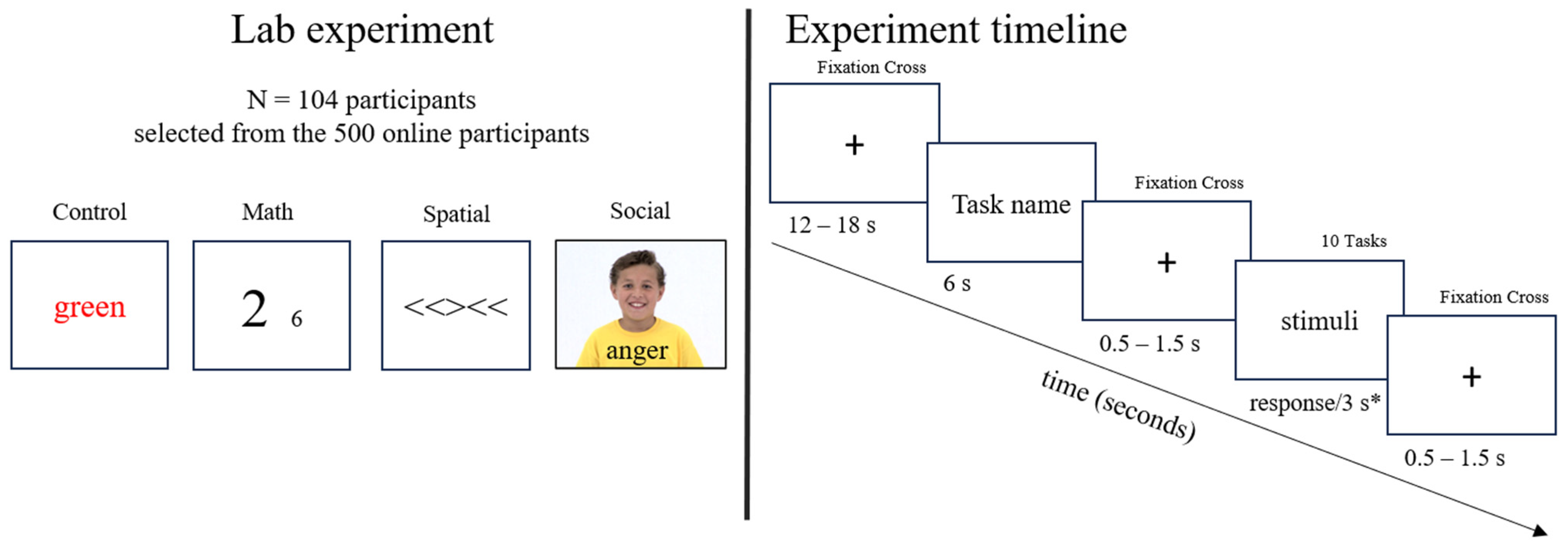
Anxiety is a multidimensional construct that influences cognitive performance in complex ways, yet its factor structure and domain-specific effects remain unclear. This study examined (1) the psychometric structure of general and specific anxiety measures, (2) their associations with cognitive performance across different domains, and (3) the predictive power of machine learning models in classifying cognitive performance based on specific anxiety in different domains. A two-stage design was employed: Stage 1 (N = 500) assessed self-reported anxiety (trait, state, generalized, social, spatial, and math anxiety) via questionnaires, while Stage 2 (N = 104) involved a set of experiments measuring cognitive performance (accuracy and reaction time) across numerical, social, spatial, and control tasks. Factor analyses revealed a correlated yet distinct structure. The model treating anxiety measures as independent factors showed the best fit among tested alternatives; however, all CFA models exhibited suboptimal absolute fit indices (TLI/CFI < 0.73). Regression analyses also demonstrated domain-specific effects: after controlling for state and generalized anxiety, trait anxiety showed small but statistically significant positive associations with performance on the social task (OR = 1.03) and spatial task (OR = 1.07). Machine learning models (Random Forest, Decision Trees, SVM) demonstrated limited predictive accuracy, with ensemble methods outperforming linear models. Prediction of reaction time in cognitive tasks, based on anxiety measures, was less powerful, suggesting that non-anxiety factors play a larger role in cognitive performance. These findings highlight the importance of distinguishing between general and domain-specific anxieties in cognitive research and demonstrate the potential of a machine learning approach in modeling anxiety–performance relationships.
Keywords: anxiety; cognitive performance; reaction time; factor analysis; Stroop task anxiety; cognitive performance; reaction time; factor analysis; Stroop task