Investigating Oral Health Information Avoidance Among Chinese Young Adults: The Roles of Subjective Norms, Message Fatigue, and Loss Aversion—A Cross-Sectional Study


Abstract
1. Introduction
2. Literature Review
2.1. Prospect Theory
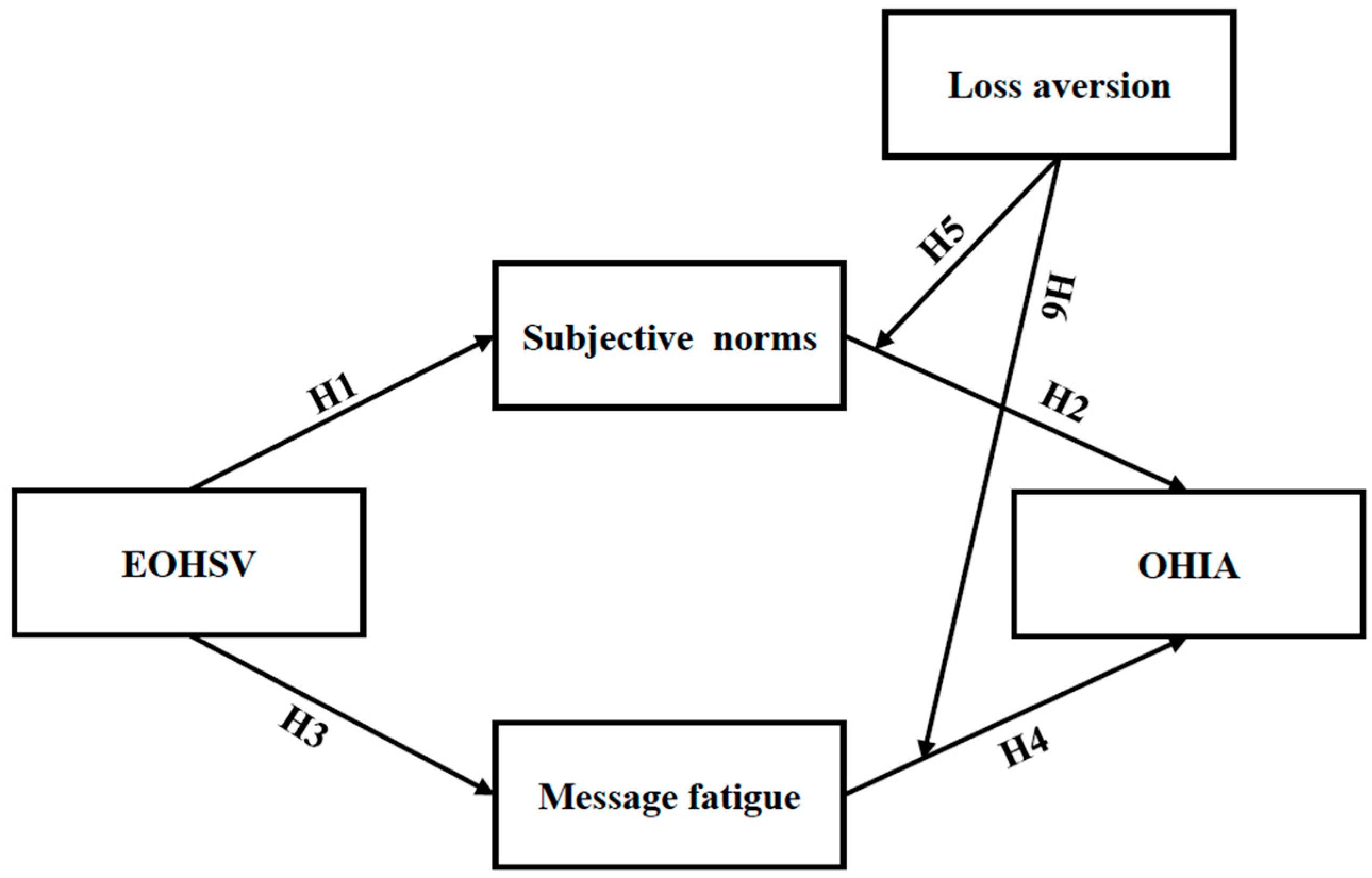
2.2. Mediation Role of Subjective Norms
2.3. Mediation Role of Message Fatigue
2.4. Moderation Role of Loss Aversion
3. Materials and Methods
3.1. Questionnaire Design
3.2. Measurement of Variables
4. Results
4.1. Validity Tests
4.2. Descriptive Data
4.3. Hypothesis Testing
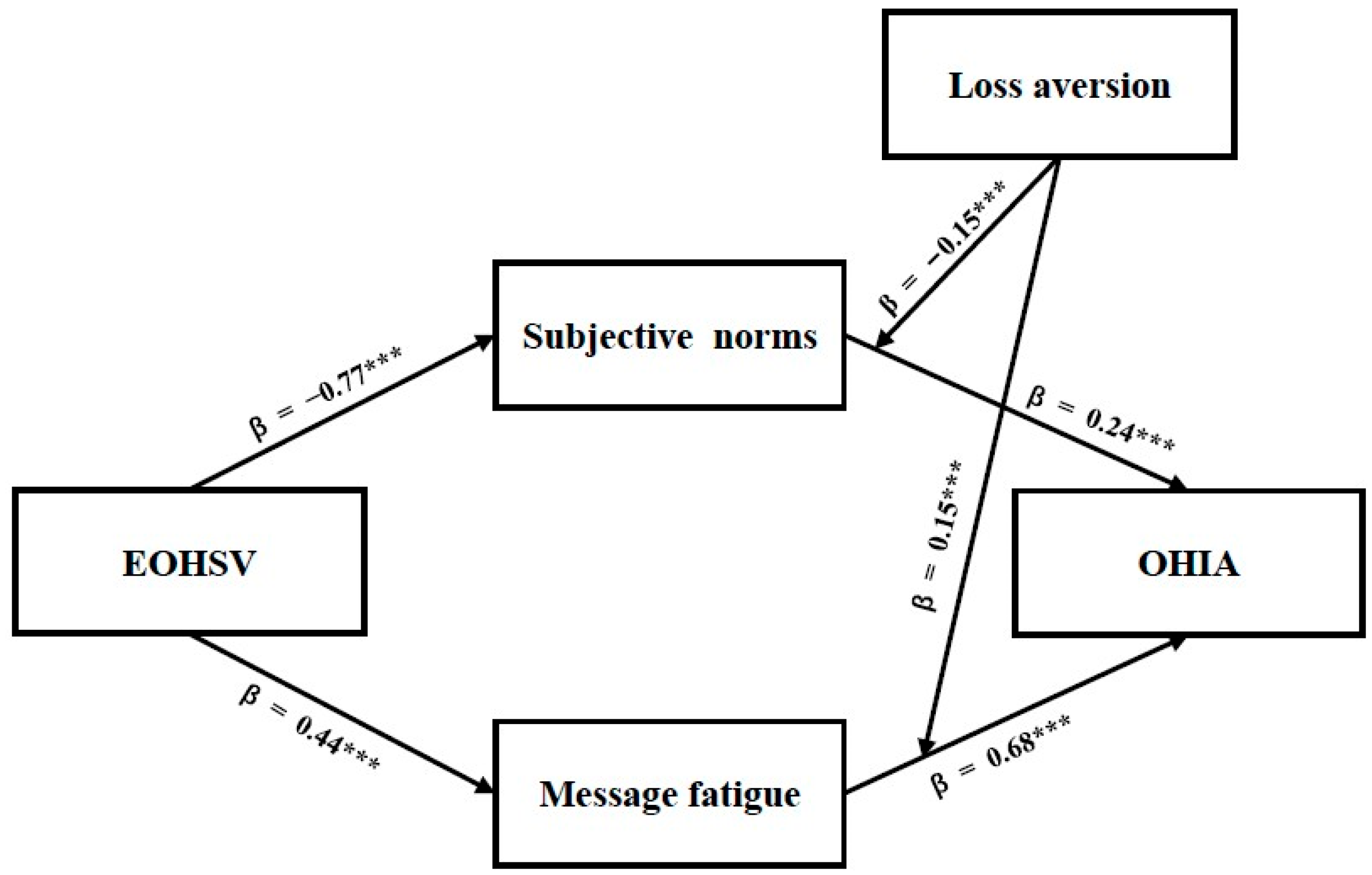
4.3.1. Path Analysis Tests
4.3.2. Mediation Analysis Test
4.3.3. Moderation Analysis Test
5. Discussion
5.1. Interpretation of Main Findings
5.2. Theoretical Implications
5.3. Practical Implications
5.4. Limitations
6. Conclusions
Author Contributions
Funding
Institutional Review Board Statement
Informed Consent Statement
Data Availability Statement
Conflicts of Interest
Abbreviations
| EOHSV | Engagement with oral health short videos |
| OHIA | Oral health information avoidance |
| CFA | Confirmatory factor analysis |
| CR | Composite reliability |
| AVE | Average variance extracted |
| TPB | Theory of Planned Behavior |
Appendix A

| Construct | Items | Factor Loadings | CA | CR | AVE |
|---|---|---|---|---|---|
| EOHSV | EOHSV1 | 0.77 | 0.94 | 0.94 | 0.73 |
| EOHSV2 | 0.85 | ||||
| EOHSV3 | 0.90 | ||||
| EOHSV4 | 0.89 | ||||
| EOHSV5 | 0.81 | ||||
| EOHSV6 | 0.84 | ||||
| EOHSV7 | 0.88 | ||||
| Subjective norms | SN1 | 0.84 | 0.92 | 0.94 | 0.80 |
| SN2 | 0.91 | ||||
| SN3 | 0.93 | ||||
| SN4 | 0.88 | ||||
| Message fatigue | MF1 | 0.80 | 0.91 | 0.93 | 0.73 |
| MF2 | 0.77 | ||||
| MF3 | 0.89 | ||||
| MF4 | 0.89 | ||||
| MF5 | 0.90 | ||||
| Loss aversion | LA1 | 0.88 | 0.89 | 0.92 | 0.75 |
| LA2 | 0.89 | ||||
| LA3 | 0.84 | ||||
| LA4 | 0.85 | ||||
| OHIA | OHIA1 | 0.91 | 0.94 | 0.95 | 0.85 |
| OHIA2 | 0.92 | ||||
| OHIA3 | 0.93 | ||||
| OHIA4 | 0.91 |
References
- Adonis, L. (2015). Screening practices of a health insured population and the role of behavioural economics. University of the Witwatersrand. [Google Scholar]
- Ahn, J., & Kahlor, L. A. (2023). When experts offer conflicting information: A study of perceived ambiguity, information insufficiency, trustworthiness and risk information behaviors. Health Communication, 38(14), 3276–3286. [Google Scholar] [CrossRef] [Scilit]
- Ajzen, I. (1991). The theory of planned behavior. Organizational Behavior and Human Decision Processes, 50(2), 179–211. [Google Scholar] [CrossRef] [Scilit]
- Akbari, H., Bahrami, A., Bidgoli, S. D., & Hosseini, A. (2023). Using structural equation modelling to predict safety and health status among stone industries. La Medicina Del Lavoro, 114(1), e2023005. [Google Scholar] [CrossRef] [Scilit]
- Andersen, K. (2022). Realizing good intentions? A field experiment of slow news consumption and news fatigue. Journalism Practice, 16(5), 848–863. [Google Scholar] [CrossRef] [Scilit]
- Anyikwa, C. L., & Ogwo, C. E. (2025). Enhancing oral health outcomes through public health policy reform. Frontiers in Oral Health, 6, 1604465. [Google Scholar] [CrossRef] [Scilit]
- Arora, M., & Kumari, S. (2015). Risk taking in financial decisions as a function of age, gender: Mediating role of loss aversion and regret. International Journal of Applied Psychology, 5(4), 83–89. [Google Scholar]
- Borah, P., & Xiao, X. (2018). The importance of ‘likes’: The interplay of message framing, source, and social endorsement on credibility perceptions of health information on Facebook. Journal of Health Communication, 23(4), 399–411. [Google Scholar] [CrossRef] [Scilit] [PubMed]
- Broder, H. L., McGrath, C., & Cisneros, G. J. (2007). Questionnaire development: Face validity and item impact testing of the child oral health impact profile. Community Dentistry and Oral Epidemiology, 35, 8–19. [Google Scholar] [CrossRef] [Scilit]
- Chan, M., Lee, F. L., & Chen, H.-T. (2024). Avoid or authenticate? A multilevel cross-country analysis of the roles of fake news concern and news fatigue on news avoidance and authentication. Digital Journalism, 12(3), 356–375. [Google Scholar] [CrossRef] [Scilit]
- Chan, M., Matthes, J., & Bojić, L. (2026). Examining perceived generative AI valence on social media and its implications on generative AI attitudes and uses among young adults. A cross-national comparison. Online Media and Global Communication. Advance online publication. [Google Scholar] [CrossRef] [Scilit]
- Chan, W. S. H. (2024). The role of oral health in the prevention of systemic diseases. Universal Library of Medical and Health Sciences, 1(1), 32–40. [Google Scholar] [CrossRef] [Scilit]
- Cristello, J. V., Litt, D. M., Sutherland, M. T., & Trucco, E. M. (2024). Subjective norms as a mediator between exposure to online alcohol and marijuana content and offline use among adolescents. Drug and Alcohol Review, 43(1), 111–121. [Google Scholar] [CrossRef] [Scilit]
- De Baets, S., & Buelens, M. (2012). Development of the loss aversion questionnaire. Available online: https://research.ou.nl/en/publications/development-of-the-loss-aversion-questionnaire/ (accessed on 15 January 2026).
- Duan, Y., Shang, B., Liang, W., Lin, Z., Hu, C., Baker, J. S., Wang, Y., & He, J. (2022). Predicting hand washing, mask wearing and social distancing behaviors among older adults during the COVID-19 pandemic: An integrated social cognition model. BMC Geriatrics, 22(1), 91. [Google Scholar] [CrossRef] [Scilit]
- Felgner, S., Dreger, M., & Henschke, C. (2022). Reasons for (not) choosing dental treatments—A qualitative study based on patients’ perspective. PLoS ONE, 17(5), e0267656. [Google Scholar] [CrossRef] [Scilit] [PubMed]
- Ford, J. L., Douglas, M., & Barrett, A. K. (2023). The role of pandemic fatigue in seeking and avoiding information on COVID-19 among young adults. Health Communication, 38(11), 2336–2349. [Google Scholar] [CrossRef] [Scilit] [PubMed]
- Franklin, M. (2024). 200+ dental industry statistics for 2024. Available online: https://www.followapp.care/200-dental-industry-statistics-for-2024/ (accessed on 1 January 2026).
- Gal, D., & Rucker, D. D. (2018). The loss of loss aversion: Will it loom larger than its gain? Journal of Consumer Psychology, 28(3), 497–516. [Google Scholar] [CrossRef] [Scilit]
- Goldberg, E., Eberhard, J., Bauman, A., & Smith, B. J. (2022). Mass media campaigns for the promotion of oral health: A scoping review. BMC Oral Health, 22(1), 182. [Google Scholar] [CrossRef] [Scilit] [PubMed]
- Guo, Y., Lu, Z., Kuang, H., & Wang, C. (2020). Information avoidance behavior on social network sites: Information irrelevance, overload, and the moderating role of time pressure. International Journal of Information Management, 52, 102067. [Google Scholar] [CrossRef] [Scilit]
- Gupta, S., & Shrivastava, M. (2022). Herding and loss aversion in stock markets: Mediating role of fear of missing out (FOMO) in retail investors. International Journal of Emerging Markets, 17(7), 1720–1737. [Google Scholar] [CrossRef] [Scilit]
- Hickerson, H., & Stamps, D. (2023). COVID-19, digital media, and health|health messaging and social media: An examination of message fatigue, race, and emotional outcomes among black audiences. International Journal of Communication, 17, 20. [Google Scholar]
- Hou, T., Zhang, T., Cai, W., Song, X., Chen, A., Deng, G., & Ni, C. (2020). Social support and mental health among health care workers during Coronavirus Disease 2019 outbreak: A moderated mediation model. PLoS ONE, 15(5), e0233831. [Google Scholar] [CrossRef] [Scilit] [PubMed]
- Howell, J. L., Lipsey, N. P., & Shepperd, J. A. (2020). Health information avoidance. In The Wiley encyclopedia of health psychology (pp. 279–286). John Wiley & Sons Ltd. [Google Scholar]
- Howell, J. L., & Shepperd, J. A. (2017). Social exclusion, self-affirmation, and health information avoidance. Journal of Experimental Social Psychology, 68, 21–26. [Google Scholar] [CrossRef] [Scilit]
- Huang, M.-N., Lu, H., Huang, M.-Y., Li, C.-Y., Zheng, Y.-M., Wang, D., & Tang, S.-J. (2025). The content quality and educational significance of early childhood caries on short video platforms. BMC Public Health, 25(1), 1713. [Google Scholar] [CrossRef] [Scilit]
- Kahneman, D., & Tversky, A. (2013). Prospect theory: An analysis of decision under risk. In Handbook of the fundamentals of financial decision making: Part I (pp. 99–127). World Scientific. [Google Scholar]
- Kang, M., & Park, C. (2025). Moderated mediating effects of supervisory consideration on the effects of desire for achievement for married female workers on work-family conflict and turnover intention. Asia-Pacific Journal of Convergent Research Interchange, 11(3), 107–130. [Google Scholar] [CrossRef] [Scilit]
- Keshavarzi, A., Asadi, S., Asadollahi, A., Mohammadkhah, F., & Khani Jeihooni, A. (2022). Tendency to breast cancer screening among rural women in Southern Iran: A structural equation modeling (SEM) analysis of theory of planned behavior. Breast Cancer: Basic and Clinical Research, 16, 11782234221121001. [Google Scholar] [CrossRef] [Scilit]
- Kim, H. S. (2021). How message features and social endorsements affect the longevity of news sharing. Digital Journalism, 9(8), 1162–1183. [Google Scholar] [CrossRef] [Scilit]
- Kumar, A., & Pandey, M. (2023). Social media and impact of altruistic motivation, egoistic motivation, subjective norms, and ewom toward green consumption behavior: An empirical investigation. Sustainability, 15(5), 4222. [Google Scholar] [CrossRef] [Scilit]
- Lam, J. Y., & Lin, S. H. (2025). Unravelling moderated mediating effects of loss aversion, information avoidance and self-efficacy on cancer fear and cancer screening. Health Information & Libraries Journal, 42(1), 14–25. [Google Scholar]
- Li, X., Dai, J., Zhu, X., Li, J., He, J., Huang, Y., Liu, X., & Shen, Q. (2023). Mechanism of attitude, subjective norms, and perceived behavioral control influence the green development behavior of construction enterprises. Humanities and Social Sciences Communications, 10(1), 266. [Google Scholar] [CrossRef] [Scilit]
- Link, E. (2021). Information avoidance during health crises: Predictors of avoiding information about the COVID-19 pandemic among German news consumers. Information Processing & Management, 58(6), 102714. [Google Scholar] [CrossRef] [Scilit]
- Liu, H., Lai, G., Shi, G., & Zhong, X. (2022). The influencing factors of HIV-preventive behavior based on health belief model among HIV-negative MSMs in Western China: A structural equation modeling analysis. International Journal of Environmental Research and Public Health, 19(16), 10185. [Google Scholar] [CrossRef] [Scilit] [PubMed]
- Liu, Y., Cai, L., Ma, F., & Wang, X. (2023). Revenge buying after the lockdown: Based on the SOR framework and TPB model. Journal of Retailing and Consumer Services, 72, 103263. [Google Scholar] [CrossRef] [Scilit]
- Lu, M., Wang, X., Ye, H., Wang, H., Qiu, S., Zhang, H., Liu, Y., Luo, J., & Feng, J. (2021). Does public fear that bats spread COVID-19 jeopardize bat conservation? Biological Conservation, 254, 108952. [Google Scholar] [CrossRef] [Scilit] [PubMed]
- Mao, B., Jia, X., & Huang, Q. (2024). How do information overload and message fatigue reduce information processing in the era of COVID-19? An ability–motivation approach. Journal of Information Science, 50(5), 1242–1254. [Google Scholar] [CrossRef] [Scilit]
- Ng, T. K., Lo, M. F., Fong, B. Y., & Yee, H. H. (2022). Predictors of the intention to use traditional Chinese medicine (TCM) using extended theory of planned behavior: A cross-sectional study among TCM users in Hong Kong. BMC Complementary Medicine and Therapies, 22(1), 113. [Google Scholar] [CrossRef] [Scilit]
- Nuriddinovna, I. G. (2025). Dental diseases and damage from them. American Journal of Social Sciences and Humanity Research, 5(5), 135–138. [Google Scholar] [CrossRef] [Scilit]
- Oktavianus, J., & Bautista, J. R. (2023). Motivating healthcare professionals to correct online health misinformation: The roles of subjective norm, third-person perception, and channel differences. Computers in Human Behavior, 147, 107839. [Google Scholar] [CrossRef] [Scilit]
- Orom, H., & Allard, N. C. (2025). Information avoidance is associated with lower willingness to be screened for dementia. Journal of Alzheimer’s Disease, 108(1), 421–427. [Google Scholar] [CrossRef] [Scilit]
- Orom, H., Schofield, E., Kiviniemi, M. T., Waters, E. A., Biddle, C., Chen, X., Li, Y., Kaphingst, K. A., & Hay, J. L. (2018). Low health literacy and health information avoidance but not satisficing help explain “don’t know” responses to questions assessing perceived risk. Medical Decision Making, 38(8), 1006–1017. [Google Scholar] [CrossRef] [Scilit]
- Ou, M., Zheng, H., Kim, H. K., & Chen, X. (2023). A meta-analysis of social media fatigue: Drivers and a major consequence. Computers in Human Behavior, 140, 107597. [Google Scholar] [CrossRef] [Scilit]
- Patterson-Norrie, T., Ramjan, L., Sousa, M. S., & George, A. (2023). Oral health and individuals with a lived experience of an eating disorder: A qualitative study. Journal of Eating Disorders, 11(1), 121. [Google Scholar] [CrossRef] [Scilit]
- Persoskie, A., Ferrer, R. A., & Klein, W. M. (2014). Association of cancer worry and perceived risk with doctor avoidance: An analysis of information avoidance in a nationally representative US sample. Journal of Behavioral Medicine, 37(5), 977–987. [Google Scholar] [CrossRef] [Scilit]
- Qiu, L. (2025). Pro-environment behavior in China: Unveiling the role of self and collective efficacy, individual and social norms. Frontiers in Psychology, 16, 1696917. [Google Scholar] [CrossRef] [Scilit]
- Ranjbar, P., Hashemian, M., Ghassabi, F., & Zare-Farashbandi, F. (2023). Reasons and factors for avoiding health information among health services providers and recipients: A scoping review. Journal of Health Administration, 26(1), 30–50. [Google Scholar]
- Schivinski, B., Christodoulides, G., & Dabrowski, D. (2016). Measuring consumers’ engagement with brand-related social-media content: Development and validation of a scale that identifies levels of social-media engagement with brands. Journal of Advertising Research, 56(1), 64–80. [Google Scholar] [CrossRef] [Scilit]
- Schumann, C. (2022). When news topics annoy—Exploring issue fatigue and subsequent information avoidance and extended coping strategies. Journalism and Media, 3(3), 538–556. [Google Scholar] [CrossRef] [Scilit]
- Seo, H., Harn, R.-W., Ebrahim, H., & Aldana, J. (2016). International students’ social media use and social adjustment. First Monday, 21(11), 1–18. [Google Scholar] [CrossRef] [Scilit]
- Sharma, S., Mohanty, V., Balappanavar, A. Y., Chahar, P., Rijhwani, K., & Balappanavar, A. (2022). Role of digital media in promoting oral health: A systematic review. Cureus, 14(9), e28893. [Google Scholar] [CrossRef] [Scilit] [PubMed]
- Shi, N., Xiu, S., Wang, J., Shen, Y., & Jin, H. (2025). Subjective norms and perceived behavior control are more critical than attitudes in HPV vaccination: An investigation in China. Vaccine, 65, 127800. [Google Scholar] [CrossRef] [Scilit] [PubMed]
- Shittu, I., & Salisu, Y. (2023). Attitude, subjective norm, perceived behavioural control and digital ṣukūk adoption in Nigeria: The mediating effect of awareness. ISRA International Journal of Islamic Finance, 15(2), 4–19. [Google Scholar] [CrossRef] [Scilit]
- So, J., Kim, S., & Cohen, H. (2017). Message fatigue: Conceptual definition, operationalization, and correlates. Communication Monographs, 84(1), 5–29. [Google Scholar] [CrossRef] [Scilit]
- Song, H., Jung, J., & Kim, Y. (2017). Perceived news overload and its cognitive and attitudinal consequences for news usage in South Korea. Journalism & Mass Communication Quarterly, 94(4), 1172–1190. [Google Scholar]
- Soroya, S. H., Farooq, A., Mahmood, K., Isoaho, J., & Zara, S.-E. (2021). From information seeking to information avoidance: Understanding the health information behavior during a global health crisis. Information Processing & Management, 58(2), 102440. [Google Scholar] [CrossRef] [Scilit]
- Strathdee, S. A., Abramovitz, D., Vera, C. F., Artamonova, I., Patterson, T. L., Smith, D. M., Chaillon, A., & Bazzi, A. R. (2023). Predictors of COVID-19 vaccine uptake among people who inject drugs. Vaccine, 41(12), 1916–1924. [Google Scholar] [CrossRef] [Scilit] [PubMed]
- Sun, J., Ahmad Ghazali, A. H., & Saiful Nujaimi Abdul, R. (2025). Imagined audiences and social media fatigue among young adults: The mediating role of impression management. Sage Open, 15(4), 21582440251397448. [Google Scholar] [CrossRef] [Scilit]
- Sun, Y. (2025). Fluoride science popularization: A study of public awareness and health communication driven by short video. Fluoride, 58(12), 1–13. [Google Scholar]
- Sweeny, K., Melnyk, D., Miller, W., & Shepperd, J. A. (2010). Information avoidance: Who, what, when, and why. Review of General Psychology, 14(4), 340–353. [Google Scholar] [CrossRef] [Scilit]
- TX. (2025). Notice of the general office of the national health commission on launching the 2025 “national love teeth day” public awareness campaign. Available online: https://mp.weixin.qq.com/s/n4sEBTaZIJWAW8vydclzZQ (accessed on 10 September 2025).
- Wang, J., & Ali, S. K. B. S. (2025). A systematic review of the relationships between attitude, subjective norms, perceived behavioral control, and exercise intention. The Open Public Health Journal, 18(1), e18749445394456. [Google Scholar]
- WHO. (2025). Oral health. Available online: https://www.who.int/news-room/fact-sheets/detail/oral-health (accessed on 17 March 2025).
- Wu, X., & Kuang, W. (2021). Exploring influence factors of WeChat users’ health information sharing behavior: Based on an integrated model of TPB, UGT and SCT. International Journal of Human–Computer Interaction, 37(13), 1243–1255. [Google Scholar] [CrossRef] [Scilit]
- Xu, B., & Hwang, J.-Y. (2025). How food literacy levels shape healthy eating intentions: A cross-sectional study of adults in Shandong Province, China, using the theory of planned behavior. Nutrition Research and Practice, 19(4), 566–576. [Google Scholar] [CrossRef] [Scilit]
- Yarmohammadi, S., Mousavi, S., Ajori, L., Mohammadzade, F., & Marashi, T. (2023). Impact of attitude, subjective norms and perceived behavioral control on health behaviors among women with low-risk HPV, and the mediating role of behavioral intention: An interventional study. International Journal of Health Promotion and Education, 61(2), 70–82. [Google Scholar] [CrossRef] [Scilit]
- Yu, J., Zhu, H., Zhang, Y., Wang, D., Guo, H., Liu, X., Lai, J., Zhang, H., Xu, H., & Bai, B. (2024). The relationship between dysphagia and frailty among Chinese hospitalized older patients: A serial mediation model through self-perceived oral health and self-reported nutritional status. BMC Geriatrics, 24(1), 110. [Google Scholar] [CrossRef] [Scilit] [PubMed]
- Yu, S., Huang, S., Song, S., Lin, J., & Liu, F. (2024). Impact of oral health literacy on oral health behaviors and outcomes among the older adults: A scoping review. BMC Geriatrics, 24(1), 858. [Google Scholar] [CrossRef] [Scilit]
- Zammit, G. (2024). Exploring the behaviours and attitudes related to dental anxiety in sufferers of mental health, who seek dental treatment. University of Malta. [Google Scholar]
- Zaremohzzabieh, Z., Samah, A. A., Roslan, S., Shaffril, H. A. M., D’Silva, J. L., Kamarudin, S., & Ahrari, S. (2021). Household preparedness for future earthquake disaster risk using an extended theory of planned behavior. International Journal of Disaster Risk Reduction, 65, 102533. [Google Scholar] [CrossRef] [Scilit]
- ZGQN. (2024). Short videos become key channel for knowledge disseation; Over 90% of respondents use them for learning. Available online: https://baijiahao.baidu.com/s?id=1800456366983173398&wfr=spider&for=pc (accessed on 1 February 2026).
- Zhang, L. (2022). Impact of psychological contract breach on firm’s innovative performance: A moderated mediation model. Frontiers in Psychology, 13, 970622. [Google Scholar] [CrossRef] [Scilit]
- Zhang, S.-Y., Zhu, J.-L., Zhou, Y.-L., Lu, W.-F., & Su, H.-R. (2024). Clinical study on guiding parents to promote oral health of pre-school children through self-made oral science video. Shanghai Journal of Stomatology, 33(5), 500. [Google Scholar]
- Zhong, F., & Gu, C. (2024). The impact of health information echo chambers on older adults avoidance behavior: The mediating role of information fatigue and the moderating role of trait mindfulness. Frontiers in Psychology, 15, 1412515. [Google Scholar] [CrossRef] [Scilit]
- Zhu, R., Zhao, H., Yun, Y., Zhao, Y., Wang, W., Wang, L., Hou, W., & Wang, F. (2024). Research on health information avoidance behavior and influencing factors of cancer patients—An empirical analysis based on structural equation modeling. BMC Public Health, 24(1), 3617. [Google Scholar] [CrossRef] [Scilit] [PubMed]
- Zou, X., Chen, Q., Zhang, Y., & Evans, R. (2023). Predicting COVID-19 vaccination intentions: The roles of threat appraisal, coping appraisal, subjective norms, and negative affect. BMC Public Health, 23(1), 230. [Google Scholar] [CrossRef] [Scilit]
- ZT. (2023). Severely damaged teeth: Is it time to act? Available online: https://mp.weixin.qq.com/s/2ioZm7BLtinbT2WU75QXLg (accessed on 28 January 2026).


| Factors | 1 | 2 | 3 | 4 | 5 |
|---|---|---|---|---|---|
| EOHSV | 0.85 | ||||
| Subjective norms | −0.77 ** | 0.89 | |||
| Message fatigue | 0.44 ** | −0.38 ** | 0.85 | ||
| Loss aversion | 0.27 ** | −0.16 ** | 0.61 ** | 0.86 | |
| OHIA | 0.28 ** | −0.16 ** | 0.63 ** | 0.76 ** | 0.92 |
| Factors | 1 | 2 | 3 | 4 | 5 |
|---|---|---|---|---|---|
| EOHSV | |||||
| Subjective norms | 0.83 | ||||
| Message fatigue | 0.47 | 0.41 | |||
| Loss aversion | 0.29 | 0.18 | 0.68 | ||
| OHIA | 0.30 | 0.17 | 0.68 | 0.83 |
| Pathways | β | t | p | LLCI | ULCI |
|---|---|---|---|---|---|
| Mediation analysis | |||||
| EOHSV → subjective norms → OHIA | −0.16 | 5.25 | p < 0.001 | −0.28 | −0.05 |
| EOHSV → message fatigue → OHIA | 0.27 | 5.25 | p < 0.001 | 0.19 | 0.35 |
| Moderation analysis | |||||
| Loss aversion × subjective norms → OHIA | −0.15 | −4.83 | p < 0.001 | −0.21 | −0.08 |
| Loss aversion × message fatigue → OHIA | 0.15 | 4.62 | p < 0.001 | 0.08 | 0.21 |
Disclaimer/Publisher’s Note: The statements, opinions and data contained in all publications are solely those of the individual author(s) and contributor(s) and not of MDPI and/or the editor(s). MDPI and/or the editor(s) disclaim responsibility for any injury to people or property resulting from any ideas, methods, instructions or products referred to in the content. |
© 2026 by the authors. Licensee MDPI, Basel, Switzerland. This article is an open access article distributed under the terms and conditions of the Creative Commons Attribution (CC BY) license.
Share and Cite
Liu, D.; Chung, D.; Meng, Y.; Wang, J. Investigating Oral Health Information Avoidance Among Chinese Young Adults: The Roles of Subjective Norms, Message Fatigue, and Loss Aversion—A Cross-Sectional Study. Behav. Sci. 2026, 16, 704. https://doi.org/10.3390/bs16050704
Liu D, Chung D, Meng Y, Wang J. Investigating Oral Health Information Avoidance Among Chinese Young Adults: The Roles of Subjective Norms, Message Fatigue, and Loss Aversion—A Cross-Sectional Study. Behavioral Sciences. 2026; 16(5):704. https://doi.org/10.3390/bs16050704
Chicago/Turabian StyleLiu, Dehuan, Donghwa Chung, Yanfang Meng, and Jiaqi Wang. 2026. "Investigating Oral Health Information Avoidance Among Chinese Young Adults: The Roles of Subjective Norms, Message Fatigue, and Loss Aversion—A Cross-Sectional Study" Behavioral Sciences 16, no. 5: 704. https://doi.org/10.3390/bs16050704
APA StyleLiu, D., Chung, D., Meng, Y., & Wang, J. (2026). Investigating Oral Health Information Avoidance Among Chinese Young Adults: The Roles of Subjective Norms, Message Fatigue, and Loss Aversion—A Cross-Sectional Study. Behavioral Sciences, 16(5), 704. https://doi.org/10.3390/bs16050704