A Randomized Controlled Trial on the Effects of Anticipated Regret on Pro-Environmental Behaviors


 , ,
, , 
Abstract
1. Introduction
Aims
2. Methods
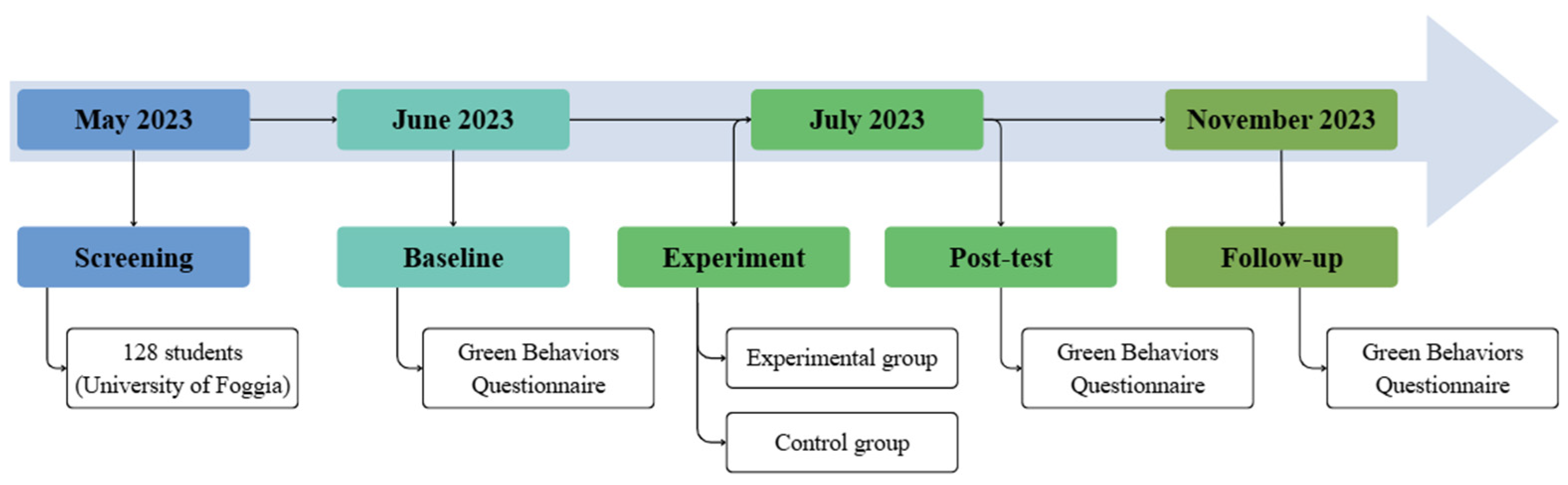
2.1. Research Design
2.1.1. Screening and Exclusion Criteria
2.1.2. Procedure
2.2. Sample
2.3. Materials
2.3.1. Self-Report Measures
2.3.2. EkoTok
2.4. Data Analysis
3. Results
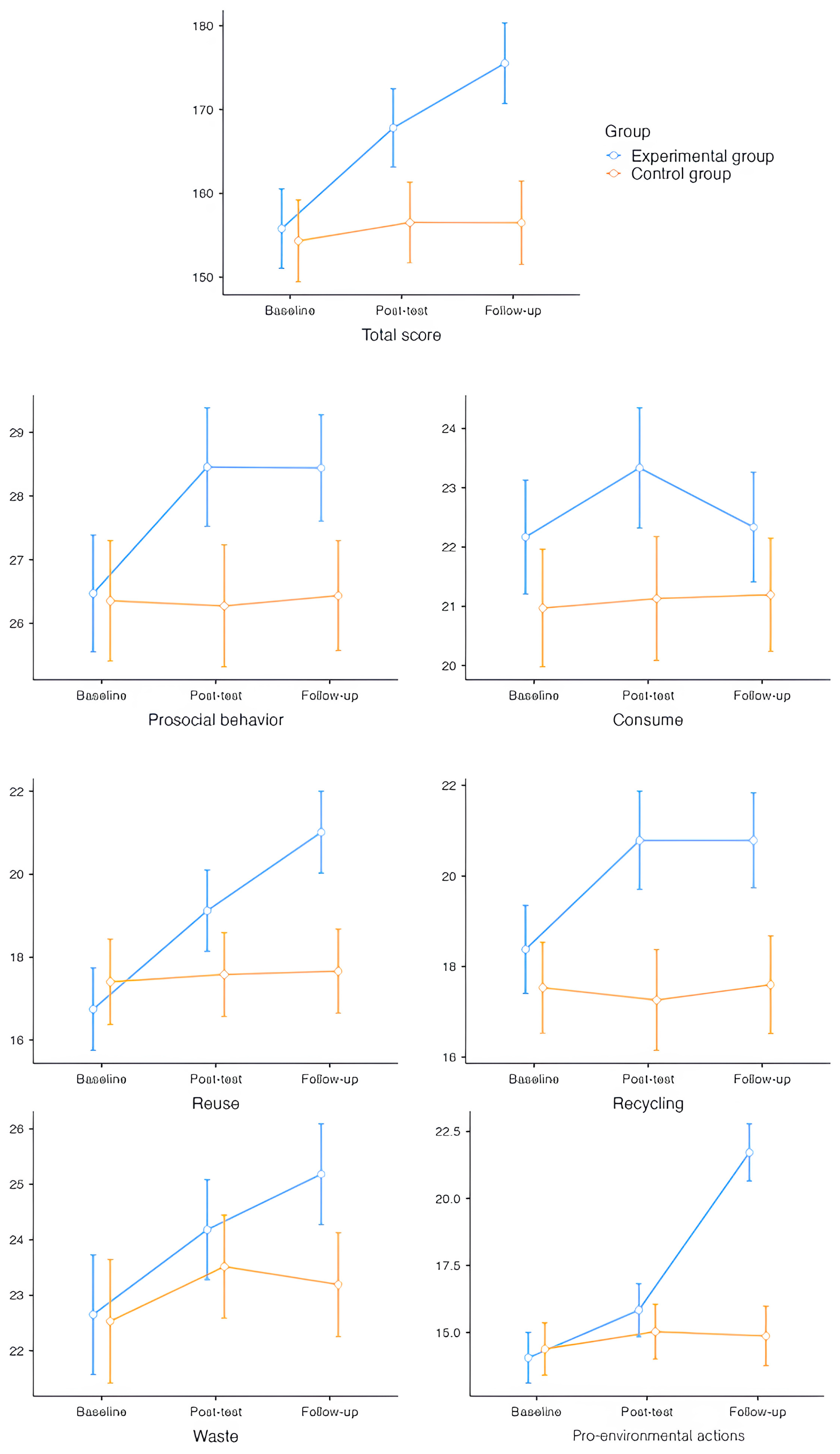
3.1. Repeated Measures ANCOVA
3.2. Differences Between Groups on Post-Intervention Psychological Outcomes
4. Discussion
4.1. Short-Term Effects: Baseline vs. Post-Test
4.2. Long-Term Effects: Baseline vs. Follow-Up
4.3. Post-Test vs. Follow-Up
4.4. Non-Significant Results: Purchase and Mobility
5. Limitations and Future Implications
6. Conclusions
Author Contributions
Funding
Institutional Review Board Statement
Informed Consent Statement
Data Availability Statement
Acknowledgments
Conflicts of Interest
Abbreviations
| ANCOVA(s) | Analysis of covariance(s) |
| CG | Control group |
| EAT-26 | Eating Attitudes Test-26 |
| EG | Experimental group |
| ES | Effect size |
| MC-SDS | Marlowe–Crowne Social Desirability Scale |
| N | Sample size |
| SAS | Self-Rating Anxiety Scale |
| SD | Standard deviation |
| SDGs | Sustainable Development Goals |
| SES | Socio-economic status |
| SPSS | The Statistical Package for the Social Sciences |
| A | Cronbach’s alpha |
| Ω | McDonald’s omega |
Appendix A

| N | Measures | Phrases |
|---|---|---|
| 1 | All Dimensions | All groups: “The concentration of CO2 causes a global rise in temperature which in turn makes floods, droughts, hydrogeological instability, the spread of diseases, crises in agricultural systems, water crises and the extinction of animal and plant species more and more frequent. Consumption choices and daily behaviors (such as recycling, reuse, mobility and waste reduction) have a constant impact on the environment”. EG: You may regret not reducing your CO2 emissions, for example by carefully choosing the products to purchase and consume, recycling using products rather than throwing them away, reducing waste of domestic energy or car use in the city especially for short trips. Think about all this. See you tomorrow! |
| 2 | Waste | All Groups: energy use is responsible for 77.1% of greenhouse gas emissions and therefore global warming; domestic uses account for 29% of world energy consumption and therefore global warming, in particular technological equipment. EG: You may regret not reducing domestic water or energy consumption (for example by leaving lights on in unusable rooms or not turning off the PC if not in use); in fact, higher temperatures increase mortality, risk of severe droughts and forest fires, sea level rise and ocean acidification. See you tomorrow! |
| 3 | Mobility | All groups: At this moment there are millions and millions of trains, ships, planes, cars, trucks, buses, trams, motorbikes… We all move, constantly. According to a recent estimate, in 2019 in Italy alone, road transport contributed 23% to greenhouse gas emissions, of which almost 70% was attributable to cars… There are contexts in which, as we know, using the car is essential, but it is worth trying to reorganize those areas of your daily life where, with different measures, you can do without them. In fact, fuels, in addition to weighing on your wallet, contribute heavily to air pollution. EG: You might feel regret in not reducing these emissions in favor of greater sustainable mobility, for example by favoring public transport, pedestrian and cycle mobility, electric vehicles or shared mobility through car sharing apps (rental of short-term vehicles) or carpooling (sharing a private car with other travelers in order to reduce travel costs) Have a good trip… See you tomorrow! |
| 4 | Consumption | All groups: Not only human beings but also all the objects created by them, bought, and used involve the consumption of energy and resources and cause carbon emissions during all phases of the production, transport, sale, use and disposal cycle. Sustainable products have a low ecological footprint and are characterized by: …aspects are guaranteed by the presence of sustainability certifications of the products on the labels. EG: You might feel regret at not consuming sustainable products by not reading the label carefully before using them or even before purchasing them, to verify that all the information necessary to make ethical and ecologically responsible consumption choices is present. See you tomorrow! |
| 5 | Purchasing | All groups: Buying seasonal products has multiple benefits for consumers and the planet. Knowing the value of a product is not just about the price, but the origin and characteristics are of vital importance for responsible consumption. EG: You may have great regrets in not purchasing seasonal products or in not carefully reading the characteristics of the product you purchase. See you tomorrow! |
| 6 | Recycling, Consumption, Reuse | All groups: More than half of the tons of rubbish produced ends up in landfill, and the less degradable the components of each product are, the slower they will be to decompose, the longer they will remain in landfill sites, emitting greenhouse gases (90–98% methane and carbon dioxide) and, unfortunately, favoring climate change one of the most powerful weapons against pollution, an ally of environmental sustainability is you… EG…you may have regrets in not reducing your waste production (e.g., buying only what you need at the supermarket and planning your shopping list in advance) in not reusing your possessions instead of throwing them away or for example by taking advantage of recent apps to resell things you no longer use in not always and correctly recycling waste. Separate waste collection guarantees, in addition to a more efficient use of resources, also benefits the environment and the economy. The savings achieved are electricity, water and raw materials. See you tomorrow! |
| 7 | Purchasing | All groups: From the 1950s to today, meat consumption per capita has doubled. Half a billion animals are killed every day All of this is having major environmental repercussions. EG: You may have regrets about often purchasing red and processed meat, given that: (1) sheep and cattle produce methane gas, which strongly contributes to global warming. (2) intensive farming contributes to deforestation. (3) the classic Western meat-based diet requires the use of almost 16,000 L of water per day, while a plant-based diet requires only 1100 L. All this negatively affects global warming and will lead to large periods of drought See you tomorrow! |
| 8 | Waste, Reuse | All groups: More than a third of the food produced worldwide is thrown away. The waste is calculated at 1.4 billion tons of food products and 800 billion dollars. In addition to the waste of still edible foods, the resources to produce them are also wasted (energy, water, land use, fuel, workforce). On an economic level, approximately one trillion dollars of social, health and environmental costs caused by food waste must be accounted for. Loss of valuable biodiversity. EG: You might feel great regret at wasting and or throwing away food rather than reusing it or by organizing a responsible and well-organized purchase beforehand or by consuming the foods with the closest expiration dates first… See you tomorrow! |
| 9 | Pro-environmental actions | All groups: Every year it is estimated that unfortunately 4 to 12 million tons of plastic end up in the seas around the world, causing 80% of marine pollution. Bottles, bags, packaging, fishing nets, cigarette butts, pesticides… most of the waste produced by man ends up in one way or another in the sea, causing serious consequences for the health of waters, marine animal life and plants, producing perhaps irreparable damage to the food chain. EG: You may have great regrets about throwing waste into the sea or about not stopping someone else from doing so It’s not just a matter of mess and dirt. Plastic waste injures animals who may become trapped in the larger pieces or may even mistake the smaller parts for food. Ingesting plastic particles prevents the digestion of normal foods and can promote the presence of toxic chemical pollutants in their body; furthermore, humans eat plastic ingested by fish through the food chain. The effects this step has on human health are still unknown. Plastic waste also causes economic loss to those sectors and communities that depend on marine products. See you tomorrow! |
| 10 | All dimensions | “The concentration of CO2 causes a global rise in temperature which in turn makes floods, droughts, hydrogeological instability, the spread of diseases, crises in agricultural systems, water crises and the extinction of animal and plant species more and more frequent. Consumption choices and daily behaviors (such as recycling, reuse, mobility and waste reduction) have a constant impact on the environment”. Thank you for your participation; remember the importance of what you saw. EG: All I must do is make one last choice: See you tomorrow! Or see you tomorrow? You might regret your choice. |
References
- Ajzen, I. (1991). The theory of planned behavior. Organizational Behavior and Human Decision Processes, 50(2), 179–211. [Google Scholar] [CrossRef] [Scilit]
- Appannagari, R. R. (2017). Environmental pollution causes and consequences: A study. North Asian International Research Journal of Social Science & Humanities, 3(8), 151–161. [Google Scholar]
- Bandura, A. (1986). Social foundations of thought and action: A social cognitive theory. Prentice-Hall. [Google Scholar]
- Berenguer, J., Corraliza, J. A., & Martín, R. (2005). Rural-urban differences in environmental concern, attitudes, and actions. European Journal of Psychological Assessment, 21(2), 128–138. [Google Scholar] [CrossRef] [Scilit]
- Bocken, N., Miller, K., & Evans, S. (2016, June 16–17). Assessing the environmental impact of new circular business models. New Business Models Conference, Rotterdam, The Netherlands. [Google Scholar]
- Bradshaw, J., Martorano, B., Natali, L., & De Neubourg, C. (2013). Children’s subjective well-being in rich countries. Child Indicators Research, 6(4), 619–635. [Google Scholar] [CrossRef] [Scilit]
- Carfora, V., Caso, D., Palumbo, F., & Conner, M. (2018). Promoting water intake. the persuasiveness of a messaging intervention based on anticipated negative affective reactions and self-monitoring. Appetite, 130, 236–246. [Google Scholar] [CrossRef] [Scilit]
- Carfora, V., Caso, D., Sparks, P., & Conner, M. (2017). Moderating effects of pro-environmental self-identity on pro-environmental intentions and behaviour: A multi-behaviour study. Journal of Environmental Psychology, 53, 92–99. [Google Scholar] [CrossRef] [Scilit]
- Carfora, V., Catellani, P., Caso, D., & Conner, M. (2019). How to reduce red and processed meat consumption by daily text messages targeting environment or health benefits. Journal of Environmental Psychology, 65, 101319. [Google Scholar] [CrossRef] [Scilit]
- Chawla, L. (1999). Life paths into effective environmental action. The Journal of Environmental Education, 31(1), 15–26. [Google Scholar] [CrossRef] [Scilit]
- Cook, J., Nuccitelli, D., Green, S. A., Richardson, M., Winkler, B., Painting, R., Way, R., Jacobs, P., & Skuce, A. (2013). Quantifying the consensus on anthropogenic global warming in the scientific literature. Environmental Research Letters, 8(2), 024024. [Google Scholar] [CrossRef] [Scilit]
- De Young, R. (1985). Encouraging environmentally appropriate behavior: The role of intrinsic motivation. Journal of Environmental Systems, 15(4), 281–292. [Google Scholar] [CrossRef] [Scilit]
- Diekmann, A., & Preisendörfer, P. (1998). Environmental behavior: Discrepancies between aspirations and reality. Rationality and Society, 10(1), 79–102. [Google Scholar] [CrossRef] [Scilit]
- Dotti, A., & Lazzari, R. (1998). Validation and reliability of the Italian EAT-26. Eating and Weight Disorders—Studies on Anorexia, Bulimia and Obesity, 3(4), 188–194. [Google Scholar] [CrossRef] [Scilit]
- Evans, G. W., Otto, S., & Kaiser, F. G. (2018). Childhood origins of young adult environmental behavior. Psychological Science, 29(5), 679–687. [Google Scholar] [CrossRef] [Scilit]
- Garner, D. M., Olmstead, M. P., & Polivy, J. (1983). Development and validation of a multidimensional eating disorder inventory for anorexia nervosa and bulimia. International Journal of Eating Disorders, 2(2), 15–34. [Google Scholar] [CrossRef] [Scilit]
- Geraci, A., Franchin, L., & Benavides-Varela, S. (2023). Evaluations of pro-environmental behaviors by 7-month-old infants. Infant Behavior and Development, 72, 101865. [Google Scholar] [CrossRef] [Scilit]
- Geraci, A., Franchin, L., & Commodari, E. (2024). Evaluations of pro-environmental behaviours in preschool age. European Journal of Developmental Psychology, 21(5), 770–794. [Google Scholar] [CrossRef] [Scilit]
- Hollingshead, A. B. (1975). Four factor index of social status [Unpublished manuscript]. Yale University.
- Hu, C., & Wu, Z. (2022). They can and will: Preschoolers encourage pro-environmental behavior with rewards and punishments. Journal of Environmental Psychology, 82, 101842. [Google Scholar] [CrossRef] [Scilit]
- Hysa, B., Karasek, A., & Zdonek, I. (2021). Social media usage by different generations as a tool for sustainable tourism marketing in society 5.0 idea. Sustainability, 13(3), 1018. [Google Scholar] [CrossRef] [Scilit]
- IBM Corp. (2017). IBM SPSS statistics for windows (Version 25.0). IBM Corp.
- Innamorati, M., Lelli, M., Aiello, S., Di Lorenzo del Casale, F. L., Russo, S., & Ferrari, V. (2006). Validazione convergente e discriminante della versione italiana della Zung Self-Rating Depression Scale [Convergent and discriminant validation of the Italian version of the Zung Self-Rating Depression Scale]. Psicoterapia Cognitiva e Comportamentale, 12(3), 343–353. [Google Scholar]
- Kaiser, F. G., Wölfing, S., & Fuhrer, U. (1999). Environmental attitude and ecological behaviour. Journal of Environmental Psychology, 19(1), 1–19. [Google Scholar] [CrossRef] [Scilit]
- Kempton, W., Boster, J. S., & Hartley, J. A. (1995). Environmental values in American culture. MIT Press. [Google Scholar]
- Kollmuss, A., & Agyeman, J. (2002). Mind the gap: Why do people act environmentally and what are the barriers to pro-environmental behavior? Environmental Education Research, 8(3), 239–260. [Google Scholar] [CrossRef] [Scilit]
- Lally, P., Van Jaarsveld, C. H. M., Potts, H. W. W., & Wardle, J. (2010). How are habits formed: Modelling habit formation in the real world. European Journal of Social Psychology, 40(6), 998–1009. [Google Scholar] [CrossRef] [Scilit]
- Lange, F., & Dewitte, S. (2019). Measuring pro-environmental behavior: Review and recommendations. Journal of Environmental Psychology, 63, 92–100. [Google Scholar] [CrossRef] [Scilit]
- Lecci, L., Okun, M. A., & Karoly, P. (1994). Life regrets and current goals as predictors of psychological adjustment. Journal of Personality and Social Psychology, 66(4), 731–741. [Google Scholar] [CrossRef]
- Loomes, G., & Sugden, R. (1982). Regret theory: An alternative theory of rational choice under uncertainty. The Economy Journal, 92(368), 805. [Google Scholar] [CrossRef] [Scilit]
- Markle, G. L. (2013). Pro-environmental behavior: Does it matter how it’s measured? Development and validation of the pro-environmental behavior scale (PEBS). Human Ecology, 41(6), 905–914. [Google Scholar] [CrossRef] [Scilit]
- Newhouse, N. (1990). Implications of attitude and behavior research for environmental conservation. The Journal of Environmental Education, 22(1), 26–32. [Google Scholar] [CrossRef] [Scilit]
- O’Brien, C. (2008). Sustainable happiness: How happiness studies can contribute to a more sustainable future. Canadian Psychology/Psychologie Canadienne, 49(4), 289–295. [Google Scholar] [CrossRef] [Scilit]
- Onwezen, M. C., Bartels, J., & Antonides, G. (2014). The self-regulatory function of anticipated pride and guilt in a sustainable and healthy consumption context. European Journal of Social Psychology, 44(1), 53–68. [Google Scholar] [CrossRef] [Scilit]
- Otto, S., & Pensini, P. (2017). Nature-based environmental education of children: Environmental knowledge and connectedness to nature, together, are related to ecological behaviour. Global Environmental Change, 47, 88–94. [Google Scholar] [CrossRef] [Scilit]
- Parker, D., Stradling, S. G., & Manstead, A. S. R. (1996). Modifying beliefs and attitudes to exceeding the speed limit: An intervention study based on the theory of planned behavior. Journal of Applied Social Psychology, 26(1), 1–19. [Google Scholar] [CrossRef] [Scilit]
- Richard, R., Van Der Pligt, J., & De Vries, N. (1996). Anticipated regret and time perspective: Changing sexual risk-taking behavior. Journal of Behavioral Decision Making, 9(3), 185–199. [Google Scholar] [CrossRef]
- Savage, L. J. (1972). The foundations of statistics (2nd ed.). Dover Publications. [Google Scholar]
- Schmidt, J., Reichstein, C., & Härting, R.-C. (2022). Influence of augmented reality on consumer behaviour in online retailing. In W. Abramowicz, S. Auer, & M. Stróżyna (Eds.), Business information systems workshops (Vol. 444, pp. 131–143). Lecture Notes in Business Information Processing. Springer. [Google Scholar] [CrossRef] [Scilit]
- Sheth, J. N., Sethia, N. K., & Srinivas, S. (2011). Mindful consumption: A customer-centric approach to sustainability. Journal of the Academy of Marketing Science, 39(1), 21–39. [Google Scholar] [CrossRef] [Scilit]
- Slovic, P., Finucane, M., Peters, E., & MacGregor, D. G. (2002). Rational actors or rational fools: Implications of the affect heuristic for behavioral economics. The Journal of Socio-Economics, 31(4), 329–342. [Google Scholar] [CrossRef] [Scilit]
- Spear, L. P. (2013). Adolescent neurodevelopment. Journal of Adolescent Health, 52(2), S7–S13. [Google Scholar] [CrossRef] [Scilit]
- Steiner, G., Geissler, B., Schreder, G., & Zenk, L. (2018). Living sustainability, or merely pretending? From explicit self-report measures to implicit cognition. Sustainability Science, 13(4), 1001–1015. [Google Scholar] [CrossRef] [Scilit] [PubMed]
- Stephens, C. (2007). Environmental justice: A critical issue for all environmental scientists everywhere. Environmental Research Letters, 2(4), 045001. [Google Scholar] [CrossRef] [Scilit]
- Świątkowski, W., Surret, F. L., Henry, J., Buchs, C., Visintin, E. P., & Butera, F. (2024). Interventions promoting pro-environmental behaviors in children: A meta-analysis and a research agenda. Journal of Environmental Psychology, 96, 102295. [Google Scholar] [CrossRef] [Scilit]
- Tapia-Fonllem, C., Corral-Verdugo, V., Fraijo-Sing, B., & Durón-Ramos, M. (2013). Assessing sustainable behavior and its correlates: A measure of pro-ecological, frugal, altruistic and equitable actions. Sustainability, 5(2), 711–723. [Google Scholar] [CrossRef] [Scilit]
- Tilikidou, I., Adamson, I., & Sarmaniotis, C. (2002). The measurement instrument of ecologically-conscious consumer behaviour. New Medit, 1(4), 46–53. [Google Scholar]
- Trenberth, K. E. (2018). Climate change caused by human activities is happening and it already has major consequences. Journal of Energy & Natural Resources Law, 36(4), 463–481. [Google Scholar] [CrossRef] [Scilit]
- Van Zomeren, M., Postmes, T., & Spears, R. (2012). On conviction’s collective consequences: Integrating moral conviction with the social identity model of collective action. British Journal of Social Psychology, 51(1), 52–71. [Google Scholar] [CrossRef] [Scilit] [PubMed]
- Zeelenberg, M. (1999). The use of crying over spilled milk: A note on the rationality and functionality of regret. Philosophical Psychology, 12(3), 325–340. [Google Scholar] [CrossRef] [Scilit]
- Zeelenberg, M., & Pieters, R. (2007). A theory of regret regulation 1.0. Journal of Consumer Psychology, 17(1), 3–18. [Google Scholar] [CrossRef] [Scilit]
- Zung, W. W. K. (1971). Self-Rating Anxiety Scale (SAS) [Database record]. APA PsycTests. [Google Scholar] [CrossRef] [Scilit]


| Characteristics | CG | EG | Total | t-Test | p |
|---|---|---|---|---|---|
| N | 62 (48%) | 66 (52%) | 128 | ||
| Female | 46 (74%) | 45 (68%) | 91 (71%) | 0.75 | 0.457 |
| Mean Age | 22 (2.9) | 23 (2.9) | 23 (2.9) | 0.64 | 0.521 |
| Mean SES | 34 (13.8) | 35 (13.4) | 35 (13.5) | −0.45 | 0.651 |
| Living in urban areas (>15,000) | 49 (79%) | 43 (65%) | 92 (72%) | ||
| Do you live with your parents? (Yes) | 50 (81%) | 50 (76%) | 100 (78%) | ||
| Do you take care of the shopping yourself? (Not Frequently) | 40 (65%) | 38 (58%) | 78 (61%) |
|
| Time | Measures | CG | EG | p-Value |
|---|---|---|---|---|
| Baseline | ||||
| Prosocial Behavior | 26.35 (3.23) | 26.47 (4.18) | ns | |
| Purchase | 20.97 (4.67) | 21.15 (4.34) | ns | |
| Consume | 20.97 (4.13) | 22.17 (3.74) | ns | |
| Reuse | 17.4 (4.08) | 16.74 (4.085) | ns | |
| Recycling | 17.53 (4.32) | 18.38 (3.65) | ns | |
| Waste Reduction | 22.53 (4.62) | 22.65 (4.21) | ns | |
| Mobility | 14.18 (4.42) | 14.17 (3.96) | ns | |
| Pro-environmental actions | 14.39 (4.11) | 14.06 (3.58) | ns | |
| Total score | 154.32 (20.07) | 155.79 (18.83) | ns | |
| Social Desirability | 17.26 (5.07) | 17.97 (5.16) | ns | |
| Post-test | ||||
| Prosocial Behavior | 26.27 (4.22) | 28.45 (3.37) | p < 0.005 | |
| Purchase | 20.89 (4.342) | 21.5 (3.919) | ns | |
| Consume | 21.13 (4.604) | 23.33 (3.672) | p < 0.01 | |
| Reuse | 17.58 (3.766) | 19.12 (4.241) | p < 0.05 | |
| Recycling | 17.26 (4.289) | 20.79 (4.566) | p < 0.001 | |
| Waste Reduction | 23.52 (3.444) | 24.18 (3.898) | ns | |
| Mobility | 14.5 (4.032) | 14.59 (3.464) | ns | |
| Pro-environmental actions | 15.03 (4.49) | 15.83 (3.506) | p < 0.005 | |
| Total score | 156.52 (19.498) | 167.8 (18,743) | p < 0.001 | |
| Perceived Regret | 29.55 (9.77) | 33.42 (7.66) | p < 0.001 | |
| Future Intention | 45 (8.2) | 47 (8.3) | p < 0.01 | |
| Effectiveness | 2.97 (0.84) | 2.97 (0.89) | ns | |
| Satisfaction | 2.90 (0.78) | 3.05 (0.86) | ns | |
| Follow-up | ||||
| Prosocial Behavior | 26.32 (3.41) | 28.43 (3.37) | p < 0.001 | |
| Purchase | 20.92 (3.97) | 21.46 (3.96) | ns | |
| Consume | 21.01(3.97) | 22.32 (3.69) | ns | |
| Reuse | 17.49 (3.94) | 21 (4.4) | p < 0.001 | |
| Recycling | 17.39 (3.94) | 20.78 (4.58) | p < 0.001 | |
| Waste Reduction | 23.02 (3.53) | 25.17 (3.91) | p < 0.005 | |
| Mobility | 14.33 (4.02) | 14.60 (3.44) | ns | |
| Pro-environmental actions | 14.71 (3.88) | 21.70 (4.77) | p < 0.001 | |
| Total score | 156.48 (19.47) | 175.5 (19.96) | p < 0.001 |
| Measures | Β | SD | Standardized Regression Coefficient | t | p-Value (Uncorrected) | p-Value (Corrected) |
|---|---|---|---|---|---|---|
| Prosocial Behavior | 0.098 | 0.034 | 0.246 | 2.854 | 0.005 | 0.045 |
| Purchase | −0.001 | 0.04 | −0.002 | −0.026 | 0.979 | ns |
| Consume | 0.071 | 0.038 | 0.167 | 1.897 | 0.06 | ns |
| Reuse | 0.126 | 0.042 | 0.256 | 2.97 | 0.004 | 0.036 |
| Recycling | 0.065 | 0.045 | 0.127 | 1.441 | 0.152 | ns |
| Waste Reduction | 0.085 | 0.038 | 0.195 | 2.233 | 0.027 | ns |
| Mobility | 0.018 | 0.037 | 0.043 | 0.486 | 0.628 | ns |
| Pro-environmental actions | 0.16 | 0.054 | 0.255 | 2.961 | 0.004 | 0.036 |
| Total score | 0.646 | 0.21 | 0.264 | 3.074 | 0.003 | 0.024 |
Disclaimer/Publisher’s Note: The statements, opinions and data contained in all publications are solely those of the individual author(s) and contributor(s) and not of MDPI and/or the editor(s). MDPI and/or the editor(s) disclaim responsibility for any injury to people or property resulting from any ideas, methods, instructions or products referred to in the content. |
© 2026 by the authors. Licensee MDPI, Basel, Switzerland. This article is an open access article distributed under the terms and conditions of the Creative Commons Attribution (CC BY) license.
Share and Cite
Bonvino, A.; Trotta, E.; Serio, G.; Cannito, L.; Quarto, T.; Palladino, P. A Randomized Controlled Trial on the Effects of Anticipated Regret on Pro-Environmental Behaviors. Behav. Sci. 2026, 16, 664. https://doi.org/10.3390/bs16050664
Bonvino A, Trotta E, Serio G, Cannito L, Quarto T, Palladino P. A Randomized Controlled Trial on the Effects of Anticipated Regret on Pro-Environmental Behaviors. Behavioral Sciences. 2026; 16(5):664. https://doi.org/10.3390/bs16050664
Chicago/Turabian StyleBonvino, Aurora, Eugenio Trotta, Gianluigi Serio, Loreta Cannito, Tiziana Quarto, and Paola Palladino. 2026. "A Randomized Controlled Trial on the Effects of Anticipated Regret on Pro-Environmental Behaviors" Behavioral Sciences 16, no. 5: 664. https://doi.org/10.3390/bs16050664
APA StyleBonvino, A., Trotta, E., Serio, G., Cannito, L., Quarto, T., & Palladino, P. (2026). A Randomized Controlled Trial on the Effects of Anticipated Regret on Pro-Environmental Behaviors. Behavioral Sciences, 16(5), 664. https://doi.org/10.3390/bs16050664