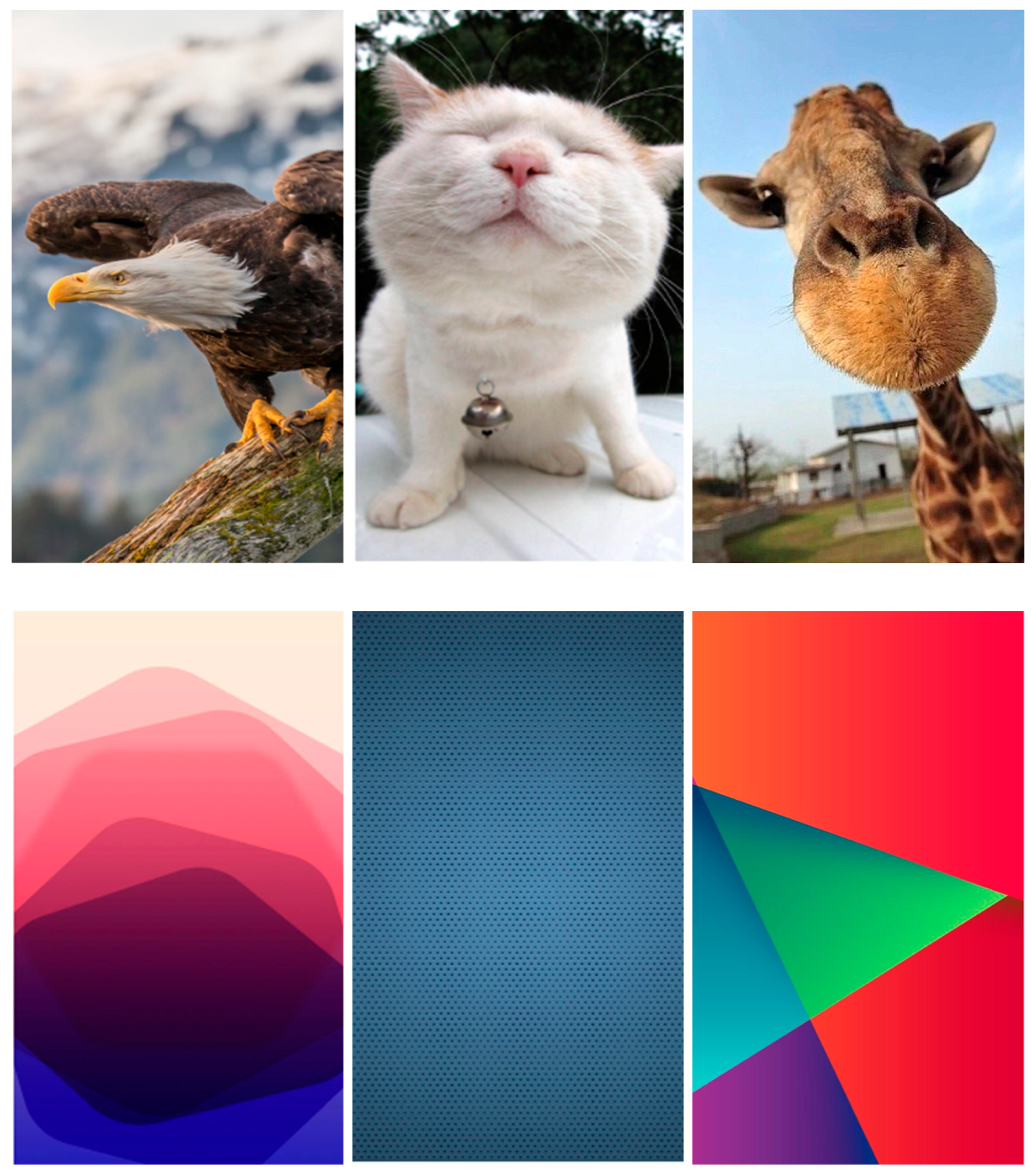
Examining the Effects of Viewing Nature and Animal Smartphone Wallpapers on Affect, Behaviour, and Cognition: A Randomised Cross-Over Trial

 , , , ,
Abstract
1. Introduction
2. Method
2.1. Sample and Power
2.2. Design and Procedure
2.2.1. Experimental Stimuli
Nature Wallpaper
Animal Wallpaper
Neutral Wallpaper (Control)
2.3. Measures
2.3.1. Individual Differences
2.3.2. Confirmatory Outcomes
2.3.3. Exploratory Outcomes
2.4. Analytic Plan
2.4.1. Interpretation
2.4.2. Pre-Registered Analyses
2.4.3. Exploratory Analyses
3. Results
3.1. Pre-Registered Confirmatory Outcomes
3.2. Non-Registered Exploratory Outcomes
3.3. Non-Registered Exploratory Moderators
4. Discussion
4.1. Brief Digital Exposure
4.2. Implications
4.3. Strengths of the Current Study
4.4. Limitations and Future Directions
5. Conclusions
Author Contributions
Funding
Institutional Review Board Statement
Data Availability Statement
Acknowledgments
Conflicts of Interest
| 1 | This effect size was obtained by setting the within-subject correlation to 0.50, with Manimal = 1, Mnature = 1, Mcontrol = 0, and SDcommon = 2.844. This effect size could also be obtained by setting the within-subject correlation to 0.25 with the same means and SDcommon = 2.322, or by setting the within-subject correlation to 0.75 with the same means and SDcommon = 4.022. Readers are encouraged to refer to Lakens and Caldwell’s (2021) work for further explanation. |
| 2 | As agreed upon between the participants and the research team prior to the start of data collection, any data which was not complete would be deleted. Thus, existing partial data from the 24 individuals who encountered the technical error and nine individuals who did not provide complete responses was deleted, and thus was not available for analysis. |
| 3 | No evidence was found for year effects in two-way mixed ANOVAs on any of the six confirmatory outcomes (stress, negative affect, positive affect, life satisfaction, productivity, procrastination) nor on any of the six exploratory outcomes (lock screen recognition, lock screen pleasingness, lock screen distractingness, excessive smartphone use, problems with executive control, mental health), with all condition × year interaction ps ≥ 0.132 (confirmatory outcomes) and pHommels ≥ 0.282 (exploratory outcomes) from Frequentist analyses. We thank an anonymous reviewer for highlighting this concern. |
| 4 | This design increases ecological validity but introduces heterogeneity in visual exposure. To assess the potential impact of this variability, we conducted exploratory analyses on a random subset of 30 participants, coding the specific images selected and estimating variance in the levels of the six confirmatory outcomes (i.e., stress, negative affect, positive affect, life satisfaction, procrastination, and productivity) attributable to wallpaper choice (nested within condition) after partitioning out variance attributable to condition itself and to individual differences. Non-zero variance attributable to wallpaper choice was observed only for stress (variance = 0.458) and procrastination (variance = 0.015), with virtually zero variance for the remaining outcomes. Details are available in the current work’s associated ResearchBox and should be interpreted cautiously given the exploratory nature and reduced sample. |
| 5 | Dispositional levels of problems with executive control and excessive smartphone use were also measured for exploratory purposes but were ultimately not used in the current work. Data on these measures remains available in the main dataset in the current work’s ResearchBox. |
| 6 | Academic performance, operationalised as participants’ Grade Point Average scores, was also intended to be collected. However, due to a technical error during the data collection procedure, Grade Point Average scores were incomplete and were thus not used in the current work. |
| 7 | Exposure to minor stressors and to minor uplifts, as well as self-perceived levels of busyness, were also measured for exploratory purposes but were ultimately not used in the current work. Data on these measures remains available in the main dataset in the current work’s ResearchBox. |
References
- Aguilar, P., Puppo-Stuardo, A., Solari, F., de la Fuente, L. M., & Ginocchio, R. (2025). Facilitating students’ connection with nature in university green spaces: The role of guided immersion in shaping emotional and symbolic engagement. Wellbeing, Space and Society, 10, 100340. [Google Scholar] [CrossRef] [Scilit]
- Anderson, A. P., Mayer, M. D., Fellows, A. M., Cowan, D. R., Hegel, M. T., & Buckey, J. C. (2017). Relaxation with immersive natural scenes presented using virtual reality. Aerospace Medicine and Human Performance, 88(6), 520–526. [Google Scholar] [CrossRef] [Scilit]
- Bakeman, R. (2005). Recommended effect size statistics for repeated measures designs. Behavior Research Methods, 37(3), 379–384. [Google Scholar] [CrossRef] [Scilit]
- Bargh, J. A., & Chartrand, T. L. (1999). The unbearable automaticity of being. American Psychologist, 54(7), 462–479. [Google Scholar] [CrossRef]
- Barker, S. B., & Wolen, A. R. (2008). The benefits of human–companion animal interaction: A review. Journal of Veterinary Medical Education, 35(4), 487–495. [Google Scholar] [CrossRef] [Scilit]
- Beetz, A., Uvnäs-Moberg, K., Julius, H., & Kotrschal, K. (2012). Psychosocial and psychophysiological effects of human-animal interactions: The possible role of oxytocin. Frontiers in Psychology, 3, 234. [Google Scholar] [CrossRef] [Scilit]
- Bell, C. N., St George, R., Honan, C., Bell, L. J., Jolly, A. T. W., & Matthews, A. (2025). The relationship between nature exposures and attention restoration, as moderated by exposure duration: A systematic review and meta-analysis. Journal of Environmental Psychology, 104, 102632. [Google Scholar] [CrossRef] [Scilit]
- Berto, R. (2014). The role of nature in coping with psycho-physiological stress: A literature review on restorativeness. Behavioral Sciences, 4(4), 394–409. [Google Scholar] [CrossRef] [Scilit]
- Bielinis, E., Takayama, N., Boiko, S., Omelan, A., & Bielinis, L. (2018). The effect of winter forest bathing on psychological relaxation of young Polish adults. Urban Forestry & Urban Greening, 29, 276–283. [Google Scholar] [CrossRef] [Scilit]
- Boot, W. R., Simons, D. J., Stothart, C., & Stutts, C. (2013). The pervasive problem with placebos in psychology: Why active control groups are not sufficient to rule out placebo effects. Perspectives on Psychological Science, 8(4), 445–454. [Google Scholar] [CrossRef] [Scilit]
- Boutron, I., Moher, D., Altman, D. G., Schulz, K. F., & Ravaud, P. (2007). Methods of blinding in reports of randomized controlled trials assessing nonpharmacological treatments: A systematic review. PLoS Medicine, 4(2), e61. [Google Scholar] [CrossRef] [Scilit] [PubMed]
- Breitwieser, J., Neubauer, A. B., Schmiedek, F., & Brod, G. (2020). Self-regulation prompts promote the achievement of learning goals—But only briefly: Uncovering hidden dynamics in the effects of a psychological intervention. PsyArXiv. [Google Scholar] [CrossRef] [Scilit]
- Brooks, A. M., Ottley, K. M., Arbuthnott, K. D., & Sevigny, P. R. (2017). Nature-related mood effects: Season and type of nature contact. Journal of Environmental Psychology, 54, 91–102. [Google Scholar] [CrossRef] [Scilit]
- Brooks, J. L. (2012). Counterbalancing for serial order carryover effects in experimental condition orders. Psychological Methods, 17(4), 600–614. [Google Scholar] [CrossRef] [Scilit]
- Browning, M. H. E. M., Mimnaugh, K. J., Van Riper, C. J., Laurent, H. K., & LaValle, S. M. (2020a). Can simulated nature support mental health? Comparing short, single-doses of 360-degree nature videos in virtual reality with the outdoors. Frontiers in Psychology, 10, 2667. [Google Scholar] [CrossRef] [Scilit]
- Browning, M. H. E. M., Shipley, N., McAnirlin, O., Becker, D., Yu, C. P., Hartig, T., & Dzhambov, A. M. (2020b). An actual natural setting improves mood better than its virtual counterpart: A meta-analysis of experimental data. Frontiers in Psychology, 11, 2200. [Google Scholar] [CrossRef] [Scilit] [PubMed]
- Buchanan, T., Heffernan, T. M., Parrott, A. C., Ling, J., Rodgers, J., & Scholey, A. B. (2010). A short self-report measure of problems with executive function suitable for administration via the Internet. Behavior Research Methods, 42(3), 709–714. [Google Scholar] [CrossRef] [Scilit]
- Cai, Y., Sun, M., Lu, Y., Wang, Y., & Goto, S. (2025). Restorative benefits of multisensory experiences in a classical Chinese garden compared to visual experiences only. Frontiers in Psychology, 16, 1663101. [Google Scholar] [CrossRef] [Scilit]
- Capaldi, C. A., Dopko, R. L., & Zelenski, J. M. (2014). The relationship between nature connectedness and happiness: A meta-analysis. Frontiers in Psychology, 5, 976. [Google Scholar] [CrossRef] [Scilit]
- Caplan, S. E., & High, A. C. (2006). Beyond excessive use: The interaction between cognitive and behavioral symptoms of problematic internet use. Communication Research Reports, 23(4), 265–271. [Google Scholar] [CrossRef] [Scilit]
- Chan, S. H. M., Qiu, L., & Xie, T. (2023). Understanding experiences in metaverse: How virtual nature impacts affect, pro-environmental attitudes, and intention to engage with physical nature. Computers in Human Behavior, 149, 107926. [Google Scholar] [CrossRef] [Scilit]
- Charness, G., Gneezy, U., & Kuhn, M. A. (2012). Experimental methods: Between-subject and within-subject design. Journal of Economic Behavior & Organization, 81(1), 1–8. [Google Scholar] [CrossRef] [Scilit]
- Chen, N. R. Y., Majeed, N. M., Lai, G. J., Koh, P. S., Kasturiratna, K. T. A. S., Kaur, M., Ho, A. Z. Y., Yong, J. C., & Hartanto, A. (2024). Human–Animal interaction and human prosociality: A meta-analytic review of experimental and correlational studies. Anthrozoös, 37(2), 269–288. [Google Scholar] [CrossRef] [Scilit]
- Chua, M. H. (2021, July 16). Categorising Singaporeans by race: The CMIO system is 100 years old and needs an update. The Straits Times. Available online: https://web.archive.org/web/20210715215121/https://www.straitstimes.com/opinion/the-cmio-system-is-100-years-old-and-needs-an-update (accessed on 10 April 2026).
- Correale, C., Borgi, M., Collacchi, B., Falamesca, C., Gentile, S., Vigevano, F., Cappelletti, S., & Cirulli, F. (2022). Improving the emotional distress and the experience of hospitalization in children and adolescent patients through animal assisted interventions: A systematic review. Frontiers in Psychology, 13, 840107. [Google Scholar] [CrossRef] [Scilit]
- Cronbach, L. J. (1951). Coefficient alpha and the internal structure of tests. Psychometrika, 16(3), 297–334. [Google Scholar] [CrossRef] [Scilit]
- De Ridder, D., Kroese, F., & Van Gestel, L. (2022). Nudgeability: Mapping conditions of susceptibility to nudge influence. Perspectives on Psychological Science, 17(2), 346–359. [Google Scholar] [CrossRef] [Scilit]
- Diaz, K. (2022). A look into 2021 phones: A quantitative survey research study on user phone customization. Journal of Advanced Research in Social Sciences and Humanities, 7(2), 43–52. [Google Scholar] [CrossRef] [Scilit]
- Dimock, M. (2019, January 17). Defining generations: Where Millennials end and Generation Z begins. Pew Research Center. Available online: https://www.pewresearch.org/short-reads/2019/01/17/where-millennials-end-and-generation-z-begins/ (accessed on 10 April 2026).
- Duke, É., & Montag, C. (2017). Smartphone addiction and beyond: Initial insights on an emerging research topic and its relationship to Internet addiction. In Internet addiction: Neuroscientific approaches and therapeutical implications including smartphone addiction (pp. 359–372). Springer. [Google Scholar]
- Elsadek, M., Liu, B., Lian, Z., & Xie, J. (2019). The influence of urban roadside trees and their physical environment on stress relief measures: A field experiment in Shanghai. Urban Forestry & Urban Greening, 42, 51–60. [Google Scholar] [CrossRef] [Scilit]
- Faria, A. L., Latorre, J., Silva Cameirão, M., Bermúdez i Badia, S., & Llorens, R. (2023). Ecologically valid virtual reality-based technologies for assessment and rehabilitation of acquired brain injury: A systematic review. Frontiers in Psychology, 14, 1233346. [Google Scholar] [CrossRef] [Scilit]
- Fogg, B. J. (2009). A behavior model for persuasive design. In Proceedings of the 4th international conference on persuasive technology (pp. 40–47). ACM. [Google Scholar] [CrossRef] [Scilit]
- Franco, L. S., Shanahan, D. F., & Fuller, R. A. (2017). A review of the benefits of nature experiences: More than meets the eye. International Journal of Environmental Research and Public Health, 14(8), 864. [Google Scholar] [CrossRef] [Scilit]
- Friedmann, E., & Son, H. (2009). The human–Companion animal bond: How humans benefit. Veterinary Clinics of North America: Small Animal Practice, 39(2), 293–326. [Google Scholar] [CrossRef] [Scilit]
- Fuegen, K., & Breitenbecher, K. H. (2018). Walking and being outdoors in nature increase positive affect and energy. Ecopsychology, 10(1), 14–25. [Google Scholar] [CrossRef] [Scilit]
- Gaekwad, J. S., Sal Moslehian, A., Roös, P. B., & Walker, A. (2022). A meta-analysis of emotional evidence for the biophilia hypothesis and implications for biophilic design. Frontiers in Psychology, 13, 750245. [Google Scholar] [CrossRef] [Scilit] [PubMed]
- Gasper, K., Spencer, L. A., & Hu, D. (2019). Does neutral affect exist? How challenging three beliefs about neutral affect can advance affective research. Frontiers in Psychology, 10, 2476. [Google Scholar] [CrossRef] [Scilit] [PubMed]
- Goh, A. Y. H., Chia, S. M., Majeed, N. M., Chen, N. R. Y., & Hartanto, A. (2023). Untangling the additive and multiplicative relations between natural scenery exposure and human–animal interaction on affective well-being: Evidence from daily diary studies. Sustainability, 15(4), 2910. [Google Scholar] [CrossRef] [Scilit]
- Grassini, S., Segurini, G. V., & Koivisto, M. (2022). Watching nature videos promotes physiological restoration: Evidence from the modulation of alpha waves in electroencephalography. Frontiers in Psychology, 13, 871143. [Google Scholar] [CrossRef] [Scilit]
- Grazuleviciene, R., Vencloviene, J., Kubilius, R., Grizas, V., Danileviciute, A., Dedele, A., Andrusaityte, S., Vitkauskiene, A., Steponaviciute, R., & Nieuwenhuijsen, M. J. (2016). Tracking restoration of park and urban street settings in coronary artery disease patients. International Journal of Environmental Research and Public Health, 13(6), 550. [Google Scholar] [CrossRef] [Scilit]
- Guevarra, D. A., Park, Y., Xu, X., Liou, J., Smith, J., Callahan, P., Simon-Thomas, E., & Epel, E. S. (2025). Scaling a brief digital well-being intervention (the Big Joy Project) and sociodemographic moderators: Single-group pre-post study. Journal of Medical Internet Research, 27, e72053. [Google Scholar] [CrossRef] [Scilit]
- Haluza, D., Kersten, P., Lazic, T., Steinparzer, M., & Godbold, D. (2025). Unlocking the Power of Nature: Insights from a 20-Minute Forest Visit on Well-Being. Forests, 16(5), 792. [Google Scholar] [CrossRef] [Scilit]
- Hartanto, A., Teo, N. L. A., Lua, V. Y. Q., Tay, K. J. Y., Chen, N. R. Y., & Majeed, N. M. (2023). Does watching videos with natural scenery restore attentional resources?: A critical examination through a pre-registered within-subject experiment. Experimental Psychology, 70(2), 96–107. [Google Scholar] [CrossRef] [Scilit]
- Heber, E., Ebert, D. D., Lehr, D., Cuijpers, P., Berking, M., Nobis, S., & Riper, H. (2017). The benefit of web- and computer-based interventions for stress: A systematic review and meta-analysis. Journal of Medical Internet Research, 19(2), e32. [Google Scholar] [CrossRef] [Scilit] [PubMed]
- Heitmayer, M., & Lahlou, S. (2021). Why are smartphones disruptive? An empirical study of smartphone use in real-life contexts. Computers in Human Behavior, 116, 106637. [Google Scholar] [CrossRef] [Scilit]
- Hicks, L. J., Smith, A. C., Ralph, B. C., & Smilek, D. (2020). Restoration of sustained attention following virtual nature exposure: Undeniable or unreliable? Journal of Environmental Psychology, 71, 101488. [Google Scholar] [CrossRef] [Scilit]
- Houlden, V., Weich, S., Porto De Albuquerque, J., Jarvis, S., & Rees, K. (2018). The relationship between greenspace and the mental wellbeing of adults: A systematic review. PLoS ONE, 13(9), e0203000. [Google Scholar] [CrossRef] [Scilit]
- Howell, A. J., & Passmore, H.-A. (2013). The nature of happiness: Nature affiliation and mental well-being. In C. L. M. Keyes (Ed.), Mental well-being (pp. 231–257). Springer. [Google Scholar] [CrossRef] [Scilit]
- Hu, S., Yang, T., Zhang, H., Gao, Y., Zhao, J., & Wang, Y. (2023). Neutral animals matter: Animacy modulates object-based attentional allocation. Quarterly Journal of Experimental Psychology, 76(3), 583–595. [Google Scholar] [CrossRef] [Scilit]
- JASP Team. (2023). JASP (Version 0.16.2) [Computer software]. Available online: https://jasp-stats.org/ (accessed on 10 April 2026).
- Johnson, E. A., Survase, S., & Gray, P. B. (2023). Examining the impact of virtual animal stimuli on college students’ affect and perception of their academic advising experience. Animals, 13(9), 1522. [Google Scholar] [CrossRef] [Scilit] [PubMed]
- Kahn, P. H., Jr., Friedman, B., Gill, B., Hagman, J., Severson, R. L., Freier, N. G., Feldman, E. N., Carrère, S., & Stolyar, A. (2008). A plasma display window?—The shifting baseline problem in a technologically mediated natural world. Journal of Environmental Psychology, 28(2), 192–199. [Google Scholar] [CrossRef] [Scilit]
- Kahneman, D. (2011). Thinking, fast and slow. Farrar, Straus and Giroux. [Google Scholar]
- Kaplan, R., & Kaplan, S. (1989). The experience of nature: A psychological perspective. Cambridge University Press. [Google Scholar]
- Kaplan, S. (1995). The restorative benefits of nature: Toward an integrative framework. Journal of Environmental Psychology, 15(3), 169–182. [Google Scholar] [CrossRef] [Scilit]
- Kassambara, A. (2016). ggpubr: ‘ggplot2’ based publication ready plots [Computer software]. CRAN. [Google Scholar] [CrossRef] [Scilit]
- Kassambara, A. (2019). rstatix: Pipe-friendly framework for basic statistical tests [Computer software]. CRAN. [Google Scholar] [CrossRef] [Scilit]
- Kasturiratna, K. T. A. S., Chua, Y. J., & Hartanto, A. (2025). A multifaceted nudge-based intervention to reduce smartphone use: Findings from a randomized cross-over trial. Mobile Media & Communication, 13(3), 504–525. [Google Scholar] [CrossRef] [Scilit]
- Keidser, G., Naylor, G., Brungart, D. S., Caduff, A., Campos, J., Carlile, S., Carpenter, M. G., Grimm, G., Hohmann, V., Holube, I., Launer, S., Lunner, T., Mehra, R., Rapport, F., Slaney, M., & Smeds, K. (2020). The quest for ecological validity in hearing science: What it is, why it matters, and how to advance it. Ear and Hearing, 41, 5S–19S. [Google Scholar] [CrossRef] [Scilit]
- Kellert, S. R. (1997). Kinship to mastery: Biophilia in human evolution and development. Island Press. [Google Scholar]
- Kim, C. M., van Rompay, T. J., Louwers, G. L., Yoon, J., & Ludden, G. D. (2024). From a morning forest to a sunset beach: Understanding visual experiences and the roles of personal characteristics for designing relaxing digital nature. International Journal of Human–Computer Interaction, 40(24), 8535–8552. [Google Scholar] [CrossRef] [Scilit]
- Kimura, T., Yamada, T., Hirokawa, Y., & Shinohara, K. (2021). Brief and indirect exposure to natural environment restores the directed attention for the task. Frontiers in Psychology, 12, 619347. [Google Scholar] [CrossRef] [Scilit] [PubMed]
- Kruschke, J. K., & Liddell, T. M. (2018). The Bayesian new statistics: Hypothesis testing, estimation, meta-analysis, and power analysis from a Bayesian perspective. Psychonomic Bulletin & Review, 25(1), 178–206. [Google Scholar] [CrossRef] [Scilit]
- Kuznetsova, A., Brockhoff, P. B., & Christensen, R. H. B. (2017). lmerTest package: Tests in linear mixed effects models. Journal of Statistical Software, 82(13), 1–26. [Google Scholar] [CrossRef] [Scilit]
- Kwon, M., Kim, D.-J., Cho, H., & Yang, S. (2013). The smartphone addiction scale: Development and validation of a short version for adolescents. PLoS ONE, 8(12), e83558. [Google Scholar] [CrossRef] [Scilit]
- Lakens, D., & Caldwell, A. R. (2021). Simulation-based power analysis for factorial analysis of variance designs. Advances in Methods and Practices in Psychological Science, 4(1), 1–14. [Google Scholar] [CrossRef] [Scilit]
- Lee, J., Park, B.-J., Tsunetsugu, Y., Kagawa, T., & Miyazaki, Y. (2009). Restorative effects of viewing real forest landscapes, based on a comparison with urban landscapes. Scandinavian Journal of Forest Research, 24(3), 227–234. [Google Scholar] [CrossRef] [Scilit]
- Lee, J., Park, B.-J., Tsunetsugu, Y., Ohira, T., Kagawa, T., & Miyazaki, Y. (2011). Effect of forest bathing on physiological and psychological responses in young Japanese male subjects. Public Health, 125(2), 93–100. [Google Scholar] [CrossRef] [Scilit]
- Lee, M. D., & Wagenmakers, E.-J. (2013). Bayesian cognitive modeling: A practical course. Cambridge University Press. [Google Scholar] [CrossRef] [Scilit]
- Le Roux, M. C., & Kemp, R. (2009). Effect of a companion dog on depression and anxiety levels of elderly residents in a long-term care facility. Psychogeriatrics, 9(1), 23–26. [Google Scholar] [CrossRef] [Scilit]
- Leung, G. Y. S., Hazan, H., & Chan, C. S. (2022). Exposure to nature in immersive virtual reality increases connectedness to nature among people with low nature affinity. Journal of Environmental Psychology, 83, 101863. [Google Scholar] [CrossRef] [Scilit]
- Lin, J. H. T., Hsieh, J. H. E., Wang, P. C. P., & Lin, C. W. D. (2025). Virtual Reality (VR) inducE well-being (VIEW): A scoping review of VR design, mechanisms, and well-being outcomes. Humanities and Social Sciences Communications, 12(1), 1766. [Google Scholar] [CrossRef] [Scilit]
- McMahan, E. A., & Estes, D. (2015). The effect of contact with natural environments on positive and negative affect: A meta-analysis. The Journal of Positive Psychology, 10(6), 507–519. [Google Scholar] [CrossRef] [Scilit]
- McNeish, D. (2018). Thanks coefficient alpha, we’ll take it from here. Psychological Methods, 23(3), 412–433. [Google Scholar] [CrossRef] [Scilit]
- Menzel, C., & Reese, G. (2021). Implicit associations with nature and urban environments: Effects of lower-level processed image properties. Frontiers in Psychology, 12, 591403. [Google Scholar] [CrossRef] [Scilit]
- Mormann, F., Dubois, J., Kornblith, S., Milosavljevic, M., Cerf, M., Ison, M., Tsuchiya, N., Kraskov, A., Quiroga, R. Q., Adolphs, R., Fried, I., & Koch, C. (2011). A category-specific response to animals in the right human amygdala. Nature Neuroscience, 14(10), 1247–1249. [Google Scholar] [CrossRef] [Scilit] [PubMed]
- Nahum-Shani, I., Smith, S. N., Spring, B. J., Collins, L. M., Witkiewitz, K., Tewari, A., & Murphy, S. A. (2018). Just-in-time adaptive interventions (JITAIs) in mobile health: Key components and design principles for ongoing health behavior support. Annals of Behavioral Medicine, 52(6), 446–462. [Google Scholar] [CrossRef] [Scilit] [PubMed]
- Nosek, B. A., Ebersole, C. R., DeHaven, A. C., & Mellor, D. T. (2018). The preregistration revolution. Proceedings of the National Academy of Sciences of the United States of America, 115(11), 2600–2606. [Google Scholar] [CrossRef] [Scilit] [PubMed]
- Ojala, A., Korpela, K., Tyrväinen, L., Tiittanen, P., & Lanki, T. (2019). Restorative effects of urban green environments and the role of urban-nature orientedness and noise sensitivity: A field experiment. Health & Place, 55, 59–70. [Google Scholar] [CrossRef] [Scilit]
- Owens, M., & Bunce, H. (2023). The effect of brief exposure to virtual nature on mental wellbeing in adolescents. Scientific Reports, 13, 17769. [Google Scholar] [CrossRef] [Scilit]
- Park, B.-J., Tsunetsugu, Y., Kasetani, T., Kagawa, T., & Miyazaki, Y. (2010). The physiological effects of Shinrin-yoku (taking in the forest atmosphere or forest bathing): Evidence from field experiments in 24 forests across Japan. Environmental Health and Preventive Medicine, 15(1), 18–26. [Google Scholar] [CrossRef] [Scilit]
- Park, B.-J., Tsunetsugu, Y., Kasetani, T., Morikawa, T., Kagawa, T., & Miyazaki, Y. (2009). Physiological effects of forest recreation in a young conifer forest in Hinokage Town, Japan. Silva Fennica, 43(2), 213. [Google Scholar] [CrossRef] [Scilit]
- Park, J., & Lee, U. (2023). Understanding disengagement in Just-in-Time mobile health interventions. Proceedings of the ACM on Interactive, Mobile, Wearable and Ubiquitous Technologies, 7(2), 1–27. [Google Scholar] [CrossRef] [Scilit]
- Passmore, H.-A., & Holder, M. D. (2017). Noticing nature: Individual and social benefits of a two-week intervention. The Journal of Positive Psychology, 12(6), 537–546. [Google Scholar] [CrossRef] [Scilit]
- Pedretti, E., & Soren, B. J. (2006). Reconnecting to the natural world through an immersive environment. Canadian Journal of Science, Mathematics and Technology Education, 6(1), 83–96. [Google Scholar] [CrossRef] [Scilit]
- R Core Team. (2021). R: A language and environment for statistical computing [Computer software]. R Foundation for Statistical Computing. Available online: https://www.R-project.org/ (accessed on 10 April 2026).
- Rescorla, R. A., & Furrow, D. R. (1977). Stimulus similarity as a determinant of Pavlovian conditioning. Journal of Experimental Psychology: Animal Behavior Processes, 3(3), 203–215. [Google Scholar] [CrossRef] [PubMed]
- Revelle, W. (2007). psych: Procedures for psychological, psychometric, and personality research [Computer software]. CRAN. [Google Scholar] [CrossRef] [Scilit]
- Russell, J. (1980). A circumplex model of affect. Journal of Personality and Social Psychology, 39, 1161–1178. [Google Scholar] [CrossRef] [Scilit]
- Schertz, K. E., & Berman, M. G. (2019). Understanding nature and its cognitive benefits. Current Directions in Psychological Science, 28(5), 496–502. [Google Scholar] [CrossRef] [Scilit]
- Schreuder, E., Van Erp, J., Toet, A., & Kallen, V. L. (2016). Emotional responses to multisensory environmental stimuli: A conceptual framework and literature review. Sage Open, 6(1), 2158244016630591. [Google Scholar] [CrossRef] [Scilit]
- Senn, S. (2002). Cross-over trials in clinical research (2nd ed.). John Wiley & Sons. [Google Scholar] [CrossRef] [Scilit]
- Sheets, V. L., & Manzer, C. D. (1991). Affect, cognition, and urban vegetation: Some effects of adding trees along city streets. Environment and Behavior, 23(3), 285–304. [Google Scholar] [CrossRef] [Scilit]
- Song, C. J., Vladescu, J. C., Reeve, K. F., Miguel, C. F., & Breeman, S. L. (2021). The influence of correlations between noncritical features and reinforcement on stimulus generalization. Journal of Applied Behavior Analysis, 54(1), 346–366. [Google Scholar] [CrossRef] [Scilit] [PubMed]
- Souter, M. A., & Miller, M. D. (2007). Do animal-assisted activities effectively treat depression? A meta-analysis. Anthrozoös, 20(2), 167–180. [Google Scholar] [CrossRef] [Scilit]
- South, E. C., Hohl, B. C., Kondo, M. C., MacDonald, J. M., & Branas, C. C. (2018). Effect of greening vacant land on mental health of community-dwelling adults: A cluster randomized trial. JAMA Network Open, 1(3), e180298. [Google Scholar] [CrossRef] [Scilit]
- Statista. (2024). Smartphone penetration rate as share of the population in Singapore from 2020 to 2029. Available online: https://www.statista.com/statistics/625441/smartphone-user-penetration-in-singapore/ (accessed on 10 April 2026).
- Steel, P. (2002). The measurement and nature of procrastination [Doctoral thesis, University of Minnesota]. [Google Scholar]
- Struk, A. A., Carriere, J. S. A., Cheyne, J. A., & Danckert, J. (2017). A short boredom proneness scale: Development and psychometric properties. Assessment, 24(3), 346–359. [Google Scholar] [CrossRef] [Scilit]
- Tan, A. L., & Su, T. (2022, November 13). In green Singapore, most youth don’t spend much time in nature. Channel NewsAsia. Available online: https://www.channelnewsasia.com/commentary/youth-nature-park-reserve-conservation-school-education-climate-3064056 (accessed on 10 April 2026).
- Twenge, J. M., & Campbell, W. K. (2018). Associations between screen time and lower psychological well-being among children and adolescents: Evidence from a population-based study. Preventive Medicine Reports, 12, 271–283. [Google Scholar] [CrossRef] [Scilit]
- Ulrich, R. S. (1983). Aesthetic and affective response to natural environment. In I. Altman, & J. F. Wohlwill (Eds.), Behavior and the natural environment (pp. 85–125). Springer. [Google Scholar] [CrossRef] [Scilit]
- Ulrich, R. S., Simons, R. F., Losito, B. D., Fiorito, E., Miles, M. A., & Zelson, M. (1991). Stress recovery during exposure to natural and urban environments. Journal of Environmental Psychology, 11(3), 201–230. [Google Scholar] [CrossRef] [Scilit]
- Vahedi, Z., & Saiphoo, A. (2018). The association between smartphone use, stress, and anxiety: A meta-analytic review. Stress and Health: Journal of the International Society for the Investigation of Stress, 34(3), 347–358. [Google Scholar] [CrossRef] [Scilit] [PubMed]
- Van Den Berg, A. E., & Custers, M. H. G. (2011). Gardening promotes neuroendocrine and affective restoration from stress. Journal of Health Psychology, 16(1), 3–11. [Google Scholar] [CrossRef] [Scilit]
- Vickerstaff, V., Omar, R. Z., & Ambler, G. (2019). Methods to adjust for multiple comparisons in the analysis and sample size calculation of randomised controlled trials with multiple primary outcomes. BMC Medical Research Methodology, 19(1), 129. [Google Scholar] [CrossRef] [Scilit]
- Wagenmakers, E. J., Marsman, M., Jamil, T., Ly, A., Verhagen, J., Love, J., Selker, R., Gronau, Q. F., Šmíra, M., Epskamp, S., Matzke, D., Rouder, J. N., & Morey, R. D. (2018). Bayesian inference for psychology. Part I: Theoretical advantages and practical ramifications. Psychonomic Bulletin & Review, 25(1), 35–57. [Google Scholar] [CrossRef]
- Weeland, J., Moens, M. A., Beute, F., Assink, M., Staaks, J. P. C., & Overbeek, G. (2019). A dose of nature: Two three-level meta-analyses of the beneficial effects of exposure to nature on children’s self-regulation. Journal of Environmental Psychology, 65, 101326. [Google Scholar] [CrossRef] [Scilit]
- White, M. P., Alcock, I., Grellier, J., Wheeler, B. W., Hartig, T., Warber, S. L., Bone, A., Depledge, M. H., & Fleming, L. E. (2019). Spending at least 120 minutes a week in nature is associated with good health and wellbeing. Scientific Reports, 9, 7730. [Google Scholar] [CrossRef] [Scilit]
- Wickham, H. (2016). ggplot2: Elegant graphics for data analysis (2nd ed.). Springer. [Google Scholar] [CrossRef] [Scilit]
- Wickham, H., François, R., Henry, L., Müller, K., & Vaughan, D. (2014). dplyr: A grammar of data manipulation [Computer software]. CRAN. [Google Scholar] [CrossRef] [Scilit]
- Wickham, H., Vaughan, D., & Girlich, M. (2025). tidyr: Tidy messy data [Computer software]. CRAN. [Google Scholar] [CrossRef] [Scilit]
- Wilson, E. O. (1984). Biophilia. Harvard University Press. [Google Scholar] [CrossRef] [Scilit]
- Yang, G., Wang, Y., & Jiang, Y. (2024). Social perception of animacy: Preferential attentional orienting to animals links with autistic traits. Cognition, 251, 105900. [Google Scholar] [CrossRef] [Scilit] [PubMed]
- Yao, W., Zhang, X., & Gong, Q. (2021). The effect of exposure to the natural environment on stress reduction: A meta-analysis. Urban Forestry & Urban Greening, 57, 126932. [Google Scholar] [CrossRef]
- Yoo, O., Wu, Y., Han, J. S., & Park, S.-A. (2024). Psychophysiological and emotional effects of human–Dog interactions by activity type: An electroencephalogram study. PLoS ONE, 19(3), e0298384. [Google Scholar] [CrossRef] [Scilit] [PubMed]
- Zeng, Q., Yang, Z., Chen, Z., & Chen, P. (2025). The relationships between nature connectedness, nature contact, and positive psychological outcomes: A meta-analysis. Journal of Environmental Psychology, 105, 102675. [Google Scholar] [CrossRef] [Scilit]
- Zhou, Z., Yin, D., & Gao, Q. (2020). Sense of presence and subjective well-being in online pet watching: The moderation role of loneliness and perceived stress. International Journal of Environmental Research and Public Health, 17(23), 9093. [Google Scholar] [CrossRef] [Scilit] [PubMed]



| Study | Duration of Exposure | Outcome |
|---|---|---|
| Exposure via Video | ||
| Grassini et al. (2022) | 3 min/video × 4 videos | Increase in perceived relaxation |
| Hartanto et al. (2023) | 6 min | No significant change in affect |
| Exposure via VR | ||
| Anderson et al. (2017) | 15 min/scene × 3 scenes | Decrease in negative affect |
| Browning et al. (2020a) | 6 min | Decrease in negative affect |
| Chan et al. (2023) | 5 min | Increase in positive affect |
| Leung et al. (2022) | 6–10 min/session × 2–3 sessions | Decrease in negative affect |
| Variable | N | M or % | SD | Observed Range | Theoretical Range |
|---|---|---|---|---|---|
| Individual differences | |||||
| Year of Participation in Study | |||||
| 2023 | 10 | 17% | |||
| 2024 | 47 | 78% | |||
| 2025 | 3 | 5% | |||
| Demographics | |||||
| Age at data collection (years) | 60 | 21.57 | 1.59 | 18–26 | 18–26 |
| Ethnicity (% Chinese) | 60 | 83% | |||
| Sex (%) | |||||
| Female | 45 | 75% | |||
| Male | 15 | 25% | |||
| Non-binary | 0 | 0% | |||
| Dispositional tendencies | |||||
| Boredom proneness | 60 | 3.33 | 1.04 | 1.00–5.88 | 1.00–7.00 |
| Smartphone reliance | 60 | 3.00 | 0.98 | 1.00–5.20 | 1.00–6.00 |
| Dispositional lock screen engagement | |||||
| Recognition frequency 1 | 58 | 5.16 | 1.59 | 1.00–7.00 | 1.00–7.00 |
| Wallpaper change frequency 1 | 59 | 2.12 | 0.72 | 1.00–6.00 | 1.00–7.00 |
| Visual appeal | 60 | 3.95 | 1.00 | 1.00–5.00 | 1.00–5.00 |
| Distraction | 60 | 1.27 | 0.61 | 1.00–4.00 | 1.00–5.00 |
| Weekly objective smartphone use (hours) 2 | |||||
| Pretest | 60 | 20.78 | 15.36 | 1–70 | 0–168 |
| Posttest, nature condition | 60 | 27.59 | 16.90 | 2–60 | 0–168 |
| Posttest, animal condition | 60 | 25.11 | 15.75 | 2–54 | 0–168 |
| Posttest, control condition | 60 | 29.45 | 15.26 | 3–56 | 0–168 |
| Pretest levels of confirmatory outcomes | |||||
| Well-being | |||||
| Perceived stress | 60 | 5.98 | 2.33 | 0–10 | 0–10 |
| Negative affect | 60 | 2.19 | 0.82 | 1.00–5.00 | 1.00–5.00 |
| Positive affect | 60 | 2.79 | 0.79 | 1.00–4.22 | 1.00–5.00 |
| Life satisfaction | 60 | 3.43 | 0.93 | 1.00–5.00 | 1.00–5.00 |
| Behaviour | |||||
| Productivity | 60 | 3.79 | 0.85 | 1.00–5.00 | 1.00–5.00 |
| Procrastination | 60 | 2.98 | 1.10 | 1.00–5.00 | 1.00–5.00 |
| Measure | Pretest | Nature | Animal | Control |
|---|---|---|---|---|
| Confirmatory outcomes | ||||
| Negative affect | 0.92 [0.90–0.93] | 0.87 [0.81–0.91] | 0.88 [0.82–0.92] | 0.85 [0.79–0.90] |
| Positive affect | 0.93 [0.92–0.95] | 0.93 [0.90–0.96] | 0.93 [0.90–0.95] | 0.94 [0.92–0.96] |
| Productivity | 0.80 [0.74–0.84] | 0.72 [0.57–0.82] | 0.79 [0.67–0.87] | 0.76 [0.62–0.85] |
| Procrastination | 0.94 [0.92–0.95] | 0.91 [0.88–0.94] | 0.94 [0.91–0.96] | 0.90 [0.86–0.94] |
| Exploratory outcomes | ||||
| Excessive smartphone use | 0.91 [0.86–0.94] | 0.94 [0.91–0.96] | 0.94 [0.91–0.96] | |
| Problems with executive control | 0.84 [0.77–0.89] | 0.90 [0.85–0.93] | 0.84 [0.76–0.89] | |
| Outcomes | N | F | df1 | df2 | p | BF10 | η2g |
|---|---|---|---|---|---|---|---|
| Confirmatory Outcomes | |||||||
| Stress | 60 | 0.31 | 2.00 | 118.00 | 0.737 | 0.075 | 0.00 |
| Negative Affect | 60 | 0.17 | 2.00 | 118.00 | 0.841 | 0.066 | 0.00 |
| Positive Affect | 60 | 0.46 | 2.00 | 118.00 | 0.631 | 0.093 | 0.00 |
| Life Satisfaction | 60 | 2.37 | 2.00 | 118.00 | 0.098 | 0.433 | 0.02 |
| Productivity | 60 | 0.85 | 2.00 | 118.00 | 0.432 | 0.116 | 0.01 |
| Procrastination | 60 | 1.10 | 1.81 | 107.02 | 0.333 | 0.143 | 0.01 |
| Exploratory Outcomes | |||||||
| Lock Screen Recognition 1 | 52 | 11.53 | 2.00 | 102.00 | <0.001 | - | 0.09 |
| Lock Screen Pleasingness | 60 | 23.98 | 2.00 | 118.00 | <0.001 | - | 0.20 |
| Lock Screen Distractingness | 60 | 12.85 | 1.40 | 82.34 | <0.001 | - | 0.08 |
| Excessive Smartphone Use | 60 | 0.47 | 2.00 | 118.00 | 0.986 | - | 0.01 |
| Problems with Executive Control | 60 | 0.30 | 2.00 | 118.00 | 0.986 | - | 0.01 |
| Mental Health | 60 | 0.01 | 2.00 | 118.00 | 0.986 | - | 0.00 |
Disclaimer/Publisher’s Note: The statements, opinions and data contained in all publications are solely those of the individual author(s) and contributor(s) and not of MDPI and/or the editor(s). MDPI and/or the editor(s) disclaim responsibility for any injury to people or property resulting from any ideas, methods, instructions or products referred to in the content. |
© 2026 by the authors. Licensee MDPI, Basel, Switzerland. This article is an open access article distributed under the terms and conditions of the Creative Commons Attribution (CC BY) license.
Share and Cite
Majeed, N.M.; Chen, N.R.Y.; Goh, A.Y.H.; Hu, M.; Koh, K.J.J.; Ang, Y.H.G.; Hartanto, A. Examining the Effects of Viewing Nature and Animal Smartphone Wallpapers on Affect, Behaviour, and Cognition: A Randomised Cross-Over Trial. Behav. Sci. 2026, 16, 623. https://doi.org/10.3390/bs16050623
Majeed NM, Chen NRY, Goh AYH, Hu M, Koh KJJ, Ang YHG, Hartanto A. Examining the Effects of Viewing Nature and Animal Smartphone Wallpapers on Affect, Behaviour, and Cognition: A Randomised Cross-Over Trial. Behavioral Sciences. 2026; 16(5):623. https://doi.org/10.3390/bs16050623
Chicago/Turabian StyleMajeed, Nadyanna M., Nicole R. Y. Chen, Adalia Y. H. Goh, Meilan Hu, Kenneth J. J. Koh, Yuolmae H. G. Ang, and Andree Hartanto. 2026. "Examining the Effects of Viewing Nature and Animal Smartphone Wallpapers on Affect, Behaviour, and Cognition: A Randomised Cross-Over Trial" Behavioral Sciences 16, no. 5: 623. https://doi.org/10.3390/bs16050623
APA StyleMajeed, N. M., Chen, N. R. Y., Goh, A. Y. H., Hu, M., Koh, K. J. J., Ang, Y. H. G., & Hartanto, A. (2026). Examining the Effects of Viewing Nature and Animal Smartphone Wallpapers on Affect, Behaviour, and Cognition: A Randomised Cross-Over Trial. Behavioral Sciences, 16(5), 623. https://doi.org/10.3390/bs16050623