Parental Bipolar Symptoms and Identity Development in Emerging Adults: The Mediating Role of Parental Attachment
Abstract
1. Introduction
1.1. Background
1.2. Identity
1.3. Bipolar Disorder
1.4. Parental Psychopathology and Child Development
1.5. The Relationship Between Adverse Experiences and Identity
1.6. The Role of Parental Attachment
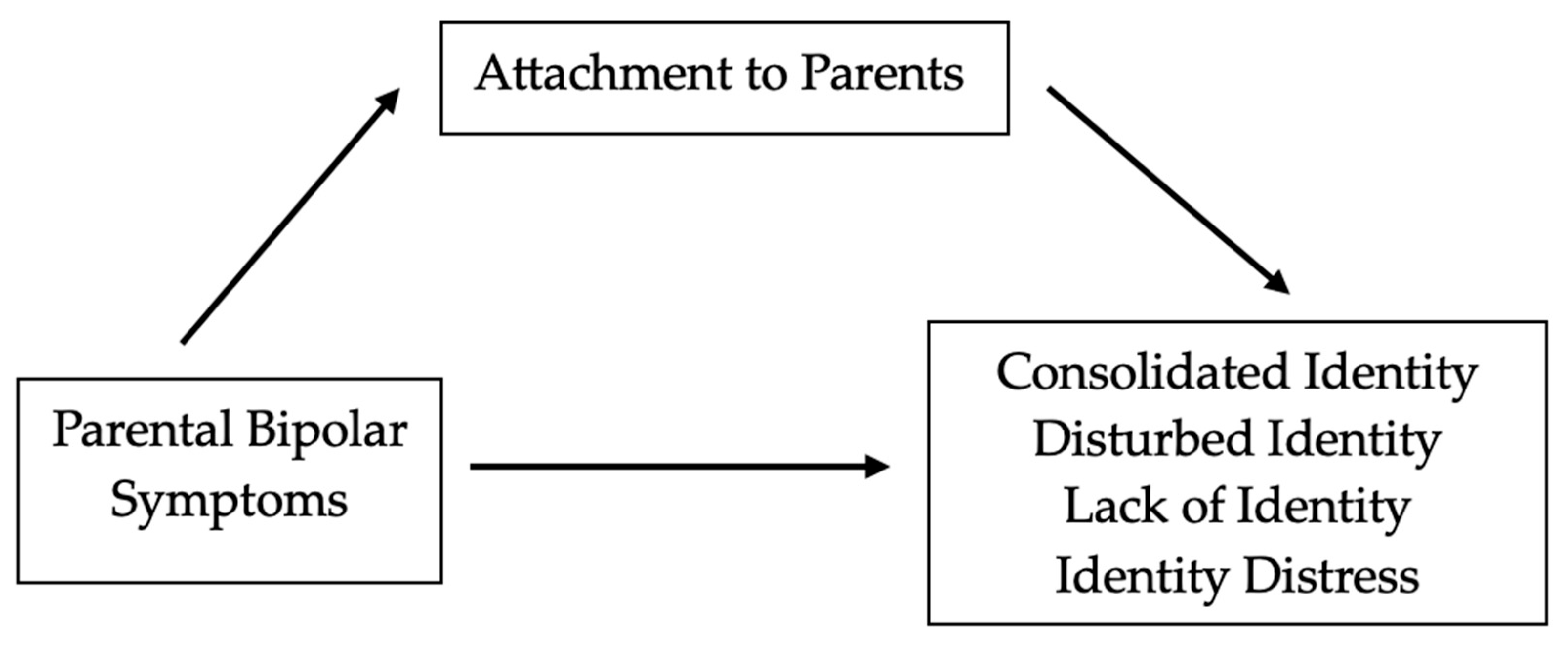
1.7. The Present Study
2. Materials and Methods
2.1. Participants
2.2. Procedure
2.3. Measures
2.4. Data Analysis
3. Results
3.1. Preliminary and Descriptive Analyses
3.2. Main Analyses
4. Discussion
4.1. Limitations and Future Research
4.2. Implications for Practice
5. Conclusions
Author Contributions
Funding
Institutional Review Board Statement
Informed Consent Statement
Data Availability Statement
Conflicts of Interest
References
- American Psychiatric Association. (1980). Diagnostic and statistical manual of mental disorders (3rd ed.). American Psychiatric Association. [Google Scholar]
- American Psychiatric Association. (2022). Diagnostic and statistical manual of mental disorders (5th ed.). American Psychiatric Association. [Google Scholar]
- Armsden, G. C., & Greenberg, M. T. (1987). The inventory of parent and peer attachment: Individual differences and their relationship to psychological well-being in adolescence. Journal of Youth and Adolescence, 16(5), 427–454. [Google Scholar] [CrossRef] [Scilit] [PubMed]
- Arnett, J. J. (2014). Emerging adulthood: The winding road from the late teens through the twenties (2nd ed.). Oxford University Press. [Google Scholar]
- Beidel, D. C., Tuerk, P. W., Spitalnick, J., Bowers, C. A., & Morrison, K. (2021). Treating childhood social anxiety disorder with virtual environments and serious games: A randomized trial. Behavior Therapy, 52(6), 1351–1363. [Google Scholar] [CrossRef] [Scilit] [PubMed]
- Berman, S. L., Montgomery, M. J., & Kurtines, W. M. (2004). The development and validation of a measure of identity distress. Identity: An International Journal of Theory and Research, 4(1), 1–8. [Google Scholar] [CrossRef] [Scilit]
- Berman, S. L., Montgomery, M. J., & Ratner, K. (2020). Trauma and identity: A reciprocal relationship? Journal of Adolescence, 79(1), 275–278. [Google Scholar] [CrossRef] [Scilit]
- Berman, S. L., & Weems, C. F. (2016). Identity distress. In R. J. R. Levesque (Ed.), Encyclopedia of adolescence (pp. 1–8). Springer International Publishing. [Google Scholar]
- Bogaerts, A., Claes, L., Verschueren, M., Bastiaens, T., Kaufman, E. A., Smits, D., & Luyckx, K. (2018). The Dutch Self-Concept and Identity Measure (SCIM): Factor structure and associations with identity dimensions and psychopathology. Personality and Individual Differences, 123, 56–64. [Google Scholar] [CrossRef] [Scilit]
- Bornovalova, M. A., Verhulst, B., Webber, T., McGue, M., Iacono, W. G., & Hicks, B. M. (2018). Genetic and environmental influences on the co-development among borderline personality disorder traits, major depression symptoms, and substance use disorder symptoms from adolescence to young adulthood. Development and Psychopathology, 30(1), 49–65. [Google Scholar] [CrossRef] [Scilit]
- Bowlby, J. (1969). Attachment and loss (No. 79). Random House. [Google Scholar]
- Bretherton, I. (1992). The origins of attachment theory: John Bowlby and Mary Ainsworth. Developmental Psychology, 28(5), 759–775. [Google Scholar] [CrossRef]
- Champion, J. E., Jaser, S. S., Reeslund, K. L., Simmons, L., Potts, J. E., Shears, A. R., & Compas, B. E. (2009). Caretaking behaviors by adolescent children of mothers with and without a history of depression. Journal of Family Psychology, 23, 156–166. [Google Scholar] [CrossRef] [Scilit]
- Chase, N. D. (Ed.). (1999). Parentification: An overview of theory, research, and societal issues. In Burdened children: Theory, research, and treatment of parentification (pp. 3–33). Sage. [Google Scholar]
- Cicchetti, D., & Toth, S. L. (2005). Child maltreatment. Annual Review of Clinical Psychology, 1, 409–438. [Google Scholar] [CrossRef] [Scilit]
- Depue, R. A., Krauss, S., Spoont, M. R., & Arbisi, P. (1989). General behavior inventory identification of unipolar and bipolar affective conditions in a nonclinical university population. Journal of Abnormal Psychology, 98(2), 117–126. [Google Scholar] [CrossRef]
- Erikson, E. H. (1950). Childhood and society. WW Norton & Co. [Google Scholar]
- Erikson, E. H. (1968). Identity: Youth and crisis. Norton & Co. [Google Scholar]
- Evans, G. J., Reid, G., Preston, P., Palmier-Claus, J., & Sellwood, W. (2015). Trauma and psychosis: The mediating role of self-concept clarity and dissociation. Psychiatry Research, 228(3), 626–632. [Google Scholar] [CrossRef] [Scilit]
- Focht-Birkerts, L., & Beardslee, W. R. (2000). A child’s experience of parental depression: Encouraging relational resilience in families with affective illness. Family Process, 39, 417–434. [Google Scholar] [CrossRef] [Scilit]
- Gander, M., Buchheim, A., Kohlböck, G., & Sevecke, K. (2025). Unresolved attachment and identity diffusion in adolescence. Development and Psychopathology, 37(1), 1–10. [Google Scholar] [CrossRef] [Scilit] [PubMed]
- Goes, F. S. (2023). Diagnosis and management of Bipolar Disorders. BMJ, 381, e073591. [Google Scholar] [CrossRef] [Scilit] [PubMed]
- Goodwin, F. K., & Jamison, K. R. (2007). Manic-depressive illness: Bipolar disorders and recurrent depression (Vol. 2). Oxford University Press. [Google Scholar]
- Greenberg, M. T., Siegel, J. M., & Leitch, C. J. (1983). The nature and importance of attachment relationships to parents and peers during adolescence. Journal of Youth and Adolescence, 12(5), 373–386. [Google Scholar] [CrossRef] [Scilit] [PubMed]
- Gullone, E., & Robinson, K. (2005). The inventory of parent and peer attachment—Revised (IPPA-R) for children: A psychometric investigation. Clinical Psychology & Psychotherapy, 12, 67–79. [Google Scholar]
- Hatano, K., Hihara, S., Nakama, R., Tsuzuki, M., Mizokami, S., & Sugimura, K. (2022). Trajectories in sense of identity and relationship with life satisfaction during adolescence and young adulthood. Developmental Psychology, 58(5), 977–989. [Google Scholar] [CrossRef] [Scilit]
- Holmbeck, G. M. (1997). Toward terminological, conceptual, and statistical clarity in the study of mediators and moderators: Examples from the child-clinical and pediatric psychology literatures. Journal of Consulting and Clinical Psychology, 65(4), 599–610. [Google Scholar] [CrossRef]
- Kaufman, E. A., Cundiff, J. M., & Crowell, S. E. (2015). The development, factor structure, and validation of the self-concept and identity measure (SCIM): A self-report assessment of clinical identity disturbance. Journal of Psychopathology and Behavioral Assessment, 37(1), 122–133. [Google Scholar] [CrossRef] [Scilit]
- Kernberg, O. F. (1970). Factors in the psychoanalytic treatment of narcissistic personalities. Journal of the American Psychoanalytic Association, 18(1), 51–85. [Google Scholar] [CrossRef] [Scilit]
- Lapalme, M., Hodgins, S., & LaRoche, C. (1997). Children of parents with bipolar disorder: A metaanalysis of risk for mental disorders. The Canadian Journal of Psychiatry, 42(6), 623–631. [Google Scholar] [CrossRef] [Scilit]
- Lebowitz, E. R., Panza, K. E., Su, J., & Bloch, M. H. (2012). Family accommodation in obsessive-compulsive disorder. Expert Review of Neurotherapeutics, 12(2), 229–238. [Google Scholar] [PubMed]
- Luyckx, K., Schwartz, S. J., Berzonsky, M. D., Soenens, B., Vansteenkiste, M., Smits, I., & Goossens, L. (2008). Capturing ruminative exploration: Extending the four-dimensional model of identity formation in late adolescence. Journal of Research in Personality, 42(1), 58–82. [Google Scholar] [CrossRef] [Scilit]
- Maassen, E. F., Regeer, B. J., Regeer, E. J., Bunders, J. F., & Kupka, R. W. (2018). The challenges of living with bipolar disorder: A qualitative study of the implications for health care and research. International Journal of Bipolar Disorders, 6(1), 23. [Google Scholar] [CrossRef] [Scilit]
- Madigan, S., Bakermans-Kranenburg, M. J., Van Ijzendoorn, M. H., Moran, G., Pederson, D. R., & Benoit, D. (2006). Unresolved states of mind, anomalous parental behavior, and disorganized attachment: A review and meta-analysis of a transmission gap. Attachment & Human Development, 8(2), 89–111. [Google Scholar] [CrossRef] [Scilit]
- Marcia, J. (1966). Development and validation of ego-identity status. Journal of Personality and Social Psychology, 3(5), 551–558. [Google Scholar] [CrossRef] [Scilit]
- Marcia, J. E. (1980). Identity in adolescence. In J. Adelson (Ed.), Handbook of adolescent psychology. Wiley. [Google Scholar]
- McElroy, S. L., Keck, P. E., Jr., & Strakowski, S. M. (1996). Mania, psychosis, and antipsychotics. The Journal of Clinical Psychiatry, 57, 14–26. [Google Scholar] [PubMed]
- Nierenberg, A. A., Agustini, B., Köhler-Forsberg, O., Cusin, C., Katz, D., Sylvia, L. G., Peters, A., & Berk, M. (2023). Diagnosis and treatment of bipolar disorder: A review. JAMA, 330(14), 1370–1380. [Google Scholar]
- Osborn, T. L., Wasil, A. R., Weisz, J. R., Kleinman, A., & Ndetei, D. M. (2020). Where is the global in global mental health? A call for inclusive multicultural collaboration. General Psychiatry, 33(6), e100351. [Google Scholar] [CrossRef] [Scilit]
- Oyserman, D., Elmore, K., & Smith, G. (2012). Self, self-concept, and identity. In M. R. Leary, & J. P. Tangney (Eds.), Handbook of self and identity (2nd ed., pp. 69–104). The Guilford Press. [Google Scholar]
- Pace, C. S., San Martini, P., & Zavattini, G. C. (2011). The factor structure of the inventory of parent and peer attachment (IPPA): A survey of Italian adolescents. Personality and Individual Differences, 51(2), 83–88. [Google Scholar] [CrossRef] [Scilit]
- Phillips, M. L., & Kupfer, D. J. (2013). Bipolar disorder diagnosis: Challenges and future directions. Lancet, 381(9878), 1663–1671. [Google Scholar] [CrossRef] [Scilit]
- Potterton, R., Austin, A., Robinson, L., Webb, H., Allen, K. L., & Schmidt, U. (2021). Identity development and social-emotional disorders during adolescence and emerging adulthood: A systematic review and meta-analysis. Journal of Youth and Adolescence, 51(1), 16–29. [Google Scholar] [CrossRef] [Scilit]
- Schwartz, S. J., Hardy, S. A., Zamboanga, B. L., Meca, A., Waterman, A. S., Picariello, S., Luyckx, K., Crocetti, E., Kim, S. Y., Brittian, A. S., Roberts, S. E., Whitbourne, S. K., Ritchie, R. A., Brown, E. J., & Forthun, L. F. (2015). Identity in young adulthood: Links with mental health and risky behavior. Journal of Applied Developmental Psychology, 36, 39–52. [Google Scholar] [CrossRef] [Scilit]
- Schwartz, S. J., & Petrova, M. (2018). Fostering healthy identity development in adolescence. Nature Human Behaviour, 2(2), 110–111. [Google Scholar] [CrossRef] [Scilit]
- Swann, W. B., Jr., & Bosson, J. K. (2008). Identity negotiation: A theory of self and social interaction. In O. P. John, R. W. Robins, & L. A. Pervin (Eds.), Handbook of personality: Theory and research (3rd ed., pp. 448–471). The Guilford Press. [Google Scholar]
- Talaifar, S., & Swann, W. (2018). Self and identity. In Oxford research encyclopedia of psychology. Oxford Academic. [Google Scholar]
- Tizazu, S. A., Naidoo, P., & Berhanu, K. Z. (2026). The relationship of parenting styles and identity foreclosure: The role of parental attachment among high school students in Debre Markos Town, Ethiopia. Medicine, 105(8), e47803. [Google Scholar] [CrossRef] [Scilit] [PubMed]
- Van Parys, H., Bonnewyn, A., Hooghe, A., De Mol, J., & Rober, P. (2014). Toward understanding the child’s experience in the process of parentification: Young adults’ reflections on growing up with a depressed parent. Journal of Marital and Family Therapy, 41(4), 522–536. [Google Scholar] [PubMed]
- World Health Organization. (2024). Bipolar disorder. World Health Organization. [Google Scholar]
- Youngstrom, E. A., Frazier, T. W., Demeter, C., Calabrese, J. R., & Findling, R. L. (2008). Developing a 10-item mania scale from the Parent General Behavior Inventory for children and adolescents. The Journal of Clinical Psychiatry, 69(5), 831–839. [Google Scholar] [CrossRef] [Scilit] [PubMed]


| Study Variables | 1 | 2 | 3 | 4 | 5 |
|---|---|---|---|---|---|
| - | ||||
| −0.49 * | - | |||
| 0.29 * | −0.34 * | - | ||
| −0.23 * | 0.41 * | −0.35 * | - | |
| 0.29 * | −0.34 * | 0.45 * | −0.43 * | - |
| 0.24 * | −0.41 * | 0.48 * | −0.42 * | −0.64 * |
| Variables | Consolidated Identity | Disturbed Identity | Lack of Identity | Identity Distress | ||||||||
|---|---|---|---|---|---|---|---|---|---|---|---|---|
| F(4, 378) = 19.90, p < 0.001 | F(4, 378) = 16.45, p < 0.001 | F(4, 378) = 20.87, p < 0.001 | F(4, 378) = 17.82, p < 0.001 | |||||||||
| β | t | p | β | t | p | β | t | p | β | t | p | |
| Age | 0.05 | 1.02 | 0.307 | −0.12 | −2.58 | 0.010 | 0.06 | 1.30 | 0.195 | −0.09 | −1.78 | 0.075 |
| Sex | 0.02 | 0.41 | 0.682 | 0.04 | 0.77 | 0.441 | 0.12 | 2.48 | 0.014 | 0.13 | 2.70 | 0.007 |
| Parental Bipolar Symptoms | −0.06 | −1.05 | 0.296 | 0.16 | 2.88 | 0.004 | 0.07 | 1.31 | 0.19 | 0.17 | 3.06 | 0.002 |
| Attachment | 0.39 | 7.22 | <0.001 | −0.27 | −4.88 | <0.001 | −0.36 | −6.76 | <0.001 | −0.26 | −4.80 | <0.001 |
Disclaimer/Publisher’s Note: The statements, opinions and data contained in all publications are solely those of the individual author(s) and contributor(s) and not of MDPI and/or the editor(s). MDPI and/or the editor(s) disclaim responsibility for any injury to people or property resulting from any ideas, methods, instructions or products referred to in the content. |
© 2026 by the authors. Licensee MDPI, Basel, Switzerland. This article is an open access article distributed under the terms and conditions of the Creative Commons Attribution (CC BY) license.
Share and Cite
Loonam, A.D.; Andrion, C.; Berman, S.L. Parental Bipolar Symptoms and Identity Development in Emerging Adults: The Mediating Role of Parental Attachment. Behav. Sci. 2026, 16, 561. https://doi.org/10.3390/bs16040561
Loonam AD, Andrion C, Berman SL. Parental Bipolar Symptoms and Identity Development in Emerging Adults: The Mediating Role of Parental Attachment. Behavioral Sciences. 2026; 16(4):561. https://doi.org/10.3390/bs16040561
Chicago/Turabian StyleLoonam, Alexa D., Casey Andrion, and Steven L. Berman. 2026. "Parental Bipolar Symptoms and Identity Development in Emerging Adults: The Mediating Role of Parental Attachment" Behavioral Sciences 16, no. 4: 561. https://doi.org/10.3390/bs16040561
APA StyleLoonam, A. D., Andrion, C., & Berman, S. L. (2026). Parental Bipolar Symptoms and Identity Development in Emerging Adults: The Mediating Role of Parental Attachment. Behavioral Sciences, 16(4), 561. https://doi.org/10.3390/bs16040561