Academic Resilience Among Vocational High School Students in Collectivist Culture: The Role of Intolerance of Uncertainty and Academic Self-Efficacy


Abstract
1. Introduction
2. Conceptual Framework
2.1. Intolerance of Uncertainty
2.2. Academic Self-Efficacy
2.3. Academic Resilience
3. Methodology
3.1. Data Collection and Participants
3.2. The Measuring Instruments
3.3. Data Analysis
3.4. Results
4. Discussion
5. Conclusions
Author Contributions
Funding
Institutional Review Board Statement
Informed Consent Statement
Data Availability Statement
Conflicts of Interest
References
- Abiola, T., & Udofia, O. (2011). Psychometric assessment of the Wagnild and Young’s resilience scale in Kano, Nigeria. BMC Research Notes, 4, 509. [Google Scholar] [CrossRef] [Scilit]
- Akkoç, İ., Dığrak, E., Yavan, T., & Ogce Aktas, F. (2025). The mediating role of psychological well-being in the association between intolerance of uncertainty and academic life satisfaction among university students. Current Psychology, 44(12), 11486–11495. [Google Scholar] [CrossRef] [Scilit]
- Aliyev, R., Akbaş, U., & Özbay, Y. (2021). Mediating role of internal factors in predicting academic resilience. International Journal of School & Educational Psychology, 9(3), 236–251. [Google Scholar] [CrossRef] [Scilit]
- Alva, S. A. (1991). Academic invulnerability among Mexican-American students: The importance of protective resources and appraisals. Hispanic Journal of Behavioral Sciences, 13(1), 18–34. [Google Scholar] [CrossRef] [Scilit]
- Ayala, J. C., & Manzano, G. (2018). Academic performance of first-year university students: The influence of resilience and engagement. Higher Education Research & Development, 37(7), 1321–1335. [Google Scholar] [CrossRef] [Scilit]
- Azpiazu, L., Antonio-Aguirre, I., Izar-de-la-Funte, I., & Fernández-Lasarte, O. (2024). School adjustment in adolescence explained by social support, resilience and positive affect. European Journal of Psychology of Education, 39(4), 3709–3728. [Google Scholar] [CrossRef] [Scilit]
- Bandura, A. (1997). Self-efficacy: The exercise of control. W.H. Freeman and Co. [Google Scholar]
- Bandura, A. (2001). Social cognitive theory: An agentic perspective. Annual Review of Psychology, 52(1), 1–26. [Google Scholar] [CrossRef] [Scilit]
- Batur, A., & Baki, A. (2022). Examination of the relationship between statistical literacy levels and statistical literacy self-efficacy of high school students. Egitim ve Bilim, 47(209), 171–205. [Google Scholar] [CrossRef] [Scilit]
- Benard, B. (2004). Resiliency: What we have learned. Children, Youth and Environments, 15(1), 432–438. [Google Scholar]
- Birrell, J., Meares, K., Wilkinson, A., & Freeston, M. (2011). Toward a definition of intolerance of uncertainty: A review of factor analytical studies of the Intolerance of Uncertainty Scale. Clinical Psychology Review, 31(7), 1198–1208. [Google Scholar] [CrossRef] [Scilit]
- Bongelli, R., Canestrari, C., Fermani, A., Muzi, M., Riccioni, I., Bertolazzi, A., & Burro, R. (2021). Associations between personality traits, intolerance of uncertainty, coping strategies, and stress in Italian frontline and non-frontline HCWs during the COVID-19 pandemic—A multi-group path-analysis. Healthcare, 9, 1086. [Google Scholar] [CrossRef] [Scilit]
- Borman, G. D., & Overman, L. T. (2004). Academic resilience in mathematics among poor and minority students. The Elementary School Journal, 104(3), 177–195. [Google Scholar] [CrossRef] [Scilit]
- Böhn, S., & Deutscher, V. (2022). Dropout from initial vocational training—A meta-synthesis of reasons from the apprentice’s point of view. Educational Research Review, 35, 100414. [Google Scholar] [CrossRef] [Scilit]
- Brashers, D. E. (2001). Communication and uncertainty management. Journal of Communication, 51(3), 477–497. [Google Scholar] [CrossRef]
- Brown, G. T., Peterson, E. R., & Yao, E. S. (2016). Student conceptions of feedback: Impact on self-regulation, self-efficacy, and academic achievement. British Journal of Educational Psychology, 86(4), 606–629. [Google Scholar] [CrossRef] [Scilit]
- Browne, M. W., & Cudeck, R. (1993). Alternative ways of assessing model fit. In K. A. Bollen, & J. S. Long (Eds.), Testing structural equation models (pp. 136–162). Sage Publications. [Google Scholar]
- Carleton, R. N., Mulvogue, M. K., Thibodeau, M. A., McCabe, R. E., Antony, M. M., & Asmundson, G. J. (2012). Increasingly certain about uncertainty: Intolerance of uncertainty across anxiety and depression. Journal of Anxiety Disorders, 26(3), 468–479. [Google Scholar] [CrossRef] [Scilit]
- Carleton, R. N., Sharpe, D., & Asmundson, G. J. G. (2007). Anxiety sensitivity and intolerance of uncertainty: Requisites of the fundamental fears? Behaviour Research and Therapy, 45, 2307–2316. [Google Scholar] [CrossRef] [Scilit]
- Carver, C. S., & Connor-Smith, J. (2010). Personality and coping. Annual Review of Psychology, 61(1), 679–704. [Google Scholar] [CrossRef] [Scilit]
- Cassidy, S. (2015). Resilience building in students: The role of academic self-efficacy. Frontiers in Psychology, 6, 1781. [Google Scholar] [CrossRef] [Scilit]
- Cassidy, S. (2016). The academic resilience scale (ARS-30): A new multidimensional construct measure. Frontiers in Psychology, 7, 1787. [Google Scholar] [CrossRef] [Scilit]
- Chemers, M. M., Hu, L., & Garcia, B. F. (2001). Academic self-efficacy and first-year college student performance and adjustment. Journal of Educational Psychology, 93, 55–64. [Google Scholar] [CrossRef]
- Chen, C. Y., & Hong, R. Y. (2010). Intolerance of uncertainty moderates the relation between negative life events and anxiety. Personality and Individual Differences, 49(1), 49–53. [Google Scholar] [CrossRef] [Scilit]
- Chen, F., Curran, P. J., Bollen, K. A., Kirby, J., & Paxton, P. (2008). An empirical evaluation of the use of fixed cutoff points in RMSEA test statistic in structural equation models. Sociological Methods & Research, 36(4), 462–494. [Google Scholar] [CrossRef] [Scilit] [PubMed]
- DeLongis, A., & Holtzman, S. (2005). Coping in context: The role of stress, social support, and personality in coping. Journal of Personality, 73(6), 1633–1656. [Google Scholar] [CrossRef] [Scilit] [PubMed]
- Duckworth, A., & Gross, J. J. (2014). Self-control and grit: Related but separable determinants of success. Current Directions Psychological Science, 23(5), 319–325. [Google Scholar] [CrossRef] [Scilit]
- Duckworth, A. L., & Seligman, M. E. (2005). Self-discipline outdoes IQ in predicting academic performance of adolescents. Psychological Science, 16(12), 939–944. [Google Scholar] [CrossRef] [Scilit]
- Dugas, M. J., Gosselin, P., & Ladouceur, R. (2001). Intolerance of uncertainty and worry: Investigating specificity in a nonclinical sample. Cognitive Therapy and Research, 25, 551–558. [Google Scholar] [CrossRef] [Scilit]
- Dugas, M. J., Sexton, K. A., Hebert, E. A., Bouchard, S., Gouin, J. P., & Shafran, R. (2022). Behavioral experiments for intolerance of uncertainty: A randomized clinical trial for adults with generalized anxiety disorder. Behavior Therapy, 53(6), 1147–1160. [Google Scholar] [CrossRef] [Scilit]
- Epskamp, S. (2025). SachaEpskamp/semPlot (Version 1.1.6) [Software]. Available online: https://github.com/SachaEpskamp/semPlot (accessed on 10 December 2025). (Original work published 2012).
- Fergus, T. A., & Rowatt, W. C. (2014). Examining a purported association between attachment to God and scrupulosity. Psychology of Religion and Spirituality, 6(3), 230–236. [Google Scholar] [CrossRef] [Scilit]
- Finn, J. D., & Rock, D. A. (1997). Academic success among students at risk for school failure. Journal of Applied Psychology, 82(2), 221–234. [Google Scholar] [CrossRef] [Scilit]
- Folkman, S., Lazarus, R. S., Gruen, R. J., & DeLongis, A. (1986). Appraisal, coping, health status, and psychological symptoms. Journal of Personality and Social Psychology, 50(3), 571–579. [Google Scholar] [CrossRef]
- Fornell, C., & Larcker, D. F. (1981). Evaluating structural equation models with unobservable variables and measurement error. Journal of Marketing Research, 18(1), 39–50. [Google Scholar] [CrossRef] [Scilit]
- Freiberg-Hoffmann, A., Romero-Medina, A., Vigh, C., Sánchez-Rosas, J., & Fernández-Liporace, M. (2024). Psychometric features of the academic resilience scale-short version (ARS-SV): A Bifactor exploratory structural equation modeling study. Adversity and Resilience Science, 6, 85–94. [Google Scholar] [CrossRef] [Scilit]
- Galyon, C. E., Blondin, C. A., Yaw, J. S., Nalls, M. L., & Williams, R. L. (2012). The relationship of academic self-efficacy to class participation and exam performance. Social Psychology of Education, 15, 233–249. [Google Scholar] [CrossRef] [Scilit]
- Gooding, P. A., Hurst, A., Johnson, J., & Tarrier, N. (2012). Psychological resilience in young and older adults. International Journal of Geriatric Psychiatry, 27(3), 262–270. [Google Scholar] [CrossRef] [Scilit]
- Grenier, S., Barrette, A. M., & Ladouceur, R. (2005). Intolerance of uncertainty and intolerance of ambiguity: Similarities and differences. Personality and Individual Differences, 39(3), 593–600. [Google Scholar] [CrossRef] [Scilit]
- Hair, J. F., Black, W. C., Babin, B. J., & Anderson, R. E. (2014). Multivariate data analysis (7th ed.). Pearson Education Limited. [Google Scholar]
- Hamill, S. K. (2003). Resilience and self-efficacy: The importance of efficacy beliefs and coping mechanisms in resilient adolescents. Colgate University Journal of the Sciences, 35(1), 115–146. [Google Scholar]
- Hancock, J., Roberts, M., Monrouxe, L., & Mattick, K. (2015). Medical student and junior doctors’ tolerance of ambiguity: Development of a new scale. Advances in Health Sciences Education, 20(1), 113–130. [Google Scholar] [CrossRef] [Scilit]
- He, X., Zhang, Y., Chen, M., Zhang, J., Zou, W., & Luo, Y. (2021). Media exposure to COVID-19 predicted acute stress: A moderated mediation model of intolerance of uncertainty and perceived social support. Frontiers in Psychiatry, 11, 613368. [Google Scholar] [CrossRef] [Scilit]
- Hong, J. C., Zhang, H. L., Ye, J. H., & Ye, J. N. (2021). Academic self-efficacy on vocational students behavioral engagement at school and at firm internships: A model of engagement-value of achievement motivation. Education Sciences, 11, 387. [Google Scholar] [CrossRef] [Scilit]
- Honicke, T., & Broadbent, J. (2016). The influence of academic self-efficacy on academic performance: A systematic review. Educational Research Review, 17, 63–84. [Google Scholar] [CrossRef] [Scilit]
- Hu, L. T., & Bentler, P. M. (1999). Cutoff criteria for fit indexes in covariance structure analysis: Conventional criteria versus new alternatives. Structural Equation Modeling: A Multidisciplinary Journal, 6(1), 1–55. [Google Scholar] [CrossRef] [Scilit]
- İnözü, M., Gök, B. G., Tuzun, D., & Haciomeroglu, A. B. (2023). Does cognitive flexibility change the nature of the relationship between intolerance of uncertainty and psychological symptoms during the COVID-19 outbreak in Turkey? Current Psychology, 42(20), 17412–17423. [Google Scholar] [CrossRef] [Scilit] [PubMed]
- Jorgensen, T. D., Pornprasertmanit, S., Schoemann, A. M., Rosseel, Y., Miller, P., Quick, C., Garnier-Villarreal, M., Selig, J., Boulton, A., Preacher, K., Coffman, D., Rhemtulla, M., Robitzsch, A., Enders, C., Arslan, R., Clinton, B., Panko, P., Merkle, E., Chesnut, S., … Johnson, A. R. (2022). semTools: Useful tools for structural equation modeling (Version 0.5-6) [Software]. Available online: https://cran.r-project.org/web/packages/semTools/index.html (accessed on 10 December 2025).
- Jossberger, H., Brand-Gruwel, S., Boshuizen, H., & Van de Wiel, M. (2010). The challenge of self-directed and self-regulated learning in vocational education: A theoretical analysis and synthesis of requirements. Journal of Vocational Education and Training, 62(4), 415–440. [Google Scholar] [CrossRef] [Scilit]
- Kestler-Peleg, M., Mahat-Shamir, M., Pitcho-Prelorentzos, S., & Kagan, M. (2023). Intolerance to uncertainty and self-efficacy as mediators between personality traits and adjustment disorder in the face of the COVID-19 pandemic. Current Psychology, 42(10), 8504–8514. [Google Scholar] [CrossRef] [Scilit]
- Kleppang, A. L., Steigen, A. M., & Finbråten, H. S. (2023). Explaining variance in self-efficacy among adolescents: The association between mastery experiences, social support, and self-efficacy. BMC Public Health, 23(1), 1665. [Google Scholar] [CrossRef] [Scilit]
- Kline, R. B. (2011). Principles and practice of structural equation modeling (3rd ed.). Guilford Publications. [Google Scholar]
- Krain, A. L., Wilson, A. M., Arbuckle, R., Castellanos, F. X., & Milham, M. P. (2006). Distinct neural mechanisms of risk and ambiguity: A meta-analysis of decision-making. Neuroimage, 32(1), 477–484. [Google Scholar] [CrossRef] [Scilit]
- Kristensen, S. M., Larsen, T. M. B., Urke, H. B., & Danielsen, A. G. (2023). Academic stress, academic self-efficacy, and psychological distress: A moderated mediation of within-person effects. Journal of Youth and Adolescence, 52(7), 1512–1529. [Google Scholar] [CrossRef] [Scilit]
- Lazarus, R., & Folkman, S. (1984). Stress, appraisal and coping. Springer. [Google Scholar]
- Lee, V. E., Winfield, L. F., & Wilson, T. C. (1991). Academic behaviors among high-achieving African-American students. Education and Urban Society, 24(1), 65–86. [Google Scholar]
- Lei, W., Wang, X., Dai, D. Y., Guo, X., Xiang, S., & Hu, W. (2022). Academic self-efficacy and academic performance among high school students: A moderated mediation model of academic buoyancy and social support. Psychology in the Schools, 59(5), 885–899. [Google Scholar] [CrossRef] [Scilit]
- Liu, S., Zhang, Y., Liu, Y., He, L., & Xiao, Y. (2022). The influence of supervisor creative feedback environment on team creativity: The role of the ambidextrous learning and creative cognitive style. Frontiers in Psychology, 13, 1007947. [Google Scholar] [CrossRef] [Scilit]
- MacCallum, R. C., Browne, M. W., & Sugawara, H. M. (1996). Power analysis and determination of sample size for covariance structure modeling. Psychological Methods, 1(2), 130–149. [Google Scholar] [CrossRef]
- MacLeod, S., Musich, S., Hawkins, K., Alsgaard, K., & Wicker, E. R. (2016). The impact of resilience among older adults. Geriatric Nursing, 37(4), 266–272. [Google Scholar] [CrossRef] [Scilit] [PubMed]
- McLaughlin, K., Moutray, M., & Muldoon, O. T. (2008). The role of personality and self-efficacy in the selection and retention of successful nursing students: A longitudinal study. Journal of Advanced Nursing, 61(2), 211–221. [Google Scholar] [CrossRef] [Scilit] [PubMed]
- Mega, C., Ronconi, L., & De Beni, R. (2014). What makes a good student? How emotions, self-regulated learning, and motivation contribute to academic achievement. Journal of Educational Psychology, 106(1), 121–131. [Google Scholar] [CrossRef] [Scilit]
- Mercer, S. H., Nellis, L. M., Martínez, R. S., & Kirk, M. (2011). Supporting the students most in need: Academic self-efficacy and perceived teacher support in relation to within-year academic growth. Journal of School Psychology, 49(3), 323–338. [Google Scholar] [CrossRef] [Scilit]
- Mikkonen, S., Pylväs, L., Rintala, H., Nokelainen, P., & Postareff, L. (2017). Guiding workplace learning in vocational education and training: A literature review. Empirical Research in Vocational Education and Training, 9, 9. [Google Scholar] [CrossRef] [Scilit]
- Muris, P. (2002). Relationships between self-efficacy and symptoms of anxiety disorders and depression in a normal adolescent sample. Personality and Individual Differences, 32(2), 337–348. [Google Scholar] [CrossRef] [Scilit]
- Nika, D. (2025). Social inequalities at the transition to higher education: The role of personality for graduates from vocational and general schools. Empirical Research in Vocational Education and Training, 17(1), 7. [Google Scholar] [CrossRef] [Scilit]
- Nunnally, J. C., & Bernstein, I. H. (1994). Psychometric theory (3rd ed.). McGraw-Hill. [Google Scholar]
- Odacı, H., Kaya, F., & Aydın, F. (2023). Does educational stress mediate the relationship between intolerance of uncertainty and academic life satisfaction in teenagers during the COVID-19 pandemic? Psychology in the Schools, 60(5), 1514–1531. [Google Scholar] [CrossRef] [Scilit]
- Oshio, A., Taku, K., Hirano, M., & Saeed, G. (2018). Resilience and Big Five personality traits: A meta-analysis. Personality and Individual Differences, 127, 54–60. [Google Scholar] [CrossRef] [Scilit]
- Pastorelli, C., Caprara, G. V., Barbaranelli, C., Rola, J., Rozsa, S., & Bandura, A. (2001). The structure of children’s perceived self-efficacy: A cross-national study. European Journal of Psychological Assessment, 17(2), 87–97. [Google Scholar] [CrossRef] [Scilit]
- Pintrich, P. R., & De Groot, E. V. (1990). Motivational and self-regulated learning components of classroom academic performance. Journal of Educational Psychology, 82(1), 33–40. [Google Scholar] [CrossRef]
- Preacher, K. J., & Hayes, A. F. (2008). Asymptotic and resampling strategies for assessing and comparing indirect effects in multiple mediator models. Behavior Research Methods, 40(3), 879–891. [Google Scholar] [CrossRef] [Scilit] [PubMed]
- Pylväs, L., Nokelainen, P., & Rintala, H. (2022). Vocational students’ perceptions of self-regulated learning in work-based VET. Vocations and Learning, 15(2), 241–259. [Google Scholar] [CrossRef] [Scilit]
- Raelin, J. A., Bailey, M., Hamann, J., Pendleton, L., Raelin, J., Reisberg, R., & Whitman, D. (2011). The effect of cooperative education on change in self-efficacy among undergraduate students: Introducing work self-efficacy. Journal of Cooperative Education and Internships, 45(2), 17–35. [Google Scholar]
- Ramadhana, M., Putra, A., Pramonojati, T., Haqqu, R., Dirgantara, P., Ismail, O. A., & Wijaksono, D. S. (2021). Learning readiness as a predictor of academic resilience in online learning during school from home. Library Philosophy and Practice, 5362. Available online: https://digitalcommons.unl.edu/libphilprac/5362 (accessed on 10 December 2025).
- R Core Team. (2025). R: A language and environment for statistical computing (Version 4.5.1) [Software]. R Foundation for Statistical Computing.
- Revelle, W. (2024). Psych: Procedures for psychological, psychometric, and personality research (Version 2.4.12) [Software]. Available online: https://cran.r-project.org/web/packages/psych/index.html (accessed on 10 December 2025).
- Romano, L., Angelini, G., Consiglio, P., & Fiorilli, C. (2021). Academic resilience and engagement in high school students: The mediating role of perceived teacher emotional support. European Journal of İnvestigation in Health, Psychology And Education, 11(2), 334–344. [Google Scholar] [CrossRef] [Scilit]
- Rosseel, Y. (2011). lavaan: An R package for structural equation modeling. Journal of Statistical Software, 48(2), 1–36. [Google Scholar] [CrossRef] [Scilit]
- RStudio Team. (2023). RStudio: Integrated development environment for R. Available online: http://www.rstudio.com/ (accessed on 10 December 2025).
- Rudd, G., Meissel, K., & Meyer, F. (2021). Measuring academic resilience in quantitative research: A systematic review of the literature. Educational Research Review, 34, 100402. [Google Scholar] [CrossRef] [Scilit]
- Sabouripour, F., Roslan, S., Ghiami, Z., & Memon, M. A. (2021). Mediating role of self-efficacy in the relationship between optimism, psychological well-being, and resilience among Iranian students. Frontiers in Psychology, 12, 675645. [Google Scholar] [CrossRef] [Scilit] [PubMed]
- Sandhu, T. R., Xiao, B., & Lawson, R. P. (2023). Transdiagnostic computations of uncertainty: Towards a new lens on intolerance of uncertainty. Neuroscience & Biobehavioral Reviews, 148, 105123. [Google Scholar] [CrossRef] [Scilit] [PubMed]
- Sargut, S. (2001). Kültürler Arası Farklılaşma ve Yönetim (2nd ed.). İmge Kİtapevi. [Google Scholar]
- Sarıçam, H., Erguvan, F. M., Akın, A., & Akça, M. Ş. (2014). The Turkish short version of the intolerance of uncertainty (IUS-12) scale: The study of validity and reliability. Route Educational and Social Science Journal, 1(3), 148–157. [Google Scholar] [CrossRef] [Scilit]
- Schmid, E., & Haukedal, C. L. (2022). Identifying resilience promoting factors in vocational education and training: A longitudinal qualitative study in Norway. Empirical Research in Vocational Education and Training, 14(1), 11. [Google Scholar] [CrossRef] [Scilit]
- Schwarze, J., & Wosnitza, M. (2018). How does apprentice resilience work? In M. Wosnitza, F. Peixoto, S. Beltman, & C. F. Mansfield (Eds.), Resilience in education (pp. 35–51). Springer. [Google Scholar] [CrossRef] [Scilit]
- Schwarzer, R., & Warner, L. M. (2012). Perceived self-efficacy and its relationship to resilience. In S. Prince, & D. E. Saklofske (Eds.), Resilience in children, adolescents and adults: Translating research into practice (pp. 139–150). Springer. [Google Scholar]
- Schweizer, P. (2020). Uncertainty: Two probabilities for the three states of neutrosophy. International Journal of Neutrosophic Science, 2(1), 18–26. [Google Scholar] [CrossRef] [Scilit]
- Schweizer, S., Lawson, R. P., & Blakemore, S. J. (2023). Uncertainty as a driver of the youth mental health crisis. Current Opinion in Psychology, 53, 101657. [Google Scholar] [CrossRef] [Scilit]
- Sever, M., & Tatlıcıoğlu, O. (2024). Psychological resilience mediates the relationship between BCE’s and life satisfaction: Examining Turkish students. Adversity and Resilience Science, 5(4), 411–417. [Google Scholar] [CrossRef] [Scilit]
- Shao, Y., & Kang, S. (2022). The association between peer relationship and learning engagement among adolescents: The chain mediating roles of self-efficacy and academic resilience. Frontiers in Psychology, 13, 938756. [Google Scholar] [CrossRef] [Scilit]
- Shihata, S., McEvoy, P. M., Mullan, B. A., & Carleton, R. N. (2016). Intolerance of uncertainty in emotional disorders: What uncertainties remain? Journal of Anxiety Disorders, 41, 115–124. [Google Scholar] [CrossRef] [Scilit]
- Stanley, D. (2021). Create American Psychological Association (APA) style tables (Version 2.0.8) [Software]. Available online: https://cran.r-project.org/web/packages/apaTables/index.html (accessed on 10 December 2025).
- Sümer, N., Bal, H. M., & Cemalcılar, Z. (2021). Differences across generations and stability of values in the turbulence of social change in Turkey. In J. Tosun, D. Pauknerová, & B. Kittel (Eds.), Intergenerational transmission and economic self-sufficiency (pp. 263–295). Springer. [Google Scholar]
- Tang, W. K. (2019). Resilience and self-compassion related with achievement emotions, test anxiety, intolerance of uncertainty, and academic achievement. Psychological Studies, 64, 92–102. [Google Scholar] [CrossRef] [Scilit]
- Telef, B., & Karaca, R. (2012). Çocuk ve ergenler için öz-yeterlik ölçeği: Geçerlik ve güvenirlik çalışması. Buca Eğitim Fakültesi Dergisi, 32, 169–187. [Google Scholar]
- Thorsen, C., Yang Hansen, K., & Johansson, S. (2021). The mechanisms of interest and perseverance in predicting achievement among academically resilient and non-resilient students: Evidence from Swedish longitudinal data. British Journal of Educational Psychology, 91(4), 1481–1497. [Google Scholar] [CrossRef] [Scilit] [PubMed]
- Uygur, S. S., Asici, E., & Kocer, M. (2023). Prediction of academic resilience in adolescents through academic, social and emotional self-efficacy and gender. Research in Pedagogy, 13(1), 251–266. [Google Scholar] [CrossRef] [Scilit]
- Victor-Aigboidion, V., Onyishi, C. N., & Ngwoke, D. U. (2020). Predictive power of academic self-efficacy on academic resilience among secondary school students. Journal of the Nigerian Council of Educational Psychologists, 12(1), 294–306. [Google Scholar]
- Voitsidis, P., Nikopoulou, V. A., Holeva, V., Parlapani, E., Sereslis, K., Tsipropoulou, V., Karamouzi, P., Giazkoulidou, A., Tsopaneli, N., & Diakogiannis, I. (2021). The mediating role of fear of COVID-19 in the relationship between intolerance of uncertainty and depression. Psychology and Psychotherapy, 94(3), 884–893. [Google Scholar] [CrossRef] [Scilit]
- Waxman, H. C., Gray, J. P., Padron, Y. N., Waxman, H. C., Gray, J. P., & Padron, Y. N. (2003). Review of research on educational resilience. Center for Research on Education, Diversity and Excellence, University of California. [Google Scholar]
- Weldon, A., & Ngo, J. K. (2019). The effects of work-integrated learning on undergraduate sports coaching students’ perceived self-efficacy. International Journal of Work Integrated Learning, 20(3), 309–319. [Google Scholar]
- Wickham, H., François, R., Henry, L., Müller, K., Vaughan, D., Software, P., & PBC. (2023). dplyr: A grammar of data manipulation (Version 1.1.4) [Software]. Available online: https://cran.r-project.org/web/packages/dplyr/index.html (accessed on 10 December 2025).
- Windle, G. (2011). What is resilience? A review and concept analysis. Reviews in Clinical Gerontology, 21(2), 152–169. [Google Scholar] [CrossRef] [Scilit]
- Wu, G., Feder, A., Cohen, H., Kim, J. J., Calderon, S., Charney, D. S., & Mathé, A. A. (2013). Understanding resilience. Frontiers in Behavioral Neuroscience, 7, 10. [Google Scholar] [CrossRef] [Scilit]
- Xu, H., & Tracey, T. J. (2015). Ambiguity tolerance with career indecision: An examination of the mediation effect of career decision-making self-efficacy. Journal of Career Assessment, 23(4), 519–532. [Google Scholar] [CrossRef] [Scilit]
- Yang, S. X., Jowett, S., & Chan, D. K. (2015). Effects of big-five personality traits on the quality of relationship and satisfaction in Chinese coach–athlete dyads. Scandinavian Journal of Medicine & Science in Sports, 25(4), 568–580. [Google Scholar] [CrossRef] [Scilit]
- Ye, W., Strietholt, R., & Blömeke, S. (2021). Academic resilience: Underlying norms and validity of definitions. Educational Assessment, Evaluation and Accountability, 33, 169–202. [Google Scholar] [CrossRef] [Scilit]
- Yıldız, B., & Iskender, M. (2019). The secure attachment style oriented psycho-educational program for reducing intolerance of uncertainty and academic procrastination. Current Psychology, 40(2), 1850–1863. [Google Scholar] [CrossRef] [Scilit]
- Zysbergf, L., & Schwabsky, N. (2021). School climate, academic self-efficacy and student achievement. Educational Psychology, 41(4), 467–482. [Google Scholar] [CrossRef] [Scilit]


| Variable | Cronbach’s α | Composite Reliability (CR) | Average Variance Extracted (AVE) |
|---|---|---|---|
| Intolerance of Uncertainty | 0.82 | 0.86 | 0.55 |
| Prospective Intolerance | 0.70 | 0.75 | 0.52 |
| Inhibitory Intolerance | 0.80 | 0.80 | 0.58 |
| Academic Self-Efficacy | 0.83 | 0.83 | 0.55 |
| Academic Resilience | 0.93 | 0.94 | 0.72 |
| Perseverance | 0.88 | 0.89 | 0.66 |
| Adaptive Help-Seeking | 0.93 | 0.93 | 0.82 |
| Model | χ2 | df | χ2/df | CFI | TLI | RMSEA | SRMR |
|---|---|---|---|---|---|---|---|
| Three-factor model (perseverance, adaptive help-seeking, negative affect) | 453.52 | 62 | 7.31 | 0.870 | 0.837 | 0.136 | 0.094 |
| Two-factor model (perseverance, adaptive help-seeking) | 49.88 | 13 | 3.84 | 0.983 | 0.972 | 0.091 | 0.029 |
| Path | B | SE | z | p | β |
|---|---|---|---|---|---|
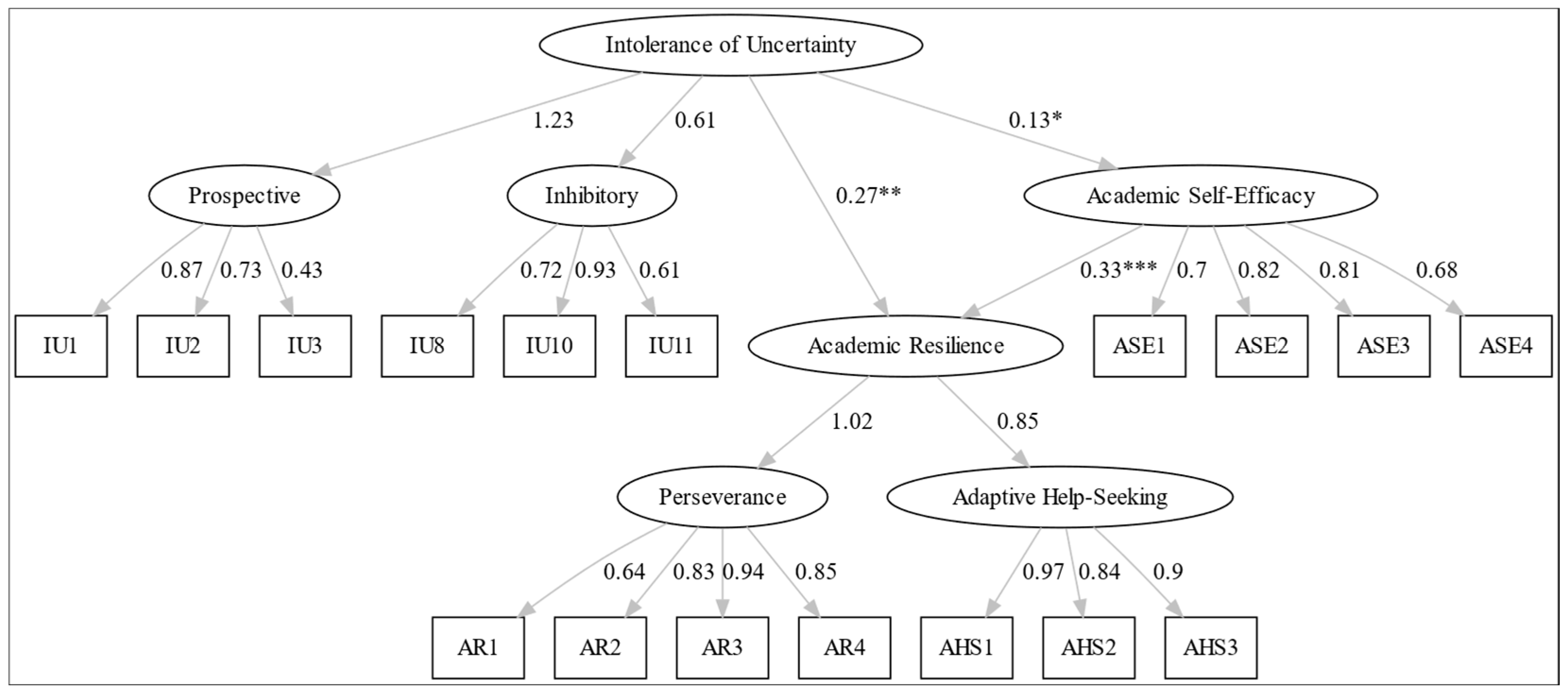
| Intolerance of uncertainty → Academic self-efficacy | 0.076 | 0.036 | 2.116 | 0.034 | 0.130 |
| Academic self-efficacy → Academic resilience | 0.402 | 0.075 | 5.395 | <0.001 | 0.334 |
| Intolerance of uncertainty → Academic resilience | 0.187 | 0.058 | 3.213 | 0.001 | 0.267 |
| Indirect effect | 0.030 | 0.015 | 2.019 | 0.043 | 0.044 |
| Total effect | 0.217 | 0.065 | 3.351 | 0.001 | 0.311 |
| Model | Model Specification | χ2 | df | χ2/df | CFI | TLI | RMSEA | SRMR |
|---|---|---|---|---|---|---|---|---|
| Hypothesized | IU → Academic Self-Efficacy → Academic Resilience + IU → Academic Resilience | 421.63 | 112 | 3.76 | 0.918 | 0.900 | 0.090 | 0.065 |
| First-order IU | IU measured as a single first-order latent factor | 510.26 | 114 | 4.48 | 0.895 | 0.874 | 0.101 | 0.078 |
| Alternative mediation | Academic Self-Efficacy → IU → Academic Resilience | 451.02 | 113 | 3.99 | 0.910 | 0.892 | 0.094 | 0.102 |
| Single-factor model | All observed indicators load onto one common latent factor | 1740.12 | 119 | 14.62 | 0.569 | 0.507 | 0.200 | 0.168 |
| Full mediation model | IU → Academic Self-Efficacy → Academic Resilience (no direct IU → Resilience path) | Did not converge | – | – | – | – | – | – |
Disclaimer/Publisher’s Note: The statements, opinions and data contained in all publications are solely those of the individual author(s) and contributor(s) and not of MDPI and/or the editor(s). MDPI and/or the editor(s) disclaim responsibility for any injury to people or property resulting from any ideas, methods, instructions or products referred to in the content. |
© 2026 by the authors. Licensee MDPI, Basel, Switzerland. This article is an open access article distributed under the terms and conditions of the Creative Commons Attribution (CC BY) license.
Share and Cite
Ünsal Akbıyık, B.S.; Çitli, İ.İ.; Kahveci, M.M. Academic Resilience Among Vocational High School Students in Collectivist Culture: The Role of Intolerance of Uncertainty and Academic Self-Efficacy. Behav. Sci. 2026, 16, 560. https://doi.org/10.3390/bs16040560
Ünsal Akbıyık BS, Çitli İİ, Kahveci MM. Academic Resilience Among Vocational High School Students in Collectivist Culture: The Role of Intolerance of Uncertainty and Academic Self-Efficacy. Behavioral Sciences. 2026; 16(4):560. https://doi.org/10.3390/bs16040560
Chicago/Turabian StyleÜnsal Akbıyık, Banu S., İhsan İlker Çitli, and Melis Melek Kahveci. 2026. "Academic Resilience Among Vocational High School Students in Collectivist Culture: The Role of Intolerance of Uncertainty and Academic Self-Efficacy" Behavioral Sciences 16, no. 4: 560. https://doi.org/10.3390/bs16040560
APA StyleÜnsal Akbıyık, B. S., Çitli, İ. İ., & Kahveci, M. M. (2026). Academic Resilience Among Vocational High School Students in Collectivist Culture: The Role of Intolerance of Uncertainty and Academic Self-Efficacy. Behavioral Sciences, 16(4), 560. https://doi.org/10.3390/bs16040560