Article

The Influence of Mindfulness-Enhanced Resistance Training Program on the Subjective Well-Being of Female College Students: A Randomized Controlled Trial

1
Department of Physical Education, Sun Yat-sen University, Guangzhou 510275, China
2
Department of Physical Education, Shenzhen Polytechnic University, Shenzhen 518055, China
*
Authors to whom correspondence should be addressed.
These author contributed equally to this work.
Behav. Sci. 2026, 16(4), 553; https://doi.org/10.3390/bs16040553
Submission received: 31 December 2025 / Revised: 8 March 2026 / Accepted: 11 March 2026 / Published: 8 April 2026
(This article belongs to the Section Health Psychology)

Abstract

This study evaluates the effects of a 30-week mindfulness-enhanced resistance training (MRT) program on the physical and mental health of female college students and explores whether changes in self-esteem or mindfulness mediate the relationship between MRT and subjective well-being. Sixty-four healthy female college students were randomly assigned to either the MRT or resistance training (RT) group. Both groups participated in 90 min weekly sessions for 30 weeks. A 2 × 2 mixed-design ANOVA analyzed the intervention’s effects on physical health, mindfulness, self-esteem, and subjective well-being. PROCESS macro (Model 4) tested mediation effects. MRT and RT significantly improved physical health, with MRT showing superior improvements in waist-to-hip ratio, flexibility, and vital capacity. Only MRT improved mindfulness, self-esteem, and subjective well-being. Self-esteem changes fully mediated the relationship between MRT and subjective well-being. MRT as a comprehensive mind–body intervention significantly enhanced the physical health and subjective well-being of female college students, outperforming resistance training. Improvements in self-esteem mediated the relationship between MRT and increased subjective well-being. MRT can serve as an effective approach to promote the physical and mental health of female college students.

1. Introduction

In recent years, physical and mental health issues among college students have become increasingly prominent worldwide (Paiva et al., 2025; Shaaban et al., 2026). In China, female college students are particularly affected due to low levels of physical activity and prolonged sedentary behavior (M. M. Guo et al., 2022). Research indicates that their physical fitness and cardiorespiratory endurance have been steadily declining (L. Guo et al., 2025), while the prevalence of mental health issues has remained consistently high (Gao et al., 2020; Lin et al., 2025). Meanwhile, mental health research has gradually shifted from focusing solely on “negative symptoms” such as depression and anxiety to emphasizing the assessment of “positive mental health,” centered on subjective well-being, including life satisfaction and positive emotions (Bohlmeijer & Westerhof, 2021; Magalhães, 2024). Subjective well-being is not only a key dimension of positive mental health (Keyes, 2002), but also a crucial indicator closely related to health outcomes (Steptoe et al., 2015). Compared to their male counterparts, female college students in China exhibit more pronounced emotional distress and a greater decline in subjective well-being (Cheng et al., 2025; Zhu et al., 2025). Therefore, how to improve physical health and subjective well-being in female college students through scalable and sustainable lifestyle interventions in the university setting has become a key issue in the fields of sport psychology and health promotion.
Resistance training (RT), as a key exercise modality for improving muscle strength and mass, has gained increasing attention in both clinical and public health fields in recent years. Systematic evidence shows that structured resistance training is safe and effective for adults, significantly improving physical fitness related to physical health (Ramos-Campo et al., 2021); it can also have a positive impact on mental health (Banyard et al., 2025). In young populations, resistance training helps improve physical fitness, body image, and body-esteem, which may, in turn, indirectly enhance subjective well-being through more positive self-evaluations and greater body satisfaction (White et al., 2024).
However, existing evidence on psychological outcomes remains unclear. Several studies focusing on young adults and adolescents have shown that resistance training alone does not lead to significant improvements in positive psychological outcomes, such as self-esteem and subjective well-being (Smith et al., 2018). Furthermore, compared to a resting state (i.e., non-active control condition), this type of training did not show a clear advantage in improving depressive mood (O’Sullivan et al., 2025). Several factors may account for this finding. In resistance training, the intensity and physical load are often associated with negative experiences such as fatigue and muscle discomfort, which may lead to a decrease in immediate pleasure and subsequently affect psychological benefits (Faro et al., 2019). Additionally, lower levels of autonomous motivation and perceived sense of control may limit the long-term psychological benefits of resistance training (Martinez Kercher et al., 2024). In the absence of strategies that promote self-awareness and emotional experiences, these negative feelings and motivational barriers may further hinder the sustained improvement of psychological benefits (Ten Hoor et al., 2025). In light of these limitations, researchers have begun to explore complementary psychological strategies that may enhance the mental health benefits of resistance training.
Mindfulness interventions, characterized by present-moment awareness and non-judgmental acceptance, have been widely applied in the field of mental health management. A large body of cross-sectional and longitudinal studies has shown a positive correlation between mindfulness training and subjective well-being (Karakurt & Durmaz, 2025; Ma & Xiang, 2023; Michaelsen et al., 2023). Mindfulness practice is also associated with lower emotional reactivity, reduced perceived stress, and fewer maladaptive behavioral patterns (Keng et al., 2011). Furthermore, evidence indicates that mindfulness-based interventions can alleviate negative emotional states, such as anxiety and depression, in various populations (Hofmann et al., 2010). Based on this, traditional mindfulness-based exercises, such as Tai Chi and yoga, which inherently incorporate mindfulness elements (Jankauskiene & Baceviciene, 2024; A. C. Lee et al., 2017), have been widely applied in the field of health promotion. Previous studies have suggested that these practices can improve stress levels (Qi et al., 2022) and anxiety and depression in college students (H. Li et al., 2023), thereby facilitating a comprehensive improvement in mental health. However, existing evidence also indicates that the beneficial effects of these traditional practices on mental health are not always consistent, particularly in relation to positive psychological indicators such as mindfulness levels and subjective well-being (Dawson et al., 2020). Meanwhile, a recent meta-analysis focusing on college students found that the effects of mindfulness interventions alone on emotional symptoms exhibit a certain degree of heterogeneity (Alrashdi et al., 2024). The improvement in positive psychological indicators, such as subjective well-being, is not stable (Dawson et al., 2020; Gong et al., 2023), and there are significant individual differences in the benefits. In the university context, single-session mindfulness courses face practical challenges, such as limited student engagement, high resource investment (Huberty et al., 2019) and insufficient adherence (Canby et al., 2021; Z. Zhang et al., 2024). These issues underscore the necessity of exploring “mind–body integration” strategies.
To enhance the stability of intervention effects and the clarity of underlying mechanisms, recent studies have innovatively attempted to integrate mindfulness training with traditional mindfulness-based exercises (such as yoga and Tai Chi). This integration involves embedding strategies like breath awareness, body scanning, and mindfulness cues during practice, resulting in more consistent or more efficient physical and mental benefits (Qu et al., 2024; J. Y. Zhang et al., 2018). Meanwhile, exercise modalities that integrate mindfulness training have expanded beyond traditional mindfulness-based practices to include a broader range of physical activities, particularly aerobic exercises characterized by repetitive, cyclical movements, such as mindful walking, mindful running, and other non-traditional forms of mindfulness-integrated exercise (Rotter et al., 2022; Zieff et al., 2024). By incorporating attention anchors and present-moment awareness training into these exercises, practitioners are encouraged to maintain a mindful state continuously. These studies also suggest that such practices have potential value in improving physical and mental health (Díaz-Silveira et al., 2025; Remskar et al., 2024). The studies described above are summarized in Table 1.
The studies on mindfulness-integrated exercise mentioned above have made significant contributions to the theory and practice of positive psychology. However, despite these promising findings, the applicability of existing mindfulness-integrated exercise trials to college populations remains limited for several reasons. The exercise modalities used in existing studies, such as yoga, are generally preferred by middle-aged women (Cramer et al., 2016), while Tai Chi, Qigong, and walking are more commonly practiced by middle-aged and older adults (Vergeer et al., 2017). This suggests that current research may need to integrate mindfulness with exercise forms that are more readily accepted by college students and offer significant physiological benefits, in order to provide more effective mind–body promotion strategies for this population.
As one such option, RT is widely practiced and well regarded among college students, producing relatively rapid and noticeable gains in strength and body morphology that can boost self-efficacy and body esteem (Collins et al., 2019). Incorporating mindfulness into this context may further amplify these benefits: by encouraging individuals to cultivate open, nonjudgmental awareness of their breath, muscular effort, and fatigue, mindfulness helps reduce tension and negative physical sensations during exercise, thereby enhancing enjoyment and fostering a greater sense of purpose in the workout experience (Cox et al., 2018). Additionally, mindfulness practice contributes to the enhancement of body image and self-efficacy during physical activity, further optimizing the exercise experience (Jankauskiene & Baceviciene, 2024; L. Li et al., 2023). The positive psychological benefits associated with both interventions can exert a positive impact on subjective well-being (C.-L. Lee et al., 2025; Song et al., 2025). Building on these psychological connections, prior research also suggests that self-esteem may serve as a psychological pathway linking physical activity and mindfulness to subjective well-being (J. Lee et al., 2023; Shang et al., 2021), warranting further investigation as a potential mediator in combined mind–body interventions.
Based on the above discussion, existing integrated intervention strategies primarily include aerobic exercises and traditional mindfulness-based training methods involving repetitive cyclical practices. However, these interventions may be influenced by demographic factors such as gender and age. Currently, there is insufficient evidence to support interventions centered around MRT, despite the fact that RT is more readily accepted and practiced by college students. Furthermore, most studies have relatively short durations and lack long-term data on intervention effects, particularly in long-term randomized controlled trials (RCTs) focusing on the comprehensive impact and mechanisms of these interventions on the physical and mental health of Chinese female college students, where relevant evidence remains limited. To address this limitation, the present study conducts a long-term RCT in which resistance training serves as the primary exercise modality, integrated with mindfulness training. The study compares MRT to RT, with the aim of evaluating its effectiveness in improving physical health, mindfulness, self-esteem, and subjective well-being. Furthermore, the present study develops a mediation model to test whether changes in self-esteem or mindfulness mediate the observed effects of MRT on subjective well-being. This study aims to provide evidence-based support for a combined intervention model using RT as a core modality, along with its psychological mechanisms, for promoting “mind–body integration” health in female college students.

2. Materials and Methods

2.1. Participants

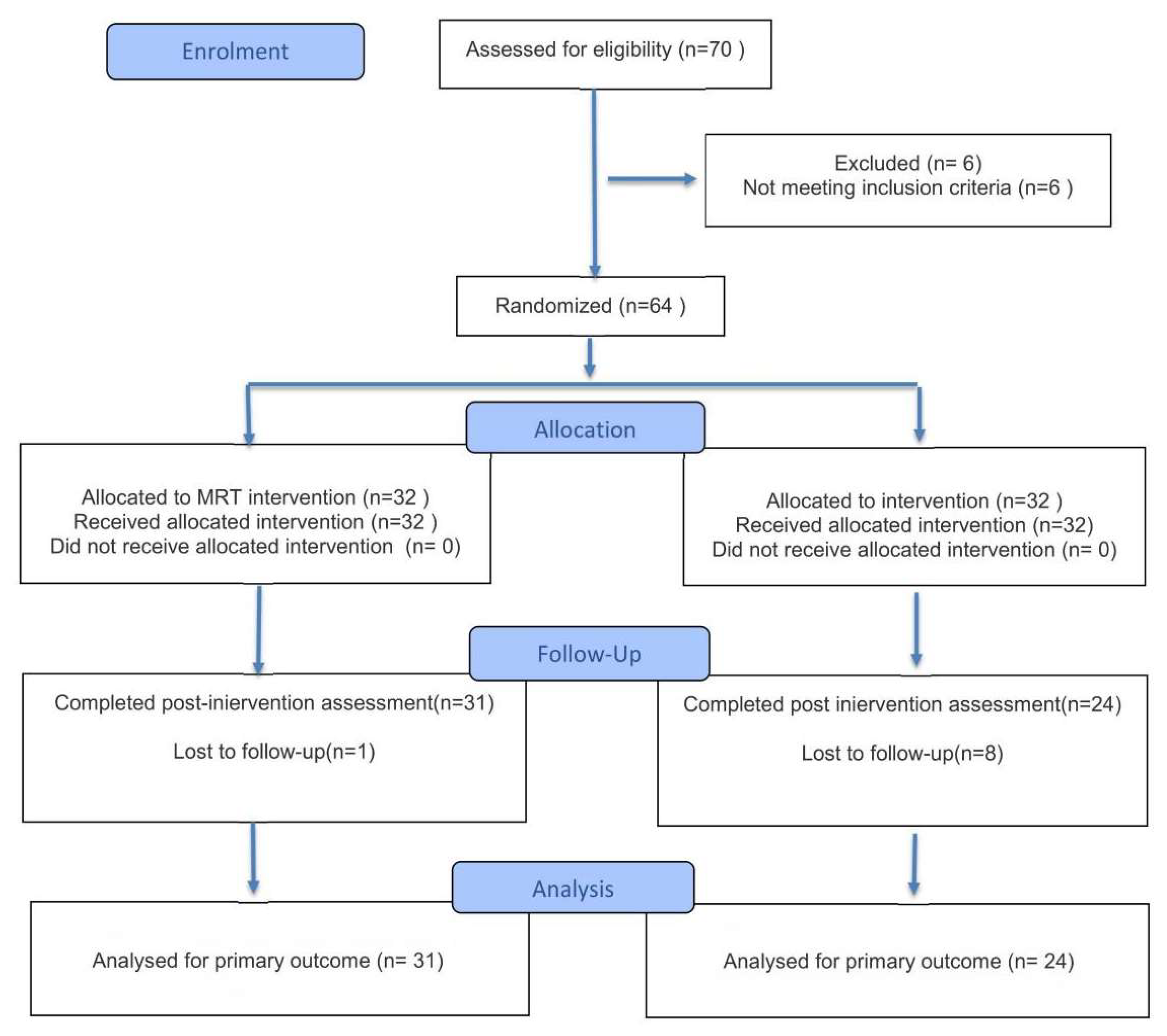
A priori power analysis was conducted to determine sample size. Sample size calculation was performed using G*Power 3.1 software (Heinrich-Heine-Universität Düsseldorf, Düsseldorf, Germany), with prior research indicating a medium effect size (range 0.25–0.4). Based on this, a type I error rate (α) of 0.05 was set, and a medium effect size (d = 0.25) was parameterized for each outcome variable. The statistical power was set at 0.8, which determined that a minimum of 48 participants was required. Considering potential dropout and attrition during the COVID-19 pandemic, a total of 64 female college students from Sun Yat-sen University who met the inclusion criteria were recruited for this study. Participants were randomly assigned to the mindfulness-enhanced resistance training MRT (n = 32) or resistance training RT (n = 32) groups. During the intervention, nine participants withdrew due to non-study-related factors impacting adherence, including one from the MRT (experimental group) and eight from the RT group. Throughout the testing process, evaluators remained blinded to group assignments to ensure objective data collection. All participants lived on campus and were instructed to maintain their usual daily routines and eating habits during the intervention to minimize the influence of non-intervention factors on the study outcomes. Table 2 shows the general characteristics of the participants.
This study was approved by the Ethics Committee of the Department of Psychology at Sun Yat-sen University prior to the intervention (approval number: 2021-1105-0213) and prospectively registered with the Chinese Clinical Trial Registry (ChiCTR: registration number: 2200058449). An informed consent form for the mindfulness intervention was prepared in accordance with the study protocol. All participants voluntarily agreed to participate in the study and provided written informed consent.
Inclusion criteria: (1) Female undergraduate students in their first or second year at Sun Yat-sen University; (2) Have no prior experience with structured mindfulness training or organized resistance training; (3) Adhere to a healthy lifestyle, regularly engage in physical activities excluding resistance training, and maintain a balanced diet; (4) In optimal health, with no history of high blood pressure, coronary artery disease, diabetes, physical disabilities, or musculoskeletal disorders; (5) Willing to participate in the study and provide written informed consent.
Withdrawal criteria: (1) Withdrawal from the study due to injury or other unforeseeable circumstances during the intervention period; (2) Poor adherence, defined as completing less than 85% of the prescribed weekly training volume (Müller et al., 2021).
Participants may compensate for missed sessions within the same week; failure to attend at least 85% of the scheduled sessions will result in removal from the study, with such cases classified as sample attrition.
The flow of participant screening and allocation is illustrated in Figure 1, and baseline characteristics are presented in Table 2.

2.2. Experimental Design and Procedures

(1)
MRT (experimental group): The intervention content and format were jointly developed by faculty members from the Department of Physical Education and the Department of Psychology at Sun Yat-sen University. The resistance training instructor had three years of experience in mindfulness practice and instruction and ten years of experience in resistance training and teaching.
(2)
RT (control group): The intervention was delivered by an instructor from the Department of Physical Education at Sun Yat-sen University with ten years of experience in resistance training and teaching.

2.3. Experimental Intervention Scheme

Both the MRT and RT groups underwent a 30-week intervention, with sessions held once a week for 90 min. The intervention for the RT group followed the curriculum and content requirements of the first-year “Fitness” course in the Department of Physical Education at Sun Yat-sen University, primarily focusing on resistance training exercises. During RT, the instructor did not introduce mindfulness explicitly nor guide participants to approach the resistance exercises with a mindfulness-centered mindset. The resistance training protocol in the MRT group was identical to that of the RT group. However, there were minor differences in the time allocation between the preparatory and main phases of each session. Additionally, the two groups performed their concentrated practice sessions at different class times, as detailed in Table 3. The MRT group followed a training intervention plan developed by the faculty team described in Section 2.2. Each session began with resistance training, mindfulness, and a round of sensory sharing and training content introduction (15 min). The instructor then guided participants through dynamic warm-ups, including cardiovascular, stretching, and core exercises (10 min), followed by a series of resistance training exercises (45 min). Throughout the practice, the instructor provided continuous verbal guidance, encouraging participants to maintain mindfulness. Participants were guided to focus on their breath while non-judgmentally noticing their internal state and muscle sensations, actively embracing challenges. During rest periods, a 10 min group mindfulness practice was conducted, including body scanning, loving-kindness meditation, and breath awareness exercises. The RT group did not engage in any exercises during the rest periods. Following the rest, participants completed 10 min of stretching and relaxation, followed by a session summary. A detailed comparison of the MRT and RT groups in terms of intervention content, teaching methods, designated exercises, and time allocation is provided in Table 3, Table 4 and Table 5 and the Supplementary Materials.

2.4. Measures

2.4.1. Psychological Indicators

(1)
Self-esteem level
The self-esteem data in this study were measured using the Chinese version of the Rosenberg Self-Esteem Scale, translated by Ji and Yu (1993), from Rosenberg (1965), which consists of 10 items, with 4 items scored reversely. The scale uses a 4-point Likert scale, ranging from 1 (strongly disagree) to 4 (strongly agree). This scale has been validated for use with Chinese college students and has shown acceptable reliability and validity (Peng et al., 2024). In this study, the overall Cronbach’s α coefficients for the pre-test and post-test were 0.804 and 0.782, respectively, meeting the basic requirements for reliability and validity.
(2)
Mindfulness level
Mindfulness was measured using the Chinese version of the Five Facet Mindfulness Questionnaire-SF (FFMQ-SF) (Bohlmeijer et al., 2011), translated by Hou et al. (2014). This scale includes 20 items that reflect five dimensions of mindfulness: observing, describing, acting with awareness, non-judging, and non-reactivity. The score range is from 20 to 100, with higher scores indicating higher levels of mindfulness. This scale has been validated for use with Chinese college students and has shown acceptable reliability and validity (Dai et al., 2022). The overall Cronbach’s α coefficients for the pre-test and post-test were 0.808 and 0.804, respectively, meeting the basic requirements for reliability and validity.
(3)
Subjective well-being
The subjective well-being data in this study were measured using the Chinese version of the Subjective Happiness Scale (Campbell, 1976), translated by J. Li and Zhao (2000). The scale consists of two components: the overall emotional index and life satisfaction, with a total of nine items, using a 7-point Likert scale. The overall happiness index score is calculated by averaging the scores of the two components (weighted 1:1). Higher scores indicate a higher level of happiness. This scale has been validated for use with Chinese college students and has shown acceptable reliability and validity (Qu et al., 2026). In this study, the Cronbach’s α coefficients for the pre-test and post-test were 0.879 and 0.939, respectively, meeting the basic requirements for reliability and validity.

2.4.2. Physical Health Indicators

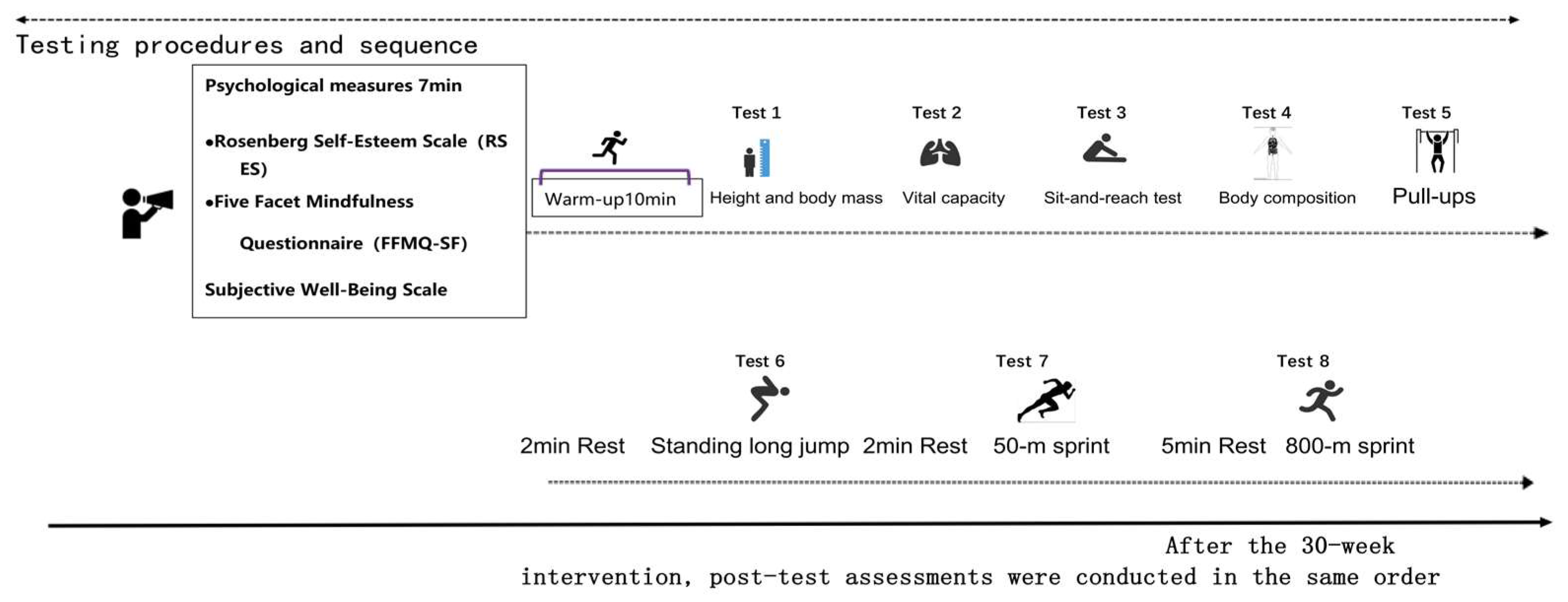
According to the physical health testing standards for female college students based on the Chinese Student Physical Health Standards (Bian, 2017), the physical health level was reflected by the overall score derived from three major categories: body morphology (body fat percentage, waist-to-hip ratio), physical fitness (endurance/800 m run, explosive power/standing long jump, muscular strength/sit-ups, flexibility/sit-and-reach, speed/50 m run), and physical function (vital capacity index). Since body fat percentage in body morphology, as well as the 800 m run and 50 m run in physical fitness, are reverse indicators (i.e., a smaller measurement value indicates better performance), reverse-scored items were transformed to ensure consistency with the direction of other indicators. The final analysis used standardized Z-scores, T-scores, and reverse-transformed scores for these physical health indicators, which were then summed to create a composite score (Figure 2). In the present study, total physical health score refers to the composite score derived from standardized indicators, whereas health-related physical fitness refers to specific physical components associated with health outcomes.

2.5. Statistical Methods

SPSS 26.0 statistical software was used to test the differences in the pre-test data and post-test data, and the normal distribution, variance homogeneity and descriptive statistics of the data were tested in turn. A mixed-design analysis of variance (ANOVA) was conducted to test the interaction between group (MRT group/RT group) and time (pre-test/post-test). If the interaction was significant, further simple effects tests for time and group were performed. Post hoc pairwise comparisons were conducted using the Bonferroni correction, and effect sizes were reported using partial η2 (0.01: small effect, 0.06: moderate effect, 0.14: large effect) (Cohen, 1977). A p-value less than 0.05 was regarded as statistically significant. Simple mediation analysis was conducted using the Process plugin with 5000 bootstrap samples. The significance of the mediation effect was determined by a 95% confidence interval that did not include zero (Preacher & Hayes, 2008).

3. Results

3.1. Baseline Differences

No significant baseline differences were found between the MRT and RT groups in terms of demographic characteristics or study variables (p > 0.05). Descriptive statistics for the study variables of both groups are presented in Table 6.

3.2. Interaction Effects (Time × Group)

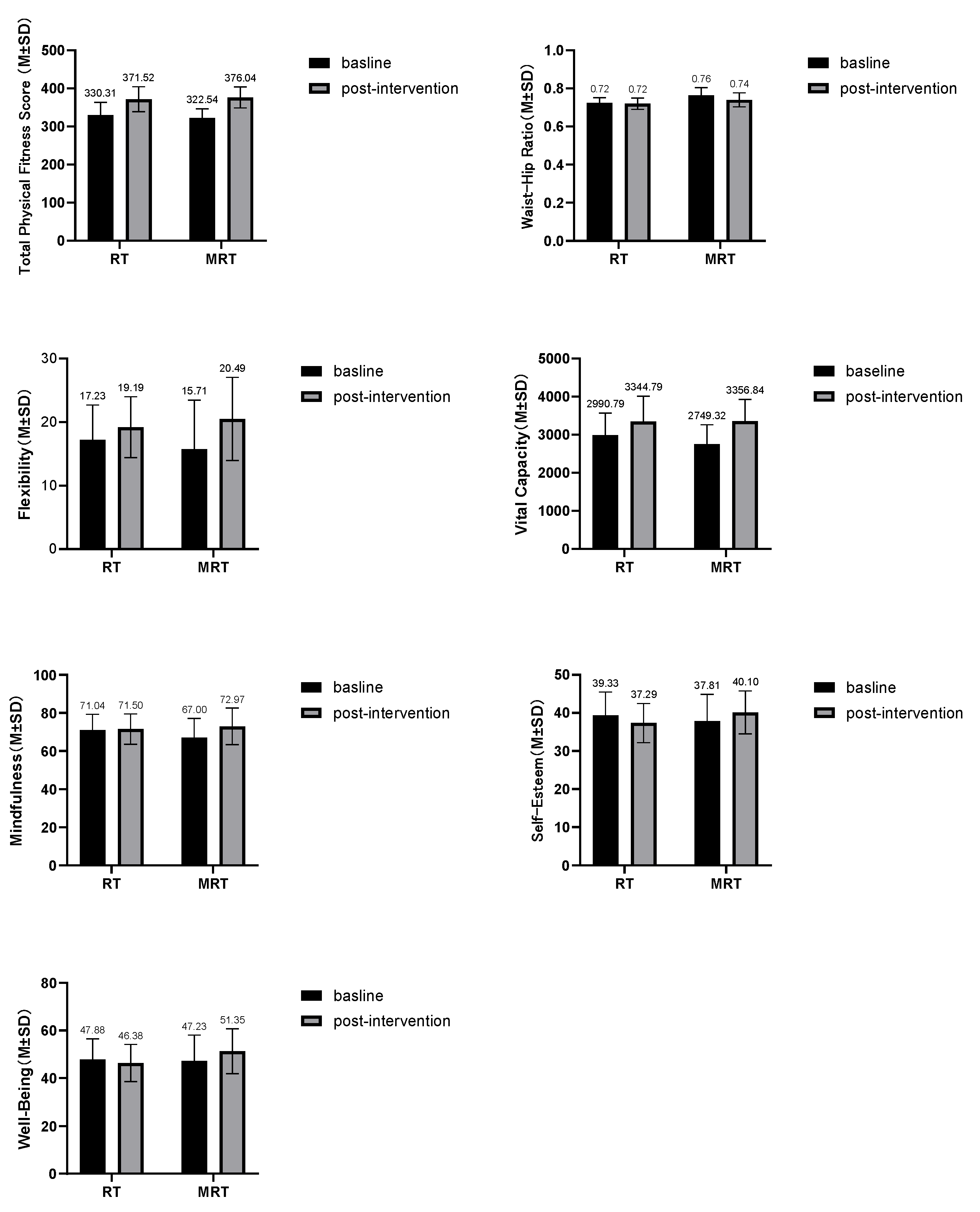
The results of the mixed-design ANOVA showed a significant interaction between time and group when the total physical health score was used as the dependent variable (F [1, 53] = 4.46, p = 0.040, η2 = 0.078).
The interaction between time and group was significant for waist-to-hip ratio (F [1, 53] = 4.31, p = 0.043, η2 = 0.075), sit-and-reach test (F [1, 53] = 7.69, p < 0.001, η2 = 0.127), and vital capacity (F [1, 53] = 6.37, p = 0.015, η2 = 0.107).
For the psychological outcomes, the interaction effects were similarly significant. The analysis yielded significant Group × Time interactions for mindfulness (F [1, 53] = 8.04, p = 0.006, η2 = 0.132), self-esteem levels (F [1, 53] = 7.52, p = 0.008, η2=0.124), and subjective well-being (F [1, 53] = 5.54, p = 0.022, η2 = 0.095).

3.3. Within-Group Simple Effects

Simple effects analysis within groups indicated that both MRT (MD = 53.50, F [1, 53] = 193.65, p < 0.001, η2 = 0.785) and RT (MD = 41.21, F [1, 53] = 88.97, p < 0.001, η2 = 0.627) showed significant increases in physical health scores post-intervention.
For the MRT group, waist-to-hip ratio (MD = −0.02, F [1, 53] = 15.68, p < 0.001, η2 = 0.228), sit-and-reach test (MD = 4.78, F [1, 53] = 50.64, p < 0.001, η2 = 0.489), and vital capacity (MD = 607.52, F [1, 53] = 87.78, p < 0.001, η2 = 0.613) all showed significant improvements post-intervention.
In the RT group, significant improvements were also found for the sit-and-reach test (MD = 1.96, F [1, 53] = 6.59, p = 0.013, η2 = 0.111) and vital capacity (MD = 354.00, F [1, 53] = 22.02, p < 0.001, η2 = 0.294). However, the change in waist-to-hip ratio for the RT group was not significant (MD = 0, F [1, 53] = 0.519, p = 0.474, η2 = 0.010).
For psychological indicators, the MRT group showed significant increases in mindfulness (MD = 5.97, F [1, 53] = 21.62, p < 0.001, η2 = 0.290), self-esteem levels (MD = 2.28 F [1, 53] = 4.82, p = 0.033, η2 = 0.083), and subjective well-being (MD = 4.12, F [1, 53] = 6.83, p = 0.012, η2 = 0.114) following the intervention. However, no significant changes were observed in these psychological variables in the RT group (p > 0.05).

3.4. Main Effects

The main effect of group was not statistically significant for body fat percentage (F [1, 53] = 2.22, p = 0.142, η2 = 0.040), 800 m run time (F [1, 53] = 1.58, p = 0.214, η2 = 0.029), standing long jump distance (F [1, 53] = 0.11, p = 0.745, η2 = 0.002), 50 m sprint time (F [1, 53] = 0.38, p = 0.541, η2 = 0.007), and sit-up count (F [1, 53] = 1.13, p = 0.292, η2 = 0.021; Table 7).
The main effect of time was significant: body fat percentage (F [1, 53] = 45.03, p < 0.001, η2 = 0.459), 800 m run time (F [1, 53] = 13.628, p = 0.001, η2 = 0.205), standing long jump distance (F [1, 53] = 32.16, p < 0.001, η2 = 0.378), 50 m sprint time (F [1, 53] = 54.52, p < 0.001, η2 = 0.507), and sit-up count (F [1, 53] = 215.07, p < 0.001, η2 = 0.802).
Post hoc comparisons confirmed that both groups improved significantly from pre-test to post-test on these measures: body fat percentage (MRT MD = −4.58, RT MD = −3.25), 800 m run time (MRT MD = −13.71, RT MD = −7.33), standing long jump distance (MRT MD = 8.13, RT MD = 6.83), 50 m sprint time (MRT MD = −0.44, RT MD = −0.55), and sit-up count (MRT MD = 12.68, RT MD = 13.37). However, consistent with the non-significant interaction effects, the magnitude of these improvements did not differ significantly between the two groups (p > 0.05; Table 7, Figure 3).

3.5. Mediation

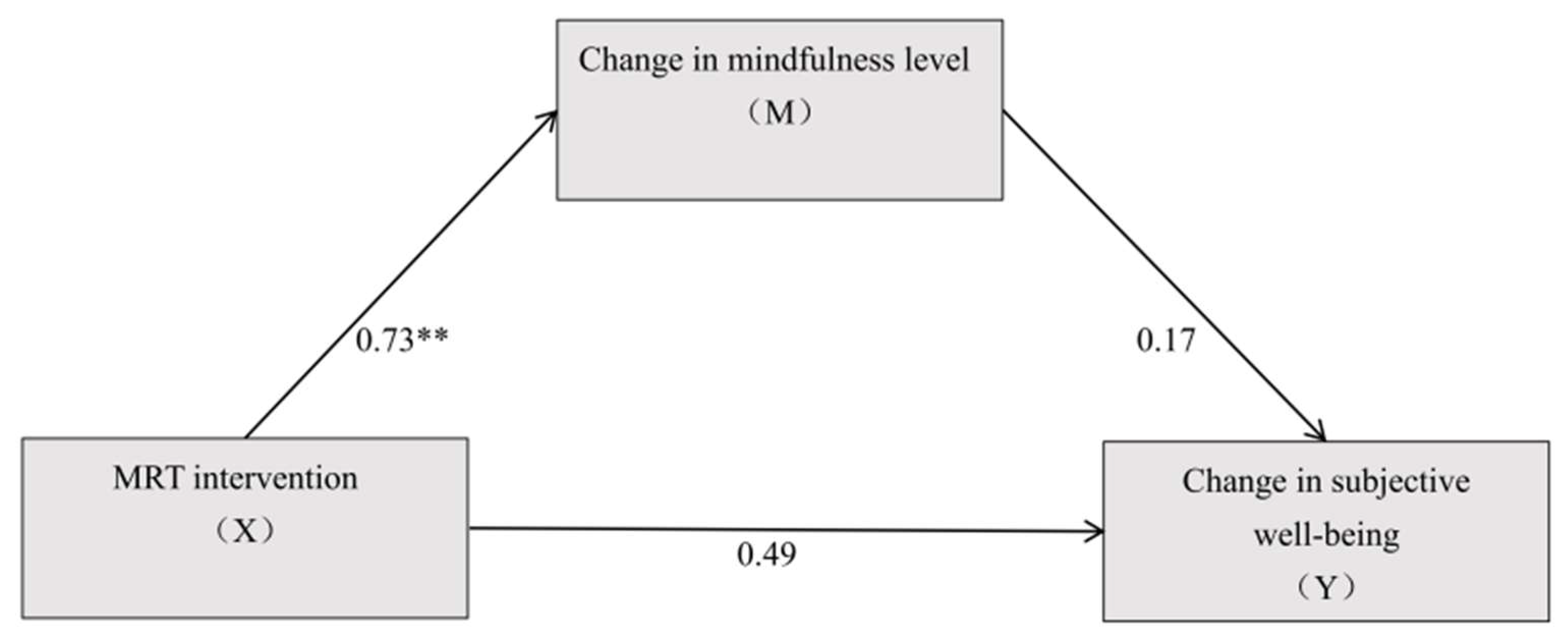
Group was treated as the independent variable (MRT = 1, RT = 0) and dummy-coded for the mediation analysis, with mindfulness level as the mediator and changes in subjective well-being as the dependent variable for the mediation analysis. The results (Figure 4, Table 8 and Table 9) showed that group significantly predicted changes in subjective well-being (β = 5.629, t = 2.354, p < 0.05). Additionally, group significantly predicted mindfulness levels (β =5.509, t = 2.835, p < 0.01). When both group and changes in mindfulness were included, group (β = 4.480, t = 1.754, p > 0.05) did not significantly predict subjective well-being, and mindfulness level did not significantly predict subjective well-being either (β = 0.209, t = 1.240, p > 0.05).
Further examination of the mediation effect revealed that, after including changes in mindfulness level, the 95% confidence interval for the direct effect of group on changes in subjective well-being included zero, with a Bootstrap (95% CI = [−0.6450, 9.6047]). Similarly, the 95% confidence interval for the mediation effect of changes in mindfulness level also included zero, with a Bootstrap (95% CI = [−1.0895, 4.9155]), indicating that the mediation effect of changes in mindfulness level was not significant. The direct effect (4.480) and the mediation effect (1.149) accounted for 79.59% and 20.41% of the total effect (5.629), respectively.
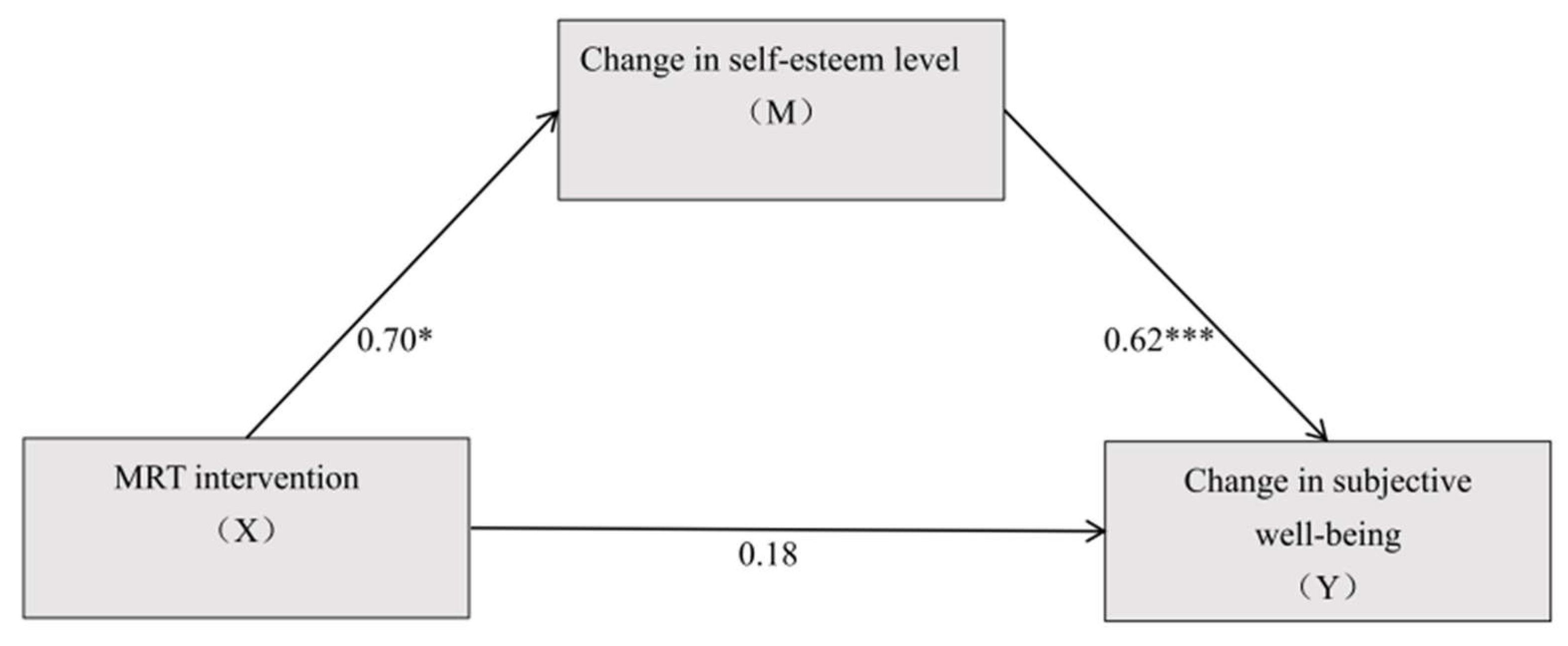
Group was treated as the independent variable (MRT = 1, RT = 0) and dummy-coded for the mediation analysis, with changes in self-esteem as the mediator and changes in subjective well-being as the dependent variable for the mediation analysis. The results (Figure 5, Table 8 and Table 9) showed that group significantly predicted changes in subjective well-being (β = 5.629, t = 2.354, p < 0.05). Additionally, group significantly predicted changes in self-esteem (β = 4.332, t = 2.742, p < 0.01). When both group and changes in self-esteem were included, group (β = 1.614, t = 0.791, p > 0.05) no longer significantly predicted the dependent variable, while changes in self-esteem still significantly predicted changes in subjective well-being (β = 0.927, t = 5.582, p < 0.001).
Further examination of the mediation effect revealed that, after including changes in self-esteem, the direct effect of group on changes in subjective well-being had a 95% confidence interval that included zero, with a Bootstrap (95% CI = [−2.4801, 5.7085]). In contrast, the 95% confidence interval for the mediation effect of changes in self-esteem did not include zero, with a Bootstrap (95% CI = [0.9607, 8.1125]), indicating a significant mediation effect of self-esteem changes, which was a full mediation. The direct effect (1.614) and the mediation effect (4.015) accounted for 28.68% and 71.32% of the total effect (5.629), respectively.

4. Discussion

This study compared the effects of a 30-week MRT and RT on the physical and mental health of female college students. It also investigated whether changes in self-esteem and mindfulness mediated the relationship between intervention type and changes in subjective well-being within the MRT model. Results indicated that both MRT and RT significantly improved physical health outcomes (including body morphology, physical fitness, and physical function) among participants. However, MRT was more effective than RT at improving the waist-to-hip ratio, flexibility, and vital capacity. Only the MRT group showed significant gains in mindfulness, subjective well-being, and self-esteem; no significant changes were observed in these psychological outcomes for the RT group. Mediation analyses revealed that changes in self-esteem fully mediated the effect of intervention type on changes in subjective well-being, whereas changes in mindfulness did not serve as a significant mediator.
Both MRT and RT produced significant improvements across multiple indices of health-related physical fitness, indicating that structured resistance training alone confers substantial health-promoting benefits. This finding is consistent with prior evidence demonstrating the positive effects of resistance training on physical fitness outcomes (E. D. Lee et al., 2022; Ramos-Campo et al., 2021). The additional improvements in flexibility and vital capacity observed in the MRT condition may be attributed to the integration of mindful breathing, an attitude of acceptance, and guided body awareness during training. Previous research indicates that performing resistance training through a full range of motion at the joints can enhance flexibility to a degree comparable to that achieved with static stretching—while simultaneously increasing muscular strength (Alizadeh et al., 2023). In the present study, participants in the MRT group may have been more willing to embrace the benefits of resistance and stretching exercises with a mindful stance, engage more fully in practice, tolerate training-related discomfort with greater self-compassion, and monitor movement amplitude more precisely, thereby promoting more standardized execution of both exercise and stretching and ultimately producing greater improvements in flexibility than RT (Wang et al., 2021). In addition, integrating breathing exercises with resistance training, or combining slow diaphragmatic breathing with strength exercise, may further enhance respiratory muscle function (Fan et al., 2024). In the MRT protocol implemented in the present study, motor learning emphasized breath–movement coordination, maintenance of a neutral spine, and mindful awareness of antagonist muscle relaxation. Over the 30-week intervention, these practice elements may have enhanced trunk stability and thoracic mobility, thereby contributing to an apparent additive benefit in both flexibility and vital capacity. Notably, despite a shorter duration of active exercise, the MRT group achieved health-related fitness improvements comparable to those observed in the RT group and even demonstrated superior gains in selected outcomes, underscoring the potential advantages and practical value of this integrated mind–body intervention.
Beyond the physical adaptations observed, the present findings further highlight distinct psychological mechanisms underlying the MRT intervention. The present study demonstrated that MRT significantly enhanced participants’ mindfulness, self-esteem, and subjective well-being, consistent with prior findings. By encouraging participants to engage in training with a mindful stance and to cultivate mindfulness-related habits and dispositions, the intervention may have strengthened momentary mindfulness experiences that subsequently generalized to daily life, thereby increasing trait mindfulness (Kiken et al., 2015). In parallel, mindfulness practice may facilitate more adaptive self-referential processing (Saraff et al., 2020) and attenuate negative self-directed affect; together, these changes in self-appraisals may ultimately contribute to higher self-esteem (Goldin & Gross, 2010). Evidence from college samples further suggests that physical activity can indirectly improve mental health through increases in mindfulness and self-esteem, with a significant serial mediation pathway in which physical activity influences psychological outcomes via mindfulness and then self-esteem, implying that mindfulness may bolster self-esteem and thereby promote more favorable psychological functioning (Tian & Yang, 2024). Moreover, mindfulness has been positively associated with self-esteem, and specific mindfulness facets (e.g., awareness and non-judgment) have been shown to predict variance in self-esteem, supporting a mechanistic account whereby mindfulness training may facilitate improvements in self-esteem (Chandna et al., 2022). From the perspective of self-determination theory, when individuals experience autonomy, competence, and relatedness through engagement in behavior, satisfaction of these basic psychological needs can strengthen self-worth and self-esteem, thereby enhancing intrinsic motivation and fostering positive affective change (Ryan & Deci, 2000). MRT may enhance perceived competence by directing participants’ attention to bodily changes and incremental progress, thereby strengthening their appraisals of personal capability. Self-compassionate language used during sessions may further encourage participants to relate to their bodies in a nonjudgmental manner, supporting autonomy by enabling them to experience, interpret, and evaluate bodily states more freely. In addition, the group-based format may cultivate interpersonal support and a sense of belonging. Together, these elements may facilitate increases in self-esteem by promoting more positive self-evaluations. Prior findings regarding the effects of RT on self-esteem have been mixed (Moore et al., 2011; Smith et al., 2018). In the present study, self-esteem in the RT group did not improve significantly after the prolonged training period. This null effect may be attributable, at least in part, to the relatively high baseline level of self-esteem in the RT sample (i.e., upper–moderate range), which could have limited observable gains (Marsh et al., 2010; Smith et al., 2018).
The present study demonstrated that changes in self-esteem fully mediated the association between MRT and subjective well-being. This mechanism is consistent with accumulating evidence indicating that self-esteem represents a central psychological resource linking physical activity to subjective well-being, with effects largely transmitted through indirect pathways rather than a robust direct effect (Liao et al., 2023; Pan et al., 2025; Yao et al., 2025). Individuals with higher self-esteem tend to cope more effectively with negative affect and regulate emotional fluctuations more adaptively, which supports more stable positive affect and higher life satisfaction (Kraiss et al., 2020; Sanchez-Sanchez et al., 2025). Moreover, increases in self-esteem are closely related to greater self-acceptance, which has been associated with enhanced subjective well-being (Klussman et al., 2022; Szentagotai-Tatar & David, 2013).
From the perspective of self-determination theory, when structured physical activity satisfies basic psychological needs—autonomy, competence, and relatedness—it can strengthen self-worth and foster well-being (Ryan & Deci, 2000). In the MRT context, mindfulness-related cues and self-compassionate guidance may have facilitated participants’ detection and affirmation of positive bodily signals and incremental progress, thereby enhancing positive self-appraisals and self-esteem; in turn, improved self-esteem may contribute to subjective well-being by promoting more adaptive social functioning and greater perceived support (Marshall et al., 2014; Siedlecki et al., 2014; Yuan et al., 2023). Beyond interpersonal pathways, self-esteem enhancement may also bolster self-efficacy and proactive engagement in daily life, which are typically associated with higher subjective well-being (Cattelino et al., 2023; Joshanloo, 2022).
Collectively, these findings support the proposed pathway whereby MRT contributes to subjective well-being through self-esteem enhancement, extending evidence for the “physical activity–self-esteem–subjective well-being” mechanism within a mindfulness-integrated resistance training context (Liao et al., 2023; Pan et al., 2025; Remskar et al., 2024).
Although mindfulness increased significantly in the MRT group, its change did not mediate the association between intervention condition and subjective well-being. Systematic reviews focusing on university students have shown that mindfulness-based interventions typically yield small-to-moderate effects on stress, anxiety, and depression, as well as on subjective well-being (Alrashdi et al., 2024). However, effects on positive psychological outcomes appear comparatively less consistent, with substantial heterogeneity across studies (Gong et al., 2023). Recent reviews further indicate that combining physical activity with mindfulness is generally beneficial for psychological health, yet the existing integrated programs are often characterized by small samples, short intervention periods, and considerable variability in intervention components and delivery (Remskar et al., 2024; Xu et al., 2025). In addition, longitudinal evidence suggests a dose–response relationship for mindfulness practice, such that higher practice frequency, longer session duration, and greater overall training exposure are associated with larger increases in trait mindfulness and more robust psychological benefits (Bowles & Van Dam, 2025; Strohmaier, 2020; Strohmaier & Goldberg, 2024). In the present study, the mindfulness component involved only one structured practice session per week, and participants’ baseline levels of subjective well-being and self-esteem were already in the upper-moderate range. These factors may have jointly constrained the magnitude and variability of mindfulness change, thereby reducing the detectable indirect effect and resulting in a nonsignificant mediation pathway.
This study has several limitations. First, the sample comprised only female university students, and differential attrition between groups (MRT: 3.1%; RT: 25.0%) represents a potential source of bias. Although baseline characteristics did not differ significantly between completers and non-completers, and withdrawals were primarily attributed to non-study-related factors during the COVID-19 period; a formal intention-to-treat analysis was not conducted due to the absence of post-intervention data for withdrawn participants. The per-protocol approach adopted in the present study may have introduced selection bias and could have inflated the observed MRT effects. Second, no post-intervention follow-up was conducted, precluding evaluation of the durability of the effects of resistance training combined with mindfulness components. Third, as an initial investigation of MRT, the outcome set focused on core dimensions closely related to the intervention and participants’ psychosocial functioning (e.g., self-esteem, mindfulness, and subjective well-being). Negative affective outcomes such as anxiety and depression were not assessed, which may limit the comprehensiveness of the psychological evaluation. Fourth, because the trial was conducted during the COVID-19 period, pandemic-related anxiety and stress may have acted as potential confounders influencing the observed effects. Finally, the duration of active exercise was not equivalent between the MRT and RT conditions, which may have affected the comparability of outcome changes across groups. Furthermore, the MRT intervention incorporated additional components beyond mindfulness training per se, including structured group sharing and instructor-guided attention, which may have introduced non-specific psychosocial effects such as social bonding and increased attention. The absence of an active psychological control condition therefore limits the present study’s ability to attribute the observed psychological benefits specifically to the mindfulness component. Notwithstanding these limitations, the present findings offer meaningful insights that can inform the design of future research.
Future studies should recruit larger and more diverse samples including males and other populations to enhance generalizability, incorporate long-term follow-up assessments to evaluate the durability of intervention effects, and broaden the range of outcome domains and measurement instruments to more comprehensively evaluate the physical and psychological benefits of MRT. Additionally, intention-to-treat analysis with appropriate imputation methods should be employed to strengthen internal validity, and an active psychological control condition should be considered to better isolate the specific effects of the mindfulness component.

5. Conclusions

The results of this study suggest that the 30-week MRT and RT interventions effectively improve the physical health of female college students. Compared to RT, MRT exhibited significantly greater improvements in enhancing subjective well-being, mindfulness, self-esteem, and several physical indicators, specifically the waist-to-hip ratio, flexibility, and vital capacity. Furthermore, changes in self-esteem fully mediated the relationship between the intervention type and enhancements in subjective well-being. These results suggest that MRT appears to be an efficient and feasible mind–body intervention for promoting holistic health in this population.

Supplementary Materials

The following supporting information can be downloaded at: https://www.mdpi.com/article/10.3390/bs16040553/s1.

Author Contributions

Conceptualization, P.Q. and F.P.; methodology, P.Q. and F.-B.L.; software, F.-B.L.; validation, Y.-W.Z., F.-B.L. and F.P.; formal analysis, F.-B.L.; investigation, P.Q. and F.P.; resources, P.Q. and F.P.; data curation, F.-B.L.; writing—original draft preparation, F.P.; writing—review and editing, P.Q. and Y.-W.Z.; visualization, P.Q. and Y.-W.Z.; supervision, P.Q. and Y.-W.Z.; project administration, P.Q. and Y.-W.Z.; funding acquisition, P.Q. All authors have read and agreed to the published version of the manuscript.

Funding

This work was supported by the Humanities and Social Sciences Research Project of the Ministry of Education of China (Grant No. 21YJC890025); the Guangdong Higher Education Teaching Reform Project (No. 30, 2024); the Teaching Quality Engineering Project of Sun Yat-sen University, China (2024); the Teaching Quality Engineering Project of Sun Yat-sen University, China (2026). The funders had no role in the study design, data collection and analysis, decision to publish, or preparation of the manuscript.

Institutional Review Board Statement

The study was conducted in accordance with the Declaration of Helsinki, and approved by the Ethics Committee of the Department of Psychology, Sun Yat-sen University (numbered 202111050213, 31 December 2021). The trial was registered at the Chinese Clinical Trial Registry (https://www.chictr.org.cn/; registration number: ChiCTR2200058449).

Informed Consent Statement

Informed consent was obtained from all subjects involved in the study.

Data Availability Statement

The data supporting this study’s findings are available from the first author (quping@mail.sysu.edu.cn) upon reasonable request.

Acknowledgments

The authors sincerely thank Minghua Huang, Hui Zhou, and Ruiqi Li for their valuable support throughout this study. The authors also express their heartfelt gratitude to all participants and to everyone who contributed to improving the manuscript. The authors gratefully acknowledge financial support from the Humanities and Social Sciences Research Project of the Ministry of Education of China and related teaching reform projects.

Conflicts of Interest

The authors declare that they have no competing interests.

References

  1. Alizadeh, S., Daneshjoo, A., Zahiri, A., Anvar, S. H., Goudini, R., Hicks, J. P., Konrad, A., & Behm, D. G. (2023). Resistance training induces improvements in range of motion: A systematic review and meta-analysis. Sports Medicine, 53(3), 707–722. [Google Scholar] [CrossRef]
  2. Alrashdi, D. H., Chen, K. K., Meyer, C., & Gould, R. L. (2024). A systematic review and meta-analysis of online mindfulness-based interventions for university students: An examination of psychological distress and well-being, and attrition rates. Journal of Technology in Behavioral Science, 9(2), 211–223. [Google Scholar] [CrossRef]
  3. Banyard, H., Edward, K. L., Garvey, L., Stephenson, J., Azevedo, L., & Benson, A. C. (2025). The effects of aerobic and resistance exercise on depression and anxiety: Systematic review with meta-analysis. International Journal of Mental Health Nursing, 34(3), e70054. [Google Scholar] [CrossRef]
  4. Bian, L. L. W. L. Y. (2017). An evaluation of the implementation effects of the 2014 revised national student physical fitness and health standard: Evidence from universities in Guangdong, China. Journal of Guangzhou Sport University, 37(2), 4–8. [Google Scholar] [CrossRef]
  5. Bohlmeijer, E., ten Klooster, P. M., Fledderus, M., Veehof, M., & Baer, R. (2011). Psychometric properties of the five facet mindfulness questionnaire in depressed adults and development of a short form. Assessment, 18(3), 308–320. [Google Scholar] [CrossRef]
  6. Bohlmeijer, E., & Westerhof, G. (2021). The model for sustainable mental health: Future directions for integrating positive psychology into mental health care. Front Psychol, 12, 747999. [Google Scholar] [CrossRef]
  7. Bowles, N. I., & Van Dam, N. T. (2025). Dose-response effects of reported meditation practice on mental-health and wellbeing: A prospective longitudinal study. Applied Psychology: Health and Well-Being, 17(4), e70063. [Google Scholar] [CrossRef]
  8. Campbell, A. (1976). Subjective measures of well-being. American Psychologis, 31(2), 117–124. [Google Scholar] [CrossRef]
  9. Canby, N. K., Eichel, K., Peters, S. I., Rahrig, H., & Britton, W. B. (2021). Predictors of out-of-class mindfulness practice adherence during and after a mindfulness-based intervention. Psychosomatic Medicine, 83(6), 655–664. [Google Scholar] [CrossRef]
  10. Cattelino, E., Testa, S., Calandri, E., Fedi, A., Gattino, S., Graziano, F., Rollero, C., & Begotti, T. (2023). Self-efficacy, subjective well-being and positive coping in adolescents with regard to COVID-19 lockdown. Current Psychology, 42, 17304–17315. [Google Scholar] [CrossRef]
  11. Chandna, S., Sharma, P., & Moosath, H. (2022). The mindful self: Exploring mindfulness in relation with self-esteem and self-efficacy in Indian population. Psychological Studies, 67(2), 261–272. [Google Scholar] [CrossRef]
  12. Cheng, C., Chen, X., & Wang, Q. (2025). Gender differences in mental well-being among Chinese college students: A Bayesian analysis. Journal of Health and Quality of Life, 7(1), 49–55. [Google Scholar] [CrossRef]
  13. Cohen, J. (1977). Statistical power analysis for the behavioral sciences (Rev. ed.). Lawrence Erlbaum Associates, Inc. [Google Scholar] [CrossRef]
  14. Collins, H., Booth, J. N., Duncan, A., Fawkner, S., & Niven, A. (2019). The effect of resistance training interventions on ‘the self’ in youth: A systematic review and meta-analysis. Sports Medicine Open, 5(1), 29. [Google Scholar] [CrossRef]
  15. Cox, A. E., Roberts, M. A., Cates, H. L., & McMahon, A. K. (2018). Mindfulness and affective responses to treadmill walking in individuals with low intrinsic motivation to exercise. International Journal of Exercise Science, 11(5), 609–624. [Google Scholar] [CrossRef]
  16. Cramer, H., Ward, L., Steel, A., Lauche, R., Dobos, G., & Zhang, Y. (2016). Prevalence, patterns, and predictors of yoga use: Results of a U.S. nationally representative survey. American Journal of Preventive Medicine, 50(2), 230–235. [Google Scholar] [CrossRef]
  17. Dai, Z., Jing, S., Wang, H., Xiao, W., Huang, Y., Chen, X., Fu, J., Pan, C., Tang, Q., Wang, H., & Su, X. (2022). Mindfulness-based online intervention on mental health among undergraduate nursing students during coronavirus disease 2019 pandemic in Beijing, China: A randomized controlled trial. Frontiers in Psychiatry, 13, 949477. [Google Scholar] [CrossRef]
  18. Dawson, A. F., Brown, W. W., Anderson, J., Datta, B., Donald, J. N., Hong, K., Allan, S., Mole, T. B., Jones, P. B., & Galante, J. (2020). Mindfulness-based interventions for university students: A systematic review and meta-analysis of randomised controlled trials. Applied Psychology: Health and Well-Being, 12(2), 384–410. [Google Scholar] [CrossRef]
  19. Díaz-Silveira, C., Burgos-Julián, F. A., Ruiz-Íñiguez, R., Alcover, C.-M., & Santed-Germán, M.-Á. (2025). Comparing mindful running and sitting meditation: A non-randomized controlled trial on mental health, stress, and salivary IgA. Mindfulness, 16(9), 2667–2682. [Google Scholar] [CrossRef]
  20. Fan, Y., Duan, Y., Gao, Z., & Liu, Y. (2024). Inspiratory muscle resistance combined with strength training: Effects on aerobic capacity in artistic swimmers. Frontiers in Sports and Active Living, 6, 1476344. [Google Scholar] [CrossRef]
  21. Faro, J., Wright, J. A., Hayman, L. L., Hastie, M., Gona, P. N., & Whiteley, J. A. (2019). Functional resistance training and affective response in female college-age students. Medicine and Science in Sports and Exercise, 51(6), 1186–1194. [Google Scholar] [CrossRef]
  22. Gao, L., Xie, Y., Jia, C., & Wang, W. (2020). Prevalence of depression among Chinese university students: A systematic review and meta-analysis. Scientific Reports, 10(1), 15897. [Google Scholar] [CrossRef]
  23. Goldin, P. R., & Gross, J. J. (2010). Effects of mindfulness-based stress reduction (MBSR) on emotion regulation in social anxiety disorder. Emotion, 10(1), 83–91. [Google Scholar] [CrossRef]
  24. Gong, X. G., Wang, L. P., Rong, G., Zhang, D. N., Zhang, A. Y., & Liu, C. (2023). Effects of online mindfulness-based interventions on the mental health of university students: A systematic review and meta-analysis. Frontiers in Psychology, 14, 1073647. [Google Scholar] [CrossRef]
  25. Guo, L., Jiang, L., & Huang, H. (2025). A longitudinal study of four-year changes in physical fitness among university students before and after COVID-19: 2019–2022. PLoS ONE, 20(10), e0334088. [Google Scholar] [CrossRef]
  26. Guo, M. M., Wang, X. Z., & Koh, K. T. (2022). Association between physical activity, sedentary time, and physical fitness of female college students in China. BMC Women’s Health, 22(1), 502. [Google Scholar] [CrossRef]
  27. Hofmann, S. G., Sawyer, A. T., Witt, A. A., & Oh, D. (2010). The effect of mindfulness-based therapy on anxiety and depression: A meta-analytic review. Journal of Consulting and Clinical Psychology, 78(2), 169–183. [Google Scholar] [CrossRef]
  28. Hou, J., Wong, S. Y.-S., Lo, H. H.-M., Mak, W. W.-S., & Ma, H. S.-W. (2014). Validation of a Chinese version of the five facet mindfulness questionnaire in Hong Kong and development of a short form. Assessment, 21(3), 363–371. [Google Scholar] [CrossRef]
  29. Huberty, J., Green, J., Glissmann, C., Larkey, L., Puzia, M., & Lee, C. (2019). Efficacy of the mindfulness meditation mobile app “calm” to reduce stress among college students: Randomized controlled trial. JMIR Mhealth Uhealth, 7(6), e14273. [Google Scholar] [CrossRef]
  30. Jankauskiene, R., & Baceviciene, M. (2024). Mindful monitoring and accepting the body in physical activity mediates the associations between physical activity and positive body image in a sample of young physically active adults. Frontiers in Sports and Active Living, 6, 1360145. [Google Scholar] [CrossRef]
  31. Ji, Y., & Yu, X. (1993). The self-esteem scale, SES. Chinese Mental Health Journal, 7, 251–252. [Google Scholar]
  32. Joshanloo, M. (2022). Self-esteem predicts positive affect directly and self-efficacy indirectly: A 10-year longitudinal study. Cognition and Emotion, 36(6), 1211–1217. [Google Scholar] [CrossRef]
  33. Karakurt, N., & Durmaz, H. (2025). The impact of mindfulness intervention on the subjective well-being of nursing students: An experimental study. BMC Psychology, 13(1), 955. [Google Scholar] [CrossRef]
  34. Keng, S.-L., Smoski, M. J., & Robins, C. J. (2011). Effects of mindfulness on psychological health: A review of empirical studies. Clinical Psychology Review, 31(6), 1041–1056. [Google Scholar] [CrossRef] [PubMed]
  35. Keyes, C. L. (2002). The mental health continuum: From languishing to flourishing in life. Journal of Health and Social Behavior, 43(2), 207–222. [Google Scholar] [CrossRef] [PubMed]
  36. Kiken, L. G., Garland, E. L., Bluth, K., Palsson, O. S., & Gaylord, S. A. (2015). From a state to a trait: Trajectories of state mindfulness in meditation during intervention predict changes in trait mindfulness. Personality and Individual Differences, 81, 41–46. [Google Scholar] [CrossRef]
  37. Klussman, K., Curtin, N., Langer, J., & Nichols, A. L. (2022). The importance of awareness, acceptance, and alignment with the self: A framework for understanding self-connection. Europe’s Journal of Psychology, 18(1), 120–131. [Google Scholar] [CrossRef]
  38. Kraiss, J. T., ten Klooster, P. M., Moskowitz, J. T., & Bohlmeijer, E. T. (2020). The relationship between emotion regulation and well-being in patients with mental disorders: A meta-analysis. Comprehensive Psychiatry, 102, 152189. [Google Scholar] [CrossRef]
  39. Lee, A. C., Harvey, W. F., Wong, J. B., Price, L. L., Han, X., Chung, M., Driban, J. B., Morgan, L. P. K., Morgan, N. L., & Wang, C. (2017). Effects of Tai Chi versus physical therapy on mindfulness in knee osteoarthritis. Mindfulness, 8(5), 1195–1205. [Google Scholar] [CrossRef] [PubMed]
  40. Lee, C.-L., Lu, Y.-Y., Hong, Z.-R., & Chang, N.-J. (2025). Effects of eight-week aerobic and resistance training on health self-efficacy, body image, and well-being in college students. Journal of Sports Medicine and Physical Fitness, 65(4), 583–597. [Google Scholar] [CrossRef]
  41. Lee, E. D., Seo, T. B., & Kim, Y. P. (2022). Effect of resistance circuit training on health-related physical fitness, plasma lipid, and adiponectin in obese college students. Journal of Exercise Rehabilitation, 18(6), 382–388. [Google Scholar] [CrossRef]
  42. Lee, J., Weiss, A., Ford, C. G., Conyers, D., & Shook, N. J. (2023). The indirect effect of trait mindfulness on life satisfaction through self-esteem and perceived stress. Current Psychology, 42(16), 13333–13345. [Google Scholar] [CrossRef]
  43. Li, H., Du, Z., Shen, S., Du, W., Kang, J., & Gong, D. (2023). An RCT-reticulated meta-analysis of six MBE therapies affecting college students’ negative psychology. iScience, 26(7), 107026. [Google Scholar] [CrossRef]
  44. Li, J., & Zhao, Y. (2000). Pilot testing report of the Campbell well-being scale in Chinese university students. Chinese Journal of Clinical Psychology, (4), 225–226+224. [Google Scholar] [CrossRef]
  45. Li, L., Jing, L., Liu, Y., Tang, Y., Wang, H., & Yang, J. (2023). Association of mindfulness with perfectionism, exercise self-efficacy, and competitive state anxiety in injured athletes returning to sports. Healthcare, 11(20), 2703. [Google Scholar] [CrossRef]
  46. Liao, T., Yin, Y., Hu, X., Tang, S., & Shim, Y. (2023). The relationship between physical activity and subjective well-being in Chinese university students: The mediating roles of perceived health, social support and self-esteem. Frontiers in Sports and Active Living, 5, 1280404. [Google Scholar] [CrossRef]
  47. Lin, Z.-Z., Cai, H.-W., Huang, Y.-F., Zhou, L.-L., Yuan, Z.-Y., He, L.-P., & Li, J. (2025). Prevalence of depression among university students in China: A systematic review and meta-analysis. BMC Psychology, 13(1), 373. [Google Scholar] [CrossRef]
  48. Ma, L., & Xiang, Y. (2023). Mindfulness and subjective well-being among Chinese adolescents: A longitudinal study and a weekly diary investigation. Journal of Happiness Studies, 24(6), 1861–1881. [Google Scholar] [CrossRef]
  49. Magalhães, E. (2024). Dual-factor models of mental health: A systematic review of empirical evidence. Psychosocial Intervention, 33(2), 89–102. [Google Scholar] [CrossRef]
  50. Marsh, H. W., Scalas, L. F., & Nagengast, B. (2010). Longitudinal tests of competing factor structures for the Rosenberg self-esteem scale: Traits, ephemeral artifacts, and stable response styles. Psychological Assessment, 22(2), 366–381. [Google Scholar] [CrossRef]
  51. Marshall, S. L., Parker, P. D., Ciarrochi, J., & Heaven, P. C. L. (2014). Is self-esteem a cause or consequence of social support? A 4-year longitudinal study. Child Development, 85(3), 1275–1291. [Google Scholar] [CrossRef] [PubMed]
  52. Martinez Kercher, V. M., Watkins, J. M., Goss, J. M., Phillips, L. A., Roy, B. A., Blades, K., Dobson, D., & Kercher, K. A. (2024). Psychological needs, self-efficacy, motivation, and resistance training outcomes in a 16-week barbell training program for adults. Frontiers in Psychology, 15, 1439431. [Google Scholar] [CrossRef] [PubMed]
  53. Michaelsen, M. M., Graser, J., Onescheit, M., Tuma, M. P., Werdecker, L., Pieper, D., & Esch, T. (2023). Mindfulness-based and mindfulness-informed interventions at the workplace: A systematic review and meta-regression analysis of RCTs. Mindfulness, 14, 1271–1304. [Google Scholar] [CrossRef]
  54. Moore, J. B., Mitchell, N. G., Bibeau, W. S., & Bartholomew, J. B. (2011). Effects of a 12-week resistance exercise program on physical self-perceptions in college students. Research Quarterly for Exercise and Sport, 82(2), 291–301. [Google Scholar] [CrossRef]
  55. Müller, D. C., Boeno, F. P., Izquierdo, M., Aagaard, P., Teodoro, J. L., Grazioli, R., Cunha, G., Ferrari, R., Saez de Asteasu, M. L., Pinto, R. S., & Cadore, E. L. (2021). Effects of high-intensity interval training combined with traditional strength or power training on functionality and physical fitness in healthy older men: A randomized controlled trial. Experimental Gerontology, 149, 111321. [Google Scholar] [CrossRef]
  56. O’Sullivan, D., Gordon, B. R., Lyons, M., Meyer, J. D., & Herring, M. P. (2025). Effects of resistance exercise on depressed mood state: A randomized controlled trial. Medicine & Science in Sports & Exercise, 57(11), 2496–2502. [Google Scholar] [CrossRef]
  57. Paiva, U., Cortese, S., Flor, M., Moncada-Parra, A., Lecumberri, A., Eudave, L., Magallón, S., García-González, S., Sobrino-Morras, Á., Piqué, I., Mestre-Bach, G., Solmi, M., & Arrondo, G. (2025). Prevalence of mental disorder symptoms among university students: An umbrella review. Neuroscience & Biobehavioral Reviews, 175, 106244. [Google Scholar] [CrossRef] [PubMed]
  58. Pan, H., Guan, H., Lv, Z., & Wu, H. (2025). College students physical activity and subjective wellbeing with the mediating role of social support self esteem and resilience. Scientific Reports, 15(1), 40841. [Google Scholar] [CrossRef]
  59. Peng, W., Zhou, Y., Chu, J., Liu, Z., Zheng, K., Yao, S., & Yi, J. (2024). Factorial and criterion validities of the Chinese version of rosenberg self-esteem scale among undergraduate students. Psychology Research and Behavior Management, 17, 4135–4144. [Google Scholar] [CrossRef]
  60. Preacher, K. J., & Hayes, A. F. (2008). Asymptotic and resampling strategies for assessing and comparing indirect effects in multiple mediator models. Behavior Research Methods, 40(3), 879–891. [Google Scholar] [CrossRef]
  61. Qi, F., Soh, K. G., Mohd Nasirudddin, N. J., & Mai, Y. (2022). Effects of Taichi on physical and psychological health of college students: A systematic review. Frontiers in Physiology, 13, 1008604. [Google Scholar] [CrossRef] [PubMed]
  62. Qu, P., Zhu, X., Zhou, H., Kang, Z., Li, R., Wen, J., Pan, F., Liu, Y., Zhu, T., Cao, Q., Wang, X., & Wang, Y. (2024). The effects of mindfulness enhanced Tai Chi Chuan training on mental and physical health among beginners: A randomized controlled trial. Frontiers in Psychology, 15, 1381009. [Google Scholar] [CrossRef] [PubMed]
  63. Qu, P., Zhu, X., Zhu, T., Zhou, H., Huang, M., Pan, F., Wang, X., Wen, J., Liu, Y., Zhang, Y., Li, F., & Wang, Y. (2026). Improving exercise motivation and physical fitness in college students through a long-term mindfulness-enhanced Tai Chi Chuan program: A randomized controlled trial. PeerJ, 14, e20602. [Google Scholar] [CrossRef] [PubMed]
  64. Ramos-Campo, D. J., Andreu Caravaca, L., Martínez-Rodríguez, A., & Rubio-Arias, J. Á. (2021). Effects of resistance circuit-based training on body composition, strength and cardiorespiratory fitness: A systematic review and meta-analysis. Biology, 10(5), 377. [Google Scholar] [CrossRef]
  65. Remskar, M., Western, M. J., Osborne, E. L., Maynard, O. M., & Ainsworth, B. (2024). Effects of combining physical activity with mindfulness on mental health and wellbeing: Systematic review of complex interventions. Mental Health and Physical Activity, 26, 100575. [Google Scholar] [CrossRef]
  66. Rosenberg, M. (1965). Society and the adolescent self-image. Social Forces, 3(2), 1381009. [Google Scholar]
  67. Rotter, G., Ortiz, M., Binting, S., Tomzik, J., Reese, F., Roll, S., Brinkhaus, B., & Teut, M. (2022). Mindful walking in patients with chronic low back pain: A randomized controlled trial. Journal of Integrative and Complementary Medicine, 28(6), 474–483. [Google Scholar] [CrossRef]
  68. Ryan, R. M., & Deci, E. L. (2000). Self-determination theory and the facilitation of intrinsic motivation, social development, and well-being. American Psychologist, 55(1), 68–78. [Google Scholar] [CrossRef] [PubMed]
  69. Sanchez-Sanchez, H., Schoeps, K., & Montoya-Castilla, I. (2025). Emotion regulation strategies and psychological well-being in emerging adulthood: Mediating role of optimism and self-esteem in a university student sample. Behavioral Sciences, 15(7), 929. [Google Scholar] [CrossRef]
  70. Saraff, S., Tiwari, A., & Rishipal, P. (2020). Effect of mindfulness on self-concept, self-esteem and growth mindset: Evidence from undergraduate students. Journal of Psychosocial Research, 15, 329. [Google Scholar] [CrossRef]
  71. Schuver, K. J., & Lewis, B. A. (2016). Mindfulness-based yoga intervention for women with depression. Complementary Therapies in Medicine, 26, 85–91. [Google Scholar] [CrossRef]
  72. Shaaban, M. E., Eltewacy, N. K., Owais, T. A., Abouzid, M., Albaser, N. A., Battah, M. M., Al-Awar, M. S. A., Alselwi, N. A., Ibrahim, M. T., Mohamed, A. I. M., Hefny, A. A. M., Gamal, A., Lamloum, H. M., Ebada, M., Alkanj, S., Rani, J., Jaber, L. E., Alswiti, A., Karmi, J. A., … EARG Collaborators. (2026). Investigating eating patterns and risk factors of weight status among undergraduate students in a multinational cross-sectional study across 15 countries with 8,482 participants. BMC Public Health, 26(1), 383. [Google Scholar] [CrossRef] [PubMed]
  73. Shang, Y., Xie, H. D., & Yang, S. Y. (2021). The relationship between physical exercise and subjective well-being in college students: The mediating effect of body image and self-esteem. Frontiers in Psychology, 12, 658935. [Google Scholar] [CrossRef]
  74. Shors, T. J., Chang, H. Y. M., & Millon, E. M. (2018). MAP Training My Brain™: Meditation plus aerobic exercise lessens trauma of sexual violence more than either activity alone. Frontiers in Neuroscience, 12, 211. [Google Scholar] [CrossRef] [PubMed]
  75. Siedlecki, K. L., Salthouse, T. A., Oishi, S., & Jeswani, S. (2014). The relationship between social support and subjective well-being across age. Social Indicators Research, 117(2), 561–576. [Google Scholar] [CrossRef]
  76. Smith, J. J., Beauchamp, M. R., Faulkner, G., Morgan, P. J., Kennedy, S. G., & Lubans, D. R. (2018). Intervention effects and mediators of well-being in a school-based physical activity program for adolescents: The ‘Resistance Training for Teens’ cluster RCT. Mental Health and Physical Activity, 15, 88–94. [Google Scholar] [CrossRef]
  77. Song, J., Guo, K.-l., Zhou, Z.-h., Cheng, L.-y., Li, Z.-y., Zong, Y., & Chen, X.-j. (2025). The serial mediating effects of mindfulness and emotion regulation between physical exercise and subjective well-being in college students. Scientific Reports, 15(1), 44243. [Google Scholar] [CrossRef]
  78. Steptoe, A., Deaton, A., & Stone, A. A. (2015). Subjective wellbeing, health, and ageing. Lancet, 385(9968), 640–648. [Google Scholar] [CrossRef]
  79. Strohmaier, S. (2020). The relationship between doses of mindfulness-based programs and depression, anxiety, stress, and mindfulness: A Dose-response meta-regression of randomized controlled trials. Mindfulness, 11(6), 1315–1335. [Google Scholar] [CrossRef]
  80. Strohmaier, S., & Goldberg, S. B. (2024). Longitudinal increases in mindfulness practice quality are associated with changes in psychological outcomes and not vice versa—A brief report. Current Psychology, 43(20), 18517–18520. [Google Scholar] [CrossRef]
  81. Szentagotai-Tatar, A., & David, D. (2013). Self-acceptance and happiness. In The strength of self-acceptance: Theory, practice and research (pp. 121–137). Springer. [Google Scholar] [CrossRef]
  82. Ten Hoor, G. A., Schäfer, H., Gugushvili, N., & Massar, K. (2025). The psychological effects of strength exercises in people who are overweight or obese: An updated literature review and meta-analysis. Sports Medicine Open, 11(1), 152. [Google Scholar] [CrossRef]
  83. Tian, Y., & Yang, S. (2024). The chain mediating effect of mindfulness and self-esteem in the relationship between leisure-time physical activity and academic burnout among college students. Scientific Reports, 14(1), 32119. [Google Scholar] [CrossRef]
  84. Vergeer, I., Bennie, J. A., Charity, M. J., Harvey, J. T., van Uffelen, J. G. Z., Biddle, S. J. H., & Eime, R. M. (2017). Participation trends in holistic movement practices: A 10-year comparison of yoga/Pilates and T’ai Chi/Qigong use among a national sample of 195,926 Australians. BMC Complement Altern Med, 17(1), 296. [Google Scholar] [CrossRef]
  85. Wang, Y., Tian, J., & Yang, Q. (2021). On mindfulness training for promoting mental toughness of female college students in endurance exercise. Evidence-Based Complementary and Alternative Medicine, 2021, 5596111. [Google Scholar] [CrossRef] [PubMed]
  86. White, R. L., Vella, S., Biddle, S., Sutcliffe, J., Guagliano, J. M., Uddin, R., Burgin, A., Apostolopoulos, M., Nguyen, T., Young, C., Taylor, N., Lilley, S., & Teychenne, M. (2024). Physical activity and mental health: A systematic review and best-evidence synthesis of mediation and moderation studies. International Journal of Behavioral Nutrition and Physical Activity, 21(1), 134. [Google Scholar] [CrossRef]
  87. Xu, X. J., Bin Abdullah, B., Samsudin, S. B., & Tan, Y. N. (2025). Integrating mindfulness and physical activity: A meta-analysis of mindful movement interventions for symptoms of anxiety and depression among university students. PeerJ, 13, e19640. [Google Scholar] [CrossRef] [PubMed]
  88. Yao, L., Guo, K., Guo, F., Li, D., Liu, Y., & Xiang, J. (2025). Relationship between physical exercise and subjective wellbeing in university students: The chain mediation role of self-identity and self-esteem. Frontiers in Psychology, 16, 1637779. [Google Scholar] [CrossRef] [PubMed]
  89. Yuan, W., Xie, Z., Dong, P., & Yang, Y. (2023). Linking perceived social support to self-esteem and social integration among adolescents with visual impairment: A cross-lagged study. Frontiers in Psychology, 13, 1054857. [Google Scholar] [CrossRef]
  90. Zhang, J. Y., Qin, S. D., Zhou, Y. Q., Meng, L. N., Su, H., & Zhao, S. (2018). A randomized controlled trial of mindfulness-based Tai Chi Chuan for subthreshold depression adolescents. Neuropsychiatric Disease and Treatment, 14, 2313–2321. [Google Scholar] [CrossRef]
  91. Zhang, Z., Lưu, B. C. P., & Gilbert-Diamond, D. (2024). Acceptability, engagement, and preliminary efficacy of a college human physiology course with integrated mindfulness practice to support student wellbeing. Frontiers in Psychology, 15, 1365778. [Google Scholar] [CrossRef]
  92. Zhu, Y., Liang, W.-M., Jiang, K., Truskauskaitė, I., Griškova-Bulanova, I., Bai, Z., & Rukšėnas, O. (2025). Mental well-being of college students: Focus on sex differences and psycho physiological indices. BMC Public Health, 25(1), 3038. [Google Scholar] [CrossRef]
  93. Zieff, G. H., Stoner, L., Frank, B., Gaylord, S., Battle, S., & Hackney, A. C. (2024). Aerobic exercise, mindfulness meditation, and stress-reduction in high-stress, college-based young adults: A pilot study. Journal of American College Health, 72(5), 1331–1335. [Google Scholar] [CrossRef] [PubMed]
Figure 1. Flow chart of experimental object selection.
Behavsci 16 00553 g001
Figure 2. Testing procedures and sequences.
Behavsci 16 00553 g002
Figure 3. Changes in the mean values of physical and psychological indicators of MRT and RT subjects before and after intervention. Note: (1) MRT refers to the Mindfulness-Enhanced Resistance Training Group, and RT refers to the Resistance Training Group; (2) “M” denotes the mean. “SD” denotes standard deviation.
Behavsci 16 00553 g003
Figure 4. The mediating effect of mindfulness. Note: ** p < 0.01.
Behavsci 16 00553 g004
Figure 5. The mediating effect of self-esteem. Note: * p < 0.05, *** p < 0.001.
Behavsci 16 00553 g005
Table 1. Mindfulness-integrated exercise trials: a comparative summary.
Intervention ModelParticipantsOutcome Measures (Compared to the Control Group)Limitations of the Study
Mindfulness + Traditional Mindfulness-Based Exercise10 weeks mindfulness-enhanced Tai Chi Chuan
(Qu et al., 2024)
119 healthy college students from a comprehensive university in ChinaHealth status and skill-related physical fitness, mindfulness levels ↑, depression ↓, anxiety and stress ↓The gender differences among participants were not adequately considered.
8 weeks mindfulness-based Tai Chi Chuan (J. Y. Zhang et al., 2018)64 college students with subclinical depression from a medical university in ChinaMindfulness levels ↑, depression ↓, anxiety and stress ↓The physical outcome measures are lacking.
12 weeks Mindfulness-based yoga
(Schuver & Lewis, 2016)
40 women with depression from abroadDepression levels ↓There are too few psychological outcome measures.
Mindfulness +
Non-traditional Mindfulness-Based Exercise
4 weeks Mindfulness Meditation Combined with Aerobic Exercise (Zieff et al., 2024)32 university students with high stress from abroad (84% female)Stress ↓, anxiety and depression ↓The intervention period was relatively short, and the sample size was small.
6 weeks Mindfulness Meditation Combined with 60–80% HRmax Aerobic Exercise (Shors et al., 2018)105 adult women from abroadRuminative thinking, self-worth ↑The physical outcome measures are absent.
8 weeks mindful walking program (MWP) (Rotter et al., 2022)55 adult patients with chronic low back pain from abroadPain, back function, and perceived stress (no significant effects)Changes in physical outcome measures were not observed.
Note: ↑ indicates increased or improved outcomes; ↓ indicates decreased or reduced outcomes.
Table 2. General information of experimental subjects (n = 55).
GroupNumber of ParticipantsAge/YearHeight/cmWeight/kg
MRT3118.00 ± 0.58160.11 ± 5.6454.72 ± 6.79
RT2418.04 ± 0.55162.75 ± 5.0652.97 ± 5.21
Table 3. Comparison table of training arrangements between the two groups.
Group Training StructureMRT (Experimental Group)RT (Control Group)
Specific ContentDurationSpecific ContentDuration
Preparation PhaseTraining Introduction + Resistance Training (5 min)
Mindfulness and Sensory Sharing (10 min)
15 minTraining Introduction5 min
Warm-up: Cardiovascular/Stretching/Core Exercises10 minWarm-up: Cardiovascular/Stretching/Core Exercises20 min
Main PhaseReview of Learned Exercises15 minReview of Learned Exercises20 min
Mindfulness-Enhanced Resistance Training, Group Exercises30 minResistance Training, Group Exercises35 min
Mindfulness Group Practice (mainly static)
(Body Scanning, Loving-Kindness Meditation, Breath Awareness, etc.)
10 minRest10 min
Conclusion PhaseRelaxation + Summary + Independent Tasks10 minRelaxation + Summary + Independent Tasks10 min
Table 4. Summary table of intervention comparison between MRT and RT.
MRTRT
Intervention ContentSet different mindfulness themes;
Resistance training exercises targeting the shoulders, chest, hips, legs, arms, and the entire body.
Teaching MethodsGuide with a mindfulness attitude, emphasizing breath awareness and increasing awareness of movement posture and positioning.Emphasize breath awareness and the perception of movement posture and positioning using Resistance training instruction methods.
Independent TasksMindfulness storytelling, mindfulness reading materials, mindfulness assignments;
Introduction to resistance training diet;
Recommendations for resistance training programs;
Daily diet and exercise log.
Introduction to resistance training diet;
Recommendations for resistance training programs;
Daily diet and exercise log.
Content Distribution for Each InterventionIntroduction to resistance training, mindfulness sharing;
Warm-up;
Mindfulness-enhanced resistance training;
Mindfulness group practice;
Stretching and relaxation, summary, and independent tasks.
Introduction to resistance training;
Warm-up;
Resistance training;
Rest;
Stretching and relaxation, summary, and independent tasks.
Table 5. Intervention procedures and schedule for MRT.
Commencement phase (15 min)1. Program Introduction (5 min)
The session commenced with an oral introduction to the weekly mindfulness theme and training content.
2. Mindfulness-based practice and independent tasks group sharing (10 min)
Warm up Exercise
(10 min)
Cardiorespiratory Fitness/Stretching/Core Stabilization Exercises (10 min)
Participants were instructed to anchor attention to breathing, redirect cognitive focus to present-moment experience, and cultivate interoceptive awareness of somatic and affective states.
MRT practice
(45 min)
Perform circuit training consisting of traditional resistance-training exercises targeting the shoulders, chest, hips, legs, arms, and whole-body movements (Review of previously learned movements, mindfulness-enhanced resistance training, and group practice).
  • Instruct participants to focus on breathing. Begin by anchoring attention to the breath and the present moment. Maintain breath awareness during movement to establish movement rhythm. Conclude by observing the breath and noting one’s state.
  • Instruct participants to observe, without judgment, emergent physical or exercise-related phenomena (including fatigue, soreness, or perceived difficulty) and to accept challenges proactively.
  • Guide participants to recognize correct movement execution and associated bodily sensations to enhance exercise quality and efficiency.
  • Utilize partnered exercises to facilitate the experience of mindful attitudes such as patience, trust, gratitude, and generosity.
  • For participants exhibiting an impatient or overly goal-driven exercise mindset, encourage the application of mindful attitudes such as “non-striving” and “patience”.
Mindfulness practice
(10 min)
  • Breath Awareness
  • Body Scan
  • Mindfulness Experience Sharing
  • Loving-Kindness Meditation
  • Breathing Space
  • Guided mindfulness exercises were administered via live facilitator narration or pre-recorded audio. Participants were given the option to select designated areas and adopt self-selected postures (seated or supine on yoga mats) to optimize physical comfort and relaxation. All participants kept their eyes closed throughout the practice.
  • Participants were invited to verbally articulate somatic and cognitive experiences derived from their previous-week mindfulness practice.
Final phase
(10 min)
  • Cool-down Stretching
  • Session Debriefing
  • Post-Session Exercise Independent Tasks
Table 6. Descriptive statistics and comparison of differences in physical and mental health indicators (n = 55).
IndicatorsMRT (n = 31)
(M ± SD)
RT (n = 24)
(M ± SD)
p
Height/cm160.11 ± 5.64162.75 ± 5.060.490
Weight/kg54.71 ± 6.7952.98 ± 5.210.160
Mindfulness67.00 ± 10.1071.04 ± 8.240.117
Self-Esteem37.81 ± 7.0439.33 ± 6.090.587
Subjective Well-Being47.23 ± 10.8647.88 ± 8.630.811
Total score of physical health322.54 ± 24.11330.31 ± 33.270.213
  Waist-to-hip ratio0.76 ± 0.040.72 ± 0.030.064
  Vital capacity/mL2749.32 ± 512.392990.79 ± 575.170.647
  Sit-and-reach test/cm15.71 ± 7.7217.23 ± 5.460.086
  Body fat percentage/%24.90 ± 2.8322.86 ± 2.500.223
  800 m run/s250.03 ± 23.65240.33 ± 20.270.236
  sprint 50/s9.44 ± 0.779.39 ± 0.810.874
  Sit-ups/pcs36.90 ± 7.6134.17 ± 9.190.554
  Standing long jump/cm166.55 ± 15.99168.67 ± 17.980.487
Note: “M” denotes the mean. “SD” denotes standard deviation.
Table 7. Pre–post outcomes and mixed-design ANOVA results (n = 55).
OutcomeGroupBaseline
(M ± SD)
Post-Intervention
(M ± SD)
MDANOVA (F, p, η2)
Time EffectGroup EffectTime × Group EffectSimple Effect Test
Total Physical Health ScoreMRT
RT
322.54 ± 24.11
330.31 ± 33.27
376.04 ± 27.69 **
371.52 ± 32.69 **
53.50
41.21
264.8410.000 **0.8330.0470.8270.0014.4560.040 *0.078193.645
88.973
0.000 **
0.000 **
0.785
0.627
Waist-to-Hip Ratio MRT
RT
0.76 ± 0.04
0.72 ± 0.03
0.74 ± 0.04 **
0.72 ± 0.03
−0.02
0.00
9.9660.003 **0.15813.7870.000 **0.2064.3050.043 *0.07515.681
0.519
0.000 **
0.474
0.228
0.010
Sit-and-reach testMRT
RT
15.71 ± 7.72
17.23 ± 5.46
20.49 ± 6.55 **
19.19 ± 4.8 **
4.78
1.96
43.9450.000 **0.4530.0040.9480.0007.6860.008 **0.12750.638
6.589
0.000 **
0.013 *
0.489
0.111
Vital CapacityMRT
RT
2749.32 ± 512.39
2990.79 ± 575.17
3356.84 ± 566.05 **
3344.79 ± 665.34 **
607.52
354.00
91.5790.000 **0.6330.5960.4440.0116.3660.015 *0.10783.782
22.024
0.000 **
0.000 **
0.613
0.294
Body fat percentageMRT
RT
25.88 ± 5.99
27.14 ± 5.08
21.30 ± 5.07 **
23.89 ± 4.44 **
−4.58
−3.25
45.0330.000 **0.4592.2230.1420.0401.2990.2590.02435.309
13.765
0.000 **
0.000 **
0.400
0.206
800 m runMRT
RT
250.03 ± 23.65
240.33 ± 20.27
236.32 ± 20.52 **
233.00 ± 22.05 **
−13.71
−7.33
13.6280.0010.2051.5830.2140.0291.2510.2680.02313.256
2.936
0.001 **
0.092
0.200
0.052
Standing long jumpMRT
RT
166.55 ± 15.99
168.67 ± 17.98
174.68 ± 15.19 **
175.50 ± 20.32 **
8.13
6.83
32.1600.0000.3780.1070.7450.0020.2410.6240.00521.754
11.901
0.000 **
0.001 **
0.291
0.183
50 m sprintMRT
RT
9.44 ± 0.77
9.39 ± 0.81
9.00 ± 0.52 **
8.84 ± 0.69 **
−0.44
−0.55
54.5150.0000.5070.3790.5410.0070.5740.4520.01125.150
29.399
0.000 **
0.000 **
0.322
0.367
Sit-upsMRT
RT
36.90 ± 7.61
34.17 ± 9.19
49.58 ± 9.73 **
47.54 ± 8.9 **
12.68
13.37
215.0860.0000.8021.1340.2920.0210.1540.6960.003116.716
100.579
0.000 **
0.000 **
0.686
0.655
MindfulnessMRT
RT
67.00 ± 10.10
71.04 ± 8.24
72.97 ± 9.57 **
71.50 ± 7.94
5.97
0.46
10.9370.002 **0.1711.3460.2510.0258.0390.006 **0.13221.616
0.099
0.001 **
0.773
0.290
0.002
Self-EsteemMRT
RT
37.81 ± 7.04
39.33 ± 6.09
40.09 ± 5.62 *
37.31 ± 5.16
2.28
2.02
0.0250.8760.1950.1950.6610.0047.5190.008 **0.1244.817
2.963
0.033 *
0.091
0.083
0.053
Subjective Well-BeingMRT
RT
47.23 ± 10.86
47.88 ± 8.63
51.35 ± 9.43 **
46.38 ± 7.82
4.12
1.50
1.2100.2770.0220.9240.3410.0175.5390.022 *0.0956.830
0.698
0.012 *
0.407
0.114
0.013
Note: (1) * p < 0.05, ** p < 0.01; (2) MRT refers to the Mindfulness-Enhanced Resistance Training Group, and RT refers to the Resistance Training Group; (3) η2: (0.01: small effect, 0.06: moderate effect, 0.14: large effect). A p-value less than 0.05 was regarded as statistically significant; (4) MD refers to mean difference.
Table 8. Decomposition of the total effect into direct and indirect effects.
Regression Equation (n = 55) Fit Indices Coefficient Significance
Dependent VariablePredictor VariablesRR2Fβt
Change in Subjective Well-BeingGroup0.3080.0955.5395.6292.354 *
Change in Self-EsteemGroup0.3520.1247.5194.3322.742 **
Change in Subjective Well-BeingGroup0.6590.43419.9271.6140.791
Self-Esteem 0.9275.582 ***
Change in Subjective Well-BeingGroup0.3080.0955.5395.6292.354 *
Change in MindfulnessGroup0.3630.1328.0395.5092.835 **
Change in Subjective Well-BeingGroup0.3470.1213.5664.4801.754
Group 0.2091.240
Note: “t” represents the t-statistic for testing whether each regression coefficient differs significantly from zero; *, **, and *** indicate significance at the 0.05, 0.01, and 0.001 levels, respectively.
Table 9. Mediation model testing for changes in self-esteem and mindfulness levels.
Independent VariableDependent VariableMediator Effect SizeBootstrappedLLCIULCIEffect Size Measure
GroupChange in Subjective Well-BeingChange in Self-EsteemTotal effect5.6292.3920.831610.4264
Direct effect1.6142.040−2.48015.708528.68%
Indirect effect4.0151.8670.96078.112571.32%
GroupChange in Subjective Well-BeingChange in MindfulnessTotal effect5.6292.3920.831610.4264
Direct effect4.4802.554−0.64509.604779.59%
Indirect effect1.1491.535−1.08954.915520.41%
Note: LLCI refers to the lower limit of the 95% interval of the estimate; ULCI refers to the upper limit of the 95% interval of the estimate.
Disclaimer/Publisher’s Note: The statements, opinions and data contained in all publications are solely those of the individual author(s) and contributor(s) and not of MDPI and/or the editor(s). MDPI and/or the editor(s) disclaim responsibility for any injury to people or property resulting from any ideas, methods, instructions or products referred to in the content.