Effect of Self-Controlled Feedback on Motor Learning and Its Association with Metacognitive Ability

Abstract
1. Introduction
2. Materials and Methods
2.1. Participants
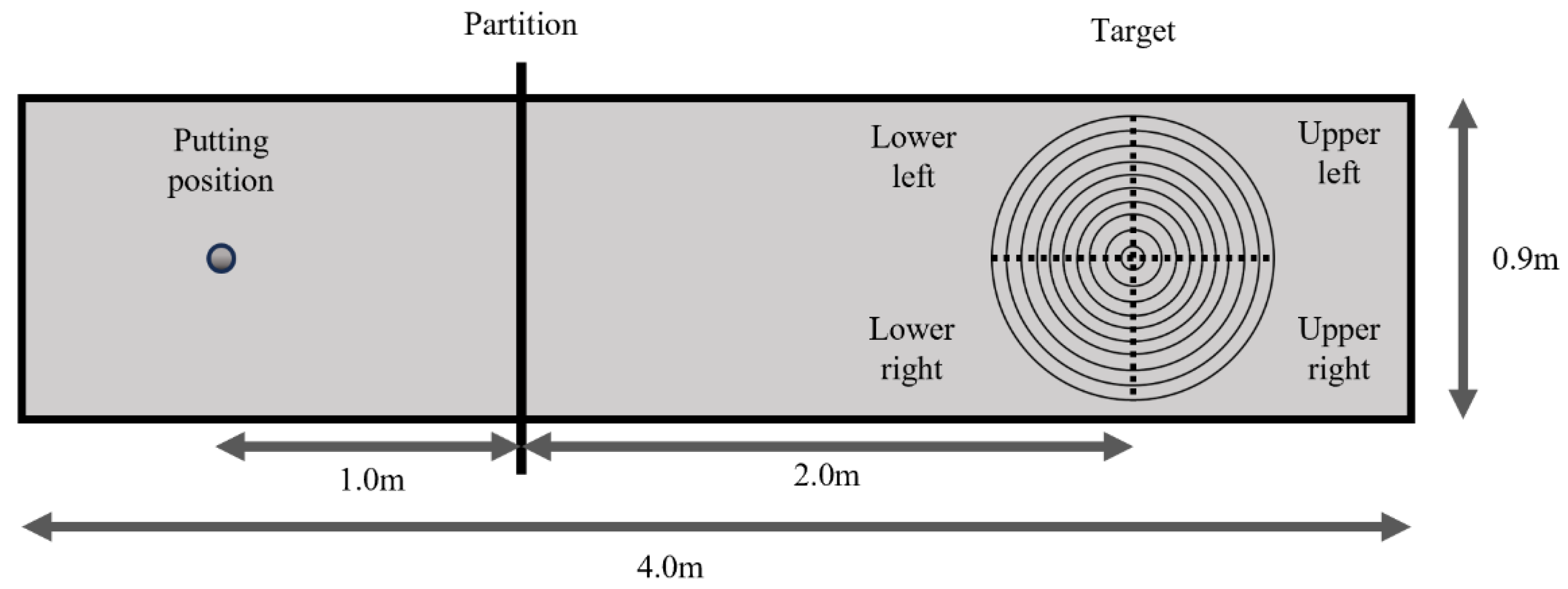
2.2. Task and Apparatus
2.3. Metacognitive Abilities
2.4. Procedure
2.5. Data Analysis
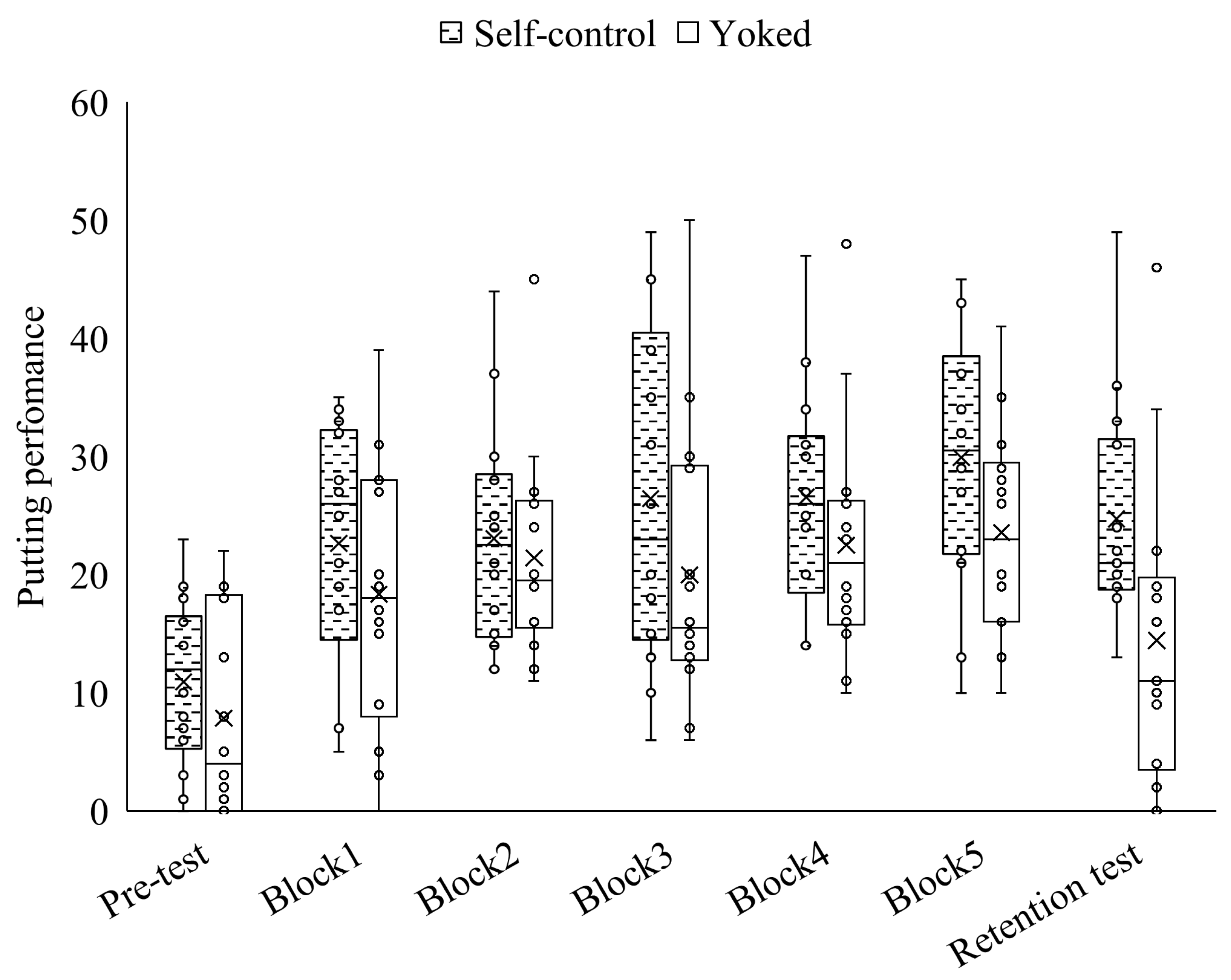
3. Results
4. Discussion
Author Contributions
Funding
Institutional Review Board Statement
Informed Consent Statement
Data Availability Statement
Acknowledgments
Conflicts of Interest
Abbreviations
| AMS | Adult Metacognition Scale |
| KR | Knowledge of results |
References
- Abe, M., & Ida, M. (2010). An attempt to construct the adults’ metacognition scale: Based on metacognitive awareness inventory. The Journal of Psychology Rissho University, 2010(1), 23–34. [Google Scholar]
- Aiken, C. A., Post, P. G., Hout, M. C., & Fairbrother, J. T. (2020). Self-controlled amount and pacing of practice facilitate learning of a sequential timing task. Journal of Sports Sciences, 38(4), 405–415. [Google Scholar] [CrossRef] [PubMed]
- Akizuki, K., & Ohashi, Y. (2015). Measurement of functional task difficulty during motor learning: What level of difficulty corresponds to the optimal challenge point? Human Movement Science, 43, 107–117. [Google Scholar] [CrossRef]
- Akizuki, K., Takeuchi, K., Yabuki, J., Yamaguchi, K., Yamamoto, R., & Kaneno, T. (2025a). Effects of self-control of feedback timing on motor learning. Frontiers in Psychology, 16, 1638827. [Google Scholar] [CrossRef] [PubMed]
- Akizuki, K., Takeuchi, K., Yamaguchi, K., Yamamoto, R., Nakano, W., & Yabuki, J. (2025b). Task difficulty modulates motor learning benefits of balance exercises in community-dwelling older adults. Experimental Gerontology, 208, 112816. [Google Scholar] [CrossRef] [PubMed]
- Altıok, S., Başer, Z., & Yükseltürk, E. (2019). Enhancing metacognitive awareness of undergraduates through using an e-educational video environment. Computers and Education, 139, 129–145. [Google Scholar] [CrossRef]
- Andrieux, M., Danna, J., & Thon, B. (2012). Self-control of task difficulty during training enhances motor learning of a complex coincidence-anticipation task. Research Quarterly for Exercise and Sport, 83(1), 27–35. [Google Scholar] [CrossRef] [PubMed]
- Barros, J. A. C., Yantha, Z. D., Carter, M. J., Hussien, J., & Ste-Marie, D. M. (2019). Examining the impact of error estimation on the effects of self-controlled feedback. Human Movement Science, 63, 182–198. [Google Scholar] [CrossRef] [PubMed]
- Carter, M. J., Carlsen, A. N., & Ste-Marie, D. M. (2014). Self-controlled feedback is effective if it is based on the learner’s performance: A replication and extension of Chiviacowsky and Wulf (2005). Frontiers in Psychology, 5, 1325. [Google Scholar] [CrossRef]
- Chan, C. W. H., Tang, F. W. K., Chow, K. M., & Wong, C. L. (2021). Enhancing generic capabilities and metacognitive awareness of first-year nursing students using active learning strategy. BMC Nursing, 20(1), 81. [Google Scholar] [CrossRef]
- Chiviacowsky, S., & Wulf, G. (2002). Self-controlled feedback: Does it enhance learning because performers get feedback when they need it? Research Quarterly for Exercise and Sport, 73(4), 408–415. [Google Scholar] [CrossRef] [PubMed]
- Chiviacowsky, S., & Wulf, G. (2005). Self-controlled feedback is effective if it is based on the learner’s performance. Research Quarterly for Exercise and Sport, 76(1), 42–48. [Google Scholar] [CrossRef]
- Czyż, S. H., Wójcik, A. M., Solarská, P., & Kiper, P. (2024). High contextual interference improves retention in motor learning: Systematic review and meta-analysis. Scientific Reports, 14(1), 15974. [Google Scholar] [CrossRef] [PubMed]
- Donovan, J. J., & Radosevich, D. J. (1999). A meta-analytic review of the distribution of practice effect: Now you see it, now you don’t. Journal of Applied Psychology, 84(5), 795–805. [Google Scholar] [CrossRef]
- Drews, R., Pacheco, M. M., Bastos, F. H., & Tani, G. (2024). Self-controlled feedback in motor learning: The effects depend on the frequency of request. Journal of Motor Behavior, 56(5), 555–567. [Google Scholar] [CrossRef] [PubMed]
- Fairbrother, J. T., Laughlin, D. D., & Nguyen, T. V. (2012). Self-controlled feedback facilitates motor learning in both high and low activity individuals. Frontiers in Psychology, 3, 323. [Google Scholar] [CrossRef] [PubMed]
- Grand, K. F., Bruzi, A. T., Dyke, F. B., Godwin, M. M., Leiker, A. M., Thompson, A. G., Buchanan, T. L., & Miller, M. W. (2015). Why self-controlled feedback enhances motor learning: Answers from electroencephalography and indices of motivation. Human Movement Science, 43, 23–32. [Google Scholar] [CrossRef] [PubMed]
- Hawkins, T. E., Alder, D. B., Bennett, T. B., & Poolton, J. M. (2025). The influence of external and internal focus of attention instructions on the organization of movement: A systematic review. Journal of Motor Learning and Development, 13(2), 339–365. [Google Scholar] [CrossRef]
- Heuer, H., & Lüttgen, J. (2015). Robot assistance of motor learning: A neuro-cognitive perspective. Neuroscience and Biobehavioral Reviews, 56, 222–240. [Google Scholar] [CrossRef] [PubMed]
- Janelle, C. M., Barba, D. A., Frehlich, S. G., Tennant, L. K., & Cauraugh, J. H. (1997). Maximizing performance feedback effectiveness through videotape replay and a self-controlled learning environment. Research Quarterly for Exercise and Sport, 68(4), 269–279. [Google Scholar] [CrossRef] [PubMed]
- Janelle, C. M., Kim, J., & Singer, R. N. (1995). Subject-controlled performance feedback and learning of a closed motor skill. Perceptual and Motor Skills, 81(2), 627–634. [Google Scholar] [CrossRef]
- Keetch, K. M., & Lee, T. D. (2007). The effect of self-regulated and experimenter-imposed practice schedules on motor learning for tasks of varying difficulty. Research Quarterly for Exercise and Sport, 78(5), 476–486. [Google Scholar] [CrossRef]
- Lewthwaite, R., Chiviacowsky, S., Drews, R., & Wulf, G. (2015). Choose to move: The motivational impact of autonomy support on motor learning. Psychonomic Bulletin and Review, 22(5), 1383–1388. [Google Scholar] [CrossRef]
- Ma, W., Chen, J., Yi, Q., Zhang, S., Xing, W., Ren, H., & Li, R. (2025). A study on the effects of different self-controlled feedback methods on the learning of table tennis serving skills. European Journal of Sport Science, 25(6), e12324. [Google Scholar] [CrossRef]
- Marchal-Crespo, L., Wolf, P., Gerig, N., Rauter, G., Jaeger, L., Vallery, H., & Riener, R. (2015). The role of skill level and motor task characteristics on the effectiveness of robotic training: First results. In 2015 IEEE international conference on rehabilitation robotics (ICORR) (pp. 151–156). IEEE. [Google Scholar] [CrossRef]
- McKay, B., Hussien, J., Vinh, M.-A., Mir-Orefice, A., Brooks, H., & Ste-Marie, D. M. (2022a). Meta-analysis of the reduced relative feedback frequency effect on motor learning and performance. Psychology of Sport and Exercise, 61, 102165. [Google Scholar] [CrossRef]
- McKay, B., Yantha, Z., Hussien, J., Carter, M., & Ste-Marie, D. (2022b). Meta-analytic findings of the self-controlled motor learning literature: Underpowered, biased, and lacking evidential value. Meta-Psychology, 6, 6. [Google Scholar] [CrossRef]
- Petancevski, E. L., Inns, J., Fransen, J., & Impellizzeri, F. M. (2022). The effect of augmented feedback on the performance and learning of gross motor and sport-specific skills: A systematic review. Psychology of Sport and Exercise, 63, 102277. [Google Scholar] [CrossRef]
- Post, P. G., Fairbrother, J. T., & Barros, J. A. C. (2011). Self-controlled amount of practice benefits learning of a motor skill. Research Quarterly for Exercise and Sport, 82(3), 474–481. [Google Scholar] [CrossRef]
- Pourazar, M., Firoozjah, M. H., & Ardakani, M. D. (2023). Improving dynamic balance by self-controlled feedback in children with cerebral palsy. Human Movement Science, 90, 103123. [Google Scholar] [CrossRef]
- Pourbehbahani, Z., Saemi, E., Cheng, M. Y., & Dehghan, M. R. (2023). Both sensorimotor rhythm neurofeedback and self-controlled practice enhance motor learning and performance in novice golfers. Behavioral Sciences, 13(1), 65. [Google Scholar] [CrossRef]
- Rivers, M. L., Dunlosky, J., & Persky, A. M. (2020). Measuring metacognitive knowledge, monitoring, and control in the pharmacy classroom and experiential settings. American Journal of Pharmaceutical Education, 84(5), 7730. [Google Scholar] [CrossRef]
- Sanli, E. A., Patterson, J. T., Bray, S. R., & Lee, T. D. (2013). Understanding self-controlled motor learning protocols through the self-determination theory. Frontiers in Psychology, 3, 611. [Google Scholar] [CrossRef]
- Schraw, G., & Dennison, R. S. (1994). Assessing metacognitive awareness. Contemporary Educational Psychology, 19(4), 460–475. [Google Scholar] [CrossRef]
- Sigrist, R., Rauter, G., Riener, R., & Wolf, P. (2013). Augmented visual, auditory, haptic, and multimodal feedback in motor learning: A review. Psychonomic Bulletin and Review, 20(1), 21–53. [Google Scholar] [CrossRef]
- St Germain, L., McKay, B., Poskus, A., Williams, A., Leshchyshen, O., Feldman, S., Cashaback, J. G. A., & Carter, M. J. (2023). Exercising choice over feedback schedules during practice is not advantageous for motor learning. Psychonomic Bulletin and Review, 30(2), 621–633. [Google Scholar] [CrossRef]
- Wang, B., Tao, T., Yuan, Y., & Guo, W. (2025). Self-controlled feedback and behavioral outcomes in motor skill learning: A meta-analysis. Behavioral Sciences, 15(9), 1291. [Google Scholar] [CrossRef]
- Williams, C. K., Tseung, V., & Carnahan, H. (2017). Self-control of haptic assistance for motor learning: Influences of frequency and opinion of utility. Frontiers in Psychology, 8, 2082. [Google Scholar] [CrossRef]
- Wulf, G. (2013). Attentional focus and motor learning: A review of 15 years. International Review of Sport and Exercise Psychology, 6(1), 77–104. [Google Scholar] [CrossRef]
- Wulf, G., Iwatsuki, T., Machin, B., Kellogg, J., Copeland, C., & Lewthwaite, R. (2018). Lassoing skill through learner choice. Journal of Motor Behavior, 50(3), 285–292. [Google Scholar] [CrossRef]
- Wulf, G., & Lewthwaite, R. (2016). Optimizing performance through intrinsic motivation and attention for learning: The OPTIMAL theory of motor learning. Psychonomic Bulletin and Review, 23(5), 1382–1414. [Google Scholar] [CrossRef]
- Wulf, G., & Toole, T. (1999). Physical assistance devices in complex motor skill learning: Benefits of a self-controlled practice schedule. Research Quarterly for Exercise and Sport, 70(3), 265–272. [Google Scholar] [CrossRef] [PubMed]
- Yabuki, J., Akizuki, K., Yamamoto, R., Yamaguchi, K., & Ohashi, Y. (2022). Effectiveness of adjusted bandwidth knowledge of results in motor learning. Cogent Psychology, 9(1), 2131039. [Google Scholar] [CrossRef]
- Yamaguchi, K., Akizuki, K., Yamamoto, R., Yabuki, J., & Ohashi, Y. (2020). How does physical guidance affect motor learning and learner’s workload? Journal of Physical Therapy Science, 32(10), 621–625. [Google Scholar] [CrossRef]
- Yamamoto, R., Imai, T., Yoshizato, Y., & Akizuki, K. (2025). Effects of self-controlled feedback on learning range of motion measurement techniques and self-efficacy among physical therapy students: A preliminary study. BMC Medical Education, 25(1), 326. [Google Scholar] [CrossRef] [PubMed]


| Block 1 | Block 2 | Block 3 | Block 4 | Block 5 | |
|---|---|---|---|---|---|
| Mean | 5.2 | 5.2 | 5.3 | 4.4 | 4.6 |
| (SD) | (2.6) | (3.0) | (2.3) | (2.4) | (2.6) |
| AMS Subcategory | Self-Control Group n = 14 | Yoked Group n = 14 | p-Value | Effect Size |
|---|---|---|---|---|
| Mean ± SD | r | |||
| Monitoring | 2.84 ± 0.41 | 2.75 ± 0.64 | 0.67 | 0.08 |
| Control | 3.27 ± 0.42 | 3.46 ± 0.54 | 0.32 | 0.19 |
| Knowledge | 3.62 ± 0.50 | 3.66 ± 0.31 | 0.82 | 0.04 |
| Group | Monitoring | Control | Knowledge |
|---|---|---|---|
| Self-control | −0.23 (0.44) | −0.13 (0.66) | −0.07 (0.82) |
| Yoked | 0.56 (0.04) | 0.36 (0.21) | 0.14 (0.63) |
Disclaimer/Publisher’s Note: The statements, opinions and data contained in all publications are solely those of the individual author(s) and contributor(s) and not of MDPI and/or the editor(s). MDPI and/or the editor(s) disclaim responsibility for any injury to people or property resulting from any ideas, methods, instructions or products referred to in the content. |
© 2026 by the authors. Licensee MDPI, Basel, Switzerland. This article is an open access article distributed under the terms and conditions of the Creative Commons Attribution (CC BY) license.
Share and Cite
Yamaguchi, K.; Yamamoto, R.; Yabuki, J.; Nakano, W.; Akizuki, K. Effect of Self-Controlled Feedback on Motor Learning and Its Association with Metacognitive Ability. Behav. Sci. 2026, 16, 517. https://doi.org/10.3390/bs16040517
Yamaguchi K, Yamamoto R, Yabuki J, Nakano W, Akizuki K. Effect of Self-Controlled Feedback on Motor Learning and Its Association with Metacognitive Ability. Behavioral Sciences. 2026; 16(4):517. https://doi.org/10.3390/bs16040517
Chicago/Turabian StyleYamaguchi, Kazuto, Ryohei Yamamoto, Jun Yabuki, Wataru Nakano, and Kazunori Akizuki. 2026. "Effect of Self-Controlled Feedback on Motor Learning and Its Association with Metacognitive Ability" Behavioral Sciences 16, no. 4: 517. https://doi.org/10.3390/bs16040517
APA StyleYamaguchi, K., Yamamoto, R., Yabuki, J., Nakano, W., & Akizuki, K. (2026). Effect of Self-Controlled Feedback on Motor Learning and Its Association with Metacognitive Ability. Behavioral Sciences, 16(4), 517. https://doi.org/10.3390/bs16040517