Iambic Production Advantage and Unbiased Recognition in Word Learning by Mandarin-Speaking Children with Cochlear Implants


Abstract
1. Introduction
1.1. Effect of Language-Predominant Stress Patterns on Word Learning in Children with CIs
1.2. Utilizing Novel Word Learning Tasks to Assess Word Learning Abilities in Children with CIs
1.3. Lexical Tones, Neutral Tone and Lexical Stress in Mandarin Chinese
1.4. The Current Study
2. Materials and Methods
2.1. Participants
2.2. Stimulus Construction
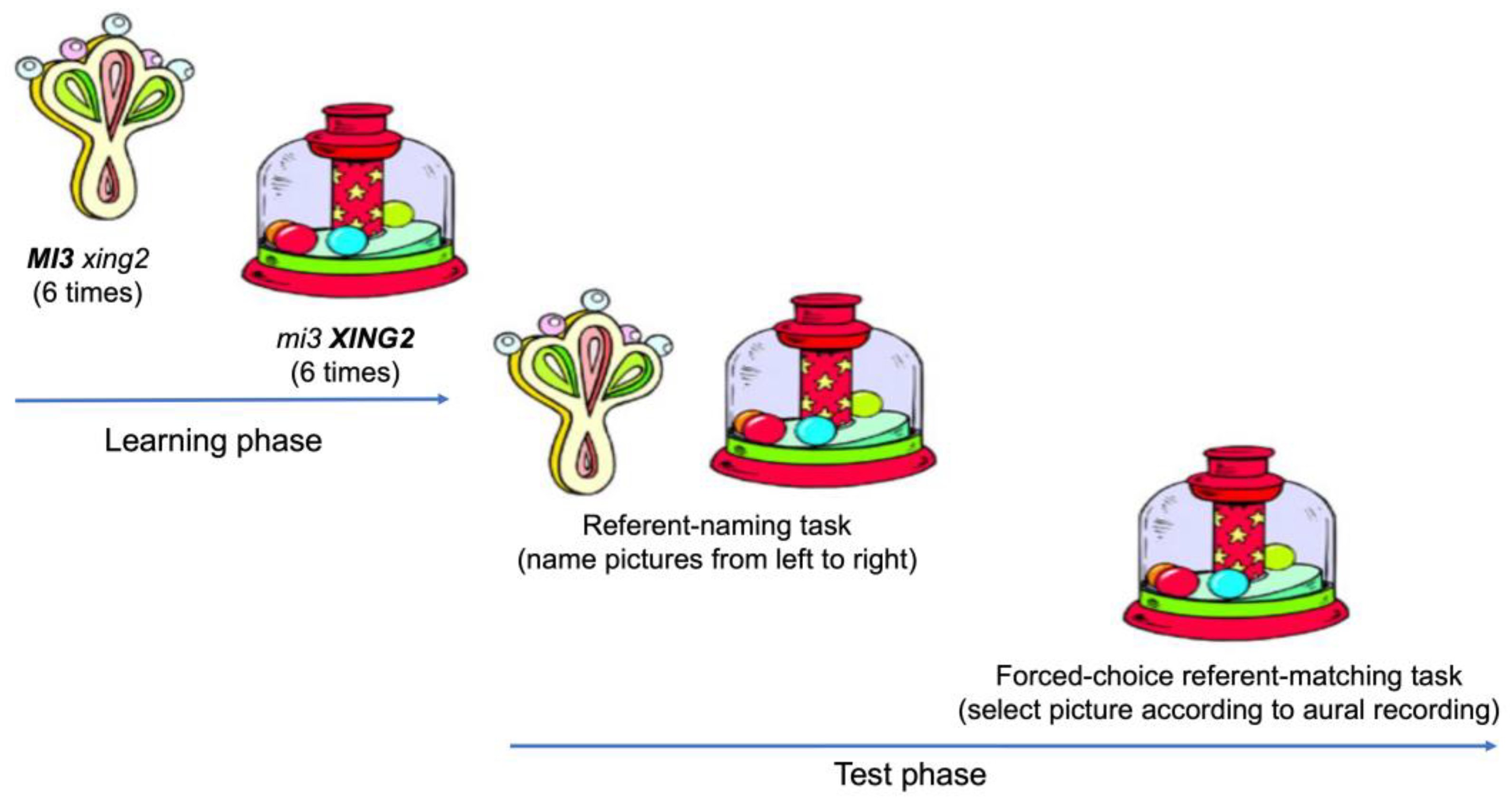
2.3. Procedure
2.4. Data Collection and Analysis
3. Results
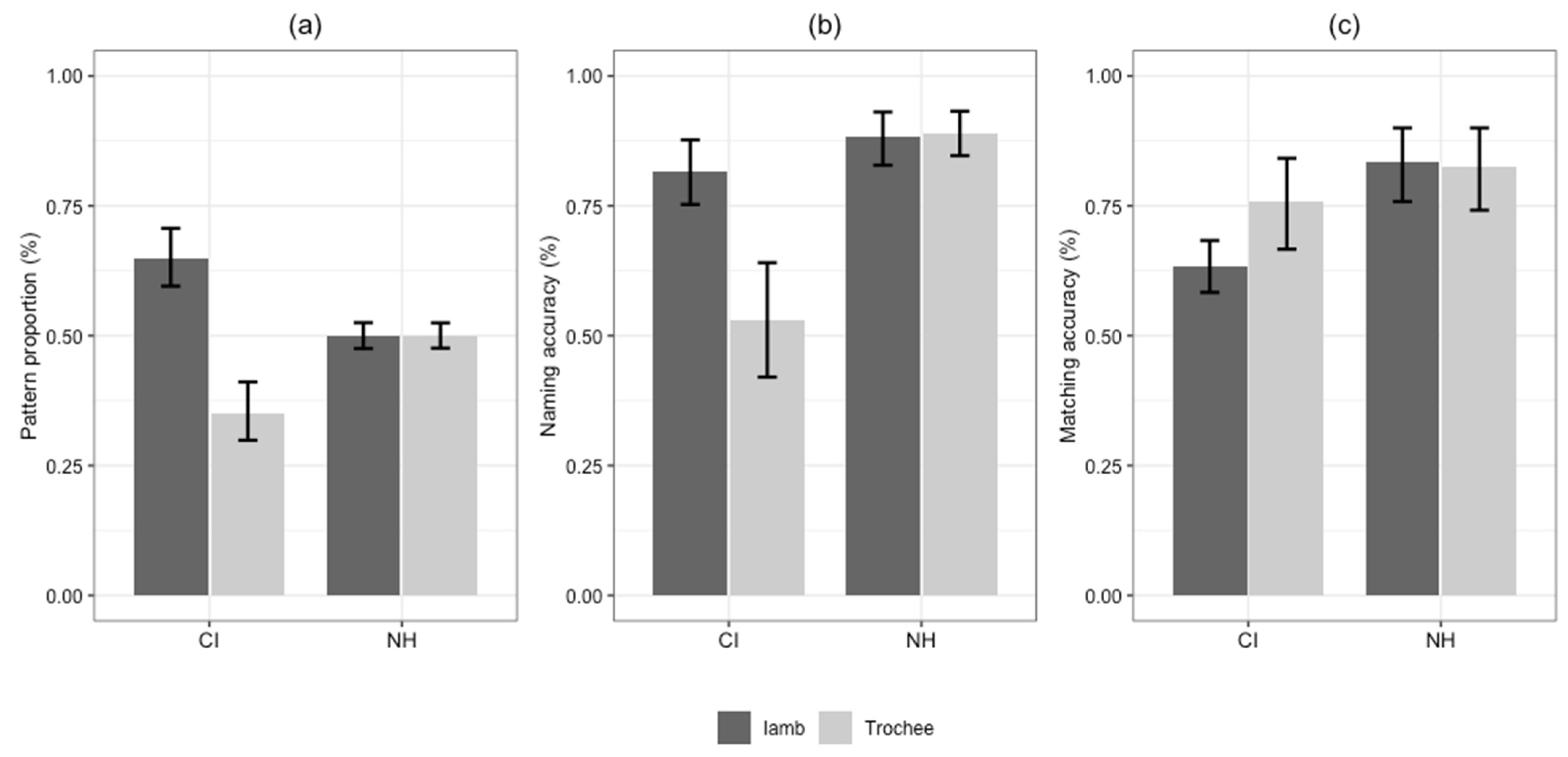
3.1. Quantity of Stress Pattern and Accuracy in Referent Naming
3.2. Accuracy in Referent Matching
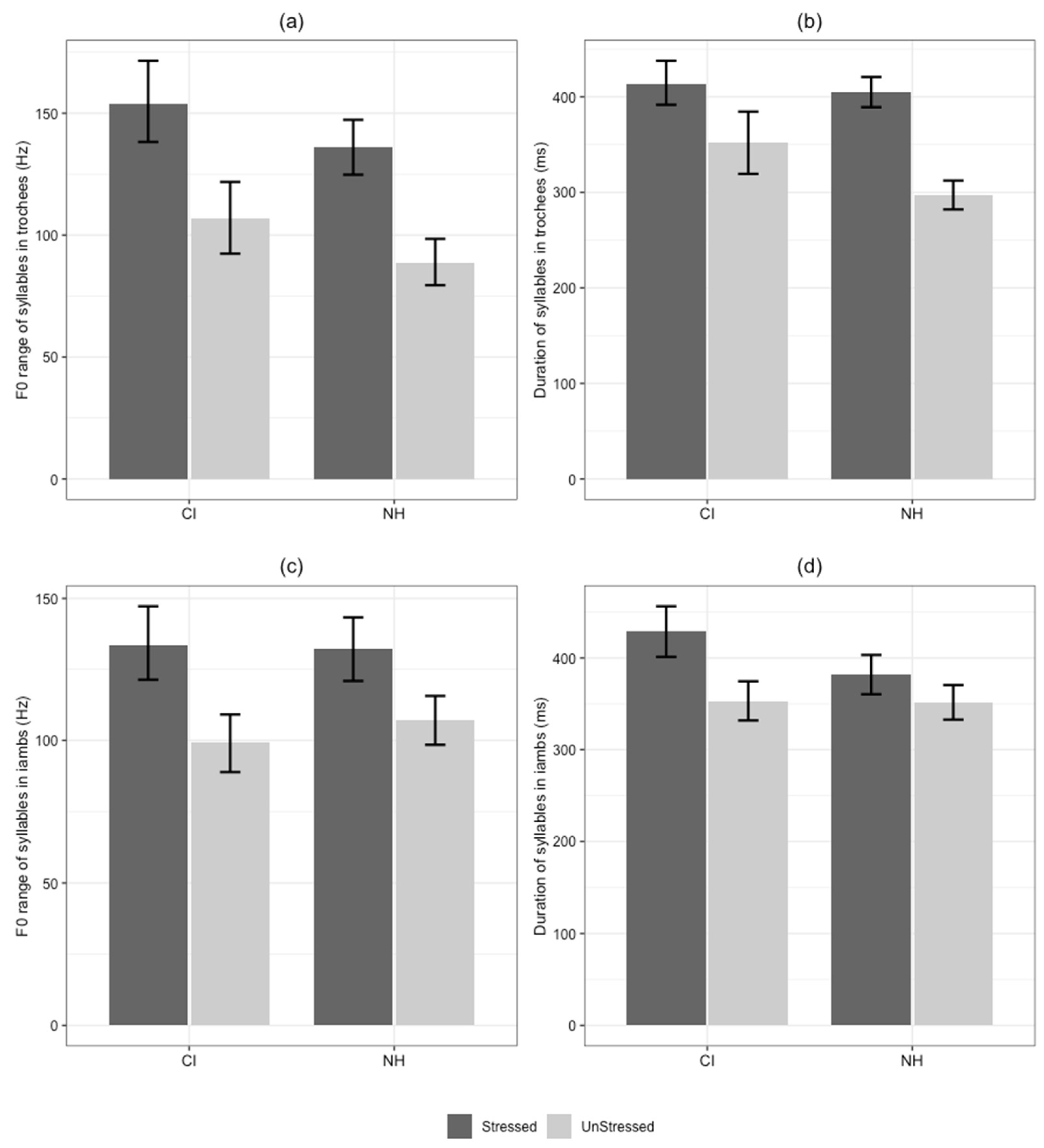
3.3. F0 Range and Duration of Syllables in Referent Naming
4. Discussion
5. Conclusions
Author Contributions
Funding
Institutional Review Board Statement
Informed Consent Statement
Data Availability Statement
Acknowledgments
Conflicts of Interest
References
- Adam, G., & Bat-El, O. (2009). When do universal preferences emerge in language development? The acquisition of Hebrew stress. Brill’s Annual of Afroasiatic Languages and Linguistics, 1(1), 255–282. [Google Scholar] [CrossRef] [Scilit]
- Adamidou, C., Okalidou, A., Fourakis, M., Printza, A., & Kyriafinis, G. (2023). Does lexical stress pattern affect learning and producing new words in Greek for children with cochlear implants? Journal of Speech, Language, and Hearing Research, 66(8), 2535–2561. [Google Scholar] [CrossRef] [Scilit]
- Adi-Bensaid, L., & Bat-El, O. (2004). The development of the prosodic word in the speech of a hearing-impaired child with a cochlear implant device. Journal of Multilingual Communication Disorders, 2(3), 187–206. [Google Scholar] [CrossRef] [Scilit]
- Adi-Bensaid, L., & Most, T. (2009). The acquisition of the prosodic word by children with hearing loss using a cochlear implant. The Volta Review, 109(1), 5–31. [Google Scholar] [CrossRef] [Scilit]
- Allen, G. D., & Hawkins, S. (1980). Phonological rhythm: Definition and development. In Child phonology (pp. 227–256). Elsevier. [Google Scholar]
- Bates, D., Mächler, M., Bolker, B., & Walker, S. (2015). Fitting linear mixed-effects models using lme4. Journal of Statistical Software, 1(67), 1–48. [Google Scholar]
- Boersma, P., & Weenink, D. (2023). Praat: Doing phonetics by computer (Version 6.4.01) [Computer software]. Available online: https://praat.org (accessed on 30 November 2023).
- Broś, K., Meyer, M., Kliesch, M., & Dellwo, V. (2021). Word stress processing integrates phonological abstraction with lexical access—An ERP study. Journal of Neurolinguistics, 57, 100959. [Google Scholar] [CrossRef] [Scilit]
- Carter, A. K., Dillon, C. M., & Pisoni, D. B. (2002). Imitation of nonwords by hearing impaired children with cochlear implants: Suprasegmental analyses. Clinical Linguistics & Phonetics, 16(8), 619–638. [Google Scholar] [CrossRef] [Scilit]
- Curtin, S. (2010). Young infants encode lexical stress in newly encountered words. Journal of Experimental Child Psychology, 105(4), 376–385. [Google Scholar] [CrossRef] [Scilit] [PubMed]
- Curtin, S., Mintz, T. H., & Christiansen, M. H. (2005). Stress changes the representational landscape: Evidence from word segmentation. Cognition, 96(3), 233–262. [Google Scholar] [CrossRef] [Scilit]
- Davidson, L. S., Geers, A. E., & Nicholas, J. G. (2014). The effects of audibility and novel word learning ability on vocabulary level in children with cochlear implants. Cochlear Implants International, 15(4), 211–221. [Google Scholar]
- De Clerck, I., Verhoeven, J., Gillis, S., Pettinato, M., & Gillis, S. (2019). Listeners’ perception of lexical stress in the first words of infants with cochlear implants and normally hearing infants. Journal of Communication Disorders, 80, 52–65. [Google Scholar] [CrossRef] [Scilit] [PubMed]
- Dillon, C. M., Cleary, M., Pisoni, D. B., & Carter, A. K. (2004). Imitation of nonwords by hearing-impaired children with cochlear implants: Segmental analyses. Clinical Linguistics & Phonetics, 18(1), 39–55. [Google Scholar]
- Duanmu, S. (2004). Left-headed feet and phrasal stress in Chinese. Cahiers de Linguistique Asie Orientale, 33(1), 65–103. [Google Scholar] [CrossRef] [Scilit]
- Duanmu, S. (2014). Stress theory and stress phenomena in Chinese. Contemporary Linguistics, 16(3), 288–302. [Google Scholar]
- Fletcher, J. (2010). The prosody of speech: Timing and rhythm. In W. J. Hardcastle, J. Laver, & F. E. Gibbon (Eds.), The handbook of phonetic sciences (1st ed., pp. 521–602). Wiley. [Google Scholar]
- Geers, A. E., Nicholas, J. G., & Sedey, A. L. (2003). Language skills of children with early cochlear implantation. Ear & Hearing, 24(1), 46S–58S. [Google Scholar] [CrossRef] [Scilit]
- Gerken, L. (1994a). A metrical template account of children’s weak syllable omissions from multisyllabic words. Journal of Child Language, 21(3), 565–584. [Google Scholar]
- Gerken, L. (1994b). Young children’s representation of prosodic phonology: Evidence from English-speakers’ weak syllable productions. Journal of Memory and Language, 33(1), 19–38. [Google Scholar] [CrossRef] [Scilit]
- Gonzalez-Gomez, N., & Nazzi, T. (2012). Phonotactic acquisition in healthy preterm infants. Developmental Science, 15(6), 885–894. [Google Scholar] [CrossRef] [Scilit]
- Graf Estes, K. (2014). Learning builds on learning: Infants’ use of native language sound patterns to learn words. Journal of Experimental Child Psychology, 126, 313–327. [Google Scholar] [CrossRef] [Scilit]
- Hayes, B. (1995). Metrical stress theory: Principles and case studies. University of Chicago Press. [Google Scholar]
- Houston, D. M., Carter, A. K., Pisoni, D. B., Iler Kirk, K., & Ying, E. (2005). Word learning in children following cochlear implantation. The Volta Review, 15(1), 39–70. [Google Scholar]
- Houston, D. M., Chen, C., Monroy, C., & Castellanos, I. (2020). How early auditory experience affects children’s ability to learn spoken words. In M. Marschark, & H. Knoors (Eds.), The Oxford handbook of deaf studies in learning and cognition (pp. 122–137). Oxford University Press. [Google Scholar]
- Hsieh, F. (2021). On the existence of word stress in mandarin Chinese. Studies in Prosodic Grammar, 7, 27–58. [Google Scholar]
- Huang, L., & Duanmu, S. (2013). Quantitative study of elastic word length in modern Chinese. Linguistic Sciences, 12(1), 8–16. [Google Scholar]
- Ingvalson, E. M., Perry, L. K., VanDam, M., & Grieco-Calub, T. M. (2023). Comparing scores on the peabody picture vocabulary test and receptive one-word picture vocabulary test in preschoolers with and without hearing loss. American Journal of Speech-Language Pathology, 32, 1610–1619. [Google Scholar] [CrossRef] [Scilit]
- Johnson, E. K., & Seidl, A. H. (2009). At 11 months, prosody still outranks statistics. Developmental Science, 12(1), 131–141. [Google Scholar] [CrossRef] [Scilit] [PubMed]
- Jusczyk, P. W., Houston, D. M., & Newsome, M. (1999). The beginnings of word segmentation in English-learning infants. Cognitive Psychology, 39(3–4), 159–207. [Google Scholar] [CrossRef] [Scilit] [PubMed]
- Kehoe, M. (2018). Prosodic phonology in acquisition: A focus on children’s early word productions. In P. Prieto, & N. Esteve-Gibert (Eds.), The development of prosody in first language acquisition (Vol. 23, pp. 165–184). John Benjamins Publishing Company. [Google Scholar]
- Lenden, J. M., & Flipsen, P. (2007). Prosody and voice characteristics of children with cochlear implants. Journal of Communication Disorders, 40(1), 66–81. [Google Scholar] [CrossRef] [Scilit]
- Li, A., & Fan, S. (2015, August 14–15). Correlates of Chinese neutral tone perception in different contexts. 18th International Congress of Phonetic Science, Glasgow, UK. [Google Scholar]
- Li, W. (1981). A preliminary study on neutral tone and stress. Studies of the Chinese Language, 1, 35–40. [Google Scholar]
- Lin, M., Yan, J., & Sun, G. (1984). A preliminary experimental study on stress of disyllabic words in Beijing mandarin. Fanyan, 1, 57–73. [Google Scholar]
- Mehler, J., Jusczyk, P. W., Lambertz, G., Halsted, N., Bertoncini, J., & Amiel-Tison, C. (1988). A precursor of language acquisition in young infants. Cognition, 19, 143–178. [Google Scholar] [CrossRef] [Scilit]
- Meng, Q., Zhou, H., & Yu, G. (2021). Pitch perception with cochlear implants: Coding mechanisms and limitations. Journal of Fudan University (Natural Science), 60(3), 279–287. [Google Scholar]
- Most, T., & Peled, M. (2007). Perception of suprasegmental features of speech by children with cochlear implants and children with hearing aids. Journal of Deaf Studies and Deaf Education, 12(3), 350–361. [Google Scholar] [CrossRef] [Scilit] [PubMed]
- Nazzi, T., Bertoncini, J., & Mehler, J. (1998). Language discrimination by newborns: Toward an understanding of the role of rhythm. Journal of Experimental Psychology: Human Perception and Performance, 24(3), 756–766. [Google Scholar] [CrossRef]
- Nittrouer, S., Muir, M., Tietgens, K., Moberly, A. C., & Lowenstein, J. H. (2018). Development of phonological, lexical, and syntactic abilities in children with cochlear implants across the elementary grades. Journal of Speech, Language, and Hearing Research, 61(10), 2561–2577. [Google Scholar] [CrossRef] [Scilit]
- Paschen, L., Fuchs, S., & Seifart, F. (2022). Final lengthening and vowel length in 25 languages. Journal of Phonetics, 94, 101179. [Google Scholar] [CrossRef] [Scilit]
- Pettinato, M., Clerck, I. D., Verhoeven, J., & Gillis, S. (2017). Expansion of prosodic abilities at the transition from babble to words: A comparison between children with cochlear implants and normally hearing children. Ear & Hearing, 38(4), 475–486. [Google Scholar] [CrossRef] [Scilit]
- Pimperton, H., & Walker, E. A. (2018). Word learning in children with cochlear implants: Examining performance relative to hearing peers and relations with age at implantation. Ear & Hearing, 39(5), 980–991. [Google Scholar] [CrossRef] [Scilit]
- Polka, L., Sundara, M., & Blue, S. (2002). The role of language experience in word segmentation: A comparison of English, French, and bilingual infants. The Journal of the Acoustical Society of America, 111(Suppl. S5), 2455. [Google Scholar] [CrossRef] [Scilit]
- R Development Core Team. (2024). R: A language and environment for statistical computing. R Foundation for Statistical Computing. [Google Scholar]
- Santos, R. S., & Fikkert, P. (2008). The relationship between word prosodic structure and sentence prosody. (Non)evidence from Brazilian Portuguese. In S. Baauw, J. Kampen, & M. Pinto (Eds.), The acquisition of romance langauges. Selected papers from the romance turn II (Vol. 8, pp. 165–179). LOT, Netherlands Graduate School of Linguistics. [Google Scholar]
- Segal, O., Houston, D., & Kishon-Rabin, L. (2016). Auditory discrimination of lexical stress patterns in hearing-impaired infants with cochlear implants compared with normal hearing: Influence of acoustic cues and listening experience to the ambient language. Ear & Hearing, 37(2), 225–234. [Google Scholar]
- Segal, O., Keren-Portnoy, T., & Vihman, M. (2020). Robust effects of stress on early lexical representation. Infancy, 25(4), 500–521. [Google Scholar] [CrossRef] [Scilit] [PubMed]
- Sharma, S. D., Cushing, S. L., Papsin, B. C., & Gordon, K. A. (2020). Hearing and speech benefits of cochlear implantation in children: A review of the literature. International Journal of Pediatric Otorhinolaryngology, 133, 109984. [Google Scholar] [CrossRef] [Scilit]
- Shen, Y., Ren, Y., Wufuer, Z., & Tang, P. (2020). The acquisition of mandarin neutral tone by children with cochlear implants. Chinese Scientific Journal of Hearing and Speech Rehabilitation, 18(2), 142–146. [Google Scholar]
- Snow, D. (1994). Phrase-final syllable lengthening and intonation in Early child speech. Journal of Speech, Language, and Hearing Research, 37(4), 831–840. [Google Scholar] [CrossRef] [Scilit]
- Stelmachowicz, P. G., Pittman, A. L., Hoover, B. M., & Lewis, D. E. (2004). Novel-word learning in children with normal hearing and hearing loss. Ear & Hearing, 25(1), 47–56. [Google Scholar] [CrossRef] [Scilit]
- Sundström, S., Löfkvist, U., Lyxell, B., & Samuelsson, C. (2018). Prosodic and segmental aspects of nonword repetition in 4- to 6-year-old children who are deaf and hard of hearing compared to controls with normal hearing. Clinical Linguistics & Phonetics, 32(10), 950–971. [Google Scholar] [CrossRef] [Scilit] [PubMed]
- Tang, P., Yuen, I., Xu Rattanasone, N., Gao, L., & Demuth, K. (2018). Acquisition of weak syllables in tonal languages: Acoustic evidence from neutral tone in Mandarin Chinese. Journal of Child Language, 46(1), 24–50. [Google Scholar] [CrossRef] [Scilit] [PubMed]
- Tang, P., Yuen, I., Xu Rattanasone, N., Gao, L., & Demuth, K. (2019). The acquisition of mandarin tonal processes by children with cochlear implants. Journal of Speech, Language, and Hearing Research, 62(5), 1309–1325. [Google Scholar] [CrossRef] [Scilit]
- Wang, Z., & Feng, S. (2006). Tonal contrast and disyllabic stress patterns in Beijing mandarin. Linguistic Sciences, 5(1), 3–22. [Google Scholar]
- White, L. (2014). Communicative function and prosodic form in speech timing. Speech Communication, 63–64, 38–54. [Google Scholar] [CrossRef] [Scilit]
- Xu, X. (2023). Re-examination of Yuen Ren Chao’s arguments on stress in mandarin Chinese. Studies of the Chinese Language, 5, 623–637. [Google Scholar]
- Yu, Q., Shen, Y., Wang, L., & Tang, P. (2023). The acquisition of mandarin tones by children with cochlear implants: Effects of age at implantation and cochlear implant experience. Chinese Journal of Phonetics, 19(1), 119–139. [Google Scholar]
- Zhu, H., & Dodd, B. (2000). Putonghua (modern standard Chinese)-speaking children with speech disorder. Clinical Linguistics & Phonetics, 14(3), 165–191. [Google Scholar] [CrossRef] [Scilit]



| ID | Gender | Age (Month) | Implanted Age (Month) | CI Experience (Month) | PTA Unaided (dB) | PTA with CI (dB) |
|---|---|---|---|---|---|---|
| CI-1 | M | 64.90 | 40.83 | 24.07 | 110 | 23 |
| CI-2 | M | 61.23 | 40.93 | 20.30 | 120 | 26 |
| CI-3 | M | 64.0 | 33.30 | 30.70 | 100 | 26 |
| CI-4 | M | 60.47 | 41.10 | 19.37 | 110 | 23 |
| CI-5 | M | 68.53 | 48.10 | 20.43 | 90 | 20 |
| CI-6 | M | 51.53 | 27.47 | 24.07 | 120 | 23 |
| CI-7 | M | 48.90 | 15.73 | 33.17 | 90 | 25 |
| CI-8 | M | 52.23 | 15.00 | 37.67 | 120 | 29 |
| CI-9 | M | 48.30 | 29.83 | 18.47 | 97 | 29 |
| CI-10 | M | 50.07 | 22.73 | 27.33 | 115 | 20 |
| CI-11 | M | 50.83 | 30.97 | 19.87 | 100 | 27 |
| CI-12 | M | 49.9 | 25.77 | 24.20 | 91 | 20 |
| CI-13 | F | 67.10 | 42.77 | 24.33 | 90 | 24 |
| CI-14 | F | 70.37 | 52.07 | 18.30 | 90 | 25 |
| CI-15 | F | 52.97 | 22.97 | 19.00 | 90 | 21 |
| No. | Tone Combination | Real Word | Gloss | Novel Word | |
|---|---|---|---|---|---|
| Trochee | Iamb | ||||
| 1 | T1 + T1 | xiang1 jiao1 | “banana” | tuo1 hua1 | tuo1 hua1 |
| 2 | T1 + T2 | tuo1 xie2 | “slipper” | qian1 mei2 | qian1 mei2 |
| 3 | T1 + T3 | qian1 bi3 | “pencil” | xiang1 gou3 | xiang1 gou3 |
| 4 | T1 + T4 | ji1 dan4 | “egg” | ji1 shi4 | ji1 shi4 |
| 5 | T2 + T1 | hong2 hua1 | “red flower” | hong2 jiao1 | hong2 jiao1 |
| 6 | T2 + T2 | yuan2 xing2 | “circle” | ping2 qiu2 | ping2 qiu2 |
| 7 | T2 + T3 | ping2 guo3 | “apple” | wan2 shou3 | wan2 shou3 |
| 8 | T2 + T4 | wan2 ju4 | “toy” | yuan2 fan4 | yuan2 fan4 |
| 9 | T3 + T1 | bing3 gan1 | “cookie” | xiao3 gan1 | xiao3 gan1 |
| 10 | T3 + T2 | cao3 mei2 | “strawberry” | mi3 xing2 | mi3 xing2 |
| 11 | T3 + T3 | xiao3 gou3 | “poppy” | bing3 bi3 | bing3 bi3 |
| 12 | T3 + T4 | mi3 fan4 | “rice” | cao3 ju4 | cao3 ju4 |
| 13 | T4 + T1 | mian4 bao1 | “bread” | dian4 bao1 | dian4 bao1 |
| 14 | T4 + T2 | qi4 qiu2 | “balloon” | you4 xie2 | you4 xie2 |
| 15 | T4 + T3 | you4 shou3 | “right hand” | mian4 guo3 | mian4 guo3 |
| 16 | T4 + T4 | dian4 shi4 | “television” | qi4 dan4 | qi4 dan4 |
| ID | Learning and Presentation Sequence for Naming Task | Audio Recording for Matching Task | |
|---|---|---|---|
| First Learned | Second Learned | ||
| 1 | tuo1 hua1 | tuo1 hua1 | tuo1 hua1 |
| 2 | qian1 mei2 | qian1 mei2 | qian1 mei2 |
| 3 | xiang1 gou3 | xiang1 gou3 | xiang1 gou3 |
| 4 | ji1 shi4 | ji1 shi4 | ji1 shi4 |
| 5 | hong2 jiao1 | hong2 jiao1 | hong2 jiao1 |
| 6 | ping2 qiu2 | ping2 qiu2 | ping2 qiu2 |
| 7 | wan2 shou3 | wan2 shou3 | wan2 shou3 |
| 8 | yuan2 fan4 | yuan2 fan4 | yuan2 fan4 |
| 9 | xiao3 gan1 | xiao3 gan1 | xiao3 gan1 |
| 10 | mi3 xing2 | mi3 xing2 | mi3 xing2 |
| 11 | bing3 bi3 | bing3 bi3 | bing3 bi3 |
| 12 | cao3 ju4 | cao3 ju4 | cao3 ju4 |
| 13 | dian4 bao1 | dian4 bao1 | dian4 bao1 |
| 14 | you4 xie2 | you4 xie2 | you4 xie2 |
| 15 | mian4 guo3 | mian4 guo3 | mian4 guo3 |
| 16 | qi4 dan4 | qi4 dan4 | qi4 dan4 |
Disclaimer/Publisher’s Note: The statements, opinions and data contained in all publications are solely those of the individual author(s) and contributor(s) and not of MDPI and/or the editor(s). MDPI and/or the editor(s) disclaim responsibility for any injury to people or property resulting from any ideas, methods, instructions or products referred to in the content. |
© 2026 by the authors. Licensee MDPI, Basel, Switzerland. This article is an open access article distributed under the terms and conditions of the Creative Commons Attribution (CC BY) license.
Share and Cite
Shi, X.; Yang, J.; Liang, D. Iambic Production Advantage and Unbiased Recognition in Word Learning by Mandarin-Speaking Children with Cochlear Implants. Behav. Sci. 2026, 16, 491. https://doi.org/10.3390/bs16040491
Shi X, Yang J, Liang D. Iambic Production Advantage and Unbiased Recognition in Word Learning by Mandarin-Speaking Children with Cochlear Implants. Behavioral Sciences. 2026; 16(4):491. https://doi.org/10.3390/bs16040491
Chicago/Turabian StyleShi, Xinyuan, Jingjing Yang, and Dandan Liang. 2026. "Iambic Production Advantage and Unbiased Recognition in Word Learning by Mandarin-Speaking Children with Cochlear Implants" Behavioral Sciences 16, no. 4: 491. https://doi.org/10.3390/bs16040491
APA StyleShi, X., Yang, J., & Liang, D. (2026). Iambic Production Advantage and Unbiased Recognition in Word Learning by Mandarin-Speaking Children with Cochlear Implants. Behavioral Sciences, 16(4), 491. https://doi.org/10.3390/bs16040491