Ketamine Use in Self-Described Therapeutic Contexts: A Thematic Analysis of Reddit Posts

 ,
,  and
and
Abstract
1. Introduction
2. Materials and Methods
2.1. Overview
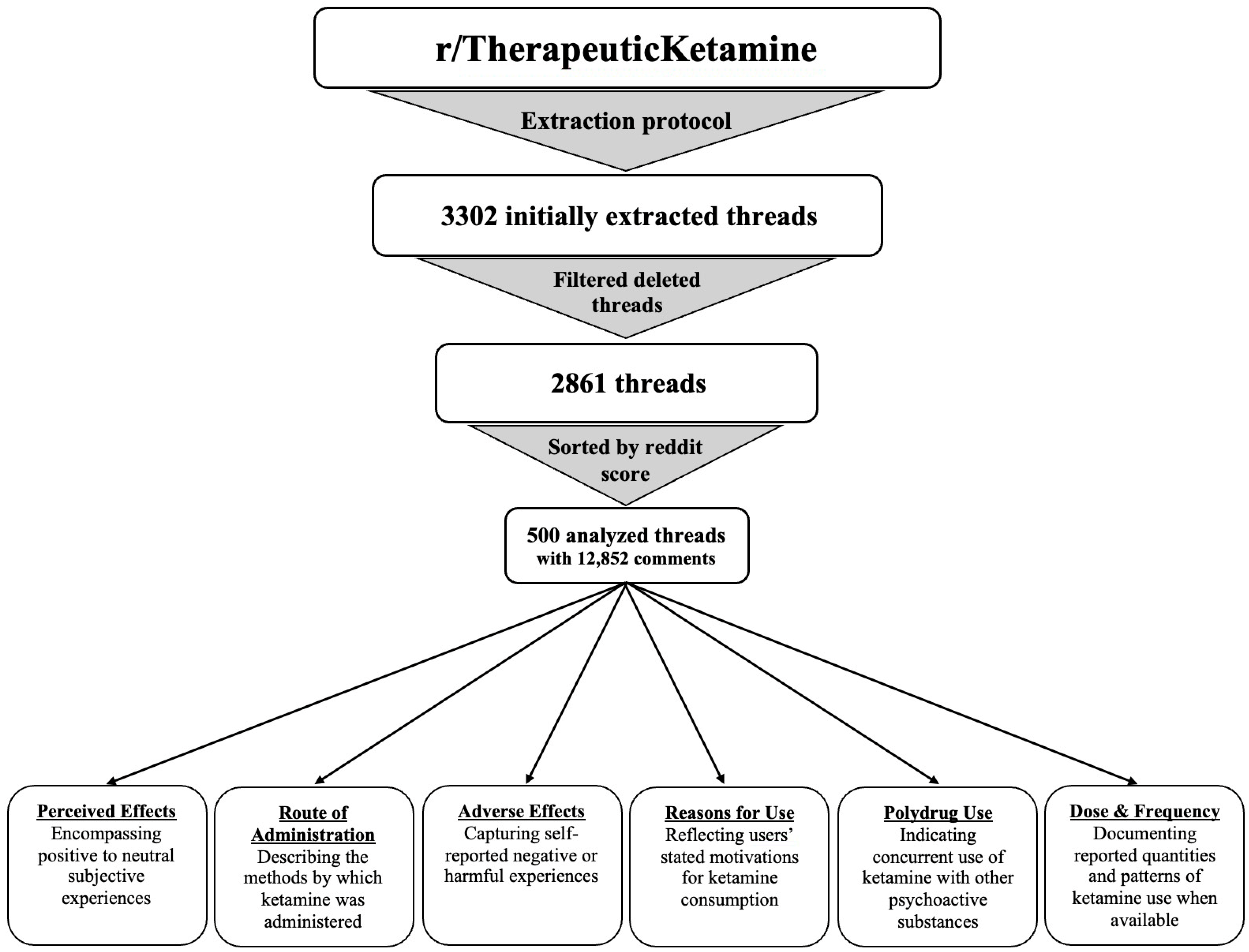
2.2. Data Extraction
2.3. Analysis
3. Results
3.1. Positive Effects
3.2. Adverse Effects
3.3. Reasons for Use
3.4. Routes of Administration
3.5. Polydrug Use
3.6. Doses
4. Discussion
5. Conclusions
Author Contributions
Funding
Institutional Review Board Statement
Informed Consent Statement
Data Availability Statement
Conflicts of Interest
References
- Anderson, D. J., Zhou, J., Cao, D., McDonald, M., Guenther, M., Hasoon, J., Viswanath, O., Kaye, A. D., & Urits, I. (2022). Ketamine-induced cystitis: A comprehensive review of the urologic effects of this psychoactive drug. Health Psychology Research, 10(3), 38247. [Google Scholar] [CrossRef]
- Ansari, M., Pittman, B., Tylee, D. S., Ostroff, R., Wilkinson, S. T., & Nikayin, S. (2024). Blood pressure changes during ketamine infusion for the treatment of depression. General Hospital Psychiatry, 90, 62–67. [Google Scholar] [CrossRef]
- Antisdel, J., Miller, W. R., & Groves, D. (2025). Data mining trauma: AI-assisted qualitative study of cyber victimization on reddit. JMIR Infodemiology, 5(1), e75493. [Google Scholar] [CrossRef]
- ArthurHeitmann. (2026). ArthurHeitmann/arctic_shift [TypeScript]. (Original work published 2023). Available online: https://github.com/ArthurHeitmann/arctic_shift (accessed on 3 July 2024).
- Ballard, E. D., & Zarate, C. A. (2020). The role of dissociation in ketamine’s antidepressant effects. Nature Communications, 11(1), 6431. [Google Scholar] [CrossRef]
- Bayes, A., Short, B., Zarate, C. A., Park, L., Murrough, J. W., McLoughlin, D. M., Riva-Posse, P., Schoevers, R., Veraart, J., Parikh, S., Glue, P., Fam, J., McShane, R., Galvez, V., Martin, D., Tor, P.-C., Brunoni, A. R., & Loo, C. K. (2022). The Ketamine Side Effect Tool (KSET): A comprehensive measurement-based safety tool for ketamine treatment in psychiatry. Journal of Affective Disorders, 308, 44–46. [Google Scholar] [CrossRef]
- Center for Drug Evaluation and Research. (2023). FDA warns patients and health care providers about potential risks associated with compounded ketamine products, including oral formulations, for the treatment of psychiatric disorders. FDA. Available online: https://www.fda.gov/drugs/human-drug-compounding/fda-warns-patients-and-health-care-providers-about-potential-risks-associated-compounded-ketamine (accessed on 15 December 2025).
- Chaves, T. V., Wilffert, B., & Sanchez, Z. M. (2023). Overdoses and deaths related to the use of ketamine and its analogues: A systematic review. The American Journal of Drug and Alcohol Abuse, 49(2), 141–150. [Google Scholar] [CrossRef] [PubMed]
- Chi, Y., & Chen, H. (2023). Investigating substance use via reddit: Systematic scoping review. Journal of Medical Internet Research, 25(1), e48905. [Google Scholar] [CrossRef] [PubMed]
- Chiappini, S., Guirguis, A., Schifano, N., Corkery, J. M., Semeraro, F., Mosca, A., D’Andrea, G., Duccio Papanti, G., Arillotta, D., Floresta, G., Martinotti, G., & Schifano, F. (2025). Comparative safety of prescribed esketamine and ketamine in relation to renal and urinary disorders: A pharmacovigilance perspective. Progress in Neuro-Psychopharmacology and Biological Psychiatry, 136, 111213. [Google Scholar] [CrossRef] [PubMed]
- Chiauzzi, E., DasMahapatra, P., Lobo, K., & Barratt, M. J. (2013). Participatory research with an online drug forum: A survey of user characteristics, information sharing, and harm reduction views. Substance Use & Misuse, 48(8), 661–670. [Google Scholar] [CrossRef]
- Coles, L., Rosenthal, E. S., Bleck, T. P., Elm, J., Zehtabchi, S., Chamberlain, J., Cloyd, J., Shinnar, S., Silbergleit, R., & Kapur, J. (2023). Why ketamine. Epilepsy & Behavior, 141, 109066. [Google Scholar] [CrossRef]
- Cristea, I. A., & Naudet, F. (2019). US Food and Drug Administration approval of esketamine and brexanolone. The Lancet Psychiatry, 6(12), 975–977. [Google Scholar] [CrossRef]
- Daly, E. J., Singh, J. B., Fedgchin, M., Cooper, K., Lim, P., Shelton, R. C., Thase, M. E., Winokur, A., Van Nueten, L., Manji, H., & Drevets, W. C. (2018). Efficacy and safety of intranasal esketamine adjunctive to oral antidepressant therapy in treatment-resistant depression: A randomized clinical trial. JAMA Psychiatry, 75(2), 139–148. [Google Scholar] [CrossRef]
- Dorandeu, F. (2013). Happy 50th anniversary ketamine. CNS Neuroscience & Therapeutics, 19(6), 369. [Google Scholar] [CrossRef]
- Dutton, M., Can, A. T., Lagopoulos, J., & Hermens, D. F. (2023). Oral ketamine may offer a solution to the ketamine conundrum. Psychopharmacology, 240(12), 2483–2497. [Google Scholar] [CrossRef] [PubMed]
- Eikermann, M., Grosse-Sundrup, M., Zaremba, S., Henry, M. E., Bittner, E. A., Hoffmann, U., & Chamberlin, N. L. (2012). Ketamine activates breathing and abolishes the coupling between loss of consciousness and upper airway dilator muscle dysfunction. Anesthesiology, 116(1), 35–46. [Google Scholar] [CrossRef]
- Elvir-Lazo, O. L., White, P. F., Yumul, R., & Eng, H. C. (2020). Management strategies for the treatment and prevention of postoperative/postdischarge nausea and vomiting: An updated review. F1000Research, 9, 983. [Google Scholar] [CrossRef] [PubMed]
- Fan, Y., Zhang, Y., Ye, Y., Li, X., & Zheng, W. (2017, November 6–10). Social media for opioid addiction epidemiology: Automatic detection of opioid addicts from twitter and case studies. 2017 ACM on Conference on Information and Knowledge Management, CIKM ’17 (pp. 1259–1267), Singapore. [Google Scholar] [CrossRef]
- Fiaschetti, D., & Martin-Long, M. (2026). Pharmacotherapeutic uses of diphenhydramine in hospital settings. Journal of Radiology Nursing, 45, 101356. [Google Scholar] [CrossRef]
- Gao, M., Rejaei, D., & Liu, H. (2016). Ketamine use in current clinical practice. Acta Pharmacologica Sinica, 37(7), 865–872. [Google Scholar] [CrossRef]
- Goddard, K., Sampson, C., Bedy, S.-M., Ghadban, R., & Stilley, J. (2021). Effect of ketamine on cardiovascular function during procedural sedation of adults. Cureus, 13(3), e14228. [Google Scholar] [CrossRef]
- Goglia, D., & Vega, D. (2024). Structure and dynamics of growing networks of reddit threads. Applied Network Science, 9(1), 48. [Google Scholar] [CrossRef]
- Guo, C., & Caine, K. (2025, February 24–28). Throwaway accounts and moderation on reddit. 2025 Symposium on Usable Security, San Diego, CA, USA. [Google Scholar] [CrossRef]
- Harding, R. E., Barton, T., Niepceron, M., Harris, E., Bennett, E., Gent, E., Fraser, F., & Morgan, C. J. A. (2025). The landscape of ketamine use disorder: Patient experiences and perspectives on current treatment options. Addiction, 120(10), 1970–1979. [Google Scholar] [CrossRef]
- Harrigian, K., & Dredze, M. (2022). Then and now: Quantifying the longitudinal validity of self-disclosed depression diagnoses. In A. Zirikly, D. Atzil-Slonim, M. Liakata, S. Bedrick, B. Desmet, M. Ireland, A. Lee, S. MacAvaney, M. Purver, R. Resnik, & A. Yates (Eds.), Proceedings of the eighth workshop on computational linguistics and clinical psychology (pp. 59–75). Association for Computational Linguistics. [Google Scholar] [CrossRef]
- Hartwig, J., Kendrick, J., Ahmad, G., Cook, J., Matthews, D. B., & Sharma, P. (2025). Exploring user experiences with amanita muscaria: A thematic analysis of reddit online forum discussions. Substance Use & Misuse, 60(7), 952–961. [Google Scholar] [CrossRef]
- Hsieh, H.-F., & Shannon, S. E. (2005). Three approaches to qualitative content analysis. Qualitative Health Research, 15(9), 1277–1288. [Google Scholar] [CrossRef]
- Ingrosso, G., Cleare, A. J., & Juruena, M. F. (2025). Is there a risk of addiction to ketamine during the treatment of depression? A systematic review of available literature. Journal of Psychopharmacology, 39(1), 49–65. [Google Scholar] [CrossRef]
- Jansen, K. L. R. (1990). Ketamine–can chronic use impair memory. International Journal of the Addictions, 25(2), 133–139. [Google Scholar] [CrossRef]
- Jansen, K. L. R. (2000). A review of the nonmedical use of ketamine: Use, users and consequences. Journal of Psychoactive Drugs, 32(4), 419–433. [Google Scholar] [CrossRef] [PubMed]
- Jelen, L. A., McShane, R., & Young, A. H. (2024). Guidelines for ketamine use in clinical psychiatry practice. BJPsych Open, 10(3), e107. [Google Scholar] [CrossRef]
- Jilka, S., Murray, C., Wieczorek, A., Griffiths, H., Wykes, T., & McShane, R. (2019). Exploring patients’ and carers’ views about the clinical use of ketamine to inform policy and practical decisions: Mixed-methods study. BJPsych Open, 5(5), e62. [Google Scholar] [CrossRef]
- Kang, M. J. Y., Hawken, E., & Vazquez, G. H. (2022). The mechanisms behind rapid antidepressant effects of ketamine: A systematic review with a focus on molecular neuroplasticity. Frontiers in Psychiatry, 13, 860882. [Google Scholar] [CrossRef] [PubMed]
- Kitch, B. B. (2020). Out-of-hospital ketamine: Review of a growing trend in patient care. JACEP Open, 1(3), 183–189. [Google Scholar] [CrossRef] [PubMed]
- Kuntz, L. (2023, June 21). Self-medicating: More than half of at-home ketamine users misuse the treatment. Psychiatric Times. Available online: https://www.psychiatrictimes.com/view/self-medicating-more-than-half-of-at-home-ketamine-users-misuse-the-treatment (accessed on 17 March 2026).
- Lake, S., & Lucas, P. (2025). Co-use of psychedelics with other substances: Findings from the global psychedelic survey. Journal of Psychopharmacology, 39(5), 453–462. [Google Scholar] [CrossRef]
- Lankenau, S. E., Sanders, B., Bloom, J. J., & Hathazi, D. (2008). Towards an explanation of subjective ketamine experiences among young injection drug users. Addiction Research & Theory, 16(3), 273–287. [Google Scholar] [CrossRef]
- Li, J.-H., Vicknasingam, B., Cheung, Y., Zhou, W., Nurhidayat, A. W., Jarlais, D., & Schottenfeld, R. (2011). To use or not to use: An update on licit and illicit ketamine use. Substance Abuse and Rehabilitation, 2, 11–20. [Google Scholar] [CrossRef]
- Li, L., & Vlisides, P. E. (2016). Ketamine: 50 years of modulating the mind. Frontiers in Human Neuroscience, 10, 612. [Google Scholar] [CrossRef]
- Li, Y., Shi, J., Yang, B., Liu, L., Han, C., Li, W., Dong, D., Pan, Z., Liu, G., Geng, J., Sheng, L., Tan, X., Sun, D., Gong, Z., & Gong, Y. (2012). Ketamine-induced ventricular structural, sympathetic and electrophysiological remodelling: Pathological consequences and protective effects of metoprolol. British Journal of Pharmacology, 165(6), 1748–1756. [Google Scholar] [CrossRef] [PubMed]
- Liu, Y., Lin, D., Wu, B., & Zhou, W. (2016). Ketamine abuse potential and use disorder. Brain Research Bulletin, Neurobiology of Emerging Psychoactive Drugs, 126, 68–73. [Google Scholar] [CrossRef] [PubMed]
- Lyhne, C. N., Thisted, J., & Bjerrum, M. (2025). Qualitative content analysis–framing the analytical process of inductive content analysis to develop a sound study design. Quality & Quantity, 59(6), 5329–5349. [Google Scholar] [CrossRef]
- Marguilho, M., Figueiredo, I., & Castro-Rodrigues, P. (2023). A unified model of ketamine’s dissociative and psychedelic properties. Journal of Psychopharmacology, 37(1), 14–32. [Google Scholar] [CrossRef] [PubMed]
- Marland, S., Ellerton, J., Andolfatto, G., Strapazzon, G., Thomassen, O., Brandner, B., Weatherall, A., & Paal, P. (2013). Ketamine: Use in anesthesia. CNS Neuroscience & Therapeutics, 19(6), 381–389. [Google Scholar] [CrossRef]
- Megli, D. (2024, January 30). The ketamine economy: New mental health clinics are a “Wild West” with few rules. NPR. Available online: https://www.npr.org/sections/health-shots/2024/01/30/1227630630/ketamine-infusion-clinic-mental-health-depression-anxiety-fda-off-label (accessed on 9 December 2025).
- Mindwell. (2026, February 1). The process of monitoring patients during ketamine treatment. Available online: https://mindwell.com/blog/the-process-of-monitoring-patients-during-ketamine-treatment/ (accessed on 15 March 2026).
- Morgan, C. J. A., Curran, H. V., & Independent Scientific Committee on Drugs (ISCD). (2012). Ketamine use: A review. Addiction, 107(1), 27–38. [Google Scholar] [CrossRef]
- Muetzelfeldt, L., Kamboj, S. K., Rees, H., Taylor, J., Morgan, C. J. A., & Curran, H. V. (2008). Journey through the K-hole: Phenomenological aspects of ketamine use. Drug and Alcohol Dependence, 95(3), 219–229. [Google Scholar] [CrossRef] [PubMed]
- Na, K.-S., & Kim, Y.-K. (2021). Increased use of ketamine for the treatment of depression: Benefits and concerns. Progress in Neuro-Psychopharmacology and Biological Psychiatry, 104, 110060. [Google Scholar] [CrossRef]
- National Institute on Drug Abuse. (2025). 2022–2026 NIDA strategic plan | National Institute on Drug Abuse (NIDA). National Institute on Drug Abuse. Available online: https://nida.nih.gov/about-nida/2022-2026-strategic-plan/introduction (accessed on 17 March 2026).
- Nesoff, E. D., Palamar, J. J., Li, Q., Li, W., & Martins, S. S. (2025). Challenging the continued usefulness of social media recruitment for surveys of hidden populations of people who use opioids. Journal of Medical Internet Research, 27(1), e63687. [Google Scholar] [CrossRef]
- Ng, S. H., Lee, Y. Z., Hong, M. Y., Kow, A. S. F., d’Arqom, A., Tham, C. L., Ho, Y.-C., & Lee, M. T. (2026). Neurobiological mechanisms of ketamine use, its addiction, and withdrawal: A mini review. Current Reviews in Clinical and Experimental Pharmacology, 21(1), 1–11. [Google Scholar] [CrossRef]
- Palamar, J. J., Jewell, J. S., El-Shahawy, O., & Black, J. C. (2025). Trends in poisonings involving ketamine in the United States, 2019–2023. Drug and Alcohol Dependence, 268, 112549. [Google Scholar] [CrossRef]
- Quibell, R., Prommer, E. E., Mihalyo, M., Twycross, R., & Wilcock, A. (2011). Ketamine. Journal of Pain and Symptom Management, 41(3), 640–649. [Google Scholar] [CrossRef]
- Quintero, J. M., Bustos, R. H., Lechtig-Wassermann, S., Beltran, S., & Zarate, C. A., Jr. (2025). Ketamine in clinical practice: Transitioning from anesthetic agent to psychiatric therapeutic. CNS Spectrums, 30(1), e51. [Google Scholar] [CrossRef]
- Rap, J. (2024, October 23). Ketamine overdose symptoms, treatment & long-term outlook. American Addiction Centers. Available online: https://americanaddictioncenters.org/ketamine-abuse/overdose-dangers (accessed on 15 March 2026).
- Raza, S., Schwartz, B., Lakamana, S., Ge, Y., & Sarker, A. (2023). A framework for multi-faceted content analysis of social media chatter regarding non-medical use of prescription medications. BMC Digital Health, 1(1), 29. [Google Scholar] [CrossRef] [PubMed]
- Reardon, S. (2018). “Party drug” turned antidepressant approaches approval. Nature Reviews Drug Discovery, 17(11), 773–775. [Google Scholar] [CrossRef]
- Reddit, Inc. (2026). Reddit announces third quarter 2025 results. Available online: https://investor.redditinc.com/news-events/news-releases/news-details/2025/Reddit-Announces-Third-Quarter-2025-Results/default.aspx (accessed on 17 March 2026).
- Reddy, A., Patel, S., Barik, A. K., Thappa, P., Jangra, K., Kaur, K., Chauhan, R., & Luthra, A. (2024). The role of ketamine in treatment-resistant depression: A narrative review. Journal of Exploratory Research in Pharmacology, 9(4), 287–297. [Google Scholar] [CrossRef]
- Release. (2013, April 9). Harm reduction: Ketamine. Release. Available online: https://www.release.org.uk/drugs/ketamine (accessed on 15 March 2026).
- Sanacora, G., Frye, M. A., McDonald, W., Mathew, S. J., Turner, M. S., Schatzberg, A. F., Summergrad, P., Nemeroff, C. B., & for the American Psychiatric Association (APA) Council of Research Task Force on Novel Biomarkers and Treatments. (2017). A consensus statement on the use of ketamine in the treatment of mood disorders. JAMA Psychiatry, 74(4), 399–405. [Google Scholar] [CrossRef] [PubMed]
- Sayad, R., Elsaeidy, A. S., Anis, A. M., Atef, M., Hawash, E. A., Saad, H. A., Hamad, K. A. A., & Kohaf, N. A. (2025). Safety considerations and risk mitigation strategies for ketamine use: A comprehensive review. Annals of Medicine and Surgery, 87(5), 2829. [Google Scholar] [CrossRef]
- Schep, L. J., Slaughter, R. J., Watts, M., Mackenzie, E., & Gee, P. (2023). The clinical toxicology of ketamine. Clinical Toxicology, 61(6), 415–428. [Google Scholar] [CrossRef] [PubMed]
- Seo, K. H., Choi, S. C., Kwak, J., & Kim, N. J. (2025). The effect of perioperative ketamine and esketamine administration on postoperative nausea and vomiting in patients undergoing general anesthesia: A systematic review and meta-analysis. Korean Journal of Anesthesiology. [Google Scholar] [CrossRef]
- Simonini, A., Brogi, E., Cascella, M., & Vittori, A. (2022). Advantages of ketamine in pediatric anesthesia. Open Medicine, 17(1), 1134–1147. [Google Scholar] [CrossRef]
- Thornton, N. L. R., Kawalsky, J., Milton, A., Klinner, C., Schokman, A., Stratton, E., Loo, C. K., & Glozier, N. (2023). A systematic review of the print media representation of ketamine treatments for psychiatric disorders. BJPsych Open, 9(4), e104. [Google Scholar] [CrossRef]
- Trimmel, M., Renner, A., & Kaltenboeck, A. (2025). How do people who undergo ketamine treatment for a psychiatric problem subjectively experience this intervention? A meta-synthesis of qualitative studies. International Journal of Mental Health Nursing, 34(1), e13425. [Google Scholar] [CrossRef]
- Ulrich Zeilhofer, H., Swandulla, D., Geisslinger, G., & Brune, K. (1992). Differential effects of ketamine enantiomers on NMDA receptor currents in cultured neurons. European Journal of Pharmacology, 213(1), 155–158. [Google Scholar] [CrossRef]
- Villanueva-Miranda, I., Xie, Y., & Xiao, G. (2025). Sentiment analysis in public health: A systematic review of the current state, challenges, and future directions. Frontiers in Public Health, 13, 1609749. [Google Scholar] [CrossRef]
- Wood, D., Cottrell, A., Baker, S. C., Southgate, J., Harris, M., Fulford, S., Woodhouse, C., & Gillatt, D. (2011). Recreational ketamine: From pleasure to pain. BJU International, 107(12), 1881–1884. [Google Scholar] [CrossRef] [PubMed]
- Yang, K. H., Kepner, W., Cleland, C. M., & Palamar, J. J. (2025). Trends and characteristics in ketamine use among US adults with and without depression, 2015–2022. Journal of Affective Disorders, 373, 345–352. [Google Scholar] [CrossRef] [PubMed]
- Yavi, M., Lee, H., Henter, I. D., Park, L. T., & Zarate, C. A. (2022). Ketamine treatment for depression: A review. Discover Mental Health, 2(1), 9. [Google Scholar] [CrossRef] [PubMed]
- Zhang, Y., Fu, J., Lai, J., Deng, S., Guo, Z., Zhong, C., Tang, J., Cao, W., & Wu, Y. (2024). Reporting of ethical considerations in qualitative research utilizing social media data on public health care: Scoping REVIEW. Journal of Medical Internet Research, 26, e51496. [Google Scholar] [CrossRef] [PubMed]
- Zhou, J., Peng, G., Liang, W., Chen, Z., Liu, Y., Wang, B., Guo, M., Deng, Y., Ye, J., Zhong, M., & Wang, L. (2023). Recent advances in the study of anesthesia-and analgesia-related mechanisms of S-ketamine. Frontiers in Pharmacology, 14, 1228895. [Google Scholar] [CrossRef]
- Zia, F., Neves, R., & O’Leary, M. J. (2025). 178 Ketamine burst protocol: Achieving pain control and opioid sparing in refractory neuropathic pain in cryoglobulinemia on a background of metastatic melanoma. BMJ Supportive & Palliative Care, 15(Suppl. S2), A75. [Google Scholar] [CrossRef]


| Theme | Specific Positive Effect | Count | Thematic Count |
|---|---|---|---|
| Improvements in emotional or psychological well-being | Improved Mental Health | 748 | 1760 |
| Improved Psychological Illness | 591 | ||
| Improved Mood | 271 | ||
| Reduced Substance Use | 56 | ||
| Improved interpersonal relationships | 52 | ||
| Improved Sleep | 42 | ||
| Altered experiences (neutral or positive) in tone | Dissociation | 328 | 760 |
| Hallucinations | 254 | ||
| Altered Perception | 129 | ||
| Psychedelic Experience | 29 | ||
| High | 20 | ||
| Physiological or physical improvements | Improved Physiological Illness | 82 | 157 |
| Energized | 59 | ||
| Sexual Effects | 16 | ||
| Cognitive or functional improvements | Cognitive Effects | 49 | 49 |
| Theme | Adverse Effect | Count | Thematic Count |
|---|---|---|---|
| Psychological- or mood-related | Psychological Effects | 440 | 538 |
| Altered Mood | 88 | ||
| Negative social impact | 10 | ||
| Neurological or sensory | Neurological Effects | 101 | 176 |
| Sensory Effects | 34 | ||
| Cognitive Effects | 34 | ||
| Speech Impairment | 7 | ||
| Gastrointestinal | Gastrointestinal Effects | 116 | 116 |
| Addictive Effects | Tolerance | 60 | 87 |
| Withdrawal | 19 | ||
| Cravings | 8 | ||
| Sleep-related | Sleeping Problems | 63 | 63 |
| Musculoskeletal | Musculoskeletal Effects | 41 | 41 |
| Urological | Urological Effects | 33 | 33 |
| Cardiovascular | Cardiovascular Effects | 17 | 17 |
| Respiratory | Respiratory Effects | 7 | 7 |
| Sexual | Sexual Effects (negative) | 5 | 5 |
| Exocrine/glandular | Exocrine Effects | 4 | 4 |
| No adverse effects reported | No effects | 30 | 30 |
| Mentioned but not present in dataset | Pain | 0 | 0 |
| Nasal Damage | 0 |
| Theme | Reason for Use | Count | Thematic Count |
|---|---|---|---|
| Mood-related concerns | Depression | 997 | 1046 |
| Anhedonia | 26 | ||
| Grief | 23 | ||
| Trauma-related concerns | PTSD | 215 | 235 |
| Trauma (unspecified) | 20 | ||
| Anxiety-related concerns | Anxiety | 193 | 216 |
| Panic disorders | 18 | ||
| Phobias | 5 | ||
| Cross-cutting symptoms/general mental health concerns | Suicidal ideation/attempts | 102 | 143 |
| Nonspecific mental health | 36 | ||
| Brain fog | 5 | ||
| Other medical conditions | Chronic pain | 55 | 109 |
| Miscellaneous | 20 | ||
| CRPS | 15 | ||
| Traumatic brain injury | 8 | ||
| Migraine | 7 | ||
| Chronic fatigue | 4 | ||
| Neurodevelopmental conditions | ADHD | 57 | 63 |
| Autism | 6 | ||
| Reduce substance use | Alcohol | 31 | 57 |
| Other substances | 19 | ||
| Opioids | 7 | ||
| Induce mental stimulation | To feel high/recreation | 30 | 38 |
| Spiritual experience/meditation | 8 | ||
| Obsessive–compulsive-related concerns | OCD | 36 | 36 |
| Bipolar-spectrum concerns | Bipolar | 22 | 22 |
| Sleep-related concerns | Sleeping disorders | 6 | 6 |
| Personality-related concerns | Personality disorders | 4 | 4 |
| Eating-related concerns | Eating disorders | 3 | 3 |
| Route Category | Specific Route | Count | Thematic Count |
|---|---|---|---|
| Sublingual administration | Troche | 140 | 209 |
| Rapid dissolve tablet (RDT) | 52 | ||
| Sublingual | 17 | ||
| Injection (parenteral) administration | IV | 238 | 294 |
| IM | 54 | ||
| Unspecified injection | 2 | ||
| Intranasal administration | Nasal spray | 66 | 82 |
| Intranasal | 16 | ||
| Oral administration | Oral (tablet/liquid) | 13 | 13 |
| Rectal administration | Rectal | 3 | 3 |
| Inhalation administration | Inhalation | 0 | 0 |
| Drug Class | Specific Drug | Count | Class Count |
|---|---|---|---|
| Symptom management/adjunct medications | Antidepressants (unspecified) | 13 | 36 |
| Zofran | 14 | ||
| Benadryl | 6 | ||
| Phenergan | 1 | ||
| Propranolol | 1 | ||
| Valerian | 1 | ||
| Illegal/non-prescribed psychoactive substances | Weed/Cannabis/THC | 12 | 24 |
| Psilocybin/Mushrooms | 10 | ||
| Molly (MDMA) | 1 | ||
| Vaping/Nicotine | 1 | ||
| SSRI/SNRI and other antidepressants | Effexor | 10 | 25 |
| SSRI (general) | 9 | ||
| Prozac | 4 | ||
| Nortriptyline | 1 | ||
| Pristiq | 1 | ||
| Stimulants | Adderall | 9 | 15 |
| Vyvanse | 5 | ||
| Ritalin | 1 | ||
| Novel antidepressants/atypical agents | Auvelity | 8 | 19 |
| Wellbutrin | 7 | ||
| Bupropion | 4 | ||
| Benzodiazepines | Clonazepam | 6 | 17 |
| Ativan | 5 | ||
| Midazolam | 5 | ||
| Valium | 1 | ||
| Other/uncategorized psychotropics | Alprazolam | 3 | 12 |
| Duloxetine | 3 | ||
| Magnesium | 3 | ||
| Strattera (Atomoxetine) | 3 | ||
| Antipsychotics | Abilify | 2 | 5 |
| Rexulti | 1 | ||
| Seroquel | 1 | ||
| Vraylar | 1 | ||
| Metabolic/weight-related medications | Semaglutide | 1 | 2 |
| Tirzepatide | 1 |
| Dose Range | Dose Range (mg) | Total Count |
|---|---|---|
| Low dose | <50 mg | 11 |
| Moderate dose | 50–149 mg | 46 |
| High dose | 150–299 mg | 60 |
| Very high dose | 300–749 mg | 69 |
| Extreme dose | ≥750 mg | 7 |
| Total | — | 193 |
Disclaimer/Publisher’s Note: The statements, opinions and data contained in all publications are solely those of the individual author(s) and contributor(s) and not of MDPI and/or the editor(s). MDPI and/or the editor(s) disclaim responsibility for any injury to people or property resulting from any ideas, methods, instructions or products referred to in the content. |
© 2026 by the authors. Licensee MDPI, Basel, Switzerland. This article is an open access article distributed under the terms and conditions of the Creative Commons Attribution (CC BY) license.
Share and Cite
Kendrick, J.; Ahmad, G.; Wood, A.; Stumo, S.; Sehgal, A.; Matthews, D.B.; Sharma, P. Ketamine Use in Self-Described Therapeutic Contexts: A Thematic Analysis of Reddit Posts. Behav. Sci. 2026, 16, 480. https://doi.org/10.3390/bs16040480
Kendrick J, Ahmad G, Wood A, Stumo S, Sehgal A, Matthews DB, Sharma P. Ketamine Use in Self-Described Therapeutic Contexts: A Thematic Analysis of Reddit Posts. Behavioral Sciences. 2026; 16(4):480. https://doi.org/10.3390/bs16040480
Chicago/Turabian StyleKendrick, Jared, Ghonwa Ahmad, Audrey Wood, Samuel Stumo, Aarav Sehgal, Douglas B. Matthews, and Pravesh Sharma. 2026. "Ketamine Use in Self-Described Therapeutic Contexts: A Thematic Analysis of Reddit Posts" Behavioral Sciences 16, no. 4: 480. https://doi.org/10.3390/bs16040480
APA StyleKendrick, J., Ahmad, G., Wood, A., Stumo, S., Sehgal, A., Matthews, D. B., & Sharma, P. (2026). Ketamine Use in Self-Described Therapeutic Contexts: A Thematic Analysis of Reddit Posts. Behavioral Sciences, 16(4), 480. https://doi.org/10.3390/bs16040480