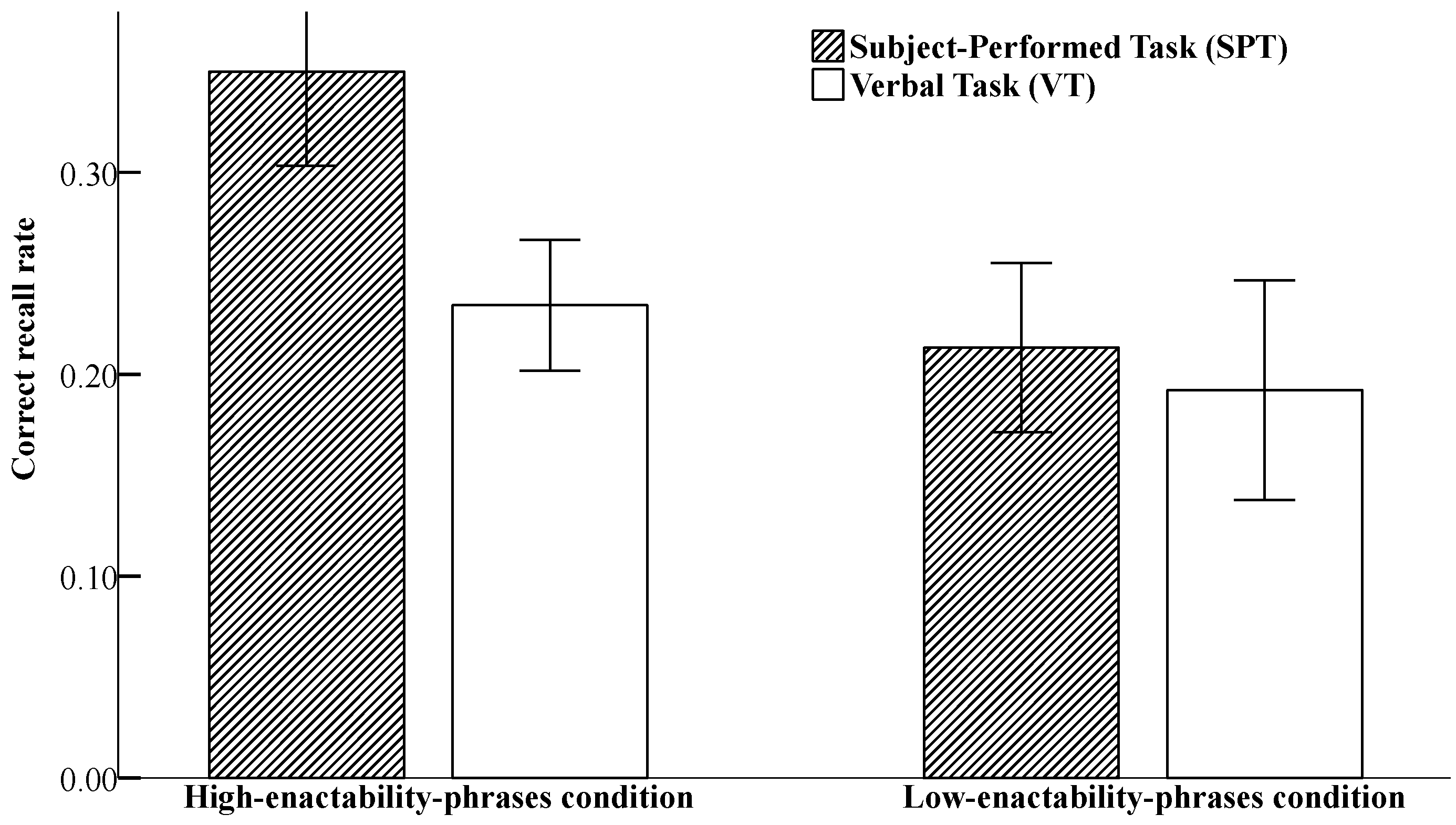
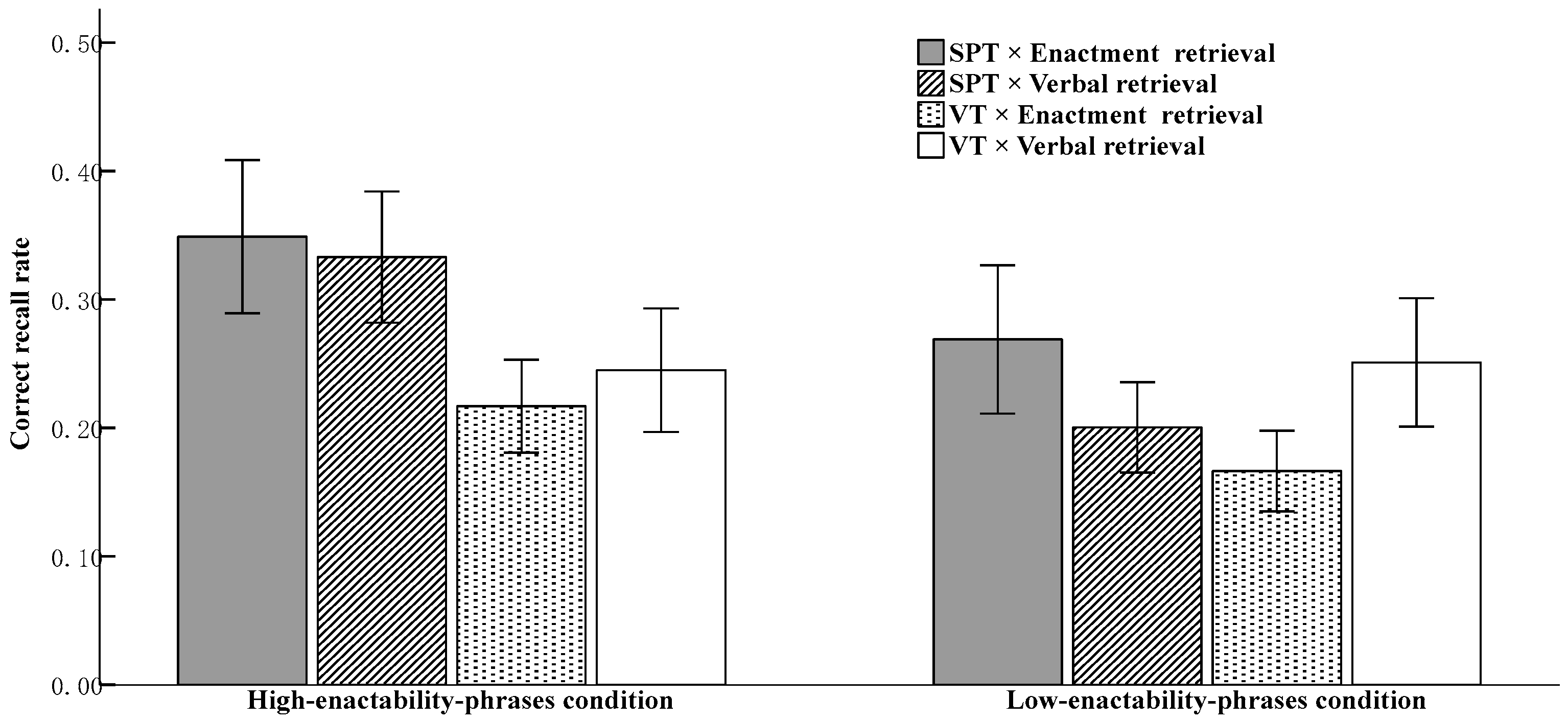
The Influence of Varying Degrees of Enactability on the Enactment Effect in Action Memory During the Encoding and Retrieval Stages: A Study with Healthy Young Adults
Abstract
1. Introduction
1.1. Processing Process Theory vs. Processing System Theory
1.2. Motor Information Representation vs. Motor Information Activation
1.3. Design of This Study and Research Hypotheses
2. Experiment 1: Exploring the Influence of the Degree of Enactability on the Enactment Effect During the Encoding Stage
2.1. Method
2.1.1. Design
2.1.2. Participants
2.1.3. Materials
2.1.4. Procedure
2.1.5. Scoring
2.1.6. Data Analysis
2.2. Results
2.3. Discussion
3. Experiment 2: Exploring the Influence of the Degree of Enactability on the Enactment Effect During the Retrieval Stage
3.1. Method
3.1.1. Design
3.1.2. Participants
3.1.3. Materials
3.1.4. Procedure
3.1.5. Scoring
3.1.6. Data Analysis
3.2. Results
3.3. Discussion
4. General Discussion
4.1. Exploring the Influence of the Degree of Enactability on the Enactment Effect During the Encoding Stage
4.2. Exploring the Influence of the Degree of Enactability on the Enactment Effect During the Retrieval Stage
4.3. Limitations and Prospects
5. Conclusions
Author Contributions
Funding
Institutional Review Board Statement
Informed Consent Statement
Data Availability Statement
Conflicts of Interest
Abbreviations
| EEG | Electroencephalography |
| ERP | Event-related potential |
| FMRI | Functional magnetic resonance imaging |
| MEG | Magnetoencephalography |
| SPT | Subject-performed task |
| VT | Verbal task |
| Act-in | Activation-Integration |
Appendix A. Experimental Materials
| Chinese Phrase | English Translation | Degree of Enactability |
| 拧瓶盖 | Twist a bottle cap | High |
| 抛硬币 | Toss a coin | High |
| 下棋 | Play chess | High |
| 拍照 | Take a photo | High |
| 捡垃圾 | Collect trash | High |
| 翻书 | Turn pages of a book | High |
| 拿杯子 | Hold a cup | High |
| 划火柴 | Strike a match | High |
| 摇铃铛 | Ring a bell | High |
| 夹菜 | Pick up food with chopsticks | High |
| 弹钢琴 | Play the piano | High |
| 剪纸 | Cut paper | High |
| 浇花 | Water flowers | High |
| 扇风 | Fan the air | High |
| 打电话 | Make a phone call | High |
| 擦黑板 | Wipe the blackboard | High |
| 画圆 | Draw a circle | High |
| 喷香水 | Spray perfume | High |
| 喝水 | Drink water | High |
| 参军 | Join the army | Low |
| 登场 | Make an entrance | Low |
| 报恩 | Repay a kindness | Low |
| 乘飞机 | Take a plane | Low |
| 过关 | Pass a level | Low |
| 做生意 | Run a business | Low |
| 求学 | Pursue academic studies | Low |
| 拼音 | Spell in pinyin | Low |
| 让步 | Concede ground | Low |
| 按时 | Meet the deadline | Low |
| 押题 | Predict exam questions | Low |
| 分家 | Split up a family | Low |
| 发芽 | Sprout a bud | Low |
| 争气 | Strive for success | Low |
| 公布 | Announce the result | Low |
| 卡壳 | Get stuck | Low |
| 扛事 | Shoulder responsibilities | Low |
| 抽样 | Conduct sampling | Low |
| 投档 | Submit application files | Low |
References
- Allen, R. J., Hill, L. J., Eddy, L. H., & Waterman, A. H. (2020). Exploring the effects of demonstration and enactment in facilitating recall of instructions in working memory. Memory & Cognition, 48(3), 400–410. [Google Scholar]
- Allen, R. J., & Waterman, A. H. (2015). How does enactment affect the ability to follow instructions in working memory? Memory & Cognition, 43, 555–561. [Google Scholar]
- Allen, R. J., Waterman, A. H., Yang, T., & Jaroslawska, A. (2023). Working memory in action: Remembering and following instructions. In R. Logie, Z. Wen, N. Cowan, & R. Engle (Eds.), Memory in science for society: There is nothing as practical as a good theory. Oxford University Press. [Google Scholar]
- Baddeley, A. D. (1966a). Short-term memory for word sequences as a function of acoustic, semantic and formal similarity. Quarterly Journal of Experimental Psychology, 18(4), 362–365. [Google Scholar]
- Baddeley, A. D. (1966b). The influence of acoustic and semantic similarity on long-term memory for word sequences. The Quarterly Journal of Experimental Psychology, 18(4), 302–309. [Google Scholar] [CrossRef]
- Badinlou, F., Kormi-Nouri, R., Mousavi Nasab, S. H., & Knopf, M. (2017). Developmental differences in episodic memory across school ages: Evidence from enacted events performed by self and others. Memory, 25(1), 84–94. [Google Scholar]
- Barsalou, L. W. (2008). Grounded cognition. Annual Review of Psychology, 59, 617–645. [Google Scholar] [CrossRef]
- Bäckman, L., & Nilsson, L. G. (1984). Aging effects in free recall: An exception to the rule. Human Learning: Journal of Practical Research & Applications, 3(1), 53–69. [Google Scholar]
- Brouillet, T., Michalland, A. H., Martin, S., & Brouillet, D. (2021). When the action to be performed at the stage of retrieval enacts memory of action verbs. Experimental Psychology, 68(1), 18–31. [Google Scholar] [CrossRef] [PubMed]
- Brown, C., & Hagoort, P. (1993). The processing nature of the N400: Evidence from masked priming. Journal of Cognitive Neuroscience, 5(1), 34–44. [Google Scholar] [CrossRef]
- Carota, F., Moseley, R., & Pulvermüller, F. (2012). Body-part-specific representations of semantic noun categories. Journal of Cognitive Neuroscience, 24(6), 1492–1509. [Google Scholar] [PubMed]
- Cohen, R. L. (1981). On the generality of some memory laws. Scandinavian Journal of Psychology, 22(1), 267–281. [Google Scholar] [CrossRef]
- Cohen, R. L. (1989). Memory for action events: The power of enactment. Educational Psychology Review, 1(1), 57–80. [Google Scholar] [CrossRef]
- Creem-Regehr, S. H., & Lee, J. N. (2005). Neural representations of graspable objects: Are tools special? Cognitive Brain Research, 22(3), 457–469. [Google Scholar] [CrossRef] [PubMed]
- Eggert, E., Takacs, A., Münchau, A., & Beste, C. (2022). On the role of memory representations in action control: Neurophysiological decoding reveals the reactivation of integrated stimulus–response feature representations. Journal of Cognitive Neuroscience, 34(7), 1246–1258. [Google Scholar] [CrossRef]
- Engelkamp, J., & Zimmer, H. D. (1984). Motor programme information as a separable memory unit. Psychological Research, 46(3), 283–299. [Google Scholar] [CrossRef] [PubMed]
- Engelkamp, J., & Zimmer, H. D. (1985). Motor programs and their relation to semantic memory. German Journal of Psychology, 9(3), 239–254. [Google Scholar]
- Engelkamp, J., & Zimmer, H. D. (1994). Motor similarity in subject-performed tasks. Psychological Research, 57(1), 47–53. [Google Scholar] [CrossRef]
- Engelkamp, J., & Zimmer, H. D. (1997). Sensory factors in memory for subject-performed tasks. Acta Psychologica, 96(1–2), 43–60. [Google Scholar] [CrossRef]
- Faul, F., Erdfelder, E., Lang, A. G., & Buchner, A. (2007). G* Power 3: A flexible statistical power analysis program for the social, behavioral, and biomedical sciences. Behavior Research Methods, 39(2), 175–191. [Google Scholar] [CrossRef]
- Ferretti, G. (2016). Through the forest of motor representations. Consciousness and Cognition, 43, 177–196. [Google Scholar] [CrossRef]
- Friederici, A. D. (2002). Towards a neural basis of auditory sentence processing. Trends in Cognitive Sciences, 6(2), 78–84. [Google Scholar] [CrossRef]
- Gerlach, C., Law, I., & Paulson, O. B. (2002). When action turns into words. Activation of motor-based knowledge during categorization of manipulable objects. Journal of Cognitive Neuroscience, 14(8), 1230–1239. [Google Scholar] [CrossRef] [PubMed]
- Grainger, C., Williams, D. M., & Lind, S. E. (2017). Recognition memory and source memory in autism spectrum disorder: A study of the intention superiority and enactment effects. Autism, 21(7), 812–820. [Google Scholar] [CrossRef]
- Hainselin, M., Quinette, P., Juskenaite, A., Desgranges, B., Martinaud, O., de La Sayette, V., Hannequin, D., Viader, F., & Eustache, F. (2014). Just do it! How performing an action enhances remembering in transient global amnesia. Cortex, 50(1), 192–199. [Google Scholar] [CrossRef]
- Heil, M., Rolke, B., Engelkamp, J., Rosler, F., Ozcan, M., & Hennighausen, E. (1999). Event-related brain potentials during recognition of ordinary and bizarre action phrases following verbal and subject-performed encoding conditions. European Journal of Cognitive Psychology, 11(2), 261–280. [Google Scholar] [CrossRef]
- Ianì, F., Foiadelli, A., & Bucciarelli, M. (2019). Mnemonic effects of action simulation from pictures and phrases. Acta Psychologica, 194(2019), 37–50. [Google Scholar] [CrossRef]
- Janczyk, M., Aßmann, M., & Grabowski, J. (2018). Oral versus written recall of long-term memory items: Replicating and extending the writing superiority effect across knowledge domains. The American Journal of Psychology, 131(3), 263–272. [Google Scholar] [CrossRef]
- Jaroslawska, A. J., Gathercole, S. E., Allen, R. J., & Holmes, J. (2016). Following instructions from working memory: Why does action at encoding and recall help? Memory & Cognition, 44(8), 1183–1191. [Google Scholar] [CrossRef]
- Jaroslawska, A. J., Gathercole, S. E., & Holmes, J. (2018). Following instructions in a dual-task paradigm: Evidence for a temporary motor store in working memory. Quarterly Journal of Experimental Psychology, 71(11), 2439–2449. [Google Scholar] [CrossRef] [PubMed]
- Knopf, M., Mack, W., Lenel, A., & Ferrante, S. (2005). Memory for action events: Findings in neurological patients. Scandinavian Journal of Psychology, 46(1), 11–19. [Google Scholar] [CrossRef] [PubMed]
- Kormi-Nouri, R. (1995). The nature of memory for action events: Anepisodic integration view. European Journal of Cognitive Psychology, 7(4), 337–363. [Google Scholar] [CrossRef]
- Kormi-Nouri, R., Moniri, S., & Nilsson, L. G. (2003). Episodic and semantic memory in bilingual and monolingual children. Scandinavian Journal of Psychology, 44(1), 47–54. [Google Scholar] [CrossRef]
- Krönke, K.-M., Mueller, K., Friederici, A. D., & Obrig, H. (2013). Learning by doing? The effect of gestures on implicit retrieval of newly acquired words. Cortex, 49(9), 2553–2568. [Google Scholar] [CrossRef]
- Leynes, P. A., Grey, J. A., & Crawford, J. T. (2006). Event-related potential (ERP) evidence for sensory-based action memories. International Journal of Psychophysiology, 62(1), 193–202. [Google Scholar] [CrossRef]
- Leynes, P. A., & Phillips, M. C. (2008). Event-related potential (erp) evidence for varied recollection during source monitoring. Journal of Experimental Psychology Learning Memory & Cognition, 34(4), 741–751. [Google Scholar]
- Li, G., Allen, R. J., Hitch, G. J., & Baddeley, A. D. (2022). Translating words into actions in working memory: The role of spatial-motoric coding. Quarterly Journal of Experimental Psychology, 75(10), 1959–1975. [Google Scholar] [CrossRef] [PubMed]
- Li, G., Wang, L., & Han, Y. (2017). Directed forgetting of negative performed actions is difficult: A behavioural study. Quarterly Journal of Experimental Psychology, 70(1), 53–61. [Google Scholar] [CrossRef]
- Li, G., Wang, L., & Han, Y. (2019). The output monitoring of performed actions: What can we learn from “recall-recognition” performance? Cognitive Processing, 20(1), 45–53. [Google Scholar] [CrossRef]
- Liu, S., & Wang, L. (2018). The association of motor information and verbal information: A new perspective on the mechanism of the SPT effect. Journal of Cognitive Psychology, 30(3), 321–335. [Google Scholar] [CrossRef]
- Macedonia, M., & Mueller, K. (2016). Exploring the neural representation of novel words learned through enactment in a word recognition task. Frontiers in Psychology, 7, 953. [Google Scholar] [CrossRef] [PubMed]
- Mangels, J. A., & Heinberg, A. (2006). Improved episodic integration through enactment: Implications for aging. The Journal of General Psychology, 133(1), 37–65. [Google Scholar] [CrossRef]
- Masumoto, K., Yamaguchi, M., Sutani, K., Tsuneto, S., Fujita, A., & Tonoike, M. (2006). Reactivation of physical motor information in the memory of action events. Brain Research, 1101(1), 102–109. [Google Scholar] [CrossRef]
- Norris, D. (2017). Short-term memory and long-term memory are still different. Psychological Bulletin, 143(9), 992–1009. [Google Scholar] [CrossRef]
- Nyberg, L., Petersson, K. M., Nilsson, L. G., Sandblom, J., Aberg, C., & Ingvar, M. (2001). Reactivation of motor brain areas during explicit memory for actions. Neuroimage, 14(2), 521–528. [Google Scholar] [CrossRef]
- Pecher, D., van Dantzig, S., Zwaan, R. A., & Zeelenberg, R. (2009). Language comprehenders retain implied shape and orientation of objects. Quarterly Journal of Experimental Psychology, 62(6), 1108–1114. [Google Scholar] [CrossRef] [PubMed]
- Ratner, H. H., & Foley, M. A. (2020). The role of goals and outcomes in young children’s memory for actions. Cognitive Processing, 21(3), 411–425. [Google Scholar] [CrossRef] [PubMed]
- Roberts, B. R., MacLeod, C. M., & Fernandes, M. A. (2022). The enactment effect: A systematic review and meta-analysis of behavioral, neuroimaging, and patient studies. Psychological Bulletin, 148(5–6), 397–434. [Google Scholar] [CrossRef] [PubMed]
- Rueschemeyer, S. A., van Rooij, D., Lindemann, O., Willems, R. M., & Bekkering, H. (2010). The function of words: Distinct neural correlates for words denoting differently manipulable objects. Journal of Cognitive Neuroscience, 22(8), 1844–1851. [Google Scholar] [CrossRef]
- Russ, M. O., Mack, W., Grama, C. R., Lanfermann, H., & Knopf, M. (2003). Enactment effect in memory: Evidence concerning the function of the supramarginal gyrus. Experimental Brain Research, 149(4), 497–504. [Google Scholar] [CrossRef]
- Sakai, K. (2003). Reactivation of memory: Role of medial temporal lobe and prefrontal cortex. Reviews in the Neurosciences, 14(3), 241–252. [Google Scholar] [CrossRef]
- Schaller, F., Weiss, S., & Müller, H. M. (2017). EEG beta-power changes reflect motor involvement in abstract action language processing. Brain and Language, 168, 95–105. [Google Scholar] [CrossRef]
- Schatz, T. R., Spranger, T., Kubik, V., & Knopf, M. (2011). Exploring the enactment effect from an information processing view: What can we learn from serial position analyses? Scandinavian Journal of Psychology, 52(6), 509–515. [Google Scholar] [CrossRef]
- Senkfor, A. J., Petten, C. V., & Kutas, M. (2002). Episodic action memory for real objects: An erp investigation with perform, watch, and imagine action encoding tasks versus a non-action encoding task. Journal of Cognitive Neuroscience, 14(3), 402–419. [Google Scholar] [CrossRef]
- Sivashankar, Y., & Fernandes, M. A. (2022). Enhancing memory using enactment: Does meaning matter in action production. Memory, 30(2), 147–160. [Google Scholar] [CrossRef]
- Slotnick, S. D. (2004). Visual memory and visual perception recruit common neural substrates. Behavioral and Cognitive Neuroscience Reviews, 3, 207–221. [Google Scholar] [CrossRef] [PubMed]
- Smyth, M. M., & Pendleton, L. R. (1989). Working memory for movements. The Quarterly Journal of Experimental Psychology, Section A: Human Experimental Psychology, 41, 235–250. [Google Scholar] [CrossRef]
- Smyth, M. M., & Pendleton, L. R. (1990). Space and movement in working memory. The Quarterly Journal of Experimental Psychology, Section A: Human Experimental Psychology, 42, 291–304. [Google Scholar] [CrossRef] [PubMed]
- Tian, L., Chen, H., Zhao, W., Wu, J., Zhang, Q., De, A., Leppänen, P., Cong, F., & Parviainen, T. (2020). The role of motor system in action-related language comprehension in L1 and L2: An fMRI study. Brain and Language, 201, 104714. [Google Scholar] [CrossRef] [PubMed]
- Tuena, C., Serino, S., Dutriaux, L., Riva, G., & Piolino, P. (2019). Virtual enactment effect on memory in young and aged populations: A systematic review. Journal of Clinical Medicine, 8(5), 620. [Google Scholar] [CrossRef]
- Tulving, E., & Thomson, D. M. (1973). Encoding specifity and retrieval processes in episodic memory. Psychological Review, 80(5), 352–373. [Google Scholar] [CrossRef]
- Versace, R., Vallet, G. T., Riou, B., Lesourd, M., Labeye, É., & Brunel, L. (2014). Act-In: An integrated view of memory mechanisms. Journal of Cognitive Psychology, 26(3), 280–306. [Google Scholar] [CrossRef]
- Wang, L., & Li, G. (2014). A review on the theories of subject performed task effect in action memory. Journal of Psychological Science, 37(4), 998–1001. [Google Scholar]
- Wang, L., Yu, Z., Ren, Z., & Ma, J. (2022). Semantic feedback processing mechanism of the enactment effect: Evidence from event-related potentials. Quarterly Journal of Experimental Psychology, 75(4), 742–753. [Google Scholar] [CrossRef]
- Waterman, A. H., Atkinson, A. L., Aslam, S. S., Holmes, J., Jaroslawska, A., & Allen, R. J. (2017). Do actions speak louder than words? Examining children’s ability to follow instructions. Memory & Cognition, 45, 877–890. [Google Scholar] [CrossRef]
- Wojcik, D. Z., Allen, R. J., Brown, C., & Souchay, C. (2011). Memory for actions in autism spectrum disorder. Memory, 19(6), 549–558. [Google Scholar] [CrossRef] [PubMed]
- Yang, T., Allen, R. J., Yu, Q., & Chan, R. C. K. (2015). The influence of input and output modality on following instructions in working memory. Scientific Reports, 5, 17657. [Google Scholar] [CrossRef] [PubMed]
- Yu, Z. (2017). The semantic processing mechanism of the enactment effect in action memory [Unpublished doctoral dissertation, Jilin University]. [Google Scholar]
- Zeelenberg, R., Pecher, D., van der Meijden, M. E., Trott, S., & Bergen, B. (2025). Non-native language comprehenders encode implied shapes of objects in memory. Cortex, 182, 100–111. [Google Scholar] [CrossRef]
- Zeelenberg, R., Remmers, S., Blaauwgeers, F., & Pecher, D. (2020). The influence of poststudy action congruency on memory consolidation. Experimental Psychology, 67(4), 211–223. [Google Scholar] [CrossRef] [PubMed]
- Zhang, J., Wang, Y., Zhang, Y., Li, B., & Zhang, Y. (2021). Enhanced written vs. verbal recall accuracy associated with greater prefrontal activation: A near-infrared spectroscopy study. Frontiers in Behavioral Neuroscience, 15, 601698. [Google Scholar] [CrossRef]
- Zhang, X., Assumpcao, L., & Wang, L. (2023). The role of motor representation in enactment effect of action memory. Experimental Psychology, 70(4), 193–202. [Google Scholar] [CrossRef]
- Zhang, X., & Zuber, S. (2020). The effects of language and semantic repetition on the enactment effect of action memory. Frontiers in Psychology, 11, 515. [Google Scholar] [CrossRef] [PubMed]
- Zimmer, H. D., & Engelkamp, J. (1985). An attempt to distinguish between kinematic and motor memory components. Acta Psychologica, 58(1), 81–106. [Google Scholar] [CrossRef]
- Zimmer, H. D., Helstrup, T., & Engelkamp, J. (2000). Pop-out into memory: A retrieval mechanism that is enhanced with the recall of subject-performed tasks. Journal of Experimental Psychology: Learning, Memory, and Cognition, 26(3), 658–670. [Google Scholar] [CrossRef] [PubMed]


Disclaimer/Publisher’s Note: The statements, opinions and data contained in all publications are solely those of the individual author(s) and contributor(s) and not of MDPI and/or the editor(s). MDPI and/or the editor(s) disclaim responsibility for any injury to people or property resulting from any ideas, methods, instructions or products referred to in the content. |
© 2026 by the authors. Licensee MDPI, Basel, Switzerland. This article is an open access article distributed under the terms and conditions of the Creative Commons Attribution (CC BY) license.
Share and Cite
Cao, H.; Li, G. The Influence of Varying Degrees of Enactability on the Enactment Effect in Action Memory During the Encoding and Retrieval Stages: A Study with Healthy Young Adults. Behav. Sci. 2026, 16, 438. https://doi.org/10.3390/bs16030438
Cao H, Li G. The Influence of Varying Degrees of Enactability on the Enactment Effect in Action Memory During the Encoding and Retrieval Stages: A Study with Healthy Young Adults. Behavioral Sciences. 2026; 16(3):438. https://doi.org/10.3390/bs16030438
Chicago/Turabian StyleCao, Hui, and Guangzheng Li. 2026. "The Influence of Varying Degrees of Enactability on the Enactment Effect in Action Memory During the Encoding and Retrieval Stages: A Study with Healthy Young Adults" Behavioral Sciences 16, no. 3: 438. https://doi.org/10.3390/bs16030438
APA StyleCao, H., & Li, G. (2026). The Influence of Varying Degrees of Enactability on the Enactment Effect in Action Memory During the Encoding and Retrieval Stages: A Study with Healthy Young Adults. Behavioral Sciences, 16(3), 438. https://doi.org/10.3390/bs16030438