Pandemic Babies: Developmental Outcomes in Preschool-Aged Children Born During the COVID-19 Era


Abstract
1. Introduction
2. Materials and Methods
2.1. Participants
2.2. Procedure
2.3. Measures
2.3.1. Participant Information Sheet
2.3.2. Behavior Rating Inventory of Executive Function—Preschool Version
2.3.3. Parents’ Assessment of Protective Factors
2.3.4. Ages and Stages Questionnaire—Third Edition
2.3.5. Ages and Stages Questionnaire: Social Emotional—Second Edition
2.3.6. Adverse Childhood Experiences Questionnaire
2.3.7. Vocabulary Assessment
2.4. Data Analysis
3. Results
3.1. Sociodemographic and Early Clinical Factors Across Cohort
3.1.1. Child Development and Pregnancy Experience
3.1.2. Parents’ Assessment of Protective Factors
3.1.3. Adverse Childhood Experiences Survey
3.1.4. Screen Time
3.2. Between-Group Differences in Executive Function
3.3. Between-Group Differences in Developmental Screening Tools
3.4. Between-Group Differences in Vocabulary Skills
4. Discussion
5. Conclusions
Supplementary Materials
Author Contributions
Funding
Institutional Review Board Statement
Informed Consent Statement
Data Availability Statement
Acknowledgments
Conflicts of Interest
Appendix A

| BRIEF-P Score | Pre-Pandemic M (SD) | Pandemic-Born M (SD) | Total M (SD) |
|---|---|---|---|
| Scale/Index | |||
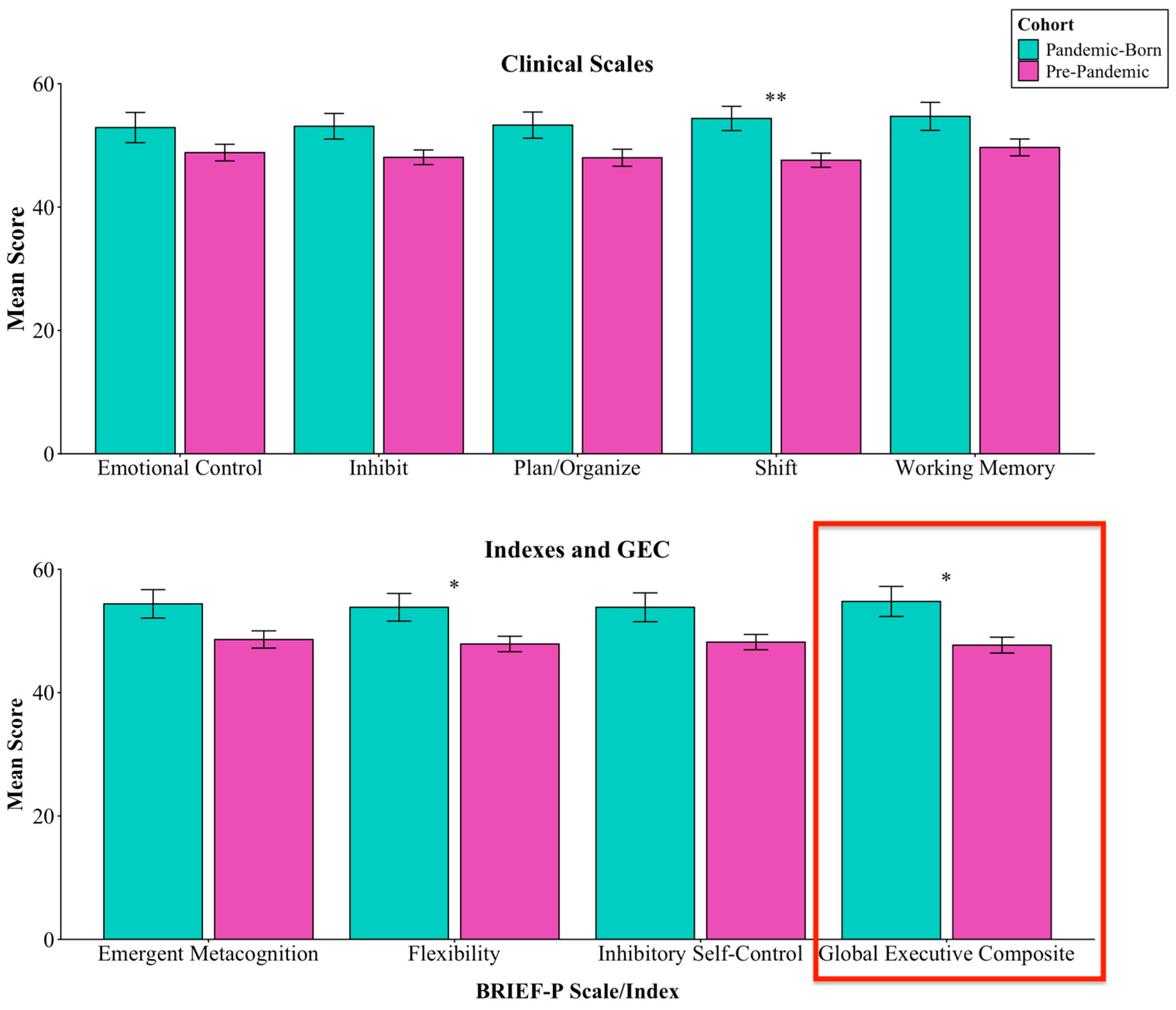
| Inhibit | 48.1 (8.8) | 53.1 (12.8) | 50.1 (10.8) |
| Shift | 47.60 (8.5) | 54.4 (12.1) | 50.4 (10.6) |
| Emotional Control (EC) | 48.8 (10.0) | 52.9 (15.1) | 50.5 (12.4) |
| Working Memory (WM) | 49.7 (10.1) | 54.7 (14.0) | 51.7 (12.1) |
| Plan/Organize (PO) | 48.0 (10.2) | 53.3 (13.1) | 50.2 (11.7) |
| ISCI (Inhibit + EC) | 48.2 (9.2) | 53.8 (14.4) | 50.5 (11.9) |
| FI (Shift + EC) | 47.9 (9.3) | 53.8 (13.8) | 50.3 (11.7) |
| EMI (WM + PO) | 48.6 (10.4) | 54.4 (14.2) | 51.0 (12.4) |
| GEC (Inhibit + Shift + EC + WM + PO) | 47.7 (9.5) | 54.8 (15.0) | 50.6 (12.5) |
| Developmental Domains | Pre-Pandemic M (SD) | Pandemic-Born M (SD) | Total M (SD) |
|---|---|---|---|
| ASQ-3 | |||
| Communication | 51.1 (9.3) | 49.6 (13.6) | 50.5 (11.2) |
| Fine Motor | 48.2 (12.7) | 41.6 (15.6) | 45.5 (14.2) |
| Gross Motor | 54.5 (8.0) | 51.8 (12.0) | 53.4 (9.9) |
| Personal Social | 52.1 (8.5) | 47.6 (13.1) | 50.3 (10.8) |
| Problem Solving | 54.6 (7.7) | 53.8 (8.26) | 54.3 (7.9) |
| ASQ:SE-2 | |||
| Social Emotional | 40.6 (21.1) | 49.7 (35.7) | 44.3 (28.1) |
References
- Alcon, S., Shen, S., Wong, H.-N., Rovnaghi, C. R., Truong, L., Vedelli, J. K. H., & Anand, K. J. S. (2024). Effects of the COVID-19 pandemic on early childhood development and mental health: A systematic review and meta-analysis of comparative studies. Psychology International, 6(4), 986–1012. [Google Scholar] [CrossRef]
- Almli, C. R., Rivkin, M. J., & McKinstry, R. C. (2007). The NIH MRI study of normal brain development (Objective-2): Newborns, infants, toddlers, and preschoolers. NeuroImage, 35(1), 308–325. [Google Scholar] [CrossRef]
- Altamimi, A. A. H., Robinson, M., McKinnon, E. J., Alenezi, E. M. A., Veselinović, T., Choi, R. S. M., & Brennan-Jones, C. G. (2023). The association between otitis media in early childhood with later behaviour and attention problems: A longitudinal pregnancy cohort. International Journal of Pediatric Otorhinolaryngology, 168, 111545. [Google Scholar] [CrossRef] [PubMed]
- Bacon, B. R., Prasad, S. I., & Carr, M. M. (2024). Children with previous COVID-19 infection are more likely to present with recurrent acute otitis media or tube otorrhea. International Journal of Pediatric Otorhinolaryngology, 184, 112072. [Google Scholar] [CrossRef] [PubMed]
- Bennett, K. E., & Haggard, M. P. (1999). Behaviour and cognitive outcomes from middle ear disease. Archives of Disease in Childhood, 80(1), 28–35. [Google Scholar] [CrossRef] [PubMed]
- Berens, A. E., & Nelson, C. A. (2015). The science of early adversity: Is there a role for large institutions in the care of vulnerable children? The Lancet, 386(9991), 388–398. [Google Scholar] [CrossRef]
- Bethell, C. D., Newacheck, P., Hawes, E., & Halfon, N. (2014). Adverse childhood experiences: Assessing the impact on health and school engagement and the mitigating role of resilience. Health Affairs (Project Hope), 33(12), 2106–2115. [Google Scholar] [CrossRef]
- Blair, C., & Raver, C. C. (2016). Poverty, stress, and brain development: New directions for prevention and intervention. Academic Pediatrics, 16(3), S30–S36. [Google Scholar] [CrossRef]
- Bogler, T., Hussain-Shamsy, N., Schuler, A., Pirmohamed, J., Shore, E. M., Wijayasinghe, S., Dennis, C.-L., Vigod, S. N., & Barker, L. C. (2021). Key concerns among pregnant individuals during the pandemic: Online cross-sectional survey. Canadian Family Physician, 67(9), e257–e268. [Google Scholar] [CrossRef]
- Buchsbaum, B. R., Greer, S., Chang, W., & Berman, K. F. (2005). Meta-analysis of neuroimaging studies of the Wisconsin Card-Sorting task and component processes. Human Brain Mapping, 25(1), 35–45. [Google Scholar] [CrossRef]
- Byrne, S., Sledge, H., Franklin, R., Boland, F., Murray, D. M., & Hourihane, J. (2023a). Social communication skill attainment in babies born during the COVID-19 pandemic: A birth cohort study. Archives of Disease in Childhood, 108(1), 20–24. [Google Scholar] [CrossRef] [PubMed]
- Byrne, S., Sledge, H., Hurley, S., Hoolahan, S., Franklin, R., Jordan, N., Boland, F., Murray, D. M., & Hourihane, J. (2023b). Developmental and behavioural outcomes at 2 years in babies born during the COVID-19 pandemic: Communication concerns in a pandemic birth cohort. Archives of Disease in Childhood, 108(10), 846–851. [Google Scholar] [CrossRef]
- Cao, M., Huang, H., Peng, Y., Dong, Q., & He, Y. (2016). Toward developmental connectomics of the human brain. Frontiers in Neuroanatomy, 10, 25. [Google Scholar] [CrossRef]
- Cao-Lei, L., Yogendran, S., Dufoix, R., Elgbeili, G., Laplante, D. P., & King, S. (2021). Prenatal maternal stress from a natural disaster and hippocampal volumes: Gene-by-environment interactions in young adolescents from project ice storm. Frontiers in Behavioral Neuroscience, 15, 706660. [Google Scholar] [CrossRef] [PubMed]
- Center on the Developing Child at Harvard University. (2011). Building the brain’s “Air Traffic Control” system: How early experiences shape the development of executive function: Working paper No. 11. Available online: www.developingchild.harvard.edu (accessed on 7 December 2021).
- Coelho, L. A., Amatto, A. N., Gonzalez, C. L. R., & Gibb, R. L. (2020). Building executive function in pre-school children through play: A curriculum. International Journal of Play, 9(1), 128–142. [Google Scholar] [CrossRef]
- Dam, D., McGill, E., Bellos, A., Coulby, C., Edwin, J., McCormick, R., & Patterson, K. (2023). COVID-19 outbreak trends in Canada, 2021. Canada Communicable Disease Report, 49(4), 133–144. [Google Scholar] [CrossRef]
- Diamond, A. (2013). Executive functions. Annual Review of Psychology, 64, 135–168. [Google Scholar] [CrossRef]
- Di Giorgio, E., Di Riso, D., Mioni, G., & Cellini, N. (2021). The interplay between mothers’ and children behavioral and psychological factors during COVID-19: An Italian study. European Child & Adolescent Psychiatry, 30(9), 1401–1412. [Google Scholar] [CrossRef]
- Doi, S., Fujiwara, T., & Isumi, A. (2020). Association between maternal adverse childhood experiences and child’s self-rated academic performance: Results from the K-CHILD study. Child Abuse & Neglect, 104, 104478. [Google Scholar] [CrossRef]
- Dunn, D. M. (2019). Peabody picture vocabulary test (5th ed.). Pearson. [Google Scholar]
- Feldman, H. M., Dollaghan, C. A., Campbell, T. F., Colborn, D. K., Janosky, J., Kurs-Lasky, M., Rockette, H. E., Dale, P. S., & Paradise, J. L. (2003). Parent-reported language skills in relation to otitis media during the first 3 years of life. Journal of Speech, Language, and Hearing Research: JSLHR, 46(2), 273–287. [Google Scholar] [CrossRef] [PubMed]
- Felitti, V. J., Anda, R. F., Nordenberg, D., Williamson, D. F., Spitz, A. M., Edwards, V., Koss, M. P., & Marks, J. S. (1998). Relationship of childhood abuse and household dysfunction to many of the leading causes of death in adults. American Journal of Preventive Medicine, 14(4), 245–258. [Google Scholar] [CrossRef]
- Fenson, L., Dale, P. S., Reznick, J. S., Bates, E., Thal, D. J., Pethick, S. J., Tomasello, M., Mervis, C. B., & Stiles, J. (1994). Variability in early communicative development. Monographs of the Society for Research in Child Development, 59(5), v–173. [Google Scholar] [CrossRef]
- Fenson, L., & Schell, R. E. (1985). The origins of exploratory play. Early Child Development and Care, 19(1–2), 3–24. [Google Scholar] [CrossRef]
- Fields, K., Ciciolla, L., Addante, S., Erato, G., Quigley, A., Mullins-Sweatt, S. N., & Shreffler, K. M. (2023). Maternal adverse childhood experiences and perceived stress during pregnancy: The role of personality. Journal of Child & Adolescent Trauma, 16(3), 649–657. [Google Scholar] [CrossRef] [PubMed]
- Finegold, K. E., Knight, J. A., Hung, R. J., Ssewanyana, D., Wong, J., Bertoni, K., Adel Khani, N., Watson, H., Levitan, R. D., Jenkins, J. M., Matthews, S. G., & Wade, M. (2023). Cognitive and emotional well-being of preschool children before and during the COVID-19 pandemic. JAMA Network Open, 6(11), e2343814. [Google Scholar] [CrossRef]
- Frota, S., Pejovic, J., Cruz, M., Severino, C., & Vigário, M. (2022). Early word segmentation behind the mask. Frontiers in Psychology, 13, 879123. [Google Scholar] [CrossRef]
- Fung, P., St Pierre, T., Raja, M., & Johnson, E. K. (2023). Infants’ and toddlers’ language development during the pandemic: Socioeconomic status mattered. Journal of Experimental Child Psychology, 236, 105744. [Google Scholar] [CrossRef]
- Gao, W., Gilmore, J. H., Shen, D., Smith, J. K., Zhu, H., & Lin, W. (2013). The synchronization within and interaction between the default and dorsal attention networks in early infancy. Cerebral Cortex, 23(3), 594–603. [Google Scholar] [CrossRef]
- Giesbrecht, G. F., Lebel, C., Dennis, C.-L., Silang, K., Xie, E. B., Tough, S., McDonald, S., & Tomfohr-Madsen, L. (2023). Risk for developmental delay among infants born during the COVID-19 pandemic. Journal of Developmental & Behavioral Pediatrics, 44(6), e412–e420. [Google Scholar] [CrossRef] [PubMed]
- Gilmore, J. H., Santelli, R. K., & Gao, W. (2018). Imaging structural and functional brain development in early childhood. Nature Reviews Neuroscience, 19(3), 123–137. [Google Scholar] [CrossRef] [PubMed]
- Gioia, G. A., Espy, K. A., & Isquith, P. K. (2003). Behavior rating inventory of executive function-preschool version. Psychological Assessment Resources. [Google Scholar]
- González, M., Loose, T., Liz, M., Pérez, M., Rodríguez-Vinçon, J. I., Tomás-Llerena, C., & Vásquez-Echeverría, A. (2022). School readiness losses during the COVID-19 outbreak. A comparison of two cohorts of young children. Child Development, 93(4), 910–924. [Google Scholar] [CrossRef]
- Hanno, E. C., Cuartas, J., Miratrix, L. W., Jones, S. M., & Lesaux, N. K. (2022). Changes in children’s behavioral health and family well-being during the COVID-19 pandemic. Journal of Developmental and Behavioral Pediatrics: JDBP, 43(3), 168–175. [Google Scholar] [CrossRef] [PubMed]
- Hendry, A., Gibson, S. P., Davies, C., Gliga, T., McGillion, M., & Gonzalez-Gomez, N. (2022). Not all babies are in the same boat: Exploring the effects of socioeconomic status, parental attitudes, and activities during the 2020 COVID-19 pandemic on early executive functions. Infancy, 27(3), 555–581. [Google Scholar] [CrossRef]
- Heyder, K., Suchan, B., & Daum, I. (2004). Cortico-subcortical contributions to executive control. Acta Psychologica, 115(2–3), 271–289. [Google Scholar] [CrossRef] [PubMed]
- Huang, P., Zhou, F., Guo, Y., Yuan, S., Lin, S., Lu, J., Tu, S., Lu, M., Shen, S., Guedeney, A., Xia, H., & Qiu, X. (2021). Association between the COVID-19 pandemic and infant neurodevelopment: A comparison before and during COVID-19. Frontiers in Pediatrics, 9, 662165. [Google Scholar] [CrossRef]
- Imboden, A., Sobczak, B. K., & Griffin, V. (2022). The impact of the COVID-19 pandemic on infant and toddler development. Journal of the American Association of Nurse Practitioners, 34(3), 509. [Google Scholar] [CrossRef]
- Jackson, D. B., Testa, A., & Vaughn, M. G. (2021). Adverse childhood experiences and school readiness among preschool-aged children. The Journal of Pediatrics, 230, 191–197.e5. [Google Scholar] [CrossRef]
- Jaffer, A., Manning, K. Y., Giesbrecht, G. F., Tomfohr-Madsen, L. M., & Lebel, C. (2024). COVID-19 pandemic–related prenatal distress and infant functional brain development. JAACAP Open, 3(3), 758–767. [Google Scholar] [CrossRef] [PubMed]
- Johnson, D. E. (2000). Medical and developmental sequelae of early childhood institutionalization in Eastern European adoptees. In C. A. Nelson (Ed.), The Minnesota symposia on child psychology: Vol. 31. The effects of early adversity on neurobehavioral development (pp. 113–162). Erlbaum. [Google Scholar]
- Kartushina, N., Mani, N., Aktan-Erciyes, A., Alaslani, K., Aldrich, N. J., Almohammadi, A., Alroqi, H., Anderson, L., Andonova, E., Aussems, S., Babineau, M., Barokova, M., Bergmann, C., Cashon, C. H., Custode, S., De Carvalho, A., Dimitrova, N., Dynak, A., Farah, R., … Mayor, J. (2022). COVID-19 first lockdown as a window into language acquisition: Associations between caregiver-child activities and vocabulary gains. Language Development Research, 2(1), 1–36. [Google Scholar] [CrossRef]
- King, S., & Laplante, D. P. (2015). Using natural disasters to study prenatal maternal stress in humans. In M. C. Antonelli (Ed.), Perinatal programming of neurodevelopment (Vol. 10, pp. 285–313). Springer. [Google Scholar] [CrossRef]
- Kiplinger, V. L., & Browne, C. H. (2014). Parents’ assessment of protective factors: User’s guide and technical report. Center for the Study of Social Policy. [Google Scholar]
- Kundakovic, M., & Champagne, F. A. (2015). Early-life experience, epigenetics, and the developing brain. Neuropsychopharmacology, 40(1), 141–153. [Google Scholar] [CrossRef]
- Lalonde, K., Buss, E., Miller, M. K., & Leibold, L. J. (2022). Face masks impact auditory and audiovisual consonant recognition in children with and without hearing loss. Frontiers in Psychology, 13, 874345. [Google Scholar] [CrossRef]
- Laplante, D. P., Barr, R. G., Brunet, A., Du Fort, G. G., Meaney, M. L., Saucier, J.-F., Zelazo, P. R., & King, S. (2004). Stress during pregnancy affects general intellectual and language functioning in human toddlers. Pediatric Research, 56(3), 400–410. [Google Scholar] [CrossRef]
- Laplante, D. P., Brunet, A., Schmitz, N., Ciampi, A., & King, S. (2008). Project ice storm: Prenatal maternal stress affects cognitive and linguistic functioning in 5½-year-old children. Journal of the American Academy of Child & Adolescent Psychiatry, 47(9), 1063–1072. [Google Scholar] [CrossRef]
- Laplante, D. P., Zelazo, P. R., Brunei, A., & King, S. (2007). Functional play at 2 years of age: Effects of prenatal maternal stress. Infancy, 12(1), 69–93. [Google Scholar] [CrossRef] [PubMed]
- Lebel, C., MacKinnon, A., Bagshawe, M., Tomfohr-Madsen, L., & Giesbrecht, G. (2020). Elevated depression and anxiety symptoms among pregnant individuals during the COVID-19 pandemic. Journal of Affective Disorders, 277, 5–13. [Google Scholar] [CrossRef] [PubMed]
- Liu, J., Wyver, S., & Chutiyami, M. (2022). Impacts of COVID-19 restrictions on young children’s outdoor activity: A systematic review. Children, 9(10), 1564. [Google Scholar] [CrossRef]
- Maxwell, S. E. (2004). The persistence of underpowered studies in psychological research: Causes, consequences, and remedies. Psychological Methods, 9(2), 147–163. [Google Scholar] [CrossRef] [PubMed]
- Miyake, A., Friedman, N. P., Emerson, M. J., Witzki, A. H., Howerter, A., & Wager, T. D. (2000). The unity and diversity of executive functions and their contributions to complex “Frontal Lobe” tasks: A latent variable analysis. Cognitive Psychology, 41(1), 49–100. [Google Scholar] [CrossRef]
- Moffitt, T. E., Arseneault, L., Belsky, D., Dickson, N., Hancox, R. J., Harrington, H., Houts, R., Poulton, R., Roberts, B. W., Ross, S., Sears, M. R., Thomson, W. M., & Caspi, A. (2011). A gradient of childhood self-control predicts health, wealth, and public safety. Proceedings of the National Academy of Sciences of the United States of America, 108(7), 2693–2698. [Google Scholar] [CrossRef]
- Muentener, P., Herrig, E., & Schulz, L. (2018). The efficiency of infants’ exploratory play is related to longer-term cognitive development. Frontiers in Psychology, 9, 635. [Google Scholar] [CrossRef]
- Nazzari, S., Pili, M. P., Günay, Y., & Provenzi, L. (2024). Pandemic babies: A systematic review of the association between maternal pandemic-related stress during pregnancy and infant development. Neuroscience & Biobehavioral Reviews, 162, 105723. [Google Scholar] [CrossRef]
- Nazzi, T., & Bertoncini, J. (2003). Before and after the vocabulary spurt: Two modes of word acquisition? Developmental Science, 6(2), 136–142. [Google Scholar] [CrossRef]
- Nelson, C. A., 3rd, Zeanah, C. H., Fox, N. A., Marshall, P. J., Smyke, A. T., & Guthrie, D. (2007). Cognitive recovery in socially deprived young children: The Bucharest early intervention project. Science, 318(5858), 1937–1940. [Google Scholar] [CrossRef]
- Paradise, J. L., Dollaghan, C. A., Campbell, T. F., Feldman, H. M., Bernard, B. S., Colborn, D. K., Rockette, H. E., Janosky, J. E., Pitcairn, D. L., Sabo, D. L., Kurs-Lasky, M., & Smith, C. G. (2000). Language, speech sound production, and cognition in three-year-old children in relation to otitis media in their first three years of life. Pediatrics, 105(5), 1119–1130. [Google Scholar] [CrossRef]
- Pejovic, J., Severino, C., Vigário, M., & Frota, S. (2024). Prolonged COVID-19 related effects on early language development: A longitudinal study. Early Human Development, 195, 106081. [Google Scholar] [CrossRef] [PubMed]
- Posit Team. (2025). RStudio: Integrated development environment for R. Posit software. PBC. Available online: http://www.posit.co/ (accessed on 30 May 2025).
- Provenzi, L., Grumi, S., Altieri, L., Bensi, G., Bertazzoli, E., Biasucci, G., Cavallini, A., Decembrino, L., Falcone, R., Freddi, A., Gardella, B., Giacchero, R., Giorda, R., Grossi, E., Guerini, P., Magnani, M. L., Martelli, P., Motta, M., Nacinovich, R., … MOM-COPE Study Group. (2023). Prenatal maternal stress during the COVID-19 pandemic and infant regulatory capacity at 3 months: A longitudinal study. Development and Psychopathology, 35(1), 35–43. [Google Scholar] [CrossRef]
- Public Health Agency of Canada. (2022). COVID-19 data trends. Government of Canada. Available online: https://www.canada.ca/en/public-health/services/diseases/coronavirus-disease-covid-19/epidemiological-economic-research-data.html (accessed on 23 October 2025).
- Roberts, J., Hunter, L., Gravel, J., Rosenfeld, R., Berman, S., Haggard, M., Hall, J., Lannon, C., Moore, D., Vernon-Feagans, L., & Wallace, I. (2004). Otitis media, hearing loss, and language learning: Controversies and current research. Journal of Developmental and Behavioral Pediatrics: JDBP, 25(2), 110–122. [Google Scholar] [CrossRef]
- Rottschy, C., Langner, R., Dogan, I., Reetz, K., Laird, A. R., Schulz, J. B., Fox, P. T., & Eickhoff, S. B. (2012). Modelling neural correlates of working memory: A coordinate-based meta-analysis. NeuroImage, 60(1), 830–846. [Google Scholar] [CrossRef] [PubMed]
- Rutter, M. (1980). The long-term effects of early experience. Developmental Medicine & Child Neurology, 22(6), 800–815. [Google Scholar]
- Rutter, M. (1998). Developmental catch-up, and deficit, following adoption after severe global early privation. Journal of Child Psychology and Psychiatry, 39, 465–476. [Google Scholar] [CrossRef]
- Sato, K., Fukai, T., Fujisawa, K. K., & Nakamuro, M. (2023). Association between the COVID-19 pandemic and early childhood development. JAMA Pediatrics, 177(9), 930. [Google Scholar] [CrossRef] [PubMed]
- Scott, R. M., Nguyentran, G., & Sullivan, J. Z. (2024). The COVID-19 pandemic and social cognitive outcomes in early childhood. Scientific Reports, 14(1), 28939. [Google Scholar] [CrossRef] [PubMed]
- Shen, J., Zhu, Y., & Zhang, G. (2025). The relationship between parental adverse childhood experiences and offspring preschool readiness: The mediating role of psychological resilience. BMC Psychology, 13(1), 136. [Google Scholar] [CrossRef]
- Shuffrey, L. C., Firestein, M. R., Kyle, M. H., Fields, A., Alcántara, C., Amso, D., Austin, J., Bain, J. M., Barbosa, J., Bence, M., Bianco, C., Fernández, C. R., Goldman, S., Gyamfi-Bannerman, C., Hott, V., Hu, Y., Hussain, M., Factor-Litvak, P., Lucchini, M., … Dumitriu, D. (2022). Association of birth during the COVID-19 pandemic with neurodevelopmental status at 6 months in infants with and without in utero exposure to maternal SARS-CoV-2 infection. JAMA Pediatrics, 176(6), e215563. [Google Scholar] [CrossRef]
- Sledge, H., Lawler, M., Hourihane, J., Franklin, R., Boland, F., Dunne, S., McCallion, N., O’Mahony, L., & Byrne, S. (2022). Parenting a newborn baby during the COVID-19 pandemic: A qualitative survey. BMJ Paediatrics Open, 6(1), e001348. [Google Scholar] [CrossRef]
- Smyke, A. T., Zeanah, C. H., Gleason, M. M., Drury, S. S., Fox, N. A., Nelson, C. A., & Guthrie, D. (2012). A randomized controlled trial comparing foster care and institutional care for children with signs of reactive attachment disorder. The American Journal of Psychiatry, 169(5), 508–514. [Google Scholar] [CrossRef]
- Sparks, S. D. (2022, April 7). Babies are saying less since the pandemic: Why that’s concerning. Education Week. Available online: https://www.edweek.org/teaching-learning/babies-are-saying-less-since-the-pandemic-why-thats-concerning/2022/04 (accessed on 8 October 2025).
- Squires, J., & Bricker, D. (2009). Ages and stages questionnaires®, third edition (ASQ®-3): A parent-completed child monitoring system. Paul H. Brookes Publishing Co., Inc. [Google Scholar]
- Squires, J., Bricker, D., & Twombly, E. (2015). Ages and stages questionnaires®: Social-emotional, second edition (ASQ®: SE-2): A parent-completed child monitoring system for social emotional behaviors. Paul H. Brookes Publishing Co., Inc. [Google Scholar]
- Statistics Canada. (2021). Focus on geography series, 2021 census of population. Government of Canada. Available online: https://www12.statcan.gc.ca/census-recensement/2021/as-sa/fogs-spg/Page.cfm?lang=E&topic=11&dguid=2021A000248 (accessed on 23 October 2025).
- Stuss, D. T., Alexander, M. P., Floden, D., Binns, M. A., Levine, B., McIntosh, A. R., Rajah, N., & Hevenor, S. J. (2002). Fractionation and localization of distinct frontal lobe processes: Evidence from focal lesions in humans. In D. T. Stuss, & R. T. Knight (Eds.), Principles of frontal lobe function (pp. 392–407). Oxford University Press. [Google Scholar]
- Teele, D. W., Klein, J. O., & Rosner, B. (1989). Epidemiology of otitis media during the first seven years of life in children in greater Boston: A prospective, cohort study. The Journal of Infectious Diseases, 160(1), 83–94. [Google Scholar] [CrossRef]
- Tierney, A. L., & Nelson, C. A. (2009). Brain development and the role of experience in the early years. Zero to Three, 30(2), 9–13. [Google Scholar]
- UNICEF. (2017). Early moments matter for every child. United Nations Children’s Fund. Available online: https://www.unicef.org/sites/default/files/press-releases/glo-media-UNICEF_Early_Moments_Matter_for_Every_Child_report.pdf (accessed on 4 May 2025).
- Vandenbroucke, J. P., Von Elm, E., Altman, D. G., Gøtzsche, P. C., Mulrow, C. D., Pocock, S. J., Poole, C., Schlesselman, J. J., & Egger, M. (2007). Strengthening the reporting of observational studies in epidemiology (STROBE): Explanation and elaboration. Epidemiology, 18(6), 805–835. [Google Scholar] [CrossRef]
- Verhagen, C., Boekhorst, M., Kupper, N., Leeuwis, F., & Duijndam, S. (2025). Associations between parental protective factors and child behavioral problems in children with ADHD and ASD. Journal of Developmental and Physical Disabilities, 1–16. [Google Scholar] [CrossRef]
- Winskel, H. (2006). The effects of an early history of otitis media on children’s language and literacy skill development. The British Journal of Educational Psychology, 76, 727–744. [Google Scholar] [CrossRef] [PubMed]
- World Health Organization. (2020). COVID-19 public health emergency of international concern (PHEIC): Global research and innovation forum. World Health Organization. Available online: https://www.who.int/publications/m/item/covid-19-public-health-emergency-of-international-concern-(pheic)-global-research-and-innovation-forum (accessed on 4 May 2025).
- Wu, T., Chen, L., Wang, Y., Shi, H., Niu, J., Yin, X., Li, M., Tan, C., Jiang, H., Zheng, D., Wei, Y., Zhao, Y., Wang, X., & Qiao, J. (2021). Effects of SARS-CoV-2 infection during late pregnancy on early childhood development: A prospective cohort study. Frontiers in Pediatrics, 9, 750012. [Google Scholar] [CrossRef]




| Sociodemographic Characteristics | Pre-Pandemic n = 63 | Pandemic-Born n = 40 |
|---|---|---|
| M (SD) Age at time of testing, y | 4.45 (0.75) | 4.23 (0.60) |
| Median (IQR) | 4.40 [3.70, 4.99] | 4.28 [4.00, 4.58] |
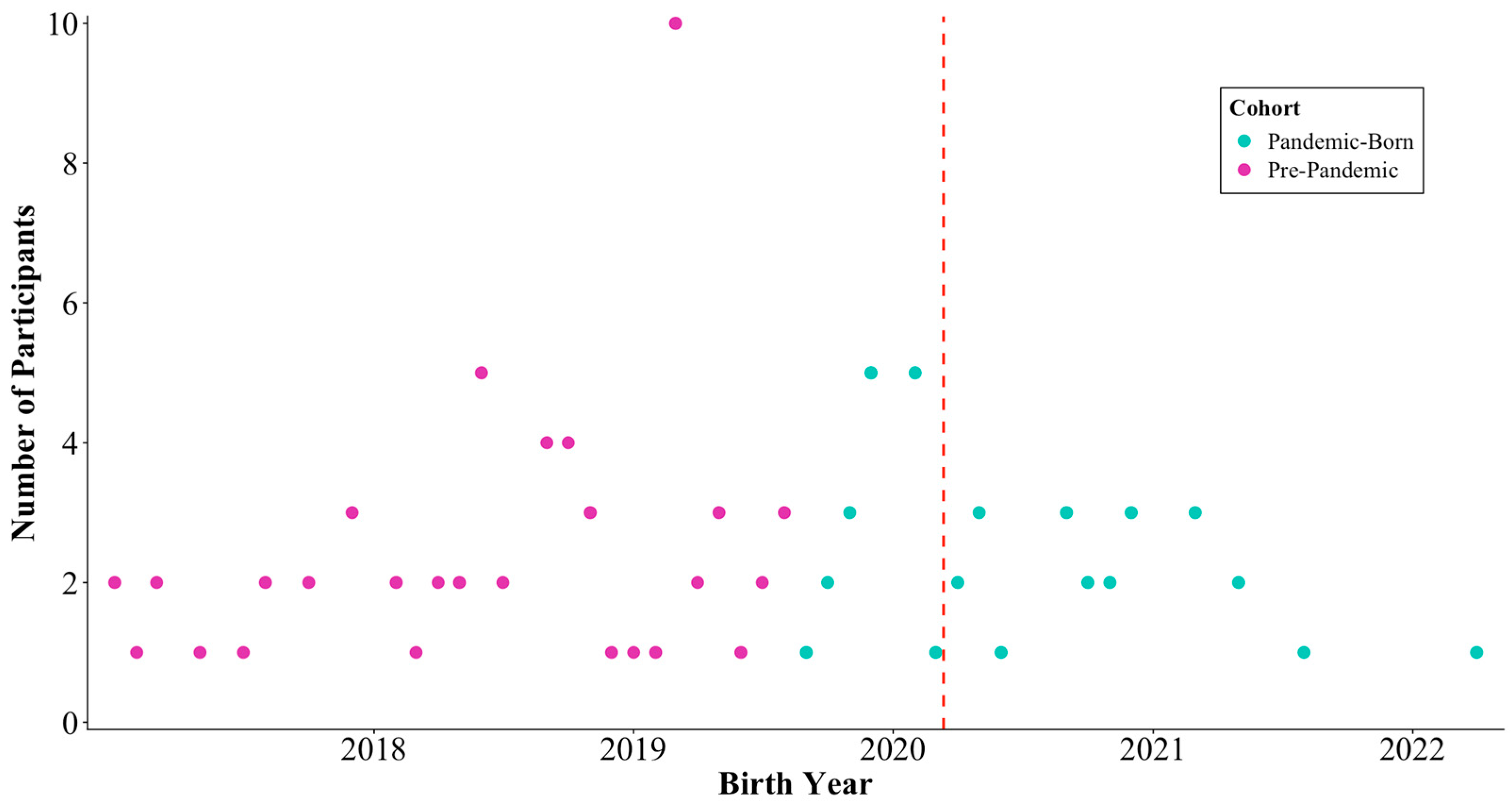
| M (SD) Age relative to pandemic start a, y | −1.59 (0.72) | 0.31 (0.60) |
| Median (IQR) | −1.45 [−2.03, −0.98] | 0.18 [−0.23, 0.71] |
| M (SD) Age relative to pandemic start a, d | −580.95 (262.23) | 114.90 (218.03) |
| Median (IQR) | −530 [−742, −359] | 67 [−85, 260] |
| Sex, n (%) | ||
| Male | 30 (47.6) | 20 (50.0) |
| Female | 33 (52.4) | 20 (50.0) |
| Race, n (%) | ||
| Caucasian, White, or European American | 42 (68.9) | 30 (76.9) |
| African American or Black | 4 (6.6) | 0 |
| Asian | 7 (11.5) | 2 (5.1) |
| Hispanic or Latino | 3 (4.9) | 1 (2.6) |
| Biracial or Multiracial | 4 (6.6) | 5 (12.8) |
| Other | 1 (1.6) | 1 (2.6) |
| Caregiver Education, n (%) | ||
| No Formal Education | 1 (1.8) | 1 (2.7) |
| High School | 7 (12.5) | 4 (10.8) |
| Trade/Technical School | 4 (7.1) | 3 (8.1) |
| 1 year college certificate | 1 (1.8) | 0 |
| 2-year college associate’s degree | 10 (17.9) | 6 (16.2) |
| 4-year bachelor’s degree | 25 (44.6) | 13 (35.1) |
| Post-Graduate Degree | 8 (14.3) | 10 (27.0) |
| Household Composition, n (%) | ||
| Nuclear Family | 53 (92.9) | 33 (89.2) |
| With Siblings | 45 (78.9) | 27 (73.0) |
| Without Siblings | 8 (14.0) | 6 (16.2) |
| Single Parent | 2 (3.5) | 2 (5.4) |
| With Siblings | 0 (0) | 1 (2.7) |
| Without Siblings | 2 (3.5) | 1 (2.7) |
| Non-Parental Care | 2 (3.5) | 2 (5.4) |
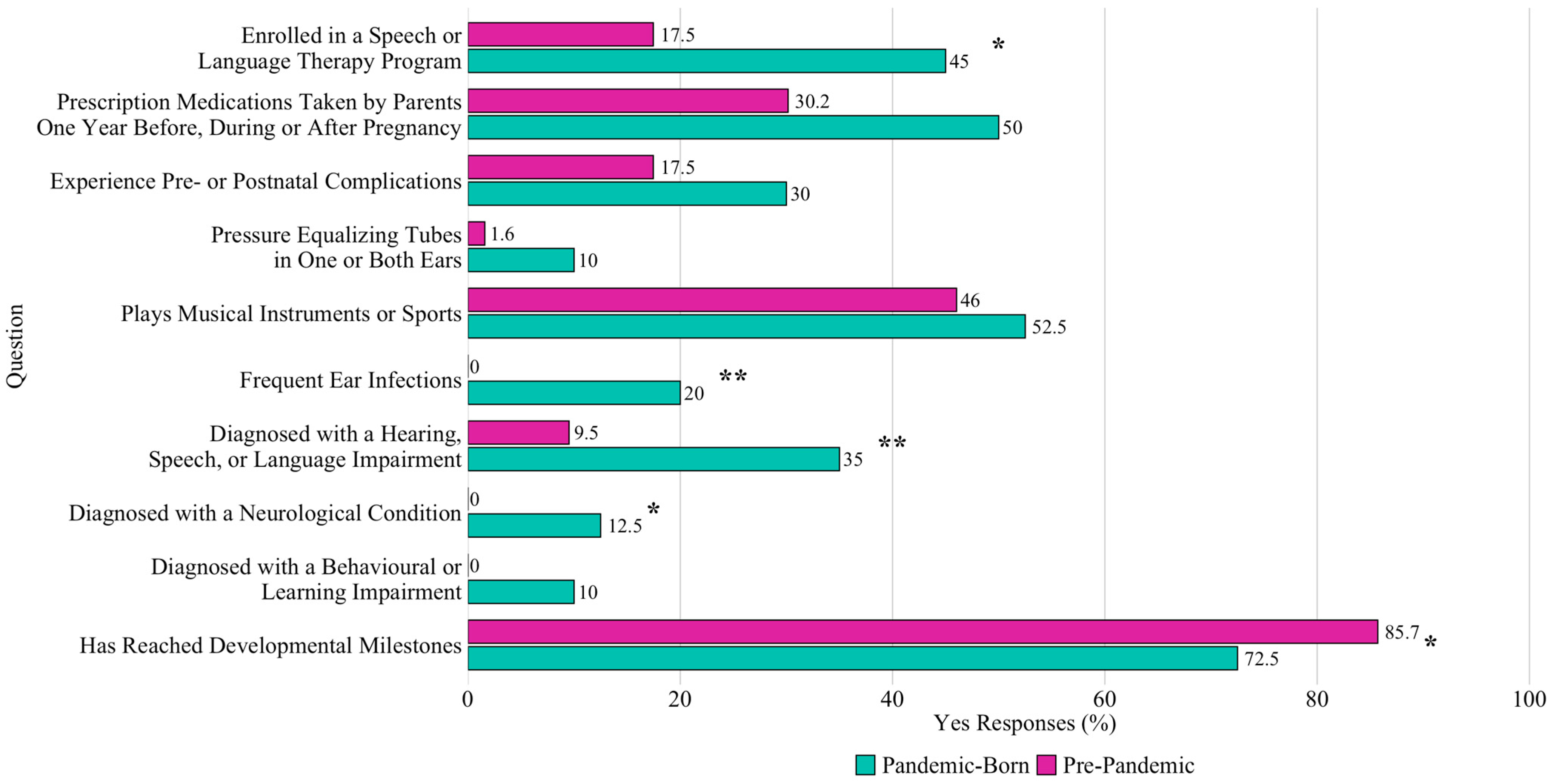
| Question | X2 | df | p |
|---|---|---|---|
| 7.07 | 1 | 0.008 |
| 2.76 | 1 | 0.097 |
| 1.26 | 1 | 0.261 |
| 1.86 | 1 | 0.173 |
| 0.03 | 1 | 0.87 |
| 10.13 | 1 | 0.001 |
| 7.91 | 1 | 0.005 |
| 5.28 | 1 | 0.022 |
| 3.76 | 1 | 0.052 |
| 5.44 | 1 | 0.020 |
| Pre-Pandemic n = 54 | Pandemic-Born n = 38 | |
|---|---|---|
| PAPF Total Scores | M (SD) | M (SD) |
| Parental Resilience | 30.5 (4.2) | 31.1 (4.5) |
| Average Score | 3.4 (0.47) | 3.5 (0.50) |
| Social Connections | 29.0 (5.2) | 29.9 (6.4) |
| Average Score | 3.2 (0.58) | 3.3 (0.71) |
| Concrete Support in Times of Need | 28.8 (5.2) | 28.5 (5.6) |
| Average Score | 3.2 (0.58) | 3.2 (0.62) |
| Social and Emotional Competence of Children | 27.9 (3.8) | 29.7 (4.5) |
| Average Score | 3.1 (0.42) | 3.3 (0.50) |
| Protective Factors Index Total | 116.1 (13.6) | 119.2 (15.7) |
| Average Score | 3.2 (0.38) | 3.3 (0.44) |
| Protective Factors Index Strength Level, n (%) | ||
| Low | 1 (1.9) | 0 |
| Moderate | 12 (22.2) | 9 (23.7) |
| High | 40 (74.1) | 28 (73.7) |
| Maximum | 1 (1.9) | 1 (2.6) |
| BRIEF-P Score | Total Mdn (IQR) | Pre-Pandemic Mdn (IQR) | Pandemic-Born Mdn (IQR) | U | p |
|---|---|---|---|---|---|
| Scale/Index | |||||
| Inhibit | 48 (42–57) | 48 (41–54) | 50 (43–58.75) | 1257.5 | 0.097 |
| Shift | 49 (42–55) | 47 (40.5–52.5) | 54 (43.5–61.25) | 1399 | 0.005 |
| Emotional Control (EC) | 49 (41–56) | 48 (41–55) | 52 (41–56) | 1186 | 0.271 |
| Working Memory (WM) | 48 (44–58) | 48 (42–56) | 50 (46–61.5) | 1257.5 | 0.097 |
| Plan/Organize (PO) | 49 (41–54) | 48 (41–52.5) | 51 (44.5–60) | 1290.5 | 0.055 |
| ISCI (Inhibit + EC) | 49 (42–55) | 48 (41.5–52) | 54 (42–57.75) | 1263.5 | 0.088 |
| FI (Shift + EC) | 47 (41–57) | 47 (39.5–55.5) | 50.5 (44–59.25) | 1298 | 0.048 |
| EMI (WM + PO) | 49 (42–58) | 48 (41–52.5) | 50.5 (43.75–62) | 1293 | 0.053 |
| GEC (Inhibit + Shift + EC + WM + PO) | 48 (42–56) | 46 (41–54) | 50 (43.5–60) | 1328 | 0.027 |
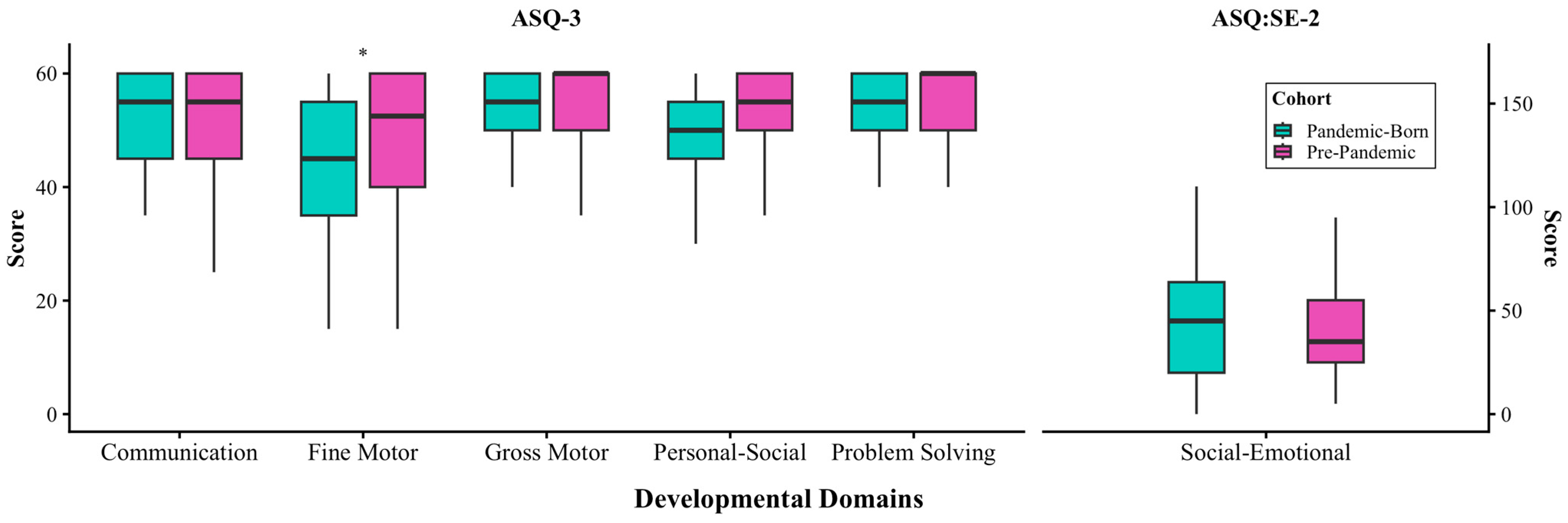
| Developmental Domains | Total Mdn (IQR) | Pre-Pandemic Mdn (IQR) | Pandemic-Born Mdn (IQR) | U | p |
|---|---|---|---|---|---|
| ASQ-3 | |||||
| Communication | 55 (45–60) | 55 (45–60) | 55 (45–60) | 962 | 0.463 |
| Fine Motor | 50 (40–55) | 52.5 (40–60) | 45 (35–55) | 759.5 | 0.018 |
| Gross Motor | 57.5 (50–60) | 60 (50–60) | 55 (50–60) | 933.5 | 0.282 |
| Personal Social | 50 (45–60) | 55 (50–60) | 50 (45–55) | 852.5 | 0.095 |
| Problem Solving | 55 (50–60) | 60 (50–60) | 55 (50–60) | 999 | 0.595 |
| ASQ:SE-2 | |||||
| Social Emotional | 40 (25–57.5) | 35 (25–55) | 45 (20–65) | 1107 | 0.384 |
Disclaimer/Publisher’s Note: The statements, opinions and data contained in all publications are solely those of the individual author(s) and contributor(s) and not of MDPI and/or the editor(s). MDPI and/or the editor(s) disclaim responsibility for any injury to people or property resulting from any ideas, methods, instructions or products referred to in the content. |
© 2026 by the authors. Licensee MDPI, Basel, Switzerland. This article is an open access article distributed under the terms and conditions of the Creative Commons Attribution (CC BY) license.
Share and Cite
Sade, S.; Gonzalez, C.L.R.; Gibb, R.L. Pandemic Babies: Developmental Outcomes in Preschool-Aged Children Born During the COVID-19 Era. Behav. Sci. 2026, 16, 309. https://doi.org/10.3390/bs16020309
Sade S, Gonzalez CLR, Gibb RL. Pandemic Babies: Developmental Outcomes in Preschool-Aged Children Born During the COVID-19 Era. Behavioral Sciences. 2026; 16(2):309. https://doi.org/10.3390/bs16020309
Chicago/Turabian StyleSade, Sally, Claudia L. R. Gonzalez, and Robbin L. Gibb. 2026. "Pandemic Babies: Developmental Outcomes in Preschool-Aged Children Born During the COVID-19 Era" Behavioral Sciences 16, no. 2: 309. https://doi.org/10.3390/bs16020309
APA StyleSade, S., Gonzalez, C. L. R., & Gibb, R. L. (2026). Pandemic Babies: Developmental Outcomes in Preschool-Aged Children Born During the COVID-19 Era. Behavioral Sciences, 16(2), 309. https://doi.org/10.3390/bs16020309