Cognate Effects on Bilingual Lexical–Semantic Processing in Children: Insights from ERPs

 , , and
Abstract
1. Introduction
1.1. The Role of Age and Bilingual Experience
1.2. Cognate Effects in Semantic Processing
1.3. The Present Study
2. Materials and Methods
2.1. Participants
2.2. Language Background Assessment
2.2.1. Cross-Linguistic Lexical Task (CLT)
2.2.2. Quantifying Bilingual EXperience (Q-BEx)
2.3. Semantic Priming Paradigm
2.3.1. Materials
2.3.2. Procedure
2.3.3. EEG Recording and Analysis
2.3.4. Individual Differences Analysis
3. Results
3.1. Language Background
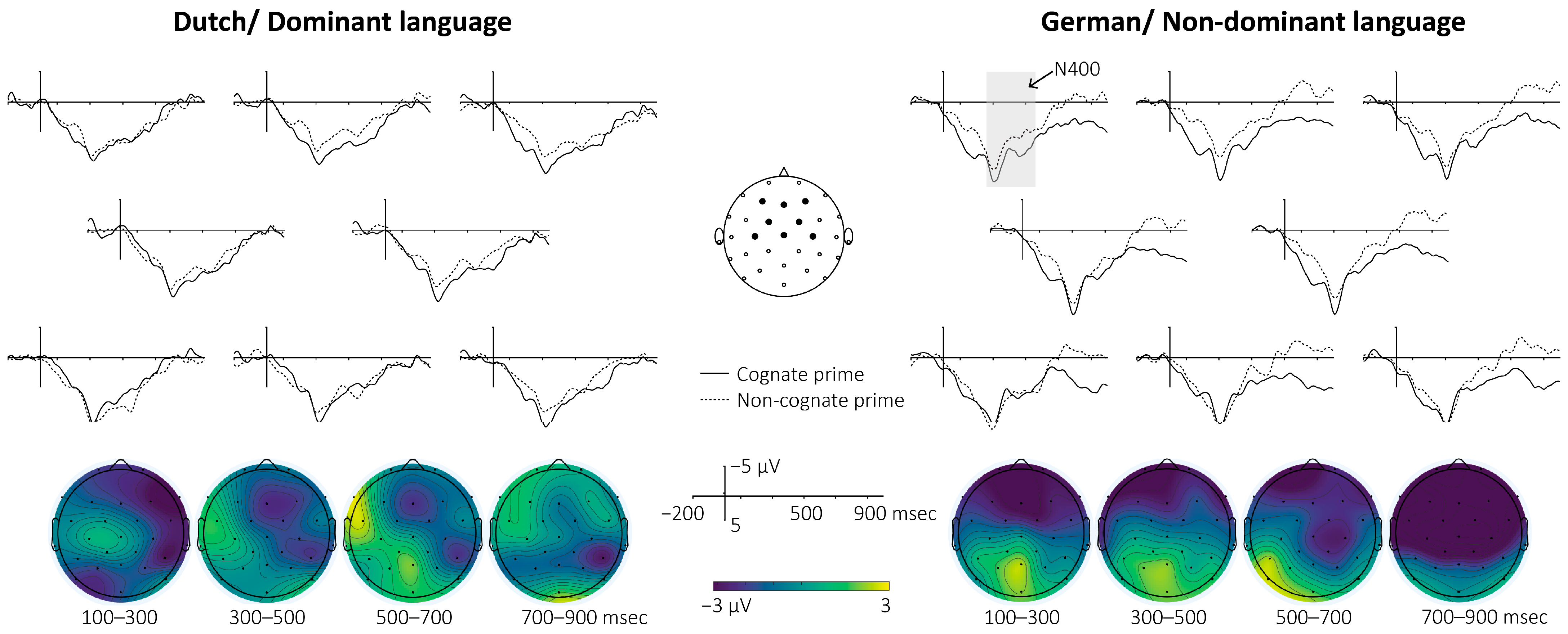
3.2. ERPs
3.3. Individual Differences
4. Discussion
Author Contributions
Funding
Institutional Review Board Statement
Informed Consent Statement
Data Availability Statement
Acknowledgments
Conflicts of Interest
Appendix A

| Dutch Prime | German Translation | Cognate Status | Prime NLD | Word Frequency | Word Length | Dutch Target | German Translation | Cognate Status | Target NLD |
| blokje | Block | C | 0.83 | 1.69 | 6 | bal | Ball | C | 0.93 |
| jas | Jacke | C | 0.7 | 48.11 | 3 | jurk | Kleid | NC | 0.57 |
| sok | Socke | C | 0.88 | 3.11 | 3 | schoen | Schuh | C | 0.73 |
| buik | Bauch | C | 0.77 | 26.09 | 3 | voet | Fuß | C | 0.87 |
| hoed | Hut | C | 1.00 | 35.95 | 3 | muts | Mütze | C | 0.76 |
| boom | Baum | C | 0.87 | 52.25 | 3 | wolk | Wolke | C | 0.86 |
| zon | Sonne | C | 0.88 | 68.67 | 3 | maan | Mond | C | 0.76 |
| balkon | Balkon | C | 0.9 | 6.63 | 6 | kelder | Keller | C | 0.92 |
| papegaai | Papagei | C | 0.77 | 3.29 | 7 | uil | Eule | C | 0.8 |
| koe | Kuh | C | 1.00 | 18.55 | 2 | varken | Schwein | NC | 0.62 |
| boot | Boot | C | 1.00 | 95.93 | 3 | trein | Zug | NC | 0.67 |
| deur | Tür | C | 0.93 | 247.48 | 3 | kamer | Zimmer | NC | 0.8 |
| fles | Flasche | C | 0.84 | 45.71 | 4 | doos | Karton | NC | 0.62 |
| krijtje | Kreide | C | 0.9 | 0.59 | 5 | potlood | Bleistift | NC | 0.66 |
| dokter | Doktor | C | 0.98 | 244.07 | 6 | verpleegster | Krankenschwester | NC | 0.71 |
| stofzuiger | Staubsauger | C | 0.82 | 2.45 | 9 | dweil | Mopp | NC | 0.54 |
| mier | Ameise | NC | 0.72 | 2.54 | 3 | spin | Spinne | C | 0.88 |
| druif | Traube | NC | 0.76 | 1.35 | 4 | meloen | Melone | C | 0.84 |
| stoep | Bürgersteig | NC | 0.59 | 7.68 | 4 | straat | Straße | C | 0.83 |
| tand | Zahn | NC | 0.78 | 8.07 | 4 | lip | Lippe | C | 0.88 |
| bord | Teller | NC | 0.66 | 27.3 | 4 | schaal | Schale | C | 0.73 |
| kikker | Frosch | NC | 0.63 | 8.23 | 5 | slang | Schlange | C | 0.84 |
| mandje | Korb | NC | 0.63 | 2.2 | 6 | emmer | Eimer | C | 0.93 |
| winkel | Geschäft | NC | 0.51 | 65.13 | 6 | bakker | Bäcker | C | 0.94 |
| gootsteen | Spülbecken | NC | 0.65 | 2.81 | 7 | keuken | Küche | C | 0.85 |
| komkommer | Gurke | NC | 0.74 | 1.33 | 8 | erwtje | Erbse | C | 0.88 |
| beschuit | Zwieback | NC | 0.51 | - | 6 | rozijntje | Rosine | C | 0.85 |
| juf | Lehrerin | NC | 0.6 | 4.71 | 3 | zus | Schwester | NC | 0.64 |
| tuin | Garten | NC | 0.71 | 36.66 | 3 | zandbak | Sandkasten | NC | 0.74 |
| broek | Hose | NC | 0.42 | 67.28 | 4 | riem | Gürtel | NC | 0.6 |
| glijbaan | Rutsche | NC | 0.58 | 0.5 | 6 | schommel | Schaukel | NC | 0.73 |
| brommer | Moped | NC | 0.78 | 1.07 | 6 | fiets | Fahrrad | NC | 0.67 |
| German Prime | Dutch Translation | Cognate Status | Prime NLD | Word Frequency | Word Length | German Target | Dutch Translation | Cognate Status | Target NLD |
| Saft | sap | C | 0.75 | 11.58 | 4 | Apfel | appel | C | 0.9 |
| Schiff | schip | C | 0.75 | 169.1 | 3 | Auto | auto | C | 0.97 |
| Messer | mes | C | 0.8 | 48.19 | 4 | Löffel | lepel | C | 0.86 |
| Fuß | voet | C | 0.87 | 62.29 | 3 | Bein | been | C | 0.87 |
| Hase | haas | C | 0.88 | 7.21 | 4 | Eichhörnchen | eekhoorntje | C | 0.73 |
| Pferd | paard | C | 0.88 | 45.91 | 4 | Reh | ree | C | 1 |
| Nilpferd | nijlpaard | C | 0.9 | 0.94 | 7 | Bär | beer | C | 0.93 |
| Ei | ei | C | 0.9 | 21.81 | 1 | Brötchen | broodje | C | 0.87 |
| Junge | jongen | C | 0.93 | 326.98 | 4 | Mädchen | meisje | C | 0.78 |
| Ohr | oor | C | 1.00 | 27.56 | 2 | Mund | mond | C | 0.93 |
| Flugzeug | vliegtuig | C | 0.83 | 78.19 | 7 | Hubschrauber | helikopter | NC | 0.71 |
| Sessel | zetel | C | 0.86 | 4.88 | 5 | Fenster | raam | NC | 0.6 |
| Buch | boek | C | 0.87 | 106.3 | 3 | Stift | potlood | NC | 0.6 |
| Stein | steen | C | 0.88 | 44.88 | 4 | Teich | vijver | NC | 0.62 |
| Schneemann | sneeuwman | C | 0.89 | 0.98 | 6 | Garten | tuin | NC | 0.71 |
| Strand | strand | C | 0.95 | 39.02 | 6 | Wald | bos | NC | 0.6 |
| Doktor | dokter | C | 0.98 | 100.28 | 6 | Feuerwehrmann | brandweerman | NC | 0.77 |
| Schal | sjaal | C | 1.00 | 3.78 | 3 | Lätzchen | slabbetje | NC | 0.69 |
| Zwieback | beschuit | NC | 0.51 | - | 6 | Pfannkuchen | pannekoek | C | 0.71 |
| Onkel | oom | NC | 0.53 | 136.78 | 5 | Bruder | broer | C | 0.83 |
| Mantel | jas | NC | 0.55 | 22.21 | 6 | Schuh | schoen | C | 0.73 |
| Nachtisch | toetje | NC | 0.59 | 7.21 | 6 | Müsli | muesli | C | 1.00 |
| Kino | bioscoop | NC | 0.64 | 34.1 | 4 | Supermarkt | supermarkt | C | 0.96 |
| Tisch | tafel | NC | 0.68 | 96.62 | 3 | Stuhl | stoel | C | 0.98 |
| Tablett | dienblad | NC | 0.79 | 3.03 | 6 | Deckel | deksel | C | 0.92 |
| Keks | koekje | NC | 0.79 | 6.38 | 4 | Brot | brood | C | 1.00 |
| Zimmer | kamer | NC | 0.8 | 204.34 | 4 | Bett | bed | C | 1 |
| Schlafanzug | pyjama | NC | 0.58 | 2.36 | 9 | Kleid | jurk | NC | 0.57 |
| Huhn | kip | NC | 0.62 | 23.31 | 3 | Schwein | varken | NC | 0.62 |
| Teller | bord | NC | 0.66 | 13.23 | 4 | Topf | pan | NC | 0.69 |
| 1 | Yeh et al. (2025) utilied a semantic priming paradigm to investigate bilingual lexical-semantic processing. The experimental design included both within-language (e.g., Dutch prime followed by Dutch target) and across-language (e.g., Dutch prime followed by German target) word pairs. The full factorial design crossed four independent variables: language context (within- or across-language), prime language (Dutch or German), word category (noun or verb), and semantic relatedness (related or unrelated). This resulted in a total of 16 experimental conditions. |
References
- Bates, D., Mächler, M., Bolker, B., & Walker, S. (2015). Fitting linear mixed-effects models using lme4. Journal of Statistical Software, 67, 1–48. [Google Scholar] [CrossRef] [Scilit]
- Bice, K., & Kroll, J. F. (2015). Native language change during early stages of second language learning. Neuroreport, 26(16), 966–971. [Google Scholar] [CrossRef] [Scilit] [PubMed]
- Bosch, L., & Ramon-Casas, M. (2014). First translation equivalents in bilingual toddlers’ expressive vocabulary: Does form similarity matter? International Journal of Behavioral Development, 38(4), 317–322. [Google Scholar] [CrossRef] [Scilit]
- Bosma, E., Blom, E., Hoekstra, E., & Versloot, A. (2019). A longitudinal study on the gradual cognate facilitation effect in bilingual children’s Frisian receptive vocabulary. International Journal of Bilingual Education and Bilingualism, 22(4), 371–385. [Google Scholar] [CrossRef] [Scilit]
- Bosma, E., & Nota, N. (2020). Cognate facilitation in Frisian–Dutch bilingual children’s sentence reading: An eye-tracking study. Journal of Experimental Child Psychology, 189, 104699. [Google Scholar] [CrossRef] [Scilit]
- Brysbaert, M., Buchmeier, M., Conrad, M., Jacobs, A. M., Bölte, J., & Böhl, A. (2011). The word frequency effect: A review of recent developments and implications for the choice of frequency estimates in German. Experimental Psychology, 58(5), 412–424. [Google Scholar] [CrossRef] [Scilit] [PubMed]
- Conboy, B. T., & Mills, D. L. (2006). Two languages, one developing brain: Event-related potentials to words in bilingual toddlers. Developmental Science, 9(1), F1–F12. [Google Scholar] [CrossRef] [Scilit]
- Costa, A., Santesteban, M., & Caño, A. (2005). On the facilitatory effects of cognate words in bilingual speech production. Brain and Language, 94(1), 94–103. [Google Scholar] [CrossRef] [Scilit]
- De Anda, S., & Friend, M. (2020). Lexical-semantic development in bilingual toddlers at 18 and 24 Months. Frontiers in Psychology, 11, 508363. [Google Scholar] [CrossRef] [Scilit]
- DeAnda, S., Poulin-Dubois, D., Zesiger, P., & Friend, M. (2016). Lexical processing and organization in bilingual first language acquisition: Guiding future research. Psychological Bulletin, 142(6), 655–667. [Google Scholar] [CrossRef] [Scilit]
- De Cat, C., Kašćelan, D., Prévost, P., Serratrice, L., Tuller, L., Unsworth, S., & The Q-BEx Consortium. (2023). How to quantify bilingual experience? Findings from a Delphi consensus survey. Bilingualism: Language and Cognition, 26(1), 112–124. [Google Scholar] [CrossRef] [Scilit]
- Delogu, F., Brouwer, H., & Crocker, M. W. (2019). Event-related potentials index lexical retrieval (N400) and integration (P600) during language comprehension. Brain and Cognition, 135, 103569. [Google Scholar] [CrossRef] [Scilit]
- Delorme, A., & Makeig, S. (2004). EEGLAB: An open source toolbox for analysis of single-trial EEG dynamics including independent component analysis. Journal of Neuroscience Methods, 134(1), 9–21. [Google Scholar] [CrossRef] [Scilit]
- Dijkstra, T., Miwa, K., Brummelhuis, B., Sappelli, M., & Baayen, H. (2010). How cross-language similarity and task demands affect cognate recognition. Journal of Memory and Language, 62(3), 284–301. [Google Scholar] [CrossRef] [Scilit]
- Dijkstra, T., & van Heuven, W. J. B. (2002). The architecture of the bilingual word recognition system: From identification to decision. Bilingualism: Language and Cognition, 5(3), 175–197. [Google Scholar] [CrossRef] [Scilit]
- Duñabeitia, J. A., Ivaz, L., & Casaponsa, A. (2016). Developmental changes associated with cross-language similarity in bilingual children. Journal of Cognitive Psychology, 28(1), 16–31. [Google Scholar] [CrossRef] [Scilit]
- Floccia, C., Delle Luche, C., Lepadatu, I., Chow, J., Ratnage, P., & Plunkett, K. (2020). Translation equivalent and cross-language semantic priming in bilingual toddlers. Journal of Memory and Language, 112, 104086. [Google Scholar] [CrossRef] [Scilit]
- Garcia-Castro, G., Avila-Varela, D. S., Castillejo, I., & Sebastian-Galles, N. (2025). Cognate beginnings to bilingual lexical acquisition. Child Development, 96(1), 286–300. [Google Scholar] [CrossRef] [Scilit] [PubMed]
- Goethe-Institut. (2004). Wortliste A1/start deutsch 1. Available online: https://www.goethe.de/pro/relaunch/prf/de/A1_SD1_Wortliste_02.pdf (accessed on 1 December 2023).
- Gollan, T. H., Montoya, R. I., Cera, C., & Sandoval, T. C. (2008). More use almost always a means a smaller frequency effect: Aging, bilingualism, and the weaker links hypothesis. Journal of Memory and Language, 58(3), 787–814. [Google Scholar] [CrossRef] [Scilit] [PubMed]
- Goriot, C., van Hout, R., Broersma, M., Lobo, V., McQueen, J. M., & Unsworth, S. (2021). Using the Peabody picture vocabulary test in L2 children and adolescents: Effects of L1. International Journal of Bilingual Education and Bilingualism, 24(4), 546–568. [Google Scholar] [CrossRef] [Scilit]
- Grainger, J., Midgley, K., & Holcomb, P. J. (2010). Re-thinking the bilingual interactive-activation model from a developmental perspective (BIA-d). In M. Kail, & M. Hickmann (Eds.), Language acquisition across linguistic and cognitive systems (Chapter 14, pp. 267–283). John Benjamins Publishing Company. Available online: https://www.degruyterbrill.com/document/doi/10.1075/lald.52.18gra/pdf?licenseType=restricted&srsltid=AfmBOor_gVjZIKuz6tFCSRAMNw-LmiXbibzik86l8G8WP3bVHdaeyUgR (accessed on 1 July 2025).
- Haman, E., Łuniewska, M., & Pomiechowska, B. (2015). Designing cross-linguistic lexical tasks (CLTs) for bilingual preschool children. Available online: http://www.scopus.com/inward/record.url?eid=2-s2.0-84949447470&partnerID=MN8TOARS (accessed on 10 August 2023).
- Hervé, E., Mento, G., Desnous, B., & François, C. (2022). Challenges and new perspectives of developmental cognitive EEG studies. NeuroImage, 260, 119508. [Google Scholar] [CrossRef] [Scilit]
- Hoff, E., Core, C., Place, S., Rumich, R., Señor, M., & Parra, M. (2012). Dual language exposure and early bilingual development. Journal of Child Language, 39(1), 1–27. [Google Scholar] [CrossRef] [Scilit] [PubMed]
- Hoff, E., & Ribot, K. M. (2017). Language growth in English monolingual and Spanish-English bilingual children from 2.5 to 5 Years. The Journal of Pediatrics, 190, 241–245.e1. [Google Scholar] [CrossRef] [Scilit]
- Hutchison, K. A., Balota, D. A., Cortese, M. J., & Watson, J. M. (2008). Predicting semantic priming at the item level. Quarterly Journal of Experimental Psychology, 61(7), 1036–1066. [Google Scholar] [CrossRef] [Scilit]
- Iniesta, A., Rivera, M., Paolieri, D., & Bajo, T. (2024). Development of L1-L2 naming skills in a monolingual context: Evidence from children and adolescents. Cognitive Development, 72, 101492. [Google Scholar] [CrossRef] [Scilit]
- Ito, A., Bautista, A., & Martin, C. (2025). Cognate facilitation effect on verb-based semantic prediction in L2 is modulated by L2 proficiency. Bilingualism: Language and Cognition, 28(3), 684–696. [Google Scholar] [CrossRef] [Scilit]
- Jardak, A., & Byers-Heinlein, K. (2019). Labels or Concepts? The development of semantic networks in bilingual two-year-olds. Child Development, 90(2), e212–e229. [Google Scholar] [CrossRef] [Scilit]
- Keuleers, E., Brysbaert, M., & New, B. (2010). SUBTLEX-NL: A new measure for Dutch word frequency based on film subtitles. Behavior Research Methods, 42(3), 643–650. [Google Scholar] [CrossRef] [Scilit]
- Koutamanis, E., Kootstra, G. J., Dijkstra, T., & Unsworth, S. (2024a). Cognate facilitation in single- and dual-language contexts in bilingual children’s word processing. Linguistic Approaches to Bilingualism, 14(4), 577–608. [Google Scholar] [CrossRef] [Scilit]
- Koutamanis, E., Kootstra, G. J., Dijkstra, T., & Unsworth, S. (2024b). Shared representations in cognate comprehension and production: An online picture naming and lexical decision study with bilingual children. Applied Psycholinguistics, 45(3), 489–515. [Google Scholar] [CrossRef] [Scilit]
- Kutas, M., & Federmeier, K. D. (2011). Thirty years and counting: Finding meaning in the N400 component of the event-related brain potential (ERP). Annual Review of Psychology, 62(1), 621–647. [Google Scholar] [CrossRef] [Scilit]
- Lenth, R. V., Piaskowski, J., Banfai, B., Bolker, B., Buerkner, P., Giné-Vázquez, I., Hervé, M., Jung, M., Love, J., Miguez, F., Riebl, H., & Singmann, H. (2025). Emmeans: Estimated marginal means, aka least-squares means (Version 2.0.1) [Computer software]. Available online: https://cran.r-project.org/web/packages/emmeans/index.html (accessed on 1 February 2026).
- Lindgren, J., & Bohnacker, U. (2020). Vocabulary development in closely-related languages: Age, word type and cognate facilitation effects in bilingual Swedish-German preschool children. Linguistic Approaches to Bilingualism, 10(5), 587–622. [Google Scholar] [CrossRef] [Scilit]
- Lopez-Calderon, J., & Luck, S. J. (2014). ERPLAB: An open-source toolbox for the analysis of event-related potentials. Frontiers in Human Neuroscience, 8, 213. [Google Scholar] [CrossRef] [Scilit] [PubMed]
- Maris, E., & Oostenveld, R. (2007). Nonparametric statistical testing of EEG- and MEG-data. Journal of Neuroscience Methods, 164(1), 177–190. [Google Scholar] [CrossRef] [Scilit] [PubMed]
- Mitchell, L., Tsui, R. K.-Y., & Byers-Heinlein, K. (2024). Cognates are advantaged over non-cognates in early bilingual expressive vocabulary development. Journal of Child Language, 51(3), 596–615. [Google Scholar] [CrossRef] [Scilit]
- Oostenveld, R., Fries, P., Maris, E., & Schoffelen, J.-M. (2011). FieldTrip: Open source software for advanced analysis of MEG, EEG, and invasive electrophysiological data. Computational Intelligence and Neuroscience, 2011, 156869. [Google Scholar] [CrossRef] [Scilit] [PubMed]
- Poarch, G. J., & van Hell, J. G. (2012). Cross-language activation in children’s speech production: Evidence from second language learners, bilinguals, and trilinguals. Journal of Experimental Child Psychology, 111(3), 419–438. [Google Scholar] [CrossRef] [Scilit]
- Rämä, P., Chiball, C., & Rukoz, Y. (2024). Lexical-semantic activation in French-Spanish or French-English bilingual toddlers: An event-related potential (ERP) investigation. Journal of Neurolinguistics, 72, 101214. [Google Scholar] [CrossRef] [Scilit]
- Rämä, P., Sirri, L., & Goyet, L. (2018). Event-related potentials associated with cognitive mechanisms underlying lexical-semantic processing in monolingual and bilingual 18-month-old children. Journal of Neurolinguistics, 47, 123–130. [Google Scholar] [CrossRef] [Scilit]
- Rinker, T., & Gagarina, N. (2017). Cross-linguistic lexical task—German. Available online: http://clts.strony.psych.uw.edu.pl/ (accessed on 29 January 2024).
- Robert, J. (2018). Pydub: Manipulate audio with a simple and easy high level interface (Version 0.25.1) [Computer software]. GitHub. Available online: https://github.com/jiaaro/pydub (accessed on 29 January 2024).
- Sassenhagen, J., & Draschkow, D. (2019). Cluster-based permutation tests of MEG/EEG data do not establish significance of effect latency or location. Psychophysiology, 56(6), e13335. [Google Scholar] [CrossRef] [Scilit]
- Schepens, J., Dijkstra, T., Grootjen, F., & van Heuven, W. J. B. (2013). Cross-language distributions of high frequency and phonetically similar cognates. PLoS ONE, 8(5), e63006. [Google Scholar] [CrossRef] [Scilit]
- Schröter, P., & Schroeder, S. (2016). Orthographic processing in balanced bilingual children: Cross-language evidence from cognates and false friends. Journal of Experimental Child Psychology, 141, 239–246. [Google Scholar] [CrossRef] [Scilit]
- Singh, L. (2014). One world, two languages: Cross-language semantic priming in bilingual toddlers. Child Development, 85(2), 755–766. [Google Scholar] [CrossRef] [Scilit] [PubMed]
- Sirri, L., & Rämä, P. (2019). Similar and distinct neural mechanisms underlying semantic priming in the languages of the French–Spanish bilingual children. Bilingualism: Language and Cognition, 22(1), 93–102. [Google Scholar] [CrossRef] [Scilit]
- Szagun, G., Stumper, B., & Schramm, S. A. (2023). Fragebogen zur frühkindlichen Sprachentwicklung: FRAKIS (Langform) und FRAKIS-K (Kurzform) (pp. 3506 KB, 1803 KB). Universität Potsdam. [Google Scholar] [CrossRef]
- Tokowicz, N., Kroll, J. F., de Groot, A. M. B., & van Hell, J. G. (2002). Number-of-translation norms for Dutch—English translation pairs: A new tool for examining language production. Behavior Research Methods, Instruments, & Computers, 34(3), 435–451. [Google Scholar] [CrossRef] [Scilit]
- Van Wonderen, E., & Unsworth, S. (2021). Testing the validity of the cross-linguistic lexical task as a measure of language proficiency in bilingual children. Journal of Child Language, 48(6), 1101–1125. [Google Scholar] [CrossRef] [Scilit]
- Wicinski, K., Yeh, C., Rowland, C., & Soares, S. (2025). Cognate effects on bilingual lexical-semantic processing in preschoolers: Insights from ERP & EEG. Available online: https://osf.io/52bg8 (accessed on 28 May 2025).
- Yeh, C., Rowland, C., & Soares, S. (2025). Within- and across-language semantic processing and individual differences in bilingual children: An EEG/ERP study. Available online: https://osf.io/j5epb (accessed on 10 February 2025).
- Zink, I., & Lejaegere, M. (2003). N-CDIs: Korte vormen, aanpassing en hernormering van de MacArthur short form vocabulary checklists van Fenson et al. [N-CDIs: Short forms, adaptation and norms of the Dutch version of the MacArthur short form vocabulary Checklists of Fenson et al.]. Acco. [Google Scholar]

| Condition | NLD (Phonetic) | Word Length (Phonemes) | Word Frequency (SUBTLEX) | Semantic Relatedness |
|---|---|---|---|---|
| German cognate prime (N = 19) | ||||
| Mean (SD) | 0.89 (0.07) | 4.11 (1.70) | 60.13 (77.96) | 4.70 (0.96) |
| Range | 0.75–1.00 | 1–7 | 0.94–326.98 | 2.60–5.82 |
| German non-cognate prime (N = 12) | ||||
| Mean (SD) | 0.65 (0.10) | 5.00 (1.71) | 49.96 (66.95) | 4.46 (0.80) |
| Range | 0.51–0.8 | 3–9 | 2.36–204.34 | 2.18–5.70 |
| Dutch cognate prime (N = 16) | ||||
| Mean (SD) | 0.88 (0.09) | 4.31 (1.96) | 56.29 (78.98) | 4.97 (0.91) |
| Range | 0.70–1.00 | 2–9 | 1.69–247.48 | 2.70–6.00 |
| Dutch non-cognate prime (N = 16) | ||||
| Mean (SD) | 0.64 (0.11) | 4.94 (1.53) | 15.79 (22.92) | 5.06 (0.67) |
| Range | 0.42–0.78 | 3–8 | 0.5–67.28 | 3.30–5.91 |
| Mean | SD | Range | |
|---|---|---|---|
| Cumulative language exposure (N = 27) | |||
| Dutch | 66.37% | 16.69% | 16–88% |
| German | 33.56% | 16.68% | 12–84% |
| Dutch CLT score (N = 28) | |||
| Nouns | 90.63% | 20.31% | 34.38–100% |
| Verbs | 82.48% | 20.84% | 31.25–100% |
| German CLT score (N = 28) | |||
| Nouns | 90.51% | 18.48% | 46.88–100% |
| Verbs | 66.85% | 27.24% | 9.38–93.75% |
| Variable | 1 | 2 | 3 | 4 | 5 | 6 | 7 | 8 | 9 | 10 | 11 | 12 | 13 | 14 | 15 |
|---|---|---|---|---|---|---|---|---|---|---|---|---|---|---|---|
| 1. Age | 1.00 | -- | -- | -- | -- | -- | -- | -- | -- | -- | -- | -- | -- | -- | -- |
| 2. Cumulated exposure of Dutch | −0.03 | 1.00 | -- | -- | -- | -- | -- | -- | -- | -- | -- | -- | -- | -- | -- |
| 3. Cumulated exposure of German | 0.03 | −1.00 *** | 1.00 | -- | -- | -- | -- | -- | -- | -- | -- | -- | -- | -- | -- |
| 4. Cumulated use of Dutch | −0.19 | 0.84 *** | −0.84 *** | 1.00 | -- | -- | -- | -- | -- | -- | -- | -- | -- | -- | -- |
| 5. Cumulated use of German | 0.20 | −0.83 *** | 0.84 *** | −1.00 *** | 1.00 | -- | -- | -- | -- | -- | -- | -- | -- | -- | -- |
| 6. Dutch noun accuracy | 0.59 ** | −0.24 | 0.24 | −0.15 | 0.15 | 1.00 | -- | -- | -- | -- | -- | -- | -- | -- | -- |
| 7. Dutch verb accuracy | 0.75 *** | 0.12 | −0.12 | 0.11 | −0.10 | 0.81 *** | 1.00 | -- | -- | -- | -- | -- | -- | -- | -- |
| 8. German noun accuracy | 0.64 *** | −0.24 | 0.25 | −0.31 | 0.32 | 0.60 ** | 0.61 ** | 1.00 | -- | -- | -- | -- | -- | -- | -- |
| 9. German verb accuracy | 0.83 *** | −0.14 | 0.14 | −0.20 | 0.21 | 0.76 *** | 0.87 *** | 0.78 *** | 1.00 | -- | -- | -- | -- | -- | -- |
| 10. Dutch accuracy | 0.71 *** | −0.04 | 0.04 | −0.01 | 0.01 | 0.94 *** | 0.96 *** | 0.64 *** | 0.86 *** | 1.00 | -- | -- | -- | -- | -- |
| 11. German accuracy | 0.81 *** | −0.18 | 0.18 | −0.25 | 0.26 | 0.75 *** | 0.83 *** | 0.89 *** | 0.98 *** | 0.83 *** | 1.00 | -- | -- | -- | -- |
| 12. All accuracy | 0.80 *** | −0.12 | 0.12 | −0.14 | 0.14 | 0.88 *** | 0.93 *** | 0.80 *** | 0.96 *** | 0.96 *** | 0.96 *** | 1.00 | -- | -- | -- |
| 13. Relative accuracy | −0.22 | 0.24 | −0.25 | 0.41 * | −0.43 * | 0.28 | 0.16 | −0.49 * | −0.27 | 0.23 | −0.35 | −0.07 | 1.00 | -- | -- |
| 14. Relative noun accuracy | 0.18 | −0.09 | 0.08 | 0.08 | −0.10 | 0.72 *** | 0.48 * | −0.12 | 0.27 | 0.62 *** | 0.15 | 0.40 * | 0.78 *** | 1.00 | -- |
| 15. Relative verb accuracy | −0.52 ** | 0.46 * | −0.46 * | 0.56 ** | −0.57 ** | −0.30 | −0.24 | −0.65 *** | −0.68 *** | −0.28 | −0.71 *** | −0.52 ** | 0.77 *** | 0.20 | 1.00 |
| Formula: N400~Cognate Status × Language × Topographic Distribution + (1 + Cognate|Subject) | |||
|---|---|---|---|
| Predictors | Estimates | CI | p |
| (Intercept) | 7.85 | 6.56–9.14 | <0.001 |
| Cognate status | −1.86 | −3.70–−0.02 | 0.048 |
| Language | −0.34 | −1.20–0.52 | 0.442 |
| Topographic distribution | −5.55 | −6.39–−4.72 | <0.001 |
| Cognate status × Language | 1.23 | 0.01–2.45 | 0.048 |
| Cognate status × Topographic distribution | 2.05 | 0.87–3.23 | 0.001 |
| Language × Topographic distribution | 1.71 | 0.53–2.89 | 0.004 |
| Cognate status × Language × Topographic distribution | −1.65 | −3.31–0.02 | 0.053 |
| Random effects | |||
| σ2 | 39.20 | ||
| τ00 Subject | 9.77 | ||
| τ11 Subject.Cognate | 20.00 | ||
| ρ01 Subject | −0.60 | ||
| ICC | 0.23 | ||
| N Subject | 29 | ||
| Observations | 3480 | ||
| Marginal R2/Conditional R2 | 0.083/0.290 | ||
| N400 Mean Amplitude (µV) | ||
|---|---|---|
| Predictors | Model 1 Estimate (CI) | Model 2 Estimate (CI) |
| (Intercept) | 18.04 *** (11.58–24.51) | 10.81 *** (5.84–15.78) |
| Cognate status | −17.79 *** (−21.77–−13.81) | −4.82 ** (−8.03–−1.61) |
| German CLT accuracy | −18.62 *** (−26.49–−10.74) | - |
| Age | - | −1.75 ** (−2.82–−0.69) |
| Cumulated exposure of German | 7.23 * (0.67–13.79) | 4.87 (−1.41–11.14) |
| Cognate status × German CLT accuracy | 23.06 *** (18.22–27.91) | - |
| Cognate status × Cumulated exposure of German | −6.30 ** (−10.33–−2.26) | −3.17 (−7.23–0.88) |
| Cognate × Age | - | 1.20 ** (0.51–1.89) |
| Random effects | ||
| σ2 | 48.89 | 51.15 |
| τ00 Subject | 6.98 | 6.45 |
| ICC | 0.12 | 0.11 |
| N Subject | 26 | 27 |
| Observations | 1560 | 1620 |
| Marginal R2/Conditional R2 | 0.074/0.190 | 0.038/0.146 |
| AIC | 10,569.7 | 11,045.5 |
| BIC | 10,612.5 | 11,088.7 |
Disclaimer/Publisher’s Note: The statements, opinions and data contained in all publications are solely those of the individual author(s) and contributor(s) and not of MDPI and/or the editor(s). MDPI and/or the editor(s) disclaim responsibility for any injury to people or property resulting from any ideas, methods, instructions or products referred to in the content. |
© 2026 by the authors. Licensee MDPI, Basel, Switzerland. This article is an open access article distributed under the terms and conditions of the Creative Commons Attribution (CC BY) license.
Share and Cite
Yeh, C.; Wicinski, K.; Rowland, C.F.; Pereira Soares, S.M. Cognate Effects on Bilingual Lexical–Semantic Processing in Children: Insights from ERPs. Behav. Sci. 2026, 16, 294. https://doi.org/10.3390/bs16020294
Yeh C, Wicinski K, Rowland CF, Pereira Soares SM. Cognate Effects on Bilingual Lexical–Semantic Processing in Children: Insights from ERPs. Behavioral Sciences. 2026; 16(2):294. https://doi.org/10.3390/bs16020294
Chicago/Turabian StyleYeh, Chih, Kathrin Wicinski, Caroline F. Rowland, and Sergio Miguel Pereira Soares. 2026. "Cognate Effects on Bilingual Lexical–Semantic Processing in Children: Insights from ERPs" Behavioral Sciences 16, no. 2: 294. https://doi.org/10.3390/bs16020294
APA StyleYeh, C., Wicinski, K., Rowland, C. F., & Pereira Soares, S. M. (2026). Cognate Effects on Bilingual Lexical–Semantic Processing in Children: Insights from ERPs. Behavioral Sciences, 16(2), 294. https://doi.org/10.3390/bs16020294