
When Words Shift: Age and Language of Elicitation Influence Syntagmatic-Paradigmatic Shifts in Bilingual Children

Abstract
1. Introduction
1.1. The Syntagmatic-Paradigmatic Shift in Monolingual and Bilingual Speakers
1.2. Schooling, Literacy, and Lexical Organization
2. Study 1: Lexical Association Accuracy Across Languages and Grades
2.1. Method
2.1.1. Participants
2.1.2. Measures
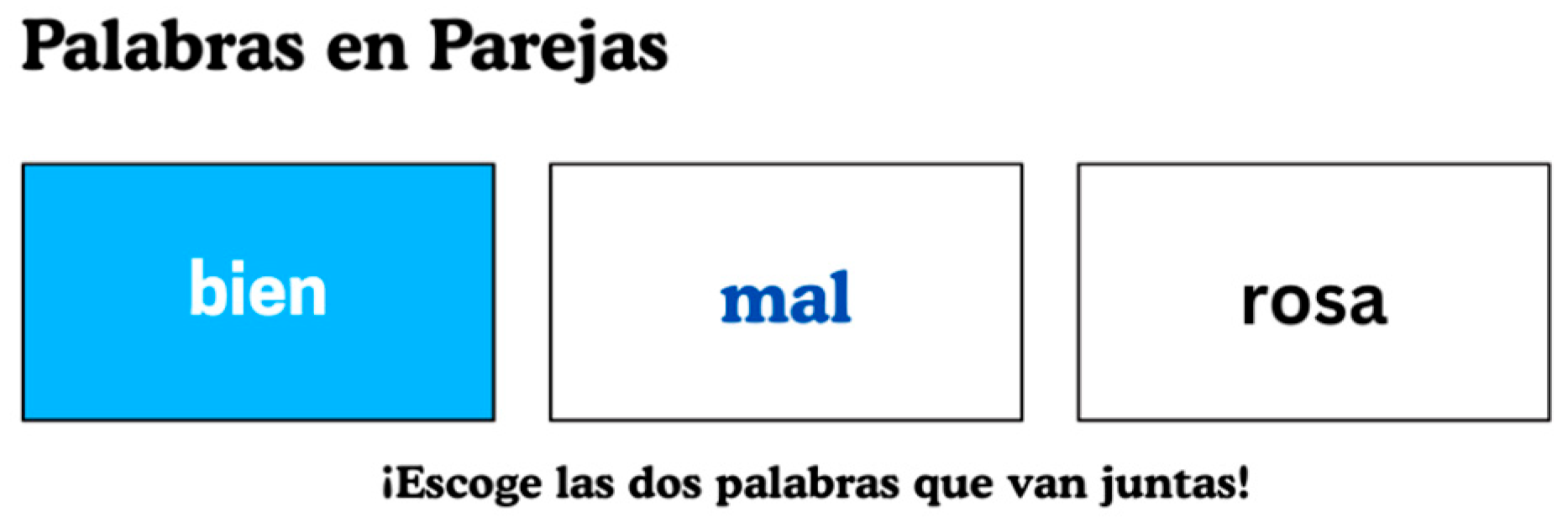
Palabras en Parejas (PEP)
Word Match Game (WMG)
2.1.3. Procedures
2.1.4. Coding
2.1.5. Inter-Rater Reliability
2.2. Results
2.2.1. Association Accuracy by Language and Grade Level
2.2.2. Influence of Grade, Language, and Association Type on Accuracy
Spanish Accuracy (PEP)
English Accuracy (WMG)
Combined Language Accuracy
2.3. Interim Discussion
3. Study 2: Lexical Selection Through Cognitive Interviewing
3.1. Method
3.1.1. Participants
3.1.2. Measures
3.1.3. Procedures
3.1.4. Coding and Analysis
3.2. Results
3.2.1. Lexical Associations
3.2.2. Bilingual Language Profiles
4. General Discussion
4.1. Developmental Patterns in Lexical Organization Across Grade Levels
4.2. Language Experience and Semantic Depth
4.3. Advancing Understanding of the Syntagmatic-Paradigmatic Shift
5. Limitations
6. Conclusions
Author Contributions
Funding
Institutional Review Board Statement
Informed Consent Statement
Data Availability Statement
Acknowledgments
Conflicts of Interest
Appendix A

| Tier (Anchor Word) | Description | Example Anchor Word | Target Word Relationship | Example Target Word |
|---|---|---|---|---|
| Tier I | Common, everyday words frequently encountered in spoken language. | Shoe | Synonym | Sneaker |
| Happy | Antonym | Sad | ||
| Dog | Thematic Relation | Leash | ||
| Tier II | Less frequent words that appear across multiple academic subjects. | Analyze | Synonym | Examine |
| Contrast | Antonym | Similar | ||
| Fair | Thematic Relation | Cotton candy | ||
| Tier III | Content-specific words found in specialized domains (e.g., science, math). | Circumference | Syntactic Relationship | Measure |
| Chrysalis | Synonym | Cocoon | ||
| Bird | Superordinate/ Subordinate | Eagle |
Appendix B
| Association Type | Participant Categorization | Words Selected | Participant Interpretation | Response Excerpt |
|---|---|---|---|---|
| Paradigmatic | Paradigmatic | rail, bleacher | size, theme, synonym | “Because there are two definitions of rail so that’s why some other people might choose beach but this definition of rail for me is the rail that you see at theme parks where you can hold on to something while you’re walking and sometimes they have those at bleachers during a football game or a baseball game and that’s my experience.” |
| Paradigmatic | Paradigmatic | aquarium, tank | size, theme | “Because an aquarium is a tank full of fish and other creatures and a tank is just the empty version of it with just water and sand at the bottom or sometimes pebbles at the bottom.” |
| Paradigmatic | Paradigmatic | bien, mal (good, bad) | antonym | “So bien vamos a decir que está feliz pero mal es como que estás triste enojado so es como lo opposite” (So let’s say he’s happy but bad is like being sad or angry so it’s like the opposite). |
| Paradigmatic | Syntagmatic | alumno, lápiz (student, pencil) | mutually dependent, semantic | “Porque los alumnos usan lápices para escribir y para dibujar” (“Because students use pencils to write and to draw”). |
| Syntagmatic | Syntagmatic | reloj, tiempo (clock, time) | Mutually dependent, theme | “Porque el reloj te dice el tiempo porque el reloj puede saber el tiempo porque está programada para hacer eso” (“Because the clock tells you the time because the clock can know the time because it is programmed to do that.” |
| Paradigmatic | Syntagmatic | discussion, silence | mutually dependent, theme | “Because in a discussion when someone is talking you have to be silent.” |
| 1 | Although the sample for the cognitive-interview phase (n = 13) is relatively small, this is consistent with qualitative interview methodology in which thematic saturation rather than statistical generalization is the goal (see Hennink & Kaiser, 2022). Typical cognitive-interview studies reach theme saturation with approximately 5–7 participants per subgroup. |
References
- Andreou, G., & Argatzopoulou, A. (2025). Neurodevelopmental disorders and foreign language learning: A systematic review of educational interventions. Review Journal of Autism and Developmental Disorders, 1–10. [Google Scholar] [CrossRef]
- Beatty, P. C., & Willis, G. B. (2007). Research synthesis: The practice of cognitive interviewing. Public Opinion Quarterly, 71(2), 287–311. [Google Scholar] [CrossRef]
- Bedore, L. M., & Peña, E. D. (2008). Assessment of bilingual children for identification of language impairment: Current findings and implications for practice. International Journal of Bilingual Education and Bilingualism, 11(1), 1–29. [Google Scholar] [CrossRef]
- Bedore, L. M., Peña, E. D., Fiestas, C., & Lugo-Neris, M. J. (2020). Language and literacy together: Supporting grammatical development in dual language learners with risk for language and learning difficulties. Language, Speech, and Hearing Services in Schools, 51(2), 282–297. [Google Scholar] [CrossRef] [PubMed]
- Bialystok, E. (2007). Acquisition of literacy in bilingual children: A framework for research. Language Learning, 57, 45–77. [Google Scholar] [CrossRef]
- Brédart, A., Marrel, A., Abetz-Webb, L., Lasch, K., & Acquadro, C. (2014). Interviewing to develop Patient-Reported Outcome (PRO) measures for clinical research: Eliciting patients’ experience. Health and Quality of Life Outcomes, 12, 15. [Google Scholar] [CrossRef]
- Brown, R., & Berko, J. (1960). Word association and the acquisition of grammar. Child Development, 31, 1–14. [Google Scholar] [CrossRef]
- California Department of Education. (2012). English language arts/English language development standards for California public schools: Kindergarten through grade twelve. Available online: https://www.cde.ca.gov/be/st/ss/documents/finalelaccssstandards.pdf (accessed on 12 March 2025).
- Clark, E. (1993). The lexicon in acquisition. Cambridge University Press. [Google Scholar]
- Connor, C. M., May, H., Sparapani, N., Hwang, J. K., Adams, A., Wood, T. S., Siegal, S., Wolfe, C., & Day, S. (2022). Bringing Assessment-to-Instruction (A2i) technology to scale: Exploring the process from development to implementation. Journal of Educational Psychology, 114(7), 1495. [Google Scholar] [CrossRef]
- Costa, A. C., Cury, L., Finger, I., Mota, N. B., & Weissheimer, J. (2023). Two languages in one mind: Biliteracy, speech connectedness and reading in 5th grade bilingual children. Ilha do Desterro, 76(3), 93–115. [Google Scholar] [CrossRef]
- Cronin, V., Pratt, M., Abraham, J., Howell, D., Bishop, S., & Manning, A. (1986). Word association and the acquisition of reading. Journal of Psycholinguistic Research, 15, 1–11. [Google Scholar] [CrossRef]
- Cronin, V. S. (2002). The syntagmatic–paradigmatic shift and reading development. Journal of Child Language, 29(1), 189–204. [Google Scholar] [CrossRef]
- Cummins, J. (1979). Linguistic interdependence and the educational development of bilingual children. Review of Educational Research, 49(2), 222–251. [Google Scholar] [CrossRef]
- Dedoose. (2025). Cloud application for managing, analyzing, and presenting qualitative and mixed method research data (Version 10.0.25). SocioCultural Research Consultants, LLC. Available online: www.dedoose.com (accessed on 20 February 2025).
- Elleman, A. M., Lindo, E. J., Morphy, P., & Compton, D. L. (2009). The impact of vocabulary instruction on passage-level comprehension of school-age children: A meta-analysis. Journal of Research on Educational Effectiveness, 2(1), 1–44. [Google Scholar] [CrossRef]
- Entwisle, D. R. (1966). Form class and children’s word associations. Journal of Verbal Learning and Verbal Behavior, 5(6), 558–565. [Google Scholar] [CrossRef]
- Ericsson, K. A., & Simon, H. A. (1980). Verbal reports as data. Psychological Review, 87(3), 215–251. [Google Scholar] [CrossRef]
- Ericsson, K. A., & Simon, H. A. (1993). Protocol analysis: Verbal reports as data (Rev. ed.). MIT Press. [Google Scholar]
- Ervin, S. M. (1961). Changes with age in the verbal determinants of word-association. The American Journal of Psychology, 74(3), 361–372. [Google Scholar] [CrossRef] [PubMed]
- Fabiano-Smith, L., & Goldstein, B. A. (2010). Phonological acquisition in bilingual Spanish-English speaking children. Journal of Speech, Language, and Hearing Research, 53(1), 160–178. [Google Scholar] [CrossRef]
- Foddy, W. (1998). An empirical evaluation of in-depth probes used to pretest survey questions. Sociological Methods & Research, 27(1), 103–133. [Google Scholar] [CrossRef]
- Francis, H. (1972). Toward an explanation of the syntagmatic-paradigmatic shift. Child Development, 43, 949–958. [Google Scholar] [CrossRef]
- García, J. R., & Cain, K. (2014). Decoding and reading comprehension: A meta-analysis to identify which reader and assessment characteristics influence the strength of the relationship in English. Review of Educational Research, 84(1), 74–111. [Google Scholar] [CrossRef]
- Ginsburg, H. (1997). Entering the child’s mind: The clinical interview in psychological research and practice. Cambridge University Press. [Google Scholar]
- Hasan, M. K., & Rahman, M. M. (2020). Analytic relations versus syntagmatic and paradigmatic relations of vocabulary depth knowledge: Their correlation and prediction to academic reading comprehension of EFL learners. Open Linguistics, 6(1), 357–371. [Google Scholar] [CrossRef]
- Hennink, M., & Kaiser, B. N. (2022). Sample sizes for saturation in qualitative research: A systematic review of empirical tests. Social Science & Medicine, 292, 114523. [Google Scholar] [CrossRef]
- Hoff, E. (2015). Language development. In Developmental science (pp. 443–488). Psychology Press. [Google Scholar]
- Hwang, H., Cabell, S. Q., & Joyner, R. E. (2023). Does cultivating content knowledge during literacy instruction support vocabulary and comprehension in the elementary school years? A systematic review. Reading Psychology, 44(2), 145–174. [Google Scholar] [CrossRef]
- Kroll, J. F., & Stewart, E. (1994). Category interference in translation and picture naming: Evidence for asymmetric connections between bilingual memory representations. Journal of Memory and Language, 33(2), 149–174. [Google Scholar] [CrossRef]
- Kroll, J. F., Van Hell, J. G., Tokowicz, N., & Green, D. W. (2010). The revised hierarchical model: A critical review and assessment. Bilingualism: Language and Cognition, 13(3), 373–381. [Google Scholar] [CrossRef] [PubMed]
- Leider, C. M., Proctor, C. P., Silverman, R. D., & Harring, J. R. (2013). Examining the role of vocabulary depth, cross-linguistic transfer, and types of reading measures on the reading comprehension of Latino bilinguals in elementary school. Reading and Writing, 26(9), 1459–1485. [Google Scholar] [CrossRef]
- Lemke, C. E., Weissheimer, J., Mota, N. B., Brentano, L. D. S., & Finger, I. (2021). The effects of early biliteracy on thought organisation and syntactic complexity in written production by 11-year-old children. Language Teaching Research Quarterly, 26, 1–17. [Google Scholar] [CrossRef]
- Liu, S., & Saad, M. R. B. M. (2025). Role of extensive reading in vocabulary development, reading comprehension, and reading speed: A systematic literature review. Eurasian Journal of Applied Linguistics, 11(1), 87–99. [Google Scholar]
- Lugo-Neris, M. J., Bedore, L. M., & Peña, E. D. (2015). Dual language intervention for bilinguals at risk for language impairment. In Seminars in speech and language (Vol. 36, pp. 133–142). Thieme Medical Publishers. [Google Scholar]
- MacGinitie, W. H., MacGinitie, R. K., Maria, K., & Dreyer, L. G. (2000). Gates-MacGinitie reading test (4th ed.). Riverside Publishing Company. [Google Scholar]
- MacLeod, A. A., Castellanos-Ryan, N., Parent, S., Jacques, S., & Séguin, J. R. (2019). Modelling vocabulary development among multilingual children prior to and following the transition to school entry. International Journal of Bilingual education and Bilingualism, 22(4), 473–492. [Google Scholar] [CrossRef]
- Mann, W., Sheng, L., & Morgan, G. (2016). Lexical-semantic organization in bilingually developing deaf children with ASL-dominant language exposure: Evidence from a repeated meaning association task. Language Learning, 66(4), 872–899. [Google Scholar] [CrossRef]
- Mattheoudakis, M. (2011). A word-association study in Greek and the concept of the syntagmatic-paradigmatic shift. Journal of Greek Linguistics, 11(2), 167–197. [Google Scholar] [CrossRef]
- McMillen, S., Anaya, J. B., Peña, E. D., Bedore, L. M., & Barquin, E. (2022). That’s hard! Item difficulty and word characteristics for bilinguals with and without developmental language disorder. International Journal of Bilingual Education and Bilingualism, 25(5), 1838–1856. [Google Scholar] [CrossRef]
- McNeill, D. (1966). A study of word association. Journal of Verbal Learning and Verbal Behavior, 5(6), 548–557. [Google Scholar] [CrossRef]
- Mirman, D., Landrigan, J. F., & Britt, A. E. (2017). Taxonomic and thematic semantic systems. Psychological Bulletin, 143(5), 499. [Google Scholar] [CrossRef]
- Nair, V., Clark, G. T., Siyambalapitiya, S., & Reuterskiöld, C. (2023). Language intervention in bilingual children with developmental language disorder: A systematic review. International Journal of Language & Communication Disorders, 58(2), 576–600. [Google Scholar]
- Namei, S. (2004). Bilingual lexical development: A Persian–Swedish word association study. International Journal of Applied Linguistics, 14(3), 363–388. [Google Scholar] [CrossRef]
- Nelson, K. (1977). The syntagmatic-paradigmatic shift revisited: A review of research and theory. Psychological Bulletin, 84(1), 93. [Google Scholar] [CrossRef]
- Nissen, H. B., & Henriksen, B. (2006). Word class influence on word association test results 1. International Journal of Applied Linguistics, 16(3), 389–408. [Google Scholar] [CrossRef]
- Ordóñez, C. L., Carlo, M. S., Snow, C. E., & McLaughlin, B. (2002). Depth and breadth of vocabulary in two languages: Which vocabulary skills transfer? Journal of Educational Psychology, 94(4), 719. [Google Scholar] [CrossRef]
- Paradis, J. (2010). The interface between bilingual development and specific language impairment. Applied Psycholinguistics, 31(2), 227–252. [Google Scholar] [CrossRef]
- Peña, E. D. (2007). Lost in translation: Methodological considerations in cross-cultural research. Child Development, 78(4), 1255–1264. [Google Scholar] [CrossRef]
- Peña, E. D., Bedore, L. M., & Rappazzo, C. (2003). Comparison of Spanish, English, and bilingual children’s performance across semantic tasks. Language, Speech & Hearing Services in the Schools, 34(1), 5–16. [Google Scholar]
- Peña, E. D., Bedore, L. M., & Zlatic-Giunta, R. (2002). Category-generation performance of bilingual children. Journal of Speech, Language, and Hearing Research, 45(5), 938–947. [Google Scholar] [CrossRef]
- Perfetti, C. (2007). Reading ability: Lexical quality to comprehension. Scientific Studies of Reading, 11(4), 357–383. [Google Scholar] [CrossRef]
- Perfetti, C., & Helder, A. (2022). Progress in reading science: Word identification, comprehension, and universal perspectives. In The science of reading: A handbook (pp. 5–35). John Wiley & Sons, Inc. [Google Scholar]
- Proctor, C. P., Silverman, R. D., Harring, J. R., & Montecillo, C. (2012). The role of vocabulary depth in predicting reading comprehension among English monolingual and Spanish-English bilingual children in elementary school. Reading and Writing, 25, 1635–1664. [Google Scholar] [CrossRef]
- Rapp, R. (2002, July 25–30). The computation of word associations: Comparing syntagmatic and paradigmatic approaches. COLING 2002: The 19th International Conference on Computational Linguistics, Bangkok, Thailand. [Google Scholar]
- Read, J. (2008). Plumbing the depths: How should the construct of vocabulary knowledge be defined? In Vocabulary in a second language: Selection, acquisition, and testing (pp. 209–227). John Benjamins Publishing Company. [Google Scholar]
- Restrepo, M. A., Morgan, G. P., & Thompson, M. S. (2013). The efficacy of a vocabulary intervention for dual-language learners with language impairment. Journal of Speech, Language, and Hearing Research, 56(2), 748–765. [Google Scholar] [CrossRef]
- Sanabria, A., & Peña, E. (2021). Developing A2i Spanish adaptive progress monitoring assessments for PK–3rd grade (Award No. R305A210136). Institute of Education Sciences. Available online: https://ies.ed.gov/use-work/awards/developing-a2i-spanish-adaptive-progress-monitoring-assessments-pk-3rd-grade (accessed on 16 November 2025).
- Schild, U., Röder, B., & Friedrich, C. K. (2011). Learning to read shapes the activation of neural lexical representations in the speech recognition pathway. Developmental Cognitive Neuroscience, 1(2), 163–174. [Google Scholar] [CrossRef]
- Sheng, L., Bedore, L. M., Peña, E. D., & Fiestas, C. E. (2013). Semantic development in Spanish-English bilingual children: Effects of age and language experience. Child Development, 84, 1034–1045. [Google Scholar] [CrossRef]
- Sheng, L., Lu, Y., & Kan, P. F. (2011). Lexical development in Mandarin–English bilingual children. Bilingualism: Language and Cognition, 14(4), 579–587. [Google Scholar] [CrossRef]
- Sheng, L., McGregor, K. K., & Marian, V. (2006). Lexical-semantic organization in bilingual children: Evidence from a repeated word association task. Journal of Speech, Language, and Hearing Research, 49, 572–587. [Google Scholar] [CrossRef] [PubMed]
- Simon-Cereijido, G., Bedore, L. M., Peña, E. D., & Iglesias, A. (2020). Insights into category sorting flexibility in bilingual children: Results of a cognitive lab study. American Journal of Speech-Language Pathology, 29(3), 1152–1161. [Google Scholar] [CrossRef] [PubMed]
- Simon-Cereijido, G., & Méndez, L. I. (2018). Using language-specific and bilingual measures to explore lexical–grammatical links in young Latino dual-language learners. Language, Speech, and Hearing Services in Schools, 49(3), 537–550. [Google Scholar] [CrossRef]
- Sonix. (2025). Sonix: Automated transcription software [Computer software]. Available online: https://sonix.ai/ (accessed on 11 January 2025).
- Söderman, T. (1993). Word associations of foreign language learners and native speakers: The phenomenon of a shift in response type and its relevance for lexical development. In H. Ringbom (Ed.), Near-native proficiency in English (pp. 91–182). Åbo Akademi. [Google Scholar]
- Tomasello, M., & Brooks, P. J. (2016). Early syntactic development: A construction grammar approach. In The development of language (pp. 161–190). Psychology Press. [Google Scholar]
- Tong, X., Yu, L., & Deacon, S. H. (2025). A meta-analysis of the relation between syntactic skills and reading comprehension: A cross-linguistic and developmental investigation. Review of Educational Research, 95(3), 385–426. [Google Scholar] [CrossRef]
- Welsh, S. N., & Hoff, E. (2021). Language exposure outside the home becomes more English-dominant from 30 to 60 months for children from Spanish-speaking homes in the United States. International Journal of Bilingualism, 25(3), 483–499. [Google Scholar] [CrossRef]
- Willis, G. B. (2005). Cognitive interviewing: A tool for improving questionnaire design. SAGE Publications. [Google Scholar]
- Wojcik, E. H., & Kandhadai, P. (2020). Paradigmatic associations and individual variability in early lexical–semantic networks: Evidence from a free association task. Developmental Psychology, 56(1), 53–69. [Google Scholar] [CrossRef]
- Wolter, B. (2001). Comparing the L1 and L2 mental lexicon. Studies in Second Language Acquisition, 23, 41–69. [Google Scholar] [CrossRef]
- Woodcock, R. W., McGrew, K. S., & Mather, N. (2001). Woodcock-Johnson III tests of achievement. Riverside Publishing. [Google Scholar]
- Yin, R. K. (2014). Case study research design and methods. Sage. [Google Scholar]
- Zhang, S., & Zhang, X. (2022). The relationship between vocabulary knowledge and L2 reading/listening comprehension: A meta-analysis. Language Teaching Research, 26(4), 696–725. [Google Scholar] [CrossRef]


| Group | M (SD) |
|---|---|
| Overall (n = 244) | 7.87 (0.88) |
| Female (n = 133) | 7.84 (0.91) |
| Male (n = 111) | 7.91 (0.85) |
| Grade 1 (n = 86) | 7.02 (0.53) |
| Grade 2 (n = 109) | 8.05 (0.50) |
| Grade 3 (n = 49) | 8.98 (0.51) |
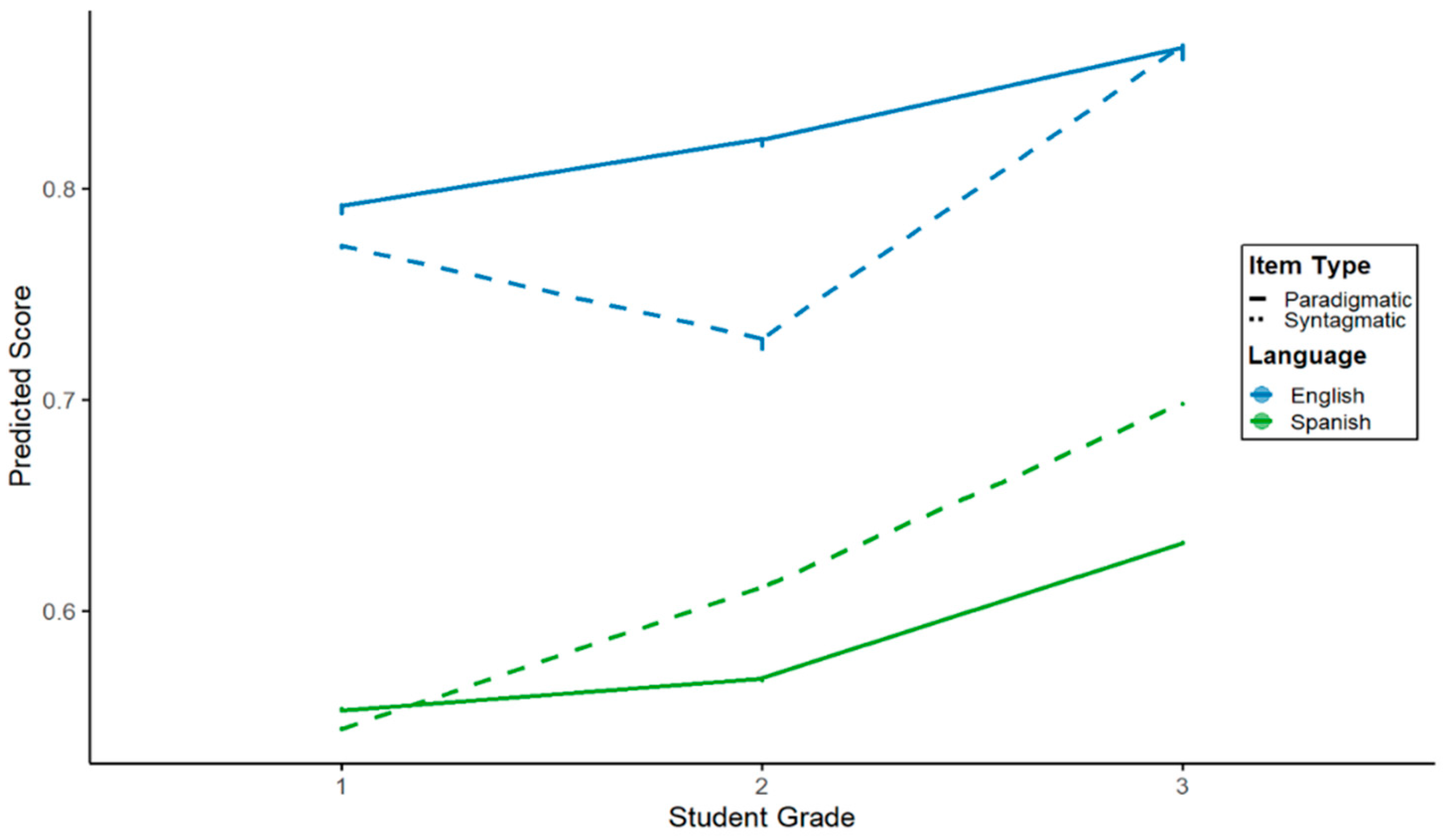
| Spanish | English | |||
|---|---|---|---|---|
| Grade | PEP Para M (SD) | PEP Syn M (SD) | WMG Para M (SD) | WMG Syn M (SD) |
| First | 0.55 (0.20) | 0.55 (0.20) | 0.79 (0.14) | 0.77 (0.22) |
| Second | 0.57 (0.18) | 0.61 (0.21) | 0.82 (0.12) | 0.73 (0.24) |
| Third | 0.63 (0.18) | 0.70 (0.20) | 0.87 (0.12) | 0.87 (0.18) |
Disclaimer/Publisher’s Note: The statements, opinions and data contained in all publications are solely those of the individual author(s) and contributor(s) and not of MDPI and/or the editor(s). MDPI and/or the editor(s) disclaim responsibility for any injury to people or property resulting from any ideas, methods, instructions or products referred to in the content. |
© 2025 by the authors. Licensee MDPI, Basel, Switzerland. This article is an open access article distributed under the terms and conditions of the Creative Commons Attribution (CC BY) license (https://creativecommons.org/licenses/by/4.0/).
Share and Cite
Cabrera Pérez, R.; Pratt, A.S.; Sanabria, A.M.; Peña, E.D. When Words Shift: Age and Language of Elicitation Influence Syntagmatic-Paradigmatic Shifts in Bilingual Children. Behav. Sci. 2025, 15, 1632. https://doi.org/10.3390/bs15121632
Cabrera Pérez R, Pratt AS, Sanabria AM, Peña ED. When Words Shift: Age and Language of Elicitation Influence Syntagmatic-Paradigmatic Shifts in Bilingual Children. Behavioral Sciences. 2025; 15(12):1632. https://doi.org/10.3390/bs15121632
Chicago/Turabian StyleCabrera Pérez, Reinaldo, Amy S. Pratt, Ashley M. Sanabria, and Elizabeth D. Peña. 2025. "When Words Shift: Age and Language of Elicitation Influence Syntagmatic-Paradigmatic Shifts in Bilingual Children" Behavioral Sciences 15, no. 12: 1632. https://doi.org/10.3390/bs15121632
APA StyleCabrera Pérez, R., Pratt, A. S., Sanabria, A. M., & Peña, E. D. (2025). When Words Shift: Age and Language of Elicitation Influence Syntagmatic-Paradigmatic Shifts in Bilingual Children. Behavioral Sciences, 15(12), 1632. https://doi.org/10.3390/bs15121632