Article

Examining Resilience in Those With and Without Suicidal Ideation
1
Centre for Mental Health & Brain Sciences, Swinburne University of Technology, Melbourne, VIC 3122, Australia
2
Orygen, The National Centre of Excellence in Youth Mental Health, Melbourne, VIC 3052, Australia
3
Centre for Youth Mental Health, The University of Melbourne, Melbourne, VIC 3052, Australia
4
Orygen Specialist Program, Parkville Youth Mental Health & Wellbeing Service, Melbourne, VIC 3052, Australia
5
Department of Mental Health, St Vincent’s Hospital, Melbourne, VIC 3065, Australia
6
Department of Mental Health, Austin Hospital, Melbourne, VIC 3084, Australia
7
Department of Psychological Sciences, Swinburne University of Technology, Melbourne, VIC 3122, Australia
8
Department of Psychiatry, Melbourne Medical School, University of Melbourne, Melbourne, VIC 3010, Australia
9
InsideOut Institute, University of Sydney, Sydney, NSW 2006, Australia
*
Author to whom correspondence should be addressed.
Behav. Sci. 2026, 16(2), 260; https://doi.org/10.3390/bs16020260
Submission received: 22 December 2025 / Revised: 5 February 2026 / Accepted: 6 February 2026 / Published: 10 February 2026

Abstract

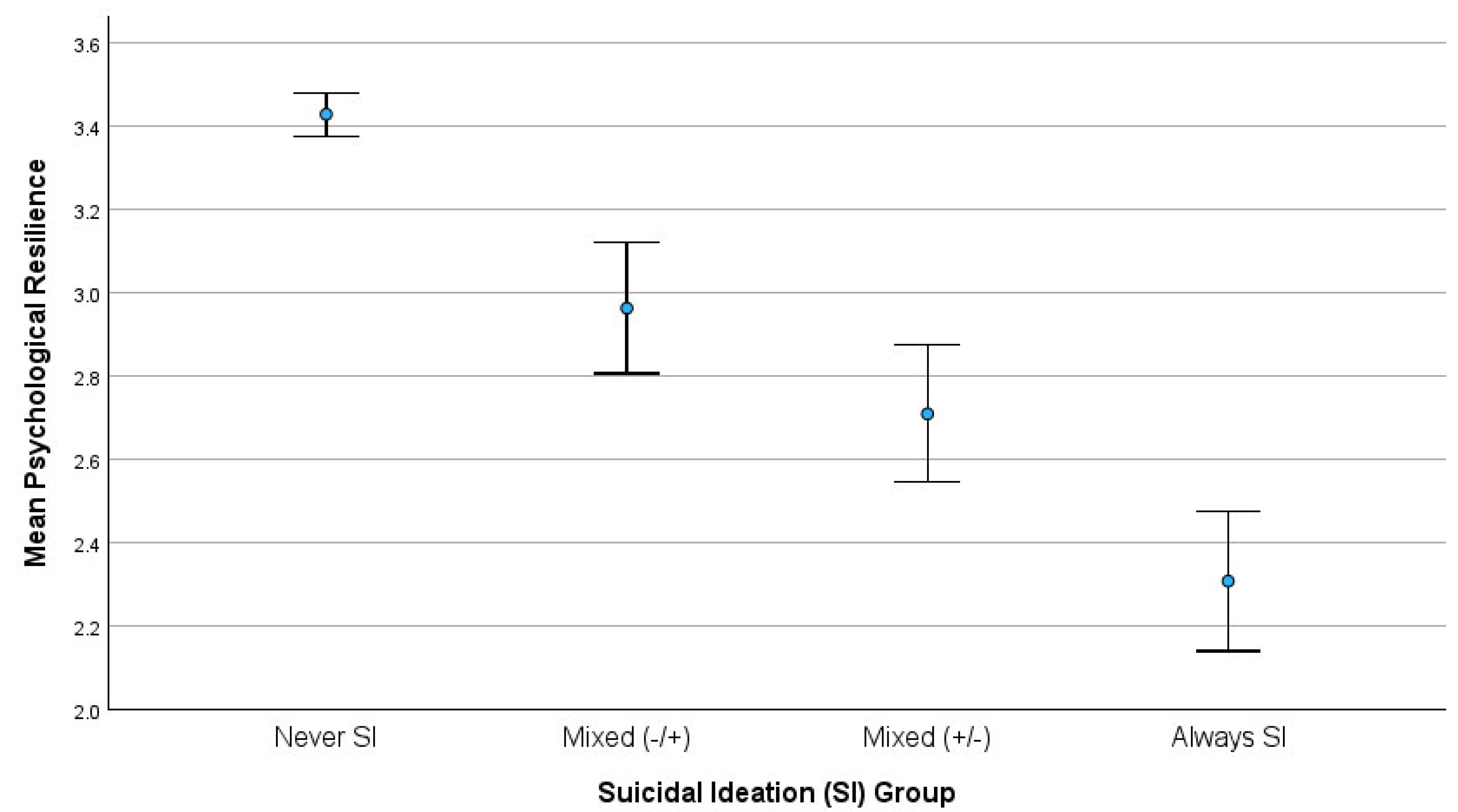
Self-report surveys were conducted in Australia between May 2020 and April 2024, allowing for an analysis of perceived psychological resilience in those with and without suicidal ideation (SI) during and after the COVID-19 pandemic. Linear mixed models were used to describe the factors associated with psychological resilience in these populations and in people experiencing transitions between SI states. Of the 1145 people who responded more than once to the survey, 879 (77%) always reported “never SI”, 84 (7%) always reported SI, while 182 (16%) reported SI for only some of their surveys. People who moved between SI states reported significantly lower psychological resilience than those who reported “never SI”, but significantly higher psychological resilience than those reporting SI in all their surveys. For participants always reporting SI, greater psychological resilience was significantly associated with greater hopefulness and quality of life, and less sleep than usual. In people who moved between SI states, greater psychological resilience was significantly associated with greater hopefulness, less psychological distress and lower likelihood of mental illness. Only participants with “never SI” reported better psychological resilience alongside consistent sleep and exercise quantities. These results have important implications for suicide prevention in Australia. However, bidirectional associations require further investigation.
Keywords: psychological resilience; transitional analysis; suicidal ideation; mental health psychological resilience; transitional analysis; suicidal ideation; mental health