Categorical Data in the Evaluation of School-Based Cyberbullying Prevention Programs: A Review of the Literature



Abstract
1. Introduction
1.1. Use of Categorical Data and Contingency Tables
1.2. Cyberbullying and Prevention Programs
- Which data analysis strategies for categorical variables are reported in the school-based cyberbullying prevention programs and selected studies? Specifically, this includes the use of contingency tables, the chi-square test of independence and its associated p-value, correlational procedures, logistic regression models, and other relevant statistical techniques.
- To what extent do the strategies employed for categorical variables align with the methodological recommendations in the literature for the accurate interpretation of results? For example, do the studies report and interpret effect sizes, accompany the chi-square goodness-of-fit statistic with confidence intervals, or utilize standardized residuals, among other recommended practices?
2. Materials and Methods
2.1. Eligibility Criteria and Search Strategy
2.2. Inclusion and Exclusion Criteria
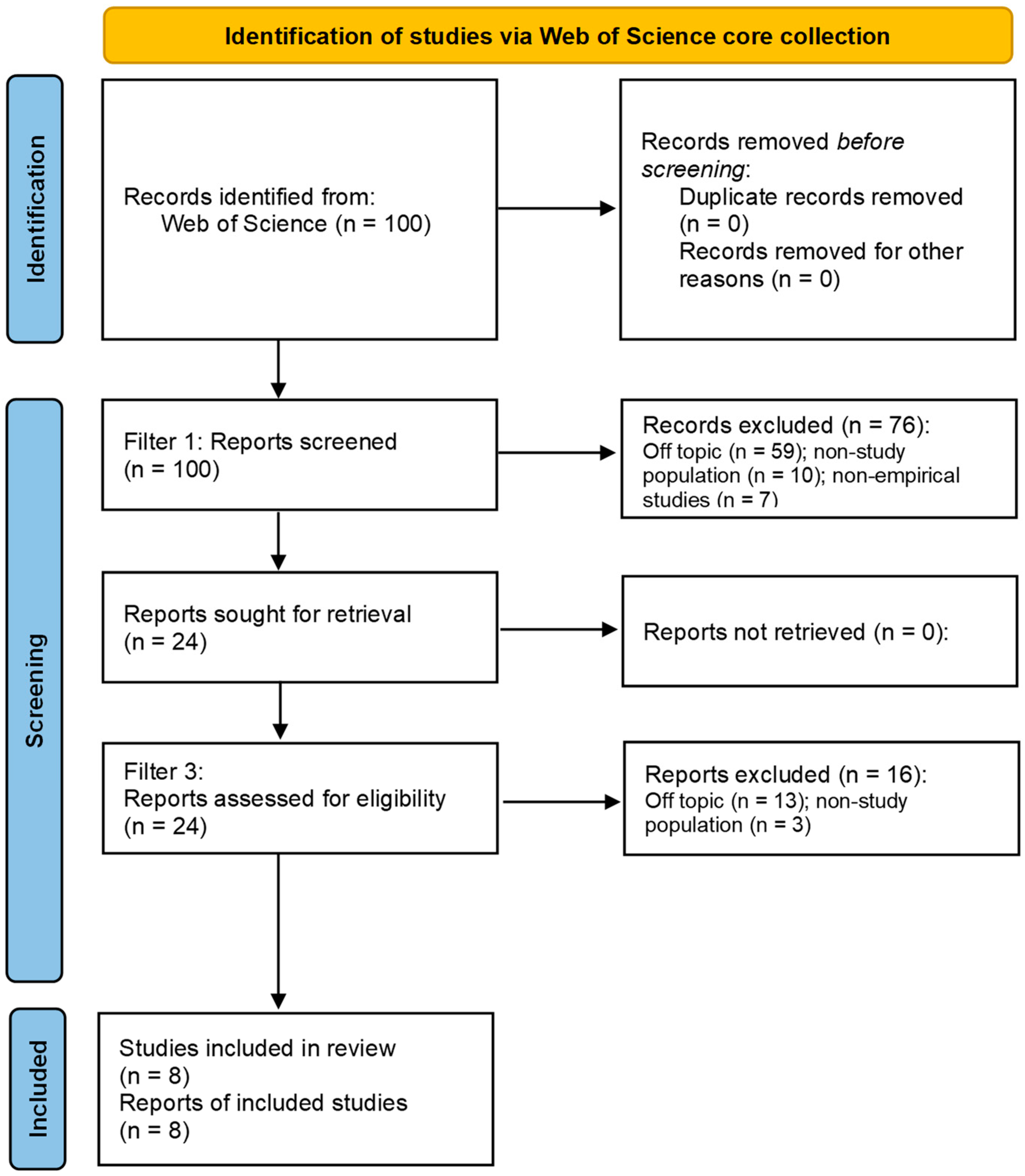
2.3. Article Selection Process
2.4. Coding of Variables
3. Results
3.1. Axis 1: Characteristics and Relevance of Quantitative Data Analysis Technique
3.1.1. Techniques Selected for Data Analysis and Their Methodological Relevance
3.1.2. Role of Significant Variables
3.1.3. Nature of Significant Variables
3.1.4. Omissions or Limitations in the Analytical Process and Interpretation of Results
3.2. Axis 2: Information Reported in the Analysis of Categorical Data
4. Discussion
5. Conclusions
Supplementary Materials
Author Contributions
Funding
Institutional Review Board Statement
Informed Consent Statement
Data Availability Statement
Conflicts of Interest
References
- Amadori, A., Real, A. G., Brighi, A., & Russell, S. T. (2025). An intersectional perspective on cyberbullying: Victimization experiences among marginalized youth. Journal of Adolescence, 97(4), 931–940. [Google Scholar] [CrossRef] [Scilit]
- Ansari, N. S. (2020). Cyberbullying: Concepts, theories, and correlates informing evidence-based best practices for prevention. Aggression and Violent Behavior, 50, 101343. [Google Scholar] [CrossRef] [Scilit]
- Arató, N., Zsidó, A. N., Lénárd, K., & Lábadi, B. (2020). Cybervictimization and cyberbullying: The role of socio-emotional skills. Frontiers in Psychiatry, 11, 248. [Google Scholar] [CrossRef] [Scilit]
- Azami, M. S., & Taremian, F. (2020). Victimization in traditional and cyberbullying as risk factors for substance use, self-harm and suicide attempts in high school students. Scandinavian Journal of Child and Adolescent Psychiatry and Psychology, 8(1), 101–109. [Google Scholar] [CrossRef] [Scilit] [PubMed]
- Batmaz, H., Türk, N., Kaya, A., & Yildirim, M. (2023). Cyberbullying and cyber victimization: Examining mediating roles of empathy and resilience. Current Psychology, 42(35), 30959–30969. [Google Scholar] [CrossRef] [Scilit]
- Beasley, T. M., & Schumacker, R. E. (1995). Multiple comparison procedures. Journal of Experimental Education, 64(1), 79–92. [Google Scholar] [CrossRef] [Scilit]
- Bergsma, W. (2013). Bias correction of Cramér’s V and Tschuprow’s T. Journal of the Korean Statistical Society, 42(3), 323–328. [Google Scholar] [CrossRef] [Scilit]
- Biernesser, C., Ohmer, M., Nelson, L., Mann, E., Farzan, R., Schwanke, B., & Radovic, A. (2023). Middle school students’ experiences with cyberbullying and perspectives toward prevention and bystander intervention in schools. Journal of School Violence, 22(3), 339–352. [Google Scholar] [CrossRef] [Scilit]
- Bravo, A., Córdoba-Alcaide, F., Ortega-Ruiz, R., & Romera, E. M. (2022). Cyber-rumor and internalizing symptoms in adolescence: Mediating effect of resilience. Psychology, Society & Education, 14(1), 13–21. [Google Scholar] [CrossRef] [Scilit]
- Buils, R. F., Miedes, A. C., & Oliver, M. R. (2020). Effect of a cyberbullying prevention program integrated in the primary education curriculum//Efecto de un programa de prevención de ciberacoso integrado en el currículum escolar de educación primaria. Revista de Psicodidáctica, 25(1), 23–29. [Google Scholar] [CrossRef] [Scilit]
- Cabrera, M. C., Larrañaga Rubio, E., & Yubero, S. (2024). Variables sociofamiliares en adolescentes ciberacosadores: Prevención e intervención desde el Trabajo Social. Cuadernos de Trabajo Social, 31(2), 378–408. [Google Scholar] [CrossRef] [Scilit]
- Dagnino, J. (2014). Análisis de varianza. Revista Chilena de Anestesia, 43(4), 306–310. [Google Scholar]
- Dávila, O. S., & Ramírez, A. (2007). Análisis de diagnóstico en el modelo de regresión logística: Una aplicación. Pesquimat, 10(1), 55–70. [Google Scholar]
- Escortell, R., Delgado, B., Baquero, A., & Martínez-Monteagudo, M. C. (2023). Special issue: Child protection in the digital age. Latent profiles in cyberbullying and the relationship with self-concept and achievement goals in preadolescence. Child & Family Social Work, 28(4), 1046–1055. [Google Scholar] [CrossRef] [Scilit]
- Favini, A., Gerbino, M., Pastorelli, C., & Giannini, A. M. (2023). Bullying and cyberbullying: Do personality profiles matter in adolescence? Telematics and Informatics Reports, 12, 100108. [Google Scholar] [CrossRef] [Scilit]
- Fienberg, S. E. (2000). Contingency tables and log-linear models: Basic results and new developments. Journal of the American Statistical Association, 95, 643–647. Available online: https://link.gale.com/apps/doc/A63841151/AONE?u=anon~f51b8eed&sid=googleScholar&xid=1c0dcfa8 (accessed on 11 October 2025). [CrossRef]
- Fienberg, S. E. (2005). Contingency tables and log-linear models. In K. Kempf-Leonard (Ed.), Encyclopedia of social measurement (pp. 499–506). Elsevier. [Google Scholar]
- Fienberg, S. E., & Rinaldo, A. (2018). Three centuries of categorical data analysis: Log-linear models and maximum likelihood estimation. Journal of Statistical Planning and Inference, 137(11), 3430–3445. [Google Scholar] [CrossRef] [Scilit]
- Fisher, M. J., Marshall, A. P., & Mitchell, M. (2011). Testing differences in proportions. Australian Critical Care: Official Journal of the Confederation of Australian Critical Care Nurses, 24(2), 133–138. [Google Scholar] [CrossRef] [Scilit] [PubMed]
- Goodman, L. (1971). The analysis of multidimensional contingency tables: Stepwise procedures and direct estimation methods for building models for multiple classifications. Technometrics, 13(1), 33–61. [Google Scholar] [CrossRef]
- Gómez, R. S., & Martínez, E. R. (2017). Métodos cuantitativos para un modelo de regresión lineal con multicolinealidad: Aplicación a rendimientos de letras del tesoro. Revista de Métodos Cuantitativos para la Economía y la Empresa, 14(24), 169–189. [Google Scholar]
- Haberman, S. J. (1973). The analysis of residuals in cross-classified tables. Biometrics, 29(1), 205–220. [Google Scholar] [CrossRef] [Scilit]
- Hajnal, A. (2021). Cyberbullying prevention: Which design features foster the effectiveness of school-based programs? A meta-analytic approach. Intersections. East European Journal of Society and Politics, 7(1), 40–58. [Google Scholar] [CrossRef] [Scilit]
- Kennedy, R. S., Dendy, K., & Lawrence, A. (2024). Trends in traditional bullying and cyberbullying victimization by race and ethnicity in the United States: A meta-regression. Aggression and Violent Behavior, 78, 101958. [Google Scholar] [CrossRef] [Scilit]
- Kunwar, S., Thapa, R., Poudel, K., Shrestha, R., Shrestha, N., & Basnet, S. (2024). Cyberbullying and cyber-victimisation among higher secondary school adolescents in an urban city of Nepal: A cross-sectional study. BMJ Open, 14(3), e081016. [Google Scholar] [CrossRef] [Scilit]
- Lee, S.-S., & Jung, S. (2025). How do internal and external control factors affect cyberbullying? Partial test of situational action theory. Behavioral Sciences, 15(7), 837. [Google Scholar] [CrossRef] [Scilit]
- Li, J., Huebner, E. S., & Tian, L. L. (2024). Linking childhood maltreatment to cyberbullying perpetration and victimization: A systematic review and multilevel meta-analysis. Computers in Human Behavior, 156, 108199. [Google Scholar] [CrossRef] [Scilit]
- López-Roldán, P., & Fachelli, S. (Eds.). (2015). Análisis de tablas de contingencia. In Metodología de la investigación social cuantitativa (1st ed.). Dipòsit Digital de Documents, Universitat Autónoma de Barcelona. Available online: http://ddd.uab.cat/record/13146 (accessed on 22 September 2025).
- Ma, J., Su, L., Li, M., Sheng, J., Liu, F., Zhang, X., Yang, Y., & Xiao, Y. (2024). Analysis of prevalence and related factors of cyberbullying–victimization among adolescents. Children, 11(10), 1193. [Google Scholar] [CrossRef] [Scilit] [PubMed]
- McHugh, M. L. (2013). The chi-square test of independence. Biochemia Medica, 23(2), 143–149. [Google Scholar] [CrossRef] [Scilit]
- Mula-Falcón, J., & González, C. C. (2023). Effectiveness of cyberbullying prevention programmes on perpetration levels: A meta-analysis. Revista Fuentes, 25(1), 12–25. [Google Scholar] [CrossRef] [Scilit]
- Oakley, A. (2012). Foreword. In D. Gough, S. Oliver, & J. Thomas (Eds.), An introduction to systematic reviews (pp. 6–10). SAGE Publications. [Google Scholar]
- Osborn, J. F. (1989). Chi 2 tests: How useful are they in the analysis of medical research data? Annali di Igiene: Medicina Preventiva e di Comunita, 1(3–4), 417–432. [Google Scholar]
- Page, M. J., McKenzie, J. E., Bossuyt, P. M., Boutron, I., Hoffmann, T. C., Mulrow, C. D., Shamseer, L., Tetzlaff, J. M., Akl, E. A., Brennan, S. E., Chou, R., Glanville, J., Grimshaw, J. M., Hróbjartsson, A., Lalu, M. M., Li, T., Loder, E. W., Mayo-Wilson, E., McDonald, S., … Moher, D. (2021). The PRISMA 2020 statement: An updated guideline for reporting systematic reviews. BMJ, 372, n71. [Google Scholar] [CrossRef] [Scilit]
- Pardo, A., Ruiz, M. A., & San Martín, R. (2010). Análisis de datos en ciencias sociales y de la salud I. Síntesis. [Google Scholar]
- Peprah, P., Oduro, M. S., Atta-Osei, G., Addo, I. Y., Morgan, A. K., & Gyasi, R. M. (2024). Problematic social media use mediates the effect of cyberbullying victimisation on psychosomatic complaints in adolescents. Scientific Reports, 14, 9773. [Google Scholar] [CrossRef] [Scilit]
- Ramachandran, K. M. (2021). Categorical data analysis and goodness-of-fit tests and applications. In K. M. Ramachandran, & C. P. Tsokos (Eds.), Mathematical statistics with applications in R (3rd ed., pp. 461–490). Academic Press. [Google Scholar]
- Romera, E. M., Ortega-Ruiz, R., Runions, K., & Camacho, A. (2019). How do you think the victims of bullying feel? A study of moral emotions in primary school. Frontiers in Psychology, 10, 1753. [Google Scholar] [CrossRef] [Scilit] [PubMed]
- Soriano-Molina, E., Limiñana-Gras, R. M., Patró-Hernández, R. M., & Rubio-Aparicio, M. (2025). The association between internet addiction and adolescents’ mental health: A meta-analytic review. Behavioral Sciences, 15(2), 116. [Google Scholar] [CrossRef] [Scilit]
- Sorrentino, A., Esposito, A., Acunzo, D., Santamato, M., & Aquino, A. (2023). Onset risk factors for youth involvement in cyberbullying and cybervictimization: A longitudinal study. Frontiers in Psychology, 13, 1090047. [Google Scholar] [CrossRef] [Scilit]
- Torgal, C., Espelage, D. L., Polanin, J. R., Ingram, K. M., Robinson, L. E., El Sheikh, A. J., & Valido, A. (2023). A meta-analysis of school-based cyberbullying prevention programs’ impact on cyber-bystander behavior. School Psychology Review, 52(2), 95–109. [Google Scholar] [CrossRef] [Scilit]
- Touloupis, T., & Athanasiades, C. (2022). Evaluation of a cyberbullying prevention program in elementary schools: The role of self-esteem enhancement. Frontiers in Psychology, 13, 980091. [Google Scholar] [CrossRef] [Scilit]
- Valarmathi, S., Hemapriya, A., & Sundar, J. S. (2024). Chi-square tests: A quick guide for health researchers. International Journal of Advanced Research, 12(10), 1214–1222. [Google Scholar] [CrossRef] [Scilit]
- Williams, C., Griffin, K. W., Botvin, C. M., Sousa, S., & Botvin, G. J. (2023). Effectiveness of digital health tools to prevent bullying among middle school students. Adolescents, 3, 110–130. [Google Scholar] [CrossRef] [Scilit]
- Wright, M. F., Schiamberg, L. B., Wachs, S., Huang, Z., Kamble, S. V., Soudi, S., Bayraktar, F., Li, Z., Lei, L., & Shu, C. (2021). The influence of sex and culture on the longitudinal associations of peer attachment, social preference goals, and adolescents’ cyberbullying involvement: An ecological perspective. School Mental Health, 13(3), 631–643. [Google Scholar] [CrossRef] [Scilit]
- Yurdakul, Y., & Ayhan, A. B. (2023). The effect of the cyberbullying awareness program on adolescents’ awareness of cyberbullying and their coping skills. Current Psychology, 42(28), 24208–24222. [Google Scholar] [CrossRef] [Scilit] [PubMed]


| Authors (Year) | Studies Included | Main Variables Analyzed | Most Relevant Findings |
|---|---|---|---|
| Ansari (2020) | 57 |
| This review critically examines current knowledge on cyberbullying, including its definition, risk and protective factors, adverse psychosocial consequences, and the design and implementation of prevention and intervention programs |
| Hajnal (2021) | 23 |
| Evidence suggests that school-based cyberbullying prevention programs integrating socioemotional learning and mentoring yield the greatest reductions in perpetration, while those focused on cyber safety and cyberbullying education are most successful in mitigating victimization. |
| Kennedy et al. (2024) | 87 |
| Trends in victimization rates for both traditional bullying and cyberbullying fluctuate over time according to race, grade, and gender |
| Li et al. (2024) | 57 |
| Experiences of child abuse, whether manifesting as neglect or emotional abuse, are linked to an increased likelihood of both cyberbullying perpetration and victimization. |
| Mula-Falcón and González (2023) | 9 |
| Educational prevention programs could reduce levels of cyberbullying perpetration among schoolchildren aged 10 to 17. |
| Torgal et al. (2023) | 9 | This study examined the impact of school programs designed to prevent cyberbullying among students at the elementary and secondary levels | Although the overall effect of school-based cyberbullying prevention programs did not reach statistical significance, moderator analyses suggest that the inclusion of an empathy activation component enhances program effectiveness. |
| Syntax (in Article Title, Abstract or Keywords) | Cyberbullying AND (“Prevention Program*” OR “Prevention AND Intervention Program*”) |
|---|---|
| Databases | Web of Science (Core Collection) |
| Year | From January 2020 to September 2025 |
| Country | All |
| Source | Scientific journals |
| Type | Article |
| Full text | Yes |
| Peer-reviewed | Yes |
| Total | n = 100 |
| Variable | Inclusion Criterion | Exclusion Criterion |
|---|---|---|
| Document type | Scientific articles | Other publications |
| Language | English or Spanish | Other languages |
| Access | Free access or available | Restricted access |
| Type of study | Studies reporting quantitative results of cyberbullying prevention programs | The prevention program was not implemented (e.g., theoretical or descriptive articles on the programs) or its results are not analyzed quantitatively |
| Setting | School context | Contexts outside of school |
| Level | Primary or secondary school students | Other educational levels or inclusion of the general population |
| Purpose of the study and characteristics | Evaluation of a prevention or prevention and intervention program (emphasizing the preventive element) Study that explicitly states | Studies evaluating programs unrelated to prevention |
| Participants | Program aimed only at schoolchildren | Programs focused on other members of the school community (e.g., primary caregivers of schoolchildren or teachers) |
| Axis 1: Characteristics and Relevance of Quantitative Data Analysis Technique | Axis 2: Information Reported in the Analysis of Categorical Data |
|---|---|
|
|
| Authors, Year, and Country of Study | Type of Study | Statistical Techniques Applied | Nature and Role of Significant Variables |
|---|---|---|---|
| Buils et al. (2020), Spain | Quasi-experimental pre-post design with two groups | T-tests, chi-square, variance analyses (ANOVAs), covariance analyses and effect size are calculated by means of Cohen’s d statistic | Quantitative DV (scores): emotional self-awareness, problem solving, responsible use, digital teaching tutoring and family supervision Categorical IV: Program “Living in harmony in the real and digital world takes” |
| Cabrera et al. (2024), Spain | Cross-sectional correlational quantitative study | Chi-square, Pearson correlation coefficient, t-test, odd ratio and logistic regression analysis | Categorical DV: be a victim of cyberbullying Categorical IV: stages of adolescence, cybervictimization, pleasant cyberbullying emotions. Quantitative IV: family cohesion, experiencing family conflicts, perceived social support, physical ability, physical appearance, relationship with peers, relationship with parents, general self-concept, language self-concept and mathematical self-concept |
| Escortell et al. (2023), Spain | Cross-sectional correlational quantitative study | Chi-square, Latent Class Analysis and MANOVA, | Quantitative variables: electronic harassment behaviors among peers, learning goals, achievement goals and social reinforcement goals |
| Sorrentino et al. (2023), Italy | Longitudinal research design | Simple correlations with Cohen’s interpretation of r-values, hierarchical regression analysis (coefficients were reported with confidence intervals) | Quantitative variables: Participants’ involvement in cyberbullying and cybervictimization, Students’ involvement in school bullying and victimization, Empathy, Moral Disengagement, Increasing Self-Awareness of Cyberbullying, students’ perceived social support, Parental online monitoring strategies and School climate. |
| Touloupis and Athanasiades (2022), Greece | Experimental longitudinal research design | Confirmatory factor analysis (involving the report of chi-square), T-test, repeated measures ANOVA, MANOVA | Quantitative DVs: cyberbullying involvement (online victimization and online bullying). Categorical IV: preventive program TABBY Others: self-esteem |
| Williams et al. (2023), USA | Cluster-randomized comparison group design with pre-test and post-test surveys (schools were matched by geographical region and enrollment size) | GLM and multilevel analyses using mixed models, chi-square | Quantitative DVs: behavior and knowledge regarding physical, social, verbal, and cyberbullying victimization and perpetration; hypothesized risk and protective factors; and the skills, knowledge and attitudes targeted by the intervention. Categorical IV: LST prevention program with added bullying prevention content. |
| Wright et al. (2021), China, Cyprus, India and the USA | Longitudinal cross-cultural design | Multigroup confirmatory factor analysis, Multigroup structural equation model (this includes the use of the chi-square goodness-of-fit test) and Pearson correlation coefficient | Quantitative DV: Cyberbullying involvement (i.e., perpetration, victimization) Quantitative IV: peer attachment, social preference goals |
| Yurdakul and Ayhan (2023), Turkey | Quasi-experimental design, including intervention and control groups and pretest- post-test follow-up test | Wilcoxon Signed Rank Test | Categorical IV: Group (control or intervention) Quantitative DV: Cyberbullying tendency, Coping with cyberbullying, Protection from cyberbullying |
Disclaimer/Publisher’s Note: The statements, opinions and data contained in all publications are solely those of the individual author(s) and contributor(s) and not of MDPI and/or the editor(s). MDPI and/or the editor(s) disclaim responsibility for any injury to people or property resulting from any ideas, methods, instructions or products referred to in the content. |
© 2026 by the authors. Licensee MDPI, Basel, Switzerland. This article is an open access article distributed under the terms and conditions of the Creative Commons Attribution (CC BY) license.
Share and Cite
Antivilo-Bruna, A.; Patino-Alonso, C. Categorical Data in the Evaluation of School-Based Cyberbullying Prevention Programs: A Review of the Literature. Behav. Sci. 2026, 16, 93. https://doi.org/10.3390/bs16010093
Antivilo-Bruna A, Patino-Alonso C. Categorical Data in the Evaluation of School-Based Cyberbullying Prevention Programs: A Review of the Literature. Behavioral Sciences. 2026; 16(1):93. https://doi.org/10.3390/bs16010093
Chicago/Turabian StyleAntivilo-Bruna, Andrés, and Carmen Patino-Alonso. 2026. "Categorical Data in the Evaluation of School-Based Cyberbullying Prevention Programs: A Review of the Literature" Behavioral Sciences 16, no. 1: 93. https://doi.org/10.3390/bs16010093
APA StyleAntivilo-Bruna, A., & Patino-Alonso, C. (2026). Categorical Data in the Evaluation of School-Based Cyberbullying Prevention Programs: A Review of the Literature. Behavioral Sciences, 16(1), 93. https://doi.org/10.3390/bs16010093