How Emotions Influence Cognitive Control: A Within-Subject Investigation


Abstract
1. Introduction
Emotions Effect on Cognitive Control
2. Materials and Methods
2.1. Ethics Statement
2.2. Sample Size
2.3. Emotional Pictures
2.4. Design
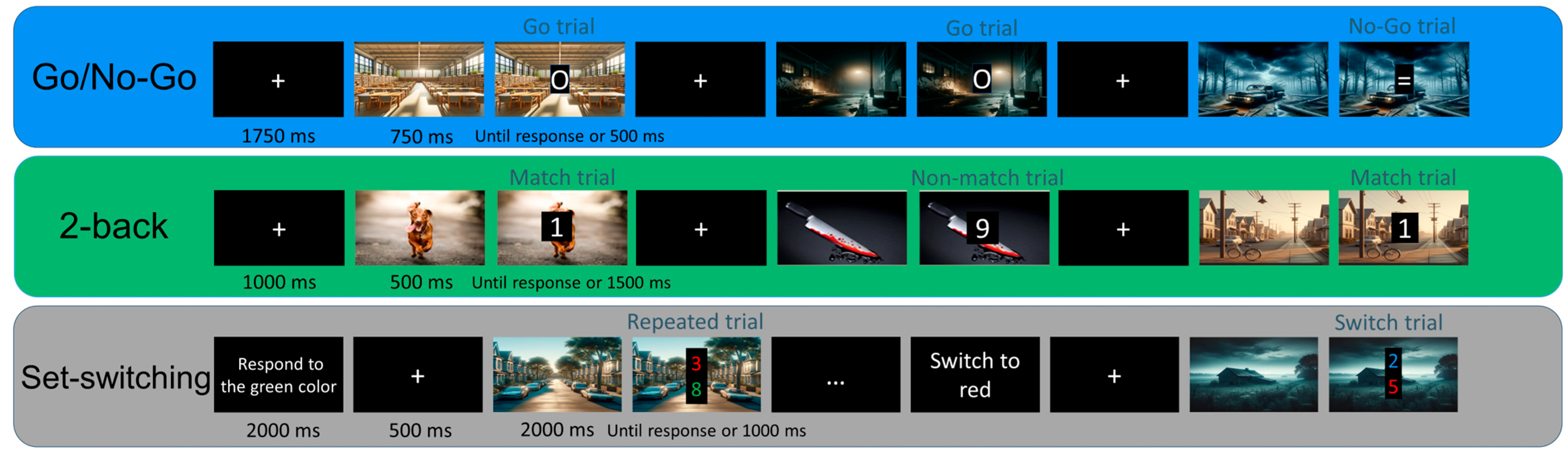
2.4.1. Go/No-Go Task
2.4.2. Two-Back Task
2.4.3. Set-Switching Task
2.5. Data Analysis
3. Results
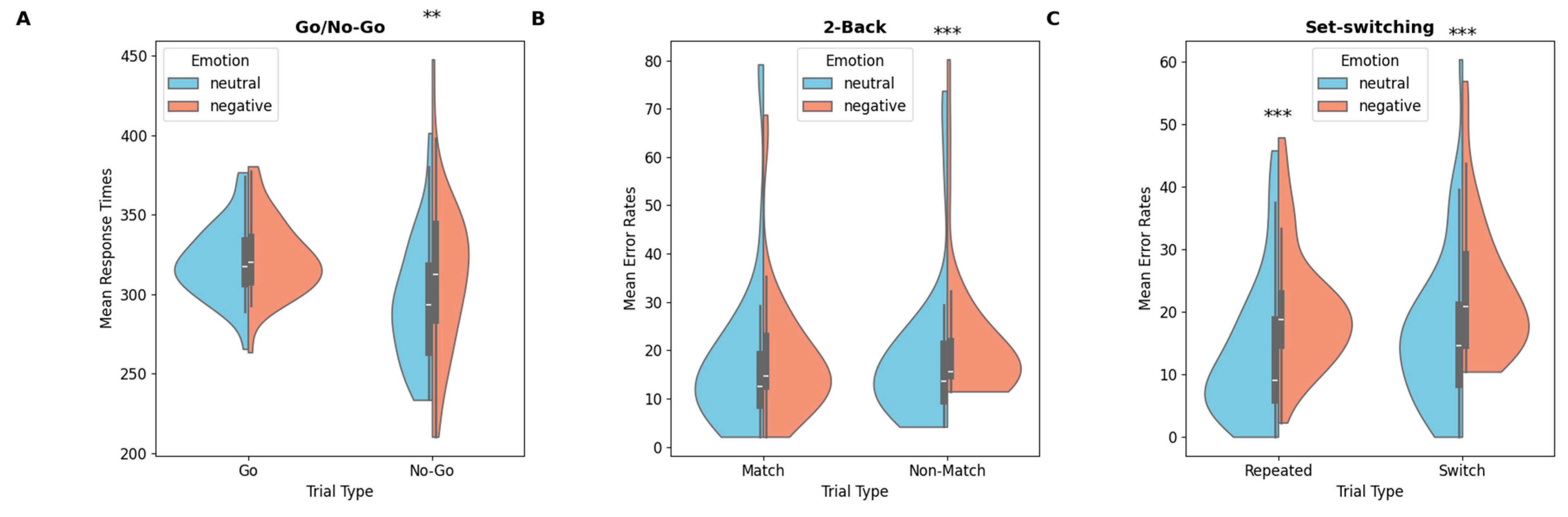
3.1. Go/No-Go Task
3.1.1. Response Times
3.1.2. Percentages of Errors
3.1.3. Emotions Effect Scores
3.2. Two-Back Task
3.2.1. Response Times
3.2.2. Percentages of Errors
3.2.3. Emotions Effect Scores
3.3. Set-Switching Task
3.3.1. Response Time
3.3.2. Percentages of Errors
3.3.3. Emotions Effect Scores
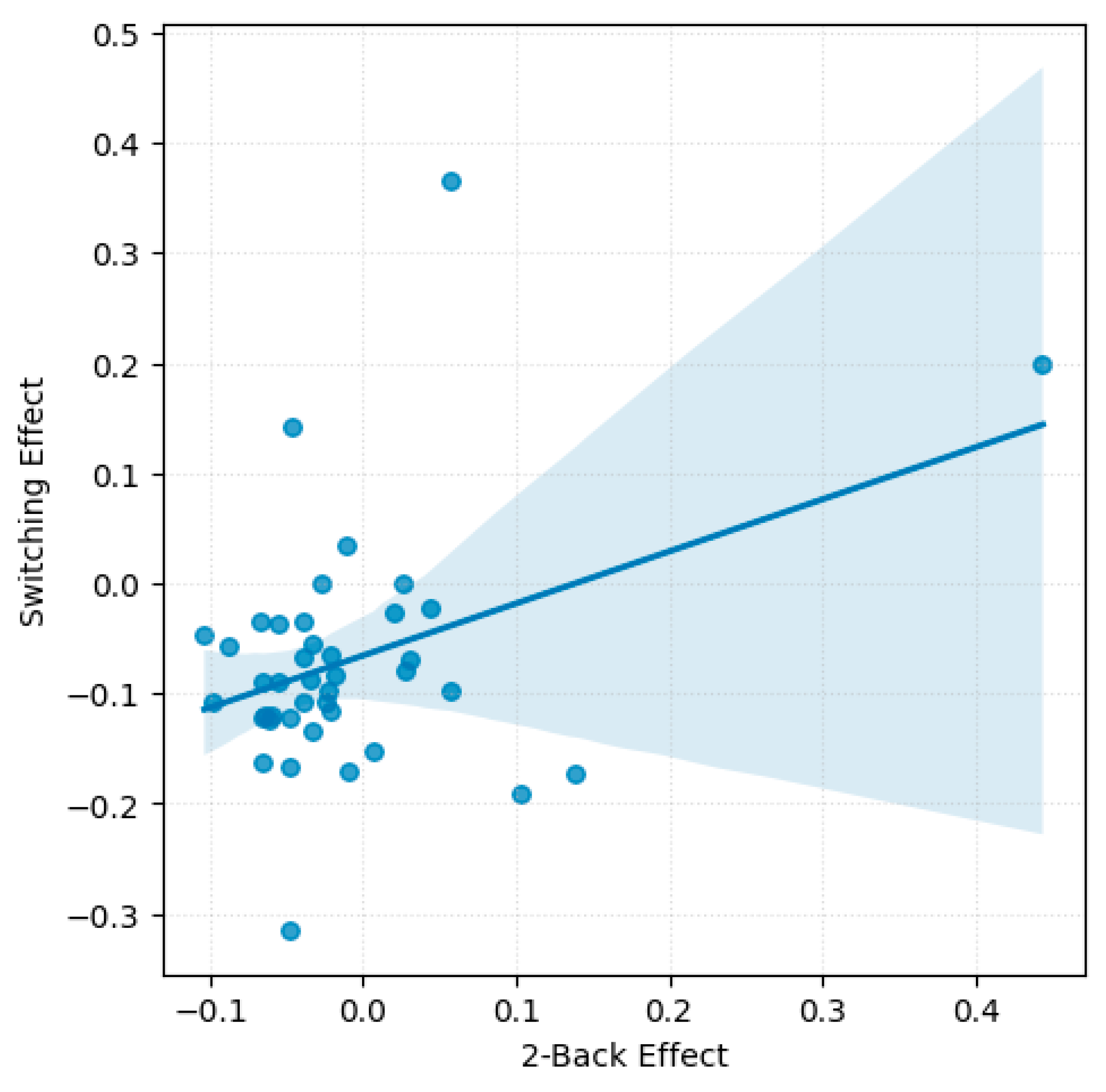
3.4. Cross-Task Correlations of Emotions Effect
4. Discussion
4.1. Effect of Emotions on Inhibition, Updating, and Shifting
4.2. The Influence of Emotions Across the Three Tasks
5. Conclusions
Author Contributions
Funding
Institutional Review Board Statement
Informed Consent Statement
Data Availability Statement
Acknowledgments
Conflicts of Interest
Abbreviations
| ANOVAs | Analysis of Variance |
| IAPS | International Affective Picture System |
| MSe | Mean Square Error |
| ms | Millisecond(s) |
| RT | Response Time(s) |
| WM | Working Memory |
| η2p | Partial Eta Squared |
Appendix A

| Elements | Negative | Neutral | F(df1,df2) |
|---|---|---|---|
| Emotional Valence | |||
| Go trial (N = 144) | 3.28 (1.81–4.75; 0.07) | 6.30 (5.35–7.18; 0.04) | 10,429 *** |
| No-Go trial (N = 48) | 3.21 (1.31–4.88; 0.19) | 6.29 (5.22–7.32; 0.12) | 1644 *** |
| F(1,47) | 0.931 (p = 0.194) | 0.0121 (p = 0.913) | |
| Non-Match trial (N = 96) | 3.23 (1.56–4.84; 0.10) | 6.27 (5.24–7.27; 0.06) | 3160 *** |
| Match trial (N = 48) | 3.29 (1.59–4.82; 0.16) | 6.31 (5.26–7.26; 0.10) | 2477 *** |
| F(1,95) | 1.81 (p = 0.185) | 1.81 (p = 0.850) | |
| Repeated trial (N = 150) | 3.25 (1.76–4.78; 0.07) | 6.29 (5.32–7.22; 0.04) | 10,178 *** |
| Switch trial (N = 18) | 3.22 (1.67–7.81; 0.31) | 6.27 (5.29–7.24; 0.19) | 701 *** |
| F(1,17) | 0.0227 (p = 0.882) | <0.001 (p = 0.985) | |
| Arousal Rating | |||
| Go trial (N = 144) | 5.22 (2.03–6.96; 0.08) | 4.81 (2.6–6.82; 0.08) | 10.9 ** |
| No-Go trial (N = 48) | 5.31 (1.72–7.26; 0.19) | 4.34 (2.51–6.34; 0.13) | 15.7 *** |
| F(1,47) | 0.849 (p = 0.400) | 3.09 (p = 0.085) | |
| Non-Match trial (N = 96) | 5.19 (2.39–7.39; 0.12) | 4.55 (2.74–6.66; 0.10) | 13.6 *** |
| Match trial (N = 48) | 3.23 (2.69–7.34; 0.19) | 4.39 (2.32–7.07; 0.16) | 9.03 * |
| F(1,47) | 1.83 (p = 0.183) | 0.033 (p = 0.885) | |
| Repeated trial (N = 150) | 5.16 (1.74–4.78; 0.08) | 4.64 (5.32–7.22; 0.08) | 15.4 *** |
| Switch trial (N = 18) | 5.20 (1.67–4.81; 0.32) | 4.26 (5.29–7.24; 0.23) | 4.42 * |
| F(1,17) | 0.485 (p = 0.496) | 0.0216 (p = 0.885) | |
| Task | Trial | Negative | Neutral |
|---|---|---|---|
| Go/No-Go | Response Times | ||
| Correct-Go trial (N = 144) | [315, 330] | [313, 328] | |
| False-positive trial (N = 48) | [296, 326] | [281, 306] | |
| Accuracies | |||
| Correct-Go trial (N = 144) | [4.8, 10.1] | [3.8, 8.9] | |
| False-positive trial (N = 48) | [7.1, 11.4] | [5.9, 9.7] | |
| 2-back | Response Times | ||
| Non-Match trial (N = 96) | [679, 640] | [632, 710] | |
| Match trial (N = 48) | [565, 632] | [558, 630] | |
| Accuracies | |||
| Non-Match trial (N = 96) | [17.2, 26.1] | [13.4, 23] | |
| Match trial (N = 48) | [14, 22.4] | [12.4, 22.7] | |
| Set-switching | Response Times | ||
| Switch trial (N = 18) | [594, 626] | [601, 6437] | |
| Repeated trial (N = 150) | [587, 622] | [595, 626] | |
| Accuracies | |||
| Switch trial (N = 18) | [20.1, 26.9] | [13.1, 20.9] | |
| Repeated trial (N = 150) | [17.4, 23.5] | [9.6, 16.7] |
References
- Albert, J., López-Martín, S., & Carretié, L. (2010). Emotional context modulates response inhibition: Neural and behavioral data. NeuroImage, 49(1), 914–921. [Google Scholar] [CrossRef] [Scilit] [PubMed]
- Banich, M. T., Haber, S. N., & Robbins, T. W. (2024). The frontal cortex: Organization, networks, and function. MIT Press. [Google Scholar]
- Blanchette, I., & Caparos, S. (2013). When emotions improve reasoning: The possible roles of relevance and utility. Thinking & Reasoning, 19(3–4), 399–413. [Google Scholar] [CrossRef] [Scilit]
- Blanchette, I., Gavigan, S., & Johnston, K. (2014). Does emotion help or hinder reasoning? The moderating role of relevance. Journal of Experimental Psychology: General, 143(3), 1049–1064. [Google Scholar] [CrossRef] [Scilit]
- Buodo, G., Sarlo, M., Mento, G., Messerotti Benvenuti, S., & Palomba, D. (2017). Unpleasant stimuli differentially modulate inhibitory processes in an emotional Go/NoGo task: An event-related potential study. Cognition and Emotion, 31(1), 127–138. [Google Scholar] [CrossRef] [Scilit]
- Buratto, L. G., Pottage, C. L., Brown, C., Morrison, C. M., & Schaefer, A. (2014). The effects of a distracting n-back task on recognition memory are reduced by negative emotional intensity. PLoS ONE, 9(10), e110211. [Google Scholar] [CrossRef] [Scilit]
- Caparos, S., & Blanchette, I. (2017). Independent effects of relevance and arousal on deductive reasoning. Cognition and Emotion, 31(5), 1012–1022. [Google Scholar] [CrossRef] [Scilit]
- Carretié, L. (2014). Exogenous (automatic) attention to emotional stimuli: A review. Cognitive, Affective & Behavioral Neuroscience, 14(4), 1228–1258. [Google Scholar] [CrossRef] [Scilit]
- Chen, Y. N., Mitra, S., & Schlaghecken, F. (2008). Sub-processes of working memory in the N-back task: An investigation using ERPs. Clinical Neurophysiology, 119(7), 1546–1559. [Google Scholar] [CrossRef] [Scilit]
- De Houwer, J., & Tibboel, H. (2010). Stop what you are not doing! Emotional pictures interfere with the task not to respond. Psychonomic Bulletin & Review, 17(5), 699–703. [Google Scholar] [CrossRef] [Scilit]
- Demanet, J., Liefooghe, B., & Verbruggen, F. (2011). Valence, arousal, and cognitive control: A voluntary task-switching study. Frontiers in Psychology, 2, 336. [Google Scholar] [CrossRef] [Scilit]
- Desimone, R., & Duncan, J. (1995). Neural mechanisms of selective visual attention. Annual Review of Neuroscience, 18(1), 193–222. [Google Scholar] [CrossRef]
- Dreisbach, G., & Goschke, T. (2004). How positive affect modulates cognitive control: Reduced perseveration at the cost of increased distractibility. Journal of Experimental Psychology: Learning, Memory, and Cognition, 30(2), 343–353. [Google Scholar] [CrossRef] [Scilit]
- Dresler, T., Mériau, K., Heekeren, H. R., & Meer, E. (2009). Emotional stroop task: Effect of word arousal and subject anxiety on emotional interference. Psychological Research Psychologische Forschung, 73(3), 364–371. [Google Scholar] [CrossRef] [Scilit] [PubMed]
- Droit-Volet, S., & Gil, S. (2009). The time–Emotion paradox. Philosophical Transactions of the Royal Society B: Biological Sciences, 364(1525), 1943–1953. [Google Scholar] [CrossRef] [Scilit] [PubMed]
- Droit-Volet, S., & Meck, W. H. (2007). How emotions colour our perception of time. Trends in Cognitive Sciences, 11(12), 504–513. [Google Scholar] [CrossRef] [Scilit]
- Eckart, C., Kraft, D., Rademacher, L., & Fiebach, C. J. (2023). Neural correlates of affective task switching and asymmetric affective task switching costs. Social Cognitive and Affective Neuroscience, 18(1), nsac054. [Google Scholar] [CrossRef] [Scilit]
- Ellis, H. C., & Ashbrook, P. W. (1989). The” state” of mood and memory research: A selective review. Journal of Social Behavior and Personality, 4(2), 1–21. [Google Scholar]
- Ellis, H. C., & Moore, B. A. (1999). Mood and memory. In Handbook of cognition and emotion (pp. 193–210). Wiley. [Google Scholar]
- Fabre, L., & Lemaire, P. (2019). How emotions modulate arithmetic performance: A study in arithmetic problem verification tasks. Experimental Psychology, 66(5), 368–376. [Google Scholar] [CrossRef] [Scilit]
- Friedman, N. P., & Miyake, A. (2017). Unity and diversity of executive functions: Individual differences as a window on cognitive structure. Cortex, 86, 186–204. [Google Scholar] [CrossRef] [Scilit]
- Friedman, N. P., Miyake, A., Young, S. E., DeFries, J. C., Corley, R. P., & Hewitt, J. K. (2008). Individual differences in executive functions are almost entirely genetic in origin. Journal of Experimental Psychology: General, 137(2), 201–225. [Google Scholar] [CrossRef] [Scilit]
- Gil, S., & Droit-Volet, S. (2011). “Time flies in the presence of angry faces”… depending on the temporal task used! Acta Psychologica, 136(3), 354–362. [Google Scholar] [CrossRef] [Scilit]
- Gratton, G., Cooper, P., Fabiani, M., Carter, C. S., & Karayanidis, F. (2018). Dynamics of cognitive control: Theoretical bases, paradigms, and a view for the future. Psychophysiology, 55(3), e13016. [Google Scholar] [CrossRef] [Scilit]
- Grimshaw, G. M., Kranz, L. S., Carmel, D., Moody, R. E., & Devue, C. (2018). Contrasting reactive and proactive control of emotional distraction. Emotion, 18(1), 26. [Google Scholar] [CrossRef] [Scilit]
- Grissmann, S., Faller, J., Scharinger, C., Spüler, M., & Gerjets, P. (2017). Electroencephalography based analysis of working memory load and affective valence in an n-back task with emotional stimuli. Frontiers in Human Neuroscience, 11, 616. [Google Scholar] [CrossRef] [Scilit] [PubMed]
- Hare, T. A., Tottenham, N., Davidson, M. C., Glover, G. H., & Casey, B. J. (2005). Contributions of amygdala and striatal activity in emotion regulation. Biological Psychiatry, 57(6), 624–632. [Google Scholar] [CrossRef] [Scilit]
- Hartanto, A., Ong, N. C., Ng, W. Q., & Majeed, N. M. (2020). The effect of state gratitude on cognitive flexibility: A within-subject experimental approach. Brain Sciences, 10(7), 413. [Google Scholar] [CrossRef] [Scilit] [PubMed]
- Heitz, R. P. (2014). The speed-accuracy tradeoff: History, physiology, methodology, and behavior. Frontiers in Neuroscience, 8, 150. [Google Scholar] [CrossRef] [Scilit]
- Hsieh, S., & Lin, S. J. (2019). The dissociable effects of induced positive and negative moods on cognitive flexibility. Scientific Reports, 9(1), 1126. [Google Scholar] [CrossRef] [Scilit] [PubMed]
- Kalanthroff, E., Henik, A., Derakshan, N., & Usher, M. (2016). Anxiety, emotional distraction, and attentional control in the Stroop task. Emotion, 16(3), 293–300. [Google Scholar] [CrossRef] [Scilit]
- Keefe, J. M., Sy, J. L., Tong, F., & Zald, D. H. (2019). The emotional attentional blink is robust to divided attention. Attention, Perception, & Psychophysics, 81(1), 205–216. [Google Scholar] [CrossRef] [Scilit]
- Kopf, J., Dresler, T., Reicherts, P., Herrmann, M. J., & Reif, A. (2013). The effect of emotional content on brain activation and the late positive potential in a word n-back task. PLoS ONE, 8(9), e75598. [Google Scholar] [CrossRef] [Scilit]
- Kraft, D., Rademacher, L., Eckart, C., & Fiebach, C. J. (2020). Cognitive, affective, and feedback-based flexibility—disentangling shared and different aspects of three facets of psychological flexibility. Journal of Cognition, 3(1), 21. [Google Scholar] [CrossRef] [Scilit] [PubMed]
- Krompinger, J. W., & Simons, R. F. (2009). Electrophysiological indicators of emotion processing biases in depressed undergraduates. Biological Psychology, 81(3), 153–163. [Google Scholar] [CrossRef] [Scilit] [PubMed]
- Kuhbandner, C., & Zehetleitner, M. (2011). Dissociable effects of valence and arousal in adaptive executive control. PLoS ONE, 6(12), e29287. [Google Scholar] [CrossRef] [Scilit]
- Ladouceur, C. D., Silk, J. S., Dahl, R. E., Ostapenko, L., Kronhaus, D. M., & Phillips, M. L. (2009). Fearful faces influence attentional control processes in anxious youth and adults. Emotion, 9(6), 855–864. [Google Scholar] [CrossRef] [Scilit]
- Lang, P. J., Bradley, M. M., & Cuthbert, B. N. (1999). International affective picture system (IAPS): Instruction manual and affective ratings. The Center for Research in Psychophysiology, University of Florida. [Google Scholar]
- Leblanc-Sirois, Y., Braun, C. M. J., & Elie-Fortier, J. (2018). Reaction time of erroneous responses in the Go/No-Go paradigm: Effects of go trial probability and memory demand. Experimental Psychology, 65(5), 314–321. [Google Scholar] [CrossRef] [Scilit] [PubMed]
- Lemaire, P. (2021). Émotion et cognition. De Boeck Supérieur. [Google Scholar]
- Levens, S. M., & Gotlib, I. H. (2010). Updating positive and negative stimuli in working memory in depression. Journal of Experimental Psychology: General, 139(4), 654–664. [Google Scholar] [CrossRef] [Scilit]
- Li, H., Feng, J., Shi, X., & Zhao, X. (2024). Neural mechanisms of Chinese character recognition, updating, and maintenance in the N-back task. International Journal of Psychophysiology, 200, 112356. [Google Scholar] [CrossRef] [Scilit]
- Mancini, C., Falciati, L., Maioli, C., & Mirabella, G. (2020). Threatening facial expressions impact goal-directed actions only if task-relevant. Brain Sciences, 10(11), 794. [Google Scholar] [CrossRef] [Scilit]
- Melani, P., Fabre, L., & Lemaire, P. (2025). How negative emotions influence arithmetic problem-solving processes: An ERP study. Neuropsychologia, 211, 109132. [Google Scholar] [CrossRef] [Scilit]
- Mirabella, G. (2023). Beyond reactive inhibition: Unpacking the multifaceted nature of motor inhibition. Brain Sciences, 13(5), 804. [Google Scholar] [CrossRef] [Scilit]
- Mirabella, G., & Montalti, M. (2025). When do facial emotions impact inhibitory control and response readiness? A gateway to understanding emotion processing. Neuroscience & Biobehavioral Reviews, 176, 106289. [Google Scholar] [CrossRef] [Scilit]
- Mirabella, G., Tullo, M. G., Sberna, G., & Galati, G. (2024). Context matters: Task relevance shapes neural responses to emotional facial expressions. Scientific Reports, 14(1), 17859. [Google Scholar] [CrossRef] [Scilit]
- Mitchell, R. L. C., & Phillips, L. H. (2007). The psychological, neurochemical and functional neuroanatomical mediators of the effects of positive and negative mood on executive functions. Neuropsychologia, 45(4), 617–629. [Google Scholar] [CrossRef] [Scilit]
- Miyake, A., Friedman, N. P., Emerson, M. J., Witzki, A. H., Howerter, A., & Wager, T. D. (2000). The unity and diversity of executive functions and their contributions to complex “frontal lobe” tasks: A latent variable analysis. Cognitive Psychology, 41(1), 49–100. [Google Scholar] [CrossRef] [Scilit]
- Murphy, J., Devue, C., Corballis, P. M., & Grimshaw, G. M. (2020). Proactive control of emotional distraction: Evidence from EEG alpha suppression. Frontiers in Human Neuroscience, 14, 318. [Google Scholar] [CrossRef] [Scilit]
- Myruski, S., Bonanno, G. A., Gulyayeva, O., Egan, L. J., & Dennis-Tiwary, T. A. (2017). Neurocognitive assessment of emotional context sensitivity. Cognitive, Affective, & Behavioral Neuroscience, 17(5), 1058–1071. [Google Scholar] [CrossRef] [Scilit]
- Nigg, J. T. (2000). On inhibition/disinhibition in developmental psychopathology: Views from cognitive and personality psychology and a working inhibition taxonomy. Psychological Bulletin, 126(2), 220. [Google Scholar] [CrossRef] [Scilit]
- Ocklenburg, S., Peterburs, J., Mertzen, J., Schmitz, J., Güntürkün, O., & Grimshaw, G. (2017). Effects of emotional valence on hemispheric asymmetries in response inhibition. Symmetry, 9(8), 145. [Google Scholar] [CrossRef] [Scilit]
- Okon-Singer, H., Hendler, T., Pessoa, L., & Shackman, A. J. (2015). The neurobiology of emotion-cognition interactions: Fundamental questions and strategies for future research. Frontiers in Human Neuroscience, 9, 58. [Google Scholar] [CrossRef] [Scilit]
- Ozawa, S., Matsuda, G., & Hiraki, K. (2014). Negative emotion modulates prefrontal cortex activity during a working memory task: A NIRS study. Frontiers in Human Neuroscience, 8, 46. [Google Scholar] [CrossRef] [Scilit] [PubMed]
- Öhman, A., Flykt, A., & Esteves, F. (2001). Emotion drives attention: Detecting the snake in the grass. Journal of Experimental Psychology: General, 130(3), 466. [Google Scholar] [CrossRef] [PubMed]
- Padmala, S., Bauer, A., & Pessoa, L. (2011). Negative emotion impairs conflict-driven executive control. Frontiers in Psychology, 2, 192. [Google Scholar] [CrossRef] [Scilit]
- Peirce, J., Gray, J. R., Simpson, S., MacAskill, M., Höchenberger, R., Sogo, H., Kastman, E., & Lindeløv, J. K. (2019). PsychoPy2: Experiments in behavior made easy. Behavior Research Methods, 51(1), 195–203. [Google Scholar] [CrossRef] [Scilit]
- Pessoa, L. (2009). How do emotion and motivation direct executive control? Trends in Cognitive Sciences, 13(4), 160–166. [Google Scholar] [CrossRef] [Scilit]
- Phelps, E. A., Ling, S., & Carrasco, M. (2006). Emotion facilitates perception and potentiates the perceptual benefits of attention. Psychological Science, 17(4), 292–299. [Google Scholar] [CrossRef] [Scilit] [PubMed]
- Pratto, F., & John, O. P. (1991). Automatic vigilance: The attention-grabbing power of negative social information. Journal of Personality and Social Psychology, 61(3), 380–391. [Google Scholar] [CrossRef]
- Reeck, C., & Egner, T. (2015). Emotional task management: Neural correlates of switching between affective and non-affective task-sets. Social Cognitive and Affective Neuroscience, 10(8), 1045–1053. [Google Scholar] [CrossRef] [Scilit] [PubMed]
- Robinson, M. D., Watkins, E., & Harmon-Jones, E. (Eds.). (2013). Handbook of cognition and emotion. The Guilford Press. [Google Scholar]
- Robinson, O. J., Krimsky, M., & Grillon, C. (2013). The impact of induced anxiety on response inhibition. Frontiers in Human Neuroscience, 7, 69. [Google Scholar] [CrossRef] [Scilit]
- Rogers, R. D., & Monsell, S. (1995). Costs of a predictible switch between simple cognitive tasks. Journal of experimental psychology: General, 124(2), 207. [Google Scholar] [CrossRef]
- Schulz, K., Fan, J., Magidina, O., Marks, D., Hahn, B., & Halperin, J. (2007). Does the emotional go/no-go task really measure behavioral inhibition? Convergence with measures on a non-emotional analog. Archives of Clinical Neuropsychology, 22(2), 151–160. [Google Scholar] [CrossRef] [Scilit]
- Stockdale, L. A., Morrison, R. G., & Silton, R. L. (2020). The influence of stimulus valence on perceptual processing of facial expressions and subsequent response inhibition. Psychophysiology, 57(2), e13467. [Google Scholar] [CrossRef] [Scilit]
- Thompson, N. M., Van Reekum, C. M., & Chakrabarti, B. (2022). Cognitive and affective empathy relate differentially to emotion regulation. Affective Science, 3(1), 118–134. [Google Scholar] [CrossRef] [Scilit] [PubMed]
- van den Wildenberg, W. P., Ridderinkhof, K. R., & Wylie, S. A. (2022). Towards conceptual clarification of proactive inhibitory control: A review. Brain Sciences, 12(12), 1638. [Google Scholar] [CrossRef] [Scilit] [PubMed]
- Verbruggen, F., & De Houwer, J. (2007). Do emotional stimuli interfere with response inhibition? Evidence from the stop signal paradigm. Cognition & Emotion, 21(2), 391–403. [Google Scholar] [CrossRef] [Scilit]
- Wang, Y., Chen, J., & Yue, Z. (2017). Positive emotion facilitates cognitive flexibility: An fMRI study. Frontiers in Psychology, 8, 1832. [Google Scholar] [CrossRef] [Scilit]
- Yiend, J., Barnicot, K., & Koster, E. (2013). Attention and emotion. In M. D. Robinson, E. Watkins, & E. Harmon-Jones (Eds.), Handbook of cognition and emotion (pp. 97–116). The Guilford Press. [Google Scholar]
- Yu, F., Ye, R., Sun, S., Carretié, L., Zhang, L., Dong, Y., Zhu, C., Luo, Y., & Wang, K. (2014). Dissociation of neural substrates of response inhibition to negative information between implicit and explicit facial go/nogo tasks: Evidence from an electrophysiological study. PLoS ONE, 9(10), e109839. [Google Scholar] [CrossRef] [Scilit]
- Zhang, J., Bürkner, P.-C., Kiesel, A., & Dignath, D. (2023). How emotional stimuli modulate cognitive control: A meta-analytic review of studies with conflict tasks. Psychological Bulletin, 149(1–2), 25–66. [Google Scholar] [CrossRef] [Scilit]


| Task | Trial | Negative | Neutral | Negative–Neutral |
|---|---|---|---|---|
| Go/No-Go | Correct-Go trial (N = 144) | 323 (7.47) | 321 (6.42) | 2 (1.05) * |
| False-positive trial (N = 48) | 311 (9.25) | 294 (7.88) | 17 * (1.37) | |
| False-positive–Go | 12 * (−1.8) | 27 *** (−1.46) | ||
| 2-back | Non-Match trial (N = 96) | 679 (21.6) | 671 (18.2) | 8 (3.4) *** |
| Match trial (N = 48) | 598 (17.5) | 594 (18.2) | 4 (−7) | |
| Match–Non-Match | 81 *** (4.1) * | 77 *** (0) | ||
| Set-switching | Switch trial (N = 18) | 610 (23.5) | 619 (17.0) | −9 (6.5) *** |
| Repeated trial (N = 150) | 604 (20.5) | 610 (13.2) | −6 (7.3) *** | |
| Switch–Repeated | 6 (1.2) * | 9 (3.8) * |
Disclaimer/Publisher’s Note: The statements, opinions and data contained in all publications are solely those of the individual author(s) and contributor(s) and not of MDPI and/or the editor(s). MDPI and/or the editor(s) disclaim responsibility for any injury to people or property resulting from any ideas, methods, instructions or products referred to in the content. |
© 2026 by the authors. Licensee MDPI, Basel, Switzerland. This article is an open access article distributed under the terms and conditions of the Creative Commons Attribution (CC BY) license.
Share and Cite
Feutren, T.; Fabre, L. How Emotions Influence Cognitive Control: A Within-Subject Investigation. Behav. Sci. 2026, 16, 89. https://doi.org/10.3390/bs16010089
Feutren T, Fabre L. How Emotions Influence Cognitive Control: A Within-Subject Investigation. Behavioral Sciences. 2026; 16(1):89. https://doi.org/10.3390/bs16010089
Chicago/Turabian StyleFeutren, Tristan, and Ludovic Fabre. 2026. "How Emotions Influence Cognitive Control: A Within-Subject Investigation" Behavioral Sciences 16, no. 1: 89. https://doi.org/10.3390/bs16010089
APA StyleFeutren, T., & Fabre, L. (2026). How Emotions Influence Cognitive Control: A Within-Subject Investigation. Behavioral Sciences, 16(1), 89. https://doi.org/10.3390/bs16010089