Childhood Unpredictability and Smartphone Addiction in Chinese Adolescents: Mediating Role of Self-Concept Clarity and Self-Control and Moderating Role of Psychological Resilience

 , ,
, ,
Abstract
1. Introduction
1.1. Childhood Unpredictability and Smartphone Addiction
1.2. The Mediating Role of Self-Concept Clarity
1.3. The Mediating Role of Self-Control
1.4. The Chain Mediating Effect of Self-Concept Clarity and Self-Control
1.5. The Moderating Effect of Psychological Resilience
1.6. The Current Study
2. Materials and Methods
2.1. Participants
2.2. Measures
2.2.1. Childhood Unpredictability
2.2.2. Self-Control
2.2.3. Smartphone Addiction
2.2.4. Self-Concept Clarity
2.2.5. Psychological Resilience
2.3. Statistical Analysis
3. Results
3.1. Descriptive Statistics and Correlation Analysis
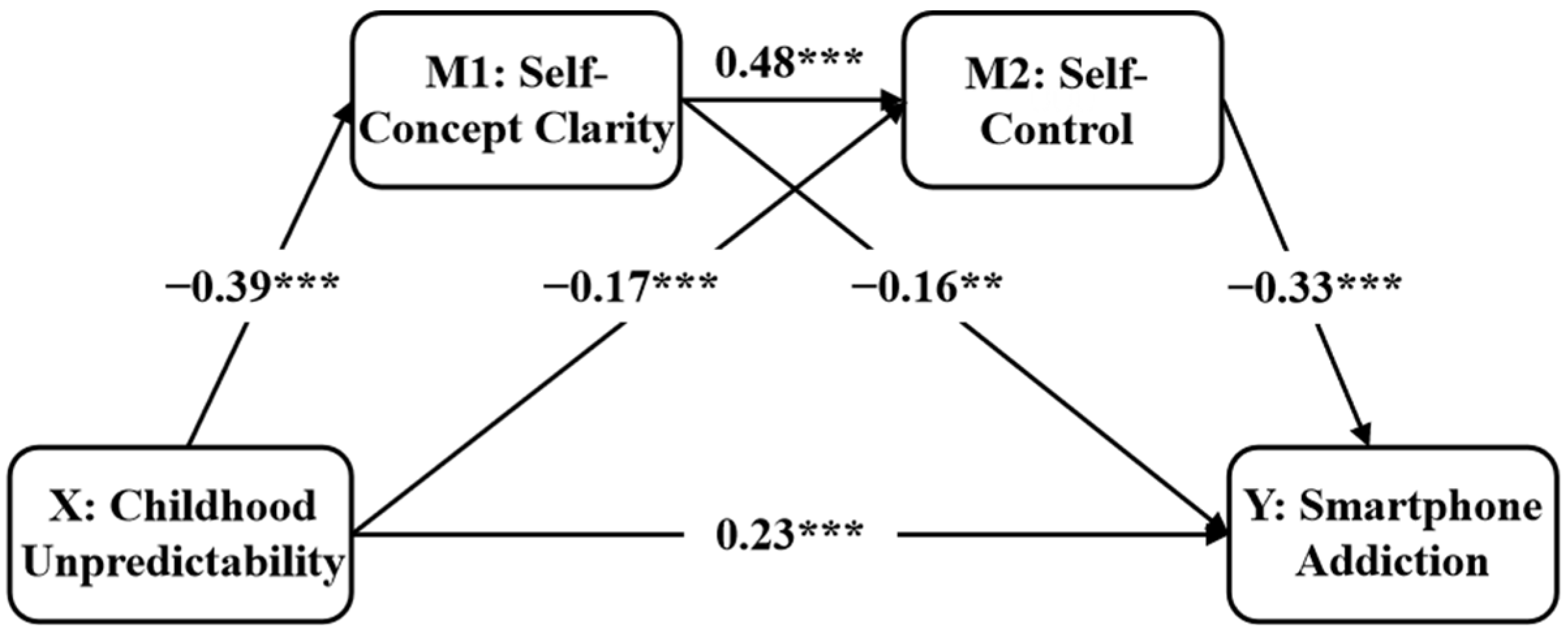
3.2. Testing the Chain Mediating Effects of Self-Concept Clarity and Self-Control
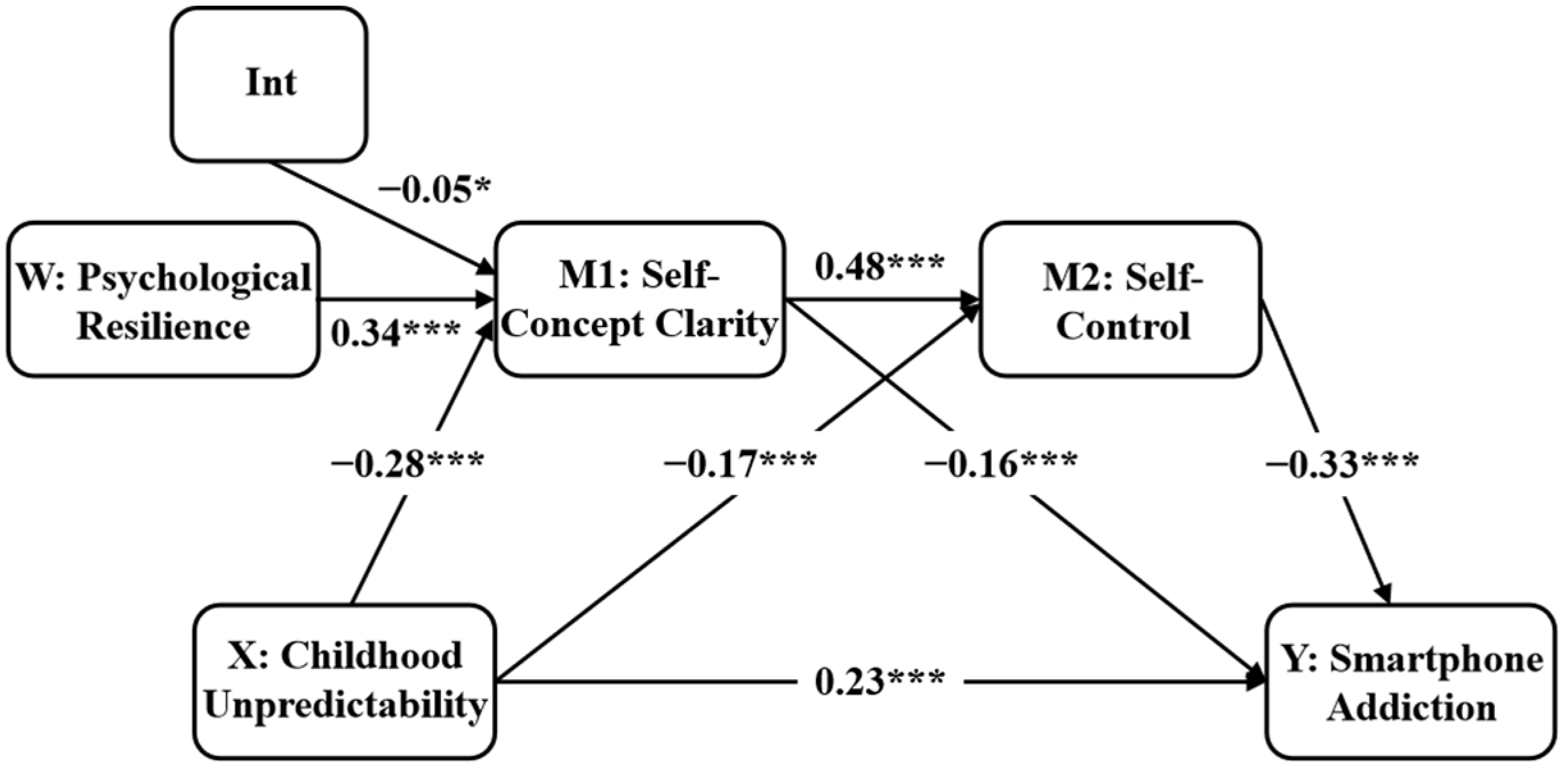
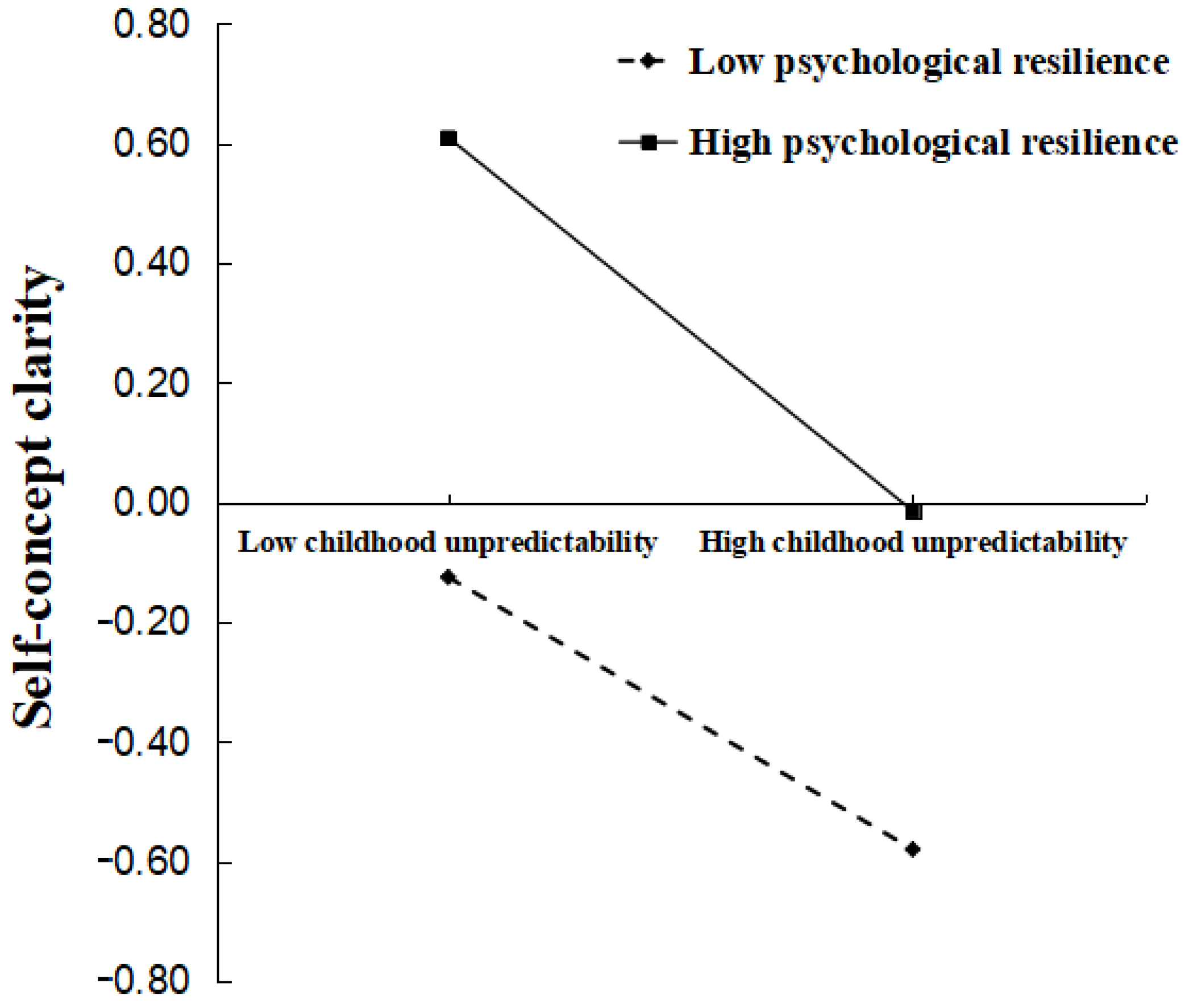
3.3. Moderated Chain Mediation Test
4. Discussion
5. Conclusions
Author Contributions
Funding
Institutional Review Board Statement
Informed Consent Statement
Data Availability Statement
Conflicts of Interest
References
- Baumeister, R. F., Vohs, K. D., & Tice, D. M. (2007). The strength model of self-control. Current Directions in Psychological Science, 16(6), 351–355. [Google Scholar] [CrossRef] [Scilit]
- Baumrind, D. (1971). Current patterns of parental authority. Developmental Psychology Monographs, 4(1), 1–103. [Google Scholar] [CrossRef] [Scilit]
- Becht, A. I., Nelemans, S. A., Van Dijk, M. P., Branje, S. J., Van Lier, P. A., Denissen, J. J., & Meeus, W. H. (2017). Clear self, better relationships: Adolescents’ self-concept clarity and relationship quality with parents and peers across 5 years. Child Development, 88(6), 1823–1833. [Google Scholar] [CrossRef] [Scilit]
- Bechtoldt, M. N., De Dreu, C. K., Nijstad, B. A., & Zapf, D. (2010). Self-concept clarity and the management of social conflict. Journal of Personality, 78(2), 539–574. [Google Scholar] [CrossRef] [Scilit]
- Bian, M., & Leung, L. (2015). Linking loneliness, shyness, smartphone addiction symptoms, and patterns of smartphone use to social capital. Social Science Computer Review, 33(1), 61–79. [Google Scholar] [CrossRef] [Scilit]
- Błachnio, A., Przepiorka, A., Cudo, A., Angeluci, A., Ben-Ezra, M., Durak, M., Kaniasty, K., Mazzoni, E., Senol-Durak, E., Hou, W. K., & Benvenuti, M. (2023). Self-control and digital media addiction: The mediating role of media multitasking and time style. Psychology Research and Behavior Management, 16, 2283–2296. [Google Scholar] [CrossRef] [Scilit] [PubMed]
- Branje, S., De Moor, E. L., Spitzer, J., & Becht, A. I. (2021). Dynamics of identity development in adolescence: A decade in review. Journal of Research on Adolescence, 31(4), 908–927. [Google Scholar] [CrossRef] [Scilit] [PubMed]
- Campbell, J. D. (1990). Self-esteem and clarity of the self-concept. Journal of Personality and Social Psychology, 59(3), 538–549. [Google Scholar] [CrossRef]
- Campbell, J. D., Trapnell, P. D., Heine, S. J., Katz, I. M., Lavallee, L. F., & Lehman, D. R. (1996). Self-concept clarity: Measurement, personality correlates, and cultural boundaries. Journal of Personality and Social Psychology, 70(1), 141–156. [Google Scholar] [CrossRef]
- Carlon, H. A., Hurlocker, M. C., Hoeppner, B. B., & Witkiewitz, K. (2025). Positive psychological interventions for substance use, addiction and recovery: An updated systematic review and meta-analysis. Addiction, 120(7), 1295–1324. [Google Scholar] [CrossRef] [Scilit]
- Choliz, M. (2012). Mobile-phone addiction in adolescence: The test of mobile phone dependence (TMD). Progress in Health Sciences, 2(1), 33–44. [Google Scholar]
- Coyne, S. M., Stockdale, L., & Summers, K. (2019). Problematic cell phone use, depression, anxiety, and self-regulation: Evidence from a three-year longitudinal study from adolescence to emerging adulthood. Computers in Human Behavior, 96, 78–84. [Google Scholar] [CrossRef] [Scilit]
- Crust, L., Swann, C., & Allen-Collinson, J. (2019). Mentally tough behaviour in extreme environments: Perceptions of elite high-altitude mountaineers. Qualitative Research in Sport, Exercise and Health, 11(3), 334–347. [Google Scholar] [CrossRef] [Scilit]
- Ding, H., Han, J., Zhang, M., Wang, K., Gong, J., & Yang, S. (2017). Moderating and mediating effects of resilience between childhood trauma and depressive symptoms in Chinese children. Journal of Affective Disorders, 211, 130–135. [Google Scholar] [CrossRef] [Scilit]
- Ellis, B. J., Figueredo, A. J., Brumbach, B. H., & Schlomer, G. L. (2009). Fundamental dimensions of environmental risk: The impact of harshness and unpredictability on the evolution and development of life history strategies. Human Nature, 20(2), 204–268. [Google Scholar] [CrossRef] [Scilit]
- Erikson, E. H. (1968). Identity: Youth and crisis. W.W. Norton & Company. [Google Scholar]
- Everri, M., Mancini, T., & Fruggeri, L. (2015). Family functioning, parental monitoring and adolescent familiar responsibility in middle and late adolescence. Journal of Child and Family Studies, 24, 3058–3066. [Google Scholar] [CrossRef] [Scilit]
- Fletcher, D., & Sarkar, M. (2013). Psychological resilience: A review and critique of definitions, concepts and theory. European Psychologist, 18(1), 12–23. [Google Scholar] [CrossRef] [Scilit]
- Geng, Y., Gu, J., Wang, J., & Zhang, R. (2021). Smartphone addiction and depression, anxiety: The role of bedtime procrastination and self-control. Journal of Affective Disorders, 293, 415–421. [Google Scholar] [CrossRef] [Scilit]
- Gillan, C. M., & Rutledge, R. B. (2021). Smartphones and the neuroscience of mental health. Annual Review of Neuroscience, 44(1), 129–151. [Google Scholar] [CrossRef] [Scilit]
- Grieve, R., Kemp, N., Norris, K., & Padgett, C. R. (2017). Push or pull? Unpacking the social compensation hypothesis of Internet use in an educational context. Computers & Education, 109, 1–10. [Google Scholar] [CrossRef] [Scilit]
- Gucciardi, D. F. (2017). Mental toughness: Progress and prospects. Current Opinion in Psychology, 16, 17–23. [Google Scholar] [CrossRef] [Scilit]
- Hayes, A. F. (2017). Introduction to mediation, moderation, and conditional process analysis: A regression-based approach. Guilford Publications. [Google Scholar]
- Higgins, E. T. (1996). Self-discrepancy theory: What patterns of self-beliefs cause people to suffer? In E. T. Higgins, & A. W. Kruglanski (Eds.), Social psychology: Handbook of basic principles (pp. 949–988). Guilford Press. [Google Scholar]
- Hofmann, W., Friese, M., & Strack, F. (2009). Impulse and self-control from a dual-systems perspective. Perspectives on Psychological Science, 4(2), 162–176. [Google Scholar] [CrossRef] [Scilit] [PubMed]
- Jiang, T., Wang, T., Poon, K.-T., Gaer, W., & Wang, X. (2023). Low self-concept clarity inhibits self-control: The mediating effect of global self-continuity. Personality and Social Psychology Bulletin, 49(11), 1587–1600. [Google Scholar] [CrossRef] [Scilit] [PubMed]
- Kardefelt-Winther, D. (2014). A conceptual and methodological critique of internet addiction research: Towards a model of compensatory internet use. Computers in Human Behavior, 31, 351–354. [Google Scholar] [CrossRef] [Scilit]
- Koss, K. J., Hyde, L. W., Essex, M. J., & Clark, R. (2025). Childhood environmental unpredictability and adolescent mental health and behavioral problems. Child Development, 95(3), 910–926. [Google Scholar] [CrossRef] [Scilit]
- Lai, X., Huang, S., Nie, C., Yan, J. J., Li, Y., Wang, Y., & Luo, Y. (2022). Trajectory of problematic smartphone use among adolescents aged 10–18 years: The roles of childhood family environment and concurrent parent-child relationships. Journal of Behavioral Addictions, 11(2), 577–587. [Google Scholar] [CrossRef] [Scilit]
- Lee, G., Lee, J., & Sanford, C. (2010). The roles of self-concept clarity and psychological reactance in compliance with product and service recommendations. Computers in Human Behavior, 26(6), 1481–1487. [Google Scholar] [CrossRef] [Scilit]
- Li, J., Zhang, H., & Liu, Y. (2024). The effect of childhood harshness and unpredictability on Internet addiction among college students: The mediating effect of self-control. Heliyon, 10, e31322. [Google Scholar] [CrossRef] [Scilit]
- Li, Q., Liu, M. J., & Fu, Z. R. (2025). Examining the longitudinal association of parental attachment with self-control among adolescents: The mediating role of self-concept clarity. Children and Youth Services Review, 179, 108614. [Google Scholar] [CrossRef] [Scilit]
- Li, Q., Song, S., Xiang, G., Fu, Z., Zhou, Z., & Chen, H. (2023). The inferior frontal gyrus spontaneous activity mediates the association of early life adversity with self-control ability in late adolescents. Psychophysiology, 60(8), e14291. [Google Scholar] [CrossRef] [Scilit]
- Light, A. E. (2018). Self-concept clarity, self-regulation, and psychological well-being. In Self-concept clarity: Perspectives on assessment, research, and applications (pp. 177–193). Springer International Publishing. [Google Scholar]
- Light, A. E., Rios, K., & DeMarree, K. G. (2018). Self-uncertainty and the influence of alternative goals on self-regulation. Personality and Social Psychology Bulletin, 44(1), 24–36. [Google Scholar] [CrossRef] [Scilit] [PubMed]
- Lin, H., Tov, W., & Qiu, L. (2014). Emotional disclosure on social networking sites: The role of network structure and psychological needs. Computers in Human Behavior, 41, 342–350. [Google Scholar] [CrossRef] [Scilit]
- Lin, Z., & Wang, Y. (2015). Life history theory: A view of life development from the perspective of evolution. Advances in Psychological Science, 23(4), 721–728. [Google Scholar] [CrossRef] [Scilit]
- Liu, Q., Yang, Y., Lin, Y., Yu, S., & Zhou, Z. K. (2017). Smartphone addiction: Concept, measurement, and influencing factors. Chinese Journal of Clinical Psychology, 25(1), 82–87. [Google Scholar]
- Liu, Q., Zhang, C., Yang, Z., & Xu, X. (2025). Problematic TikTok use severity, self-control, and school engagement: A one-year longitudinal study. Cyberpsychology: Journal of Psychosocial Research on Cyberspace, 19(3), 5. [Google Scholar] [CrossRef] [Scilit]
- Lu, H. J., & Chang, L. (2019). Aggression and risk-taking as adaptive implementations of fast life history strategy. Developmental Science, 22(5), e12827. [Google Scholar] [CrossRef] [Scilit]
- Luthar, S. S., & Cicchetti, D. (2000). The construct of resilience: Implications for interventions and social policies. Development and Psychopathology, 12(4), 857–885. [Google Scholar] [CrossRef] [Scilit]
- Masten, A. S. (2018). Resilience theory and research on children and families: Past, present, and promise. Journal of Family Theory & Review, 10, 12–31. [Google Scholar] [CrossRef] [Scilit]
- McKay, M. T., Kilmartin, L., Meagher, A., Cannon, M., Healy, C., & Clarke, M. C. (2022). A revised and extended systematic review and meta-analysis of the relationship between childhood adversity and adult psychiatric disorder. Journal of Psychiatric Research, 156, 268–283. [Google Scholar] [CrossRef] [Scilit]
- Meggs, J., Ditzfeld, C., & Golby, J. (2014). Self-concept organisation and mental toughness in sport. Journal of Sports Sciences, 32(2), 101–109. [Google Scholar] [CrossRef] [Scilit]
- Mukherjee, S., & Kumar, U. (2016). Psychological resilience: A conceptual review of theory and research. In The Routledge international handbook of psychosocial resilience (pp. 3–12). Routledge. [Google Scholar]
- Niu, G. F., Sun, X. J., Zhou, Z. K., Tian, Y., Liu, Q. Q., & Lian, S. L. (2016). The influence of adolescents’ use of social networking sites on self-concept clarity: The mediating role of social comparison. Psychological Science, 39(1), 97–102. [Google Scholar]
- Samaha, M., & Hawi, N. S. (2016). Relationships among smartphone addiction, stress, academic performance, and satisfaction with life. Computers in Human Behavior, 57, 321–325. [Google Scholar] [CrossRef] [Scilit]
- Sanders, M. T., Welsh, J. A., Bierman, K. L., & Heinrichs, B. S. (2020). Promoting resilience: A preschool intervention enhances the adolescent adjustment of children exposed to early adversity. School Psychology, 35(5), 285. [Google Scholar] [CrossRef] [Scilit]
- Soenens, B., Deci, E. L., & Vansteenkiste, M. (2017). How parents contribute to children’s psychological health: The critical role of psychological need support. In M. Wehmeyer, K. Shogren, T. Little, & S. Lopez (Eds.), Development of self-determination through the life-course (pp. 277–298). Springer. [Google Scholar]
- Su, S., Pan, T., Liu, Q., Chen, X., Wang, Y., & Li, M. (2014). Preliminary compilation of the smartphone addiction scale for college students. Chinese Mental Health Journal, 28(5), 392–397. [Google Scholar]
- Tangney, J. P., Baumeister, R. F., & Boone, A. L. (2004). High self-control predicts good adjustment, less pathology, better grades, and interpersonal success. Journal of Personality, 72(2), 271–324. [Google Scholar] [CrossRef] [Scilit]
- Van Dijk, M. P. A., Branje, S., Keijsers, L., Hawk, S. T., Hale, W. W., & Meeus, W. (2014). Self-concept clarity across adolescence: Longitudinal associations with open communication with parents and internalizing symptoms. Journal of Youth and Adolescence, 43(11), 1861–1876. [Google Scholar] [CrossRef] [Scilit]
- Vartanian, L. R. (2009). When the body defines the self: Self-concept clarity, internalization, and body image. Journal of Social and Clinical Psychology, 28(1), 94–126. [Google Scholar] [CrossRef] [Scilit]
- Vartanian, L. R., Nicholls, K., & Fardouly, J. (2023). Testing the identity disruption model among adolescents: Pathways connecting adverse childhood experiences to body dissatisfaction. Journal of Youth and Adolescence, 52(1), 134–148. [Google Scholar] [CrossRef] [Scilit]
- Wang, D., Zhou, M., & Hu, Y. (2024). The relationship between harsh parenting and smartphone addiction among adolescents: Serial mediating role of depression and social pain. Psychology Research and Behavior Management, 17, 735–752. [Google Scholar] [CrossRef] [Scilit] [PubMed]
- Willis, K. D., & Burnett, H. J., Jr. (2016). The power of stress: Perceived stress and its relationship with rumination, self-concept clarity, and resilience. North American Journal of Psychology, 18(3), 483–498. [Google Scholar]
- Wong, A. E., Dirghangi, S. R., & Hart, S. R. (2019). Self-concept clarity mediates the effects of adverse childhood experiences on adult suicide behavior, depression, loneliness, perceived stress, and life distress. Self and Identity, 18(3), 247–266. [Google Scholar] [CrossRef] [Scilit]
- Wong, A. E., & Vallacher, R. R. (2018). Reciprocal feedback between self-concept and goal pursuit in daily life. Journal of Personality, 86(3), 543–554. [Google Scholar] [CrossRef] [Scilit]
- Wu, D., Liu, M., Li, D., & Yin, H. (2024). The longitudinal relationship between loneliness and both social anxiety and mobile phone addiction among rural left-behind children: A cross-lagged panel analysis. Journal of Adolescence, 96(5), 969–982. [Google Scholar] [CrossRef] [PubMed]
- Xiang, G., Li, Q., & Du, X. (2022). Links between family cohesion and subjective well-being in adolescents and early adults: The mediating role of self-concept clarity and hope. Current Psychology, 41, 76–85. [Google Scholar] [CrossRef] [Scilit]
- Xiang, G., Teng, Z., Yang, L., & He, Y. (2024). Longitudinal relationships among sociocultural pressure for body image, self-concept clarity, and emotional well-being in adolescents. Journal of Adolescence, 96, 98–111. [Google Scholar] [CrossRef] [Scilit] [PubMed]
- Xiong, S. C., Zhang, B., Jiang, Y. Z., Jiang, H. B., & Chen, Y. (2021). A meta-analysis of the prevalence and influencing factors of mobile phone addiction. Studies of Psychology and Behavior, 19(6), 802–808. [Google Scholar]
- Yang, Z., Luo, Y., Chen, F., Qi, M., Luo, R., Li, Y., & Wang, Y. (2024). Environmental unpredictability and self-concept clarity in Chinese adolescents during the COVID-19 pandemic: The mediating role of depressive symptoms. Current Psychology, 43(29), 24159–24167. [Google Scholar] [CrossRef] [Scilit]
- Zhang, K., Shi, J., & Wang, Y. (2008). Compilation and application of the psychological resilience scale. Studies of Psychology and Behavior, 6(2), 99–104. [Google Scholar]
- Zhang, M. X., Ku, L., & Wu, A. M. S. (2024). Childhood risks and problematic smartphone use: Dual processes of life history strategy and psychological distress. Cyberpsychology: Journal of Psychosocial Research on Cyberspace, 18(4), 1. [Google Scholar] [CrossRef] [Scilit]
- Zhang, M. X., Su, X., & Wu, A. M. S. (2023). Is fast life history strategy associated with poorer self-regulation and higher vulnerability to behavioral addictions? A cross-sectional study on smartphone addiction and gaming disorder. Current Psychology, 42, 22770–22780. [Google Scholar] [CrossRef] [Scilit]
- Zhang, M. X., & Wu, A. M. S. (2022). Effects of childhood adversity on smartphone addiction: The multiple mediation of life history strategies and smartphone use motivations. Computers in Human Behavior, 134, 107298. [Google Scholar] [CrossRef] [Scilit]
- Zhou, H., & Long, L. (2004). Statistical remedies for common method biases. Advances in Psychological Science, 12(6), 942. [Google Scholar]


| Variables | M | SD | 1 | 2 | 3 | 4 | 5 |
|---|---|---|---|---|---|---|---|
| 1 Childhood unpredictability | 2.49 | 0.62 | - | ||||
| 2 Self-concept clarity | 3.80 | 1.07 | −0.40 ** | - | |||
| 3 Self-control | 2.81 | 0.57 | −0.37 ** | 0.56 ** | - | ||
| 4 Psychological resilience | 4.11 | 0.98 | −0.33 ** | 0.45 ** | 0.50 ** | - | |
| 5 Smartphone addiction | 2.33 | 0.60 | 0.41 ** | −0.43 ** | −0.51 ** | −0.41 ** | - |
| Independent Variable | Dependent Variable | ||||||||
|---|---|---|---|---|---|---|---|---|---|
| Self-Concept Clarity | Self-Control | Smartphone Addiction | |||||||
| β | t | 95%CI | β | t | 95%CI | β | t | 95%CI | |
| Sex | −0.25 | −6.39 *** | [−0.33, −0.17] | −0.08 | −2.24 * | [−0.15, −0.01] | −0.03 | −0.77 | [−0.10, 0.04] |
| Age | 0.01 | 0.84 | [−0.01, 0.03] | 0.01 | 0.90 | [−0.01, 0.03] | −0.02 | −1.85 | [−0.03, 0.00] |
| Income | 0.03 | 1.54 | [−0.01, 0.08] | 0.01 | 0.36 | [−0.03, 0.04] | 0.01 | 0.65 | [−0.03, 0.05] |
| Childhood unpredictability | −0.39 | −20.44 *** | [−0.43, −0.35] | −0.17 | −9.35 *** | [−0.21, −0.14] | 0.23 | 11.84 *** | [0.19, 0.27] |
| Self-concept clarity | 0.48 | 25.63 *** | [0.45, 0.52] | −0.16 | −7.21 *** | [−0.20, −0.11] | |||
| Self-control | −0.33 | −15.74 *** | [−0.38, −0.29] | ||||||
| R2 | 0.18 | 0.34 | 0.34 | ||||||
| F | 121.15 *** | 232.84 *** | 185.32 *** | ||||||
| Effect | Pathway | Value | SE | 95%CI |
|---|---|---|---|---|
| Direct effect | childhood unpredictability→smartphone addiction | 0.23 | 0.02 | [0.19, 0.27] |
| Mediation effect | childhood unpredictability→self-concept clarity→smartphone addiction | 0.06 | 0.01 | [0.04, 0.08] |
| childhood unpredictability→self-control→smartphone addiction | 0.06 | 0.01 | [0.04, 0.07] | |
| childhood unpredictability→self-concept clarity→self-control→smartphone addiction | 0.06 | 0.01 | [0.05, 0.08] | |
| Total effect | 0.41 | 0.02 | [0.37, 0.45] |
Disclaimer/Publisher’s Note: The statements, opinions and data contained in all publications are solely those of the individual author(s) and contributor(s) and not of MDPI and/or the editor(s). MDPI and/or the editor(s) disclaim responsibility for any injury to people or property resulting from any ideas, methods, instructions or products referred to in the content. |
© 2026 by the authors. Licensee MDPI, Basel, Switzerland. This article is an open access article distributed under the terms and conditions of the Creative Commons Attribution (CC BY) license.
Share and Cite
Li, Q.; Zhang, M.; Wang, H.; Liu, W.; Wang, Y.; Li, Z.; Fu, Z. Childhood Unpredictability and Smartphone Addiction in Chinese Adolescents: Mediating Role of Self-Concept Clarity and Self-Control and Moderating Role of Psychological Resilience. Behav. Sci. 2026, 16, 85. https://doi.org/10.3390/bs16010085
Li Q, Zhang M, Wang H, Liu W, Wang Y, Li Z, Fu Z. Childhood Unpredictability and Smartphone Addiction in Chinese Adolescents: Mediating Role of Self-Concept Clarity and Self-Control and Moderating Role of Psychological Resilience. Behavioral Sciences. 2026; 16(1):85. https://doi.org/10.3390/bs16010085
Chicago/Turabian StyleLi, Qingqing, Mingyang Zhang, Hailan Wang, Wenjing Liu, Yanjing Wang, Zhuoran Li, and Zhenrong Fu. 2026. "Childhood Unpredictability and Smartphone Addiction in Chinese Adolescents: Mediating Role of Self-Concept Clarity and Self-Control and Moderating Role of Psychological Resilience" Behavioral Sciences 16, no. 1: 85. https://doi.org/10.3390/bs16010085
APA StyleLi, Q., Zhang, M., Wang, H., Liu, W., Wang, Y., Li, Z., & Fu, Z. (2026). Childhood Unpredictability and Smartphone Addiction in Chinese Adolescents: Mediating Role of Self-Concept Clarity and Self-Control and Moderating Role of Psychological Resilience. Behavioral Sciences, 16(1), 85. https://doi.org/10.3390/bs16010085