Replication of Strategic and Interactive Writing Instruction in a Nationwide Randomized Controlled Trial

 ,
,  , ,
, ,  ,
,
Abstract
1. Literature Review
1.1. Writing Instruction and Deaf Students
1.2. Strategic and Interactive Writing Instruction
1.2.1. Interactive Instruction
1.2.2. Strategy Instruction
1.2.3. Metalinguistic Knowledge/Linguistic Competence
1.3. Motivation
1.4. Writing and Language Outcomes of SIWI
1.5. Broader Impacts
1.6. RCT and Replication
1.7. The Current Study
2. Method
2.1. Research Questions
2.2. Design
2.2.1. Random Assignment
2.2.2. Study Disruption Due to COVID-19
2.2.3. Funding and Participant Compensation
2.3. Teacher Participants
2.4. SIWI Professional Development
2.5. SIWI Intervention
Fidelity Scoring
2.6. BAU Writing Instruction as Distinct from SIWI
2.7. Student Participants
2.8. Educational Context
2.9. Hearing Levels
2.10. Data Collection
2.11. Measures
2.11.1. Genre-Related Writing Traits
2.11.2. Written Language Clarity
2.11.3. Broad Written Language
2.11.4. Writing Motivation
2.11.5. Handwriting
2.12. Data Analysis
2.12.1. Treatment Analyses
2.12.2. Moderation Analyses
3. Results
3.1. Results of Treatment Analyses
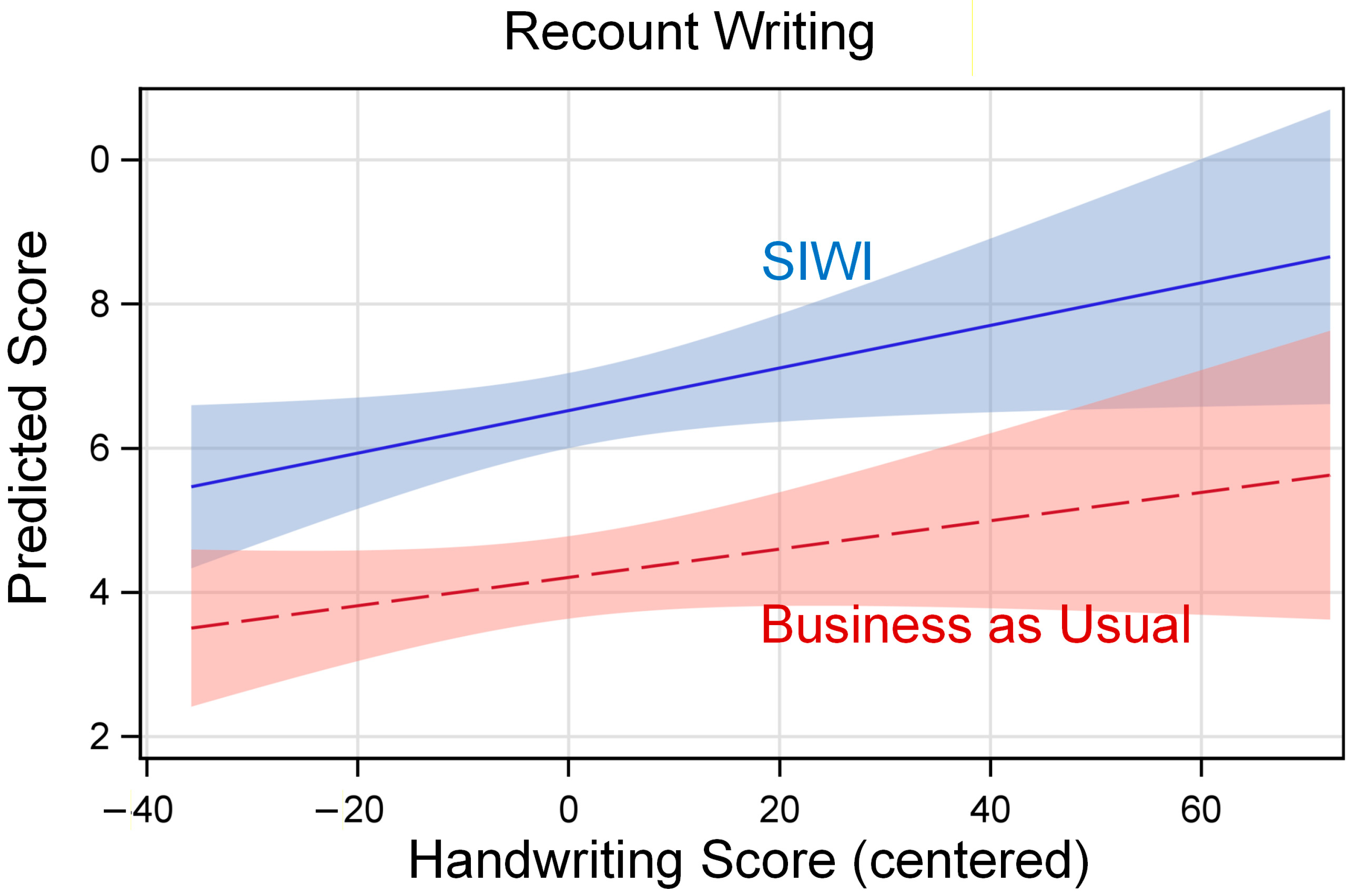
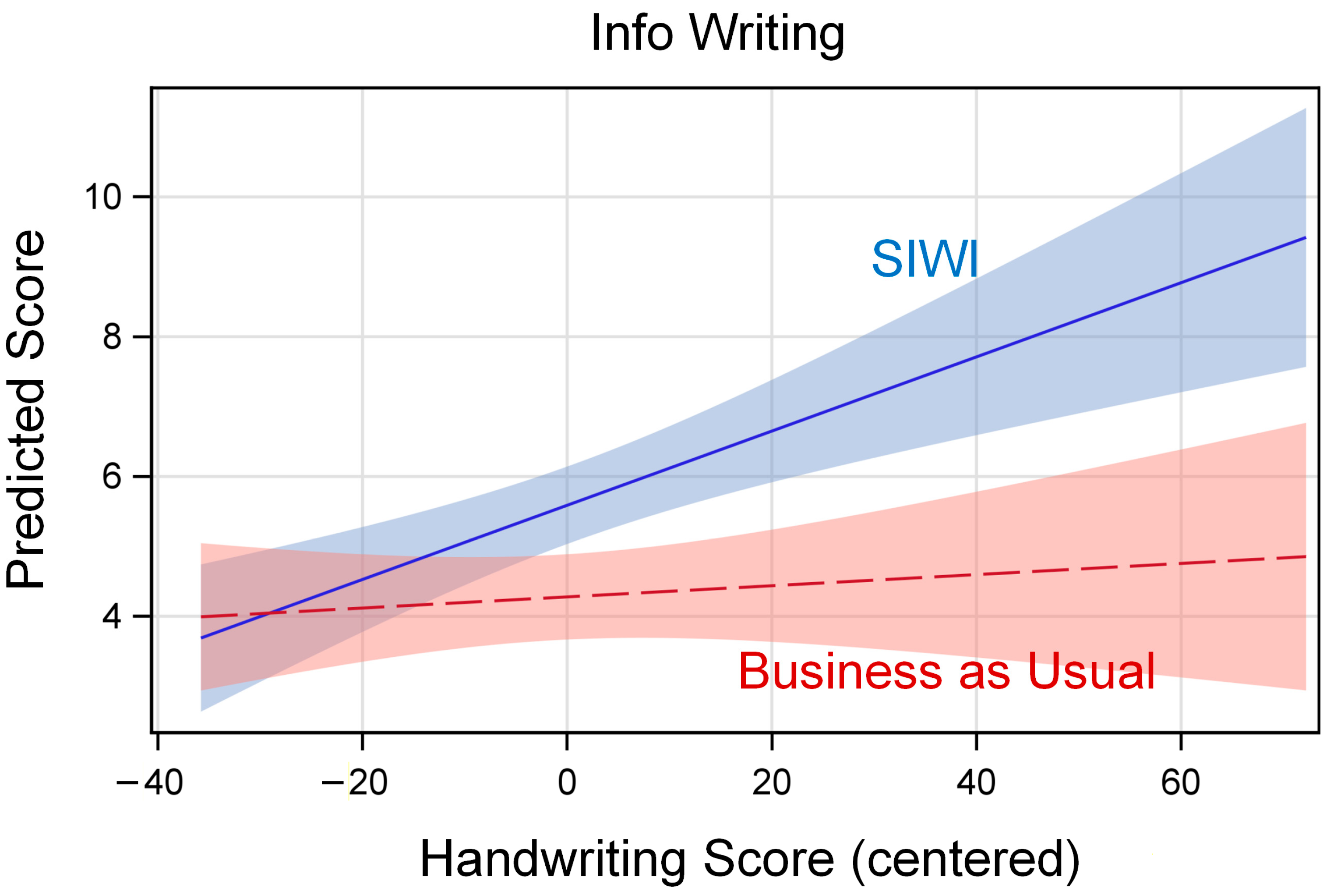
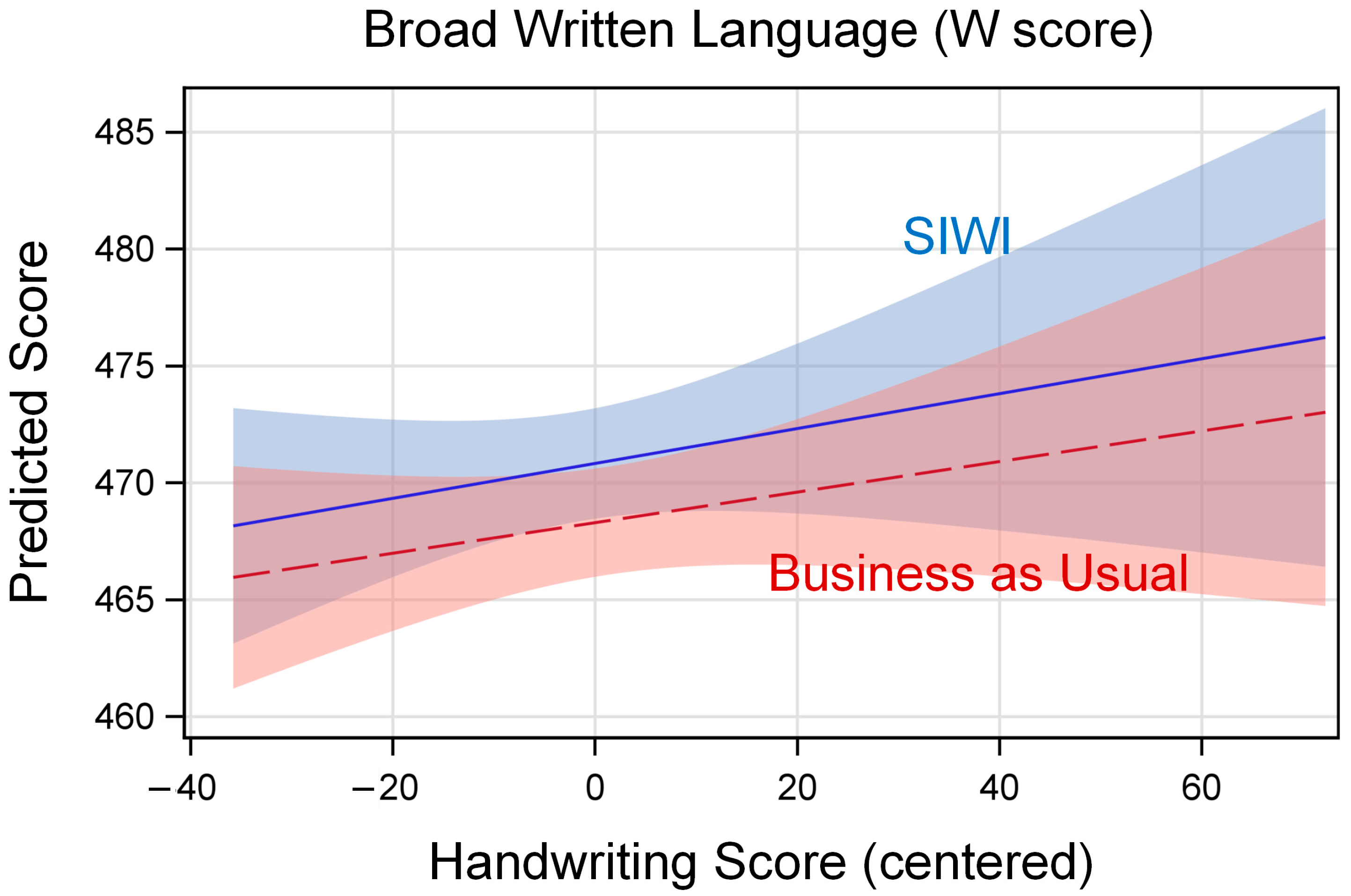
3.2. Results of Moderation Analyses
4. Discussion
4.1. Impact of Handwriting
4.2. Impact on Motivation
4.3. Limitations
4.4. Future Directions
5. Conclusions
Author Contributions
Funding
Institutional Review Board Statement
Informed Consent Statement
Data Availability Statement
Conflicts of Interest
Appendix A

| Outcome | Wave | Classroom | Student | ICC |
|---|---|---|---|---|
| Recount Writing | pretest | 3.67 | 5.00 | 0.42 |
| posttest | 6.90 | 6.27 | 0.52 | |
| Info Writing | pretest | 2.72 | 5.01 | 0.35 |
| posttest | 4.38 | 6.99 | 0.39 | |
| Recount WER III | pretest | 0.04 | 0.04 | 0.49 |
| posttest | 0.03 | 0.04 | 0.43 | |
| Info WER III | pretest | 0.02 | 0.05 | 0.31 |
| posttest | 0.03 | 0.03 | 0.49 | |
| WJ Broad Writing | pretest | 347.46 | 353.61 | 0.50 |
| posttest | 315.19 | 258.86 | 0.55 | |
| Recount Motivation | pretest | 0.04 | 0.85 | 0.04 |
| posttest | 0.20 | 0.50 | 0.28 | |
| Info Motivation | pretest | 0.09 | 0.71 | 0.12 |
| posttest | 0.15 | 0.68 | 0.18 | |
| Handwriting Fluency | pretest | 99.32 | 265.50 | 0.27 |
| posttest | 174.40 | 239.57 | 0.42 |
| Outcome | Est | SE | Ratio | p |
|---|---|---|---|---|
| Recount Writing | 1.09 | 0.21 | 5.09 | <0.01 |
| Info Writing | 0.73 | 0.20 | 3.58 | <0.01 |
| Recount WER III | 0.45 | 0.19 | 2.39 | 0.02 |
| Info WER III | 0.10 | 0.19 | 0.50 | 0.62 |
| WJ Broad Writing | 0.24 | 0.17 | 1.42 | 0.16 |
| Recount Motivation | 0.39 | 0.22 | 1.76 | 0.08 |
| Info Motivation | 0.46 | 0.17 | 2.68 | 0.01 |
| 1 | We calculated minimal detectable effect sizes in Optimal Design using information from our previous studies: 80% power, alpha = 0.05, 4 students per classroom, ICC = 30%, and pretest R-squared of 36%. For a range of participating teachers from 46 to 67, we found a range of MDES of 0.36 to 0.60. |
References
- Aboudi, C. M. (2022). The impact of two components of Strategic Interactive Writing Intervention (SIWI) on the writing skills of an elementary student with hearing loss [Master’s thesis, Minot State University]. [Google Scholar]
- Al-Enazi, F., & Turkestani, M. (2024). The effect of the Strategic and Interactive Writing Instruction (SIWI) on developing composition writing skills among hard of hearing high school students and their tendencies towards writing. Journal of Educational and Psychological Studies, 18(1), 51–67. [Google Scholar] [CrossRef] [Scilit]
- Alsraisry, N., & Albakheet, H. (2020). Effectiveness of the Strategic and Interactive Writing Instruction (SIWI) in improving written expression skills among students with hard of hearing in higher education. Journal of Education Sohag UNV, 79(79), 1347–1374. [Google Scholar] [CrossRef] [Scilit]
- Appanah, T. M., & Hoffman, N. (2014). Using scaffolded self-editing to improve the writing of signing adolescent deaf students. American Annals of the Deaf, 159(3), 269–283. [Google Scholar] [CrossRef] [Scilit]
- Applebee, A. N. (2000). Alternative models of writing development. In R. Indrisano, & J. Squire (Eds.), Perspectives on writing: Research, theory and practice (pp. 90–110). International Reading Association. [Google Scholar]
- Applebee, A. N., & Langer, J. A. (2011). A snapshot of writing instruction in middle schools and high schools. English Journal, 100(6), 14–27. [Google Scholar] [CrossRef] [Scilit]
- Arfé, B. (2015). Oral and written discourse skills in deaf and hard of hearing children: The role of reading and verbal working memory. Topics in Language Disorders, 35(2), 180–197. [Google Scholar] [CrossRef] [Scilit]
- August, D., Branum-Martin, L., Cardenas-Hagan, E., & Francis, D. J. (2009). The impact of an instructional intervention on the science and language learning of middle grade English language learners. Journal of Research on Educational Effectiveness, 2(4), 345–376. [Google Scholar] [CrossRef] [Scilit]
- Beal, J. S., Dostal, H. M., & Easterbrooks, S. R. (2024). Literacy instruction for students who are deaf and hard of hearing (2nd ed.). Oxford University Press. [Google Scholar]
- Berninger, V. W. (1999). Coordinating transcription and text generation in working memory during composing: Automatic and constructive processes. Learning Disability Quarterly, 22(2), 99–112. [Google Scholar] [CrossRef] [Scilit]
- Bialystok, E. (2001). Bilingualism in development: Language, literacy, and cognition. Cambridge University Press. [Google Scholar]
- Blanch, N., Forsythe, L. C., Van Allen, J. H., & Roberts, S. K. (2017). Reigniting writers: Using the literacy block with elementary students to support authentic writing experiences. Childhood Education, 93(1), 48–57. [Google Scholar] [CrossRef] [Scilit]
- Bowers, L., Dostal, H., Wolbers, K., & Graham, S. C. (2018). The assessment of written phrasal constructs and grammar of deaf and hard of hearing students with varying expressive language abilities. Education Research International, 2018, 1–10. [Google Scholar] [CrossRef] [Scilit]
- Brindle, M., Graham, S., Harris, K., & Hebert, M. (2016). Third and fourth grade teacher’s classroom practices in writing: A national survey. Reading and Writing, 29, 929–954. [Google Scholar] [CrossRef] [Scilit]
- Bruning, R. H., & Horn, C. (2000). Developing motivation to write. Educational Psychologist, 35(1), 25–37. [Google Scholar] [CrossRef] [Scilit]
- Burbules, N. (1993). Dialogue in teaching. Teachers College Press. [Google Scholar]
- Camacho, A., Alves, R. A., & Boscolo, P. (2020). Writing motivation in school: A systematic review of empirical research in the early twenty-first century. Educational Psychology Review, 33, 213–247. [Google Scholar] [CrossRef] [Scilit]
- Chomsky, N. (1965). Persistent topics in linguistic theory. Diogenes, 13(51), 13–20. [Google Scholar] [CrossRef] [Scilit]
- Chomsky, N. (2014). Aspects of the theory of syntax (50th anniversary ed.). MIT Press. [Google Scholar]
- Cook, B. G. (2014). A call for examining replication and bias in special education research. Remedial and Special Education, 35(4), 233–246. [Google Scholar] [CrossRef] [Scilit]
- Courson, F. F. (2022). A Survey of novice deaf education teachers’ pedagogy for writing instruction [Doctoral dissertation, Lamar University]. Available online: https://www.proquest.com/dissertations-theses/survey-novice-deaf-education-teachers-pedagogy/docview/2755893478/se-2 (accessed on 14 November 2025).
- Cui, Y. C. (2022). SAWC: The rubric of Chinese deaf students’ writing ability. International Journal of Elementary Education, 11(4), 84–91. [Google Scholar] [CrossRef]
- Darling-Hammond, L., & Richardson, N. (2009). Teacher learning: What matters? Educational Leadership, 66(5), 46–53. [Google Scholar]
- Deci, E. L., & Ryan, R. M. (1985). Intrinsic motivation and self-determination in human behavior. Plenum Press. [Google Scholar]
- De Smedt, F., & Van Keer, H. (2014). A research synthesis on effective writing instruction in primary education. Procedia-Social and Behavioral Sciences, 112, 693–701. [Google Scholar] [CrossRef] [Scilit]
- De Smedt, F., & Van Keer, H. (2018). An analytic description of an instructional writing program combining explicit writing instruction and peer-assisted writing. Journal of Writing Research, 10(2), 225–277. [Google Scholar] [CrossRef] [Scilit]
- Dostal, H., Bowers, L., Wolbers, K., & Gabriel, R. (2015). “We are authors”: A qualitative analysis of deaf students’ writing during one year of Strategic and Interactive Writing Instruction (SIWI). Review of Disability Studies: An International Journal, 11(2), 1–19. [Google Scholar]
- Dostal, H., & Wolbers, K. (2014). Developing language and writing skills of deaf and hard of hearing students: A simultaneous approach. Literacy Research and Instruction, 53(3), 245–268. [Google Scholar] [CrossRef] [Scilit]
- Dostal, H., & Wolbers, K. (2015). Video review and reflection for ongoing inservice teacher professional development. In E. Ortlieb, L. Shanahan, & M. McVee (Eds.), Video research in disciplinary literacies: Literacy research, practice and evaluation, Volume 6 (pp. 329–352). Emerald Group Publishing Limited. [Google Scholar]
- Dostal, H., & Wolbers, K. (2016). Examining student writing proficiencies across genres: Results of an intervention study. Deafness & Education International, 18(3), 159–169. [Google Scholar] [CrossRef] [Scilit]
- Dostal, H., Wolbers, K., & Kilpatrick, J. (2019). The language zone. Writing & Pedagogy, 11(1), 1–22. [Google Scholar] [CrossRef] [Scilit]
- Dostal, H., Wolbers, K., & Weir, J. (2021). Transfer of writing skills across genres mong deaf and hard of hearing elementary writers. International Journal of Educational Research, 109(2021), 101849. [Google Scholar] [CrossRef] [Scilit]
- Dostal, H. M., Wolbers, K., Ward, S., & Saulsburry, R. (2018). A national survey of teachers of the deaf on disciplinary writing. Exceptionality, 29(2), 95–113. [Google Scholar] [CrossRef] [Scilit]
- Duke, N. K., & Cartwright, K. B. (2021). The science of reading progresses: Communicating advances beyond the simple view of reading. Reading Research Quarterly, 56(S1), S25–S44. [Google Scholar] [CrossRef] [Scilit]
- Ellis, N. (2015). Implicit and explicit learning of languages. John Benjamins. [Google Scholar]
- Englert, C. S., Mariage, T. V., & Dunsmore, K. (2006). Tenets of sociocultural theory in writing instruction research. In C. MacArthur, S. Graham, & J. Fitzgerald (Eds.), Handbook of writing research (pp. 208–221). The Guilford Press. [Google Scholar]
- Enns, C., Hall, R., Isaac, B., & MacDonald, P. (2007). Process and product: Creating stories with deaf students. TESL Canada Journal, 25(1), 1–22. [Google Scholar] [CrossRef] [Scilit]
- Faes, C., Molenberghs, G., Aerts, M., Verbenke, G., & Kenward, M. G. (2009). The effective sample size and an alternative small-sample degrees-of-freedom method. The American Statistician, 63(4), 389–399. [Google Scholar] [CrossRef] [Scilit]
- Flower, L. S., & Hayes, R. J. (1980). The cognition of discovery: Defining a rhetorical problem. College Composition and Communication, 31, 21–32. [Google Scholar] [CrossRef] [Scilit]
- García, O., Johnson, S. I., & Seltzer, K. (2017). The Translanguaging classroom: Leveraging student bilingualism for learning. Caslon Publishing. [Google Scholar]
- García, O., & Wei, L. (2014). Translanguaging: Language, bilingualism, and education. Palgrave MacMillan. [Google Scholar]
- Gärdenfors, M. (2023). Writing development in DHH students: A bimodal bilingual approach. Journal of Deaf Studies and Deaf Education, 28(2), 211–225. [Google Scholar] [CrossRef] [Scilit] [PubMed]
- Gombert, J. E. (1992). Metalinguistic development. University of Chicago Press. [Google Scholar]
- Graham, S., Berninger, V., Abbott, R., Abbott, S., & Whitaker, D. (1997). The role of mechanics in composing of elementary school students: A new methodological approach. Journal of Educational Psychology, 89, 170–182. [Google Scholar] [CrossRef]
- Graham, S., Bollinger, A., Booth Olson, C., D’Aoust, C., MacArthur, C., McCutchen, D., & Olinghouse, N. (2012). Teaching elementary school students to be effective writers: A practice guide. National Center for Education Evaluation and Regional Assistance (NCEE). Institute of Education Sciences. U.S. Department of Education.
- Graham, S., & Harris, K. R. (2000). The role of self-regulation and transcription skills in writing and writing development. Educational Psychologist, 35(1), 3–12. [Google Scholar] [CrossRef] [Scilit]
- Graham, S., Harris, K. R., & McKeown, D. (2014). The writing of students with learning disabilities, meta-analysis of self-regulated strategy development writing intervention studies, and future directions: Redux. In H. L. Swanson, K. R. Harris, & S. Graham (Eds.), Handbook of learning disabilities (2nd ed., pp. 405–438). The Guilford Press. [Google Scholar]
- Graham, S., & Perin, D. (2007). Writing next: Effective strategies to improve writing of adolescents in middle and high schools. Alliance for Excellent Education. [Google Scholar]
- Graham, S., Wolbers, K., Dostal, H., & Holcomb, L. (2021). Does teacher efficacy predict writing practices of teachers of deaf and hard of hearing students. Journal of Deaf Studies and Deaf Education, 26(3), 438–450. [Google Scholar] [CrossRef] [Scilit]
- Guthrie, J. T., & Humenick, N. M. (2004). Motivating students to read: Evidence for classroom practices that increase motivation and achievement. In P. McCardle, & V. Chhabra (Eds.), The voice of evidence in reading research (pp. 329–354). Brookes. [Google Scholar]
- Guthrie, J. T., & Wigfield, A. (2000). Engagement and motivation in reading. In M. L. Kamil, P. B. Mosenthal, P. D. Pearson, & R. Barr (Eds.), Handbook of reading research (Vol. 3, pp. 403–422). Lawrence Erlbaum Associates. [Google Scholar]
- Hall, M. L., & De Anda, S. (2021). Measuring “language access profiles” in deaf and hard-of-hearing children with the DHH language exposure assessment tool. Journal of Speech, Language, and Hearing Research, 64(1), 134–158. [Google Scholar] [CrossRef] [Scilit]
- Haptonstall-Nykaza, T. S., & Schick, B. (2007). The transition from fingerspelling to English print: Facilitating English decoding. Journal of Deaf Studies and Deaf Education, 12(2), 172–183. [Google Scholar] [CrossRef] [Scilit]
- Hayes, J. R. (1996). A new framework for understanding cognition and affect in writing. In C. M. Levy, & S. Ransdell (Eds.), The science of writing: Theories, methods, individual differences, and applications (pp. 1–27). Lawrence Erbaum Associates. [Google Scholar]
- Hayes, J. R. (2006). New directions in writing theory. In C. A. MacArthur, S. Graham, & J. Fitzgerald (Eds.), Handbook of writing research (pp. 28–40). The Guilford Press. [Google Scholar]
- Hedges, L. V. (2007). Effect sizes in cluster-randomized designs. Journal of Educational and Behavioral Statistics, 32(4), 341–370. [Google Scholar] [CrossRef] [Scilit]
- Holcomb, L. (2024). Exploring signed literacy in elementary deaf students through evidence-based instructional methods. Sign Language Studies, 24(4), 843–882. [Google Scholar] [CrossRef] [Scilit]
- Holcomb, L., Dostal, H., & Wolbers, K. (2023a). Characteristics of deaf emergent writers who experienced language deprivation. Bilingual Research Journal, 45(3–4), 358–379. [Google Scholar] [CrossRef] [Scilit]
- Holcomb, L., Dostal, H., & Wolbers, K. (2023b). Supporting deaf students who experience language deprivation. Odyssey, 23, 28–31. [Google Scholar]
- Huda, K., Purwati, O., & Retnaningdyah, P. (2023). Implementation of the SIWI learning strategy to encourage deaf students’ writing skills at Extraordinary School (SLB) Lamongan. International Journal of Humanities Education and Social Sciences (IJHESS), 3(1), 375–389. [Google Scholar]
- Jackendoff, R. (1994). Patterns in the mind. BasicBooks. [Google Scholar]
- Khalsa, I. K., & Chan, D. K. (2023). Hearing impairment and school engagement outcomes in US children. JAMA Otolaryngology--Head & Neck Surgery, 149(12), 1091–1100. [Google Scholar] [CrossRef] [Scilit]
- Kolaqani, A. Q., Dastjerdi, H. V., Salehi, H., & Tabatabaei, O. (2022). Web-based Googling techniques and Strategic-Interactive Writing Instruction: A study of deaf and hearing-impaired students’ L2 writing performance. Journal of Language and Translation, 12(3), 75–85. [Google Scholar]
- Kuhn, M. R., Schwanenflugel, P. J., & Meisinger, E. B. (2010). Aligning theory and assessment of reading fluency: Automaticity, prosody, and definitions of fluency. Reading Research Quarterly, 45(2), 230–251. [Google Scholar] [CrossRef] [Scilit]
- LaBerge, D., & Samuels, S. J. (1974). Toward a theory of automatic information processing in reading. Cognitive Psychology, 6(2), 293–323. [Google Scholar] [CrossRef] [Scilit]
- Lave, J., & Wenger, E. (2003). Situated learning: Legitimate peripheral participation. Cambridge University Press. [Google Scholar]
- Littell, R. D., Milliken, G. A., Stroup, W. W., Wolfinger, R. D., & Schabenberger, O. (2006). SAS for mixed models (2nd ed.). SAS Institute. [Google Scholar]
- Logan, G. D. (1997). Automaticity and reading: Perspectives from the instance theory of automatization. Reading & Writing Quarterly, 13(2), 123–146. [Google Scholar] [CrossRef] [Scilit]
- López-Escribano, C., Martín-Babarro, J., & Pérez-López, R. (2022). Promoting handwriting fluency for preschool and elementary-age students: Meta-analysis and meta-synthesis of research from 2000 to 2020. Frontiers in Psychology, 13, 841573. [Google Scholar] [CrossRef] [Scilit]
- Magnifico, A. M. (2010). Writing for whom? Cognition, motivation, and a writer’s audience. Educational Psychologist, 45(3), 167–184. [Google Scholar] [CrossRef] [Scilit]
- Martín, J. L. O., Hameleers, I. B., Trujillo-Torres, J. M., & Moreno-Guerrero, A. J. (2020). A comparison between collaborative and individual writings in promoting motivation and language acquisition. Sustainability, 12(19), 7959. [Google Scholar] [CrossRef] [Scilit]
- McCutchen, D. (1996). A capacity theory of writing: Working memory in composition. Educational Psychology Review, 8(3), 299–325. [Google Scholar] [CrossRef] [Scilit]
- McNeish, D. (2017). Small sample methods for multilevel modeling: A colloquial elucidation of REML and the Kenward-Roger correction. Multivariate Behavioral Research, 52(5), 661–670. [Google Scholar] [CrossRef] [Scilit]
- Monroe, M., & Sherman, E. (1966). Group diagnostic reading aptitude and achievement tests. C.H. Nevins Printing Co. [Google Scholar]
- National Assessment Governing Board, US Department of Education. (2010). Writing framework for the 2011 national assessment of educational progress. Driscoll, DP.
- National Governors Association Center for Best Practices & Council of Chief State School Officers. (2010). Common core state standards. Available online: http://www.corestandards.org (accessed on 14 November 2025).
- Otheguy, R., García, O., & Reid, W. (2015). Clarifying translanguaging and deconstructing named languages: A perspective from linguistics. Applied Linguistics Review, 6(3), 281–307. [Google Scholar] [CrossRef] [Scilit]
- Pajares, F. (2003). Self-efficacy beliefs, motivation, and achievement in writing: A review of the literature. Reading & Writing Quarterly, 19(2), 139–158. [Google Scholar] [CrossRef] [Scilit]
- Pajares, F., Valiante, G., & Cheong, Y. F. (2007). Writing self-efficacy and its relation to gender, writing motivation, and writing competence: A developmental perspective. In S. Hidi, & P. Boscolo (Eds.), Studies in writing: Writing and motivation (Vol. 19, pp. 141–159). Elsevier. [Google Scholar]
- Pearson, P. D., & Gallagher, M. C. (1983). The instruction of reading comprehension. Contemporary Educational Psychology, 8, 317–344. [Google Scholar] [CrossRef] [Scilit]
- Pimwong, K., & Saksiriphol, D. (2018). A study on sentence writing ability of students with hearing impairment in grade 2 through SIWI and storyboard [Unpublished master’s thesis, Srinakharinwirot University]. [Google Scholar]
- Pinker, S. (1995). The language instinct: How the mind creates language. Harper Collins Publishers, Inc. [Google Scholar]
- Rogoff, B. (1990). Apprenticeship in thinking: Cognitive development in social context. Oxford University Press. [Google Scholar]
- Samuels, S. J. (2004). Toward a theory of automatic information processing in reading, revisited. In R. B. Ruddell, & N. J. Unrau (Eds.), Theoretical models and processes (pp. 1127–1148). International Reading Association. [Google Scholar]
- Samuels, S. J. (2006). Reading fluency: Its past, present, and future. In T. Rasinski, C. Blachowicz, & K. Lems (Eds.), Fluency instruction: Research-based best practices (pp. 7–20). Guilford. [Google Scholar]
- Santangelo, T., & Graham, S. (2016). A comprehensive meta-analysis of handwriting instruction. Educational Psychology Review, 28(2), 225–265. [Google Scholar] [CrossRef] [Scilit]
- SAS Institute Inc. (2014). SAS release 9.4. In SAS Institute Inc. [Google Scholar]
- Scardamalia, M., & Bereiter, C. (1986). Research on written composition. In M. C. Wittrock (Ed.), Handbook of research on teaching (3rd ed., pp. 778–803). MacMillan. [Google Scholar]
- Schleppegrell, M. J. (2004). The language of schooling: A functional linguistics perspective. Routledge. [Google Scholar]
- Schrank, F. A., Mather, N., & McGrew, K. S. (2014). Woodcock-johnson IV tests of achievement. Riverside Publishing. [Google Scholar]
- Secora, K., Wolbers, K., & Dostal, H. (2023). Writing instruction as an authentic context for targeting speech and language therapy goals for deaf and hard of hearing children. Perspectives of the ASHA Special Interest Groups, 8(1), 73–87. [Google Scholar] [CrossRef] [Scilit]
- Simpson, L. (2022). Examination of spelling skills of elementary students who are deaf and hard of hearing [Rehabilitation, Human Resources and Communication Disorders Undergraduate Honors Theses, University of Arkansas]. Available online: https://scholarworks.uark.edu/rhrcuht/80 (accessed on 14 November 2025).
- Skar, G. B., Lei, P. W., & Graham, S. (2022). Handwriting fluency and the quality of primary grade students’ writing. Reading and Writing, 35(2), 509–538. [Google Scholar] [CrossRef] [Scilit]
- Skerrit, P. (2017). Practices and routines in SIWI lessons that develop reading proficiency for D/HH learners. Caribbean Curriculum, 25(2017), 38–52. [Google Scholar]
- Skyer, M. E. (2023). Beautiful utility: Visual tools make teaching more effective and fun! Odyssey: New Directions in Deaf Education, 23, 54–58. Available online: https://files.eric.ed.gov/fulltext/EJ1408415.pdf (accessed on 14 November 2025).
- Strassman, B. K., & Schirmer, B. (2013). Teaching writing to deaf students: Does research offer evidence for practice? Remedial and Special Education, 34(3), 166–179. [Google Scholar] [CrossRef] [Scilit]
- Swanwick, R. (2017). Translanguaging, learning and teaching in deaf education. International Journal of Multilingualism, 14(3), 233–249. [Google Scholar] [CrossRef] [Scilit]
- Travers, J. C., Cook, B. G., Therrien, W. J., & Coyne, M. D. (2016). Replication research and special education. Remedial and Special Education, 37(4), 195–204. [Google Scholar] [CrossRef] [Scilit]
- Troia, G. A., & Graham, S. (2002). The effectiveness of a highly explicit, teacher-directed strategy instruction routine: Changing the writing performance of students with learning disabilities. Journal of Learning Disabilities, 35(4), 290–305. [Google Scholar] [CrossRef] [Scilit]
- Troia, G. A., Harbaugh, A. G., Shankland, R. K., Wolbers, K. A., & Lawrence, A. M. (2013). Relationships between writing motivation, writing activity, and writing performance: Effects of grade, gender, and ability. Reading and Writing, 26, 17–44. [Google Scholar] [CrossRef] [Scilit]
- Villanueva, E. (2022). An examination of the spelling patterns of deaf and hard of hearing elementary school students [Bachelor’s thesis, University of Arkansas]. Available online: https://scholarworks.uark.edu/rhrcuht/74 (accessed on 14 November 2025).
- Vygotsky, L. (1994). Thought and language. The Massachusetts Institute of Technology Press. [Google Scholar]
- Vygotsky, L. S. (1978). Mind in society: The development of the higher psychological processes. Harvard University Press. [Google Scholar]
- Waller, L., & Papi, M. (2017). Motivation and feedback: How implicit theories of intelligence predict L2 writers’ motivation and feedback orientation. Journal of Second Language Writing, 35, 54–65. [Google Scholar] [CrossRef] [Scilit]
- Wells, G. (2000). Dialogic inquiry in education: Building on the legacy of Vygotsky. In C. D. Lee, & P. Smagorinsky (Eds.), Vygotskian perspectives on literacy research (pp. 51–85). Cambridge University Press. [Google Scholar]
- Wertsch, J. V. (1991). Voices of the mind: A sociocultural approach to mediated action. Harvard University Press. [Google Scholar]
- What Works Clearinghouse. (2022). What works clearinghouse standards handbook, version 5.0. U.S. Department of Education, Institute of Education Sciences, National Center for Education Evaluation and Regional Assistance. Available online: https://ies.ed.gov/ncee/wwc/handbooks (accessed on 24 December 2025).
- Whitaker, D., Berninger, V., Johnston, J., & Swanson, H. L. (1994). Intraindividual differences in levels of language in intermediate grade writers: Implications for the translating process. Learning and Individual Differences, 6(1), 107–130. [Google Scholar] [CrossRef] [Scilit]
- White, A. (2007). A tool for monitoring the development of written English: T-unit analysis using the SAWL. American Annals of the Deaf, 152(1), 29–41. [Google Scholar] [CrossRef] [Scilit]
- Williams, C. (2018). Learning to write with interactive writing instruction. The Reading Teacher, 71(5), 523–532. [Google Scholar] [CrossRef] [Scilit]
- Williams, C., & Mayer, C. (2015). Writing in young deaf children. Review of Educational Research, 85(4), 630–666. [Google Scholar] [CrossRef] [Scilit]
- Wolbers, K. (2008). Strategic and Interactive Writing Instruction (SIWI): Apprenticing deaf students in the construction of English text. ITL International Journal of Applied Linguistics, 156, 299–326. [Google Scholar] [CrossRef]
- Wolbers, K. (2010). Using ASL and print-based sign to build fluency and greater independence with written English among deaf students. L1 Educational Studies in Language and Literature, 10(1), 99–125. [Google Scholar] [CrossRef] [Scilit]
- Wolbers, K., Dostal, H., Cihak, D., & Holcomb, L. (2020). Written language outcomes of deaf elementary students engaged in authentic writing. Journal of Deaf Studies and Deaf Education, 25(2), 224–238. [Google Scholar] [CrossRef] [Scilit] [PubMed]
- Wolbers, K., Dostal, H., Graham, S., Branum-Martin, L., Allen, T., Holcomb, L., & Saulsburry, R. (2023b). Writing knowledge, practices, efficacy, interests, and beliefs of deaf education teachers: A randomized controlled trial. Frontiers in Psychology—Educational Psychology, 14, 1214246. [Google Scholar] [CrossRef] [Scilit]
- Wolbers, K., Dostal, H., Graham, S., Branum-Martin, L., & Holcomb, L. (2022). Specialized writing instruction for deaf students: A randomized controlled trial. Exceptional Children, 88(2), 185–204. [Google Scholar] [CrossRef] [Scilit]
- Wolbers, K., Dostal, H., Graham, S., Branum-Martin, L., Kilpatrick, J., & Saulsburry, R. (2018). Strategic and Interactive Writing Instruction: An efficacy study in grades 3-5. Journal of Educational and Developmental Psychology, 8(1), 99–117. [Google Scholar] [CrossRef] [Scilit]
- Wolbers, K., Dostal, H., Graham, S., Cihak, D., Kilpatrick, J., & Saulsburry, R. (2015). The writing performance of elementary students receiving Strategic and Interactive Writing Instruction. Journal of Deaf Studies and Deaf Education, 20(4), 385–398. [Google Scholar] [CrossRef] [Scilit] [PubMed]
- Wolbers, K., Dostal, H., & Holcomb, L. (2023a). Teacher reports of secondary writing instruction with deaf students. Journal of Literacy Research, 55(1), 28–50. [Google Scholar] [CrossRef] [Scilit]
- Wolbers, K., Dostal, H., Holcomb, L., & Spurgin, K. (2024). Developing expressive language skills of deaf students through specialized writing instruction. Journal of Deaf Studies and Deaf Education, 29(3), 350–361. [Google Scholar] [CrossRef] [Scilit]
- Wolbers, K., Dostal, H., Holton, K., Weir, J., & Alsabei, A. (2019). The relationship between elementary deaf and hard of hearing students’ writing performance and writing motivation. Journal of Communication Disorders, Deaf Studies, and Hearing Aids, 7(3), 1–9. [Google Scholar] [CrossRef] [Scilit]
- Wolbers, K., Dostal, H., Skerrit, P., & Stephenson, B. (2016). A three-year study of a professional development program’s impact on teacher knowledge and classroom implementation of Strategic and Interactive Writing Instruction. Journal of Educational Research, 110, 61–71. [Google Scholar] [CrossRef] [Scilit]
- Wolbers, K., Dostal, H., & Spurgin, K. (2025). Variability in Language and Literacy Outcomes Among Deaf Elementary Students in a National Sample. Behavioral Sciences, 15(8), 1100. [Google Scholar] [CrossRef] [Scilit]
- Wolbers, K., Holcomb, L., & Hamman-Ortiz, L. (2023). Translanguaging Framework in Deaf Education. Languages, 8(1), 59. [Google Scholar] [CrossRef] [Scilit]
- Wolbers, K. A., Bowers, L. M., Dostal, H. M., & Graham, S. C. (2014). Deaf writers’ application of American Sign Language knowledge to English. International Journal of Bilingual Education and Bilingualism, 17(4), 410–428. [Google Scholar] [CrossRef] [Scilit]


| Variable | Value | Treatment | BAU | Total | % |
|---|---|---|---|---|---|
| Gender | Female | 26 | 23 | 49 | 98 |
| Male | 0 | 1 | 1 | 2 | |
| Ethnicity/race | White | 24 | 23 | 47 | 94 |
| African American | 1 | 1 | 2 | 4 | |
| Asian/Pacific Islander | 1 | 1 | 2 | ||
| Hearing status | Deaf | 4 | 4 | 8 | 16 |
| Hearing | 22 | 20 | 42 | 84 | |
| Degree | Advanced Graduate | 2 | 4 | 6 | 12 |
| Graduate | 19 | 17 | 36 | 72 | |
| Undergraduate | 5 | 3 | 8 | 16 | |
| Total | 26 | 24 | 50 | 100 |
| Variable | Value | Treatment | BAU | Total | % |
|---|---|---|---|---|---|
| Gender | Female | 63 | 63 | 126 | 43 |
| Male | 101 | 65 | 166 | 56 | |
| Not reported | 2 | 0 | 2 | 1 | |
| Ethnicity/race | White | 71 | 49 | 120 | 41 |
| African American | 40 | 29 | 69 | 23 | |
| Latine | 28 | 31 | 59 | 20 | |
| Asian/Pacific Islander | 13 | 6 | 19 | 6 | |
| Native American | 1 | 0 | 1 | 1 | |
| Multiracial | 8 | 7 | 15 | 5 | |
| Other | 5 | 6 | 11 | 4 | |
| Grade | Not reported | 0 | 1 | 1 | 1 |
| 3 | 25 | 24 | 49 | 17 | |
| 4 | 43 | 29 | 72 | 24 | |
| 5 | 52 | 29 | 81 | 27 | |
| 6 | 46 | 45 | 91 | 31 | |
| Disability | Not reported | 2 | 0 | 2 | 1 |
| No additional disability | 127 | 99 | 226 | 77 | |
| Additional disability | 37 | 29 | 66 | 22 | |
| Total | 166 | 128 | 294 | 100 |
| ASL, n (%) | Spoken English, n (%) | Language a, n (%) | ||||
|---|---|---|---|---|---|---|
| Treatment | BAU | Treatment | BAU | Treatment | BAU | |
| Can express most anything (1) | 43 (26%) | 32 (25%) | 38 (23%) | 21 (16%) | 71 (44%) | 44 (34%) |
| Can express many things (2) | 46 (28%) | 37 (29%) | 35 (21%) | 31 (24%) | 55 (33%) | 50 (39%) |
| Difficulty expressing many things (3) | 34 (21%) | 27 (21%) | 25 (15%) | 23 (18%) | 29 (18%) | 23 (18%) |
| Difficulty expressing most things (4) | 11 (7%) | 6 (5%) | 9 (5%) | 14 (11%) | 7 (4%) | 8 (6%) |
| Does not use the language (5) | 28 (17%) | 25 (20%) | 55 (33%) | 38 (30%) | – | – |
| Not reported | 4 (2%) | 1 (1%) | 4 (2%) | 1 (1%) | 4 (2%) | 1 (1%) |
| Outcome | Wave | Group | n | Mean | SD | Min | Max |
|---|---|---|---|---|---|---|---|
| Recount Writing Total | Pre | BAU | 128 | 4.25 | 2.96 | 0 | 13 |
| Pre | Treatment | 166 | 3.88 | 2.87 | 0 | 14 | |
| Post | BAU | 107 | 4.49 | 3.12 | 0 | 14 | |
| Post | Treatment | 123 | 6.50 | 3.70 | 0 | 15 | |
| Info Writing Total | Pre | BAU | 128 | 3.84 | 3.07 | 0 | 14 |
| Pre | Treatment | 164 | 3.43 | 2.54 | 0 | 12 | |
| Post | BAU | 103 | 4.47 | 3.14 | 0 | 18 | |
| Post | Treatment | 122 | 5.53 | 3.59 | 0 | 15 | |
| Recount WER III | Pre | BAU | 84 | 0.69 | 0.27 | 0 | 1 |
| Pre | Treatment | 109 | 0.71 | 0.26 | 0 | 1 | |
| Post | BAU | 80 | 0.68 | 0.28 | 0 | 1 | |
| Post | Treatment | 94 | 0.74 | 0.26 | 0 | 1 | |
| Info WER III | Pre | BAU | 86 | 0.73 | 0.26 | 0 | 1 |
| Pre | Treatment | 94 | 0.70 | 0.29 | 0 | 1 | |
| Post | BAU | 72 | 0.73 | 0.24 | 0 | 1 | |
| Post | Treatment | 88 | 0.71 | 0.25 | 0 | 1 | |
| Broad Written Language | Pre | BAU | 126 | 461.07 | 26.78 | 377 | 509 |
| Pre | Treatment | 162 | 461.89 | 26.10 | 379 | 516 | |
| Post | BAU | 95 | 467.21 | 26.28 | 361 | 521 | |
| Post | Treatment | 91 | 471.97 | 21.11 | 392 | 513 | |
| Recount Motivation | Pre | BAU | 88 | 3.88 | 0.83 | 2.27 | 5.93 |
| Pre | Treatment | 124 | 4.02 | 1.01 | 0.47 | 5.73 | |
| Post | BAU | 78 | 4.01 | 0.84 | 2.00 | 6.00 | |
| Post | Treatment | 78 | 4.29 | 0.81 | 1.07 | 5.80 | |
| Info Motivation | Pre | BAU | 101 | 3.86 | 0.83 | 1.60 | 5.60 |
| Pre | Treatment | 124 | 4.11 | 0.93 | 1.47 | 6.00 | |
| Post | BAU | 75 | 3.96 | 0.94 | 1.80 | 6.00 | |
| Post | Treatment | 78 | 4.41 | 0.82 | 2.11 | 6.00 | |
| Handwriting Fluency | Pre | BAU | 128 | 37.54 | 19.56 | 1.33 | 109.33 |
| Pre | Treatment | 166 | 36.80 | 18.76 | 2.00 | 94.67 | |
| Post | BAU | 103 | 41.67 | 19.58 | 7.33 | 84.67 | |
| Post | Treatment | 112 | 43.45 | 21.42 | 6.67 | 97.33 |
| Pretest | d |
|---|---|
| Recount Writing | −0.13 |
| Info Writing | −0.15 |
| Recount WER III | 0.08 |
| Info WER III | −0.11 |
| Broad Written Language | 0.03 |
| Recount Motivation | 0.15 |
| Info Motivation | 0.28 |
| Handwriting Fluency | −0.04 |
| Outcome | Fixed Effects | Est. | SE | df | t | p |
|---|---|---|---|---|---|---|
| Recount Writing | Intercept | 4.46 | 0.30 | 45 | 15.11 | <0.01 |
| Classroom pretest | 1.07 | 0.09 | 60 | 11.26 | <0.01 | |
| Child pretest | 0.63 | 0.11 | 162 | 5.64 | <0.01 | |
| SIWI | 2.37 | 0.40 | 45 | 5.87 | <0.01 | |
| Pretest * SIWI | 0.06 | 0.16 | 169 | 0.37 | 0.71 | |
| Effect size (g) | 1.11 | |||||
| Random Effects | Est. | SD | ||||
| Classroom | 1.09 | 1.04 | ||||
| Residual | 4.55 | 2.13 | ||||
| Info Writing | Fixed Effects | Est. | SE | df | t | p |
| Intercept | 4.38 | 0.32 | 50 | 13.43 | <0.01 | |
| Classroom pretest | 0.84 | 0.10 | 64 | 8.08 | <0.01 | |
| Child pretest | 0.78 | 0.10 | 160 | 7.58 | <0.01 | |
| SIWI | 1.38 | 0.44 | 50 | 3.10 | <0.01 | |
| Pretest * SIWI | 0.10 | 0.14 | 160 | 0.74 | 0.46 | |
| Effect size (g) | 0.72 | |||||
| Random Effects | Est. | SD | ||||
| Classroom | 1.77 | 1.33 | ||||
| Residual | 3.72 | 1.93 | ||||
| Recount WER III | Fixed Effects | Est. | SE | df | t | p |
| Intercept | 0.70 | 0.03 | 37 | 26.29 | <0.01 | |
| Classroom pretest | 0.79 | 0.08 | 49 | 9.42 | <0.01 | |
| Child pretest | 0.85 | 0.13 | 84 | 6.55 | <0.01 | |
| SIWI | 0.09 | 0.04 | 36 | 2.53 | 0.02 | |
| Pretest * SIWI | −0.42 | 0.17 | 88 | −2.50 | 0.01 | |
| Effect size (g) | 0.64 | |||||
| Random Effects | Est. | SD | ||||
| Classroom | 0.01 | 0.08 | ||||
| Residual | 0.02 | 0.14 | ||||
| Info WER III | Fixed Effects | Est. | SE | df | t | p |
| Intercept | 0.76 | 0.02 | 36 | 38.23 | <0.01 | |
| Classroom pretest | 0.70 | 0.06 | 70 | 10.68 | <0.01 | |
| Child pretest | 0.53 | 0.09 | 86 | 5.90 | <0.01 | |
| SIWI | 0.03 | 0.03 | 40 | 0.92 | 0.36 | |
| Pretest * SIWI | −0.38 | 0.13 | 89 | −2.88 | <0.01 | |
| Effect size (g) | 0.20 | |||||
| Random Effects | Est. | SD | ||||
| Classroom | 0.00 | 0.04 | ||||
| Residual | 0.02 | 0.13 | ||||
| Broad Written Language | Fixed Effects | Est. | SE | df | t | p |
| Intercept | 468.92 | 1.16 | 53 | 406.50 | <0.01 | |
| Classroom pretest | 0.93 | 0.04 | 59 | 23.07 | <0.01 | |
| Child pretest | 0.83 | 0.06 | 146 | 14.88 | <0.01 | |
| SIWI | 2.37 | 1.65 | 53 | 1.46 | 0.15 | |
| Pretest * SIWI | −0.16 | 0.09 | 152 | −1.82 | 0.07 | |
| Effect size (g) | 0.27 | |||||
| Random Effects | Est. | SD | ||||
| Classroom | 11.23 | 3.35 | ||||
| Residual | 76.96 | 8.77 | ||||
| Recount Motivation | Fixed Effects | Est. | SE | df | t | p |
| Intercept | 3.94 | 0.10 | 42 | 39.93 | <0.01 | |
| Classroom pretest | 0.52 | 0.11 | 52 | 4.52 | <0.01 | |
| Child pretest | 0.46 | 0.12 | 99 | 3.86 | <0.01 | |
| SIWI | 0.31 | 0.14 | 44 | 2.26 | 0.03 | |
| Pretest * SIWI | −0.21 | 0.16 | 106 | −1.30 | 0.20 | |
| Effect size (g) | 0.49 | |||||
| Random Effects | Est. | SD | ||||
| Classroom | 0.08 | 0.29 | ||||
| Residual | 0.40 | 0.63 | ||||
| Info Motivation | Fixed Effects | Est. | SE | df | t | p |
| Intercept | 3.95 | 0.10 | 39 | 38.66 | <0.01 | |
| Classroom pretest | 0.56 | 0.12 | 65 | 4.52 | <0.01 | |
| Child pretest | 0.42 | 0.13 | 105 | 3.20 | <0.01 | |
| SIWI | 0.36 | 0.14 | 44 | 2.49 | 0.02 | |
| Pretest * SIWI | −0.19 | 0.19 | 107 | −0.99 | 0.32 | |
| Effect size (g) | 0.47 | |||||
| Random Effects | Est. | SD | ||||
| Classroom | 0.05 | 0.23 | ||||
| Residual | 0.58 | 0.76 |
| Outcome | Fixed Effects | Est. | SE | df | t | p |
|---|---|---|---|---|---|---|
| Recount Writing | Intercept | 4.46 | 0.29 | 41 | 15.36 | <0.01 |
| Classroom pretest | 0.96 | 0.10 | 74 | 9.27 | <0.01 | |
| Child pretest | 0.55 | 0.12 | 179 | 4.46 | <0.01 | |
| SIWI | 2.32 | 0.40 | 41 | 5.84 | <0.01 | |
| Pretest * SIWI | 0.07 | 0.17 | 182 | 0.42 | 0.67 | |
| Handwriting | 0.02 | 0.01 | 219 | 1.46 | 0.14 | |
| Handwriting * SIWI | 0.01 | 0.02 | 195 | 0.53 | 0.59 | |
| Random Effects | Est. | SD | ||||
| Classroom | 1.03 | 1.01 | ||||
| Residual | 4.49 | 2.12 | ||||
| Info Writing | Fixed Effects | Est. | SE | df | t | p |
| Intercept | 4.40 | 0.31 | 51 | 14.22 | <0.01 | |
| Classroom pretest | 0.75 | 0.10 | 78 | 7.11 | <0.01 | |
| Child pretest | 0.75 | 0.11 | 174 | 6.64 | <0.01 | |
| SIWI | 1.31 | 0.42 | 50 | 3.09 | <0.01 | |
| Pretest * SIWI | 0.04 | 0.14 | 173 | 0.27 | 0.78 | |
| Handwriting | 0.01 | 0.01 | 215 | 0.63 | 0.53 | |
| Handwriting * SIWI | 0.04 | 0.02 | 215 | 2.60 | 0.01 | |
| Random Effects | Est. | SD | ||||
| Classroom | 1.55 | 1.25 | ||||
| Residual | 3.50 | 1.87 | ||||
| Broad Written Language | Fixed Effects | Est. | SE | df | t | p |
| Intercept | 468.81 | 1.18 | 51 | 396.80 | <0.01 | |
| Classroom pretest | 0.89 | 0.05 | 76 | 19.17 | <0.01 | |
| Child pretest | 0.80 | 0.06 | 155 | 12.84 | <0.01 | |
| SIWI | 2.59 | 1.69 | 51 | 1.53 | 0.13 | |
| Pretest * SIWI | −0.14 | 0.09 | 157 | −1.58 | 0.12 | |
| Handwriting | 0.06 | 0.06 | 177 | 1.14 | 0.26 | |
| Handwriting * SIWI | 0.01 | 0.08 | 158 | 0.11 | 0.91 | |
| Random Effects | Est. | SD | ||||
| Classroom | 12.93 | 3.60 | ||||
| Residual | 75.75 | 8.70 |
Disclaimer/Publisher’s Note: The statements, opinions and data contained in all publications are solely those of the individual author(s) and contributor(s) and not of MDPI and/or the editor(s). MDPI and/or the editor(s) disclaim responsibility for any injury to people or property resulting from any ideas, methods, instructions or products referred to in the content. |
© 2026 by the authors. Licensee MDPI, Basel, Switzerland. This article is an open access article distributed under the terms and conditions of the Creative Commons Attribution (CC BY) license.
Share and Cite
Wolbers, K.; Dostal, H.M.; Branum-Martin, L.; Graham, S.; Kilpatrick, J.R.; Allen, T.; Saulsburry, R.; Holcomb, L.; Spurgin, K. Replication of Strategic and Interactive Writing Instruction in a Nationwide Randomized Controlled Trial. Behav. Sci. 2026, 16, 86. https://doi.org/10.3390/bs16010086
Wolbers K, Dostal HM, Branum-Martin L, Graham S, Kilpatrick JR, Allen T, Saulsburry R, Holcomb L, Spurgin K. Replication of Strategic and Interactive Writing Instruction in a Nationwide Randomized Controlled Trial. Behavioral Sciences. 2026; 16(1):86. https://doi.org/10.3390/bs16010086
Chicago/Turabian StyleWolbers, Kimberly, Hannah M. Dostal, Lee Branum-Martin, Steve Graham, Jennifer Renée Kilpatrick, Thomas Allen, Rachel Saulsburry, Leala Holcomb, and Kelsey Spurgin. 2026. "Replication of Strategic and Interactive Writing Instruction in a Nationwide Randomized Controlled Trial" Behavioral Sciences 16, no. 1: 86. https://doi.org/10.3390/bs16010086
APA StyleWolbers, K., Dostal, H. M., Branum-Martin, L., Graham, S., Kilpatrick, J. R., Allen, T., Saulsburry, R., Holcomb, L., & Spurgin, K. (2026). Replication of Strategic and Interactive Writing Instruction in a Nationwide Randomized Controlled Trial. Behavioral Sciences, 16(1), 86. https://doi.org/10.3390/bs16010086