


Freshman Experiences Among Neurodivergent Students Following a STEM-Focused High School-to-College Transition Program


Abstract
1. Introduction
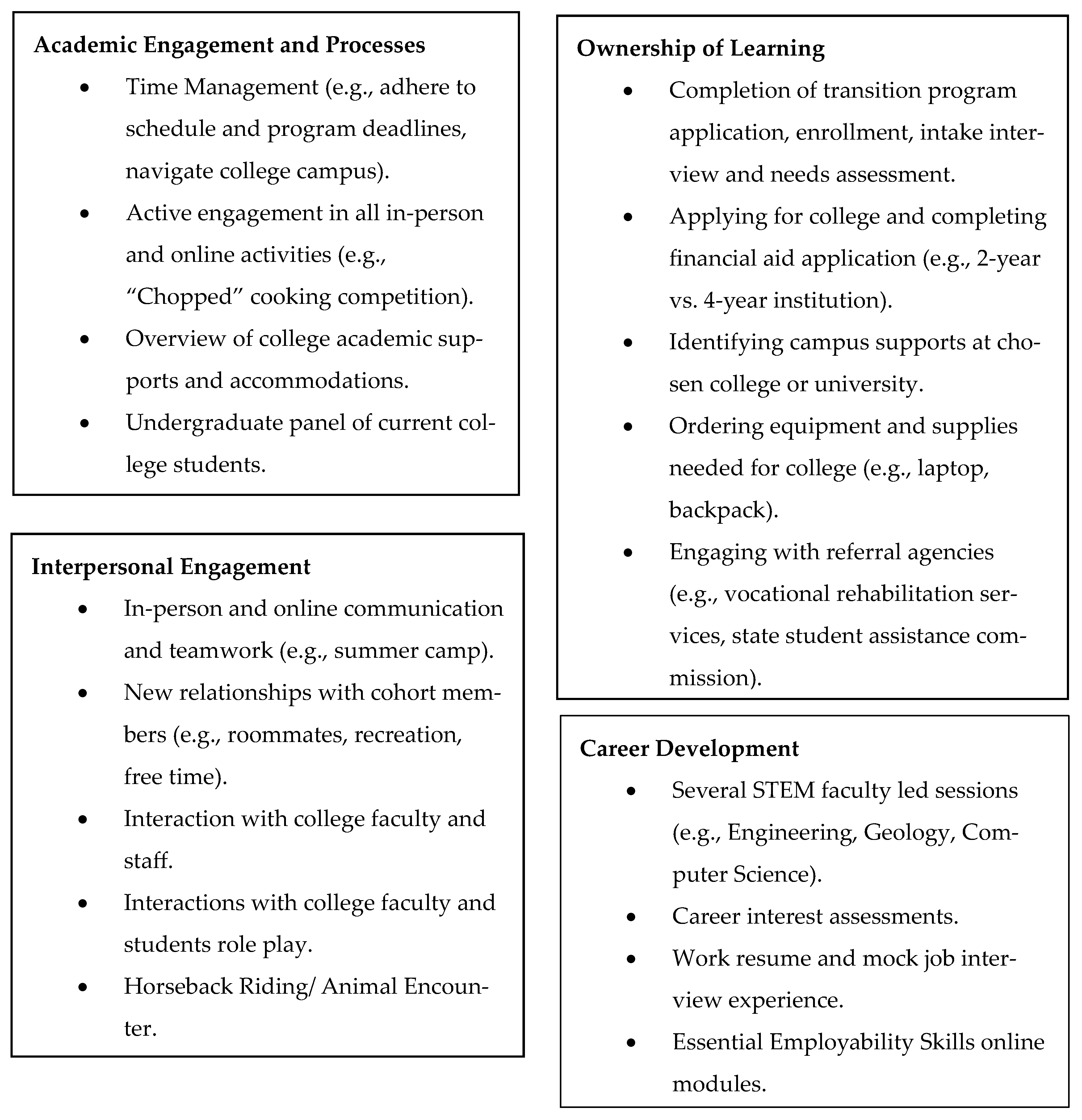
1.1. STEM-Focused High School-to-College Transition Program
1.2. Transition Program Assessment and the Current Study
2. Materials and Methods
2.1. Recruitment
2.2. Instruments
2.3. College and Career Readiness
3. Results
3.1. Academic Engagement and Processes and Interpersonal Engagement
“...they had this website called glean, which is like a recording site and a site that can organize my notes basically. It records, but so then I can listen back to lectures, and it allows me to take notes live. I missed something in the lecture that was spoken I can get everything I can have written down, but then also have the spoken notes so then I can make notes from that.”(Student #1, ADHD and Anxiety)
“The school has a lot of posters, and they send out messages on your phone. And so usually, like at the beginning of the year, they sent like three messages about the bus system and how it worked. During the first welcome week there was a bunch of like advertising for the rec center and stuff and then I heard about the doctor’s office and stuff through friends.”(Student #2, ASD)
“As freshman in college, we were put into this class called First Year Success. And my professor told us about all the things that you can go to, if you need help. He talked about getting a U-Pass if you’re a commuter student and you don’t want to drive here. Which is very helpful and very useful. I used the commuter train and the bus system.”(Student #3, LD)
“But I also like to go to the writing center which was a lot of help. A writing major that they had would also give me feedback of what to say and, you know, to take this out or put this in and they would just give me their opinion, and they would just you know correct me on some of my errors.”(Student #3, LD)
“No, I was going to, but I think I missed the deadline. But I was just going to get extra time on the homework and stuff. I did all right, but I still, there’s like a lot of homework that I just didn’t do or get to.”(Student #2, ASD)
“I feel like I go to those things, if I really need them, I’ll get them if I am really struggling, but if I can figure it out for the most part, then I don’t. If I need like a little bit of help also and I just can’t figure out whatever. Then I’ll go to them. But nine times out of 10, if I can figure out myself and I can get it right, then I say don’t really go to them.”(Student #4, ADHD)
“I mean, the main reason was because I wanted to kind of test myself and kind of have that independence, if that makes sense. When it came to deadlines, I always made sure my stuff was turned in on time. Instead of asking for a later due date.”(Student #3, LD)
“They’ve helped me like get, like accommodations for my classes and a living space that’s close to the quad that allows me to get to class on time.”(Student #5, ADHD and Executive Functioning/Processing Speed Disorder)
“I’d say they helped me with time in classes. Working or completing assignments, I guess. I do get pretty slow when I take tests and stuff like that. So, I will need extra time.”(Student #6, LD, ADHD, and Speech/Language Impairment)
“I use extended time on tests, no judgment and things, but most of the teachers just put a big fricking timer on the wall which stresses me the hell out because if I can see a timer, my immediate reaction is frick, frick, frick, get it done....”(Student #7, ASD and Anxiety)
“I’d say I managed poorly during these times without any accommodations, and I feel like I should have done this earlier in the beginning.”(Student #6, LD, ADHD, and Speech/Language Impairment)
“In the beginning months, August through September it was kind of challenging because there is some stuff that my professors were talking about that I didn’t really understand, especially the classwork that I don’t think I was fully prepared for. But that is something that I had a one-on-one conversation with my professors. They were truly understanding, and they helped break it down for me a lot more when it came to the topic.”(Student #3, LD)
“My chemistry teacher was really accommodating. He said that I could take the test at the testing center or in the department.”(Student #8, ADHD and Depression)
“I just started using teaching assistant (TA) support because I needed to get out of my room like I would just be trapped in my room for like hours in the day. I don’t think I started seeing my TAs until like later in the semester, so I feel like that helped a bit.”(Student #5, ADHD and Executive Functioning/Processing Speed Disorder)
“I was in marching bands all throughout middle school and high school, and I just really loved it” (Student #5, ADHD and Executive Functioning/Processing Speed Disorder). Other students shared their extracurricular activities such as participating in sports (e.g., track), Information Technology (IT) academy or pre-vet club. Multiple participants also mentioned that they enjoyed music or playing video games with friends during their free time.
3.2. Ownership of Learning
“Compared to high school, the amount of classes felt a lot different in the credit system.”(Student #6, LD, ADHD, and Speech/Language Impairment)
“I didn’t completely expect the amount of homework and how I thought it was going to be.”(Student #2, ASD)
“The level of preparation I didn’t really grasp going from high school to college because there’s some stuff that they don’t tell you in high school that you need in college.”(Student #3, LD)
“I wasn’t prepared for the time management that would be required.”(Student #7, ASD and Anxiety)
“I would say the parts of the transition that I was least prepared for or that were hard, kind of like I said, like getting used to having that freedom...That was definitely a little different because, you know, in high school your teachers are always reminding you like, oh, this assignment’s upcoming or this is due.”(Student #9, Physical Disability)
“My confidence really fluctuated throughout. In the beginning, I was pretty confident. And then as I went on, I was getting a bit less confident then when finals were coming, I knew I was prepared going into the tests. And then I was getting more confident again. I’m a little surprised, I guess, by how much better I’m enjoying college than I thought.”(Student #8, ADHD and Depression)
“Now I feel… confident that I will be able to pass all of the classes that I have currently taken because I have a much better support system now and I feel that the courses that I’ve taken are manageable to me.”(Student #7, ASD and Anxiety)
“I did take a lot of honors or AP courses throughout my years in high school, but I know like going prior to getting to college, a lot of my teachers in high school would say like, oh the workload in college is much more intense. And so I kind of went in expecting like, not that it wasn’t intense, but it was a lot more manageable than I thought it was.”(Student #9, Physical Disability)
3.3. Career Development
“Yeah, I’m doing…Computer science and then I think I’m double majoring. I’m still talking it out with my…my advisor, but I think I’m double majoring in math statistics.”(Student #2, ASD)
“I have narrowed it down to like two or three. So I either want to do mechanical engineering maybe aerospace engineering. Those are very close, like either something like that or theoretical physics, astrophysics, that kind of thing. And there are some career paths where there’s a lot of overlap in the research fields especially so I don’t need to choose right away.”(Student #8, ADHD and Depression)
“So yeah, so my major is animal sciences and I know like some schools do it differently, here it’s just like kind of like the regular one you pick your major as you apply your or like when you apply and then when you’re accepted and that’s your major. I’m still working or figuring out now. It’s kind of early, but I might end up later on picking up a chemistry minor because my major requires five chemistry courses. And to get the chemistry minor, it’s like one or two extra classes.”(Student #9, Physical Disability)
“So, it was my first semester of my senior year. I took one of those classes [Computer Science] because it was just a random elective that filled in with my schedule and....I feel like I was really good at it and I was really like kind of, I want to say like passion about it. But it was a skill that just clicked with me. I mean, I took. I took a little bit of courses in like middle school so that also kind of helped, but I felt like that was the right thing for me to do.(Student #4, ADHD)
“I did an internship where I got to see what being an engineer is like. And things like that have helped me explore what various career paths and what the education everything is like. And I think that’s helped me to see what things I like about each career and major and what I probably prefer not having to do. And we also had something in my engineering class last semester where every other week there would be two guest speakers who would come in and talk about their type of engineering. I guess that also helped. I guess I watch a lot of like physics and engineering videos on YouTube that probably also builds into my career exploration. I’m also in a program called Engineering Pathways where you apply to a specific university and then you do two years at a community college where you meet the requirements like GPA and other stuff.”(Student #8, ADHD and Depression)
“I guess Boy Scouting is a big part of it. I’ve always been very interested in the environment and I love nature a lot. And I just want to protect it. Every day like we used to do like roadside cleanup in Boy Scouts for like community service hours, which was a requirement Every time I did that, I was just utterly disgusted of how Awful people could be just throwing trash every which way, not caring at all and I just made me want to like fix it.”(Student #7, ASD and Anxiety)
“It helped me like on the environment side of things, you know it was very different from what I was used to. It kind of gave me a taste of what college life is going to be like. So I feel like that’s what really helped. I feel like the most helpful was. One staying in a dormitory with another person to exploring the campus and like knowing everything that’s around it and like how to utilize it, I feel like that’s what helped me the most.”(Student #4, ADHD)
“I worked with personal care attendants (PCAs) for the first time. I think that helped tremendously. When I got to my university, we have an accessible dorm. And then we have PCAs who will come in the morning and night or throughout the day to help us. And for some people I know here, this was their first time working with PAs. And I know for a lot of people, it’s a little hard because usually their parents or family members would help them, and I think that part of the transition program helped me a lot.”(Student #9, Physical Disability)
“It felt like how being in college would feel for me, actually living there, seeing other people, how the buildings are going to be, and how long is it going to take for you to actually get to class because the campus is big. I feel like it helped me along the way, that I’m more prepared and more serious.”(Student #10, LD and Speech/Language Impairment)
“And it also helped me learn how to be social with people you just met. I got to be more social during the program.”(Student #1, ADHD and Anxiety)
“There’s times that we had to work in groups, really working together as a team, and there were some teamwork skills that we did. Communication skills was another big one.”(Student #3, LD)
“A big thing would be a big thing would be career exploration with engineers. I remember I got to speak with an engineering professor.”(Student #8, ADHD and Depression)
“I feel like the biggest thing, at least immediately was it just got me thinking about college in like a good way and I was a lot more excited, I guess. And I guess a lot of the fears of certain aspects of it were lessened.”(Student #8, ADHD and Depression)
“The program helped because it got me used to college too, like college life because I was worried about that. I was worried about what is was going to be like living on campus and stuff.”(Student #1, ADHD and Anxiety)
4. Discussion
Limitations and Future Research
Author Contributions
Funding
Institutional Review Board Statement
Informed Consent Statement
Data Availability Statement
Acknowledgments
Conflicts of Interest
Appendix A
- (1)
- Please describe how your transition from high school to college has gone. For example, what challenges have you experienced? What successes have you had?
- (2)
- Overall, how prepared did you feel for college this semester?
- In what areas did you feel most prepared?
- Least prepared?
- How confident do you feel in your ability to succeed in your college coursework and why?
- (3)
- Have you decided on a college major and/or minor? Or, what subjects are you interested in?
- How did you make this decision?
- (4)
- Now let’s talk a bit about your college life. Did you engage in any extracurricular activities? If so, please describe.
- (5)
- What other activities do you currently do for fun, leisure, or recreation?
- (6)
- What strategies do you use to manage your time and stay organized in your studies?
- (7)
- In the survey you mentioned that you used xxxx campus service.
- How did you learn about these services?
- Please explain how they assisted you.
- (8)
- Did you disclose a health condition or disability to your college and/or use the campus disability resource center?
- If so, please explain how they assisted you, including any successes or challenges experienced.
- If no, is there any particular reason why you chose not to disclose?
- (9)
- How do you talk with peers and professors regarding accommodations or your disability?
- (10)
- In what ways, if at all, did the college transition program help prepare you for college?
References
- Anderson, A. H., Stephenson, J., & Carter, M. (2020). Perspectives of former students with ASD from Australia and New Zealand on their university experience. Journal of Autism and Developmental Disorders, 50(8), 2886–2901. [Google Scholar] [CrossRef] [Scilit]
- Anderson, A. H., Stephenson, J., & Carter, M. (2024). A qualitative study of the transition to employment of former university students on the autism spectrum from Australia and New Zealand. International Journal of Developmental Disabilities, 70(3), 365–374. [Google Scholar] [CrossRef] [Scilit]
- Austermann, Q., Gelbar, N. W., Reis, S. M., & Madaus, J. W. (2023). The transition to college: Lived experiences of academically talented students with autism. Frontiers in Psychiatry, 14, 1125904. [Google Scholar] [CrossRef] [Scilit]
- Blasey, J., Wang, C., & Blasey, R. (2023). Accommodation use and academic outcomes for college students with disabilities. Psychological Reports, 126(4), 1891–1909. [Google Scholar] [CrossRef] [Scilit]
- Braun, V., & Clarke, V. (2006). Using thematic analysis in psychology. Qualitative Research in Psychology, 3(2), 77–101. [Google Scholar] [CrossRef] [Scilit]
- Dunn, L., Diener, M., Wright, C., Wright, S., & Narumanchi, A. (2015). Vocational exploration in an extracurricular technology program for youth with autism. Work, 52(2), 457–468. [Google Scholar] [CrossRef] [Scilit]
- DuPaul, G. J., Franklin, M. K., Pollack, B. L., Stack, K. S., Jaffe, A. R., Gormley, M. J., AnastopouIos, A. D., & Weyandt, L. L. (2018). Predictors and trajectories of educational functioning in college students with and without attention-deficit/hyperactivity disorder. Journal of Postsecondary Education and Disability, 31(2), 161. [Google Scholar]
- DuPaul, G. J., Gormley, M. J., Anastopoulos, A. D., Weyandt, L. L., Labban, J., Sass, A. J., Busch, C. Z., Franklin, M. K., & Postler, K. B. (2021). Academic trajectories of college students with and without ADHD: Predictors of four-year outcomes. Journal of Clinical Child & Adolescent Psychology, 50(6), 828–843. [Google Scholar] [CrossRef] [Scilit]
- Dwyer, P., Mineo, E., Mifsud, K., Lindholm, C., Gurba, A., & Waisman, T. C. (2023). Building neurodiversity-inclusive postsecondary campuses: Recommendations for leaders in higher education. Autism in Adulthood, 5(1), 1–14. [Google Scholar] [CrossRef] [Scilit] [PubMed]
- Falvo, D., & Holland, B. E. (2018). Medical and psychosocial aspects of chronic illness and disability. Jones & Bartlett Learning. [Google Scholar]
- Grandin, T., & Duffy, K. (2008). Developing talents: Careers for individuals with Asperger syndrome and high-functioning autism. AAPC Publishing. [Google Scholar]
- Griffiths, A. J., Brady, J., Riley, N., Alsip, J., Trine, V., & Gomez, L. (2021, February). STEM for everyone: A mixed methods approach to the conception and implementation of an evaluation process for STEM education programs for students with disabilities. In Frontiers in education (Vol. 5, p. 545701). Frontiers Media SA. Available online: https://www.frontiersin.org/journals/education/articles/10.3389/feduc.2020.545701/full (accessed on 5 August 2025).
- Hinz, S. E., Arbeit, C. A., & Bentz, A. (2017). Characteristics and outcomes of undergraduates with disabilities. National Center for Educational Statistics.
- Holzberg, D., & Ferraro, B. (2021). Speak up: Teaching self-advocacy skills at the communication center to students with disabilities. Communication Center Journal, 7(1), 53–72. [Google Scholar]
- IDEA. (2004). Individuals with disabilities education improvement act of 2004. In 1008 Congress, Public Law 108–446. Available online: https://www.govinfo.gov/app/details/PLAW-108publ446 (accessed on 5 August 2025).
- Illinois State University. (2025). Illinois essential employability skills framework. Available online: https://icsps.illinoisstate.edu/illinois-essential-employability-skills-framework (accessed on 5 August 2025).
- Kouo, J. L., Hogan, A. E., Morton, S., & Gregorio, J. (2021). Supporting students with an autism spectrum disorder in engineering: K-12 and beyond. Journal of Science Education for Students with Disabilities, 24(1), n1. [Google Scholar] [CrossRef] [Scilit]
- Lee, A. (2011). A comparison of postsecondary science, technology, engineering, and mathematics (STEM) enrollment for students with and without disabilities. Career Development for Exceptional Individuals, 34(2), 72–82. [Google Scholar] [CrossRef] [Scilit]
- Lee, A. (2014). Students with Disabilities Choosing Science Technology Engineering and Math (STEM) majors in postsecondary institutions. Journal of Postsecondary Education and Disability, 27(3), 261–272. [Google Scholar]
- Lee, Y., Wehmeyer, M. L., Palmer, S. B., Williams-Diehm, K., Davies, D. K., & Stock, S. E. (2012). Examining individual and instruction-related predictors of the self-determination of students with disabilities: Multiple regression analyses. Remedial and Special Education, 33(3), 150–161. [Google Scholar] [CrossRef] [Scilit] [PubMed]
- Lombardi, A., Gelbar, N., Dukes, L. L., III, Kowitt, J., Wei, Y., Madaus, J., Lalor, A. R., & Faggella-Luby, M. (2018). Higher education and disability: A systematic review of assessment instruments designed for students, faculty, and staff. Journal of Diversity in Higher Education, 11(1), 34. [Google Scholar] [CrossRef] [Scilit]
- Lombardi, A. R., Rifenbark, G. G., Esposito, C., Taconet, A., Mazzotti, V. L., & Morningstar, M. E. (2025). An intersectional examination of college and career readiness for youth with and without disabilities. Journal of Education, 205(2), 87–97. [Google Scholar] [CrossRef] [Scilit]
- Lombardi, A. R., Rifenbark, G. G., Rogers, H. J., Swaminathan, H., Taconet, A., Mazzotti, V. L., Morningstar, M. E., Wu, R., & Langdon, S. (2023). Establishing construct validity of a measure of adolescent perceptions of college and career readiness. Career Development and Transition for Exceptional Individuals, 46(1), 4–14. [Google Scholar] [CrossRef] [Scilit]
- Los Santos, D., Bain, S., & Mundy, M. A. (2019). Determining academic success in students with disabilities in higher education. International Journal of Higher Education, 8(2), 16–38. [Google Scholar] [CrossRef] [Scilit]
- Madaus, J., Tarconish, E., Langdon, S. W., & Gelbar, N. (2022). High school and transition experiences of twice exceptional students with autism spectrum disorder: Parents’ perceptions. Frontiers in Psychology, 13, 995356. [Google Scholar] [CrossRef] [Scilit]
- Marshak, L., Van Wieren, T., Ferrell, D. R., Swiss, L., & Dugan, C. (2010). Exploring barriers to college student use of disability services and accommodations. Journal of Postsecondary Education and Disability, 22(3), 151–165. [Google Scholar]
- Maslow, G., Haydon, A. A., McRee, A. L., & Halpern, C. T. (2012). Protective connections and educational attainment among young adults with childhood-onset chronic illness. Journal of School Health, 82(8), 364–370. [Google Scholar] [CrossRef] [Scilit]
- Mazzotti, V. L., Morningstar, M. E., Lombardi, A., Kwiatek, S., Taconet, A., Buddeke, K., Monahan, J., & Harris, R. (2024). Policy and practice considerations to support college and career readiness for youth with disabilities: A systematic mixed studies review. Journal of Disability Policy Studies, 34(4), 278–289. [Google Scholar] [CrossRef] [Scilit]
- McCall, Z. A. (2015). The transition experiences, activities, and supports of four college students with disabilities. Career Development and Transition for Exceptional Individuals, 38(3), 162–172. [Google Scholar] [CrossRef] [Scilit]
- McLeod, J. D., Hawbaker, A., & Meanwell, E. (2021). The health of college students on the autism spectrum as compared to their neurotypical peers. Autism, 25(3), 719–730. [Google Scholar] [CrossRef] [Scilit] [PubMed]
- McLeod, J. D., Meanwell, E., & Hawbaker, A. (2019). The experiences of college students on the autism spectrum: A comparison to their neurotypical peers. Journal of Autism and Developmental Disorders, 49(6), 2320–2336. [Google Scholar] [CrossRef] [Scilit]
- Morningstar, M. E., Lombardi, A., Fowler, C. H., & Test, D. W. (2017). A college and career readiness framework for secondary students with disabilities. Career Development and Transition for Exceptional Individuals, 40(2), 79–91. [Google Scholar] [CrossRef] [Scilit]
- Nachman, B. R., Kim, H., Liu, C., Ottens, M., Cook, K., & Cates, G. (2024). The current state of knowledge regarding stem career pathways for students with autism: A systematic literature review. Journal of Postsecondary Education and Disability, 37(2), 115–130. [Google Scholar]
- Petcu, S. D., Marshall, K. J., Zhang, D., Lalor, A. R., & Hussain, Y. (2025). Factors influencing the college decision-making process for students with disabilities. Disabilities, 5(2), 36. [Google Scholar] [CrossRef] [Scilit]
- Pfeifer, M. A., Reiter, E. M., Cordero, J. J., & Stanton, J. D. (2021). Inside and out: Factors that support and hinder the self-advocacy of undergraduates with ADHD and/or specific learning disabilities in STEM. CBE—Life Sciences Education, 20(2), ar17. [Google Scholar] [CrossRef] [Scilit]
- Pingry O’Neill, L. N., Markward, M. J., & French, J. P. (2012). Predictors of graduation among college students with disabilities. Journal of Postsecondary Education and Disability, 25(1), 21–36. [Google Scholar]
- Reis, S. M., Gelbar, N. W., & Madaus, J. W. (2022). Understanding the academic success of academically talented college students with autism spectrum disorders. Journal of Autism and Developmental Disorders, 52(10), 4426–4439. [Google Scholar] [CrossRef] [Scilit]
- Stevens, A. E., Lefler, E. K., Serrano, J. W., & Hartung, C. M. (2024). Transitioning to college with ADHD: A qualitative examination of parental support and the renegotiation of the parent-child relationship. Current Psychology, 43(4), 3134–3149. [Google Scholar] [CrossRef] [Scilit] [PubMed]
- Taylor, J. L., & Mailick, M. R. (2014). A longitudinal examination of 10-year change in vocational and educational activities for adults with autism spectrum disorders. Developmental Psychology, 50(3), 699–708. [Google Scholar] [CrossRef] [Scilit] [PubMed]
- Toutain, C. (2019). Barriers to accommodations for students with disabilities in higher education: A literature review. Journal of Postsecondary Education and Disability, 32(3), 297–310. [Google Scholar]
- Troiano, P. F., Liefeld, J. A., & Trachtenberg, J. V. (2010). Academic support and college success for postsecondary students with learning disabilities. Journal of College Reading and Learning, 40(2), 35–44. [Google Scholar] [CrossRef] [Scilit]
- U.S. Bureau of Labor Statistics. (2025). Persons with a disability: Labor force characteristics news release. Available online: https://www.bls.gov/news.release/disabl.htm (accessed on 5 August 2025).
- U.S. Department of Health and Human Services. (2017, October). Report to congress: Young adults and transitioning youth with autism spectrum disorder. Available online: https://www.hhs.gov/sites/default/files/2017AutismReport.pdf (accessed on 5 August 2025).
- Wei, X., Yu, J. W., Shattuck, P., McCracken, M., & Blackorby, J. (2013). Science, technology, engineering, and mathematics (STEM) participation among college students with an autism spectrum disorder. Journal of Autism and Developmental Disorders, 43, 1539–1546. [Google Scholar] [CrossRef] [Scilit] [PubMed]
- Yu, M., Novak, J. A., Lavery, M. R., Vostal, B. R., & Matuga, J. M. (2018). Predicting college completion among students with learning disabilities. Career Development and Transition for Exceptional Individuals, 41(4), 234–244. [Google Scholar] [CrossRef] [Scilit]

| Characteristics | Category | Frequency | Percentage |
|---|---|---|---|
| Gender | Male | 11 | 91.6 |
| Non-binary | 1 | 8.4 | |
| Primary Disability or Health Condition | Autism | 4 | 33.3 |
| ADHD | 4 | 33.3 | |
| Learning Disability | 3 | 25 | |
| Physical Impairment | 1 | 8.4 | |
| Race/Ethnicity | White | 6 | 50 |
| Black | 3 | 25 | |
| Hispanic/Latino | 2 | 16.6 | |
| Asian | 1 | 8.4 |
| Characteristics | Category | Frequency | Percentage |
|---|---|---|---|
| Postsecondary Institution | 4-Year University | 8 | 66.7 |
| Community College | 4 | 33.3 | |
| Living Arrangements | On-Campus Residence Hall | 7 | 58.3 |
| Family Residence | 5 | 41.7 | |
| Campus Resources Used | Writing Center | 4 | 33.3 |
| Tutoring | 4 | 33.3 | |
| Recreation Center | 4 | 33.3 | |
| Public Transportation | 4 | 33.3 | |
| Disability Resource Center | 4 | 33.3 | |
| Health/Medical Clinic | 3 | 25 | |
| Counseling Center | 2 | 16.7 | |
| Paid Work/Volunteer Hours | None | 9 | 75 |
| 11–20 h per week | 1 | 8.3 | |
| 21–30 h per week | 1 | 8.3 | |
| 30+ h per week | 1 | 8.3 | |
| College Credit in High School (e.g., advanced placement, dual credit) | Yes | 8 | 66.7 |
| No/Unsure | 4 | 33.3 |
Disclaimer/Publisher’s Note: The statements, opinions and data contained in all publications are solely those of the individual author(s) and contributor(s) and not of MDPI and/or the editor(s). MDPI and/or the editor(s) disclaim responsibility for any injury to people or property resulting from any ideas, methods, instructions or products referred to in the content. |
© 2026 by the authors. Licensee MDPI, Basel, Switzerland. This article is an open access article distributed under the terms and conditions of the Creative Commons Attribution (CC BY) license.
Share and Cite
Dallas, B.K.; Yuan, S.; Humphrey, B. Freshman Experiences Among Neurodivergent Students Following a STEM-Focused High School-to-College Transition Program. Behav. Sci. 2026, 16, 160. https://doi.org/10.3390/bs16010160
Dallas BK, Yuan S, Humphrey B. Freshman Experiences Among Neurodivergent Students Following a STEM-Focused High School-to-College Transition Program. Behavioral Sciences. 2026; 16(1):160. https://doi.org/10.3390/bs16010160
Chicago/Turabian StyleDallas, Bryan K., Shupei Yuan, and Briona Humphrey. 2026. "Freshman Experiences Among Neurodivergent Students Following a STEM-Focused High School-to-College Transition Program" Behavioral Sciences 16, no. 1: 160. https://doi.org/10.3390/bs16010160
APA StyleDallas, B. K., Yuan, S., & Humphrey, B. (2026). Freshman Experiences Among Neurodivergent Students Following a STEM-Focused High School-to-College Transition Program. Behavioral Sciences, 16(1), 160. https://doi.org/10.3390/bs16010160

