Review

The Emotional Reinforcement Mechanism of and Phased Intervention Strategies for Social Media Addiction

School of Physical Education and Sport Science, Fujian Normal University, Fuzhou 350108, China
*
Author to whom correspondence should be addressed.
Behav. Sci. 2025, 15(5), 665; https://doi.org/10.3390/bs15050665
Submission received: 9 April 2025 / Revised: 24 April 2025 / Accepted: 7 May 2025 / Published: 13 May 2025

Abstract

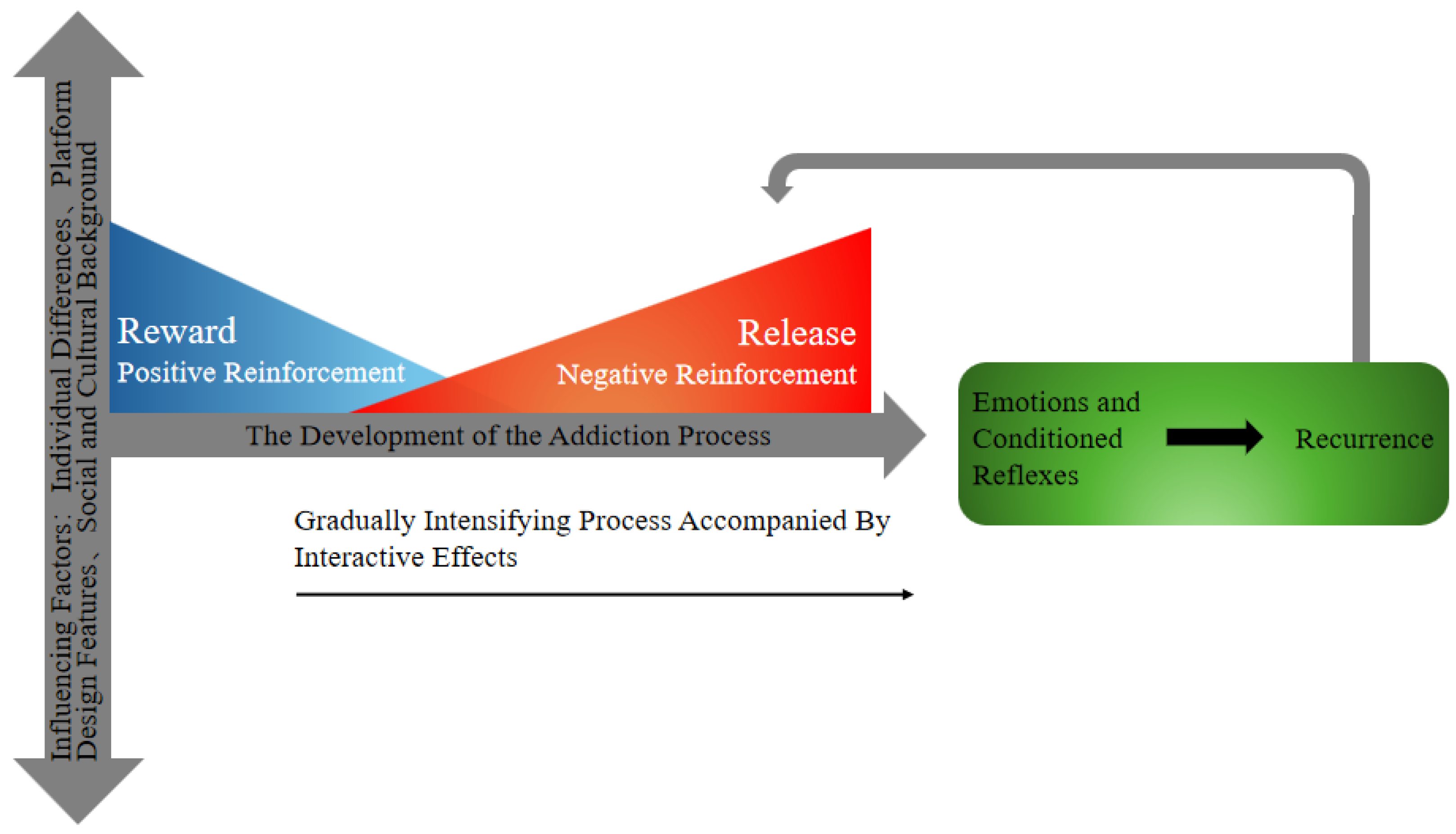
Social media addiction has become a global public health challenge, and understanding its mechanism’s complexity requires the integration of the transitional characteristics of addiction development stages and breaking through the traditional single-reinforcement-path explanatory framework. This study is based on the dual pathway of positive and negative emotional reinforcement, integrating multidisciplinary evidence from neuroscience, psychology, and computational behavioral science to propose an independent and dynamic interaction mechanism of positive reinforcement (driven by social rewards) and negative reinforcement (driven by emotional avoidance) in social media addiction. Through a review, it was found that early addiction is mediated by the midbrain limbic dopamine system due to immediate pleasurable experiences (such as liking), while late addiction is maintained by negative emotional cycles due to the dysfunction of the prefrontal limbic circuit. The transition from early addiction to late addiction is characterized by independence and interactivity. Based on this, a phased intervention strategy is proposed, which uses reward competition strategies (such as cognitive behavioral therapy and alternative rewards) to weaken dopamine sensitization in the positive reinforcement stage, enhances self-control by blocking emotional escape (such as through mindfulness training and algorithm innovation) in the negative reinforcement stage, and uses cross-pathway joint intervention in the interaction stage. This study provides a theoretical integration framework for interdisciplinary research on social media addiction from a dynamic perspective for the first time. It is recommended that emotional reinforcement variables are included in addiction diagnosis, opening up new paths for precise intervention in different stages of social media addiction development.
Keywords: social media addiction; emotional reinforcement mechanism; positive and negative reinforcement; intervention strategy social media addiction; emotional reinforcement mechanism; positive and negative reinforcement; intervention strategy