How Family Functioning Shapes Adolescent Adjustment: The Mediating Role of Interpersonal Competence

Abstract
1. Introduction
1.1. Family Functioning and Adolescent Adjustment
1.2. Family Functioning and Interpersonal Competence
1.3. Interpersonal Competence and Adolescent Adjustment
1.4. The Mediating Role of Interpersonal Competence
1.5. The Current Study
2. Materials and Methods
2.1. Participants and Procedure
2.2. Measures
2.2.1. Family Adaptability and Cohesion Evaluation Scales II (FACES II-CV)
2.2.2. Adjustment Scale for Adolescents (ASA)
2.2.3. Interpersonal Competence Scale
2.3. Data Analysis
3. Results
3.1. Common Method Bias Test
3.2. Correlation Analysis
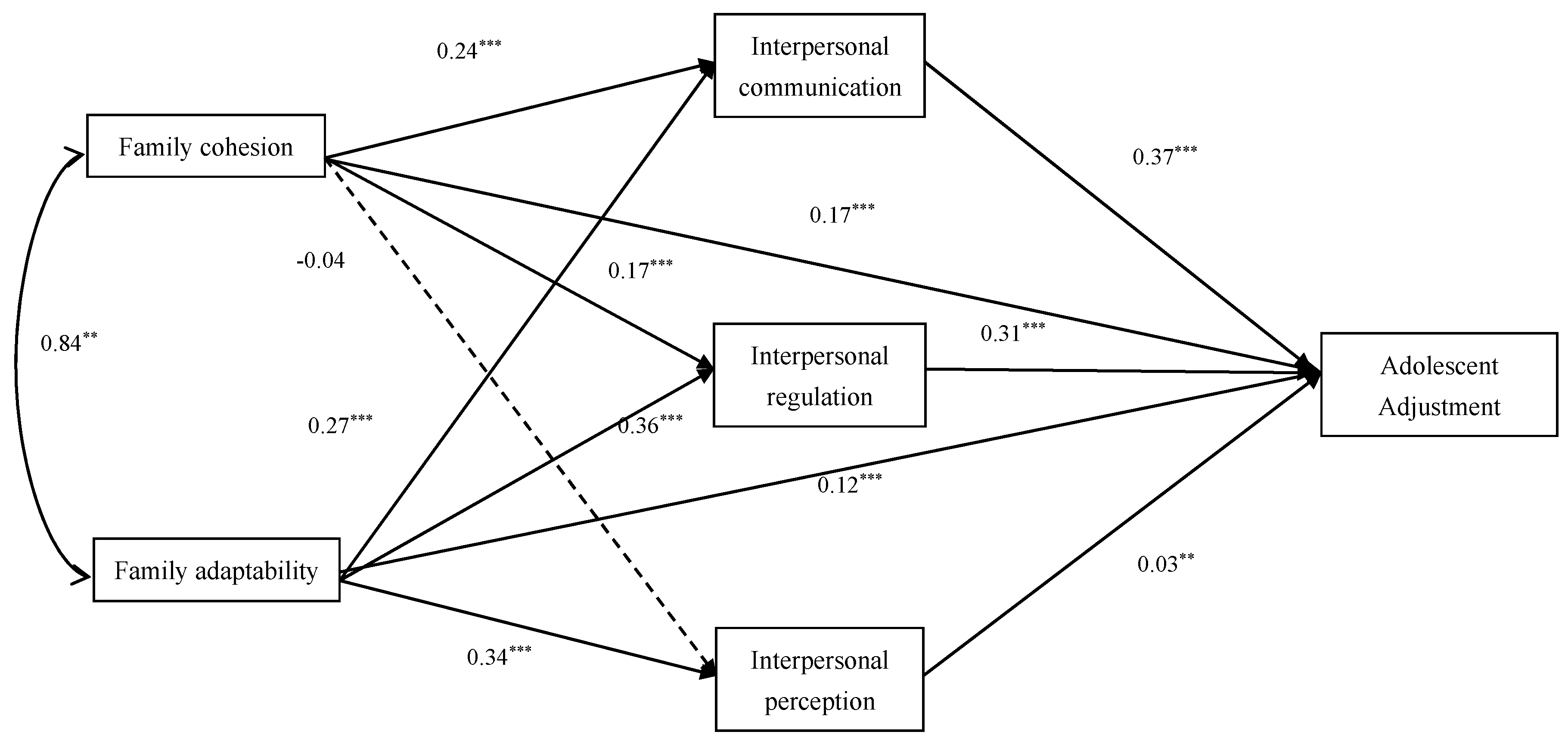
3.3. Mediating Role of Interpersonal Competence in the Relationship Between Family Functioning and Adolescent Adjustment Among Junior High School Students
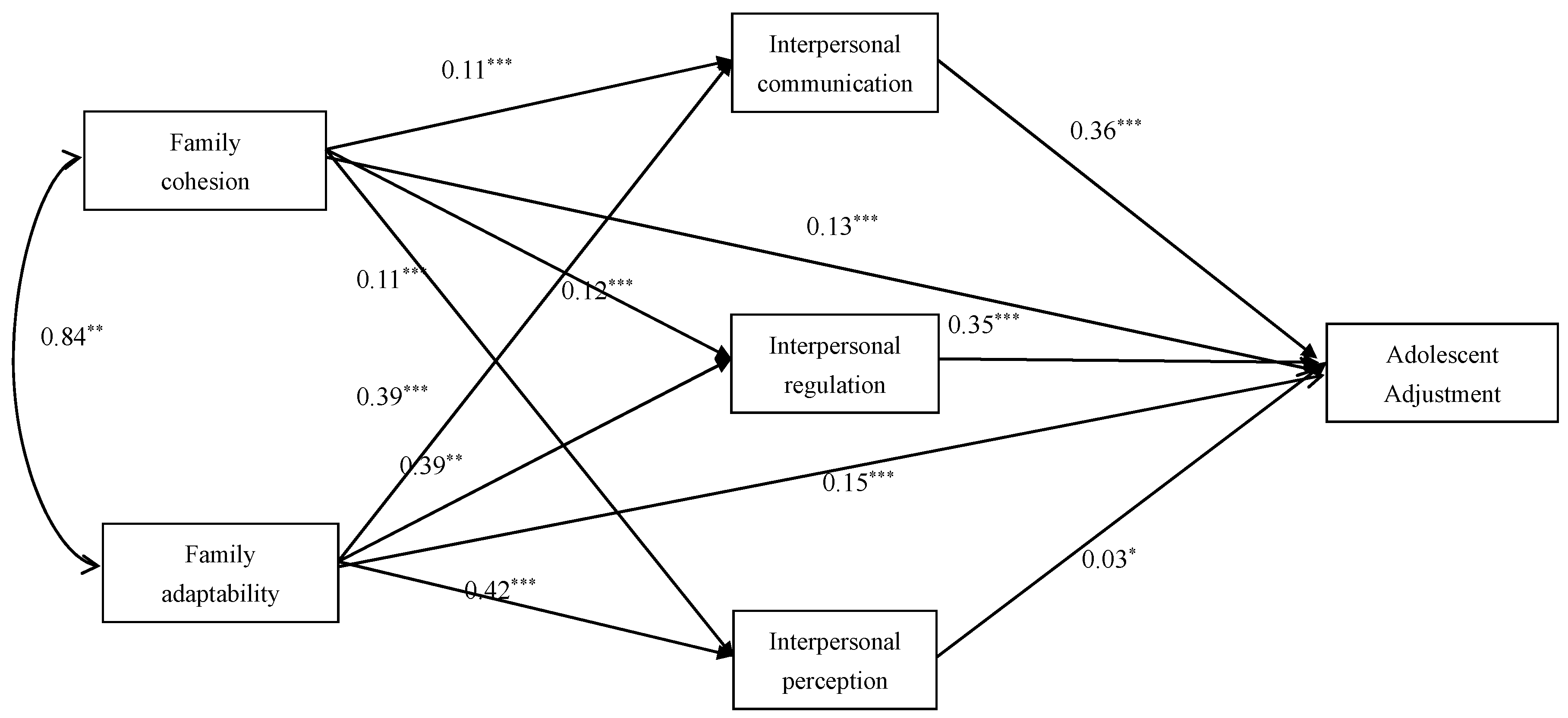
3.4. Mediating Role of Interpersonal Competence in the Relationship Between Family Functioning and Adolescent Adjustment Among Senior High School Students
4. Discussion
4.1. Relationship Between Family Functioning and Adolescent Adjustment
4.2. The Mediating Role of Interpersonal Competence in Family Functioning and Adolescent Adjustment Among Junior High School Students
4.3. The Mediating Role of Interpersonal Competence in Family Functioning and Adolescent Adjustment Among Senior High School Students
4.4. Practical Implications
5. Limitations and Future Research Directions
6. Conclusions
Author Contributions
Funding
Institutional Review Board Statement
Informed Consent Statement
Data Availability Statement
Acknowledgments
Conflicts of Interest
References
- Aspen Institute National Commission on Social, Emotional, and Academic Development. (2018). The brain basis for integrated social, emotional, and academic development. Aspen Institute. Available online: https://www.aspeninstitute.org/publications/the-brain-basis-for-integrated-social-emotional-and-academic-development/ (accessed on 10 October 2024).
- Beavers, R., & Hampson, R. B. (2000). The beavers systems model of family functioning. Journal of Family Therapy, 22(2), 128–143. [Google Scholar] [CrossRef]
- Bronfenbrenner, U. (1979). The ecology of human development: Experiments by nature and design. Harvard University Press. [Google Scholar] [CrossRef]
- Brown, B. B., & Larson, J. (2009). Peer relationships in adolescence. In R. M. Lerner, & L. Steinberg (Eds.), Handbook of adolescent psychology (1st ed.). Wiley. [Google Scholar] [CrossRef]
- Campione-Barr, N., Rote, W., Killoren, S. E., & Rose, A. J. (2021). Adolescent adjustment during COVID-19: The role of close relationships and COVID-19-related stress. Journal of Research on Adolescence, 31(3), 608–622. [Google Scholar] [CrossRef]
- Chen, X., Chen, H., Kaspar, V., & Noh, S. (2000). Adolescent social, emotional, and school adjustment in mainland china. International Journal of Group Tensions, 29(1–2), 51–78. [Google Scholar] [CrossRef]
- Chen, Y., Xiao, S., Li, Y., Deng, Q., Gao, Y., & Gao, F. (2019). Relationship between shyness and middle school students’ adjustment: A mediated moderation model. Chinese Journal of Clinical Psychology, 27(4), 790–794. [Google Scholar] [CrossRef]
- Chi, X., Chen, S., Wang, Q., Huang, Q., & Han, P. (2021). Effect of family functioning on behavior problem in adolescents: A moderated mediating effect. Chinese Journal of Clinical Psychology, 29(2), 246–250. [Google Scholar] [CrossRef]
- Choi, J., & Becher, E. H. (2019). Supportive coparenting, parenting stress, harsh parenting, and child behavior problems in nonmarital families. Family Process, 58(2), 404–417. [Google Scholar] [CrossRef]
- Cobos-Sánchez, L., Flujas-Contreras, J. M., & Gómez-Becerra, I. (2017). Inteligencia emocional y su papel en el ajuste psicológico en la adolescencia. Anales de Psicología, 33(1), 66–73. [Google Scholar] [CrossRef]
- Dai, W. (2021). Relationship between original family function and cognitive bias of college students: Multiple mediating effects of security and the behavior puzzle of interpersonal relationship. China Journal of Health Psychology, 29(9), 1407–1411. [Google Scholar] [CrossRef]
- Destin, M., Castillo, C., & Meissner, L. (2018). A field experiment demonstrates near peer mentorship as an effective support for student persistence. Basic and Applied Social Psychology, 40(5), 269–278. [Google Scholar] [CrossRef]
- Deutsch, N. L., Reitz-Krueger, C. L., Henneberger, A. K., Futch Ehrlich, V. A., & Lawrence, E. C. (2017). “It gave me ways to solve problems and ways to talk to people”: Outcomes from a combined group and one-on-one mentoring program for early adolescent girls. Journal of Adolescent Research, 32(3), 291–322. [Google Scholar] [CrossRef]
- Devaney, E., Moroney, D., & Malone, H. (2018, December 5). Afterschool webinar: Social and emotional learning in out-of-school time: Foundations and futures (part 1) [Video recording]. Afterschool Alliance. Available online: http://afterschoolalliance.org/webinars.cfm?ID=CBD51088-5056-A82E-7A4F2B50A6716E05 (accessed on 10 October 2024).
- Du, K. (2023). A review of the influence of family environment on adolescent mental health. Advances in Social Sciences, 12(08), 4733–4739. [Google Scholar] [CrossRef]
- Eccles, J. S., & Roeser, R. W. (2005). School and community influences on human development. In M. H. Bornstein, & M. E. Lamb (Eds.), Developmental science: An advanced textbook (5th ed., pp. 513–555). Lawrence Erlbaum Associates Publishers. [Google Scholar]
- Eisenstein, C., Zamperoni, V., Humphrey, N., Deighton, J., Wolpert, M., Rosan, C., Bohan, H., A. Kousoulis, A., Promberger, M., & Edbrooke-Childs, J. (2019). Evaluating the peer education project in secondary schools. Journal of Public Mental Health, 18(1), 58–65. [Google Scholar] [CrossRef]
- Erikson, E. H. (1966). Eight ages of man. International Journal of Psychiatry, 2(3), 281–307. [Google Scholar]
- Fan, C., & Sun, X. (2013). Adolescent psychological development and education. Central China Normal University Press. [Google Scholar]
- Fei, L., Shen, Q., Zhen, Y., Zhao, J., Jiang, S., Wang, L., & Wang, X. (1991). Preliminary evaluation of Chinese version of FACES II and FES: Comparison of normal families and families of schizophrenic patients. Chinese Mental Health Journal, 5, 198–202. [Google Scholar]
- Feng, T., & Li, H. (2002). Primary research about study adaptation of undergraduate. Psychological Exploration, 1, 44–48. [Google Scholar]
- Geng, Y., Liu, Y., & Yan, L. (2021). The influence of family cohesion on social adaptation of left-behind children: A moderated mediating effect. Journal of Southwest University Natural Science Edition, 43(8), 10–19. [Google Scholar] [CrossRef]
- Gross, J. J. (Ed.). (2015). Handbook of emotion regulation (2nd ed., paperback edition). The Guilford Press. [Google Scholar]
- Guo, D., Zhao, X., & Yuan, G. (2017). Research progress on interpersonal perception. Chinese Journal of Health Psychology, 25(9), 1426–1430. [Google Scholar] [CrossRef]
- Hao, J., & Niu, H. (2015). College fresh men adjustment: The role of metacognition, interpersonal health diathesis and professional identification. Studies of Psychology and Behavior, 13(6), 778–783. [Google Scholar]
- Hawkins, J. D. (Ed.). (1996). Delinquency and crime: Current theories. Cambridge University Press. [Google Scholar]
- Hayashi, A., Liew, J., Aguilar, S. D., Nyanamba, J. M., & Zhao, Y. (2022). Embodied and social-emotional learning (sel) in early childhood: Situating culturally relevant SEL in Asian, African, and North American contexts. Early Education and Development, 33(5), 746–763. [Google Scholar] [CrossRef]
- Huang, X., Zhang, Y., & Yu, G. (2022). Prevalence of mental health problems among primary school students in Chinese mainland from 2010 to 2010: A meta-analysis. Advances in Psychological Science, 30(5), 953–964. [Google Scholar] [CrossRef]
- Ke, Z., & Yang, H. (2025). The influence of family cohesion and adaptability on college students’ interpersonal skills: The mediating role of emotion regulation strategies. Psychologies, 20(10), 79–82. [Google Scholar] [CrossRef]
- Lee, K., & Yun, C. (2020). Analysis of the Structural Relationships among academic stress, emotional regulation ability, interpersonal ability, and school adjustment in middle school students. Korean Association For Learner-Centered Curriculum And Instruction, 20(1), 1245–1264. [Google Scholar] [CrossRef]
- Li, J., Tong, Q., & Fan, Q. (2024). Research on the trend prediction of China’s school-age population changes in compulsory education and its educational resource allocation from 2022 to 2040. Journal of Beijing Institute of Education, 38(04), 12–20. [Google Scholar] [CrossRef]
- Liao, J., Liu, Y., & Chen, S. (2023). The effects of family and school interpersonal relationships on left-behind children’s social adaptability: The chain-mediated role of self-esteem and life satisfaction. Journal of Southwest University Natural Science Edition, 45(12), 2–11. [Google Scholar] [CrossRef]
- Lin, J., Zhang, L., & Kuo, Y.-L. (2024). The role of social–emotional competencies in interpersonal relationships: A structural equation modeling approach. Frontiers in Psychology, 15, 1360467. [Google Scholar] [CrossRef]
- Liu, C., Sun, Z., Gao, Y., Chen, H., Lu, T., & Yan, J. (2025). The relationship between perceived social support and school adjustment in adolescents: The mediating role of school belongingness and the moderating role of physical activity. Psychology in the Schools, 62(6), 1926–1936. [Google Scholar] [CrossRef]
- Liu, D. (2024). A review of research on the development of students’ social and emotional competence. Advances in Psychology, 14(5), 749–757. [Google Scholar] [CrossRef]
- Liu, X., Bai, X., Li, X., & Hao, J. (2016). Psychological health diathesis assessment system: The national survey of interpersonal health diathesis for chinese adults. Studies of Psychology and Behavior, 14(6), 729–734. [Google Scholar]
- Liu, Y., Wang, L., & Kong, M. (2023). The Influence of Family Cohesion and Adaptability on School Adaptation of Junior High School Students: The Mediating Role of Self-Concept. Psychology Monthly, 18(16), 89–92. [Google Scholar] [CrossRef]
- Ma, H., & Bai, X. (2006). Development of interpersonal communication scale in adolescent mental health dialesis. Studies of Psychology and Behavior, 4(3), 168–171. [Google Scholar]
- Majolo, M., Gomes, W. B., & DeCastro, T. G. (2023). Self-consciousness and self-awareness: Associations between stable and transitory levels of evidence. Behavioral Sciences, 13(2), 117. [Google Scholar] [CrossRef]
- Martinez, M. E., & Gomez, V. (2024). The importance of social-emotional learning in schools. Acta Pedagogia Asiana, 3(2), 101–112. [Google Scholar] [CrossRef]
- Maynard, M. L., Khalid, H., Karimi Valoojerdy, Z., Talwar, V., & Bosacki, S. L. (2025). Adolescent development in unprecedented times: A comparative study of theory of mind before and after COVID-19. Adolescents, 5(2), 11. [Google Scholar] [CrossRef]
- Mierjiang, H. (2024). The relationship between family intimacy and school adaptation for left-behind children. Advances in Psychology, 14(3), 474–477. [Google Scholar] [CrossRef]
- Olson, D. (1989). Family Assessment and Intervention: The Circumplex Model of Family Systems. Child & Youth Services, 11(1), 9–48. [Google Scholar] [CrossRef]
- Olson, D. H. (2000). Circumplex model of marital and family systems. Journal of Family Therapy, 22(2), 144–167. [Google Scholar] [CrossRef]
- Paris, W., & White-Williams, C. (2005). Social adaptation after cardiothoracic transplantation: A review of the literature. The Journal of Cardiovascular Nursing, 20, S67–S73. [Google Scholar] [CrossRef]
- Rogers, C. R., & Koch, S. (1959). A theory of therapy, personality, and interpersonal relationships: As developed in the client-centered framework. McGraw-Hill. [Google Scholar]
- Sadikaj, G., Moskowitz, D. S., & Zuroff, D. C. (2017). Intrapersonal variability in interpersonal perception in romantic relationships: Biases and accuracy. Journal of Research in Personality, 69, 67–77. [Google Scholar] [CrossRef]
- Sandilos, L. E., Neugebauer, S. R., DiPerna, J. C., Hart, S. C., & Lei, P. (2023). Social–emotional learning for whom? Implications of a universal sel program and teacher well-being for teachers’ interactions with students. School Mental Health, 15(1), 190–201. [Google Scholar] [CrossRef]
- Sekar, J. M. A., & Lawrence, A. S. A. (2016). Emotional, social, educational adjustment of higher secondary school students in relation to academic achievement. I-Manager’s Journal on Educational Psychology, 10(1), 29. [Google Scholar] [CrossRef]
- Shao, J., Zhang, L., Ren, Y., Xiao, L., & Zhang, Q. (2018). Parent–child cohesion, basic psychological needs satisfaction, and emotional adaptation in left-behind children in China: An indirect effects model. Frontiers in Psychology, 9, 1023. [Google Scholar] [CrossRef]
- Shek, D. T. L. (2002). Family functioning and psychological well-being, school adjustment, and problem behavior in chinese adolescents with and without economic disadvantage. The Journal of Genetic Psychology, 163(4), 497–502. [Google Scholar] [CrossRef]
- Shek, D. T. L. (2024). Do student mental health problems disappear over night in the postpandemic era? Journal of Adolescent Health, 74(6), 1066–1067. [Google Scholar] [CrossRef]
- Shen, D., Ma, H., & Bai, X. (2009). The structure and empirical study of adolescents’ psychological health quality. Psychological Science, 32(2), 258–261. [Google Scholar] [CrossRef]
- Shi, R. (2013). Modern social psychology. East China Normal University Press. [Google Scholar]
- Skaar, N. R., & Townsley, M. (2025). Integrating social-emotional learning and standards-based grading: Principles, barriers, and future directions. Social and Emotional Learning: Research, Practice, and Policy, 5, 100076. [Google Scholar] [CrossRef]
- Sonego, M., Llácer, A., Galán, I., & Simón, F. (2013). The influence of parental education on child mental health in Spain. Quality of Life Research, 22(1), 203–211. [Google Scholar] [CrossRef]
- Srivastva, A., & Ramanujan, K. (2019). The blue dot: Exploring new ideas for a shared future. Available online: https://unesdoc.unesco.org/ark:/48223/pf0000369079 (accessed on 20 October 2024).
- Steinberg, L. (2005). Cognitive and affective development in adolescence. Trends in Cognitive Sciences, 9(2), 69–74. [Google Scholar] [CrossRef]
- Steinberg, L., & Morris, A. S. (2001). Adolescent development. Annual Review of Psychology, 52(1), 83–110. [Google Scholar] [CrossRef]
- Tang, J., & Jiang, G. (2009). The relationship of college students’ interpersonal trust and family cohesion and adaptability. China Journal of Health Psychology, 3, 307–309. [Google Scholar] [CrossRef]
- Tang, T., Yuan, Z., Peng, X., Pan, Y., Wang, T., & Yang, L. (2025). The longitudinal relationship between high school students’ family functioning and school adaptation: The chain mediating roles of parent-child relationships and self-directed learning. Current Psychology, 44(10), 9074–9086. [Google Scholar] [CrossRef]
- UNESCO. (2016). Education 2030: Incheon declaration and framework for action for the implementation of sustainable development goal 4: Ensure inclusive and equitable quality education and promote lifelong learning opportunities for all. Scientific and Cultural Organization (UNESCO). Available online: https://unesdoc.unesco.org/ark:/48223/pf0000245656 (accessed on 5 October 2024).
- Vorauer, J. D., Petsnik, C., & Quesnel, M. S. (2020). Who brings you up when you’re feeling down? Distinct implications of dispositional empathy versus situationally-prompted empathic mindsets for targets’ affective experience in face-to-face interpersonal interaction. Journal of Experimental Social Psychology, 89, 103991. [Google Scholar] [CrossRef]
- Wang, C.-C. D., & Mallinckrodt, B. (2006). Acculturation, attachment, and psychosocial adjustment of Chinese/Taiwanese international students. Journal of Counseling Psychology, 53(4), 422–433. [Google Scholar] [CrossRef]
- Wang, Q., Li, J., Xu, H., & Shi, J. (2018). Middle school students’ mobile phone dependence and its grade differences. Advances in Psychology, 8(6), 820–827. [Google Scholar] [CrossRef]
- Wang, X. (2022). The significance of the times and the localization practice path of social and emotional learning (SEL). Advances in Social Sciences, 11(01), 86–90. [Google Scholar] [CrossRef]
- Wen, Z., & Ye, B. (2014). Analyses of mediating effects: The development of methods and models. Advances in Psychological Science, 22(5), 731. [Google Scholar] [CrossRef]
- Wentzel, K. R. (1998). Social relationships and motivation in middle school: The role of parents, teachers, and peers. Journal of Educational Psychology, 90(2), 202–209. [Google Scholar] [CrossRef]
- World Health Organization. (2023). Impact of COVID-19 on adolescents’ mental health in Europe (No. WHO-EURO-2023-8920-48692-72363). World Health Organization Regional Office for Europe. Available online: https://iris.who.int/bitstream/handle/10665/375106/WHO-EURO-2023-8920-48692-72363-eng.pdf (accessed on 15 October 2024).
- Xia, Q., Xie, H., Li, C., & Shi, L. (2022). The relationship between family function and social anxiety in high school students. Psychological Monthly, 17(15), 8–8. [Google Scholar] [CrossRef]
- Xu, F. (2000). Social psychological analysis of human adaptability development. Educational Research and Experiment, 06, 38–42. [Google Scholar]
- Yan, Q., Yang, Y., Qi, Y., Qi, W., Yang, D., & Luo, C. (2022). Trends in the prevalence of Internet addiction among adolescents from 2004 to 2019 in Shanghai. Chinese Journal of School Health, 43(8), 1193–1197. [Google Scholar] [CrossRef]
- Yang, M. (2018). The relationship between family cohesion, adaptability, and sociocultural adaptation among junior high school migrant children: The mediating role of positive psychological capital. Chinese Journal of Health Education, 34(10). [Google Scholar] [CrossRef]
- Yang, M. (2019). The influence of family and school environment on positive psychological capital among migrant children. Chinese Journal of Health Education, 35(6), 517–520. [Google Scholar] [CrossRef]
- Yen, C.-F., Yang, P., Wu, Y.-Y., & Cheng, C.-P. (2013). The relation between family adversity and social anxiety among adolescents in Taiwan: Effects of family function and self-esteem. Journal of Nervous & Mental Disease, 201(11), 964–970. [Google Scholar] [CrossRef]
- Yu, G., & Li, S. (2021). Childhood maltreatment and its effect on adolescent internalizing and externalizing mental health problems: Mechanisms and interventions. Journal of Beijing Normal University (Social Sciences Edition), (1), 5–15. [Google Scholar]
- Yuan, Z., Li, B., Hu, J., & Liu, Y. (2025). The current situation and countermeasures of academic stress among high school students under the background of home-school cooperation. Psychological Monthly, 20(2), 122–124. [Google Scholar] [CrossRef]
- Zhang, D., & Jiang, Q. (2006). A report on the construction of the adaptation scale for adolescents. Studies of Psychology and Behavior, 4(2), 81–84. [Google Scholar]
- Zhao, D., Cheng, X., Wang, T., Guo, Y., & Qin, X. (2019). Parental conflicts perceived by left-behind middle school students and teacher-student conflicts: The mediating role of parent-child attachment. Educational Research and Experiment, 3, 91–96. [Google Scholar]
- Zhao, X. (2020). Research on the relationship among family intimacy, school adaptation and mental health. Advances in Social Sciences, 9(1), 41–47. [Google Scholar] [CrossRef]
- Zhou, X., Huang, J., Qin, S., Tao, K., & Ning, Y. (2023). Family intimacy and adolescent peer relationships: Investigating the mediating role of psychological capital and the moderating role of self-identity. Frontiers in Psychology, 14, 1165830. [Google Scholar] [CrossRef] [PubMed]



| Variable | M | SD | 1 | 2 | 3 | 4 | 5 | 6 | 7 | 8 |
|---|---|---|---|---|---|---|---|---|---|---|
| 1. Family cohesion | 71.6 | 11.22 | 1 | |||||||
| 2. Family adaptability | 50.36 | 9.80 | 0.84 *** | 1 | ||||||
| 3. Family functioning | 60.98 | 10.07 | 0.96 *** | 0.95 *** | 1 | |||||
| 4. Interpersonal competence | 3.77 | 0.73 | 0.44 *** | 0.49 *** | 0.49 *** | 1 | ||||
| 5. Interpersonal communication | 3.69 | 0.91 | 0.45 *** | 0.48 *** | 0.49 *** | 0.88 *** | 1 | |||
| 6. Interpersonal regulation | 3.98 | 0.75 | 0.46 *** | 0.50 *** | 0.50 *** | 0.89 *** | 0.73 *** | 1 | ||
| 7. Interpersonal perception | 3.65 | 0.87 | 0.25 *** | 0.32 *** | 0.29 *** | 0.84 *** | 0.56 *** | 0.62 *** | 1 | |
| 8. Adolescent Adjustment | 3.87 | 0.73 | 0.59 *** | 0.61 *** | 0.62 *** | 0.78 *** | 0.76 *** | 0.75 *** | 0.52 *** | 1 |
| Predictor | Step 1: Adolescent Adjustment β | Step 2: Interpersonal Communication β | Step 2: Interpersonal Regulation β | Step 2: Interpersonal Perception β | Step 3: Adolescent Adjustment β | |
|---|---|---|---|---|---|---|
| Control variables | ||||||
| Gender | 0.08 *** | 0.07 *** | 0.19 *** | −0.03 | 0.03 * | 0.03 ** |
| Age | −0.06 *** | −0.02 | 0.01 | 0.01 | 0.03 * | −0.03 ** |
| Hukou status | 0.05 ** | 0.04 ** | 0.04 * | 0.05 ** | 0.06 *** | 0.01 |
| Only-child status | 0.03 | 0.03 * | 0.03 * | −0.01 | 0.00 | 0.02 |
| Parental education | 0.12 *** | 0.01 | −0.02 | −0.03 * | 0.02 | 0.02 * |
| Predictors | ||||||
| Family cohesion | 0.31 *** | 0.24 *** | 0.17 *** | −0.04 | 0.17 *** | |
| Family adaptability | 0.34 *** | 0.27 *** | 0.36 *** | 0.34 *** | 0.12 *** | |
| Mediators | ||||||
| Interpersonal communication | 0.37 *** | |||||
| Interpersonal regulation | 0.31 *** | |||||
| Interpersonal perception | 0.03 ** | |||||
| R2 | 0.04 | 0.4 | 0.26 | 0.26 | 0.1 | 0.71 |
| R2adj | 0.04 | 0.37 | 0.26 | 0.26 | 0.1 | 0.71 |
| F | 34.07 *** | 408.90 *** | 211.51 *** | 208.19 *** | 70.55 *** | 1015.59 *** |
| Predictor | Path | Standardized Effect | 95% CI Lower | 95% CI Upper | Proportion (%) |
|---|---|---|---|---|---|
| Family Cohesion | Total indirect effect of interpersonal competence | 0.138 | 0.108 | 0.169 | 45.10% |
| Cohesion → Interpersonal Communication → Adjustment | 0.086 | 0.068 | 0.107 | 28.10% | |
| Cohesion → Interpersonal Regulation → Adjustment | 0.053 | 0.037 | 0.069 | 17.32% | |
| Cohesion → Interpersonal Perception → Adjustment | −0.001 | −0.004 | 0.000 | 0.33% | |
| Family Adaptability | Total indirect effect of interpersonal competence | 0.222 | 0.190 | 0.255 | 65.49% |
| Adaptability → Interpersonal Communication → Adjustment | 0.100 | 0.080 | 0.120 | 29.50% | |
| Adaptability → Interpersonal Regulation → Adjustment | 0.110 | 0.092 | 0.130 | 32.45% | |
| Adaptability → Interpersonal Perception → Adjustment | 0.012 | 0.004 | 0.020 | 3.54% |
| Predictor | Step 1: Adolescent Adjustment β | Step 2: Interpersonal Communication β | Step 2: Interpersonal Regulation β | Step 2: Interpersonal Perception β | Step 3: Adolescent Adjustment β | |
|---|---|---|---|---|---|---|
| Control variables | ||||||
| Gender | 0.08 *** | 0.06 *** | 0.08 *** | −0.03 | 0.03 | 0.04 *** |
| Age | 0.01 | 0.01 | 0.00 | −0.03 | −0.04 * | 0.02 * |
| Hukou status | 0.01 | 0.04 | 0.00 | 0.00 | 0.03 | 0.00 |
| Only-child status | −0.03 | −0.03 * | −0.02 | −0.03 | −0.04 * | −0.02 |
| Parental education | 0.08 *** | 0.01 | 0.02 | 0.00 | 0.02 | 0.00 |
| Predictors | ||||||
| Family cohesion | 0.20 *** | 0.11 *** | 0.12 *** | 0.11 *** | 0.13 *** | |
| Family adaptability | 0.44 *** | 0.39 *** | 0.39 ** | 0.42 *** | 0.15 *** | |
| Mediators | ||||||
| Interpersonal communication | 0.36 *** | |||||
| Interpersonal regulation | 0.35 *** | |||||
| Interpersonal perception | 0.03 * | |||||
| R2 | 0.01 | 0.39 | 0.24 | 0.25 | 0.12 | 0.72 |
| R2adj | 0.01 | 0.38 | 0.24 | 0.25 | 0.12 | 0.72 |
| F | 8.31 *** | 282.71 *** | 139.88 *** | 147.72 *** | 57.58 *** | 800.98 *** |
| Predictor | Path | Standardized Effect | 95% CI Lower | 95% CI Upper | Proportion (%) |
|---|---|---|---|---|---|
| Family Cohesion | Total indirect effect of interpersonal competence | 0.078 | 0.039 | 0.117 | 38.24% |
| Cohesion → Interpersonal Communication → Adjustment | 0.038 | 0.016 | 0.060 | 18.63% | |
| Cohesion → Interpersonal Regulation → Adjustment | 0.044 | 0.022 | 0.065 | 21.57% | |
| Cohesion → Interpersonal Perception → Adjustment | −0.003 | −0.008 | 0.000 | 1.47% | |
| Family Adaptability | Total indirect effect of interpersonal competence | 0.289 | 0.248 | 0.330 | 65.53% |
| Adaptability → Interpersonal Communication → Adjustment | 0.138 | 0.113 | 0.164 | 31.29% | |
| Adaptability → Interpersonal Regulation → Adaptation | 0.138 | 0.115 | 0.164 | 31.29% | |
| Adaptability → Interpersonal Perception → Adaptation | 0.013 | 0.001 | 0.026 | 2.95% |
Disclaimer/Publisher’s Note: The statements, opinions and data contained in all publications are solely those of the individual author(s) and contributor(s) and not of MDPI and/or the editor(s). MDPI and/or the editor(s) disclaim responsibility for any injury to people or property resulting from any ideas, methods, instructions or products referred to in the content. |
© 2025 by the authors. Licensee MDPI, Basel, Switzerland. This article is an open access article distributed under the terms and conditions of the Creative Commons Attribution (CC BY) license (https://creativecommons.org/licenses/by/4.0/).
Share and Cite
Jiang, Y.; Huang, L.; Song, Y.; Wang, J.; Zhang, K. How Family Functioning Shapes Adolescent Adjustment: The Mediating Role of Interpersonal Competence. Behav. Sci. 2025, 15, 1441. https://doi.org/10.3390/bs15111441
Jiang Y, Huang L, Song Y, Wang J, Zhang K. How Family Functioning Shapes Adolescent Adjustment: The Mediating Role of Interpersonal Competence. Behavioral Sciences. 2025; 15(11):1441. https://doi.org/10.3390/bs15111441
Chicago/Turabian StyleJiang, Yuhan, Leping Huang, Yi Song, Jingxin Wang, and Kuo Zhang. 2025. "How Family Functioning Shapes Adolescent Adjustment: The Mediating Role of Interpersonal Competence" Behavioral Sciences 15, no. 11: 1441. https://doi.org/10.3390/bs15111441
APA StyleJiang, Y., Huang, L., Song, Y., Wang, J., & Zhang, K. (2025). How Family Functioning Shapes Adolescent Adjustment: The Mediating Role of Interpersonal Competence. Behavioral Sciences, 15(11), 1441. https://doi.org/10.3390/bs15111441