Article

Research on Predicting the Turnover of Graduates Using an Enhanced Random Forest Model

1
School of Marxism Studies, Xi’an Polytechnic University, Xi’an 710048, China
2
School of Computer Science, Xi’an Polytechnic University, Xi’an 710048, China
*
Author to whom correspondence should be addressed.
Behav. Sci. 2024, 14(7), 562; https://doi.org/10.3390/bs14070562
Submission received: 30 May 2024 / Revised: 28 June 2024 / Accepted: 1 July 2024 / Published: 4 July 2024
(This article belongs to the Special Issue External Influences in Adolescents’ Career Development)

Abstract

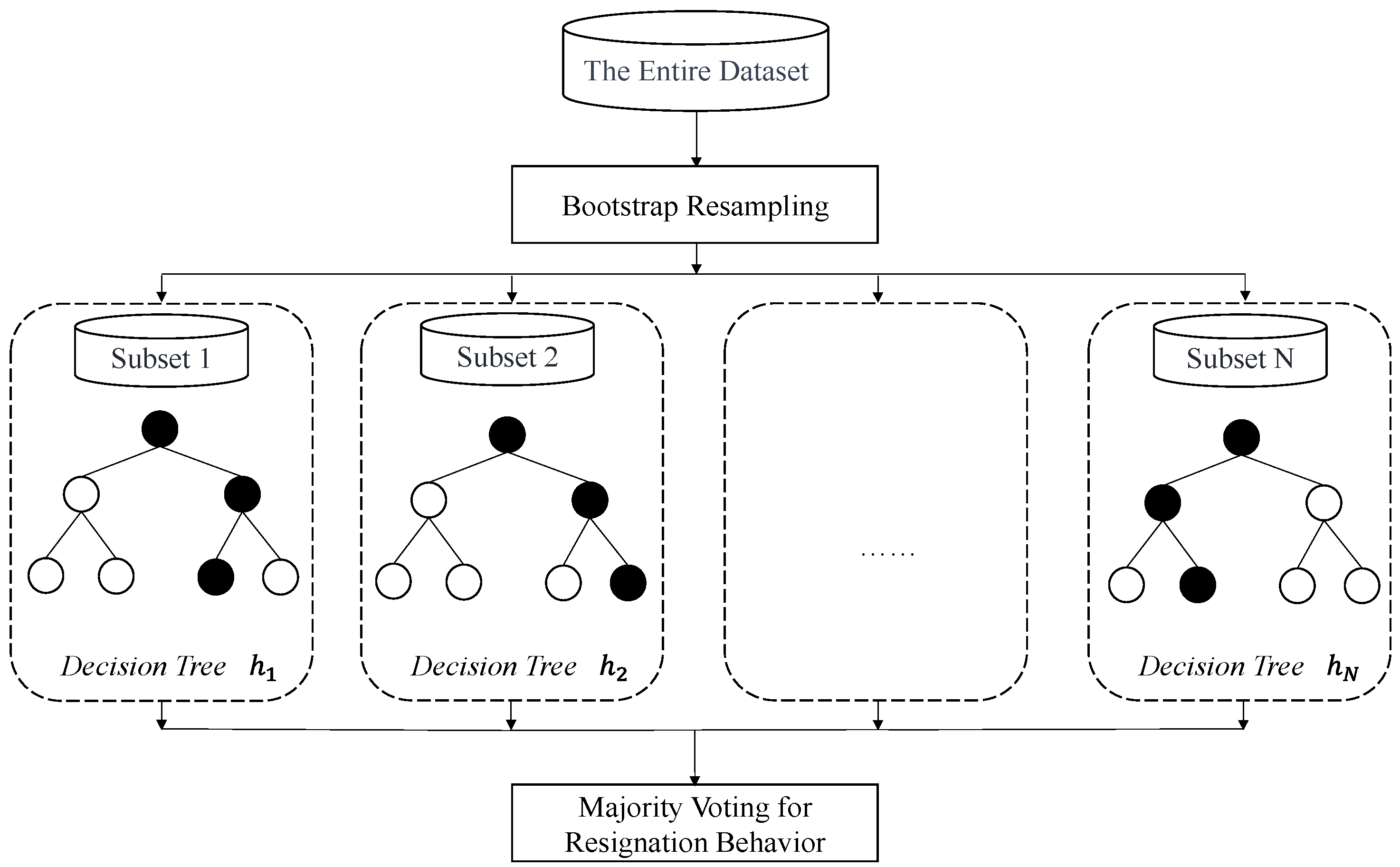
The frequent turnover of college graduates is a key factor leading to the frictional unemployment and structural unemployment of youth, which are important research fields concerned with pedagogy, sociology, and management; however, there is little research on the prediction of college graduates’ turnover. Therefore, this study investigated the turnover status of 17,268 college graduates from 52 universities in China, constructed and optimized a random forest model for predicting the turnover of college graduates, and analyzed the influencing mechanism of college graduates’ turnover and the importance of influencing factors. The enhanced random forest model could deal with the unbalanced data and has a higher prediction accuracy as well as stronger generalization ability in predicting the turnover of college graduates. Individual background variables, job characteristic variables, and work environment variables are all important factors influencing whether college graduates resign or not. The top five factors that affect the turnover of college graduates by more than 10% are income level, job satisfaction degree, job opportunities, and job matching degree. The conclusion of this study is conducive to improving the accuracy of turnover prediction, systematically exploring the influencing factors of college graduates’ turnover, and effectively guaranteeing the overall stability of youth employment.
Keywords: turnover prediction; influencing factors; machine learning; optimized random forest model turnover prediction; influencing factors; machine learning; optimized random forest model