
Article

Lurasidone and Fluvoxamine Combination in Eating Disorders with Comorbid Obsessive–Compulsive Disorder: Preliminary Evidence from an Observational Study

by
Francesco Monaco
1,2,†,
Annarita Vignapiano
1,2,†,
Ernesta Panarello
1,*,
Stefania Landi
1,
Giuseppe Scarano
3,
Giovanna Celia
4,
Giulio Corrivetti
1,2,
Luca Steardo, Jr.
5 and
Mauro Cozzolino
3
1
Department of Mental Health, ASL Salerno, 84127 Salerno, Italy
2
European Biomedical Research Institute of Salerno (EBRIS), 84121 Salerno, Italy
3
Department of Humanities, Philosophy and Education, University of Salerno, 84084 Fisciano, Italy
4
Department of Human Sciences, Education and Sport, University of Pegaso, 80100 Naples, Italy
5
Psychiatric Unit, Department of Health Sciences, University Magna Graecia of Catanzaro, 88100 Catanzaro, Italy
*
Author to whom correspondence should be addressed.
These authors have contributed equally to this work and share first authorship.
Med. Sci. 2026, 14(1), 8; https://doi.org/10.3390/medsci14010008

Submission received: 2 September 2025 / Revised: 23 October 2025 / Accepted: 22 December 2025 / Published: 23 December 2025
(This article belongs to the Section Neurosciences)

Abstract

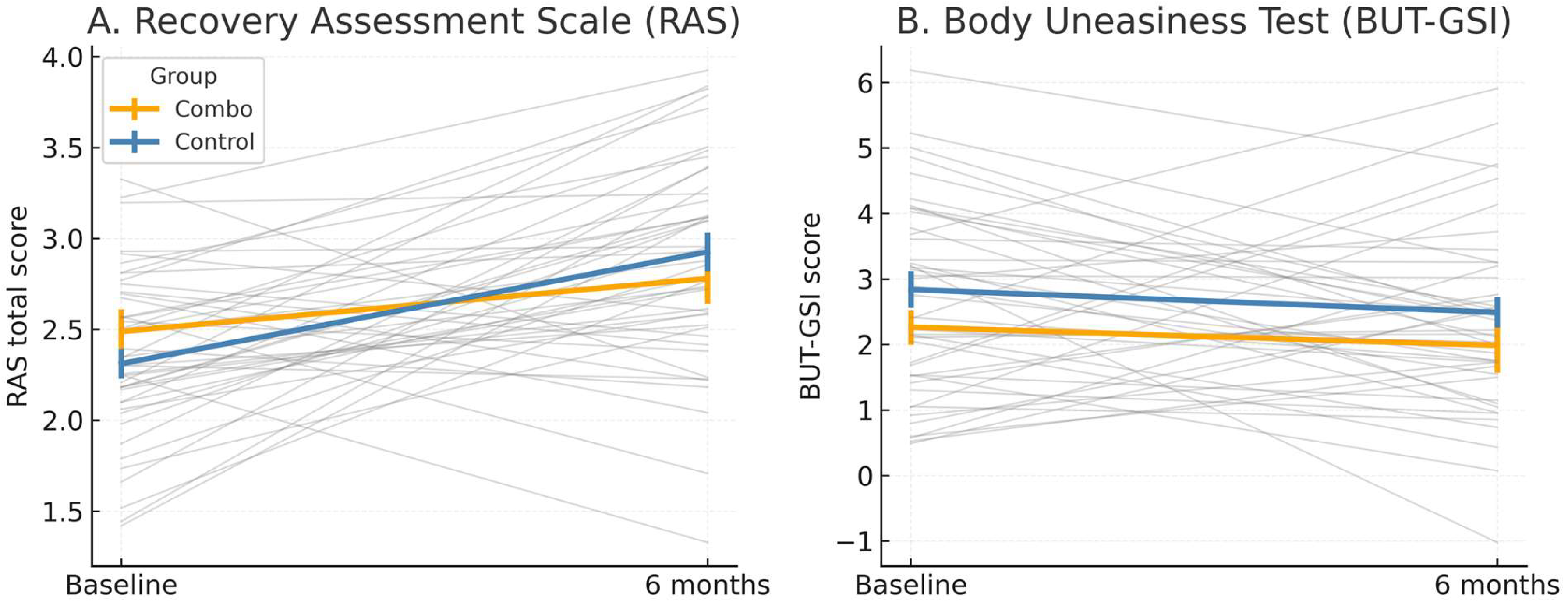
Background: Anorexia nervosa (AN) and obsessive–compulsive disorder (OCD) share core features of cognitive rigidity, anxiety, and altered reward processing. Pharmacological options remain limited, and combined modulation of serotonergic and dopaminergic systems may provide new therapeutic directions. This naturalistic study explored the combined use of lurasidone and fluvoxamine in individuals with restrictive AN (AN-r) and comorbid OCD. Methods: Forty-five female inpatients with AN-r and OCD were followed for six months. Participants received either lurasidone + fluvoxamine (n = 14) or heterogeneous SSRI/antipsychotic regimens (n = 31). Primary outcomes were the Recovery Assessment Scale (RAS) and Body Uneasiness Test Global Severity Index (BUT-GSI). Secondary outcomes included the Eating Disorder Examination-Questionnaire (EDE-Q) and Eating Disorder Inventory-3 (EDI-3). Bayesian repeated-measures ANOVAs were conducted, reporting BF10, BFInclusion, and P(M│data) values, with multiple imputation applied to manage missing data. Results: Analyses indicated time-related changes across primary outcomes (RAS and BUT-GSI), with moderate-to-strong evidence (BF10 = 4.2–18.6) supporting overall improvement during treatment. Secondary and exploratory measures showed weaker or inconsistent trends (BF10 < 3). No evidence emerged for group-by-time interactions exceeding anecdotal strength. Conclusions: Within the constraints of this small, all-female inpatient cohort, the findings illustrate directional, time-related changes compatible with global rehabilitation effects rather than drug-specific efficacy. The study demonstrates the feasibility—and methodological challenges—of applying Bayesian longitudinal modeling to incomplete clinical datasets. Future randomized or adaptive trials incorporating objective endpoints and data-quality pipelines are warranted to test whether serotonergic–dopaminergic–σ-1 synergy provides genuine clinical benefit in the AN–OCD spectrum.
Keywords: anorexia nervosa; obsessive–compulsive disorder; lurasidone; fluvoxamine; exploratory study; Bayesian analysis; missing data anorexia nervosa; obsessive–compulsive disorder; lurasidone; fluvoxamine; exploratory study; Bayesian analysis; missing data