
Climate-Induced Vegetation Changes Leading to Polygenetic Soil Development in NE Hungary at the MIS3/MIS 2 Transition
 ,
,  ,
, 
Abstract
1. Introduction
2. Geological Setting
3. Material and Methods
3.1. Sampling
3.2. Numerical Chronology
3.3. Rock Magnetism
3.4. Grain-Size Distribution
3.5. Mineralogical Composition
3.6. Geochemistry
3.7. Phytolith Analysis
3.8. Paleotemperature and Paleoprecipitation Estimations
4. Results
4.1. The Assumed Interval of Soil Formation
4.2. Rock Magnetism
4.3. Grain-Size Distribution
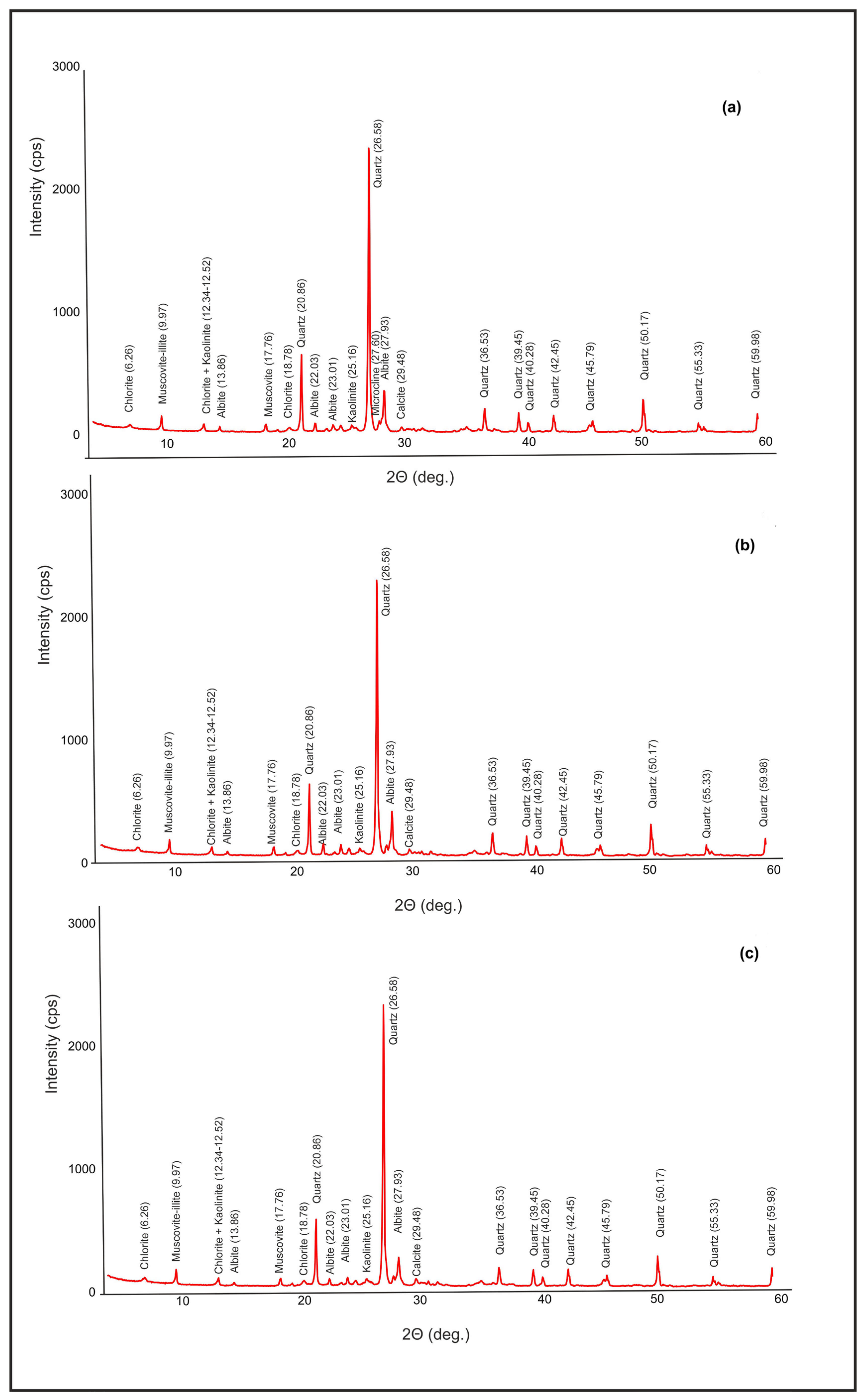
4.4. Mineral Composition
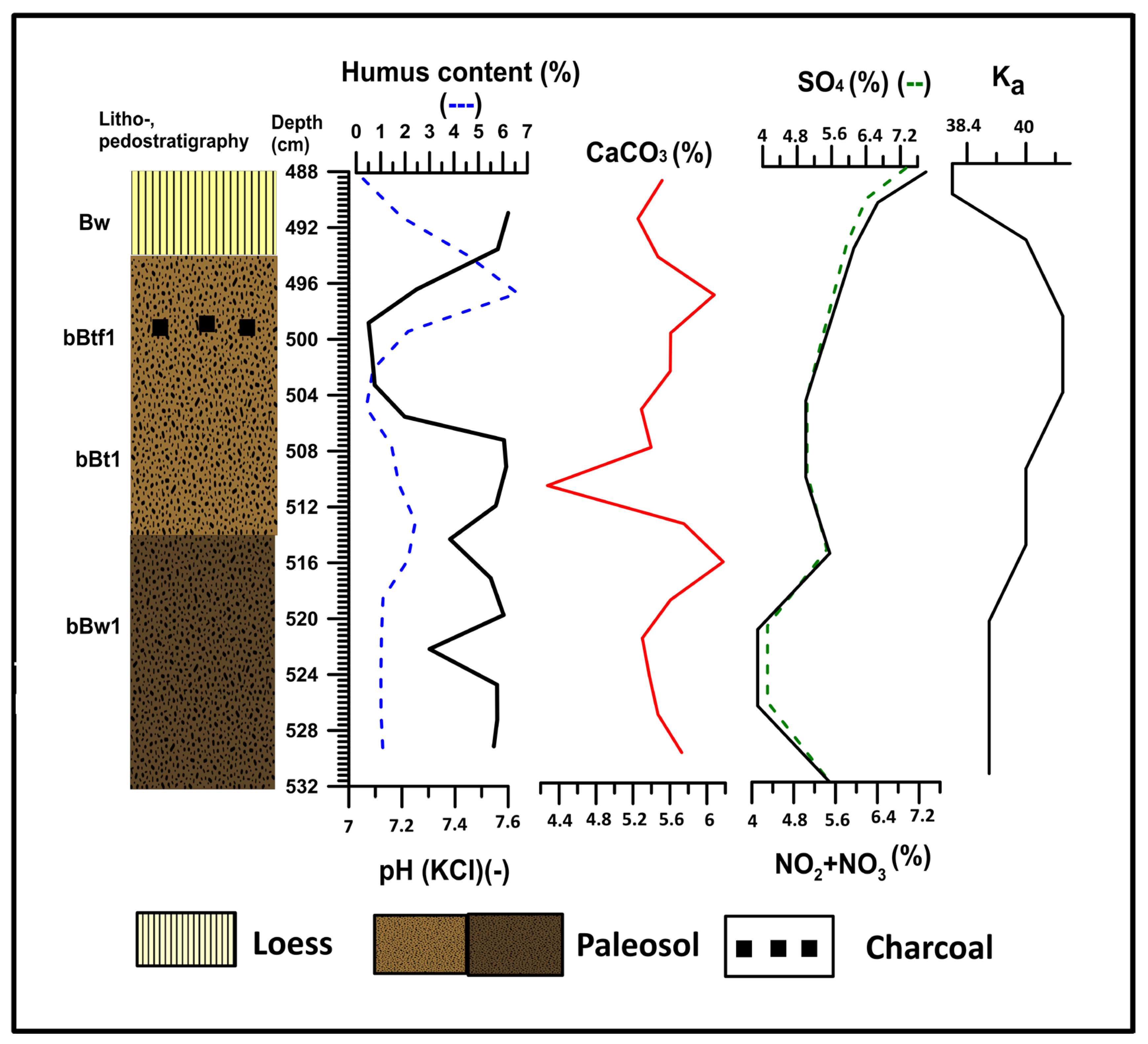
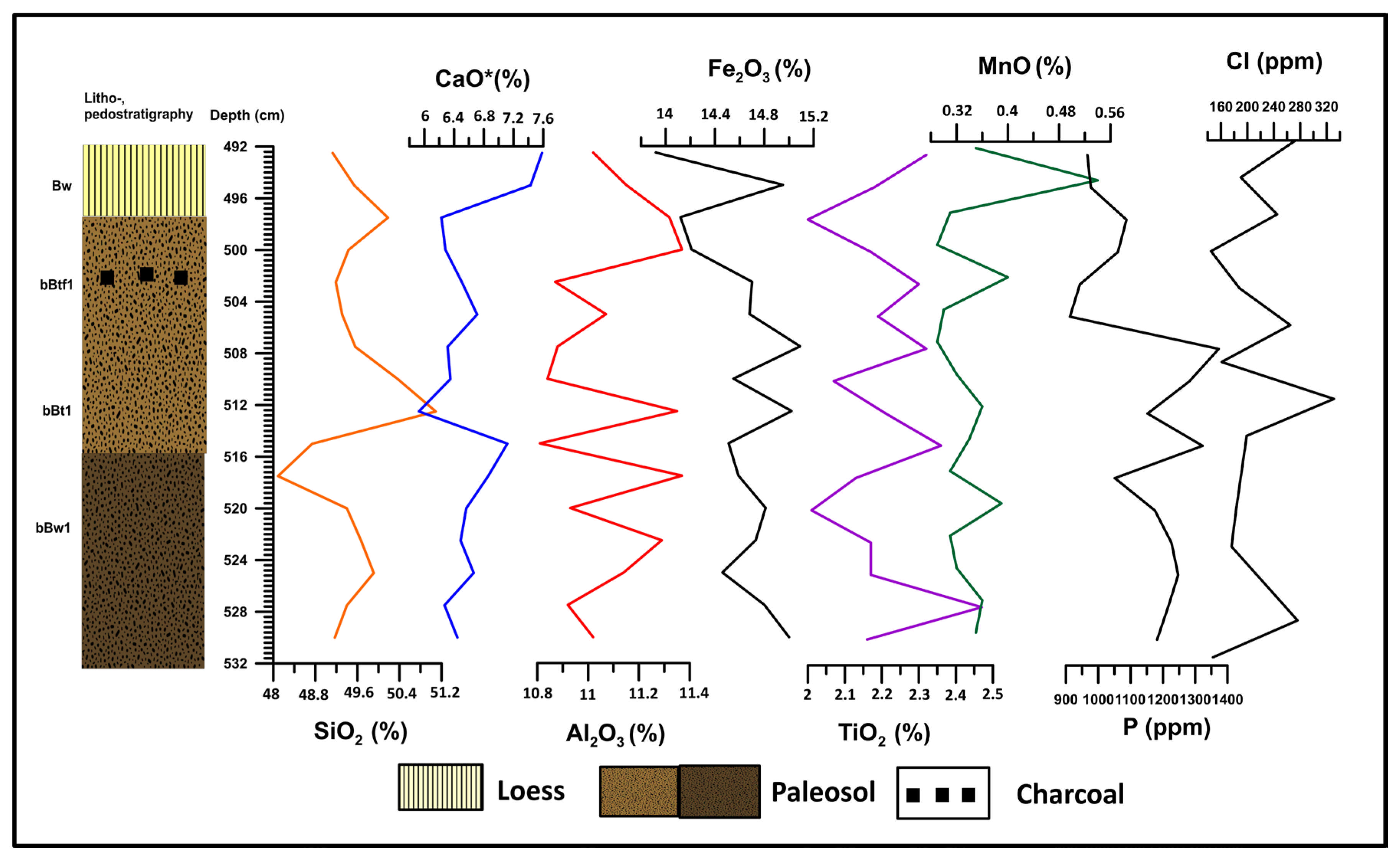
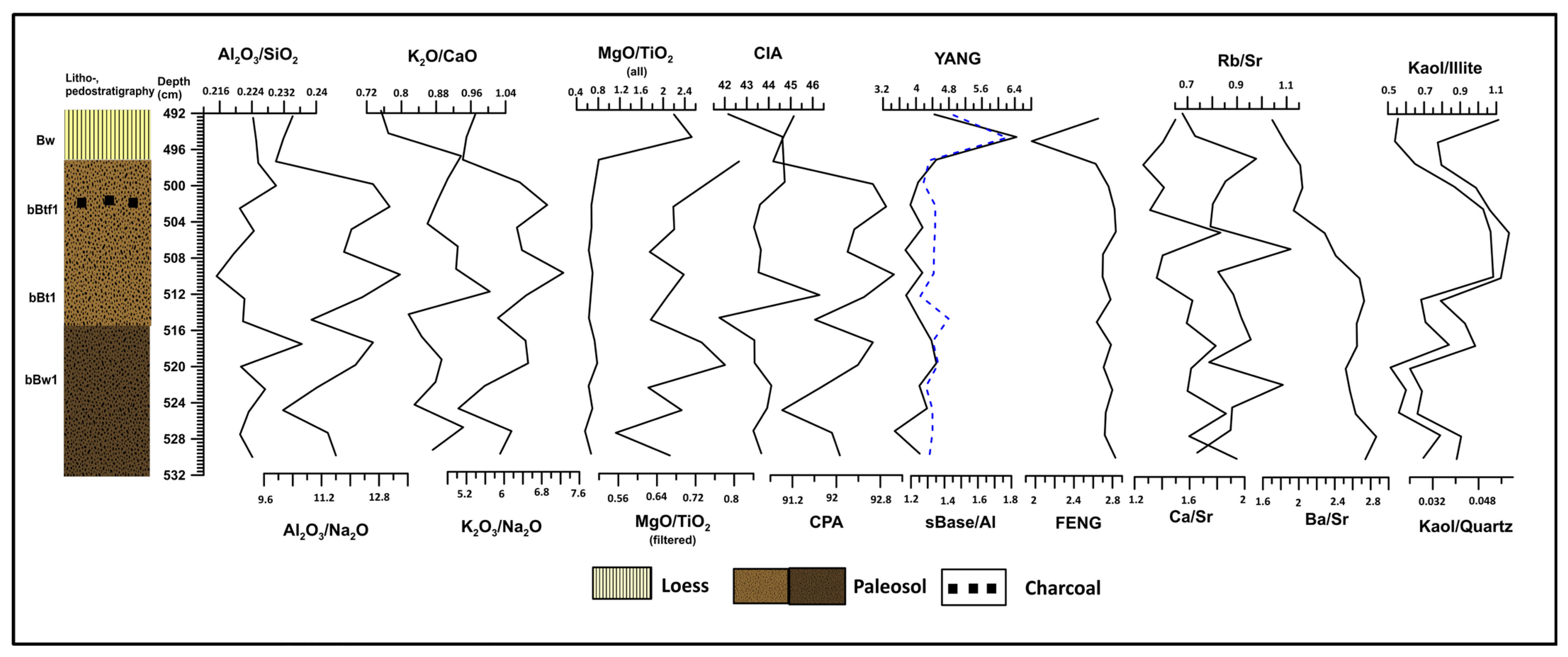
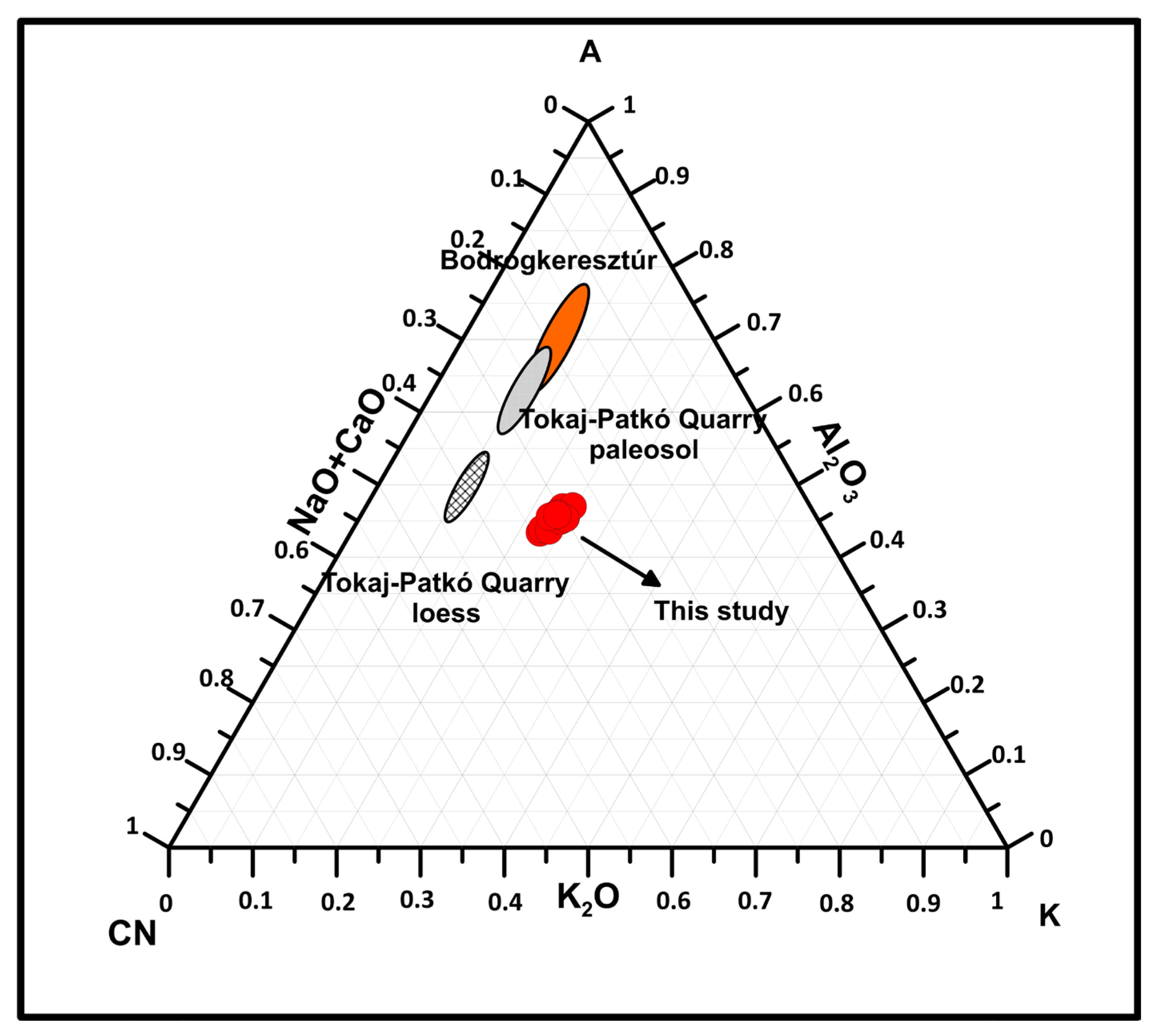
4.5. Geochemistry
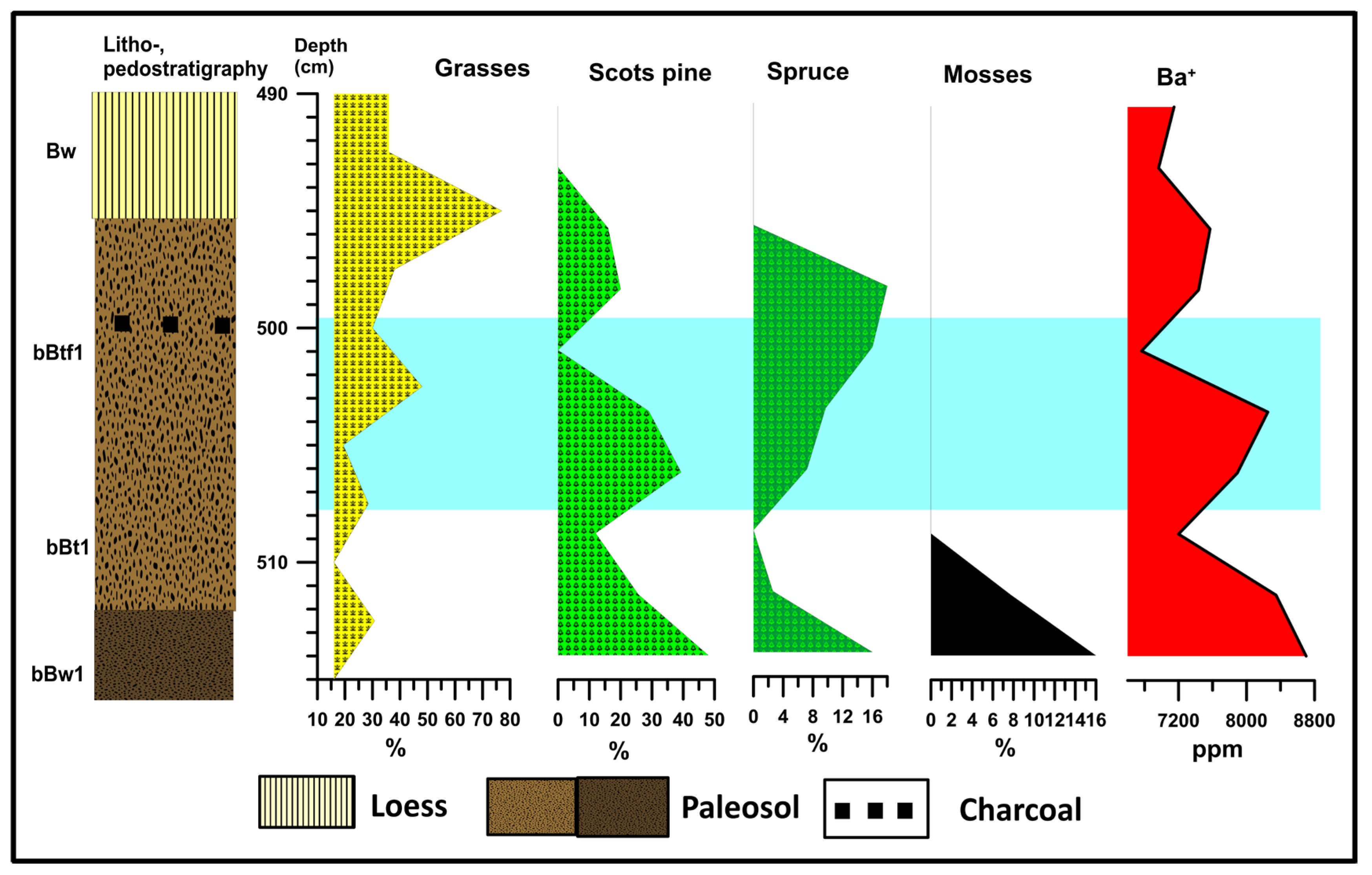
4.6. Phytolith Analysis
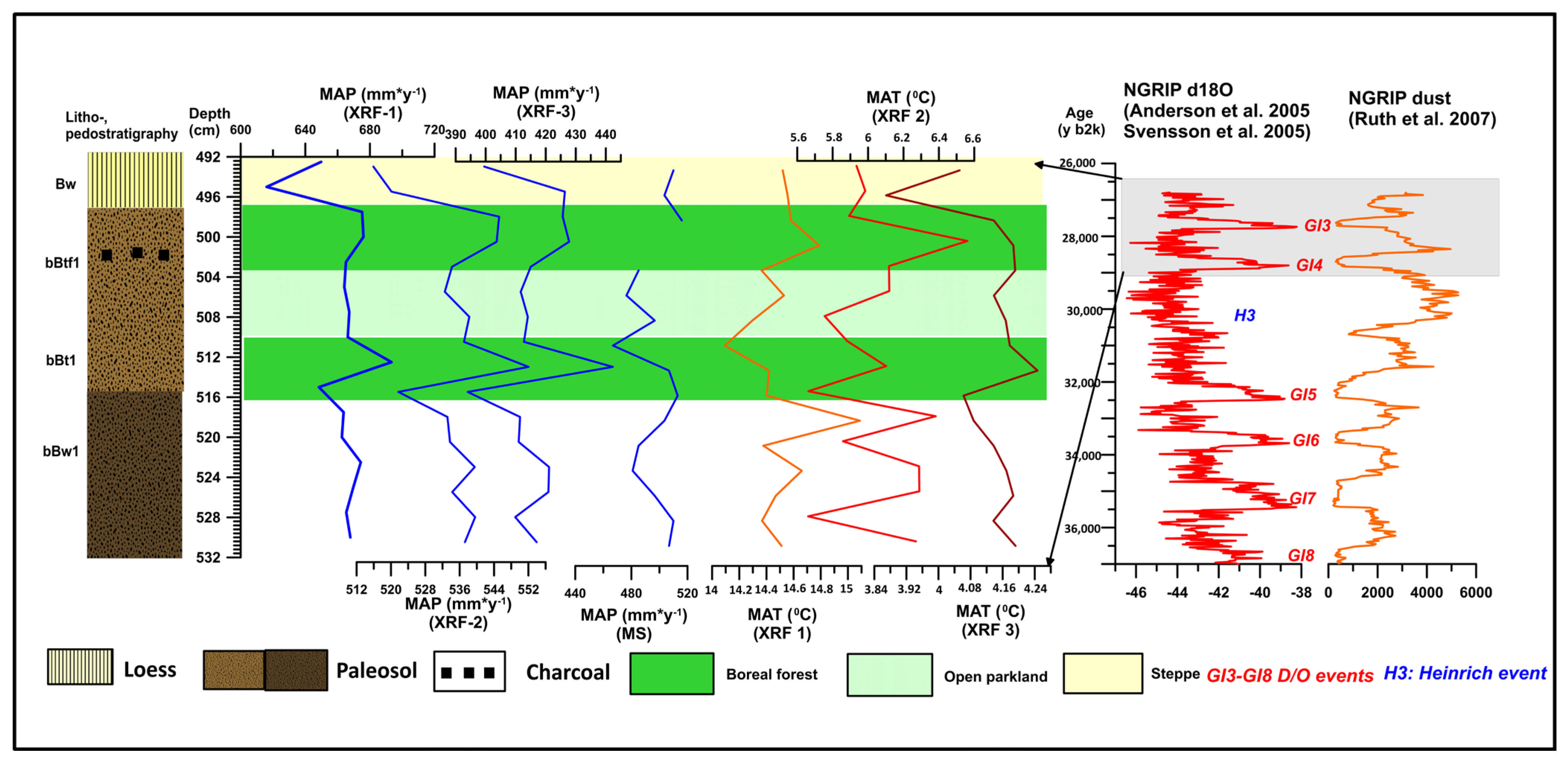
4.7. Paleotemperature and Precipitation Rates
5. Discussion
6. Concluding Remarks
Supplementary Materials
Author Contributions
Funding
Data Availability Statement
Acknowledgments
Conflicts of Interest
Appendix A
| Climate parameter |
| XRF-based |
| XRF1-MAP = −259.3ln(ÎBases/Al) + 759 [63] |
| XRF2-MAPa = −130.9ln(Ca/Al) + 467 [63] |
| XRF3-MAP = 221.1e0.0179(CIA-K) [63] |
| XRF1-MATb = 46.9(Al/Si) + 4 [62] |
| XRF2-MAT = −18.5 · [(K + Na)/Al] + 17.3 [63] |
| XRF3-MATc = −2.74ln(PWI) + 21.39 [88] |
| MS-based |
| MS1-MAPd = 222 + 199log(XB−C) [64] |
| a mollisols-specific |
| b inceptisol-specific |
| c forest soil-specific |
| d XB−C = [(mean MS of B horizon)−(mean MS of loess)], MS [10−8 m3 kg−1] |
References
- An, Z.; Kukla, G.J.; Porter, S.C.; Xiao, J. Magnetic susceptibility evidence of monsoon variation on the Loess Plateau of central China during the last 130,000 years. Quat. Res. 1991, 36, 29–36. [Google Scholar] [CrossRef] [Scilit]
- Catt, J.A.; Kemp, R.; Felix-Henningsen, P.; Scholten, T. Recent and paleo-pedogenesis as tools for modelling past and future global change. Catena 2000, 41, 1–25. [Google Scholar]
- Ponge, J.F. The soil as an ecosystem. Biol. Fert. Soils 2015, 51, 645–648. [Google Scholar] [CrossRef] [Scilit]
- Powlson, D. Climatology: Will soil amplify climate change? Nature 2005, 433, 204–205. [Google Scholar] [CrossRef] [Scilit] [PubMed]
- Dominati, E.; Patterson, M.; Mackay, A. A framework for classifying and quantifying the natural capital and ecosystem services of soils. Ecol. Econ. 2010, 69, 1858–1868. [Google Scholar] [CrossRef] [Scilit]
- Kemp, R.A. Pedogenic modification of loess: Significance for palaeoclimatic reconstructions. Earth-Sci. Rev. 2001, 54, 145–156. [Google Scholar] [CrossRef] [Scilit]
- Kühn, P.; Techmer, A.; Weidenfeller, M. Lower to middle Weichselian pedogenesis and palaeoclimate in Central Europe using combined micromorphology and geochemistry: The loess-paleosol sequence of Alsheim (Mainz Basin, Germany). Quat. Sci. Rev. 2013, 75, 43–58. [Google Scholar] [CrossRef] [Scilit]
- Pietsch, D.; Kühn, P. Early Holocene paleosols at the southwestern Ramlat As-Sab’atayn desert margin: New climate proxies for southern Arabia. Palaeogeogr. Palaeoec. Palaeocl. 2012, 365–366, 154–165. [Google Scholar] [CrossRef] [Scilit]
- Sümegi, P. Upper Pleistocene Evolutionary History of the Hajdúság Based on Fine Stratigraphic (Sediment, Paleontological, Geochemical) Data. Ph.D. Thesis, University of Debrecen, Debrecen, Hungary, 1989. [Google Scholar]
- Sümegi, P. Loess and Upper Paleolithic Environment in Hungary; Aurea Kiadó: Nagykovácsi, Hungary, 2005; 312p. [Google Scholar]
- Sümegi, P.; Rudner, E.; Hertelendi, E.; Borsos, S.; Deli, T.; Kozák, J.; Szöőr, G. Paleoecological research of the loess on the Kopasz mount (Tokaj, North Hungary). In Abstract of “Geomorphology and the Changing Environment in Europe Congress”; ELTE University Press: Budapest, Hungary, 1996; p. 112. [Google Scholar]
- Sümegi, P.; Molnár, M.; Svingor, É.; Szántó, Z.; Hum, L.; Gulyás, S. Results of radiocarbon analysis of Upper Wechselian loess sequences from Hungary. Radiocarbon 2007, 49, 1023–1030. [Google Scholar] [CrossRef] [Scilit]
- Páll, D.G.; Persaits, G.; Náfrádi, K.; Sümegi, P. Középső-würm végi fosszilis talaj- és löszréteg átmeneti szintjének komplex paleoökológiai vizsgálata a tokaji Kopasz-hegyen. Földtani Közlöny 2012, 142, 251–268. [Google Scholar]
- Sümegi, P.; Hertelendi, E. Reconstruction of microenvironmental changes in Kopasz Hill loess area at Tokaj (Hungary) between 15.000–70.000 BP years. Radiocarbon 1998, 40, 855–863. [Google Scholar]
- Schatz, A.K.; Zech, M.; Buggle, B.; Gulyás, S.; Hambach, U.; Markovic, S.B.; Sümegi, P.; Scholten, T. The late Quaternary loess record of Tokaj, Hungary: Reconstructing palaeoenvironment, vegetation and climate using stable C and N isotopes and biomarkers. Quat. Int. 2011, 240, 52–61. [Google Scholar] [CrossRef] [Scilit]
- Schatz, A.K.; Buylaert, J.P.; Murray, A.; Stevens, T.; Scholten, T. Establishing a luminescence chronology for a palaeosol-loess profile at Tokaj (Hungary): A comparison of quartz OSL and polymineral IRSL signals. Quat. Geochronol. 2012, 10, 68–74. [Google Scholar] [CrossRef] [Scilit]
- Schatz, A.K.; Scholten, T.; Kühn, P. Paleoclimate and weathering of the Tokaj (NE Hungary) loess-paleosol sequence: A comparison of geochemical weathering indices and paleoclimate parameters. Clim. Past Discuss. 2014, 10, 4069–4507. [Google Scholar]
- Bösken, J.; Sümegi, P.; Zeeden, C.; Klasen, N.; Gulyás, S.; Lehmkuhl, F. Investigating the last glacial Gravettian site “Ságvár Lyukas Hill” (Hungary) and its paleoenvironmental and geochronological context using a multi-proxy approach. Palaeogeogr. Palaeoclimatol. Palaeoecol. 2018, 509, 77–90. [Google Scholar] [CrossRef] [Scilit]
- Bösken, J.; Obrecht, I.; Zeeden, C.; Klasen, N.; Hambach, U.; Sümegi, P.; Lehmkuhl, F. High-resolution paleoclimatic proxy data from the MIS 3/MIS 2 transition recorded in northestern Hungarian loess. Quat. Int. 2019, 502, 95–107. [Google Scholar] [CrossRef] [Scilit]
- Sümegi, P.; Rudner, E. In situ charcoal fragments as remains of natural wildfires of the Upper Würm in the Carpathian Basin. Quat. Int. 2001, 76, 165–176. [Google Scholar]
- Rudner, E.; Sümegi, P. Recurring taiga forest steppe habitats in the Carpathian Basin in the Upper Weichselian. Quat. Int. 2001, 76, 177–189. [Google Scholar] [CrossRef] [Scilit]
- Rudner, E.; Sümegi, P. Charcoal as a Remain of Natural and Human-set Fires of Palaeolithic Times—Case Study from Hungary. Br. Archeol. Rep. 2002, 1089, 11–18. [Google Scholar]
- Pigati, J.S.; Quade, J.; Shanahan, T.M.; Haynes, C.V., Jr. Radiocarbon dating of minute gastropods and new constraints on the timing of spring-discharge deposits in southern Arizona, USA. Palaeogeogr. Palaeoclim. Palaeoecol. 2004, 204, 33–45. [Google Scholar] [CrossRef] [Scilit]
- Pigati, J.S.; Rech, J.A.; Nekola, J.C. Radiocarbon dating of small terrestrial gastropod shells in North America. Quat. Geochronol. 2010, 5, 519–532. [Google Scholar] [CrossRef] [Scilit]
- Pigati, J.S.; McGeehin, J.P.; Muhs, D.R.; Bettis, E.A., III. Radiocarbon dating late Quaternary loess deposits using small terrestrial gastropod shells. Quat. Sci. Rev. 2013, 76, 114–128. [Google Scholar] [CrossRef] [Scilit]
- Újvári, G.; Molnár, M.; Novothny, Á.; Páll-Gergely, B.; Kovács, J.; Várhegyi, A. AMS 14C and OSL/IRSL dating of the Dunaszekcső loess sequence (Hungary): Chronology for 20 to 150 ka and implications for establishing reliable age-depth models for the last 40 ka. Quat. Sci. Rev. 2014, 106, 140–154. [Google Scholar]
- Xu, B.; Gu, Z.; Han, J.; Hao, Q.; Lu, Y.; Wang, L.; Wu, N.; Peng, Y. Radiocarbon age anomalies of land snail shells in the Chinese Loess Plateau. Quat. Geochronol. 2011, 6, 383–389. [Google Scholar] [CrossRef] [Scilit]
- Hertelendi, E.; Csongor, É.; Záborszky, L.; Molnár, I.; Gál, I.; Győrffy, M.; Nagy, S. Counting system for high precision C-14 dating. Radiocarbon 1989, 32, 399–408. [Google Scholar] [CrossRef] [Scilit]
- Hertelendi, E.; Sümegi, P.; Szöőr, G. Geochronologic and paleoclimatic characterization of Quaternary sediments in the Great Hungarian Plain. Radiocarbon 1992, 34, 833–839. [Google Scholar] [CrossRef] [Scilit]
- Molnár, M.; Janovics, R.; Major, I.; Orsovszki, J.; Gönczi, R.; Veres, M.; Leonard, A.G.; Castle, S.M.; Lange, T.E.; Wacker, L.; et al. Status Report of the New AMS 14C Sample Preparation Lab of the Hertelendi Laboratory of Environmental Studies (Debrecen, Hungary). Radiocarbon 2013, 55, 665–676. [Google Scholar] [CrossRef] [Scilit]
- Reimer, P.J.; Bard, E.; Bayliss, A.; Beck, J.W.; Blackwell, P.G.; Ramsey, C.B.; Buck, C.E.; Cheng, H.; Edwards, R.L.; Friedrich, M.; et al. IntCal13 and Marine13 radiocarbon age calibration curves 0–50,000 Years cal BP. Radiocarbon 2013, 55, 1869–1887. [Google Scholar] [CrossRef] [Scilit]
- Crowther, J. Potential magnetic susceptibility and fractional conversion studies of archaeological soils and sediments. Archaeometry 2003, 45, 685–701. [Google Scholar] [CrossRef] [Scilit]
- Harvey, A.M.; Foster, G.; Hannam, J.; Mather, A.E. The Tabernas alluvial fan and lake system, southeast Spain: Applications of mineral magnetic and pedogenic iron oxide analyses towards clarifying the Quaternary sediment sequences. Geomorphology 2003, 50, 151–171. [Google Scholar] [CrossRef] [Scilit]
- Zhou, R.; Liu, Q.; Jackson, M.J. Paleoenvironmental significance of the magnetic fabrics in Chinese loess-paleosols since the last interglacial (<130 ka). Earth Planet. Sci. Lett. 2004, 221, 55–69. [Google Scholar]
- Dearing, J. Environmental Magnetic Susceptibility; Using the Bartington MS2 system; Chi Publishing: Kenilworth, UK, 1994. [Google Scholar]
- Konert, M.; Vandenberghe, J. Comparison of laser grain size analysis with pipette and sieve analysis: A solution for the underestimation of the clay fraction. Sedimentology 1997, 44, 523–535. [Google Scholar] [CrossRef] [Scilit]
- Vandenberghe, J.; Huijzer, B.; Mücher, H.; Laan, W. Short climatic oscillations in a western European loess sequence (Kesselt, Belgium). J. Quat. Sci. 1998, 13, 471–485. [Google Scholar] [CrossRef] [Scilit]
- Antoine PHatté Rousseau, C.; Zöller, L.; Lang, A.; Fontugne, M.; Moine, O. Événements éoliens rapides en contexte loessique: L’exemple de la séquence du Pléniglaciaire supérieur weichselien de Nussloch (Vallée du Rhin-Allemagne). Quaternaire 2002, 13, 199–208. [Google Scholar] [CrossRef] [Scilit]
- Antoine, P.; Rousseau, D.D.; Moine, O.; Kunesch, S.; Hatté, C.; Lang, A.; Zöller, L. Evidence of rapid and cyclic eolian deposition during the Last Glacial in European loess series (Loess events): The high-resolution records from Nussloch (Germany). Quat. Sci. Rev. 2009, 28, 2955–2973. [Google Scholar]
- Antoine, P.; Rousseau, D.D.; Fuchs, M.; Hatté, C.; Marković, S.B.; Jovanovic, M.; Gaudenyi, T.; Moine, O.; Rossignol, J. High-resolution record of the last climatic cycle in the southern Carpathian Basin at Surduk (Vojvodina, Serbia). Quat. Int. 2009, 198, 19–36. [Google Scholar] [CrossRef] [Scilit]
- Sümegi, P.; Gulyás, S.; Molnár, D.; Sümegi, B.P.; Törőcsik, T.; Almond, P.; Smalley, I.; Zhou, L.; Galovic, L.; Pál-Molnár, E.; et al. Periodicities of paleoclimate variations in the first high-resolution non-orbitally tuned grain size record of the past 1 ma from SW Hungary and regional, global correlations. Aeolian Res. 2019, 40, 74–90. [Google Scholar]
- Antoine, P.; Rousseau, D.D.; Zöller, L.; Lang, A.; Munaut, A.V.; Hatté, C.; Fontugne, M. High-resolution record of the last inter-glacial–glacial cycle in the Nussloch loess-palaeosol sequences. Germany Upper Rhine Area. Quat. Int. 2001, 76–77, 211–229. [Google Scholar]
- Dániel, P. Methods of the five-step extraction-digestion method. Results of the five-step extraction-digestion method. In The Geohistory of Bátorliget Marshland; Sümegi, P., Gulyás, S., Eds.; Archaeolingua Press: Budapest, Hungary, 2004; pp. 53–56+98–108. [Google Scholar]
- DeLong, S.E.; McCullough, D.B. Compton-scattered Tungs X-ray a Measure of Mass Absorption Coefficients in Rocks. Am. Mineral. 1973, 58, 1073–1075. [Google Scholar]
- Wilband, J.T. Rapid Method for background Corrections in trace Element Analysis by X-ray Fluorescence Analysis. Am. Mineral. 1975, 60, 320–323. [Google Scholar]
- Bokhorst, M.P.; Beets, C.J.; Markovic, S.B.; Gerasimenko, N.P.; Matviishina, Z.N.; Frechen, M. Pedo-chemical climate proxies in Late Pleistocene Serbian-Ukrainian loess sequences. Quat. Int. 2009, 191, 111–123. [Google Scholar]
- Buggle, B.; Glaser, B.; Hambach, U.; Gerasimenko, N.; Marković, S.B. An evaluation of geochemical weathering indices in loess–paleosol studies. Quat. Int. 2011, 240, 12–21. [Google Scholar] [CrossRef] [Scilit]
- Li, C.; Yang, S. Is chemical index of alteration (CIA) a reliable proxy for chemical weathering in global drainage basins? Am. J. Sci. 2010, 310, 111–127. [Google Scholar] [CrossRef] [Scilit]
- Sheldon, N.D.; Tabor, N.J. Quantitative paleoenvironmental and paleoclimatic reconstruction using paleosols. Earth-Sci. Rev. 2009, 95, 1–52. [Google Scholar] [CrossRef] [Scilit]
- Retallack, G.J. Soils of the Past; Blackwell: Oxford, UK, 2001; p. 600p. [Google Scholar]
- Varga, A.; Újvári, G.; Raucsik, B. Tectonic versus climatic control on the evolution of a loess–paleosol sequence at Beremend, Hungary: An integrated approach based on paleoecological, clay mineralogical, and geochemical data. Quatern. Int. 2011, 240, 71–86. [Google Scholar] [CrossRef] [Scilit]
- Nesbitt, H.W.; Young, G.M. Formation and diagenesis of weathering profiles. J. Geol. 1989, 97, 129–147. [Google Scholar] [CrossRef] [Scilit]
- Feng, Z.D. Geochemical characteristics of a loess-soil sequence in central Kansas. Soil Sci. Soc. Am. J. 1997, 61, 534–541. [Google Scholar]
- Yang, S.; Ding, F.; Ding, Z. Pleistocene chemical weathering history of Asian arid and semi-arid regions recorded in loess deposits of China and Tajikistan. Geochim. Cosmochim. Acta 2006, 70, 1695–1709. [Google Scholar] [CrossRef] [Scilit]
- Profe, J.; Zolitschka, B.; Schirmer, W.; Frechen, M.; Ohlendorf, C. Geochemistry unravels MIS 3/2 paleoenvironmental dynamics at the loess/paleosol sequence Schwalbenberg II, Germany. Palaeogeogr. Palaeoclimatol. Palaeoecol. 2016, 459, 537–551. [Google Scholar] [CrossRef] [Scilit]
- Profe, J.; Neumann, L.; Novothny, Á.; Barta, G.; Rolf, C.; Frechen, M.; Ohlendorf, C.; Zolitschka, B. Paleoenvironmental conditions and sedimentation dynamics in Central Europe inferred from geochemical data of the loess-paleosol sequence at Süttő (Hungary). Quat. Sci. Rev. 2018, 196, 21–37. [Google Scholar] [CrossRef] [Scilit]
- Persaits, G. A Fitolitok Szerepe a Geo-Archeológiai Minták Értékelésében. Ph.D. Thesis, University of Szeged, Szeged, Hungary, 2010. [Google Scholar]
- Persaits, G.; Sümegi, P. A fitolitok szerepe a régészeti geológiai és környezettörténeti minták értékelésében. In Geoszférák 2010; Unger, J., Pál-Molnár, E., Eds.; GeoLitera: Szeged, Hungary, 2011; pp. 307–354. [Google Scholar]
- Persaits, G.; Gulyás, S.; Náfrádi, K.; Sümegi, P.; Szalontay, C. Phytolithic aided paleoenvironmental studies from the Dutch Neolithic. Open Geosci. 2015, 1, 732–741. [Google Scholar]
- Piperno, D.R. Phytoliths: A Comprehensive Guide for Archaeologists and Paleoecologists; Altamira Press: Oxford, UK, 2006; p. 238p. [Google Scholar]
- Golyeva, A.A. Biomorphic analysis as a part of soil morphological investigations. Catena 2001, 43, 217–230. [Google Scholar] [CrossRef] [Scilit]
- Sheldon, N.D. Quaternary glacial-interglacial climate cycles in Hawaii. J. Geol. 2006, 114, 367–376. [Google Scholar] [CrossRef] [Scilit]
- Sheldon, N.D.; Retallack, G.J.; Tanaka, S. Geochemical climofunctions from North American soils and application to Paleosols across the Eocene–Oligocene boundary in Oregon. J. Geol. 2002, 110, 687–696. [Google Scholar] [CrossRef] [Scilit] [PubMed]
- Maher, B.A.; Thompson, R.; Zhou, L.-P. Spatial and temporal re constructions of changes in the Asian palaeomonsoon: A new mineral magnetic approach. Earth Planet. Sci. Lett. 1994, 125, 462–471. [Google Scholar]
- Marković, S.B.; Stevens, T.; Kukla, G.J.; Hambach, U.; Fitzsimmons, K.E.; Gibbard, P.; Buggle, B.; Zech, M.; Guo, Z.; Hao, Q.; et al. Danube loess stratigraphy—Towards a pan-European loess stratigraphic model. Earth-Sci. Rev. 2015, 148, 228–258. [Google Scholar] [CrossRef] [Scilit]
- Újvári, G.; Varga, A.; Raucsik, B.; Kovács, J. The Paks loess-paleosol sequence: A record of chemical weathering and provenance for the last 800 ka in the mid-Carpathian Basin. Quat. Int. 2014, 319, 22–37. [Google Scholar] [CrossRef] [Scilit]
- Újvári, G.; Varga, A.; Balogh-Brunstad, Z. Origin, weathering, and geochemical composition of loess in southwestern Hungary. Quat. Res. 2008, 69, 421–437. [Google Scholar] [CrossRef] [Scilit]
- Andersen, K.K.; Svensson, A.M.; Johnsen, S.J.; Rasmussen, S.O.; Bigler, M.; Röthlisberger, R.; Ruth, U.; Siggaard-Andersen, M.L.; Steffensen, J.P.; Dahl-Jensen, D.; et al. The Greenland Ice Core Chronology 2005, 15–42 ka. Part 1: Constructing the time scale. Quat. Sci. Rev. 2005, 25, 3246–3257. [Google Scholar] [CrossRef] [Scilit]
- Svensson, A.; Nielsen, S.W.; Kipfstuhl, S.; Johnsen, S.J.; Steffensen, J.P.; Bigler, M.; Ruth, U.; Röthlisberger, R. Visual stratigraphy of the North Greenland Ice Core Project (NorthGRIP) ice core during the last glacial period. J. Geophys. Res. 2005, 110, D02108. [Google Scholar] [CrossRef] [Scilit]
- Ruth, U. Mineral dust records from Greenland ice cores. PAGES Newsl. 2005, 13, 17–18. [Google Scholar] [CrossRef] [Scilit]
- Sümegi, P.; Molnár, D.; Gulyás, S.; Náfrádi, K.; Sümegi, B.P.; Törőcsik, T.; Persaits, G.; Molnár, M.; Vandenberghe, J.; Zhou, L. High-resolution proxy record of the environmental response to climatic variations during transition MIS3/MIS2 and MIS2 in Central Europe: The loess-paleosol sequence of Katymár brickyard (Hungary). Quat. Int. 2019, 504, 40–55. [Google Scholar]
- Sümegi, P.; Persaits, G.; Gulyás, S. Woodland-grassland ecotonal shifts in environmental mosaics: Lessons learnt from the environmental history of the Carpathian Basin (central Europe) during the Holocene and the last ice age based on investigation of paleobotanical and mollusk remains. In Ecotones between Forest and Grassland; Myster, R.W., Ed.; Springer Press: New York, NY, USA, 2012; pp. 17–57. [Google Scholar]
- Sümegi, P.; Gulyás, S.; Csökmei, B.; Molnár, D.; Hambach, U.; Stevens, T.; Markovic, S.B.; Almond, P.C. Climatic fluctuations inferred for the Middle and Late Pleniglacial (MIS 2) based on high-resolution (~ca. 20 y) preliminary environmental magnetic investigation of the loess section of the Madaras brickyard (Hungary). Cent. Eur. Geol. 2012, 55, 329–345. [Google Scholar] [CrossRef] [Scilit]
- Tao, J.; Chen, M.-T.; Xu, S. A Holocene environmental record from the southern Yangtze River delta, eastern China. Palaeogeogr. Palaeoclim. Palaeoecol. 2006, 230, 204–229. [Google Scholar] [CrossRef] [Scilit]
- Buggle, B.; Glaser, B.; Zöller, L.; Hambach, U.; Markovi’c, S.; Glaser, I.; Gerasimenko, N. Geochemical characterization and origin of Southeastern and Eastern European loesses (Serbia, Romania, Ukraine). Quat. Sci. Rev. 2008, 27, 10581075. [Google Scholar] [CrossRef] [Scilit]
- Antoine, P.; Rousseau, D.G.; Degeai, J.P.; Moine, O.; Lagroix, F.; Kreutzer, S.; Fuchs, M.; Hatté, C.; Gauthier, C.; Svoboda, J.; et al. High-resolution record of the environmental response to climatic variations during the Last Interglacial–Glacial cycle in Central Europe: The loess-palaeosol sequence of Dolní Vestonice (Czech Republic). Quat. Sci. Rev. 2013, 148, 228–258. [Google Scholar]
- Fitzsimmons, K.E.; Markovic, S.B.; Hambach, U. Pleistocene environmental dynamics recorded in the loess of the middle and lower Danube basin. Quat. Sci. Rev. 2012, 41, 104–118. [Google Scholar] [CrossRef] [Scilit]
- Sümegi, P.; Gulyás, S.; Molnár, D.; Szilágyi, G.; Sümegi, B.P.; Törőcsik, T.; Molnár, M. 14C dated chronology of the thickest and best resolved loess/paleosol record of the LGM from SE Hungary based on comparing the precision and accuracy of age-depth models. Radiocarbon 2020, 20, 403–417. [Google Scholar] [CrossRef] [Scilit]
- Sümegi, P.; Gulyás, S.; Molnár, D.; Bozsó, G.; Fekete, I.; Makó, L.; Cseh, P.; Molnár, M.; Sümegi, B.P.; Almond, P.; et al. New chronology andextended palaeoenvironmental data to the 1975 loess profile of Madaras brickyard, South Hungary. J. Quat. Sci. 2021, 36, 1364–1381. [Google Scholar]
- Frenzel, B.; Pécsi, M.; Velichko, A.A. Atlas of Paleoclimates and Paleoenvironments of the Northern Hemisphere, Late Pleistocene–Holocene; Geographical Institute, Hungarian Academy of Sciences: Budapest, Hungary; Gustav Fischer Verlag: Stuttgart, Germany, 1992. [Google Scholar]
- Hatté, C.; Guiot, J. Palaeoprecipitation reconstruction by inverse modelling using the isotopic signal of loess organic matter: Application to the Nußloch loess sequence (Rhine Valley, Germany). Clim. Dynam. 2005, 25, 315–327. [Google Scholar] [CrossRef] [Scilit]
- Sümegi, P.; Náfrádi, K.; Molnár, D.; Sávai, S. Results of paleoecological studies in the loess region of Szeged-Öthalom (SE Hungary). Quat. Int. 2015, 372, 66–78. [Google Scholar] [CrossRef] [Scilit]
- Sümegi, P.; Gulyás, S.; Persaits, G.; Molnár, D. The loess-paleosol sequence of Basaharc (Hungary) revisited: Mollusc-based paleoecological results for the Middle and Upper Pleistocene. Quat. Int. 2011, 240, 181–192. [Google Scholar]
- Markovic, S.B.; Hao, Q.; Ludwig, P.; Zeeden, C.; Peric, Z.M.; Mihailovic, D.; Radovic, P.; Roksandic, M.; Lindal, J.; Krsmanovic, P.; et al. Environmental dynamics recorded at Dupljaja loess section (southeastern Carpathian Basin, northern Serbia). Catena 2026, 263, 109732. [Google Scholar]
- Markovic, S.B.; Oches, E.A.; Peric, Z.M.; Gaudenyi, T.; Jovanovic, M.; Sipos, G.y.; Thiel, C.; Buylaert, J.; Savic, S.; McCoy, W.D.; et al. The Požarevac loess–paleosol sequence: A record of increased aridity in the south-eastern margin of the Carpathian Basin during the last 350 ka. J. Quat. Sci. 2021, 36, 1436–1447. [Google Scholar] [CrossRef] [Scilit]
- Marković, S.B.; Vandenberghe, J.; Perić, Z.M.; Filyó, D.; Bartyik, T.; Radaković, M.G.; Hao, Q.; Marković, R.S.; Lukić, T.; Tomić, N.; et al. Local differentiation in the loess deposition as a function of dust source: Key study novo Orahovo loess Paleosol sequence (Vojvodina, Serbia). Quaternary 2023, 6, 23. [Google Scholar] [CrossRef] [Scilit]
- Fenn, K.; Millar, I.L.; Durcan, J.A.; Thomas, D.S.G.; Banak, A.; Marković, S.B.; Veres, D.; Stevens, T. The provenance of Danubian loess. Earth Sci. Rev. 2022, 226, 103920. [Google Scholar] [CrossRef] [Scilit]
- Gallagher, T.M.; Sheldon, N.D. A new paleothermometer for forest paleosols and its implications for Cenozoic climate. Geology 2013, 41, 647–650. [Google Scholar] [CrossRef] [Scilit]


Disclaimer/Publisher’s Note: The statements, opinions and data contained in all publications are solely those of the individual author(s) and contributor(s) and not of MDPI and/or the editor(s). MDPI and/or the editor(s) disclaim responsibility for any injury to people or property resulting from any ideas, methods, instructions or products referred to in the content. |
© 2026 by the authors. Licensee MDPI, Basel, Switzerland. This article is an open access article distributed under the terms and conditions of the Creative Commons Attribution (CC BY) license.
Share and Cite
Gulyás, S.; Sümegi, P.; Molnár, D.; Almond, P.; Persaits, G.; Pál-Molnár, E.; Töröcsik, T.; Molnár, M.; Náfrádi, K.; Vári, T.Z. Climate-Induced Vegetation Changes Leading to Polygenetic Soil Development in NE Hungary at the MIS3/MIS 2 Transition. Geosciences 2026, 16, 254. https://doi.org/10.3390/geosciences16070254
Gulyás S, Sümegi P, Molnár D, Almond P, Persaits G, Pál-Molnár E, Töröcsik T, Molnár M, Náfrádi K, Vári TZ. Climate-Induced Vegetation Changes Leading to Polygenetic Soil Development in NE Hungary at the MIS3/MIS 2 Transition. Geosciences. 2026; 16(7):254. https://doi.org/10.3390/geosciences16070254
Chicago/Turabian StyleGulyás, Sándor, Pál Sümegi, Dávid Molnár, Peter Almond, Gergő Persaits, Elemér Pál-Molnár, Tünde Töröcsik, Mihály Molnár, Katalin Náfrádi, and Tamás Zsolt Vári. 2026. "Climate-Induced Vegetation Changes Leading to Polygenetic Soil Development in NE Hungary at the MIS3/MIS 2 Transition" Geosciences 16, no. 7: 254. https://doi.org/10.3390/geosciences16070254
APA StyleGulyás, S., Sümegi, P., Molnár, D., Almond, P., Persaits, G., Pál-Molnár, E., Töröcsik, T., Molnár, M., Náfrádi, K., & Vári, T. Z. (2026). Climate-Induced Vegetation Changes Leading to Polygenetic Soil Development in NE Hungary at the MIS3/MIS 2 Transition. Geosciences, 16(7), 254. https://doi.org/10.3390/geosciences16070254