Article

Fluorapatite from a Pegmatite with Miarolitic Cavities in the Larsemann Hills, East Antarctica: ID-TIMS U-Pb Ages and LA-ICP-MS Trace-Element Constraints on the Late Pan-African Orogenic Evolution


by
Ivan A. Babenko
1,*,
Nailya G. Rizvanova
2,
Sergey G. Skublov
2,
Yuri A. Bishaev
3,
Irina V. Talovina
1,
Olga L. Galankina
2 and
Alexander V. Kuznetsov
1
1
Department of Historical and Dynamic Geology, Empress Catherine II Saint Petersburg Mining University, St. Petersburg 199106, Russia
2
Institute of Precambrian Geology and Geochronology, Russian Academy of Sciences, St. Petersburg 199034, Russia
3
V.S. Sobolev Institute of Geology and Mineralogy, Siberian Branch Russian Academy of Sciences, Novosibirsk 630090, Russia
*
Author to whom correspondence should be addressed.
Geosciences 2026, 16(3), 133; https://doi.org/10.3390/geosciences16030133
Submission received: 18 February 2026 / Revised: 18 March 2026 / Accepted: 19 March 2026 / Published: 23 March 2026
(This article belongs to the Section Geochemistry)

Abstract

Pegmatites with miarolitic cavities have not previously been reported from the Larsemann Hills, East Antarctica, and their age and origin remain poorly constrained. We report the first geochemical and geochronological data for fluorapatite from a newly discovered pegmatite with miarolitic cavities in the Larsemann Hills. Large Fe-rich fluorapatite crystals (up to 5 cm) contain abundant oriented monazite-(Ce) inclusions and display elevated REE (1397–7966 ppm), relatively high Y (945–4192 ppm), and low Sr (52.2–83.5 ppm). Their trace-element signatures plot within the fields of partial melts, high-grade metamorphic rocks, and evolved fluid-rich magmatic systems. U–Pb dating of fluorapatite yields concordant ages of 519 ± 4 Ma (ID-TIMS) and 521 ± 31 Ma (LA-ICP-MS), indicating crystallization during the D4 stage of the Pan-African orogeny. The isotopic equilibrium between apatite and monazite inclusions suggests synchronous formation and late-stage fluid overprinting. Combined geological, geochemical, and isotopic evidence shows that the pegmatite formed in situ as a product of anatexis of the Broknes paragneisses and evolved within a volatile-rich magmatic–hydrothermal system. These results provide the first direct age constraints on pegmatites with miarolitic cavities in Antarctica and shed new light on the final stages of East Gondwana assembly.

1. Introduction

The Pan-African orogeny (650–450 Ma) was one of the major tectono-thermal events in Antarctic geological history, culminating in the assembly of the supercontinent Gondwana in the Early Paleozoic [1,2]. Its manifestations are recorded across present-day Antarctica, India, Australia, Africa, South America and Madagascar [3].
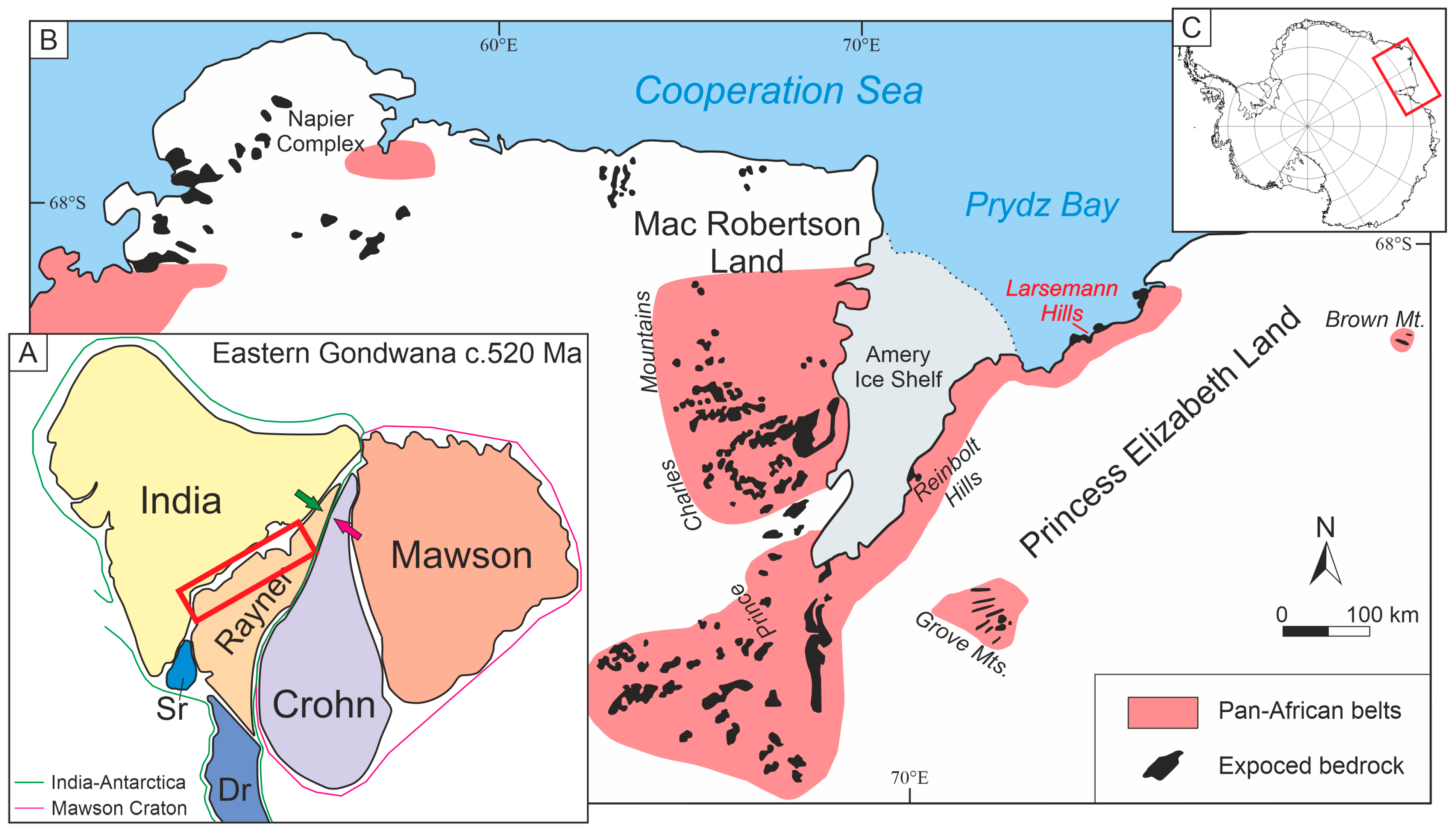
East Antarctica represents a key component of this ancient supercontinent, where metamorphic and magmatic complexes of different ages are exposed, preserving evidence of several global tectono-thermal events [4,5]. During the final stage of Gondwana assembly (Figure 1A), the crystalline basement of the region underwent tectono-magmatic reactivation, resulting in the emplacement of numerous small stock-like and dome-shaped Early Paleozoic granitoid intrusions accompanied by abundant pegmatite dykes within the area of Princess Elizabeth Land and the adjacent Mac Robertson Land [6].
Such intrusions are widely distributed across Princess Elizabeth Land and are particularly well developed in the Larsemann Hills, where five pegmatite types have been identified [7], each related to distinct deformation stages of the Pan-African orogeny. Although pegmatites in the Larsemann Hills have been described in terms of petrology, their classification and petrogenesis remain insufficiently constrained by high-precision in situ geochronology and detailed trace-element data. Previous studies have primarily focused on specific mineralogical and geochemical aspects [8,9,10,11,12,13,14], while geochronological constraints have been addressed in [14,15,16].
A recently discovered pegmatite with miarolitic cavities described by the authors is unique within the region, and determining its age and origin is a central objective of this study. Until now, no such bodies have been documented, and therefore, no direct geochronological constraints on this type of pegmatite have been available. Furthermore, the origin of miarolitic cavities in such deep-seated pegmatitic systems remains poorly understood, as their development is generally considered uncommon in abyssal pegmatites [17]. Pegmatites with well-developed miarolitic cavities have not previously been documented in Antarctica [17]. Pegmatites with broadly similar mineralogical assemblages (e.g., the pegmatites from Reinbolt Hills [18]) differ in internal structure and geometry, and their available geochronological data (538 ± 25 Ma) remain insufficiently precise. They are located at some distance from the Larsemann Hills and belong to the same Prydz Bay belt. This spatial-temporal framework provides a basis for evaluating the progression of late Pan-African tectono-magmatic processes and fluid evolution in this sector of East Antarctica.
To refine the age and formation conditions of the pegmatites with miarolitic cavities, geochemical and isotopic analyses of apatite samples from such bodies were carried out. In recent years, apatite has been increasingly recognized as an effective geochemical and geochronological indicator, capable of constraining the origin, age, and subsequent evolution of its host rocks, as well as their ore-forming potential [19,20,21,22]. This accessory mineral can crystallize over a wide range of crystallization stages [23,24,25], and its ability to incorporate REE, U, Th and halogens makes it particularly sensitive to melt evolution and fluid activity [26,27,28,29,30]. In pegmatitic systems, apatite therefore serves as a valuable recorder of late-stage magmatic differentiation and fluid-melt interaction, and can provide both geochronological and geochemical constraints on the timing and evolution of pegmatite-forming processes.
The aim of this study is to reconstruct the timing of formation of the pegmatites with miarolitic cavities in the Larsemann Hills based on U–Pb dating of apatite using ID-TIMS and LA-ICP-MS, and to refine the timing of pegmatite formation in East Antarctica and the terminal stages of the Pan-African tectono-thermal event.

2. Geological Setting

2.1. Regional Geological Framework

The study area (Larsemann Hills) is located within the East Antarctic shield, in the central part of the coast of Princess Elizabeth Land (Figure 1B). The geological history of this region reflects the multistage evolution of the continental crust of East Antarctica [2,31,32,33], including Archean and Mesoproterozoic sedimentation (with a presumed major structural unconformity between these sequences [6]), tectono-thermal events associated with the Grenvillian and Pan-African orogenies, high-temperature metamorphic reworking of Mesoproterozoic deposits, and the emplacement of syn- and post-orogenic granitoids in the Early Paleozoic [34,35].

2.2. Geological Structure of the Larsemann Hills

The Larsemann Hills (69°25′ S, 76°13′ E) represent a small (15 × 5 km) ice-free bedrock exposure (oasis) along the coast of Prydz Bay.
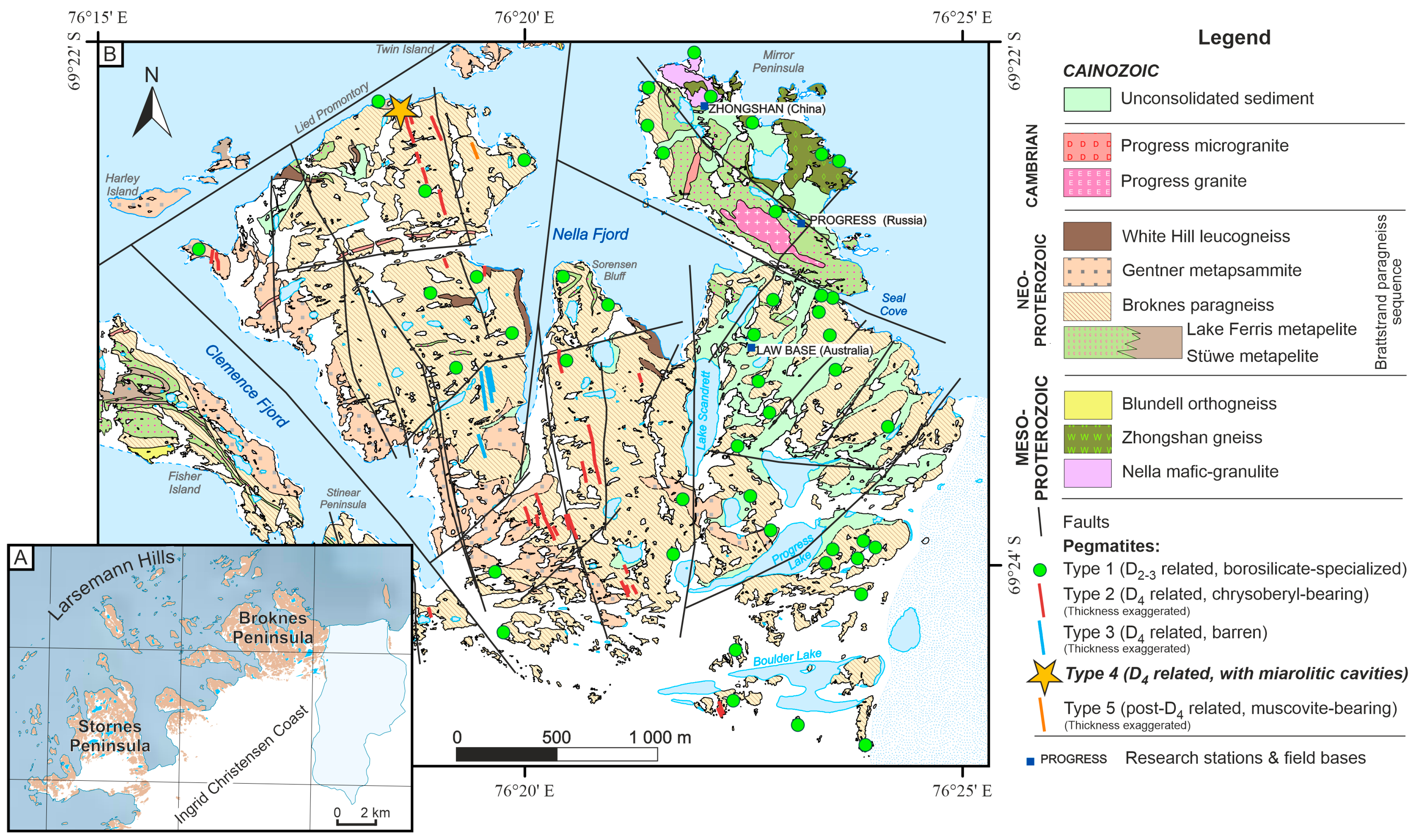
The geological section of the study area is dominated by metamorphic rocks of the amphibolite and granulite facies [36], including the Mesoproterozoic Nella mafic granulites, the Zhongshan leucogneisses, and the Blundell orthogneisses, as well as Meso- and Neoproterozoic paragneisses of the Brattstrand paragneiss sequence. The latter are subdivided into several subformations: the Stüwe and Lake Ferris metapelites, the Broknes paragneisses, the Gentner metapsammites, and the White Hill leucogneisses [37] (Figure 2).
The Nella mafic granulites are sporadically distributed within the oasis and are represented by dark, massive gneisses composed of orthopyroxene–clinopyroxene–amphibole–biotite–plagioclase assemblages. The crystallization age of their protoliths is estimated as late Mesoproterozoic (1126–940 Ma) [39], whereas the peak of metamorphism is dated to 990–900 Ma [6,40].
The Zhongshan leucogneisses are light, banded gneisses of quartz–feldspar–garnet–biotite composition, with an age of 940 ± 6 Ma [15].
The Brattstrand paragneiss sequence is the most widespread unit within the oasis and is mainly represented by grey, banded, medium- to coarse-grained quartz–feldspar–cordierite–sillimanite–magnetite gneisses (the Stüwe and the Lake Ferris metapelites), dated to ~1000 Ma [41], as well as light-colored, fine- to medium-grained garnet–biotite–quartz paragneisses of the Broknes subformation, with ages of 940–934 Ma [36]. Less abundant are light, weakly banded to massive garnet–quartz paragneisses of the Gentner subformation and the White Hill paragneisses. A distinctive feature of the Brattstrand paragneiss sequence is its enrichment in B and P. In some “biotite–plagioclase” gneisses of this formation, large (up to 30 cm) apatite nodules, porphyroblastic prisms of prismatic minerals, and granular tourmaline segregations in cordierite and feldspar have been documented [37,42].

2.3. Pegmatites of the Larsemann Hills: Classification and Structural Relationships

Most of the pegmatites in the Larsemann Hills occur within the Brattstrand paragneiss sequence, forming dykes up to 1 m in thickness and ranging in length from several tens of meters (for D2–3 pegmatites) to 100–150 m (for D4 pegmatites). They are predominantly associated with a system of submeridional (north–south) fractures in Broknes Peninsula and sublatitudinal (east–west) fractures in Stornes Peninsula. Five types of granitic pegmatites are identified in the oasis, differing in morphology, mineral assemblage, and timing of emplacement [7]:
  • Type 1 (D2–3 related; borosilicate-specialized)—Concordant to sub-concordant bodies containing tourmaline, sillimanite, grandidierite [12], prismatine, boralsilite [11,13], and magnetite. These pegmatites represent deformed vein-like bodies whose emplacement is attributed to the early stages (D2–D3) of the Pan-African orogeny, 578–531 Ma ago [14,16].
  • Type 2 (D4 related; chrysoberyl-bearing)—Cross-cutting, elongate, thin microcline–plagioclase pegmatites with well-developed symmetric zonation. Accessory minerals include chrysoberyl [7], tourmaline [12], monazite, sillimanite, Nb-bearing rutile, and garnet. Their age is constrained to 526–510 Ma [16].
  • Type 3 (D4 related; barren)—Morphologically similar to the Type 2 pegmatites, these bodies are composed predominantly of microcline, with only subordinate amounts of quartz and biotite. Accessory minerals include tourmaline and magnetite. Their age is likewise constrained to 521–517 Ma [14].
  • Type 4 (D4 related; with miarolitic cavities)—Sub-concordant microcline–plagioclase pegmatites with asymmetric internal zonation and large miarolitic cavities filled with crystals of smoky quartz, feldspar, apatite, ilmenite, spinel, garnet and other minerals [7].
  • Type 5 (post-D4 related; muscovite-bearing)—Sub-concordant to cross-cutting zoned albite–oligoclase pegmatites containing beryl and tourmaline, and represent the only rocks in the Larsemann Hills with clearly developed primary muscovite. Their age is estimated at ~515 Ma [13].
Based on their geological, mineralogical and geochemical characteristics, most pegmatites of the study area (Type 1–4) can be broadly assigned to abyssal pegmatites, whereas Type 5 corresponds to muscovite-bearing pegmatites according to the classification of Černý [43]. In terms of the pegmatite classification proposed by Zagorsky et al. [17,44,45,46,47], the studied bodies fall within the high-pressure pegmatite groups, including feldspar formation pegmatites (Types 1, 3 and 4), muscovite subformation pegmatites of the plagioclase type (Type 5), and compositionally unusual pegmatites (Type 2).

2.4. Pegmatites with Miarolitic Cavities

The pegmatite with miarolitic cavities was discovered during geological traverses along the northwestern margin of the Broknes Peninsula, based on fragments of quartz crystals found in slope debris. It forms an elongated horizontal body, approximately 1 × 0.5 × 1 m in size, lying sub-concordantly within a local leucocratic granitoid zone that is not shown on existing geological maps and likely represents an in situ anatectic granitoid formed by partial melting of the Broknes paragneisses. The contacts of the pegmatite with the host rocks are gradual and diffuse.
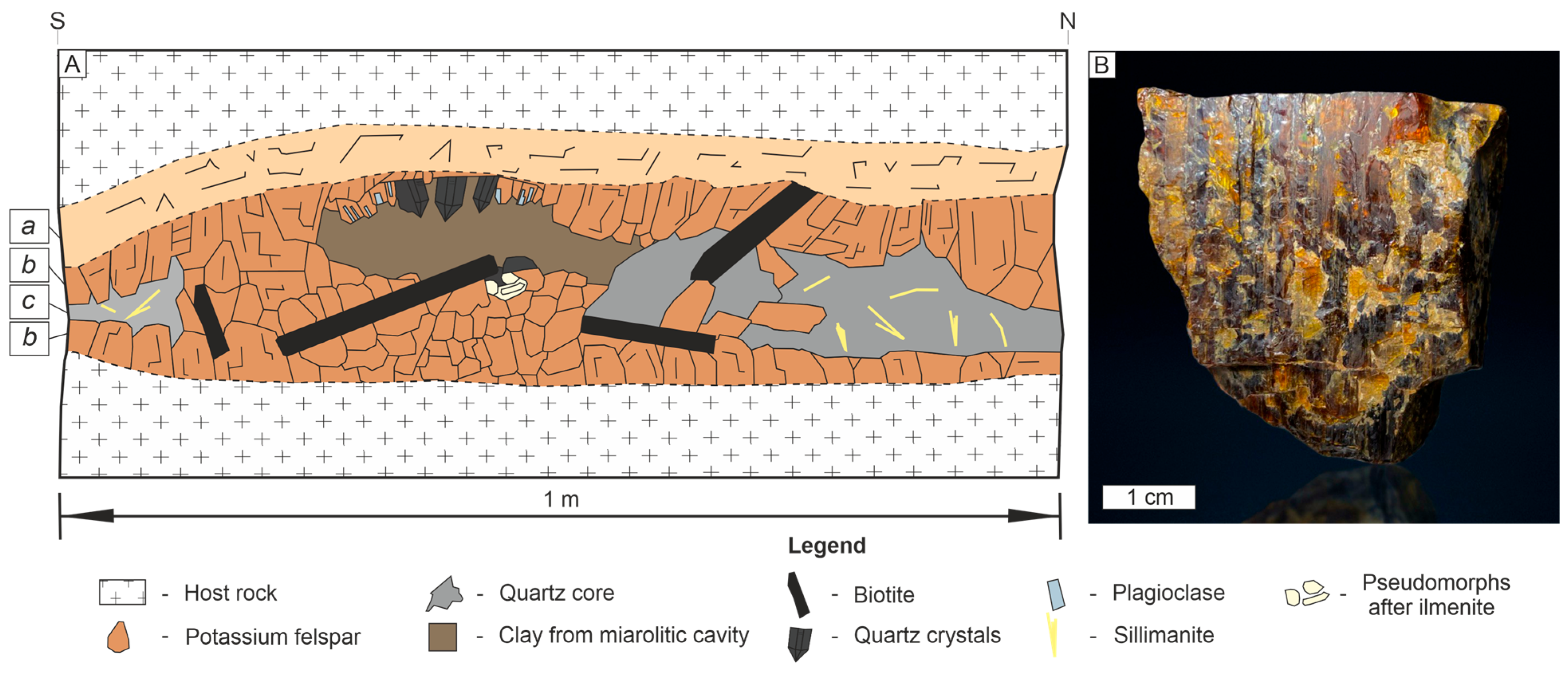
The internal structure of the pegmatite with miarolitic cavities consists of several successive zones with gradual transitions between them (Figure 3A):
  • Marginal graphic zone, represented by variably developed intergrowths of beige K-feldspar and light grey quartz.
  • Blocky zone, composed of large aggregates of beige K-feldspar (5–10 cm) with occasional large biotite crystals (up to 30 cm). This zone contains numerous miarolitic cavities up to 20 × 30 cm in size, hosting smoky quartz crystals (3–4 cm), light grey albite with bluish iridescence, small (up to several mm) acicular rutile crystals (as inclusions in quartz), brownish-red fluorapatite up to 5 cm (Figure 3B) with inclusions of monazite and xenotime, as well as dense dark radioactive clusters of cryptocrystalline minerals (up to 2–3 cm). Complex pseudomorphs after ilmenite and magnetite are present, containing minerals that likely represent exsolution products of Fe–Ti solid solutions: armalcolite, rutile, magnetite, ilmenite, and pseudorutile. The cavities are filled with loose clay-like material containing abundant small (up to a few mm), flattened golden crystals of xenotime and monazite, as well as zircon.
  • Core zone, composed of massive grey quartz aggregates (30–50 cm) containing numerous, often curved, greenish-yellow, dull sillimanite crystals up to 7–10 cm in length, with rare pyrite inclusions.
Figure 3. (A)—schematic cross-section of the D4 pegmatite with miarolitic cavities; (B)—fluorapatite crystal from the miarolitic cavity.
Geosciences 16 00133 g003
The pegmatite body described here differs markedly from all other pegmatites in the oasis in its morphology, internal structure, mineral and chemical composition, as well as in gamma-spectrometric characteristics, which show a pronounced increase in the abundance of radioactive isotopes relative to both the host rocks and the other pegmatite types.
The fluorapatites used in this study were collected from the miarolitic cavity, where they occur as large idiomorphic to hypidiomorphic crystals and their smaller fragments.

3. Materials and Methods

Fieldwork was carried out on the Broknes Peninsula (Larsemann Hills oasis) (Figure 2) during the 70th Russian Antarctic Expedition in 2024–2025 by staff of Empress Catherine II Saint Petersburg Mining University. The work included geological mapping of the area and a comprehensive investigation of the pegmatite bodies, encompassing their morphological, structural, and mineralogical–petrographic characteristics, as well as gamma-spectrometric observations. Particular attention was paid to the internal structure and zonation of the pegmatites. Sampling was performed across the strike of the pegmatite veins, from their contacts with host rocks and marginal zones toward the central parts of the bodies.
Large fluorapatite crystals (up to 5 cm in size) collected directly from the miarolitic cavity of the studied pegmatite were used for analysis. The age and isotopic composition of fluorapatite from the pegmatite with miarolitic cavities of the Larsemann Hills were determined using two independent methods: ID-TIMS and LA-ICP-MS. This approach provided integrated isotope–geochemical data and allowed the age of pegmatite formation to be confirmed with a high degree of confidence.
ID-TIMS isotope studies of apatite were performed at the Institute of Precambrian Geology and Geochronology, Russian Academy of Sciences, St. Petersburg. A single large apatite crystal was used for analysis. A fragment was separated, crushed, and sieved. For isotopic analysis, fragments 0.25–0.5 µm in size were selected, and only those free of inclusions and intergrowths with dark-colored minerals were used. Seven aliquots weighing 2.3 to 8.6 mg were analyzed. The samples were dissolved in 1N HCl at room temperature, except for one aliquot, which was dissolved in Teflon liners placed in stainless steel bombs at 220 °C for 24 h (sample 6, Table 3). The resulting solutions were split into two aliquots for: (1) determination of U and Pb concentrations, and (2) Pb isotopic composition. U and Pb concentrations were determined by isotope dilution using a 235U–208Pb mixed tracer. Lead was separated on Bio-Rad anion-exchange resin in bromide form following [48], and uranium was separated on UTEVA SPEC extraction resin in nitric form. All measurements of Pb and U isotopes were carried out on a Thermo Scientific Triton TI multicollector thermal ionization mass spectrometer (TIMS) (Thermo Fisher Scientific, Waltham, MA, USA). Laboratory blanks did not exceed 25 pg for Pb and 10 pg for U. Measured Pb isotope ratios were corrected for instrumental fractionation based on repeated analyses of the SRM-982 standard (0.13% per amu). The error in determining the concentrations and Pb/U ratios was given with a 95% (2σ) confidence interval. Data reduction and isochron calculations were performed using PbDAT (Version 1.21) [49] and ISOPLOT (Version 3.75) [50].
LA-ICP-MS studies were performed at V.S. Sobolev Institute of Geology and Mineralogy, Siberian Branch of the Russian Academy of Sciences. A total of twelve fluorapatite crystals and crystal fragments from the miarolitic cavity of the pegmatite were examined by LA-ICP-MS to obtain trace element compositions. Trace-element concentrations in apatite were measured using a laser ablation system NWR-231 (ArF excimer laser, 193 nm) (Elemental Scientific, Omaha, NE, USA) coupled to a Thermo Scientific iCAP Qc quadrupole mass spectrometer (Thermo Fisher Scientific, Waltham, MA, USA). The glass reference material SRM NIST 610 (National Institute of Standards and Technology, Gaithersburg, MD, USA). was used for primary calibration [51]. All samples and standards were analyzed under identical conditions: 30 s gas blank and 90 s ablation time, with a laser spot diameter of 30 µm, fluence of 3.5 J/cm2, and repetition rate of 10 Hz. The flow rates of the cooling, plasma-forming, and auxiliary Ar gases were 16.0, 1.0, and 1.0 L/min, respectively. High-purity helium (grade 6.0) was used as the carrier gas at a flow rate of 0.8 L/min. The plasma power was 1550 W. Element concentrations were calculated using the LADR software package (1.1.07) [52]. Instrumental drift was monitored using the secondary reference material SRM NIST 612. The isotope 43Ca was used as an internal standard, with its concentration estimated from the stoichiometry of apatite.
The content of major elements in minerals was determined at the Institute of Precambrian Geology and Geochronology, Russian Academy of Sciences, by the scanning electron microscopy (SEM) and energy dispersive X-ray spectroscopy (EDS) method on the JEOL-JSM-6510LA scanning electron microscope with the JEOL-JED-2200 energy dispersive spectrometer (JEOL Ltd., Tokyo, Japan). In total, about 15 analyses were performed. Analyses were performed under the following conditions: accelerating voltage is 20 kV, probe current on a Faraday cylinder is 1 nA, ZAF method of matrix effects correction. Samples of rock-forming minerals and pure metals were used as standards. The locality of the analysis was 1–2 μm.

4. Results

4.1. Characteristics of Fluorapatite

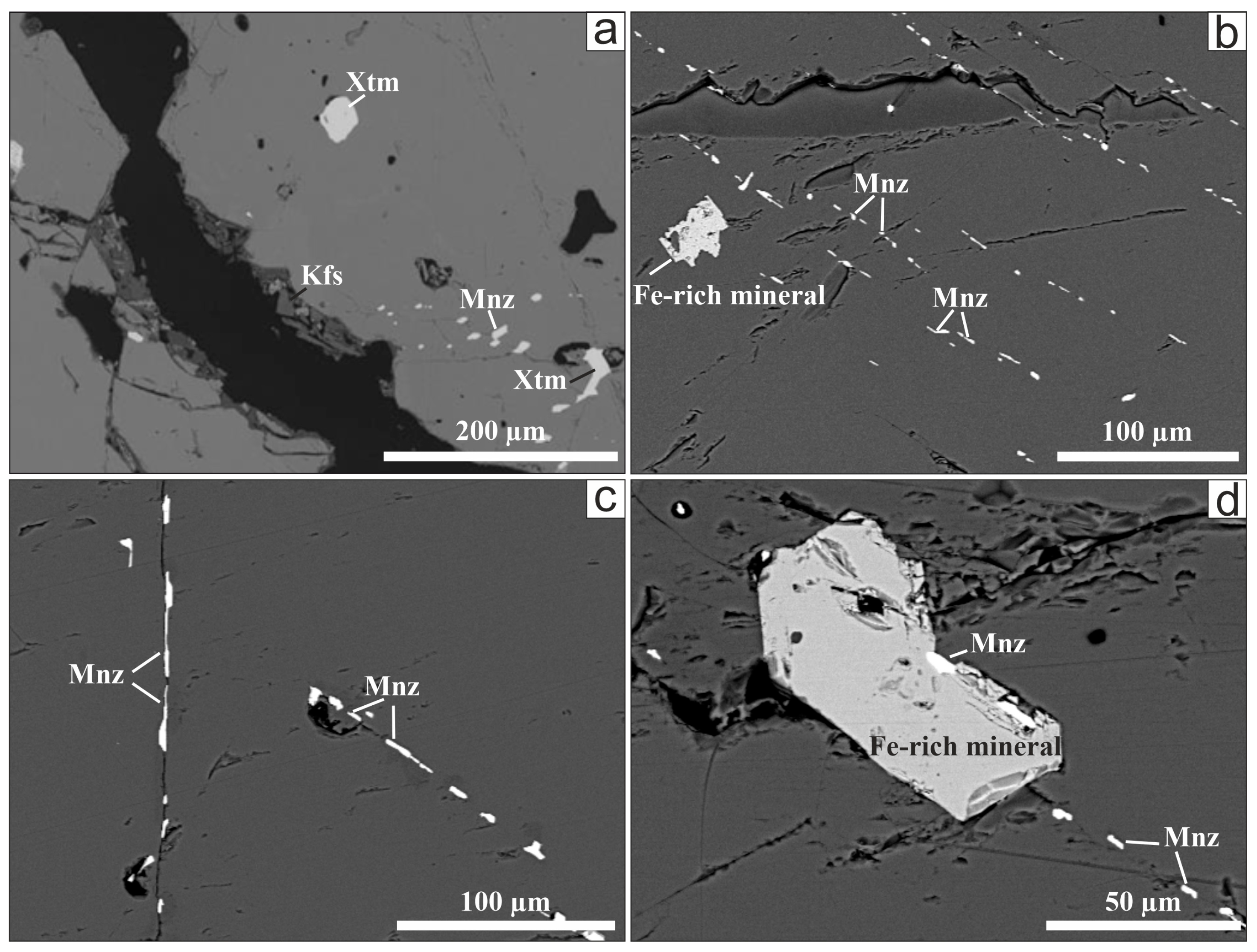
Fluorapatite from the studied pegmatite occurs as large (up to 5 cm), dark brown, semi-transparent to translucent crystals, commonly displaying pronounced internal zoning and containing numerous inclusions of monazite and xenotime. The outermost crystal zone is expressed as a thin (ca. 1 mm), lighter yellowish, matte rim with a rough, locally “scaly” surface. This rim is not continuous and is observed only on some prism and pyramid faces. It contains abundant fluid and mineral inclusions (xenotime, monazite, K-feldspar, kaolinite, magnetite). Xenotime inclusions in the outer zone form idiomorphic single crystals up to 40–50 μm in size. The inner portions of the crystals are dense and semi-transparent, with a bright vitreous luster. They contain well-developed oriented chains of monazite-(Ce) crystals (Figure 4). Individual monazite crystals are typically up to 20 μm, although the largest reach 1–2 mm. Isolated inclusions of an Fe-rich mineral (FeO(t) = 87–88 wt.%) also occur as crystals up to 100 μm in size. These crystals are aligned parallel to the monazite chains and are commonly incorporated within them.

4.2. Fluorapatite Composition

Fluorapatite from the pegmatite with miarolitic cavities is compositionally quite homogeneous and does not show wide variations in major components: CaO ranges from 51.1 to 54.1 wt.% and P2O5 from 40.7 to 41.9 wt.% (Table 1). In contrast, the halogen contents vary more substantially: F = 2.04–3.92 wt.% (average 3.2 wt.%) and Cl = 0.36–1.71 wt.% (average 1.2 wt.%). A notable feature is the elevated FeO content (up to 2.4 wt.%), which significantly exceeds typical values reported for apatites [53,54,55]. Similarly high and even higher FeO concentrations have been documented in fluorapatite nodules from the Larsemann Hills [42], where apatite contains up to 2.57–3.23 wt.% FeO. Although our samples are crystal aggregates rather than nodule-type segregations, the comparison highlights that iron enrichment is characteristic of phosphate phases in this region. MnO in studied crystals varies from 0.24 to 0.57 wt.% (average 0.4 wt.%). No systematic correlations were observed among the major element contents.
According to the LA-ICP-MS data (Table 2), fluorapatites from the pegmatite with miarolitic cavities of the Larsemann Hills are characterized by high concentrations of REE (1397–7966 ppm) and Y (945–4192 ppm), together with low Sr contents (52.2–83.5 ppm). Positive correlations are observed between Y and REE, as well as between U and Th, and Y and Ho. Comparison of large fluorapatite crystals (Table 2; analyses No 11 and 12) with smaller (0.1–0.2 mm) grains (Table 2; analyses No 1–10) demonstrates a pronounced compositional contrast. The U contents in the large crystals range from 85.0 to 98.5 ppm, whereas the smaller grains contain only 7.16–28.1 ppm. For most analyzed grains, the Th/U ratios fall within 0.09–0.13; however, in one crystal, the ratio reaches 0.40, while in two small grains, it decreases to 0.029 and 0.00047, indicating an almost complete loss of Th. The large crystals also contain Fe and Mg concentrations that are an order of magnitude higher than those in the small grains, as well as significantly elevated Mn, Y, La, Ce and other elements. LREE values in the large crystals are likewise several times higher than in the small grains.
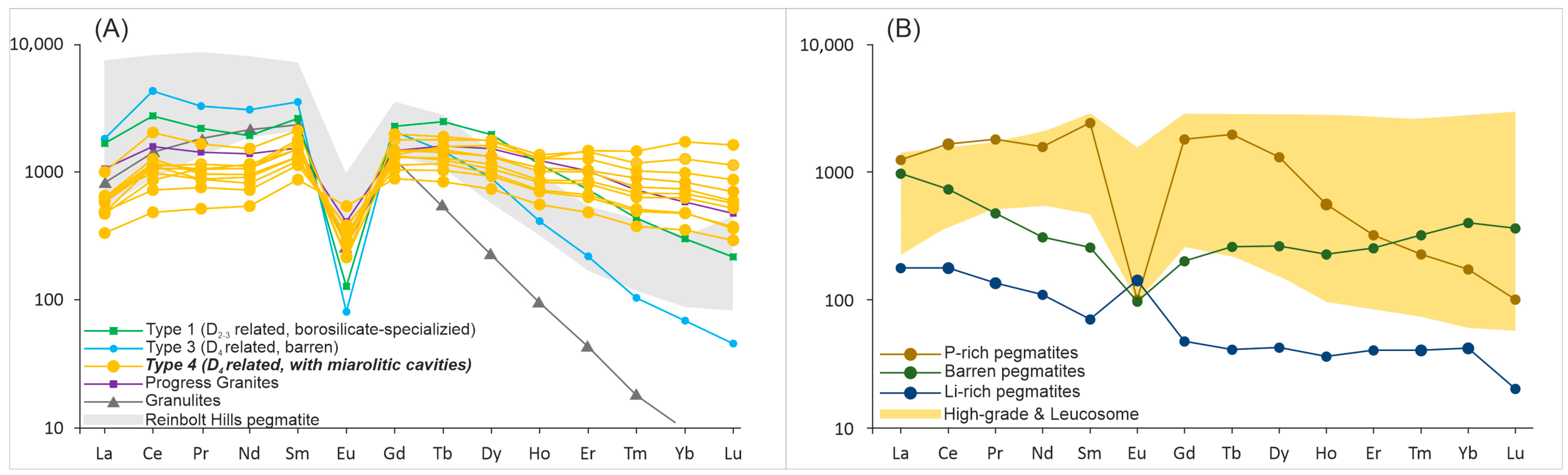
The REE distribution patterns are similar among the analyzed grains and are characterized by weak fractionation between LREE and HREE (La/Yb)N = 1.02), a pronounced negative Eu anomaly (Eu/Eu* = 0.11–0.62), and a positive Ce anomaly (Ce/Ce* = 1.17–1.66) (Figure 5A).
In comparison with apatites from granulites [57] and other pegmatite types in the Larsemann Hills and the Reinbolt Hills [18], as well as with apatites from various pegmatite types and from and leucosomes and high-grade metamorphic rocks [25,27], the fluorapatites studied here exhibit nearly flat REE patterns that sharply contrast with most of the reference apatite spectra (Figure 5B).
Fluorapatites from the pegmatite with miarolitic cavities of the Larsemann Hills are characterized by a pronounced negative Eu anomaly, which is generally less strongly developed than in apatites from other pegmatite types in the study area. In contrast to fluorapatites from granulites and other pegmatites of the Larsemann Hills and the Reinbolt Hills [18], whose REE patterns are characterized by depleted HREEs and resemble those typical of P-rich pegmatites [25], the samples studied here show REE distributions similar to those of apatites from the Progress granites. They display a slight left-ward incline in the LREE and either a moderate enrichment or only a very gentle decrease in HREE, which is characteristic of apatites from leucosomes and high-grade metamorphic rocks [27].

4.3. Fluorapatite U-Pb Dating Results

U–Pb isotope analyses of fluorapatite performed using the ID-TIMS method yield Pb contents of 11.5–15.6 ppm and U contents of 76–104 ppm. Measured 206Pb/204Pb ratios range from 76 to 118 (Table 3), indicating the presence of a substantial common Pb component.
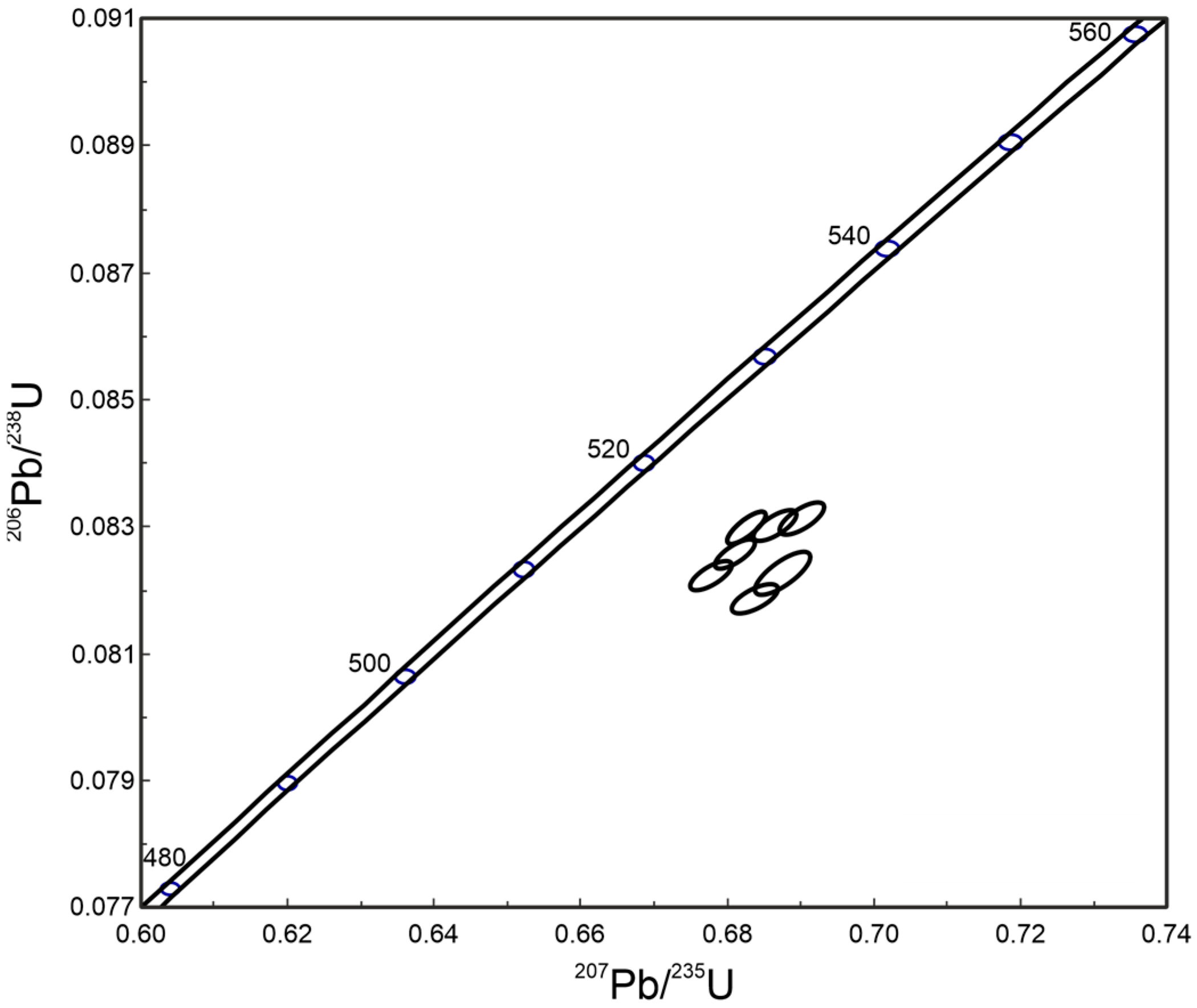
An initial Pb correction based on the Stacey and Kramers lead isotope evolution model [58], commonly applied in U–Pb geochronology of accessory minerals, may not be appropriate for these data. The relatively low 206Pb/204Pb ratios (<100 in most subsamples) indicate that common Pb is significant in the Pb budget of the analyzed fluorapatite. Application of the Stacey and Kramers correction causes the analyses to collapse into a narrow cluster plotting below the Concordia, thereby preventing the extraction of a meaningful age (Figure 6).
To account for initial Pb without assuming a specific Pb isotopic composition, a three-dimensional Total Pb/U isochron approach was applied [59]. This method has previously been used in cases where conventional Stacey–Kramers corrections are unsuitable [60,61].
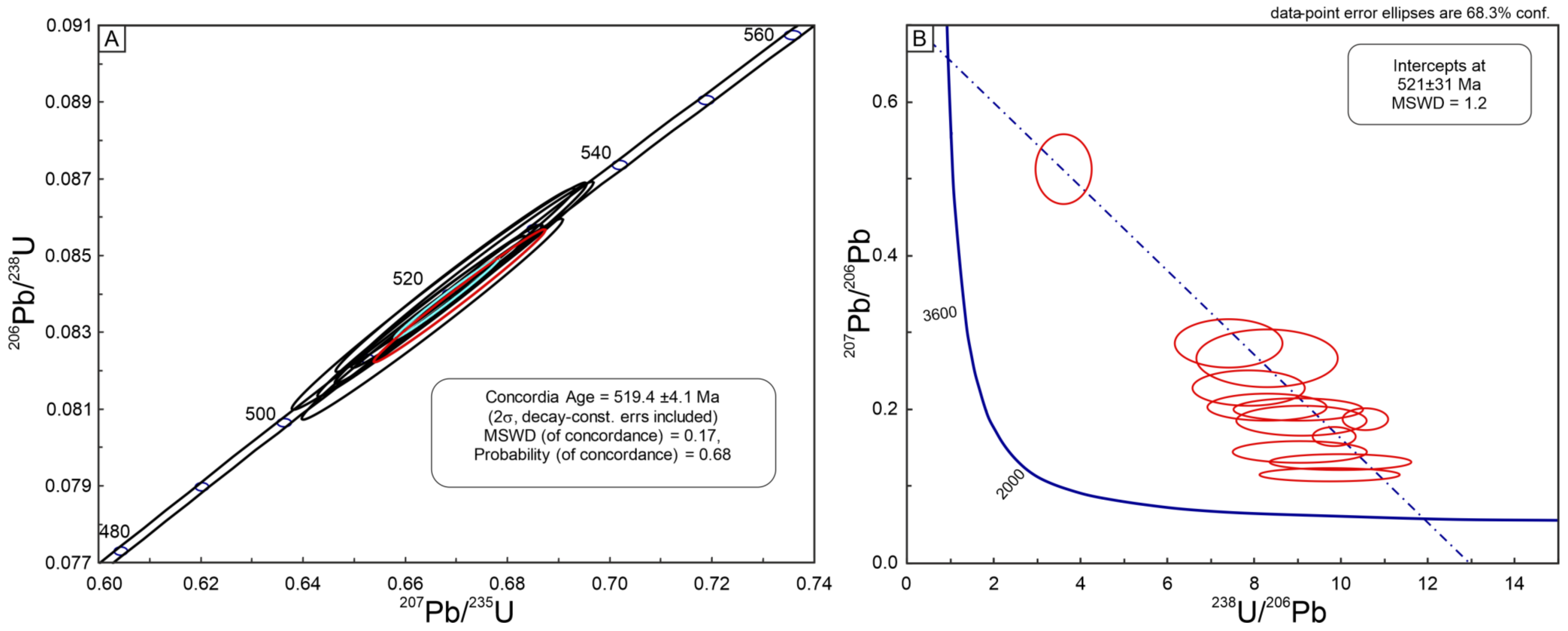
When the initial Pb ratios derived from the three-dimensional isochron are used to construct a Wetherill Concordia diagram, the analyses define a Concordia age of 519.4 ± 4.1 Ma (MSWD = 0.17; Figure 7A).
U-Pb ages for apatite analyzed by LA-ICP-MS (Table 4) were calculated using an inverse Tera–Wasserburg diagram (207Pb/206Pb vs. 238U/206Pb), which allows correction for common Pb without specifying its initial isotopic composition. The resulting age of 521 ± 31 Ma is within the uncertainty of the ID-TIMS age, although the LA-ICP-MS result has a substantially larger error. This reduced precision reflects the low U and Pb concentrations in the small grains (grain sizes used in each analysis № are consistent with those reported in Table 2) and the analytical limitations of spot analyses. Nevertheless, the LA-ICP-MS data independently confirm the ID-TIMS age and support the interpretation that the pegmatite with miarolitic cavities crystallized during the final stages of the Pan-African orogeny.

5. Discussion

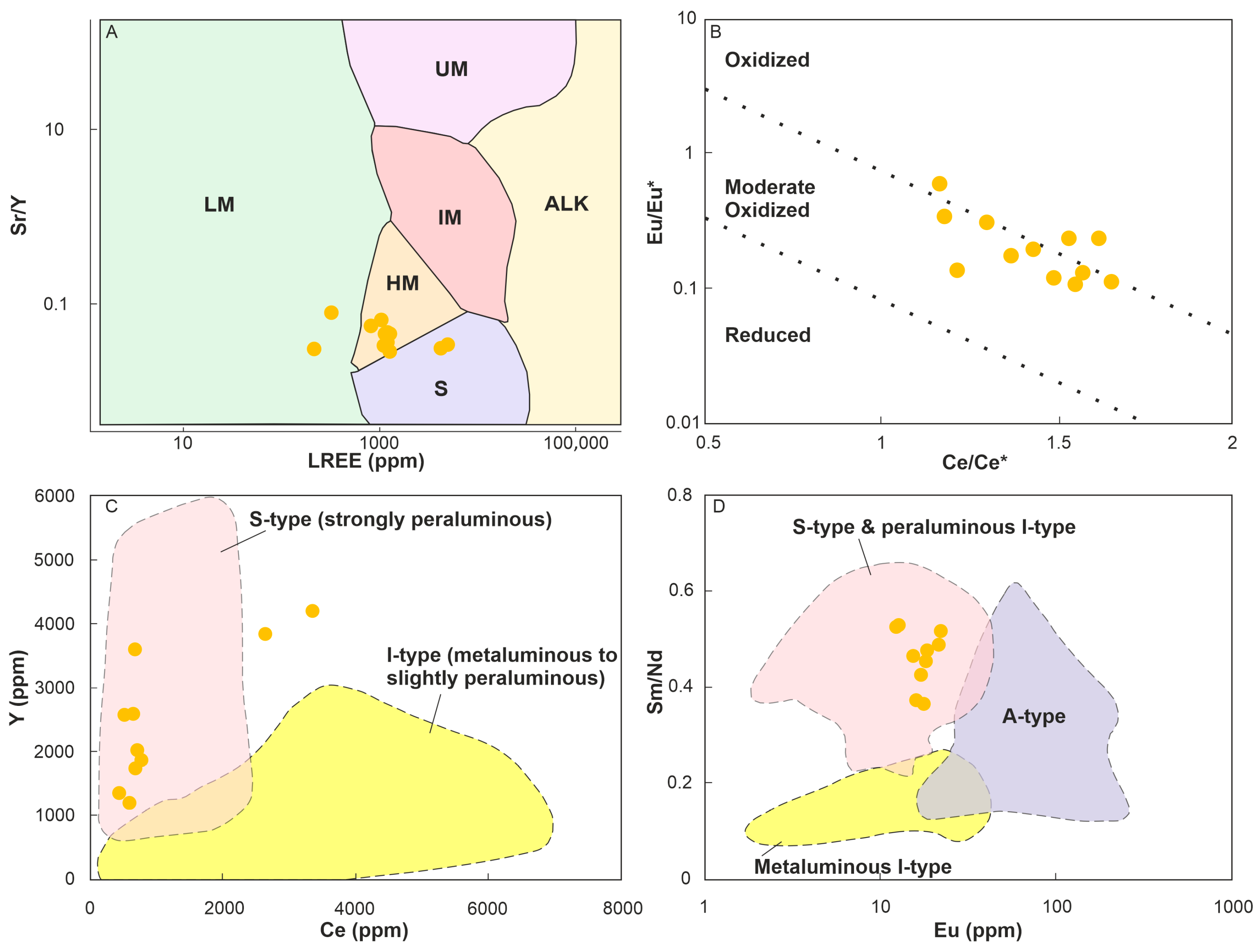
The major- and trace element compositions of the fluorapatite provide constraints on the conditions and characteristics of crystallization of the host pegmatite with miarolitic cavities. On the LREE–Sr/Y discrimination diagram of [27], the fluorapatite compositions plot mainly within the field of partial melts/leucosomes and high-temperature metamorphic rocks (Figure 8A), with some points extending into the fields of S-type granites as well as metasomatic and low- to medium-grade metamorphic rocks (LM) (Figure 8C,D).
Ce/Ce* values of 1–2 indicate moderately oxidized crystallization conditions (Figure 7B). The average Y/Ho ratio in the studied fluorapatites is 37.7, suggesting crystallization from a transitional magmatic–hydrothermal system enriched in H2O, B, F, P and/or Cl [64].
Comparison with fluorapatites from granulites and other pegmatite types in the Larsemann Hills, as well as with those from compositionally similar pegmatites in the Reinbolt Hills [18], shows that although the LREE patterns are broadly similar, the fluorapatites from the Larsemann Hills pegmatite with miarolitic cavities exhibit nearly flat or only very weakly sloping HREE patterns and lower overall REE concentrations (see Figure 5). This could indicate a more evolved, fluid-rich stage of crystallization for the pegmatite with miarolitic cavities in the Larsemann Hills.
The obtained data support our hypothesis that the pegmatite with miarolitic cavities formed as a result of anatexis of the paragneisses, producing a granitic melt that subsequently evolved and underwent metasomatic overprinting during the late stages of crystallization. This interpretation is consistent with field observations of the body’s geometry and internal structure, as well as with the microstructural features of the fluorapatite, including the presence of oriented monazite inclusions (Figure 4).
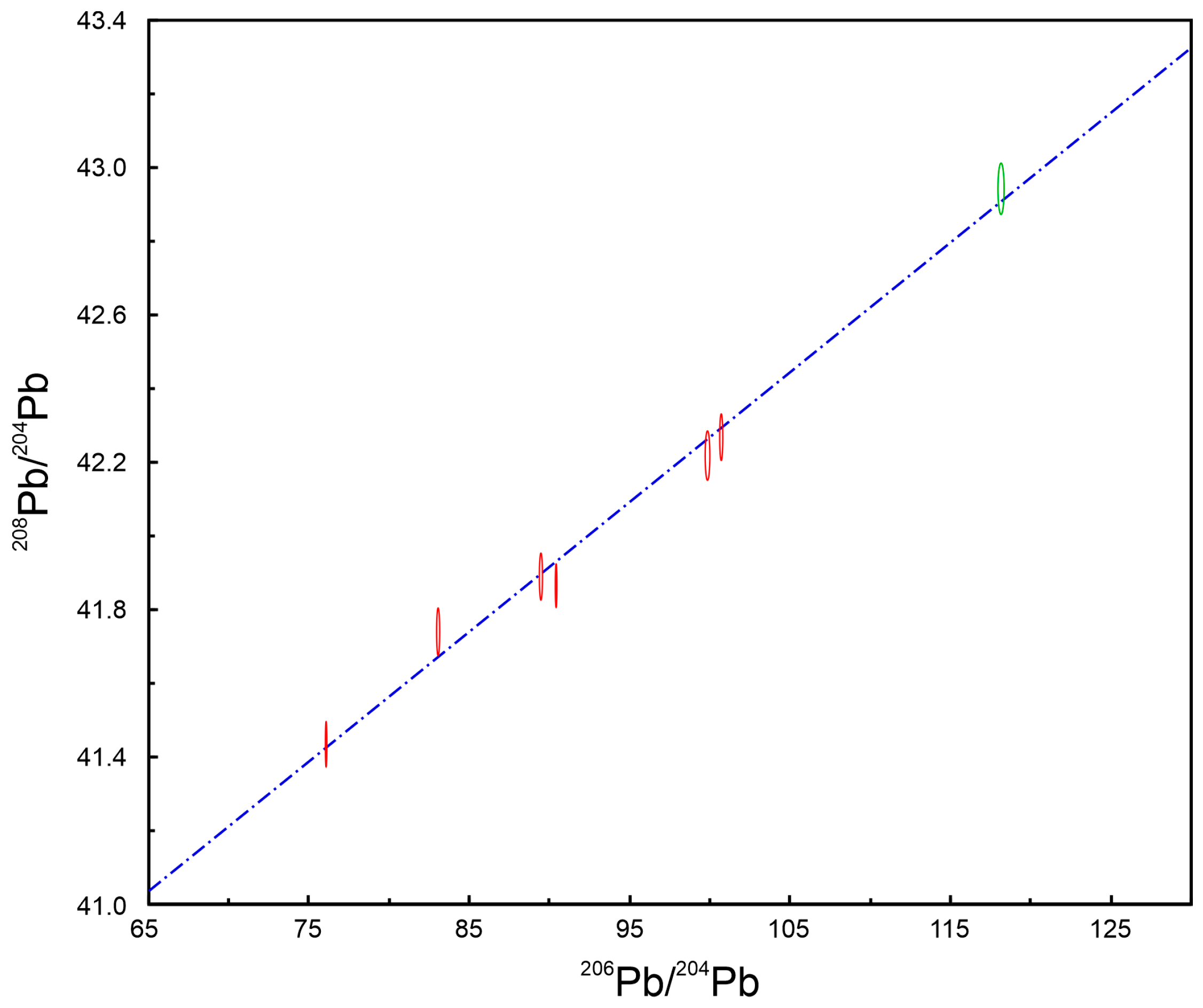
Additional constraints on the late-stage evolution of the pegmatite are provided by the isotopic composition of monazite inclusions within the fluorapatite. Ziemann et al. [18] noted that the ages of small monazite inclusions in fluorapatite from the Reinbolt Hills could not be determined, leaving their origin uncertain. Our results help to clarify this issue. In Table 3 (sample 6) and in Figure 7 (red ellipse), we show the age obtained from a fluorapatite aliquot that was completely digested together with its monazite inclusions in concentrated HCl at 220 °C. In contrast, the remaining aliquots were dissolved in 1 N HCl at room temperature, which is insufficient to decompose monazite. The consistency of the age values indicates that fluorapatite and monazite formed at approximately the same time. Additional support for this interpretation is provided by the fact that, on the 208Pb/204Pb–206Pb/204Pb plot, all data points—including sample 6—lie along a single linear trend (Figure 9). This indicates that the fluorapatite and monazite phases are in isotopic equilibrium. In addition, the monazite inclusions within the fluorapatite are characterized by elevated U and low Th contents, as confirmed by the data in Table 3 (sample 6): the highest U concentration (104.4 ppm), a 206Pb/204Pb ratio of 118, and the lowest Th/U ratio of 0.156. These observations support the suggestion of Ziemann et al. [18] that the Th-poor, U-rich monazite-(Ce) formed through exsolution of fluorapatite, contemporaneously or shortly after its crystallization.
One of the key objectives of this study was to determine the age of the pegmatite with miarolitic cavities. The three-dimensional Total Pb/U isochron defined in 238U/206Pb–207Pb/206Pb–204Pb/206Pb space yields the fluorapatite age of 519 ± 11 Ma. In addition to yielding an age, the Total Pb/U isochron approach allows determination of initial 206Pb/204Pb and 207Pb/204Pb ratios of 16.70 ± 1.70 and 15.69 ± 0.12, respectively. Comparable initial Pb isotope ratios (206Pb/204Pb = 16.9 ± 2.5 and 207Pb/204Pb = 15.67 ± 0.15) were obtained for Y-axis intercepts of the 238U/204Pb vs. 206Pb/204Pb and 235U/204Pb vs. 207Pb/204Pb isochrons. These initial Pb compositions differ beyond analytical uncertainty from the Pb isotopic composition of average continental crust at ~520 Ma predicted by the Stacey and Kramers [58] model (206Pb/204Pb = 17.885; 207Pb/204Pb = 15.582), underscoring the importance of appropriate treatment of initial Pb in U–Pb age determinations of minerals containing substantial common Pb.
The use of the initial Pb ratios obtained on the basis of the three-dimensional isochron to construct the Wetherill Concordia diagram is 519.4 ± 4.1 Ma. This age is more precise than the 3D Total Pb/U isochron age despite the relatively large uncertainties associated with the estimated initial Pb isotope ratios and their propagation through the age calculations. Accordingly, the Concordia age is considered the most robust constraint on the timing of fluorapatite formation. According to U–Pb zircon data, the cross-cutting D4 pegmatites in the region crystallized between 521 ± 4 Ma and 517 ± 4 Ma [14]. The fluorapatite ages obtained in this study (519 ± 4 Ma and 521 ± 31 Ma) indicate that the pegmatite with miarolitic cavities crystallized during the D4 deformational event, contemporaneously with the emplacement of the D4 pegmatites. It is noteworthy that the largest S-type granite body in the oasis—the Progress granite—located a few kilometers east of the pegmatite with miarolitic cavities, has a similar age (ca. 515 Ma) [10]. This, together with the similarity of the REE distribution patterns in fluorapatite from the pegmatite with miarolitic cavities and the Progress granites, suggests that the pegmatite with miarolitic cavities, the Progress S-type granites, and the D4 pegmatites formed during the coeval events associated with the final stage of the Pan-African orogeny. The obtained ages are broadly consistent with published cooling ages reported from Prydz Bay (530–500 Ma) [57,65,66], which have been interpreted to reflect late-orogenic thermal relaxation of the crust. Comparison of the obtained fluorapatite ages with published geochronological data from the mineralogically similar pegmatites located farther west in the Reinbolt Hills area suggests that pegmatite formation during terminal stages of the Pan-African orogeny in Prydz Bay may have occurred over a relatively short time interval along the coast, consistent with regional models describing retrogression and cooling along a clock-wise P-T path. The geochemical characteristics of fluorapatite from the pegmatites with miarolitic cavities further imply that these particular late-stage pegmatitic systems could be influenced by fluid-rich conditions, consistent with enhanced fluid-melt interaction during late-orogenic reactivation.

6. Conclusions

Large crystals of Fe-rich fluorapatite (FeO up to 2.4 wt.%) were identified in the pegmatite with miarolitic cavities of the Larsemann Hills. These fluorapatites are characterized by moderately high concentrations of REE (1397–7966 ppm) and Y (945–4192 ppm), together with low Sr contents (52.2–83.5 ppm). The studied crystals display secondary peripheral zoning and contain abundant inclusions of oriented chains of hydrothermal–metasomatic monazite-(Ce), along with isolated Fe-rich mineral inclusions.
The combined geological and geochemical evidence suggests that the pegmatite with miarolitic cavities was most likely derived from partial melting of the host paragneisses and crystallized within the local anatectic domain. In terms of its geochemical characteristics, it is closely comparable to the Progress granites.
The geochemical data indicate that the fluorapatites from the pegmatite with miarolitic cavities crystallized within a transitional magmatic–hydrothermal system enriched in fluids and volatile components. The presence of miarolitic cavities is consistent with enhanced fluid activity during late-stage crystallization.
U–Pb dating of fluorapatite (519 ± 4 Ma by ID-TIMS and 521 ± 31 Ma by LA-ICP-MS) indicates that crystallization of the pegmatite with miarolitic cavities was synchronous with the formation of the D4 pegmatites, as well as with the emplacement of the Progress S-type granites (ca. 515 Ma). In a regional context, these ages are broadly compatible with the post-peak cooling phase recognized in the Prydz Bay sector and with regional models describing late-orogenic evolution along a clockwise P-T path. These results correspond to the final stage of the Pan-African tectono-thermal event and record the closing phase of East Gondwana assembly. The data obtained represent the first constraints on the age of the pegmatite with miarolitic cavities in Antarctica.

Author Contributions

Conceptualization, I.A.B. and I.V.T.; methodology, S.G.S.; validation, S.G.S. and Y.A.B.; formal analysis, I.A.B., N.G.R., Y.A.B. and O.L.G.; investigation, S.G.S., N.G.R. and Y.A.B.; resources, S.G.S. and A.V.K.; data curation, I.A.B. and Y.A.B.; writing—original draft preparation, I.A.B.; writing—review and editing, I.A.B., N.G.R., S.G.S., Y.A.B. and I.V.T.; visualization, I.A.B. and N.G.R.; supervision, S.G.S. and I.V.T.; project administration, S.G.S. and I.A.B.; funding acquisition, S.G.S., I.V.T. and Y.A.B. All authors have read and agreed to the published version of the manuscript.

Funding

This research was carried out with support from the State Assignment grant for scientific research in 2024 (Project No. FSRW-2024-0003). ID-TIMS dating of apatite was performed on the equipment of the Shared Equipment Center AIRES as part of the Institute of Precambrian Geology and Geochronology, Russian Academy of Sciences (IPGG RAS) research program (Project No. FMUW-2022-0005). LA-ICP-MS analyses and dating were supported by the State Assignment of V.S. Sobolev Institute of Geology and Mineralogy Siberian Branch Russian Academy of Sciences, state assignment of IGM SB RAS (FWZN-2026-0018).

Data Availability Statement

The raw data supporting the conclusions of this article will be made available by the authors on request.

Acknowledgments

Fieldwork was carried out at Progress Station during the 70th Russian Antarctic Exped ition. We thank the station personnel for their logistical support. We are also grateful to D.R. Khalimov, D.E. Ushakov, N.S. Krikun, A.V. Zaprudsky, and G.D. Gorelik for their assistance in the field investigation of the pegmatite and in sample collection. We also thank S.V. Kolisnichenko, V.A. Popov, and A.F. Khokhryakov for their help with mineralogical examination and laboratory analyses. The authors would like to thank L.A. Neymark for his helpful comments when discussing the geochronological results.

Conflicts of Interest

The authors declare no conflicts of interest.

Abbreviations

The following abbreviations are used in this manuscript:
ID-TIMSIsotope Dilution–Thermal Ionization Mass Spectrometry
LA-ICP-MSLaser Ablation-Inductively Coupled Plasma-Mass Spectrometry
MnzMonazite
XtmXenotime
KfsK-feldspar

References

  1. Kröner, A.; Stern, R.J. Pan-African Orogeny. In Encyclopedia of Geology, 1st ed.; Selley, R.C., Cocks, L.R.M., Plimer, I.R., Eds.; Elsevier: Amsterdam, The Netherlands, 2005; pp. 1–12. [Google Scholar] [CrossRef]
  2. Gupta, S.; Chatterjee, S.; Arora, D.; Bose, S.; Dobe, R. Locating the Indo-Antarctica suture—Correlating the Rengali, Rauer and Ruker terranes in Gondwana. Polar Sci. 2021, 30, 100689. [Google Scholar] [CrossRef]
  3. Ren, L.; Zong, S.; Wang, Y.; Li, C. Distribution of the Pan-African Domains in East Antarctica and Adjacent Areas. Acta Geol. Sin. 2020, 94, 45–46. [Google Scholar] [CrossRef]
  4. Yoshida, M.; Santosh, M. Assembly of East Gondwanaland during the Mesoproterozoic and its rejuvenation during the Pan-African period. In India and Antarctica During the Precambrian; Yoshida, M., Santosh, M., Eds.; Geological Society of India: Bengaluru, India, 1995; Memoir 34; pp. 22–45. [Google Scholar]
  5. Fitzsimons, I.C.W. Grenville-age basement provinces in East Antarctica: Evidence for three separate collisional orogens. Geology 2000, 28, 879–882. [Google Scholar] [CrossRef]
  6. Ravich, M.G.; Solovyev, D.S.; Fedorov, L.V. Geological Structure of Mac. Robertson Land, East Antarctica, 1st ed.; Gidrometeoizdat: Leningrad, Russia, 1978; pp. 5–20. (In Russian) [Google Scholar]
  7. Babenko, I.A.; Talovina, I.V.; Ushakov, D.E.; Krikun, N.S. Pegmatites of the Larsemann Hills oasis, East Antarctica: New field geological and geophysical data. J. Min. Inst. 2025, 273, 65–79. [Google Scholar]
  8. Stüwe, K.; Braun, H.; Peer, H. Geology and structure of the Larsemann Hills area, Prydz Bay, East Antarctica. Aust. J. Earth Sci. 1989, 36, 219–223. [Google Scholar] [CrossRef]
  9. Dirks, P.H.G.M.; Carson, C.J.; Wilson, C.J.L. The deformational history of the Larsemann Hills, Prydz Bay: The importance of the Pan-African (500 Ma) in East Antarctica. Antarct. Sci. 1993, 5, 179–192. [Google Scholar] [CrossRef]
  10. Carson, C.J.; Fanning, C.M.; Wilson, C.J.L. Timing of the Progress granite, Larsemann Hills: Additional evidence for early Palaeozoic orogenesis within the east Antarctic Shield and implications for Gondwana assembly. Aust. J. Earth Sci. 1996, 43, 539–553. [Google Scholar] [CrossRef]
  11. Grew, E.S.; Mcgee, J.J.; Yates, M.G.; Peacor, D.R.; Rouse, R.C.; Huijsmans, J.P.P.; Shearer, C.K.; Wiedenbeck, M.; Thost, D.E.; Su, S.-C. Boralsilite (Al16B6Si2O37): A new mineral related to sillimanite from pegmatites in granulite-facies rocks. Am. Mineral. 1998, 83, 638–651. [Google Scholar] [CrossRef]
  12. Wadoski, E.R.; Grew, E.S.; Yates, M.G. Compositional evolution of tourmaline-supergroup minerals from granitic pegmatites in the Larsemann Hills, East Antarctica. Can. Mineral. 2011, 49, 381–405. [Google Scholar] [CrossRef]
  13. Maas, R.; Grew, E.S.; Carson, C.J. Isotopic constraints (Pb, Rb-Sr, Sm-Nd) on the sources of early Cambrian Pegmatites with boron and beryllium minerals in the Larsemann hills, Prydz Bay, Antarctica. Can. Mineral. 2015, 53, 249–272. [Google Scholar] [CrossRef]
  14. Zong, S.; Cui, Y.; Ren, L.; Zhang, H.; Chen, S.; Wang, W.; Li, S. Geochemical Characteristics, Zircon U-Pb Ages and Lu-Hf Isotopes of Pan-African Pegmatites from the Larsemann Hills, Prydz Bay, East Antarctica and Their Tectonic Implications. Minerals 2024, 14, 55. [Google Scholar] [CrossRef]
  15. Zhao, Y.; Song, B.; Wang, Y.; Ren, L.; Li, J.; Chen, T. Geochronology of the late granite in the Larsemann, Hills East Antarctica. In Recent Progress in Antarctic Earth Science, 1st ed.; Yoshida, Y., Kaminuma, K., Shiraishi, K., Eds.; Terra Scientific Publishing: Tokyo, Japan, 1992; pp. 155–161. [Google Scholar]
  16. Spreitzer, S.K. In Situ Dating of Multiple Events in Granulite-Facies Rocks of the Larsemann Hills, Prydz Bay, East Antarctica Using Electron Microprobe Analysis of Monazite. Ph.D. Thesis, University of Maine, Orono, ME, USA, 2017. [Google Scholar]
  17. Zagorsky, V.E.; Peretyazhko, I.S.; Shmakin, B.M. Granitic Pegmatites. Volume 3: Miarolitic Pegmatites; Nauka: Novosibirsk, Russia, 1999; pp. 16–38. [Google Scholar]
  18. Ziemann, M.A.; Förster, H.-J.; Harlov, D.E.; Frei, D. Origin of fluorapatite-monazite assemblages in a metamorphosed, sillimanite-bearing pegmatoid, Reinbolt Hills, East Antarctica. Eur. J. Mineral. 2005, 17, 567–580. [Google Scholar] [CrossRef]
  19. Gawęda, A.; Szopa, K.; Chew, D. LA-ICP-MS U-Pb dating and REE patterns of apatite from the Tatra Mountains, Poland as a monitor of the regional tectonomagmatic activity. Geochronometria 2014, 41, 306–314. [Google Scholar] [CrossRef]
  20. Sun, Z.; Dong, G.; Tang, J.; Guo, J.; Wang, Z. Apatite chemistry of Late Triassic granitic rocks from Yidun Terrane: Implications for petrogenesis and mineralization. Mineral. Petrol. 2023, 117, 745–759. [Google Scholar] [CrossRef]
  21. Glorie, S.; March, S.; Nixon, A.; Meeuws, F.; O’Sullivan, G.J.; Chew, D.M.; Kirkland, C.L.; Konopelko, D.; De Grave, J. Apatite U–Pb dating and geochemistry of the Kyrgyz South Tian Shan (Central Asia): Establishing an apatite fingerprint for provenance studies. Geosci. Front. 2020, 11, 2003–2015. [Google Scholar] [CrossRef]
  22. Li, H.; Han, J.; Li, F.; Li, H.; Zhao, Z.; Liu, Y.; Chen, J.; Yin, Y.; Han, Y. Apatite textural and geochemical insights into the petrogenesis of intrusive rocks. Sci. Rep. 2024, 14, 31985. [Google Scholar] [CrossRef] [PubMed]
  23. Hoskin, P.W.O.; Kinny, P.D.; Wyborn, D.; Chappell, B.W. Identifying Accessory Mineral Saturation during Differentiation in Granitoid Magmas: An Integrated Approach. J. Petrol. 2000, 41, 1365–1396. [Google Scholar] [CrossRef]
  24. Bea, F.; Fershtater, G.; Corretge, L.G. The geochemistry of phosphorus in granite rocks and the effect of aluminium. Lithos 1992, 29, 43–56. [Google Scholar] [CrossRef]
  25. Roda-Robles, E.; Gil-Crespo, P.P.; Pesquera, A.; Lima, A.; Garate-Olave, I.; Merino-Martínez, E.; Cardoso-Fernandes, J.; Errandonea-Martin, J. Compositional Variations in Apatite and Petrogenetic Significance: Examples from Peraluminous Granites and Related Pegmatites and Hydrothermal Veins from the Central Iberian Zone (Spain and Portugal). Minerals 2022, 12, 1401. [Google Scholar] [CrossRef]
  26. Pochon, A.; Poujol, M.; Gloaguen, E.; Branquet, Y.; Cagnard, F.; Gumiaux, C.; Gapais, D. U-Pb LA-ICP-MS dating of apatite in mafic rocks: Evidence for a major magmatic event at the Devonian-Carboniferous boundary in the Armorican Massif (France). Am. Mineral. 2016, 101, 2430–2442. [Google Scholar] [CrossRef]
  27. O’Sullivan, G.; Chew, D.; Kenny, G.; Henrichs, I.; Mulligan, D. The trace element composition of apatite and its application to detrital provenance studies. Earth Sci. Rev. 2020, 201, 103044. [Google Scholar] [CrossRef]
  28. Belousova, E.A.; Walters, S.; Griffin, W.L.; O’Reilly, S.Y. Trace-element signatures of apatites in granitoids from the Mt Isa Inlier, northwestern Queensland. Aust. J. Earth Sci. 2001, 48, 603–619. [Google Scholar] [CrossRef]
  29. Belousova, E.A.; Griffin, W.L.; O’Reilly, S.Y.; Fisher, N.I. Apatite as an indicator mineral for mineral exploration: Trace-element compositions and their relationship to host rock type. J. Geochem. Explor. 2002, 76, 45–69. [Google Scholar] [CrossRef]
  30. Kusebauch, C.; John, T.; Whitehouse, M.J.; Klemme, S.; Putnis, A. Distribution of halogens between fluid and apatite during fluid-mediated replacement processes. Geochim. Cosmochim. Acta 2015, 170, 225–246. [Google Scholar] [CrossRef]
  31. Grikurov, G.E.; Mikhalsky, E.V. Tectonic structure and evolution of East Antarctica in the light of knowledge about supercontinents. Russ. J. Earth Sci. 2002, 4, 247–257. [Google Scholar] [CrossRef][Green Version]
  32. Harley, S.L.; Fitzsimons, I.C.W.; Zhao, Y. Antarctica and supercontinent evolution: Historical perspectives, recent advances and unresolved issues. Geol. Soc. Spec. Publ. 2013, 383, 1–34. [Google Scholar] [CrossRef]
  33. Egorov, S.; Ageev, A.S.; Shuklin, I.A.; Markov, A.N.; Egorov, A.S.; Lukin, V.V.; Gorelik, G.D.; Grokhotov, E.I. On the similarity of deep structure of the basement and genesis of depressions on the eastern flank of East Antarctic and in Lake Baikal area. J. Min. Inst. 2025, 273, 26–41. [Google Scholar]
  34. Mikhalsky, E.V.; Borovkov, N.V.; Gonzhurov, N.A.; Gogolev, M.A.; Svetov, S.A.; Kunakkuzin, E.L. Reconstruction of the Neoproterozoic–Cambrian orogeny in Princess Elizabeth Land (East Antarctica) based on studies of granitoids. Geotectonics 2018, 4, 25–53. [Google Scholar] [CrossRef]
  35. Wang, Y.; Liu, D.; Chung, S.-L.; Tong, L.; Ren, L. SHRIMP Zircon Age Constraints from the Larsemann Hills Region, Prydz Bay, for a Late Mesoproterozoic to Early Neoproterozoic Tectono-Thermal event in East Antarctica. Am. J. Earth Sci. 2008, 308, 573–617. [Google Scholar] [CrossRef]
  36. Carson, C.J.; Dirks, P.H.G.M.; Hand, M.P.; Sims, J.P.; Wilson, C.J.L. Compressional and extensional tectonics in low-medium pressure granulites from the Larsemann Hills, East Antarctica. Geol. Mag. 1995, 132, 151–170. [Google Scholar] [CrossRef]
  37. Carson, C.J.; Grew, E.S. Geology of the Larsemann Hills, Antarctica, 1:25 000 Scale Map; Geoscience Australia: Canberra, Australia, 2007.
  38. Cherkashev, G.A.; Leychenkov, G.L. Report on the Geological and Geophysical Studies and Evaluation of the Mineral Resource Potential of Antarctica and Its Marginal Seas During the 66th Russian Antarctic Expedition; VNIIOkeangeologia: St. Petersburg, Russia, 2022. (In Russian) [Google Scholar]
  39. Grew, E.S.; Carson, C.J.; Christy, A.G.; Maas, R.; Yaxley, G.M.; Boger, S.D.; Fanning, C.M. New constraints from U-Pb, Lu-Hf and Sm-Nd isotopic data on the timing of sedimentation and felsic magmatism in the Larsemann Hills, Prydz Bay, East Antarctica. Precambrian Res. 2012, 206–207, 87–108. [Google Scholar] [CrossRef]
  40. Tong, L.; Liu, Z.; Li, Z.-X.; Liu, X.; Zhou, X. Poly-phase metamorphism of garnet-bearing mafic granulite from the Larsemann Hills, East Antarctica: P-T path, U-Pb ages and tectonic implications. Precambrian Res. 2019, 326, 385–398. [Google Scholar] [CrossRef]
  41. Carson, C.J.; Powell, R.; Wilson, C.J.L.; Dirks, P.H.C.M. Partial melting during tectonic exhumation of a granulite terrane: An example from the Larsemann Hills, East Antarctica. J. Metamorph. Geol. 1997, 15, 105–126. [Google Scholar] [CrossRef]
  42. Grew, E.S.; Armbruster, T.; Medenbach, O.; Yates, M.G.; Carson, C.J. Stornesite-(Y), (Y, Ca)□2Na6(Ca,Na)8(Mg,Fe)43(PO4)36, the first terrestrial Mg-dominant member of the fillowite group, from granulite-facies paragneiss in the Larsemann Hills, Prydz Bay, East Antarctica. Am. Mineral. 2006, 91, 1412–1424. [Google Scholar] [CrossRef]
  43. Černý, P.; Ercit, T.S. The classification of granitic pegmatites revisited. Can. Mineral. 2005, 43, 2005–2026. [Google Scholar] [CrossRef]
  44. Makagon, V.M.; Zagorsky, V.E.; Shmakin, B.M. Granitic Pegmatites. Volume 1: Mica-Bearing Pegmatites; Nauka: Novosibirsk, Russia, 1990; pp. 88–95. (In Russian) [Google Scholar]
  45. Zagorsky, V.E.; Makagon, V.M.; Shmakin, B.M.; Makrygina, V.A.; Kuznetsova, L.G. Granitic Pegmatites. Volume 2: Rare-Metal Pegmatites; Nauka: Novosibirsk, Russia, 1997; pp. 7–13. (In Russian) [Google Scholar]
  46. Shmakin, B.M.; Zagorsky, V.E.; Makagon, V.M. Granitic Pegmatites. Volume 4: Rare-Earth Pegmatites of Unusual Composition; Nauka: Novosibirsk, Russia, 2007; pp. 286–288. (In Russian) [Google Scholar]
  47. Zagorsky, V.E.; Makagon, V.M.; Shmakin, B.M. Systematics of granitic pegmatites. Geol. Geofiz. 2003, 44, 422–435. (In Russian) [Google Scholar]
  48. Manhes, G.; Minster, J.F.; Allegre, C.J. Comparative uranium-thorium-lead and rubidium-strontium study of the Saint Sèverin amphoterite: Consequences for early solar system chronology. Earth Planet. Sci. Lett. 1978, 39, 14–24. [Google Scholar] [CrossRef]
  49. Ludwig, K. PbDat for MS-DOS. Version 1.21; U.S. Geological Survey Open-File Report 91-445; U.S. Geological Survey: Denver, CO, USA, 1991; 35p.
  50. Ludwig, K. Isoplot/Ex, Version 3.75: A Geochronological Toolkit for Microsoft Excel; Special Publication 5; Berkeley Geochronology Center: Berkeley, CA, USA, 2012; 75p. [Google Scholar]
  51. Jochum, K.P.; Weis, U.; Stoll, B.; Kuzmin, D.; Yang, Q.; Raczek, I.; Jacob, D.E.; Stracke, A.; Birbaum, K.; Frick, D.A.; et al. Determination of reference values for NIST SRM 610-617 glasses following ISO guidelines. Geostand. Geoanal. Res. 2011, 35, 397–429. [Google Scholar] [CrossRef]
  52. Norris, C.A.; Danyushevsky, L. Towards estimating the complete uncertainty budget of quantified results measured by LA-ICP-MS. In Goldschmidt Conference Abstracts 2018; Geochemical Society: Paris, France, 2018; p. 1894. [Google Scholar]
  53. Černý, P.; Fryer, B.J.; Chapman, R. Apatite from granitic pegmatite exocontacts in Moldanubian serpentinites. J. Czech Geol. Soc. 2001, 46, 15–20. [Google Scholar]
  54. Harlov, D.E.; Förster, H.-J. High-Grade Fluid Metasomatism on both a Local and a Regional Scale: The Seward Peninsula, Alaska, and the Val Strona di Omegna, Ivrea-Verbano Zone, Northern Italy. Part II: Phosphate Mineral Chemistry. J. Petrol. 2002, 43, 801–824. [Google Scholar] [CrossRef]
  55. Azadbakht, Z.; Lentz, D.R.; McFarlane, C.R.M. Apatite chemical compositions from Acadian-Related Granitoids of New Brunswick, Canada: Implications for Petrogenesis and Metallogenesis. Minerals 2018, 8, 598. [Google Scholar] [CrossRef]
  56. Sun, S.S.; McDonough, W.F. Chemical and isotopic systematics of oceanic basalts: Implications for mantle composition and processes. Geol. Soc. Spec. Publ. 1989, 42, 313–345. [Google Scholar] [CrossRef]
  57. Sorcar, N.; Dev, J.A.; Mukherjee, S.; Batuk Joshi, K.; Padma Rao, B. Metamorphic evolution of granulites from Grovnes Peninsula of Larsemann Hills, East Antarctica: Constraints from phase equilibrium modelling and geochronology. Polar Sci. 2023, 38, 100982. [Google Scholar] [CrossRef]
  58. Stacey, J.S.; Kramers, J.D. Approximation of Terrestrial Lead Isotope Evolution by a Two-Stage Model. Earth Planet. Sci. Lett. 1975, 26, 207–221. [Google Scholar] [CrossRef]
  59. Ludwig, K. On the treatment of concordant uranium-lead ages. Geochim. Cosmochim. Acta 1998, 62, 665–676. [Google Scholar] [CrossRef]
  60. Carr, P.A.; Zink, S.; Bennett, V.C.; Norman, M.D.; Amelin, Y.; Blevin, P.L. A new method for U-Pb geochronology of cassiterite by ID-TIMS applied to the Mole Granite polymetallic system, eastern Australia. Chem. Geol. 2020, 539, 119539. [Google Scholar] [CrossRef]
  61. Krestianinov, E.; Amelin, Y.u.; Neymar, L.; Aleinikoff, J. U-Pb systematics of uranium-rich apatite from Adirondacks: Inferences about regional geological and geochemical evolution, and evaluation of apatite reference materials for in situ dating. Chem. Geol. 2021, 581, 120417. [Google Scholar] [CrossRef]
  62. Sun, S.J.; Yang, X.Y.; Wang, G.J.; Sun, W.D.; Zhang, H.; Li, C.Y.; Ding, X. In situ elemental and Sr-O isotopic studies on apatite from the Xu-Huai intrusion at the southern margin of the North China Craton: Implications for petrogenesis and metallogeny. Chem. Geol. 2019, 510, 200–214. [Google Scholar] [CrossRef]
  63. Bau, M. Controls on the fractionation of isovalent trace elements in magmatic and aqueous systems: Evidence from Y/Ho, Zr/Hf, and lanthanide tetrad effect. Contrib. Mineral. Petrol. 1996, 123, 323–333. [Google Scholar] [CrossRef]
  64. Hsieh, P.S.; Chen, C.H.; Yang, H.J.; Lee, C.Y. Petrogenesis of the Nanling Mountains granites from South China: Constraints from systematic apatite geochemistry and whole-rock geochemical and Sr-Nd isotope compositions. J. Asian Earth Sci. 2008, 33, 428–451. [Google Scholar] [CrossRef]
  65. Arora, D.; Pant, N.; Pandey, M.; Chattopadhyay, A.; Greenbaum, J.; Siegert, M.; Bo, S.; Blankenship, D.; Rao, N.C.; Bhandari, A. Insights into geological evolution of Princess Elizabeth Land, East Antarctica—Clues for continental suturing and breakup since Rodinian time. Gondwana Res. 2020, 84, 260–283. [Google Scholar] [CrossRef]
  66. Spreitzer, S.K.; Walters, J.B.; Cruz-Uribe, A.; Williams, M.L.; Yates, M.G.; Jercinovic, M.J.; Grew, E.S.; Carson, C.J. Monazite petrochronology of polymetamorphic granulite-facies rocks of the Larsemann Hills, Prydz Bay, east Antarctica. J. Metamorph. Geol. 2021, 39, 1205–1228. [Google Scholar] [CrossRef]
Figure 1. Location of the study area. (A)—Reconstruction of East Gondwana assembly at ~520 Ma; (B)—Pan-African belts of Mac. Robertson Land and Princess Elizabeth Land; (C)—Position of the area in the present-day map of Antarctica. Sr—Sri Lanka; Dr—Dronning Maud Land (after [2]). The green and pink arrows indicate the direction of collision. The red boxes delineates the study area.
Geosciences 16 00133 g001
Figure 2. Location of the study area in the Larsemann Hills (A) and geological map of the Broknes Peninsula, Larsemann Hills (B) [37,38], modified by the authors. Materials of the digital database SCAR (ver. 7.0) of the international GIS project Quantarctica 3.2 were used in the compilation.
Geosciences 16 00133 g002
Figure 4. BSE images of fluorapatite from the pegmatites with miarolitic cavities of the Larsemann Hills: (a) mineral inclusions of monazite, xenotime and K-feldspar in the outer crystal zone; (b,c) chains of elongated monazite crystals; (d) inclusion of an Fe-rich mineral. Abbreviations: Mnz—monazite, Xtm—xenotime, Kfs—K-feldspar.
Geosciences 16 00133 g004
Figure 5. Chondrite-normalized REE patterns of apatite (A) from pegmatites and granulites [57] from the Larsemann and Reinbolt Hills [18] and (B) other types of pegmatites [25,27]. CI-chondrite normalization values are after [56].
Geosciences 16 00133 g005
Figure 6. Concordia diagram for fluorapatite; U–Pb ratios are corrected for the initial Pb isotope composition using the Stacey–Kramers model [58].
Geosciences 16 00133 g006
Figure 7. (A) Concordia diagram for fluorapatite, with U–Pb ratios corrected using the initial Pb composition obtained from the Total-Pb/U isochron; (B) Tera–Wasserburg concordia plots for LA-ICP-MS U-Pb apatite analyses.
Geosciences 16 00133 g007
Figure 8. (A) LREE-Sr/Y [27]; (B) Ce/Ce*-Eu/Eu*; (C) Ce-Y (fields after [22,62]; (D) Eu-Sm/Nd diagrams of apatites (fields after [22,63]). Abbreviations: ALK—alkali-rich igneous rocks, HM—partial melt/leucosome/high-grade metamorphic rock, IM—mafic I-type granite and mafic igneous rock, LM—low and intermediate metamorphic and metasomatic rocks, S—S-type granite, UM—ultramafic rocks.
Geosciences 16 00133 g008
Figure 9. Plot of 208Pb/204Pb vs. 206Pb/204Pb for fluorapatite. The green ellipse marks the analysis obtained from the aliquot in which monazite inclusions were fully dissolved (sample 6 in Table 3).
Geosciences 16 00133 g009
Table 1. Electron microprobe analyses of fluorapatite from the pegmatite with miarolitic cavities in the Larsemann Hills (wt.%).
Analysis No.123456789101112131415
Al2O3-------------0.29-
FeO(t)2.112.181.532.041.901.611.852.392.350.202.162.312.25-1.97
MnO0.480.450.240.420.280.410.530.430.270.430.280.570.470.32-
MgO-0.530.150.280.400.370.260.100.36-0.250.500.08--
CaO51.9851.5152.4151.4352.2751.5251.0851.6951.4453.5152.0751.3651.5754.1452.51
P2O541.6040.6641.0141.0741.2841.2241.6940.7841.2241.7841.2540.9941.3940.8841.90
F2.183.113.332.782.043.432.953.062.803.722.512.962.693.922.11
Cl1.651.561.321.591.701.431.641.561.560.361.471.711.560.441.51
Total100.00100.0099.9999.6199.8799.99100.00100.01100.00100.0099.99100.40100.0199.99100.00
Table 2. LA-ICP-MS analyses of fluorapatite from the pegmatite with miarolitic cavities in the Larsemann Hills (ppm).
Analysis123456789101112
Fe342433483082338632943025286337763922504119,24722,090
Mn169611431113121813261213140012341315188930213754
Rb14.815.713.413.314.314.116.314.115.011.616.417.5
Sr57.559.954.552.354.756.663.152.260.849.967.583.5
Y18542015134717233588258994530971190256338374192
La15014911614211513778.9237154112653746
Ce775713441683682654295124360253026353351
Pr91.499.572.283.811099.948.915883.3102265330
Nd44553933742451750025271238349311601190
Sm201228173202273232133322186260430433
Eu18.417.222.218.612.815.531.516.021.712.416.118.0
Gd267302213274367300183406233280479532
Tb48.256.138.746.667.053.531.370.743.359.380.391.8
Dy292332236268450338186446248411500525
Ho48.857.239.847.177.260.931.672.141.172.292.5101
Er14116510413423817080.1209110244263297
Tm17.419.612.616.129.822.99.5726.013.137.138.539.6
Yb11512580.810721514159.716781.8292247290
Lu14.615.29.4613.228.717.97.4122.19.2041.237.039.8
Hf0.330.330.190.300.420.360.180.430.200.480.420.48
Th1.691.201.441.500.011.020.820.771.755.068.799.34
U16.310.511.011.323.88.917.1628.113.812.685.098.5
Th/U0.100.110.130.130.000.110.110.030.130.400.100.09
ΣLREE (La-Sm)16621729113915351697162380826721408149751436050
ΣHREE
(Gd-Lu)
9441072734906147311045891419780143717371916
Eu/Eu*0.240.200.350.240.120.180.620.140.320.140.110.11
Ce/Ce*1.621.431.181.541.491.371.171.571.301.221.551.66
Notes: LREE = La-Sm; HREE = Gd-Lu. Eu/Eu* = Eu/√Sm × Gd; Ce/Ce* = Ce/√ La × Pr. REE concentrations are normalized to CI chondrite after [56].
Table 3. U-Pb isotopic data of fluorapatite from the pegmatite with miarolitic cavities from Larsemann Hills (ID-TIMS method).
Wt
(mg)
Pb
ppm
U
ppm
Isotopic RatiosRho dTh/U eAge, Ma
206Pb/
204Pb a
207Pb/
206Pb b
208Pb/
206Pb b
207Pb/
235U c
206Pb/
238U c
206Pb/238U207Pb/235U207Pb/206Pb
18.6015.692.776.02 ± 10.0576 ± 70.04733 ± 30.6668 ± 2360.0840 ± 240.990.189520 ± 15519 ± 18515 ± 4
26.7314.091.889.43 ± 10.0578 ± 40.06103 ± 40.6732 ± 1940.0845 ± 200.990.180523 ± 12523 ± 15521 ± 4
36.9011.576.290.39 ± 10.0576 ± 40.05984 ± 40.6698 ± 1900.0844 ± 200.990.177522 ± 12521 ± 15514 ± 4
42.3013.998.599.84 ± 10.0577 ± 40.05596 ± 70.6632 ± 1670.0834 ± 170.990.165517 ± 11517 ± 13517 ± 3
53.5012.881.683.05 ± 10.0579 ± 40.06299 ± 60.6654 ± 2090.0834 ± 210.990.186516 ± 13518 ± 16526 ± 4
63.3213.7104.4118.08 ± 10.0579 ± 30.05299 ± 60.6707 ± 1380.0840 ± 140.990.156520 ± 9521 ± 11527 ± 3
73.5514.5102.7100.66 ± 10.0577 ± 30.05605 ± 50.6665 ± 1660.0838 ± 170.990.165519 ± 11519 ± 13519 ± 3
Notes: a—isotopic ratios corrected for blank and fractionation; b—isotopic ratios corrected for blank, fractionation and common Pb; c—the U-Pb ratios and ages are calculated with corrections for initial lead obtained using a 3D model (Total-Pb/U isochrone). The values of errors (2σ) correspond to the last digits; d—Rho is the correlation coefficient of errors in the ratios 207Pb/235U and 206Pb/238U; e—the Th/U ratio is calculated at the time of crystallization.
Table 4. U-Pb isotopic data of fluorapatite from the pegmatite with miarolitic cavities from Larsemann Hills (LA-ICP-MS method).
Conc. (ppm)Isotopic Ratios and 1σ ErrorsAge (Ma) and 1σ Errors
206Pb1σ (%)238U1σ (%)Th/U1σ (%)238U/206Pb1σ (%)207Pb/206Pb1σ (%)238U/206Pb1σ (Ma)238U/206Pb (207Pb-Corrected)1σ (Ma)
11.555.4116.27.390.1089.729.04511.260.1446.7467611.266108
21.016.1710.57.470.1199.559.01611.010.1995.0567811.015688
31.146.6910.97.130.1379.748.30010.980.2026.0573310.9861311
41.086.4511.37.010.1389.249.08210.940.1857.1567310.9457511
52.065.6023.86.960.00029.009.99010.800.1305.4861510.805645
62.1310.198.896.480.1198.833.61611.780.5125.83157411.7883854
70.836.317.146.670.1209.047.41311.120.2857.3881611.1260620
82.505.3828.16.890.0298.619.74610.950.1145.3463010.955905
91.517.0113.87.010.1338.907.87510.940.2276.8677110.9462314
101.325.8212.65.740.4017.748.29513.010.2669.3673413.0155822
118.073.9898.56.190.0957.8310.5595.850.1863.8158334.14957
127.483.2585.06.020.1037.659.8385.810.1643.3162436.35478
Disclaimer/Publisher’s Note: The statements, opinions and data contained in all publications are solely those of the individual author(s) and contributor(s) and not of MDPI and/or the editor(s). MDPI and/or the editor(s) disclaim responsibility for any injury to people or property resulting from any ideas, methods, instructions or products referred to in the content.