Article

Shear Behavior and Strength Model for the Ice-Rock Interface with Different Roughnesses

1
State Key Laboratory of Geohazard Prevention and Geo-Environment Protection, Chengdu University of Technology, Chengdu 610059, China
2
Qinghai Provincial Key Laboratory of Green Transportation Disaster Prevention and Reduction and Digital Technology, Qinghai Vocational Technical University, Xining 810016, China
3
Sichuan Highway Planning, Survey, Design and Research Institute Ltd., Chengdu 610041, China
4
Dazhou Water Conservancy, Power and Construction Survey and Design Institute Co., Ltd., Dazhou 635000, China
5
Department of Civil Engineering, Panzhihua University, Panzhihua 617000, China
*
Author to whom correspondence should be addressed.
Geosciences 2026, 16(3), 132; https://doi.org/10.3390/geosciences16030132
Submission received: 7 February 2026 / Revised: 18 March 2026 / Accepted: 20 March 2026 / Published: 23 March 2026
(This article belongs to the Special Issue Editorial Board Members' Collection Series: Natural Hazards)

Abstract

The ice–rock interface shear mechanism is fundamental to understanding ice–rock avalanche hazards. This study conducts a series of direct shear tests under various normal stresses to analyze the mechanical response and acoustic emission (AE) evolution of the interface, establishing a shear strength prediction model. Results indicate that the roughness significantly affects mechanical properties and AE responses: as the roughness increases, the shear strength, cohesion, and internal friction angle improve significantly, while peak AE ringing counts and energy exhibit an increasing trend. During failure, the proportion of shear cracks decreases while tensile cracks increase, reflecting a shift in crack development modes driven by the roughness. Based on AE characteristics and stress–displacement relations, the shear failure process is categorized into five stages: initial, crack development, crack propagation, crack coalescence, and residual stages. Incorporating the effects of the roughness and cementation force, a shear mechanical model was established. Experimental data verify the model’s rationality; however, its applicability may be limited when the roughness is excessively high.

1. Introduction

In recent years, with the rapid progress of major engineering projects in the Qinghai-Tibet Plateau, ice–rock avalanche disasters have become increasingly frequent. These disasters have emerged as one of the key geological hazards threatening engineering safety, operational stability, and the safety of people’s lives and property [1,2]. The initiation and instability process of ice–rock avalanches is essentially characterized by the continuous degradation and gradual reduction in shear strength of the ice–rock mass within the sliding zone due to long-term environmental influences. As the sliding stress increases, this eventually leads to the failure of the sliding zone and the occurrence of overall instability [2]. Therefore, the shear mechanical properties of the ice–rock interface are a key factor controlling the stability and failure evolution of ice–rock slopes.
Currently, research on the shear mechanical properties of ice–rock and related multi-material interfaces remains limited, with studies both domestically and internationally still in the exploratory stage. Existing studies have shown that the shear strength of glacier ice in mountainous regions significantly decreases as temperature increases, exhibiting an approximately linear decline in the range of −40 °C to −10 °C. Moreover, the shear strength increases significantly with the increase in the content of rock debris or gravel in the ice body [3]. In addition to temperature, interface roughness is considered another key factor influencing the shear properties of ice–rock contact surfaces. Regarding surface roughness, Barton and Choubey [4] systematically classified and described the morphology of 136 rock joint profiles collected in the field, representing them as curves, and proposed 10 typical roughness curves, from which the Joint Roughness Coefficient (JRC) was defined. Subsequent scientists improved Barton’s method by introducing geometric parameters such as relative undulation and elongation, providing a simplified calculation method for the JRC [5,6,7]. Research on shear behavior of rock–rock interfaces has demonstrated that the shear failure mode of sandstone interfaces with different roughness can mainly be divided into wear-type failure and gouge-type failure. Under low normal stress conditions, wear-type failure dominates, while gouge-type failure becomes more dominant as normal stress increases, especially under high normal stress conditions [8]. Furthermore, with the increase in roughness, the shear displacement corresponding to the peak shear stress and peak friction coefficient significantly decreases [9,10,11], while the peak shear stress shows a marked increase [12,13]. In contrast, research on the shear properties of the ice–rock dual-material system is still insufficient. Existing studies have pointed out that the shear strength of ice-filled rock joints is significantly affected by temperature, and the strength of ice-filled rock joints and frozen clay interfaces increases as the temperature decreases [14,15]. Additionally, the shear strength of ice–material interfaces increases with the increase in interface roughness [16]. Regarding ice–soil and soil–structure interfaces, relevant scholars have conducted a series of shear tests and constitutive modeling studies. For instance, based on damage mechanics theory, a shear strength-compression strain damage model was established to describe the shear behavior of frozen soil and structural contact interfaces [17]. In low-temperature environments (−3 °C), direct shear tests of ice–frozen soil and corresponding ice–soil particle interfaces under different initial porosity ratios and moisture contents led to the development of a nonlinear elastic damage model for ice–frozen soil interfaces considering ice crystal bonding [18]. Moreover, some scholars improved traditional statistical damage constitutive models and established a complete statistical damage model considering initial shear stiffness and shear displacement, which more effectively described the shear deformation characteristics of soil–structure contact interfaces under specific normal stress conditions [19]. Based on this, further assumptions were made that the damage of the soil shear surface and soil–structure contact interfaces follows a Weibull distribution. By introducing a damage factor considering interface roughness, a statistical damage model was proposed that effectively predicts the shear deformation behavior of soil–structure contact interfaces under different shear areas and roughness conditions [20].
AE technology, used to monitor and analyze the characteristic evolution of rock damage and catastrophic processes, helps reveal the initiation, propagation, and failure mechanisms of internal cracks in rocks under external loading [21]. In uniaxial compression tests of rocks, AE counts and energy exhibit significant differences in their evolutionary patterns across different deformation and failure stages. For example, in sandstone, during the stable creep stage, both the total AE event count and cumulative energy remain relatively stable. After entering the decelerating creep stage, both increase slightly. In the accelerating creep stage, AE event count and energy increase significantly, with noticeable differences in the distribution of absolute AE energy across the various creep stages. When the specimen enters the stage of unstable crack propagation, both AE counts and energy increase rapidly [22]. In shear tests of rocks, AE parameters can also effectively represent crack evolution characteristics. The RA–AF parameter is widely used to identify crack types and their evolution during the shear process [23]. Changes in the AE b-value reflect the scale distribution characteristics of rupture events, where a gradually increasing b-value indicates the dominance of small-scale fractures, while a decrease in b-value typically corresponds to the formation of large-scale cracks or macroscopic failure [24,25,26]. Although AE technology has been widely applied in the field of rock mechanics, the ice–rock interface, in contrast, represents a typical heterogeneous composite interface system. Its mechanical response is governed not only by interface roughness and applied normal stress, but also by the temperature sensitivity of ice, its brittle–plastic transition characteristics, and the micro-defect structures formed during the freezing process. Furthermore, unlike conventional rock joint shear behavior, the ice–rock interface under low-temperature conditions may involve specific physical processes such as localized melting–refreezing, frictional heat accumulation, and degradation of ice bonding strength. These processes can significantly influence the generation mechanisms and propagation characteristics of AE signals. Therefore, directly adopting AE analysis approaches developed for rock joints is insufficient to comprehensively elucidate the damage evolution mechanism of the ice–rock interface. More systematic and targeted investigations are thus required.
In summary, existing research shows that, despite a large number of scholars systematically studying the mechanical properties of dual-material contact surfaces, there are still significant gaps in the study of ice–rock interface issues. On one hand, the effect of interface roughness on the shear behavior and failure mechanisms of ice–rock interfaces has not been systematically considered. On the other hand, most existing studies focus on macroscopic mechanical responses, revealing the shear failure characteristics of structural surfaces, but there is a lack of quantitative descriptions and mechanism analyses regarding crack initiation, propagation, and evolution during shear failure. Based on this, this study conducted direct shear tests on ice-rock interfaces with varying roughness. By monitoring AE response characteristics during shear failure, it systematically analysed the evolution patterns of AE exhibited by ice-rock interfaces under different roughness conditions. Furthermore, a shear strength model was established, thereby providing theoretical foundations for deepening understanding of the initiation and instability mechanisms underlying ice-rock avalanche disasters.

2. Testing Apparatus and Specimen Processing

2.1. Testing Apparatus

The shear tests were conducted using a four-channel strain-controlled automatic direct shear apparatus equipped at the State Key Laboratory of Geohazard Prevention and Geoenvironmental Protection, Chengdu University of Technology. The apparatus has a maximum normal stress capacity of 400 kPa, a maximum shear rate of 4.8 mm/min, and a maximum shear displacement of 10 mm. The specimens were prepared as short cylindrical samples with a diameter of 61.8 mm and a height of 20 mm. The AE monitoring system used was the DS5-32C full-information AE signal analyzer, with a sampling frequency of 3 MHz and an 8-channel synchronous data acquisition system. The equipment is supplied by Beijing Softland Times Technology Co., Ltd. of Beijing, China. The AE trigger threshold was set at 40 dB. The raw signals collected were processed using the associated software for waveform analysis, enabling the extraction of AE characteristics such as peak amplitude, duration, rise time, ringing count, and energy.

2.2. Specimen Preparation and Testing Procedure

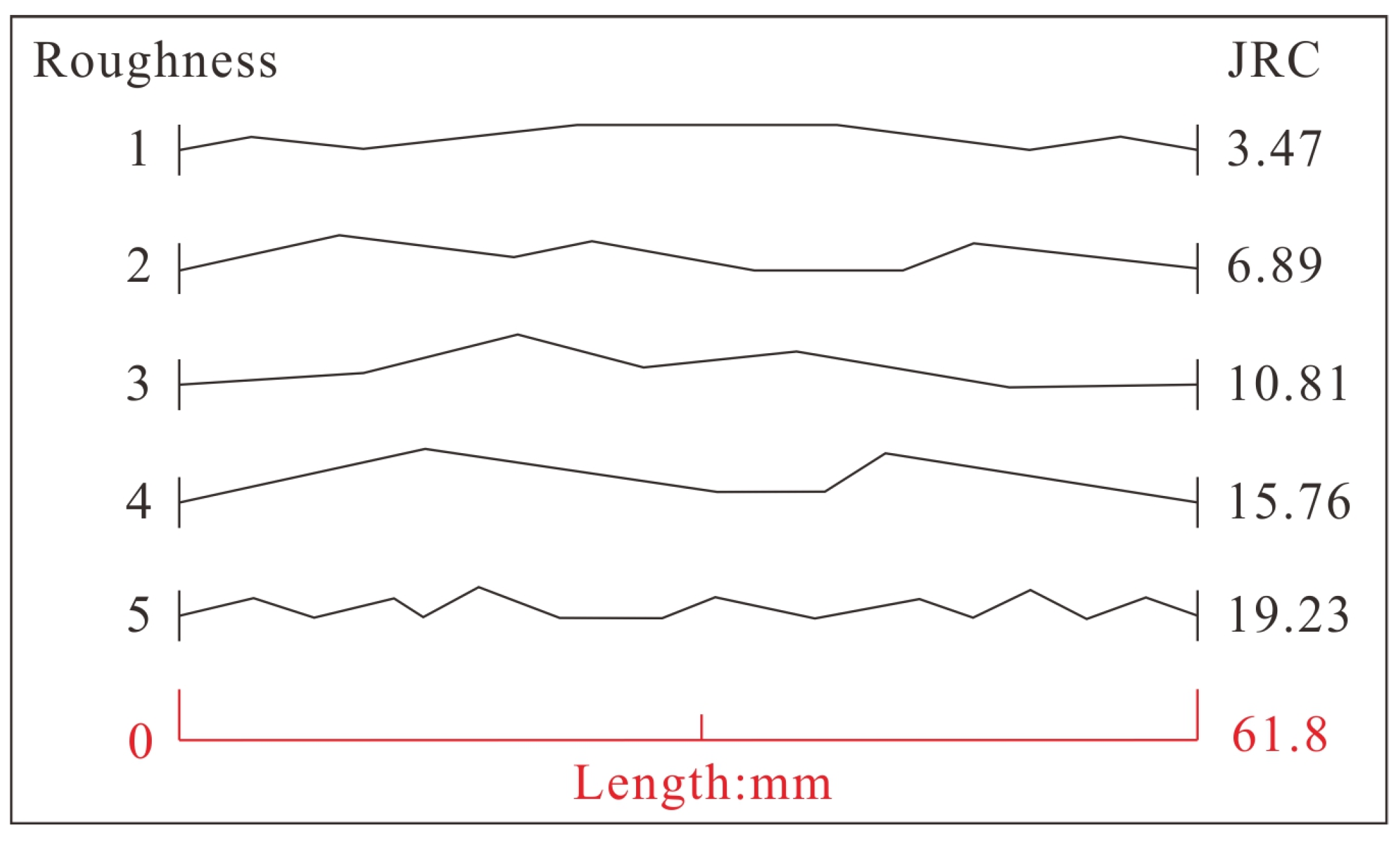
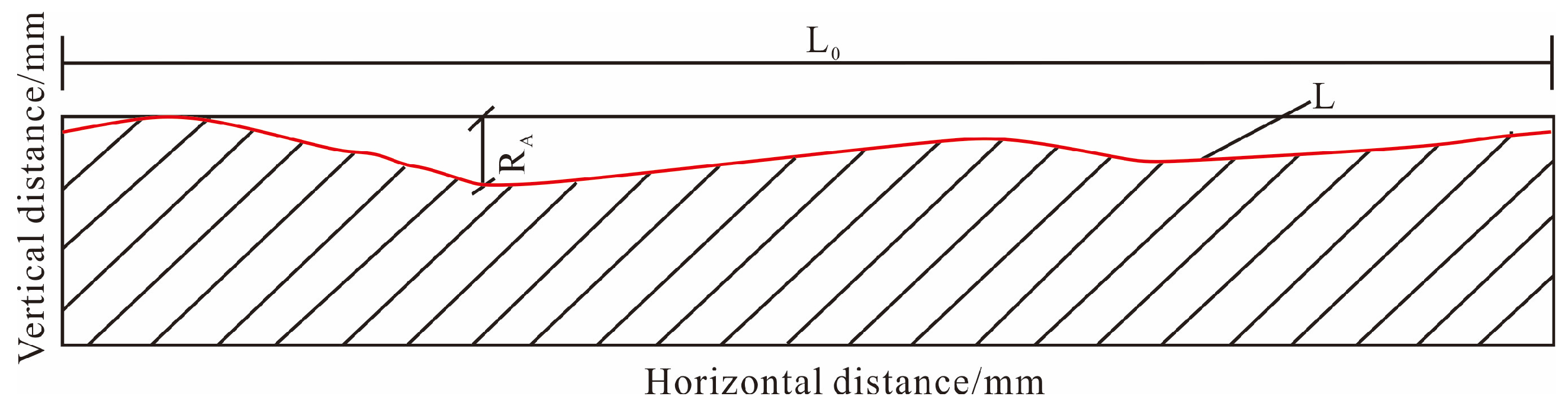
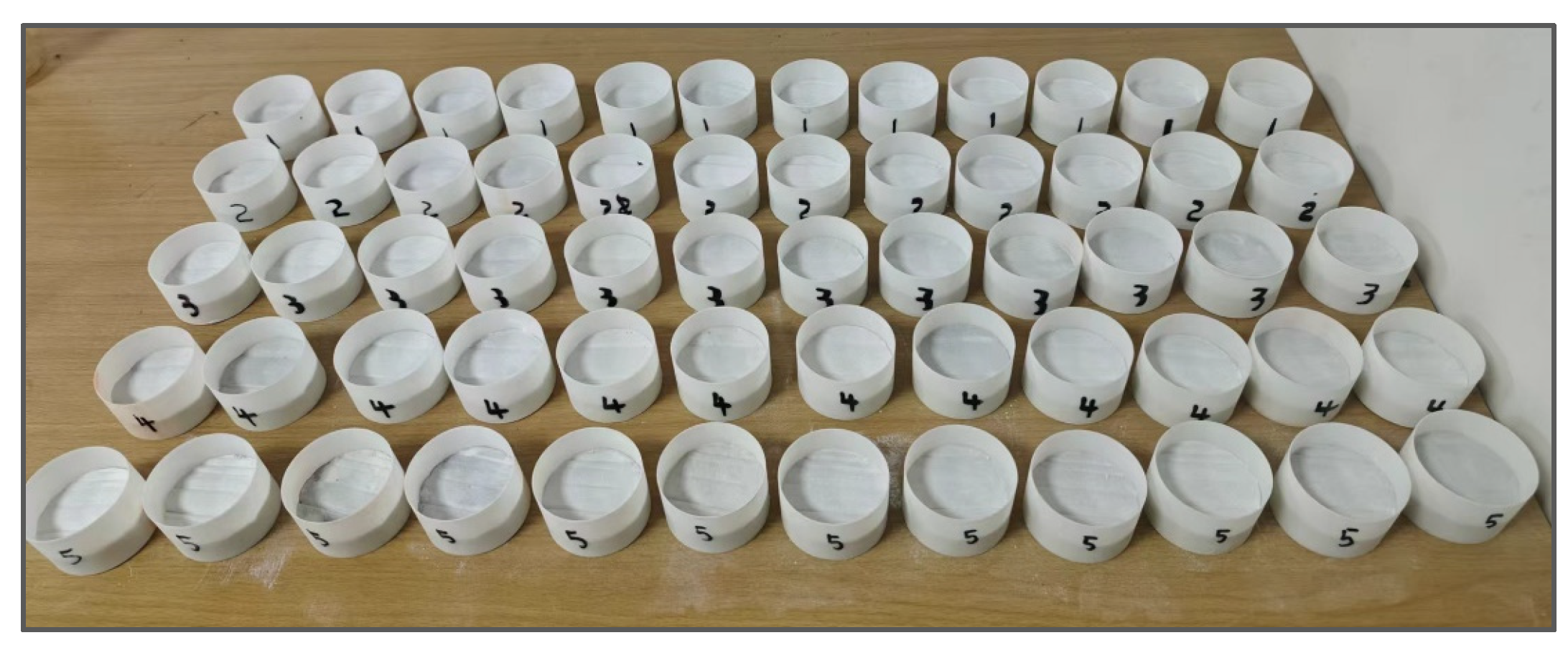
For the preparation of rock roughness, five standard roughness curves proposed by Barton were selected as the profile morphology for the ice-rock interface [4], and were replicated using AutoCAD2023 software (Figure 1). The structure surface roughness coefficient, JRC, for each standard curve was then calculated using Equations (3)–(5) where R a is the relative undulation and R is the elongation ratio (Equations (1) and (2)) [7]. The geometric meanings of the various parameters are shown in Figure 2. Subsequently, concrete blocks were used to simulate rock and fabricate the lower half of the specimen (Figure 3) based on the required specimen dimensions.
The elongation at break R is expressed as
R = L L 0 L 0
The relative roughness Ra is expressed as
R a = R A L 0
For the straight profile curve (0 ≤ JRC ≤ 8), the following applies:
J R C = 12.862   R + 10.316   arctan 100   R a 4.017
For the wavy profile curve (8 < JRC ≤ 16), the following applies:
J R C = 2.719   R + 0.585   100   R a 2 + 6.169
For the sawtooth profile curve (16 < JRC ≤ 20), the following applies:
J R C = 10.544   R + 0.327   100   R a 2 + 10.377
Due to constraints in experimental conditions, tests at varying temperatures could not be conducted. All experiments were performed at a room temperature of approximately 5 °C during winter. After 8 days of curing, the rock specimens were demolded and placed into ice–rock molds. The bottom was wrapped in plastic film and sealed with waterproof glue to prevent leakage before injecting distilled water. The assembly was then frozen at −15 °C for 48 h. Simultaneously, the shear box was disassembled and pre-cooled in the freezer to ensure its temperature was consistent with the specimens, thereby preventing premature melting due to temperature gradients during the testing process.
For each roughness, three groups of experiments were set up, with each group containing four specimens. At the start of the test, the ice–rock specimen and the pre-cooled shear box were removed together and installed on the direct shear apparatus. AE sensors were then attached to both sides of the shear box. Conventional Vaseline was employed as the coupling agent. At 5 °C, Vaseline remains in a visco-elastic state without vitrification or significant embrittlement; thus, issues related to acoustic impedance mismatch caused by low-temperature hardening were expected to be limited. A system signal check was performed before each test to ensure stable data acquisition. All tests were conducted using identical sensor mounting methods and a unified trigger threshold (40 dB) to ensure comparability.
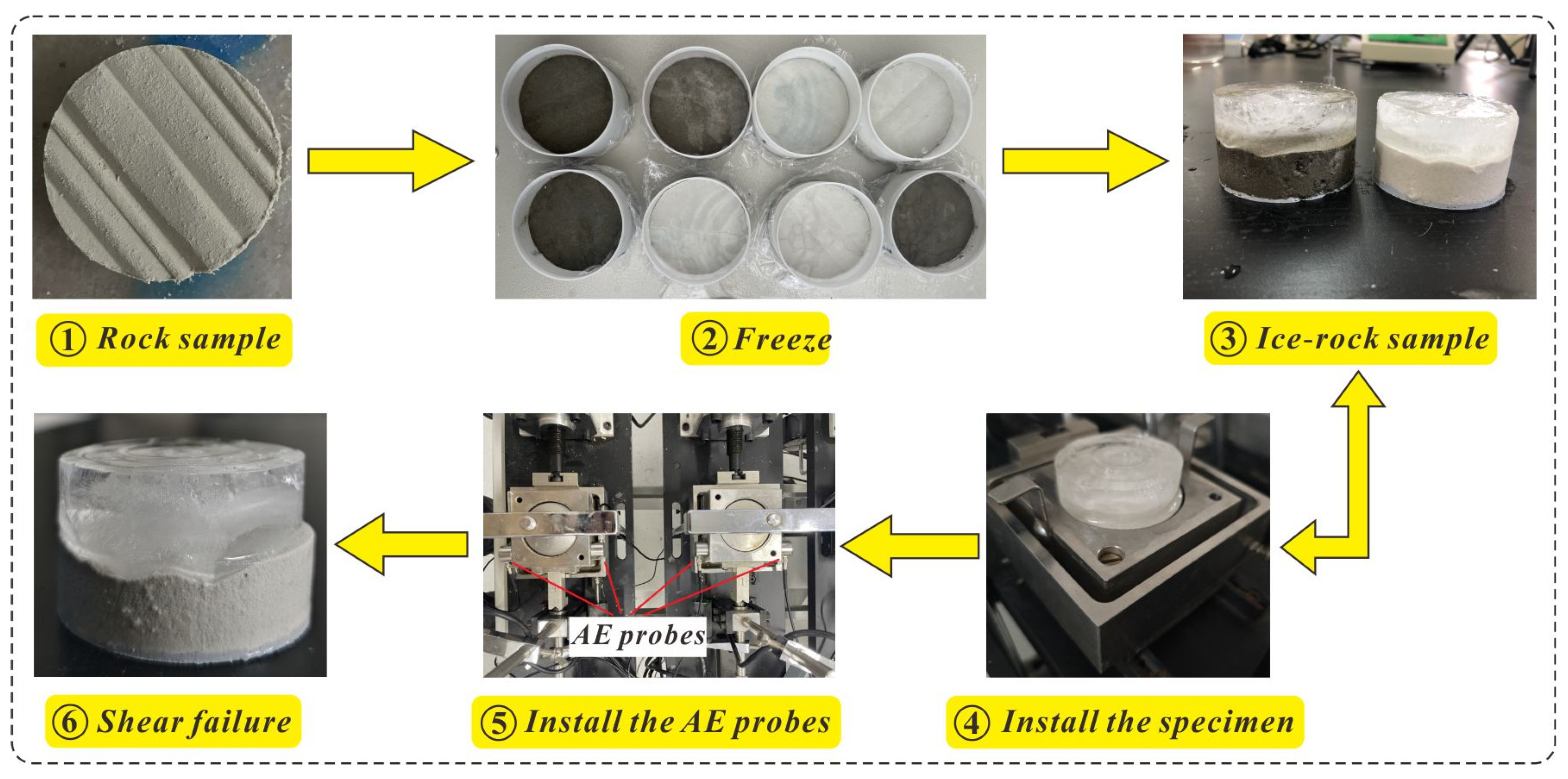
The shear rate was set at 4 mm/min and loading continued until failure. This rate ensured that the test duration was controlled within 2 min, significantly minimizing the influence of room temperature on the results. The pre-cooled shear box maintained the internal temperature for a sufficient duration, preserving the rigidity of the ice body. Real-time AE signal acquisition was synchronized with the onset of shear loading (Figure 4). The detailed experimental loading scheme is presented in Table 1.

3. Test Results

3.1. Shear Mechanical Behaviour at the Ice-Rock Interface

3.1.1. Shear Stress-Displacement Curve

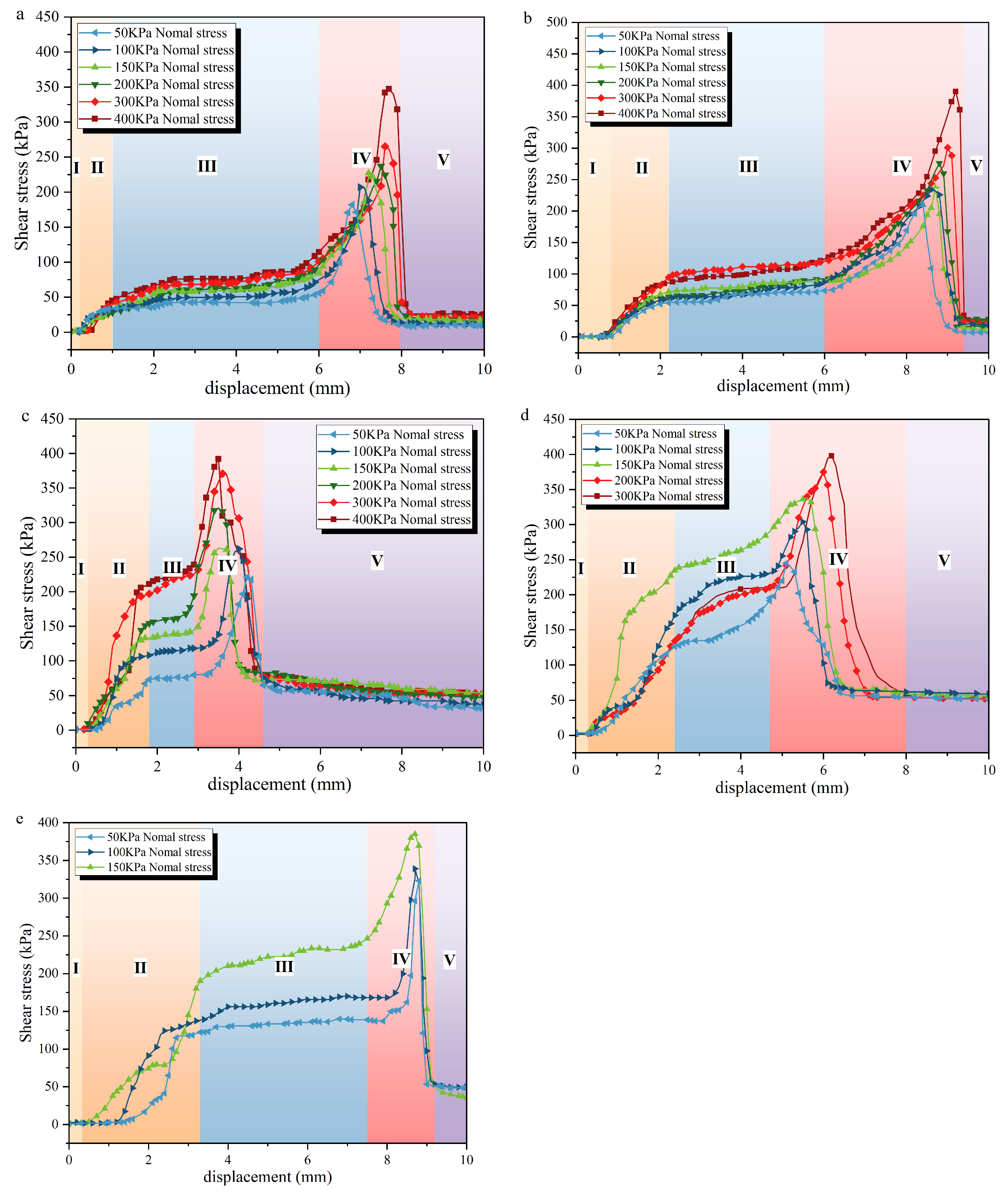
During the experiments, it was observed that the specimen with roughness level 4 did not reach shear failure under a normal stress of 400 kPa, and the specimen with roughness level 5 similarly did not fail under a normal stress of 200 kPa. To ensure the completeness and comparability of the experimental results, supplementary shear tests were conducted under normal stresses of 50 kPa and 150 kPa for these two specific cases. The shear stress–displacement curves obtained under all working conditions are presented in Figure 5. Overall, the shear responses under different normal stress levels exhibit similar evolutionary patterns.
According to the evolution characteristics of the shear stress–displacement curves, the entire shear process can be divided into five stages: the initial stage (I), compaction stage (II), gradual growth stage (III), failure stage (IV), and residual stage (V).
Initial stage (I): Due to the presence of a certain gap between the specimen and the shear box, the shear stress does not increase.
Compaction stage (II): After the specimen comes into contact with the shear box, the shear stress begins to increase slightly.
Slow growth stage (III): Once the specimen is fully compacted, the dilatancy effect is constrained by the normal resistance. The energy generated by crack propagation during the failure process cannot be completely released, resulting in a continuous but relatively slow increase in shear stress over a certain period.
Failure stage (IV): Upon entering the failure stage, the shear stress increases significantly until the accumulated internal energy reaches its peak and is completely released, causing a sudden drop in shear stress to a very low level. This process occurs within a very short time and is often accompanied by a distinct brittle cracking sound.
Residual stage (V): After the specimen is sheared through, the ice–rock interface continues to experience shear. The residual stress is extremely low but does not decrease to zero. The entire process exhibits typical brittle failure characteristics.
Comprehensive analysis indicates that prior to shear failure, the ice–rock interface generally experiences a pronounced damage accumulation stage followed by a damage acceleration stage. The former corresponds to the progressive initiation and propagation of microcracks, exerting a limited influence on the overall structural integrity. The latter is characterized by rapid crack coalescence and macroscopic instability, representing the critical transition from a stable to an unstable state of the interface. Once the damage acceleration stage is reached, the interface enters a highly unstable condition, and external disturbances can readily trigger further crack propagation, ultimately leading to ice–rock separation and global failure.
As shown in Figure 5a, with increasing normal stress, the peak shear stresses are 182 kPa, 207 kPa, 227 kPa, 237 kPa, 265 kPa, and 347 kPa, respectively, demonstrating a clear increasing trend. Correspondingly, the displacements at peak shear stress are 6.8 mm, 7.01 mm, 7.0 mm, 7.2 mm, 7.6 mm, and 7.7 mm, indicating a moderate increase. In addition, the evolutionary trends vary with roughness. As illustrated in Figure 5, at relatively low roughness levels, the stress–displacement curve exhibits a slight initial increase, followed by a prolonged slow-growth stage, and then a rapid acceleration to the peak stress. In contrast, at higher roughness levels, the shear stress rises rapidly once displacement initiates, subsequently undergoes a brief period of slow growth, and then accelerates again to reach the peak value. These results demonstrate that increasing surface roughness exerts a significant and non-negligible influence on the shear mechanical behavior of the ice–rock interface.

3.1.2. The Influence of Roughness on Mechanical Parameters at the Ice-Rock Interface

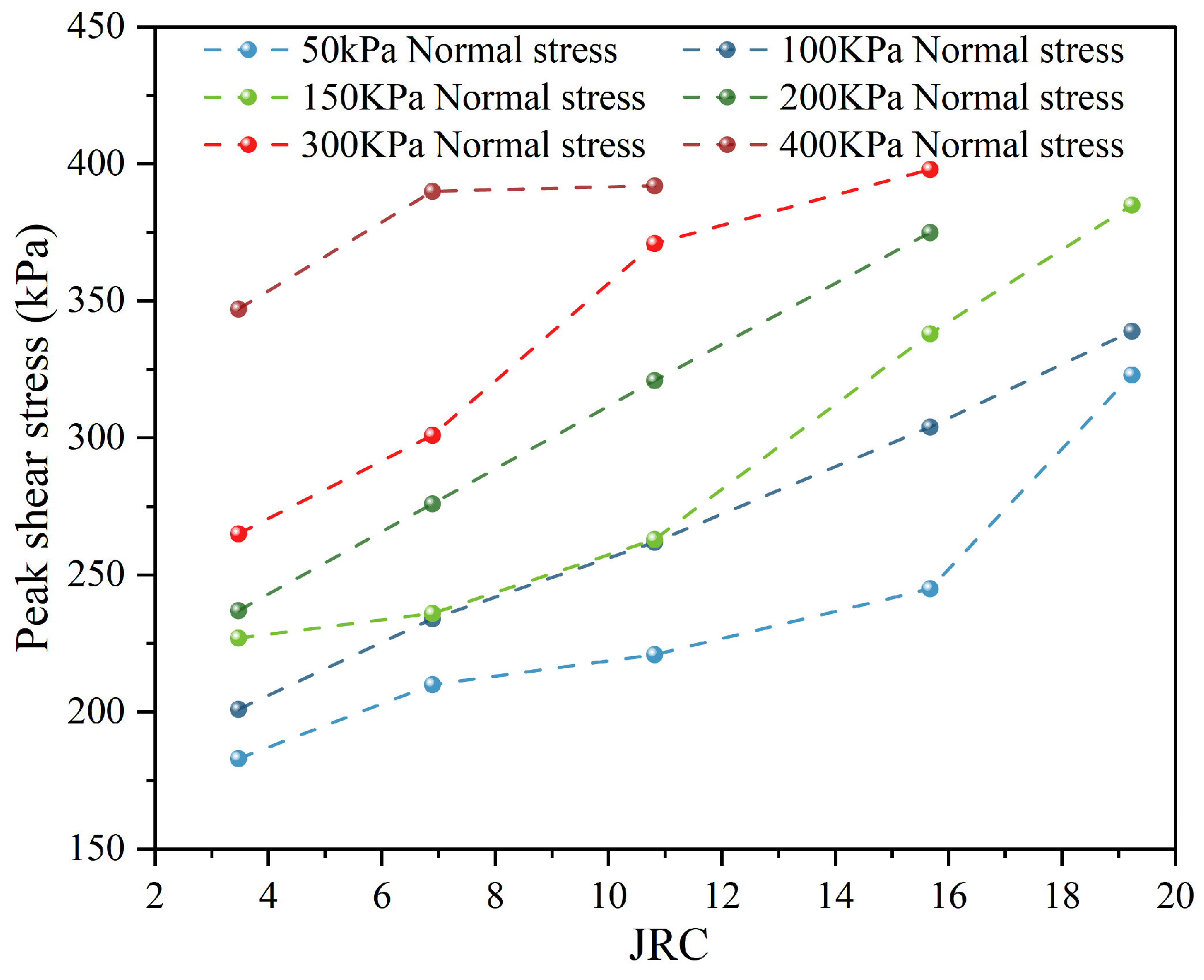
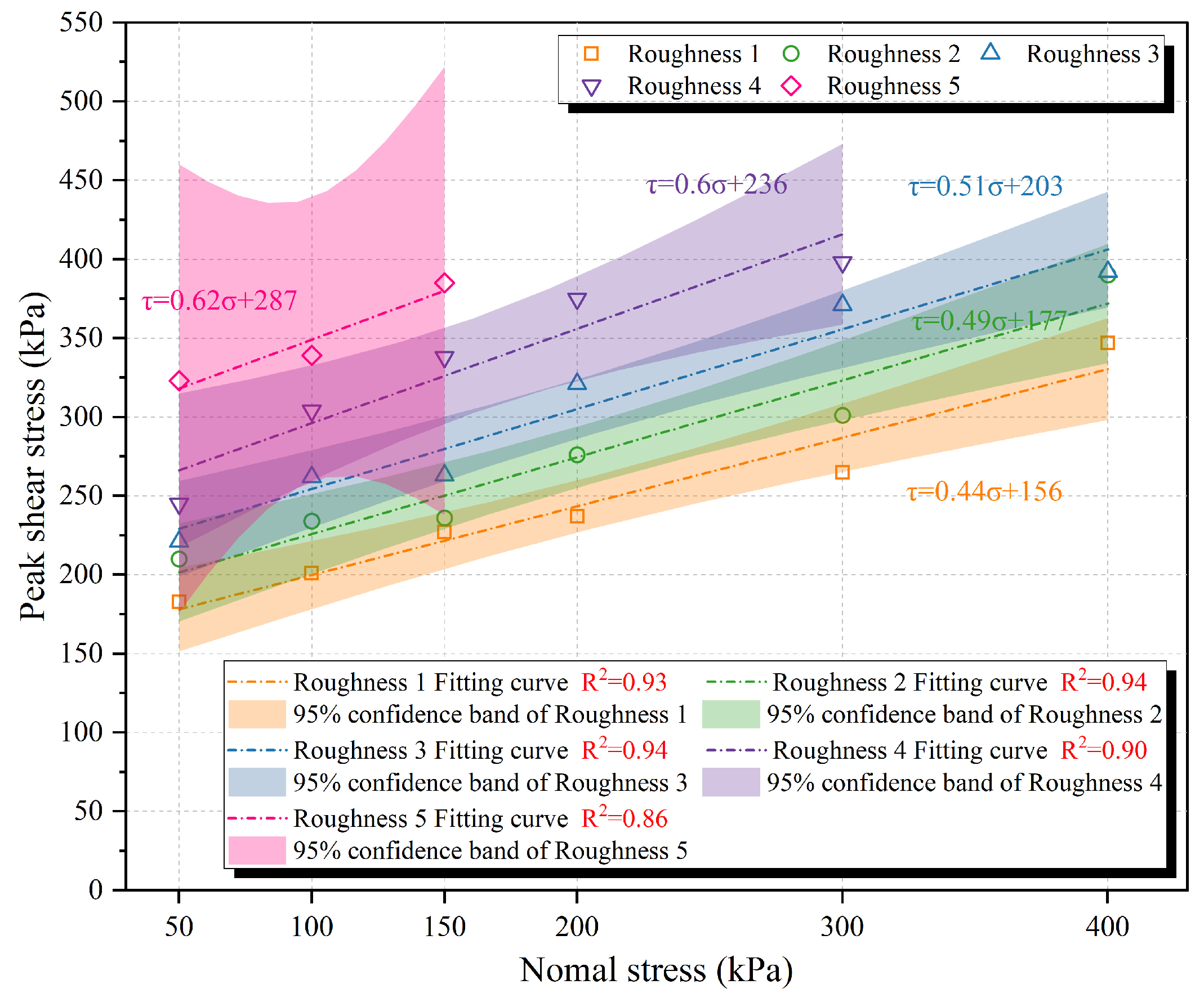
Further analysis of the impact of roughness on the shear strength parameters of the ice-rock interface can be observed in Figure 6. Under the same roughness conditions, as the normal stress increases, the peak shear stress shows a significant increasing trend. Under the same normal stress, as the structural surface roughness coefficient increases, the model’s peak shear stress also increases, which is consistent with previous research results [16]. Using the Mohr-Coulomb strength criterion, shear stress-normal stress fitting curves were plotted (Figure 7). Further analysis in the 50 kPa–400 kPa normal stress range reveals that the cohesion of the ice-rock interface is approximately 156 kPa–287 kPa, and the internal friction angle is approximately 23.7–31.8°. It can be seen that with the increase in roughness, both the cohesion and internal friction angle of the interface increase, indicating that the friction parameters of the ice-material interface are not only affected by temperature and moisture content [15,27] but also adjust significantly with changes in the structural surface roughness. Increased surface roughness enhances the mechanical interlocking effect between ice and rock surfaces while expanding the contact area, significantly improving the adhesive capacity of ice on rock surfaces. This physical interlocking effect formed by the irregular surface texture effectively impedes the sliding and detachment of ice under stress, thereby strengthening the mechanical properties at the interface.

3.2. Shear AE Characteristics at the Ice-Rock Interface

3.2.1. AE Count Characteristics

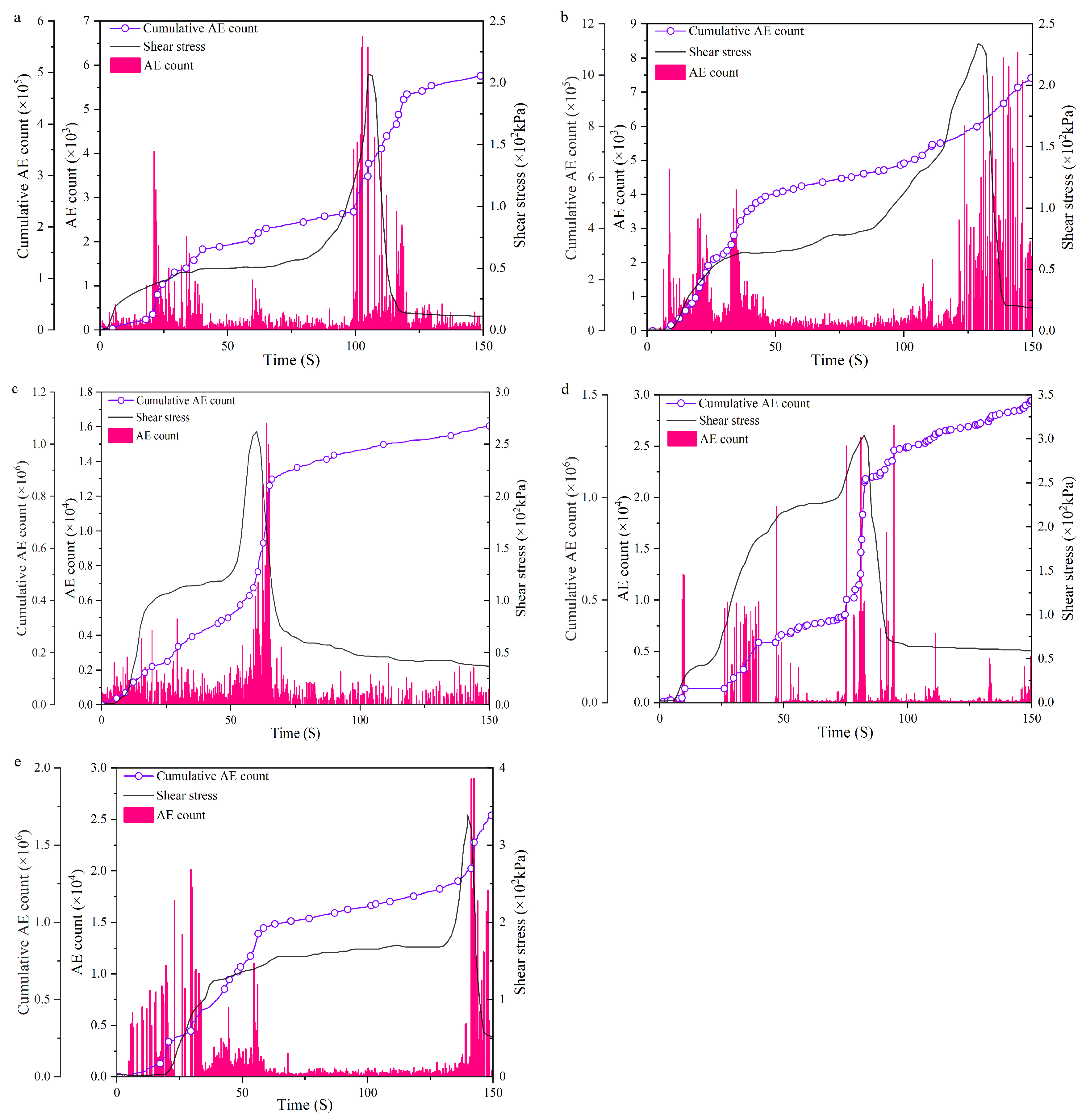
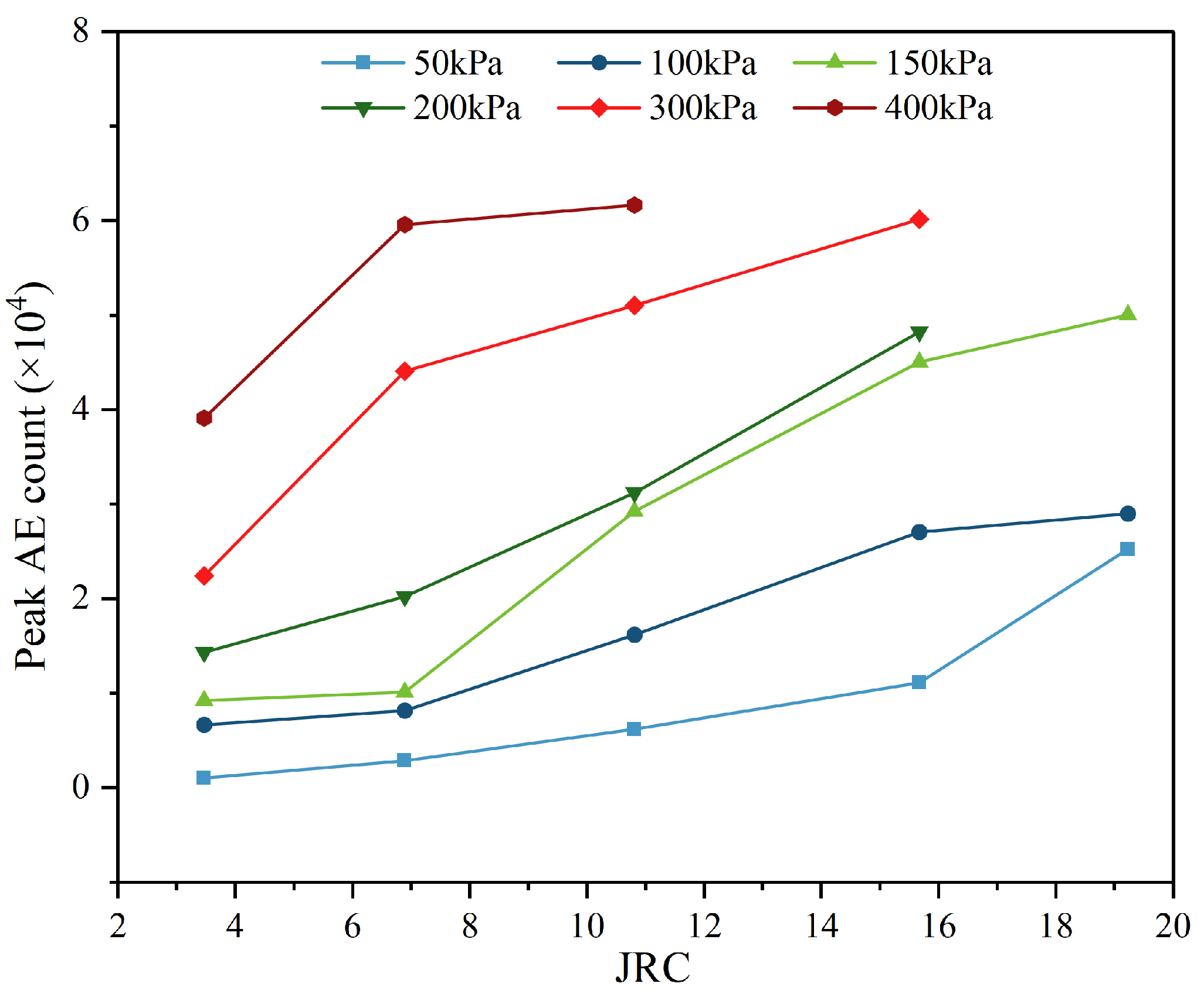
The ring-down count represents the number of times the AE signal exceeds a predefined threshold. It essentially reflects the frequency and activity level of microcracking within the material and serves as an important indicator for damage evolution stage classification and failure precursor identification [28]. Taking the shear specimens under a normal stress of 100 kPa as an example, the relationships among AE count characteristics, cumulative count characteristics, and shear stress were analyzed, as shown in Figure 8. A comprehensive comparison of the AE count distributions for specimens with five different roughness levels indicates that significant surges in AE counts occur during both the compaction stage (II) and the failure stage (IV) of the shear curve. This suggests that a large number of cracks are generated at the ice–rock interface during these stages. In particular, during the failure stage (IV), the AE count reaches its peak value, corresponding to the overall failure of the specimen. As illustrated in Figure 9, with increasing joint roughness and normal stress, the AE counts increase markedly. The peak AE count rises from 4428 to 28,980, while the cumulative count increases from 493,844 to 1,693,398. This phenomenon indicates that the enhancement of mechanical interlocking and bonding effects at the interface intensifies the shear failure process, leading to the release of greater transient energy during the crack coalescence stage.

3.2.2. AE Energy Characteristics

The AE system can determine the AE energy of damage events. The size and duration of the damage are closely related to the characteristics of the AE energy release, and the calculation formula is shown in Equation (6). In the equation, i , E i , and U i represent the recorded channel, AE energy, and voltage, respectively. R , t 0 , and t 1 refer to the reference resistance, and the start and end times of the voltage transient recording. The event duration Δ t = t 0 t 1 [29].
E i = 1 R t 0 t 1 U i 2 t   d t
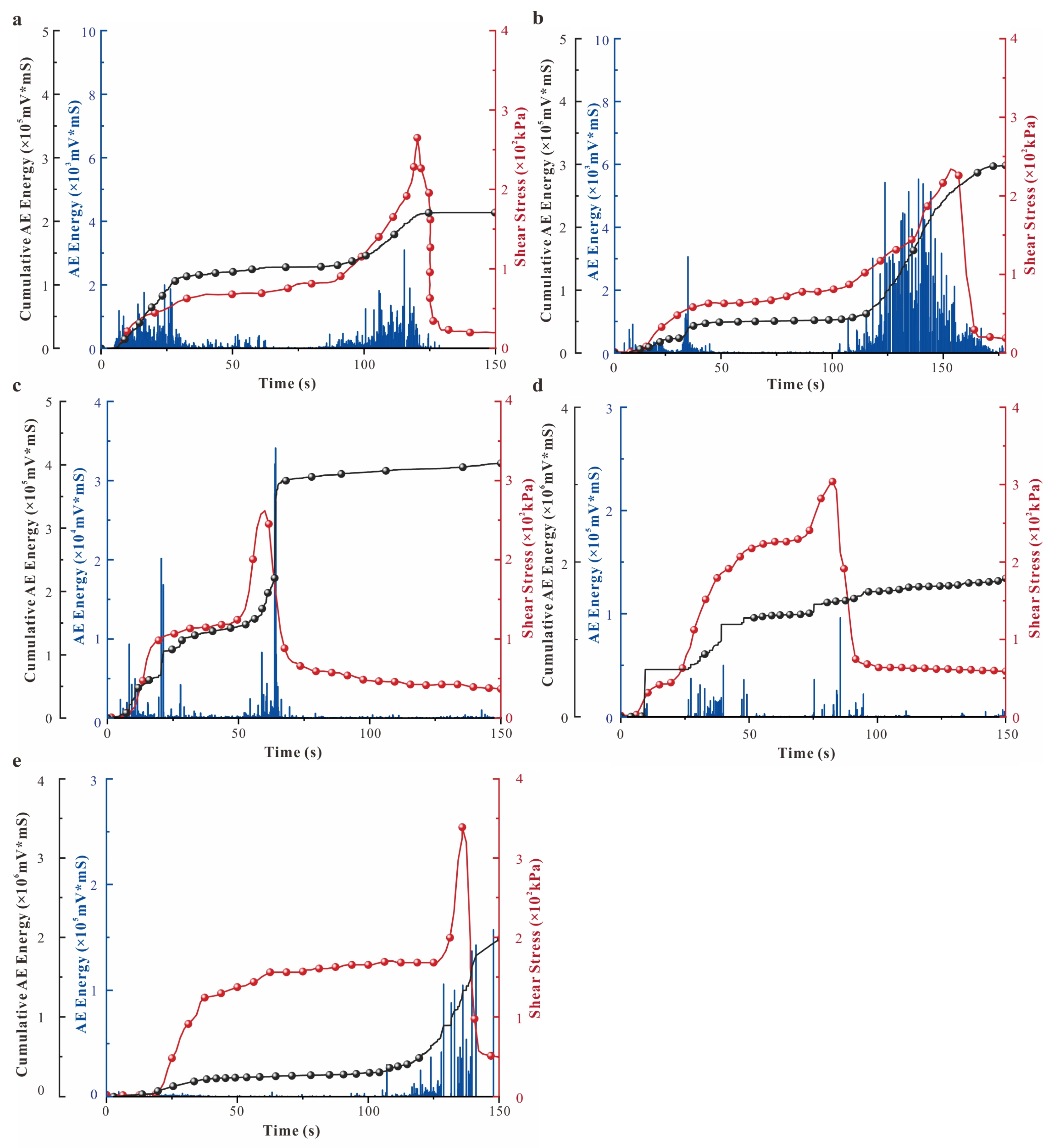
Under a normal stress of 100 kPa, a systematic analysis was further conducted on the relationship between AE energy characteristics, their cumulative evolution, and shear stress during the shear process of ice–rock interfaces with different roughness levels (Figure 10). The results indicate that the temporal distribution of AE energy is highly consistent with that of AE counts. High-energy events are mainly concentrated in compaction stage (II) and failure stage (IV) of the shear curve, suggesting that these two stages represent critical periods of rapid crack propagation and concentrated energy release at the interface. Quantitatively, with increasing interface roughness, the peak AE energy increases markedly from 3093 to 157,324, with the order of magnitude rising from 103 to 105. Meanwhile, the cumulative AE energy increases from 213,865 to 1,927,343, exhibiting a pronounced upward trend. This reflects a significant enhancement in the level of energy release during the interfacial fracture process as roughness increases.
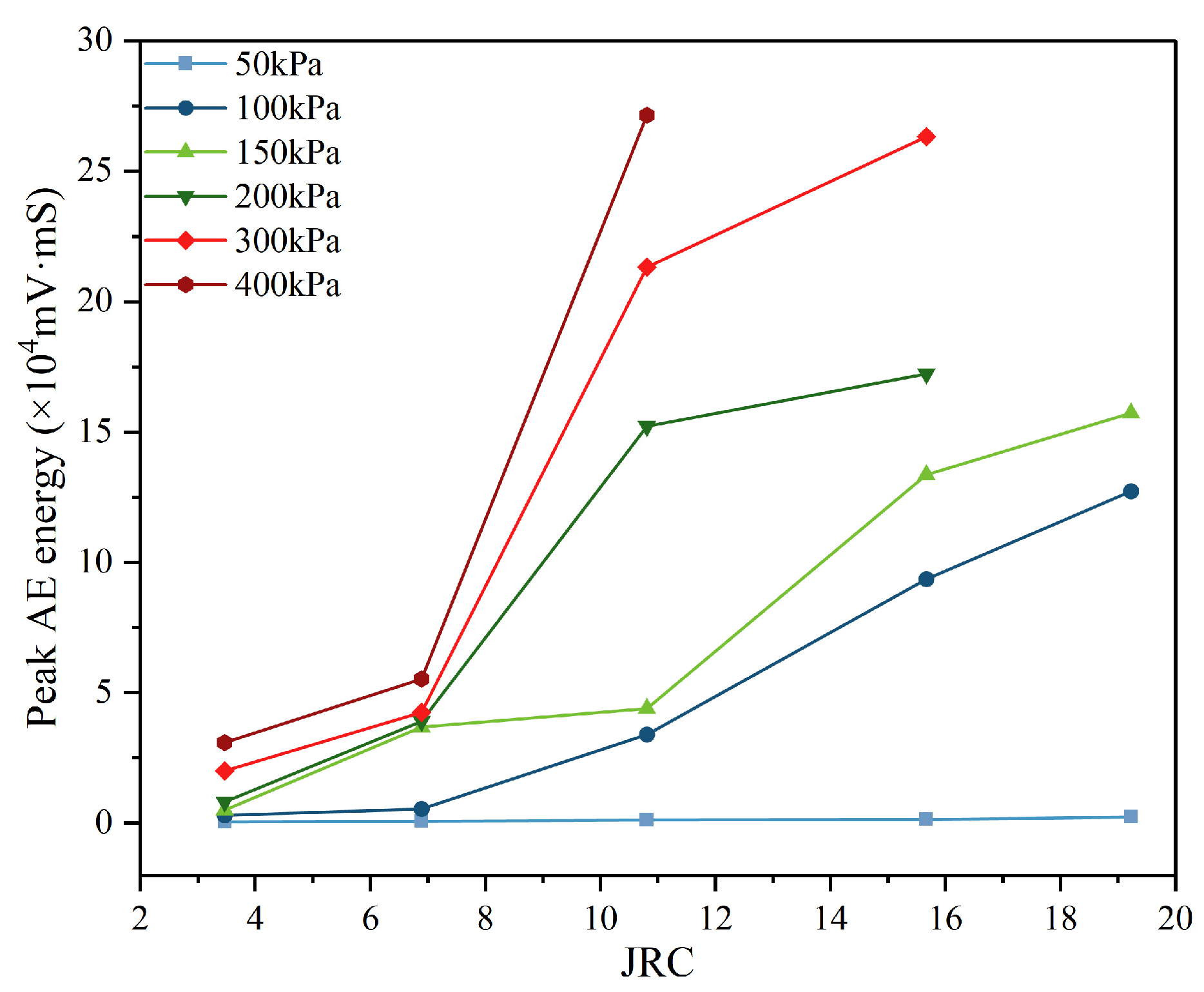
As shown in Figure 11, under different experimental conditions, AE energy generally increases with increasing joint roughness and normal stress. This phenomenon indicates that higher normal confinement and more complex interfacial geometries promote the generation of a greater number of high-energy AE events during shearing. Previous studies have demonstrated that the distribution characteristics of AE energy can effectively reflect the dynamics of crack propagation: high-energy events are typically associated with the rapid extension or coalescence of large-scale cracks, whereas low-energy events are mainly related to the initiation, growth, and local adjustment of microcracks [30]. Combined with the present experimental results, compaction stage (II) and failure stage (IV) can be identified as the main stages of macroscopic crack formation and propagation, corresponding to significant evolution in the load-bearing capacity of the interface. In contrast, the AE energy levels in stages C and E are relatively low, indicating that the interface is dominated by stable microcrack development or post-failure frictional sliding during these stages.
Further comparison of the evolution curves of AE counts and AE energy reveals a high degree of consistency in their overall trends, both exhibiting stage-dependent intensification and concentrated release. Numerous experimental studies have shown that AE energy and AE counts are generally positively correlated during microcrack propagation [31]. In this study, AE counts and energy can thus be regarded as effective indicators of crack development within the ice–rock interface. During initial stage (I) and gradual growth stage (III), both AE counts and energy remain at relatively low levels, indicating limited crack initiation and relatively slow crack growth. In contrast, during compaction stage (II) and failure stage (IV), both parameters increase abruptly, corresponding to the formation, propagation, and eventual coalescence of large-scale cracks within the interface, which marks the occurrence of overall shear failure of the specimen. These results further confirm the effectiveness and consistency of AE energy and count parameters in characterizing the evolution of shear failure at ice–rock interfaces.

3.2.3. RA-AF Characteristics

The characteristics of AE count and energy both indicate that different degrees of deformation and fracture occurred on the ice-rock structural interface during the shear test. To further investigate the internal fracture mechanism of the structural interface, the ratio of rise time/amplitude RA (Rise Amplitude) and average frequency AF (Average Frequency) can be used to classify the crack modes as either shear or tensile [23,32]. The values of RA and AF can be obtained through the AE parameters as shown in Equations (7) and (8).
RA = Rising   time Amplitude
AF = Rising   counts Duration
Tensile cracking is typically accompanied by rapid energy release. Its AE signals are characterized by a short rise time, short duration, high amplitude, and a relatively large number of ring-down counts, resulting in low RA values and high AF values. In contrast, the initiation and propagation of shear cracks occur more gradually. Their AE signals generally exhibit longer rise times and durations, lower amplitudes, and fewer ring-down counts, leading to higher RA values and lower AF values for shear-related events [33,34]. Consequently, the combined use of RA–AF parameters has been widely adopted to discriminate between different crack types and to identify fracture mechanisms. However, under different material conditions and loading modes, no unified quantitative threshold has yet been established to distinguish tensile from shear cracking. In studies of typical brittle materials such as concrete, the ratio between RA and AF is commonly reported to fall within a range from 1:8000 to 10:1 [32], providing an empirical reference for crack-type classification. Based on the AE characteristics obtained from the ice–rock interface shear tests in this study, and considering both the parameter distribution patterns and the actual crack evolution behavior, a criterion of K = 200   was adopted to differentiate micro-tensile cracks from micro-shear cracks. Specifically, events with A F / R A > 200   were identified as micro-tensile cracks, whereas those with A F / R A < 200   were classified as micro-shear cracks.
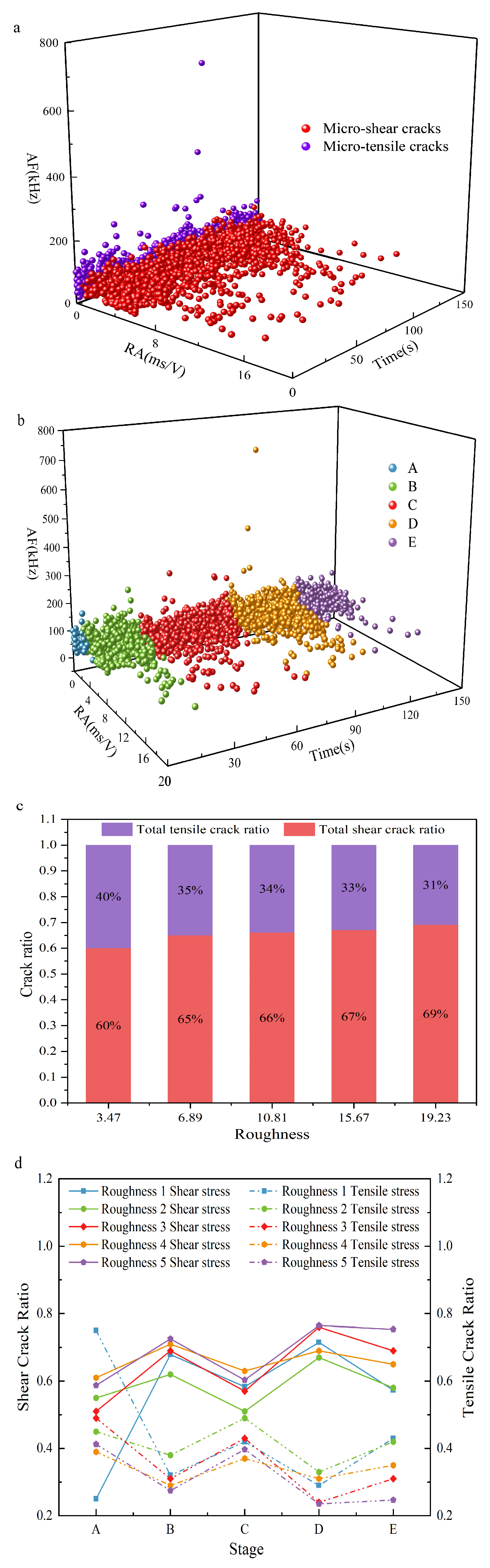
The test results under a normal stress of 100 kPa are taken as a representative example for analysis (Figure 12a,c). The results indicate that micro-shear cracks dominate numerically throughout the entire shear loading process, with their proportion being significantly higher than that of micro-tensile cracks. This observation suggests that the shear failure of the ice–rock interface is primarily governed by shear slip and interface friction–controlled crack propagation mechanisms. Meanwhile, with increasing interface roughness, the proportion of micro-shear cracks exhibits a slight increasing trend, indicating that interface geometric asperities promote the initiation and development of shear cracks. Further stage-by-stage statistical analysis (Figure 12b,d) shows that, for all five roughness levels, micro-shear cracks prevail in every shear stage, and their proportion consistently exceeds that of micro-tensile cracks. The proportion of micro-shear cracks displays an alternating stage-dependent evolution during loading, reaching maximum values in compaction stage (II) and failure stage (IV). This indicates that the formation and coalescence of large-scale cracks are mainly concentrated in these two critical stages, further confirming that shear cracking is the dominant failure mechanism during the shear failure process of the ice–rock interface.

3.2.4. b-Value Characteristics

The b-value, which originates from seismology, serves as a critical parameter characterizing the relationship between earthquake magnitude and frequency. The fundamental calculation formula is derived from Gutenberg and Richter, who established the empirical magnitude–frequency relationship through systematic investigations and proposed the renowned G–R equation [35]:
lg N = a b M
where M is the earthquake magnitude; N is the frequency of earthquakes with magnitudes between M + ΔM; and a and b are constants.
Some scholars [36] have proposed that the b-value in AE can be applied to characterize the degree of crack development, where the increase or decrease of the b-value reflects changes in the scale of micro-cracks during the rock fracturing process. Since the concept of earthquake magnitude is not directly applicable to AE monitoring, the AE amplitude (dB) is typically divided by 20 to represent the equivalent magnitude (ML) in experimental practice.
M L = A d B 20
where ML denotes the ‘seismic magnitude’ in the experiment and AdB denotes the acoustic emission amplitude.
The b-value is generally calculated using two classical approaches: the least-squares method and the maximum-likelihood method. In this study, the least-squares method was adopted. Using the equivalent magnitude (ML) as the abscissa and the logarithm of the cumulative frequency of AE events (lgN) as the ordinate, a linear regression analysis was performed. The absolute slope of the resulting fitting line represents the b-value.
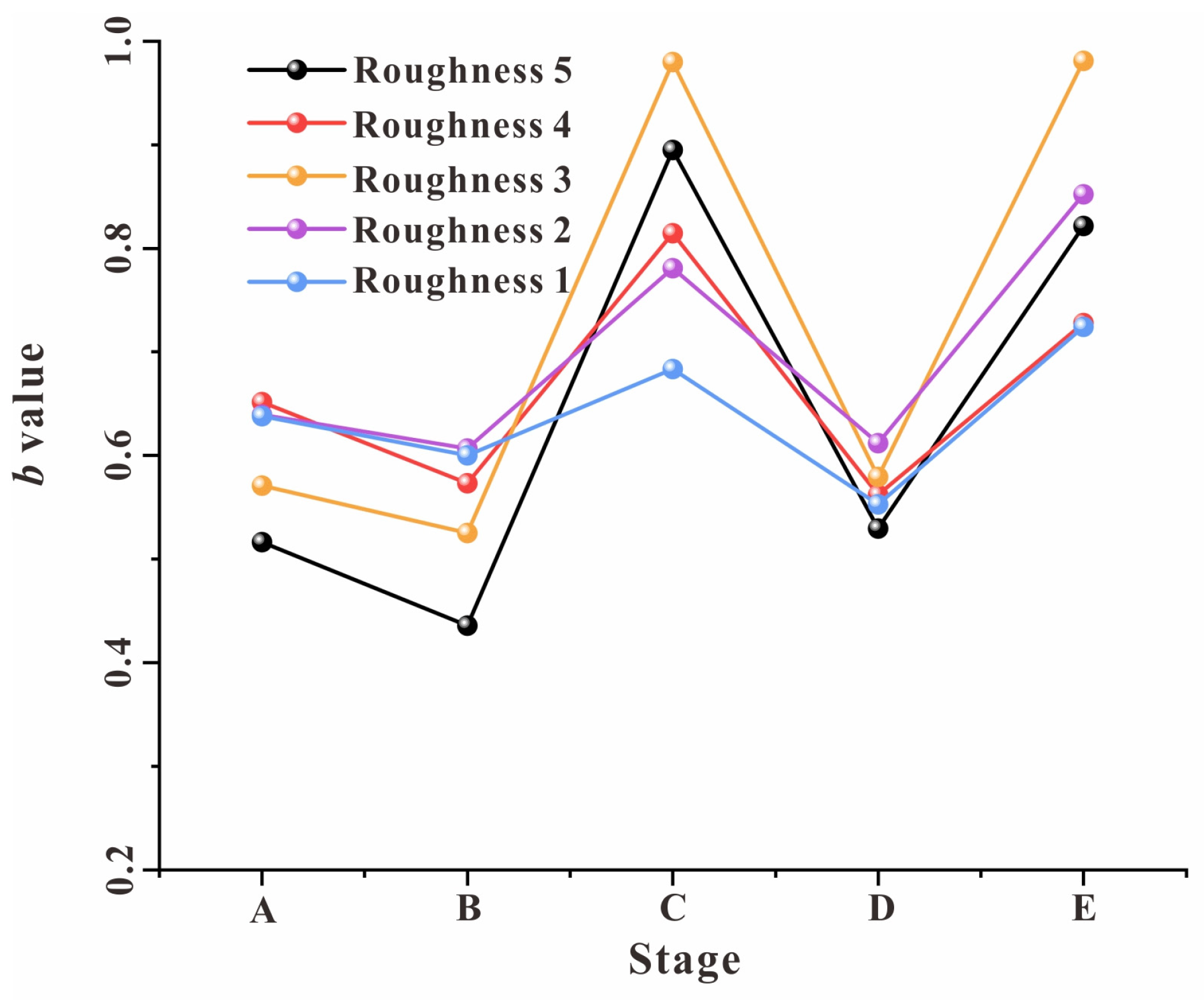
The b-value of AE was calculated for the five stages as shown in Figure 13. The b-values of the five roughness specimens exhibit an alternating pattern of decrease and increase during the test. The larger the roughness, the smaller the b-value at the peak shear stress. Overall, smaller b-values indicate larger fractures forming inside the specimen, which are reflected in compaction stage (II) and failure stage (IV) of the test, where both the AE count and energy reach their peaks, and the shear stress increases sharply. This pattern aligns with the stress-displacement curve.

3.2.5. Frequency-Amplitude Characteristics

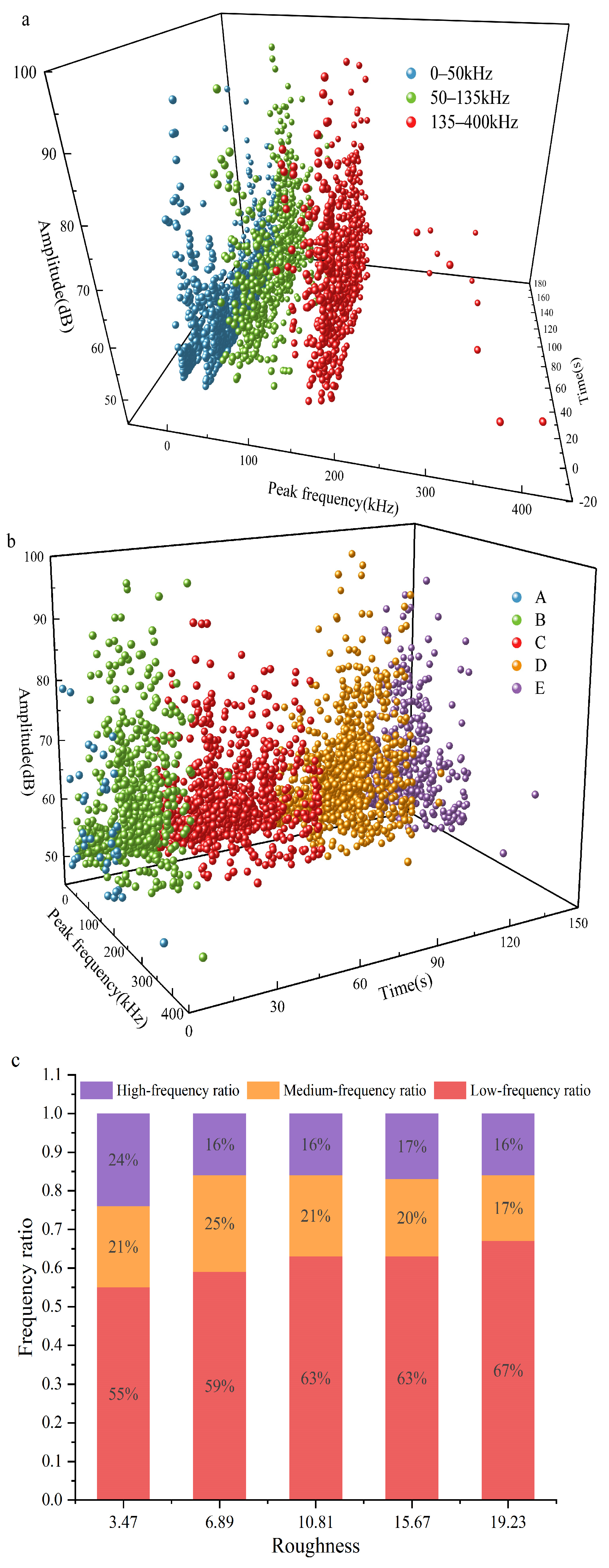
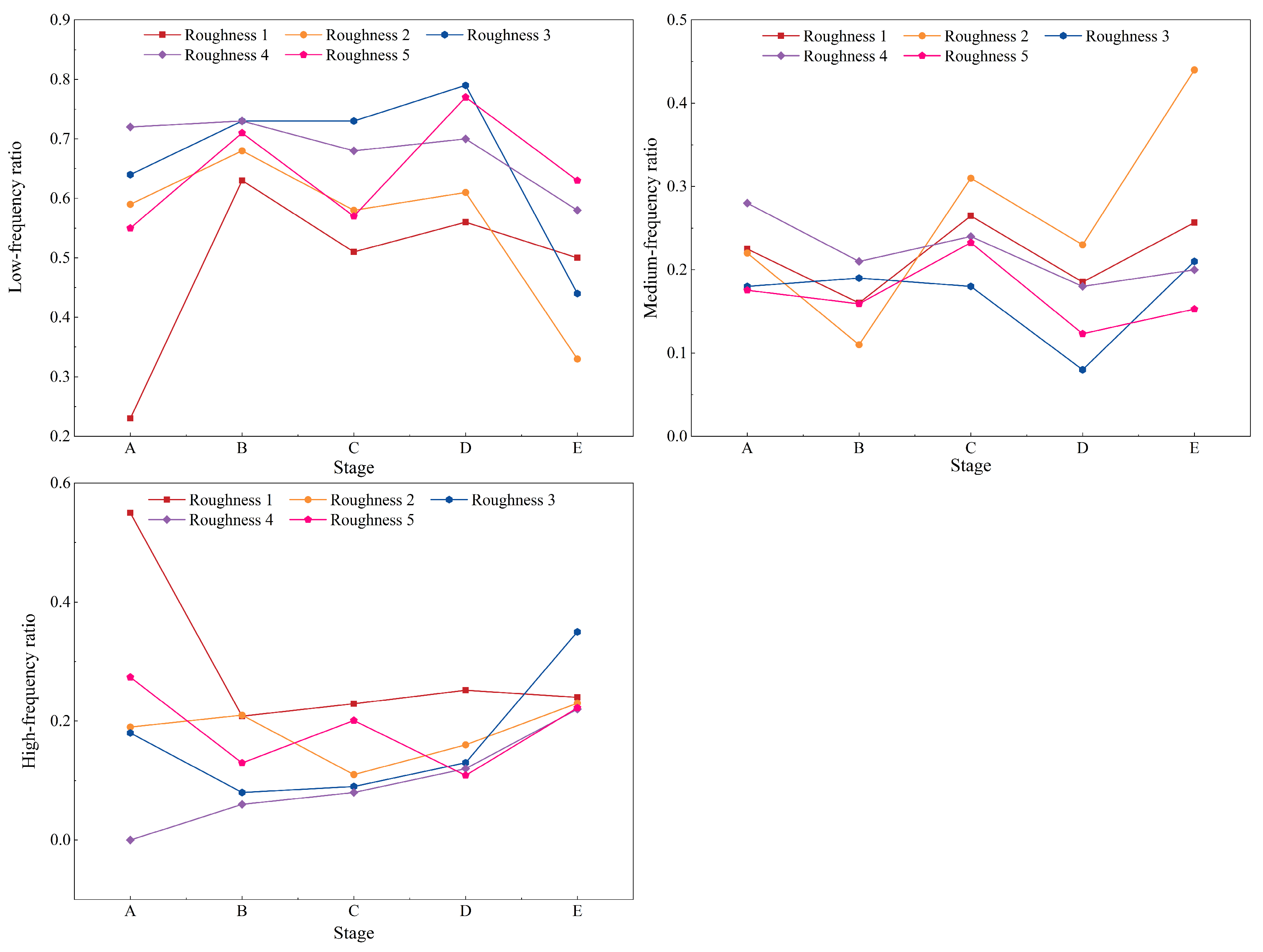
Taking the roughness 1 specimen under a normal stress of 100 kPa as an example, its peak frequency–amplitude distribution is shown in Figure 14a. The overall frequency range can be divided into three bands: low-frequency (0–50 kHz), medium-frequency (50–135 kHz), and high-frequency (135–400 kHz). A comparison of the peak frequency–amplitude distributions for specimens with different roughness levels (Figure 14c) indicates that, as the interface roughness increases, the proportion of medium- and high-frequency signals generally decreases, while the proportion of low-frequency signals gradually increases, accounting for more than half of all signals throughout the shear process. Further analysis of the frequency–amplitude characteristics at each shear stage (Figure 14b) reveals that low-frequency, high-amplitude signals are particularly pronounced during compaction stage (II) and failure stage (IV). This suggests that such signals can serve as effective indicators of crack initiation and the formation of large-scale through-cracks. The frequency–amplitude distribution ratios for each stage are presented in Figure 15, showing that the variation trend of low-frequency signals closely matches the proportion of micro-shear cracks, indicating that micro-shear cracks persist throughout the entire shear process. In contrast, during gradual growth stage (III), the proportion of medium- and high-frequency signals increases, reflecting the initiation and growth of micro-tensile cracks. Overall, the analysis demonstrates that frequency–amplitude characteristics can effectively characterize crack types and their evolution during shear failure of the ice–rock interface, providing quantitative AE-based indicators for further elucidating the interface failure mechanism.
By combining the shear stress–displacement response with AE characteristics, the shear failure process of the ice–rock interface can be systematically divided into five stages from the perspective of crack evolution:
Initial Stage (I): In the early loading stage, the shear stress is relatively low with little variation. Both the AE count and energy remain at extremely low levels, indicating that the initiation of internal cracks is slow and their distribution is relatively uniform. During this stage, the AE b-value remains at a high level, reflecting a crack distribution dominated by microcracks.
Crack Development Stage (II): Shear stress increases at a relatively high rate, accompanied by a significant release of AE energy. The AE count reaches its first peak. At this stage, interface cracks begin to develop, and the AE b-value decreases, indicating a change in crack scale.
Crack Propagation Stage (III): Shear stress growth starts to slow down, and both the AE count and energy remain at relatively low levels. Internal cracks within the specimen expand in a stable manner. The AE b-value rises rapidly, suggesting that microcracks remain dominant and the crack propagation is relatively uniform and continuous.
Crack Coalescence Stage (IV): After a rapid increase, the shear stress reaches its peak and then sharply drops to a low level, releasing a large amount of energy. The AE count reaches its peak. Internal cracks in the specimen coalesce, forming large-scale fractures. The AE b-value rapidly decreases, marking the occurrence of macroscopic failure. This is the key stage for shear failure of the specimen.
Residual Stage (V): The specimen has undergone overall failure, but residual stress still exists internally. The AE count and energy are low, and crack development slows down, primarily driven by microcracks. The AE b-value remains at a high level, indicating that microcracks continue to expand, but the overall failure process is essentially complete.
This five-stage classification provides a quantitative framework for revealing the nucleation, stable propagation, and coalescence of cracks during ice–rock interface shear failure. It offers a scientific basis for understanding the mechanisms of ice–rock-related geological hazards and provides critical reference for interface mechanical modeling and engineering stability assessment.

4. Shear Mechanics Model for Ice-Rock Interfaces

4.1. Empirical Formula for Ice-Rock Interface Strength Considering Roughness

According to the experimental data, the internal friction angle and cohesion value of the ice-rock interface are calculated using the Mohr-Coulomb criterion (Equation (11)), where c (kPa) is the cohesion and ϕ (°) is the internal friction angle.
τ = σ n t a n ϕ + c  
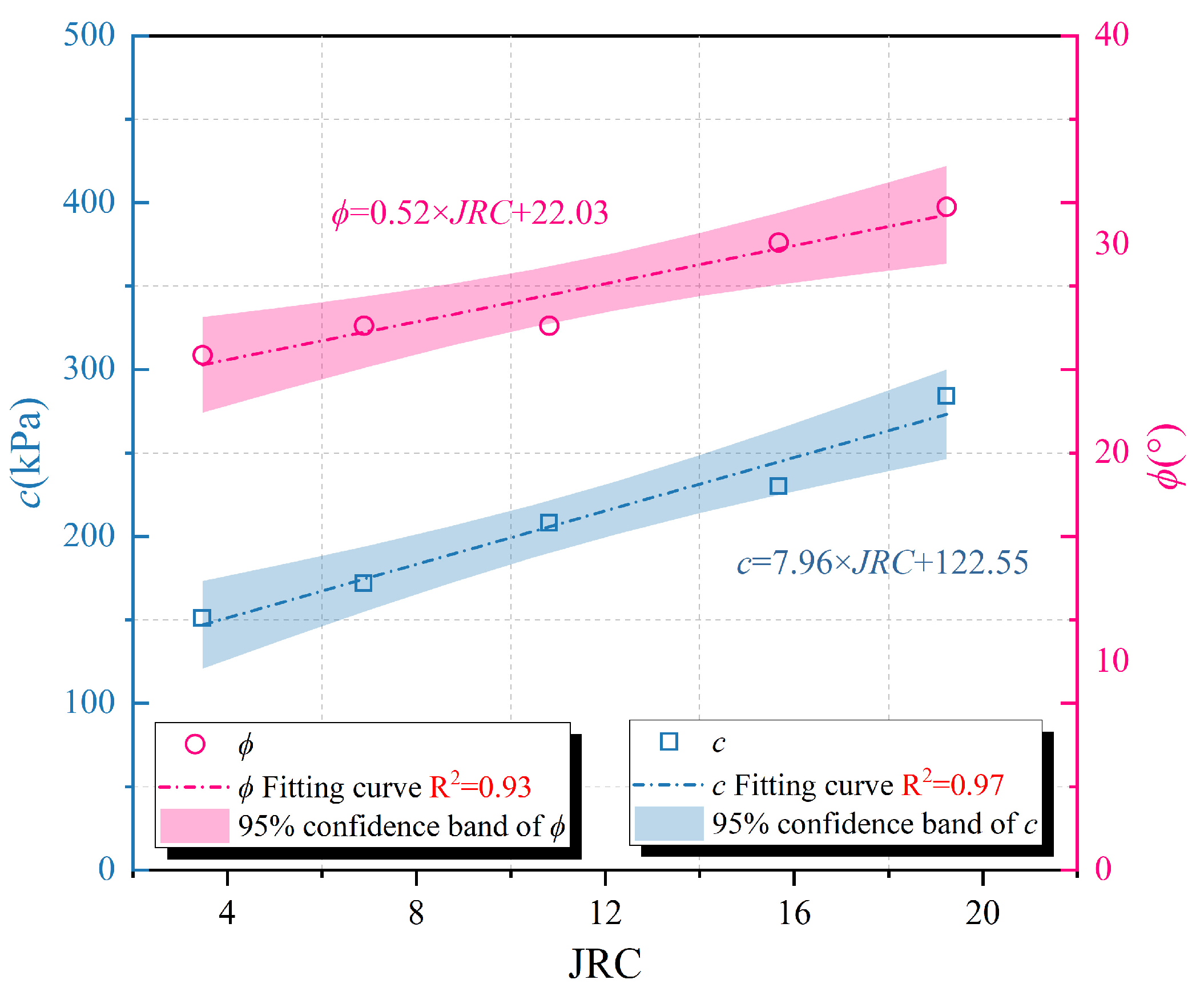
The fitting relationship between the internal friction angle and cohesion with roughness is shown in Figure 16. The strength parameters exhibit an approximately linear trend. Equations (12) and (13) consider the influence of roughness on the internal friction angle and cohesion.
ϕ = 0.52   JRC + 22.03
c = 7.96   JRC + 122.55
By substituting Equations (12) and (13) into Equation (11), an empirical formula for the ice-rock interface strength considering roughness is established as Equation (14).
τ = σ n tan 0.52   JRC + 22.03 + 7.96   JRC + 122.55
Equation (14) represents the relationship between roughness and peak shear strength under different normal stresses. However, in reality, the ice-rock interface is an uneven structural surface, and its strength is influenced by more than just roughness. Since the ice and rock are frozen together to form the interface, the interface bonding strength may also be affected by the ice-rock bonding force. Therefore, it is inaccurate to represent the interface strength model using the above equation, and a new shear model needs to be reconstructed.

4.2. Analysis of Factors Affecting the Strength of the Ice-Rock Interface

In cold-region engineering and geohazard studies, the strength of the ice–rock interface is a key mechanical parameter controlling rock mass stability and engineering safety. Its formation and evolution are governed by the combined effects of multiple physical, mechanical, and environmental factors. Under the experimental conditions considered in this study, the ice–rock interface strength is mainly controlled by two categories of factors. First, during the freezing process, water at the interface undergoes a phase transition from liquid to solid, and the growing ice crystals interlock with the rock surface and mineral particles within surface pores, thereby forming an effective cemented structure between the ice and the rock and generating a certain ice–rock bonding force [37]. Second, after shear failure occurs, the geometric roughness of the ice–rock contact surface becomes progressively pronounced. Its macroscopic undulations and microscopic irregularities provide significant frictional resistance, enabling the ice–rock system to retain a certain level of residual shear strength after failure. Consequently, the total shear resistance of the ice–rock interface can be regarded as the combined contribution of ice–rock bonding strength and roughness-induced friction, with each component playing a dominant role at different loading stages.
From a microstructural perspective, the ice–rock cementation formed during freezing is not a homogeneous and continuous medium, but rather a composite structure consisting of ice crystals, rock surface asperities, and residual pore water. This structure is highly sensitive to temperature variations and external loading. Under low stress levels, it can effectively transfer shear stress and inhibit interfacial sliding. However, with continued shear loading, local stress concentrations gradually intensify, preferentially inducing microcracks in weakly bonded zones or at locations where ice–rock contact is insufficient. The initiation and propagation of these microcracks not only signify the progressive degradation of the cemented structure, but also lead to a continuous reduction in the equivalent stiffness and load-bearing capacity of the interface. In terms of macroscopic mechanical response, this process is manifested by the evolution of the shear curve from slow growth to rapid increase and ultimately to peak instability. Once cracks coalesce across the interface and form a continuous shear band, the ice–rock bonding effect is essentially lost, and the interface behavior transitions from a “bonding-controlled” regime to a “friction-controlled” regime. At this stage, the rough morphology of the ice and rock surfaces governs the interfacial mechanical behavior: macroscopic asperities provide mechanical interlocking and resistance to ice movement, while microscopic roughness elements dissipate shear energy through friction and localized crushing, thereby determining the level of residual shear strength.
It is noteworthy that interface roughness not only affects post-failure frictional resistance, but also participates in regulating crack propagation paths and failure modes prior to macroscopic failure. Higher roughness enhances geometric discontinuity at the interface, making crack propagation during shearing more tortuous and complex, which can, to some extent, delay the onset of macroscopic failure and increase the peak shear strength of the interface. However, when roughness becomes excessively large, local rock asperities may directly participate in the shear failure process, leading to pronounced stress concentrations and a transition in failure mode, with the mechanical response deviating from the conventional assumption of simple superposition between bonding and friction.
Therefore, the evolution of ice–rock interface strength is essentially the result of the coupled effects of bonding degradation, crack evolution, and roughness-induced friction, exhibiting a nonlinear transition from bonding-dominated behavior to friction-dominated behavior.

4.3. Ice-Rock Interface Shear Model Construction

The combined analysis of ice-rock adhesion strength τ b and shear strength τ s constitutes the total ice-rock interface strength τ , which can be expressed by Formula (15).
τ = τ b + τ s
Adhesion strength is a component of the bonding strength formed between ice and the structure [38]. The bonding strength between ice and rock primarily reflects the adhesion between ice particles and rock particles. Numerous scholars have studied the adhesion strength of ice to different materials [39,40,41]. The calculation formula is as follows in Equation (16), where τ b represents the ice adhesion strength, F is the ice-rock adhesion force, and A is the contact area.
τ b = F A
The ice-rock adhesion force can be expressed using Coulomb’s friction law, as shown in Equation (17), where μ is the ice-rock contact friction coefficient, G ice is the gravitational force of ice in the model, and F n is the normal pressure.
F = μ ( G ice + F n )
The calculation of the ice-rock contact friction coefficient μ is given by Equation (18), where F max is the maximum force required to initiate relative motion between the smooth ice surface and the rock surface.
μ = F max G ice
By substituting Equations (17) and (18) into Equation (16), we obtain Equation (19), where σ n is the normal stress (MPa).
τ b = F max A × G ice ( A × σ n + G ice )
The shear strength τ s of the ice-rock interface is mainly influenced by the roughness and can be calculated using the improved JRC-JCS relationship in Equation (20) [42], where J C S is the uniaxial compressive strength of the joint surface (Joint Compressive Strength), and ϕ i is the basic friction angle of ice.
τ s = σ n t a n ϕ i + i i = JRC log 10 J C S σ n
Since the ice-rock interface involves the contact between two different materials, the concept of C J C S (combined joint compressive strength) and λ (interface strength ratio) is introduced. Here, J C S h i g h refers to the compressive strength of the higher strength side of the interface, and J C S l o w refers to the compressive strength of the lower strength side of the interface [43].
λ = J C S high J C S low C J C S = J C S low 1 + a 1 + ae b λ 1
By replacing J C S with C J C S , and based on the experimental parameters, the final values of a = 0.62361 and b = 1.10176 are determined. The final shear strength formula τ s is given by Equation (22):
τ s = σ n t a n φ i + JRClog 10 J C S low 1.62361 1 + 0.62361 × e 1.10176 λ 1 σ n
In this experiment, J C S h i g h represents the uniaxial compressive strength of the rock ( σ r ), and J C S l o w represents the uniaxial compressive strength of the ice ( σ i ). The basic friction angle of ice, φ r , at −10 °C was measured to be 20.5°. Combining Equations (15), (19), and (22), the ice-rock interface shear strength mechanical model is as follows in Equation (23):
τ = F max A × G ice ( A × σ n + G ice ) + σ n t a n 20.5 + JRClog 10 σ i 1.62361 1 + 0.62361 × e 1.10176 σ r σ i 1 σ n

4.4. Model Validation

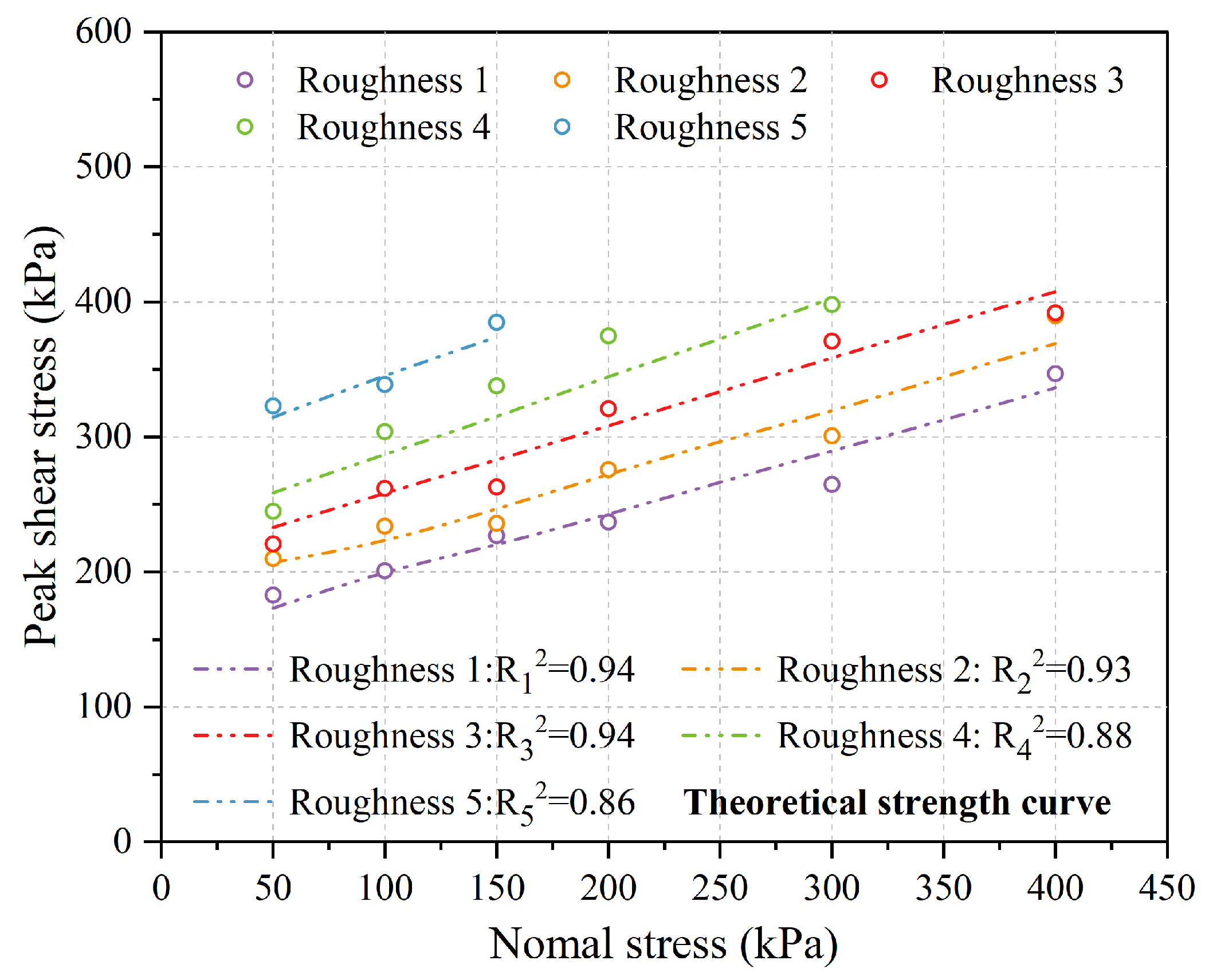
To validate the applicability of the new calculation formula, the values of G i c e , F m a x , A , J R C , σ n , σ r , and σ i for different roughness specimens are substituted into Equation (21) for calculation. Figure 17 compares the theoretical strength curves for different roughness levels under various normal stresses with the experimental data.
From the theoretical strength curves, it can be observed that as roughness and normal stress increase, the peak shear stress shows an increasing trend, which is consistent with the experimental results. The correlation coefficients between the theoretical and experimental data are R12 = 0.94, R22 = 0.93, R32 = 0.94, R42 = 0.88, R52 = 0.86. Overall, the correlation is quite good; however, as the roughness increases, the correlation coefficients show a decreasing trend, suggesting that excessively high roughness may lead to model failure. Under low to medium roughness conditions, shear behaviour is primarily governed by a combination of geometric sliding and physicochemical bonding. Within this range, the superposition of bonding and frictional effects fully reflects the interfacial strength. However, as the JRC value increases, the protrusions on the ice surface become sharper and more pronounced. During shearing, the ice layer must overcome these protruding, concrete-like features. This may induce localised shearing, crushing, or internal damage to the ice mass, rather than purely expansion-controlled slip. This transition from an expansion-dominated mechanism to a protrusion-failure-dominated mechanism introduces additional nonlinearity and complexity, which simplified analytical models fail to fully capture. Consequently, fitting accuracy is moderately reduced.

5. Conclusions

The ice–rock interface shear mechanism is fundamental to understanding ice–rock avalanche hazards. This study investigated the mechanical behavior and AE characteristics of the interface under various roughness conditions through direct shear tests, elucidating the failure process via crack evolution. A shear strength prediction model was developed by integrating roughness, ice–rock cementation, normal stress, and the uniaxial compressive strengths of ice and rock. Results indicate that roughness significantly influences the interface’s shear strength. As roughness increases, the shear stress–displacement curves exhibit distinct evolutionary features, and shear strength parameters increase monotonically. Within the five investigated levels, interface cohesion ranged from 151 to 284 kPa, and the internal friction angle varied between 24.7° and 31.8°. Both roughness and normal stress exert pronounced impacts on AE responses; as they increase, AE ringing counts and energy rise significantly, with peaks concentrated during crack initiation and failure. By correlating AE features with stress–displacement responses, the failure was identified as a progressive process consisting of five stages: initial stage, crack development stage, crack propagation stage, crack coalescence stage, and residual stage. Comparisons between model predictions and experimental data show good agreement at low roughness, though the model’s applicability diminishes under high roughness conditions.

Author Contributions

Conceptualization, T.L. and S.H.; methodology, T.L.; software, W.R.; validation, S.H., T.L. and W.R.; formal analysis, J.G.; investigation, H.J.; resources, T.L.; data curation, J.Y.; writing—original draft preparation, S.H.; writing—review and editing, T.L.; visualization, S.C.; supervision, T.L.; project administration, S.H.; funding acquisition, T.L. All authors have read and agreed to the published version of the manuscript.

Funding

This research was funded by the National Natural Science Foundation of China (NO. 42377194), Sichuan Province Central Government Guides Local Science and Technology Development Special Project (NO. 2023ZYD0151), Financial funds of Sichuan Institute of Geological Survey (SCIGS-CZDZX-2025005), Open Funding of Qinghai Provincial Key Laboractory of Green Transportation Disaster Prevention and Reduction and Digital Technology. The APC was funded by the National Natural Science Foundation of China.

Data Availability Statement

The original contributions presented in this study are included in the article. Further inquiries can be directed at the corresponding authors.

Conflicts of Interest

The authors declare that they have no known competing financial interests or personal relationships that could have appeared to influence the work reported in this paper.

References

  1. Li, J.; Chu, H.; Li, B.; Gao, Y.; Wang, M.; Zhao, C.; Liu, X. Analysis on the development characteristics of high-chain geological hazards in Zelong Lane, Nyingchi, Tibet based on high-resolution images and InSAR interpretation. Chin. J. Geol. Hazard Control 2021, 32, 42–50. (In Chinese) [Google Scholar] [CrossRef]
  2. Tang, M.; Liu, X.; Li, G.; Zhao, H.; Xu, Q.; Zhu, X.; Li, W. Experimental study on ice avalanche mechanism in Sedongpugou of Yarlung Zangbo River. Earth Sci. Front. 2023, 30, 405–417. (In Chinese) [Google Scholar] [CrossRef]
  3. Ni, W.; Tang, M.; Zhao, H.; Yang, W.; Shuai, Y.; Li, Y.; Zhang, Q. Study on shear strength characteristics and influencing factors of glacier ice based on discrete element numerical simulation. J. Eng. Geol. 2024, 32, 811–824. (In Chinese) [Google Scholar] [CrossRef]
  4. Barton, N.; Choubey, V. The Shear Strength of Rock Joints in Theory and Practice. Rock Mech. 1977, 10, 1–54. [Google Scholar] [CrossRef]
  5. Du, S.; Chen, Y.; Fan, L. Mathematical expression of JRC modified straight edge method. J. Eng. Geol. 1996, 4, 36–43. (In Chinese) [Google Scholar]
  6. Hu, X.; Du, S. Concise formula of Barton straight-edge method for roughness coefficient of structural plane. J. Eng. Geol. 2008, 16, 196–200. (In Chinese) [Google Scholar] [CrossRef]
  7. Li, H.; Huang, R. Study on the quantitative determination method of JRC roughness coefficient of rock structural plane. Chin. J. Rock Mech. Eng. 2014, 33, 3489–3497. (In Chinese) [Google Scholar] [CrossRef]
  8. Feng, W.; Zou, D.; Wang, T.; Qiao, C.; Xu, S. Study on a nonlinear shear damage constitutive of structural plane and application of discrete element. Comput. Geotech. 2023, 155, 105190. [Google Scholar] [CrossRef]
  9. Park, J.-W.; Lee, Y.-K.; Song, J.-J.; Choi, B.-H. A Constitutive Model for Shear Behavior of Rock Joints Based on Three-Dimensional Quantification of Joint Roughness. Rock Mech. Rock Eng. 2013, 46, 1513–1537. [Google Scholar] [CrossRef]
  10. Yuan, W.; Li, J.C.; Zheng, Y.L.; Wang, Z.J. Experimental Study on Shear Characteristics of a Rock Joint Subjected to Dynamic Shear Load. Rock Mech. Rock Eng. 2023, 57, 2483–2500. [Google Scholar] [CrossRef]
  11. Li, L.; Hu, X.; Pan, Y.; Sun, Y. Experimental study on ultra-low friction effect and acoustic emission characteristics of coal-rock interface with different roughness. Chin. J. Theor. Appl. Mech. 2024, 56, 1047–1056. (In Chinese) [Google Scholar] [CrossRef]
  12. Hu, Y.; Wang, X.; Zhong, Z. Investigations on the jointed influences of saturation and roughness on the shear properties of artificial rock joints. Geomech. Geophys. Geo-Energy Geo-Resour. 2022, 8, 115. [Google Scholar] [CrossRef]
  13. Wu, X.; Zheng, H.; Jiang, Y.; Deng, T.; Xiao, G.; Wang, Y. Effect of Cyclic Shear Loading on Shear Performance of Rock Bolt Under Different Joint Roughness. Rock Mech. Rock Eng. 2022, 56, 1969–1980. [Google Scholar] [CrossRef]
  14. Davies, M.C.R.; Hamza, O.; Lumsden, B.W.; Harris, C. Laboratory measurement of the shear strength of ice-filled rock joints. Ann. Glaciol. 2000, 31, 463–467. [Google Scholar] [CrossRef]
  15. Shi, S.; Zhang, F.; Feng, D.; Xu, X. Experimental investigation on shear characteristics of ice–frozen clay interface. Cold Reg. Sci. Technol. 2020, 176, 103090. [Google Scholar] [CrossRef]
  16. Cao, X.; Mo, H.; Zhang, G.; Zhang, Q.; Fan, F. Experimental Study on Shear Strengths of Ice-Roof Interface Aiming the Study of Roof Snow Sliding. Front. Earth Sci. 2022, 10, 862134. [Google Scholar] [CrossRef]
  17. Yang, P.; Zhao, L.; Wang, G. A damage model for frozen soil-structure interface under cyclic shearing. Rock Soil Mech. 2016, 37, 1217–1223. (In Chinese) [Google Scholar] [CrossRef]
  18. Shi, S.; Wang, G.; Liu, T.; Feng, D.; Zhang, F. Mechanical properties of ice-frozen soil interface undercementation of ice crystals. Trans. Chin. Soc. Agric. Eng. 2023, 39, 114–124. (In Chinese) [Google Scholar] [CrossRef]
  19. Wang, Y.; Ren, J.; Li, S.; Xiong, F. Study on shear constitutive relation of soil—Structure Interface in whole process. J. Hunan Univ. (Nat. Sci. Ed.) 2021, 48, 144–152. [Google Scholar]
  20. Li, H.; Yan, C.; Shi, Y.; Sun, W.; Bao, H.; Li, C. A statistical damage model for the soil–structure interface considering interface roughness and soil shear area. Constr. Build. Mater. 2024, 431, 136606. [Google Scholar] [CrossRef]
  21. Zhu, X.; Liu, H.; Hu, J.; Fan, J. Experimental study on the characteristics of the precursor of the critical acoustic emission moderation of sandstone failure. Rock Soil Mech. 2022, 43, 164–172. [Google Scholar] [CrossRef]
  22. Gao, S.; Wu, F.; Gao, R.; Ye, C. Multi-stepped creep constitutive model based on asymptotic damage evolution behavior of sandstone. Environ. Earth Sci. 2023, 83, 17. [Google Scholar] [CrossRef]
  23. Liu, X.; Wu, L.; Zhang, Y.; Wang, S.; Yao, X.; Wu, X. The characteristics of crack existence and development during rock shear fracturing evolution. Bull. Eng. Geol. Environ. 2021, 80, 1671–1682. [Google Scholar] [CrossRef]
  24. Wang, H.; Zhao, F.; Huang, Z.; Yu, H.; Niu, J.; Zhang, P. Study on acoustic emission characteristics of sandstone under different fracture modes. Arab. J. Geosci. 2018, 11, 772. [Google Scholar] [CrossRef]
  25. Cui, Y.; Xue, L.; Zhai, M.; Xu, C.; Bu, F.; Wan, L. Experimental investigation on the influence on mechanical properties and acoustic emission characteristics of granite after heating and water-cooling cycles. Geomech. Geophys. Geo-Energy Geo-Resour. 2023, 9, 88. [Google Scholar] [CrossRef]
  26. Miao, S.; Pan, P.-Z.; Zang, A.; Zhang, C.; Hofmann, H.; Li, Y. Laboratory Shear Behavior of Tensile- and Shear-Induced Fractures in Sandstone: Insights from Acoustic Emission. Rock Mech. Rock Eng. 2024, 57, 5397–5413. [Google Scholar] [CrossRef]
  27. Mamot, P.; Weber, S.; Schröder, T.; Krautblatter, M. A temperature- and stress-controlled failure criterion for ice-filled permafrost rock joints. Cryosphere 2018, 12, 3333–3353. [Google Scholar] [CrossRef]
  28. Chen, J. Experimental study on triaxial compression deformation and acoustic emission property of rock. J. Wuhan Univ. Technol. 2008, 2, 94–96+118. [Google Scholar]
  29. Li, P. Study on statistical characteristics of the acoustic emissionenergy of the pre-cracked rock materials. Coal Sci. Technol. 2024, 45, 97–102+109. [Google Scholar] [CrossRef]
  30. Zeng, Z.; Ma, J.; Wu, X.; Wang, A. Characteristics and significance of acoustic emission energy during deformation and failure of single-joint rock mass. Seismol. Geol. 1994, 1, 71–77. [Google Scholar]
  31. Carpinteri, A.; Lacidogna, G.; Pugno, N. Structural damage diagnosis and life-time assessment by acoustic emission monitoring. Eng. Fract. Mech. 2007, 74, 273–289. [Google Scholar] [CrossRef]
  32. Zhang, Z.-H.; Deng, J.-H. A new method for determining the crack classification criterion in acoustic emission parameter analysis. Int. J. Rock Mech. Min. Sci. 2020, 130, 104323. [Google Scholar] [CrossRef]
  33. Hou, Z.; Li, C.; Song, Z.; Xiao, Y.; Qiao, C.; Wang, Y. Investigation on Acoustic Emission Kaiser Effect and Frequency Spectrum Characteristics of Rock Joints Subjected to Multilevel Cyclic Shear Loads. Geofluids 2021, 2021, 5569525. [Google Scholar] [CrossRef]
  34. Gong, H.; Wang, G.; Luo, Y.; Li, X.; Liu, T.; Song, L.; Wang, X. Shear fracture behaviors and acoustic emission characteristics of granite with discontinuous joints under combinations of normal static loads and dynamic disturbances. Theor. Appl. Fract. Mech. 2023, 125, 103923. [Google Scholar] [CrossRef]
  35. Gutenberg, B.; Richter, C.F. Frequency of earthquakes in California. Bull. Seismol. Soc. Am. 1944, 34, 185–188. [Google Scholar] [CrossRef]
  36. Zhang, Q.; Zhang, X.-P. A numerical study on cracking processes in limestone by the b-value analysis of acoustic emissions. Comput. Geotech. 2017, 92, 1–10. [Google Scholar] [CrossRef]
  37. Matsumoto, K.; Kubota, H.; Umehara, Y.; Ehara, K.; Sakamoto, J.; Ueda, J.; Sato, K. Investigation on cohesive force of ice particles in ice slurry for long-term ice storage. Int. J. Refrig. 2018, 90, 156–162. [Google Scholar] [CrossRef]
  38. Barker, A.; Bruneau, S.; Colbourne, B. Bulk Adhesion of Ice to Concrete: Review of Test Programs. J. Cold Reg. Eng. 2021, 35, 03121001. [Google Scholar] [CrossRef]
  39. Jiang, X.; Li, X.; Zhang, Z.; Hu, J.; Ye, H.; Zhang, D. Research on ice-covered adhesion and influencing factors on insulator surface. Power Syst. Technol. 2014, 38, 3464–3469. [Google Scholar] [CrossRef]
  40. Rønneberg, S.; He, J.; Zhang, Z. The need for standards in low ice adhesion surface research: A critical review. J. Adhes. Sci. Technol. 2020, 34, 319–347. [Google Scholar] [CrossRef]
  41. Bleszynski, M.; Clark, E. Current Ice Adhesion Testing Methods and the Need for a Standard: A Concise Review. Standards 2021, 1, 117–133. [Google Scholar] [CrossRef]
  42. Jian, Z. A new JRC-JMC model of shear strength of rock joints. Chin. J. Rock Mech. Eng. 1998, 4, 1–9. (In Chinese) [Google Scholar]
  43. Yuan, W.; Lai, X.; Sun, R.; Jiao, H.; Wang, W.; Niu, Q.; Chang, J.; Ying, C. Shear properties of anisotropic structural surfaces and shear strength calculation method. Eng. Sci. Technol. 2024, 56, 124–133. (In Chinese) [Google Scholar] [CrossRef]
Figure 1. Interface roughness curve (left column: roughness; right column: corresponding JRC value; text in red indicates the length of the line).
Geosciences 16 00132 g001
Figure 2. Graphical representation of parameters in Equations (1) and (2). L0 denotes the straight-line length of the profile, L denotes the curved length of the profile; RA denotes the undulation of the profile. The shaded area represents the rock mass. The red lines indicate the surface morphology of the rock mass.
Geosciences 16 00132 g002
Figure 3. The bottom half of the sample (The JRC values for roughness 1 to 5 were 3.47, 6.89, 10.81, 15.67 and 19.23 respectively, with 12 samples per category).
Geosciences 16 00132 g003
Figure 4. Shear experimental procedure.
Geosciences 16 00132 g004
Figure 5. Shear stress-displacement curves for different roughness ((a): roughness 1; (b): roughness 2; (c): roughness 3; (d): roughness 4; (e): roughness 5. (I) initial stage; (II) compaction stage; (III) gradual growth stage; (IV) failure stage; (V) residual stage).
Geosciences 16 00132 g005
Figure 6. Effect of different roughness on peak shear stress (The figure displays normal stresses ranging from 50 to 400 kPa, with dashed lines connecting the data points).
Geosciences 16 00132 g006
Figure 7. Friction angle and cohesive force at different roughness.
Geosciences 16 00132 g007
Figure 8. AE counting feature ((a): roughness 1; (b): roughness 2; (c): roughness 3; (d): roughness 4; (e): roughness 5).
Geosciences 16 00132 g008
Figure 9. Relationship between peak AE counts and roughness (The figure displays normal stresses ranging from 50 to 400 kPa, with solid lines connecting the data points).
Geosciences 16 00132 g009
Figure 10. AE energy feature ((a): roughness 1; (b): roughness 2; (c): roughness 3; (d): roughness 4; (e): roughness 5. * Represents multiplication sign).
Geosciences 16 00132 g010
Figure 11. Relationship between peak AE energy and roughness (The figure displays normal stresses ranging from 50 to 400 kPa, with solid lines connecting the data points).
Geosciences 16 00132 g011
Figure 12. Distribution relationship between RA and AF under 100 kPa normal stress ((a) is the overall crack distribution of roughness 1; (b) is the phase crack distribution of roughness 1; (c) is the overall crack distribution of five kinds of roughness; (d) is the phase crack distribution of five kinds of roughness).
Geosciences 16 00132 g012
Figure 13. The change of AE b-value at each stage.
Geosciences 16 00132 g013
Figure 14. Distribution relationship between amplitude and peak frequency under 100 kPa normal stress ((a) is the overall distribution of roughness 1; (b) is the phase distribution of roughness 1; (c) is the overall distribution of five kinds of roughness).
Geosciences 16 00132 g014
Figure 15. The phase distribution of five kinds of roughness (The figure illustrates the evolution of the proportion of low-frequency signals, mid-frequency signals, and high-frequency signals across five roughness levels at different stages).
Geosciences 16 00132 g015
Figure 16. The internal friction Angle and cohesion are fitted to the roughness coefficient.
Geosciences 16 00132 g016
Figure 17. The theoretical strength curves of different roughness under different normal stresses are compared with the experimental data.
Geosciences 16 00132 g017
Table 1. Shear test loading scheme.
RoughnessJRC ValueNomal Stress
(kPa)
Freeze Temperature
(°C)
Loading Speed
(mm/min)
13.47100, 200, 300, 400−154.0
26.89
310.81
415.67
519.23
Disclaimer/Publisher’s Note: The statements, opinions and data contained in all publications are solely those of the individual author(s) and contributor(s) and not of MDPI and/or the editor(s). MDPI and/or the editor(s) disclaim responsibility for any injury to people or property resulting from any ideas, methods, instructions or products referred to in the content.