Abstract
Water levels in the Great Salt Lake (GSL), UT, USA, have been declining overall since 1989, leading to a 70% decrease in surface area. To understand GSL’s future, we seek to image fresh groundwater input and lithologic variation along the lake’s boundary. Determining the amount of groundwater recharge into GSL is crucial for lake management but currently unknown. During the Fall of 2024 and Spring 2025, we conducted 16 electrical resistivity tomography (ERT) and six transient electromagnetic (TEM) surveys along the southern shore of GSL between Burmester Road (to the West), Saltair, and Lee’s Creek (to the East). These measurements indicate a low-resistivity layer consistent with brine pore-water, with variable thickness ranging from 7.1 ± 0.1 m at Burmester to 9.6 ± 0.2 m at Saltair. The Saltair region shows a high-resistivity layer, consistent with a 4.4 ± 0.05 m thick layer of mirabilite. This layer contains vertical conduits that allow saline pore-water to upwell onto the surface forming evaporite deposits. Near Lee’s Creek, we find evidence of high resistivities consistent with fresher groundwater as shallow as 2.8 ± 0.03 m, where increased permeability along the paleo-Jordan River corridor may provide a path for groundwater recharge from the Wasatch Mountains.
1. Introduction
1.1. GSL Water Levels and Importance
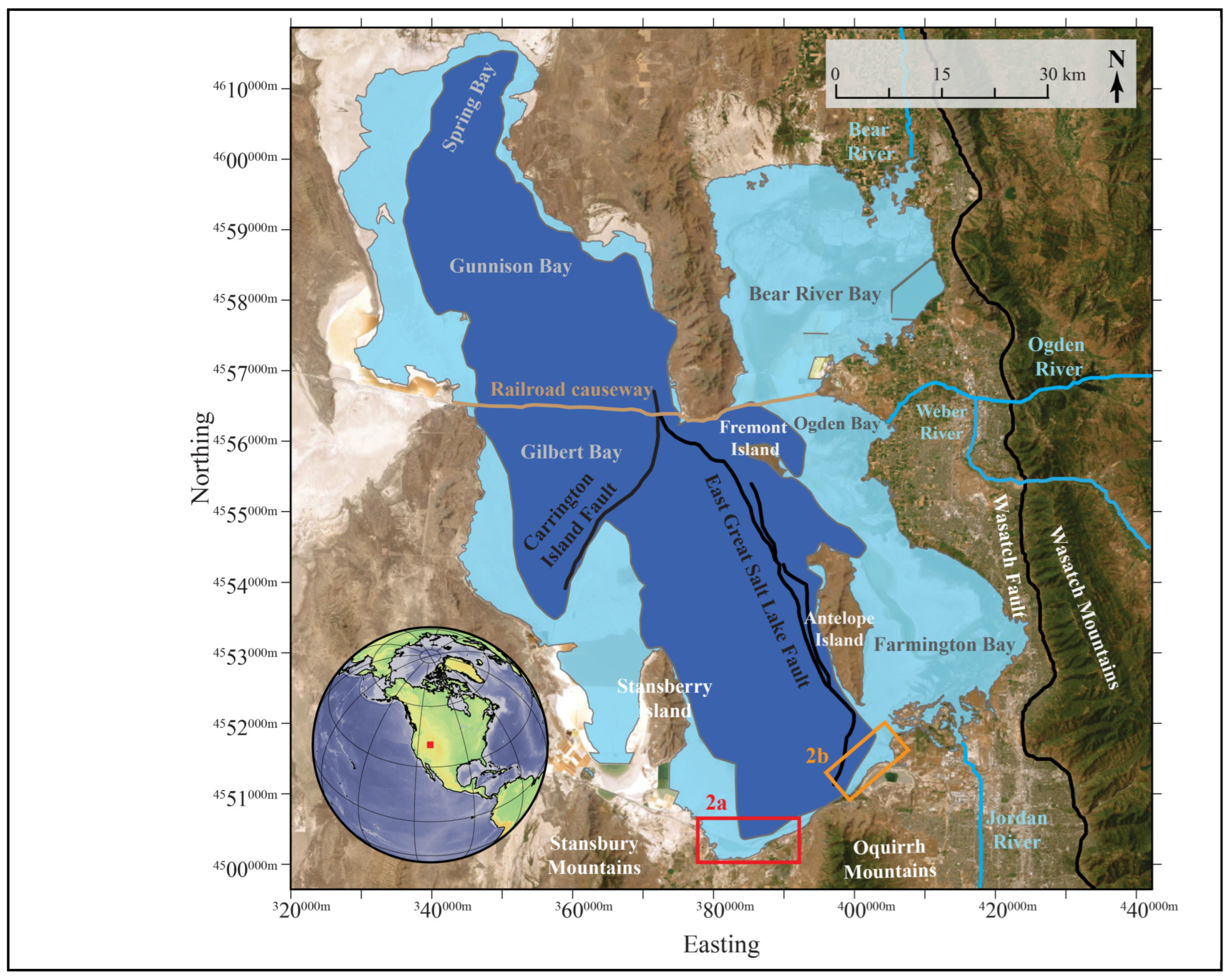
The Great Salt Lake (GSL) is the largest terminal lake in North America and the eighth-largest saline lake in the world. With an average depth of only 4.3 m, the lake’s surface area is susceptible to changes in water input. The elevation of the lake has been recorded for over 150 years [1], with a high point of ~1284 m occurring in 1873 and 1986. The lake level has exhibited fluctuations occurring on decadal time scales [2] but has experienced a period of overall decline in elevation since 1986, with all-time historic lows of ~1277 m recorded in 2016, 2020, 2022, and 2023 [3,4]. This minimum corresponds to a decrease in water level elevation of roughly 7 m, which, due to the shallow average depth of the lake, results in a decrease in surface area from 8547 to 2451 km2. The massive 70% decrease in surface area is depicted in Figure 1, which shows the lake level in 1986 (light blue shading) and in the Fall of 2024 when we initiated this study (dark blue shading). Consequently, the area shown in light blue in Figure 1 has transitioned from being overlain by water into either a mudflat or a playa.
Figure 1.
Study area and overview of the Great Salt Lake. Light and dark blue regions show the extent of the GSL at its most recent high point in 1986 and in the Fall of 2024, respectively. The red and orange boxes outline the study sites that are shown in more detail in Figure 2.
The GSL receives most of its water input from direct precipitation and stream inflow predominantly from the Bear River, the Weber River, and the Jordan River [3,4,5] (see Figure 1). Although difficult to constrain, early estimates suggested that the GSL receives only 2–3% of its input from groundwater [6,7]. However, more recent studies suggest that groundwater input could be 3 to 4 times higher [8,9,10]. Because the GSL is a terminal lake, water loss occurs primarily through evaporation. Recent mass balance calculations have demonstrated that, although precipitation varies, it has generally not declined since 1986 [3,4,5]. Increased diversions from the GSL for human use, such as for agriculture, evaporation ponds for mineral extraction, municipal use, and freshwater ponds, has been argued to be a primary cause for lake level decline [3,4,5]. Nevertheless, more recent efforts have specifically pointed out that reduced streamflow into the lake is the primary cause of low lake levels, which provides a more nuanced explanation than just diversions. For example, increased air temperatures can result in less efficient runoff due to reduced groundwater storage, which reduces streamflow. Rising local air temperatures increase direct evaporation from the lake [3] and minimize stream inflows due to increased evapotranspiration in the watershed, decreased snowpack accumulation, and earlier snowmelt timing [11]. Multiple processes are contributing to the lake’s demise, related to changes in climate and human use.
The decline in lake level has numerous far-reaching impacts [12], including the exposure of playa (Figure 1), which has been shown to increase harmful dust exposure to the local population in the vicinity of GSL [13]. Economically, the GSL is responsible for approximately 8–9% of Utah’s total economy, which consists of varied activities such as brine shrimping, recreation, and mineral extraction [14,15]. Decreased lake levels complicate brine extraction by the mineral industries. Increased salinity associated with lake decline decreases biological diversity [16], which could adversely affect the $10 to $60 million brine shrimp industry [17]. Microbialites are also affected by decreasing water levels. Microbialites are formed by microorganisms in the GSL, which represent a foundational component of the lake’s ecosystem. They are a crucial food source for organisms like brine shrimp and brine flies, which in turn feed birds that use the lake as a stopover during migration [18,19]. As the water recedes, microbialite populations are exposed and can die within approximately two years of continuous exposure [20,21,22]. Thus, the decline of lake levels could produce a trophic cascade.
1.2. Previous Geophysical Efforts
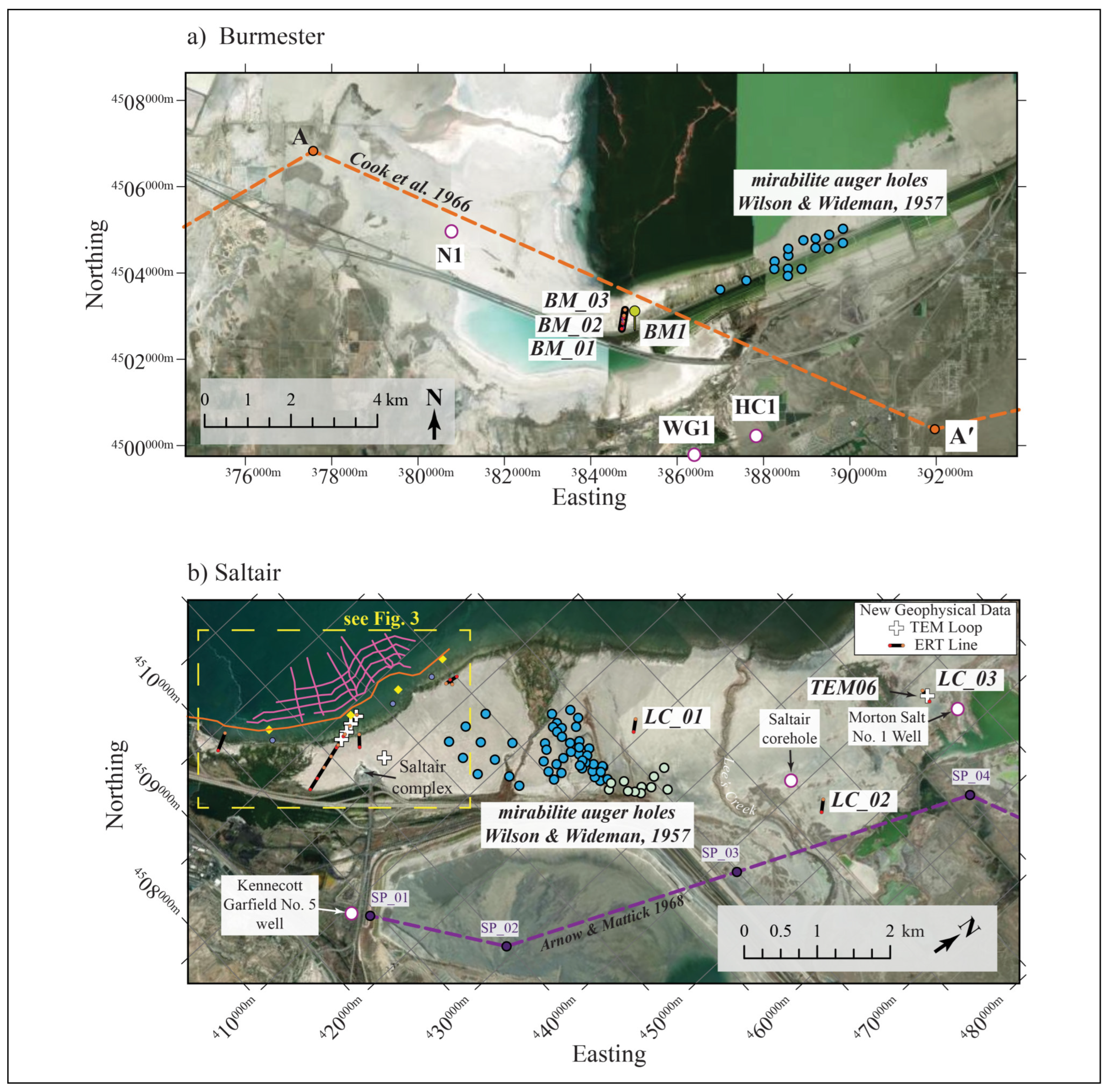
Several geophysical efforts have been conducted in and around the Great Salt Lake over the past decades to characterize the major geological structures and groundwater resources. These studies used a range of geophysical techniques including gravity [23,24], seismic refraction [25], seismic reflection [26,27,28], aeromagnetic surveys [22], continuous resistivity profiling (CRP) and fiber-optic distributed temperature sensing (FO-DTS) [29]. Locations of previous geophysical studies along the south shore of GSL are shown in Figure 2 and Figure 3, with a cartoon of some of the significant findings shown in Figure 4 (to be discussed below).
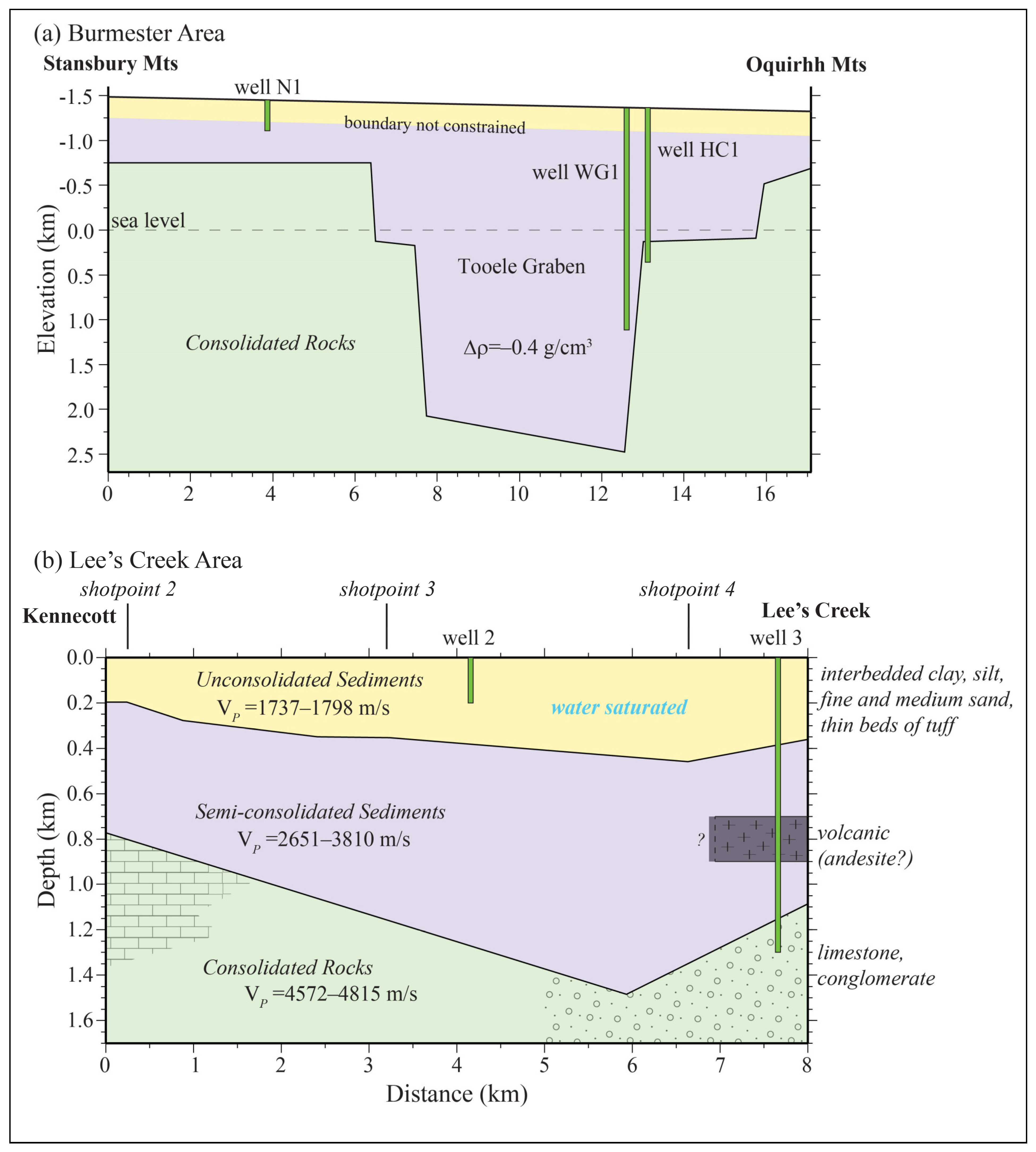
Between 1956 and 1961, a series of gravity measurements were made in the vicinity of the GSL [24]. These measurements were used to infer a series of graben structures associated with Basin and Range extension. On the south side of the GSL, Cook et al. [24] inferred the presence of a graben, referred to as the Tooele Graben, with a depth to bedrock at the center of the graben of nearly 4.5 km. Cook et al. [24] model their gravity observations using a constant 0.4 g/cm3 density contrast representing both shallow Quaternary- and Tertiary-aged sediments overlying older bedrock. They present an interpretive cross-section (location labeled A-Aʹ in Figure 2a), a portion of which we summarize in Figure 4a. Oil test wells were available at the time of this gravity study. Of the wells drilled, only the Jess Hickey Cassity No. 1 well (HC1 in Figure 2a and Figure 4a) penetrated bedrock at a depth of 1.47 km. Cook et al. [24] note that the number of steps shown and inferred fault dips are speculative due to inherent uncertainty in gravity modeling.
Mabey et al. [30] provided a more qualitative assessment of the gravity data from Cook and Berg [23] and available aeromagnetic data. They created a subsurface profile running from the northernmost end of the Oquirrh range to Antelope Island in the north, crossing our study region in the vicinity of the Saltair complex (Figure 2b). They infer a depth to bedrock of approximately 4.5 km in the vicinity of Saltair, which linearly shallows to the north as one approaches Antelope Island. Zoback [31] provides a regional summary of basement depth based on gravity observations and includes both aforementioned studies in their summary.
Figure 2.
Detailed maps of the study area, enclosed by rectangles in Figure 1. (a) Map of the Burmester study area. New ERT lines are shown as black lines with a red circle at the start of the line and an orange circle at the end of the line. Piezometer BM1 is shown with the yellow pin. Locations of positive mirabilite detections, based on Auger holes reported in Wilson and Wideman [32], are shown as blue circles. The orange line shows the cross-section through gravity interpreted in Cook et al. [24]. Well locations (N1, HC1, and WG1) are also from Cook et al. [24]. (b) Map of the Saltair study area. New TEM loops are indicated by white crosses, and new ERT line locations are shown as black lines with red circles at the start and orange circles at the end of the lines. Positive mirabilite detections are as in panel (a), but negative detections are shown as light green circles. Location of refraction survey and shot points (SP_01 through SP_04) from Arnow and Mattick [25] are shown with a dashed purple line and purple circles. Well locations (Kennecott No. 1, Saltair borehole, and Morton No. 1) are also from Arnow and Mattick [25]. Details on the region within the yellow box are given in Figure 3.
Figure 2.
Detailed maps of the study area, enclosed by rectangles in Figure 1. (a) Map of the Burmester study area. New ERT lines are shown as black lines with a red circle at the start of the line and an orange circle at the end of the line. Piezometer BM1 is shown with the yellow pin. Locations of positive mirabilite detections, based on Auger holes reported in Wilson and Wideman [32], are shown as blue circles. The orange line shows the cross-section through gravity interpreted in Cook et al. [24]. Well locations (N1, HC1, and WG1) are also from Cook et al. [24]. (b) Map of the Saltair study area. New TEM loops are indicated by white crosses, and new ERT line locations are shown as black lines with red circles at the start and orange circles at the end of the lines. Positive mirabilite detections are as in panel (a), but negative detections are shown as light green circles. Location of refraction survey and shot points (SP_01 through SP_04) from Arnow and Mattick [25] are shown with a dashed purple line and purple circles. Well locations (Kennecott No. 1, Saltair borehole, and Morton No. 1) are also from Arnow and Mattick [25]. Details on the region within the yellow box are given in Figure 3.

As part of a study aimed at investigating groundwater resources, the United States Geological Survey (USGS) conducted a seismic refraction survey of the area to determine the thickness of the valley fill [25]. The locations of the refraction lines are shown in Figure 2b, and the individual shot point locations are labeled (SP_01 through SP_04). A cartoon interpretation between shot points 2 (SP_02) and 4 (SP_04) is shown in Figure 4b. The Arnow and Mattick study [25] showed a well-defined boundary between Quaternary-aged unconsolidated sediments and Tertiary-aged semi-consolidated sediments. The unconsolidated sediments primarily consisted of interbedded clays, silt, fine and medium sands, and thin layers of tuff. Little information is provided on the semi-consolidated sediments, but it was noted that a roughly 100 m thick layer of volcanic rocks (that were labeled as possibly being andesitic) was also observed in a deep well (well #3) near Lee’s Creek. Deep wells show bedrock consisting of limestone near the Kennecott mine (well #1) and the Oquirrh mountains, and a bedrock consisting of conglomerate (well #3) near the Lee’s Creek area, with a maximum depth to bedrock of roughly 1.4 km. The Arnow and Mattick [25] study qualitatively compared their results to gravity measurements from Cook and Berg [23], stating that their model is generally compatible with measured gravity anomalies.
In 1940 and 1947, two different mining companies sampled the south shore of GSL in search of sodium sulfate found in mirabilite (Na2SO4·10H2O; also known as Glauber’s salt) [32]. The locations of their auger holes are shown in Figure 2 and Figure 3 with blue circles where mirabilite was found and light green circles where auger holes did not contain any mirabilite. The mirabilite layer, when present, generally occurs with a thickness between roughly 1 and 2 m and is underlain by either sand or clay containing pore-water. The presence of mirabilite in the areas outlined was postulated to be due to precipitation from Great Salt Lake brines in the winter, which were deposited on the southeastern shores after being transported by prevalent northwesterly winds.
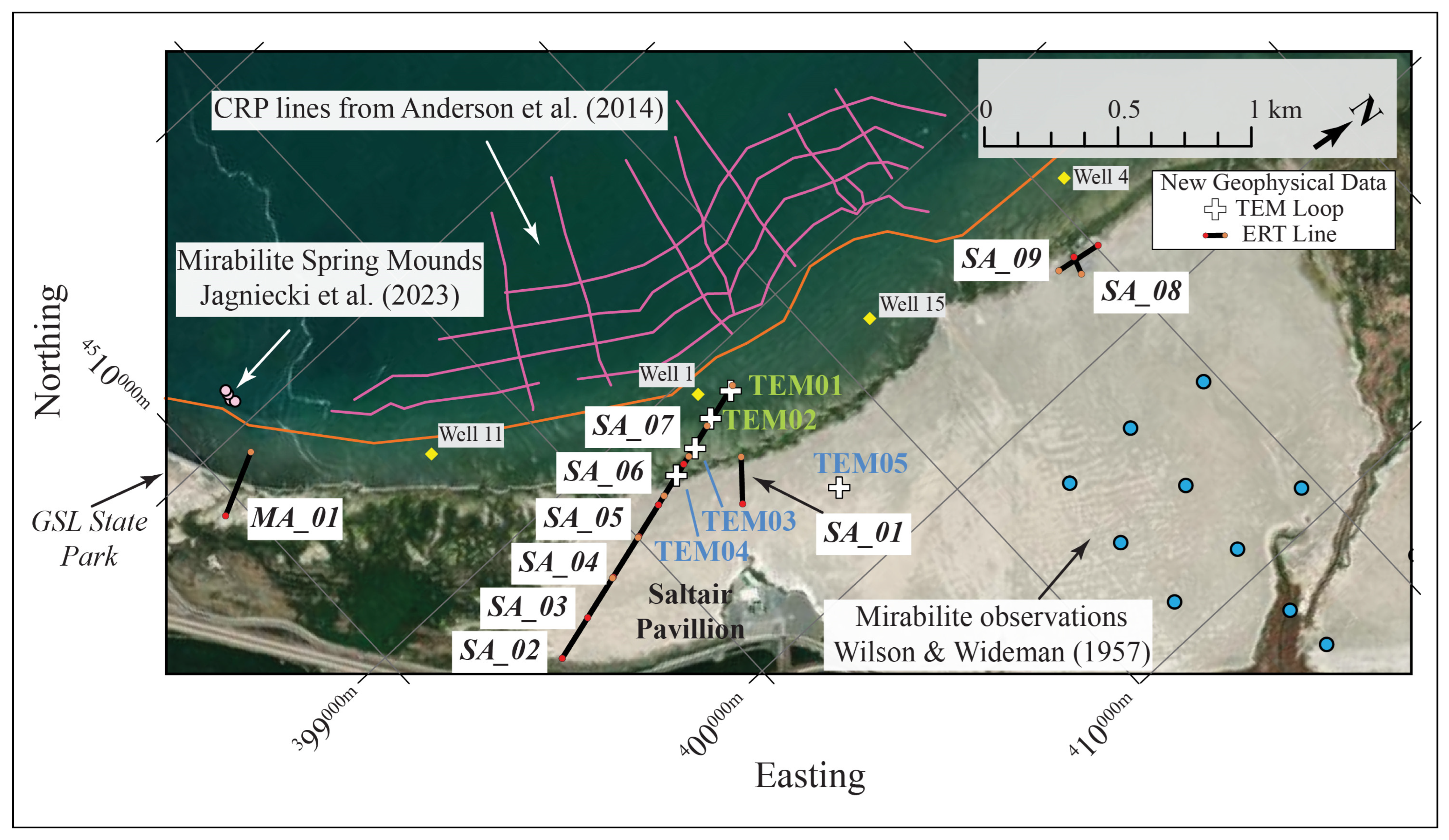
To assess groundwater discharge into the GSL, Anderson et al. [29] deployed a fiber-optic distributed temperature sensing (FO-DTS) sensor to measure temperature in the lake between the marina at Great Salt Lake State Park and the Saltair complex (orange line in Figure 2b and Figure 3). Anderson et al. [29] sought to locate regions of cool groundwater discharging into warm GSL water during the summer months. In addition, they used continuous resistivity profiling (CRP) towed by boat (pink lines in Figure 2b and Figure 3) to measure the subsurface electrical resistivity profile. Anderson et al. attempted to delineate areas of higher electrical resistivity that could indicate where fresh groundwater is discharging from the subsurface as salt water has a lower electrical resistivity (~few tenths of Ω·m) than fresh groundwater (~10 Ω·m). Several zones of cooler temperature were found in the southwest end of the FO-DTS line (near the marina) that could indicate freshwater discharge. There was less of an indication of fresh groundwater discharge to the east closer to the Saltair complex. The temperature anomalies indicated by the FO-DTS were not clearly observed in the CRP profiles, which were dominated by variable lithologic properties in the subsurface. The CRP profiles revealed an upper layer that was about 1–2 m thick primarily consisting of oolitic sands with a resistivity of roughly 0.5 Ω·m. This layer was underlain by a 3 to 4 m thick high resistivity zone (~4 to 5 Ω·m) consistent with a layer of mirabilite. The mirabilite layer was laterally continuous in the near-shore CRP lines but gradually disappeared for the lines further away from shore. A more conductive (0.5 to 1 Ω·m) layer was found beneath the mirabilite layer. Pressure measurements in wells drilled at the study site suggested that the mirabilite layer semi-confines groundwater.
Starting in the Fall of 2019 mirabilite spring mounds began forming on the southern shore of GSL in the vicinity of the marina and the Saltair complex [33]. As the lake level decreased and regions that were previously below lake level transitioned to mudflat and playa, subsurface groundwater discharged through the mirabilite layer precipitating Glauber’s Salt (Na2SO4•10H2O) on the surface. Jagniecki et al. [33] conducted extensive chemical analysis on these mounds and discussed their potential biological significance. For the purposes of this paper, their presence provides additional lithologic evidence for a laterally varying mirabilite layer in the subsurface. The locations of the spring mounds studied in Jagniecki et al. [33] are shown in Figure 3.
Figure 3.
Detailed study area in the vicinity of the Saltair complex. New ERT lines are shown as black lines with a red circle at the start of the line and an orange circle at the end of the line. Center points of new TEM loops are drawn as white crosses. Locations of positive mirabilite detections, based on auger holes reported in Wilson and Wideman [32], are shown as blue circles. Locations of Mirabilite spring mounds reported in Jagniecki et al. [33] are shown as pink circles. Continuous Resistivity Profile (CRP) lines and well locations from Anderson et al. [29] are drawn as pink lines and yellow diamonds respectively. The location of the fiber-optic distributed temperature sensing (FO-DTS) line is drawn in orange.
Figure 3.
Detailed study area in the vicinity of the Saltair complex. New ERT lines are shown as black lines with a red circle at the start of the line and an orange circle at the end of the line. Center points of new TEM loops are drawn as white crosses. Locations of positive mirabilite detections, based on auger holes reported in Wilson and Wideman [32], are shown as blue circles. Locations of Mirabilite spring mounds reported in Jagniecki et al. [33] are shown as pink circles. Continuous Resistivity Profile (CRP) lines and well locations from Anderson et al. [29] are drawn as pink lines and yellow diamonds respectively. The location of the fiber-optic distributed temperature sensing (FO-DTS) line is drawn in orange.

Figure 4.
Summary of subsurface structure interpreted from previous geophysical observations along the south shore of Great Salt Lake. (a) Model of Tooele Graben from the gravity survey of Cook et al. [24] using a constant density contrast of −0.4 g/cm3. (b) Subsurface P-wave velocity model from seismic refraction study of Arnow and Mattick [25]. In each panel, the yellow area denotes unconsolidated sediments of Quaternary age, the purple area shows Tertiary-aged semi-consolidated sediments, and the green area shows older consolidated rocks. In panel (a), the boundary between unconsolidated and semi-consolidated rocks is not defined in the gravity model but is inferred to exist. Green rectangles show the projected locations of nearby wells.
Figure 4.
Summary of subsurface structure interpreted from previous geophysical observations along the south shore of Great Salt Lake. (a) Model of Tooele Graben from the gravity survey of Cook et al. [24] using a constant density contrast of −0.4 g/cm3. (b) Subsurface P-wave velocity model from seismic refraction study of Arnow and Mattick [25]. In each panel, the yellow area denotes unconsolidated sediments of Quaternary age, the purple area shows Tertiary-aged semi-consolidated sediments, and the green area shows older consolidated rocks. In panel (a), the boundary between unconsolidated and semi-consolidated rocks is not defined in the gravity model but is inferred to exist. Green rectangles show the projected locations of nearby wells.

1.3. Overview of This Study
In this paper, we use geophysical techniques (electrical resistivity and transient electromagnetics) to investigate the shallow subsurface beneath the southern shore of GSL, with the primary goal of understanding the lithologic variations and character of groundwater present in the system. As discussed above, discrepancies exist in estimates of how much groundwater is recharging into the GSL system, which is a crucial piece of information necessary to manage the GSL. Thus, we seek to identify and understand the processes that bring freshwater into the lake. Prior to the present study, only Anderson et al. [29] has explored the shallow subsurface of the GSL using geophysical methods and only in the top 5–6 m near Great Salt Lake State Park (Figure 3). Here we investigate potential sources of freshwater input using electrical methods to directly image the subsurface in a series of profiles. These techniques are sensitive to both lithologic variations, pore-water concentration, and pore-water salinity and have been used for decades to image groundwater and lithologic variations in the subsurface [34,35]. Electrical resistivity tomography (ERT) has been especially useful in coastal areas to delineate between fresh and saltwater groundwater sources [36,37,38]. Transient electromagnetic (TEM) techniques have also been employed, often in conjunction with ERT methods, to investigate shallow groundwater and coastal freshwater/saltwater interfaces [39,40,41,42].
Between Fall 2024 and Spring 2025, we collected 30 2D ERT lines along the southern and eastern shores of GSL, as well as along the eastern shore of Antelope Island. The character of ERT data recorded is fundamentally different between the data collected along the south shore and in the eastern portions of the lake. Results from our work along the Eastern shore of GSL are presented in another paper. In this paper, we focus on 2D ERT and 1D TEM methods to characterize the electrical resistivity structure of the uppermost 10s of meters of the subsurface along the southern shore of the Great Salt Lake focusing on the region north of Burmester road (Figure 2a) and further east starting at Great Salt Lake State Park, extending through the Saltair complex, and northeast past the Lee’s Creek Nature Area (Figure 2b and Figure 3). Resistivity structures revealed in this work show predominantly 1D layered structures that are sensitive to both lithology and saltwater content but vary laterally across the study area. We model these data using standard 2D inversion methods as well as introducing a Bayesian inversion scheme for a 1D layered resistivity structure. This work represents the first exploratory efforts at characterizing the large-scale resistivity structure beneath the GSL demonstrating that pore-water bordering between slightly saline and freshwater characterizations exists close to the surface at several of our measurement sites.
2. Data
2.1. ERT Measurements
We collected ERT data on the playa along the southern shores of the GSL between August and November 2024 and between May and June 2025. We collected measurements for 16 unique lines with locations shown in Figure 2 and Figure 3. Data were collected using a Syscal Pro 10 Switch system manufactured by IRIS instruments. All measurements were made in a dipole–dipole configuration with an electrode spacing of 1, 2.5, or 5 m. A summary of electrode spacing, number of electrodes, and number of measurements made for each line is provided in Table 1. The endpoint locations of each ERT line are given in Table 2. Each individual ERT measurement consisted of between three and eight stacked recordings. Recordings were made (up to a maximum of 8) until a percent difference of less than 2% was obtained. All measurements were plotted as a function of pseudodepth and examined for outliers, allowing for a greater range of potential outliers near the surface than at depth. Outliers were discarded prior to subsequent modeling steps. Table 1 shows the number of measurements originally obtained (raw) relative to those retained after quality control (clean). Both original (raw) and quality-controlled data (clean) are included in the data repository. We group our measurement areas into four general locations as follows. Along the southern shore of the GSL, we made measurements at (1) a location near the end of Burmester Road (denoted by BM), (2) near the Great Saltair Pavilion (SA), (3) near Great Salt Lake State Park and marina (MA), and (4) in the vicinity of Lee’s Creek (LC).
Table 1.
Summary of ERT measurements.
Table 2.
ERT measurement endpoint locations.
We used a Trimble r780 Real Time Kinematic (RTK) GPS unit to measure elevations along our longest line (SA_01 through SA_05, see Table 1) that was 900 m in total length. Over this line length, we observed a total elevation change of less than 2 m, which is a negligible amount to consider in forward modeling our ERT observations. Because the elevation change along the playa is so small, we do not measure elevations at each electrode position and ignore elevation in subsequent inverse modeling.
One of our measurement locations coincides with a University of Utah (UU) piezometer [43]. This piezometer is located near Burmester (closest to our line BM_01 and labeled BE1 in Figure 2b), where four wells were also installed at depths of 4.6, 9.1, 16.8, and 23.0 m. From the cores drilled at these wells, the lithology was described, and pore-water conductivity was measured as discussed below.
2.2. TEM Measurements
We conducted TEM measurements near the Saltair complex (22 October 2024) and at Lee’s Creek (on 23 May 2025). The intent of the TEM surveys is to attempt to obtain deeper penetration into the subsurface to complement ERT data models. Near the Saltair complex, we made measurements at four unique locations using a 40 m transmitter loop centered on the ERT line between SA_05 and SA_07 (Figure 3) and an additional site to the east of SA_01 using a 100 m transmitter loop (see Figure 2b and Figure 3). Another TEM measurement site with a 100 m transmitter loop was centered on LC_03 in the Lee’s Creek area (Figure 2b). All measurements were made with an ABEM WalkTEM system, which employs a dual moment signal (1A and 10A current pulses) so that shallow and deep information is recorded simultaneously. This provides higher resolution, a larger depth of investigation (DOI) [44,45], and significantly reduces acquisition time.
The WalkTEM system has a built-in graphical user interface, which enables efficient data quality control and simple 1D inversions in the field. The TEM transmitter loop wire is laid out on the ground in a square shape with 40 m (or 100 m) specifying the length of one side of the square. There are two receivers for the TEM system, one is a 10 m insulated wire square loop, and the other is a rigid plastic square approximately 0.5 × 0.5 m. The dual receivers effectively provide a range of both short and long wavelength signals recorded. The 40 m and 100 m loop provide different depths of investigation and can utilize both receivers, though in practice the smaller rigid receiver provides little benefit to the 100 m loop compared to the 10 m receiver loop. There are no surface disturbances required for a TEM survey (equipment is simply laid upon the ground), so environmental impact is virtually non-existent. Total time at a measurement site is about 1 h, which includes setup and takedown of the TEM equipment. The receiver antennae are located in the center of the transmitter loop, and the position of each center point is given in Table 3.
Table 3.
TEM measurement locations.
For the 40 m transmitter loops, we made separate measurements on site with 200 and 330 Ω damping resistors in parallel with the transmitter wire and utilized both receivers. The first and last gate of the 40 m loops are 5.4910 × 10−06 and 2.22 × 10−02 s, respectively. For the 100 m transmitter loops, we made measurements using an 820 Ω damping resistor in parallel with the transmitter wire and utilized only the 10 m receiver loop after tests with both receivers showed the small receiver was only picking up noise. The first and last gate of the 100 m loops are 5.50 × 10−06 and 2.22 × 10−02 s, respectively. The output of the TEM sounding is a recording representing the attenuation of the induced magnetic field with time provided in units of Volt/(Amp·m2) vs. time in seconds, which can also be shown as apparent resistivity in units of Ohm-m vs. time seconds. The soundings can be viewed as the full raw dataset or the stacked dataset and include data from two noise channels to confirm data fidelity. No significant local noise or interference was observed in the field data, which is consistent for the study area setting of a dry lakebed far from potential noise sources.
2.3. Geochemical Measurements
Pore-water salinity measurements were made in the wells located at Burmester (BM1, Figure 2 and Figure 5). Details on measurement procedures are provided in [43]. We classify the measured values based on characterizations from Heath [46], as shown in Table 4. For reference, seawater has a specific conductance of roughly 54,000 μS/cm. In this paper we focus on resistivity measurements and convert all specific conductance values to resistivity.
Figure 5.
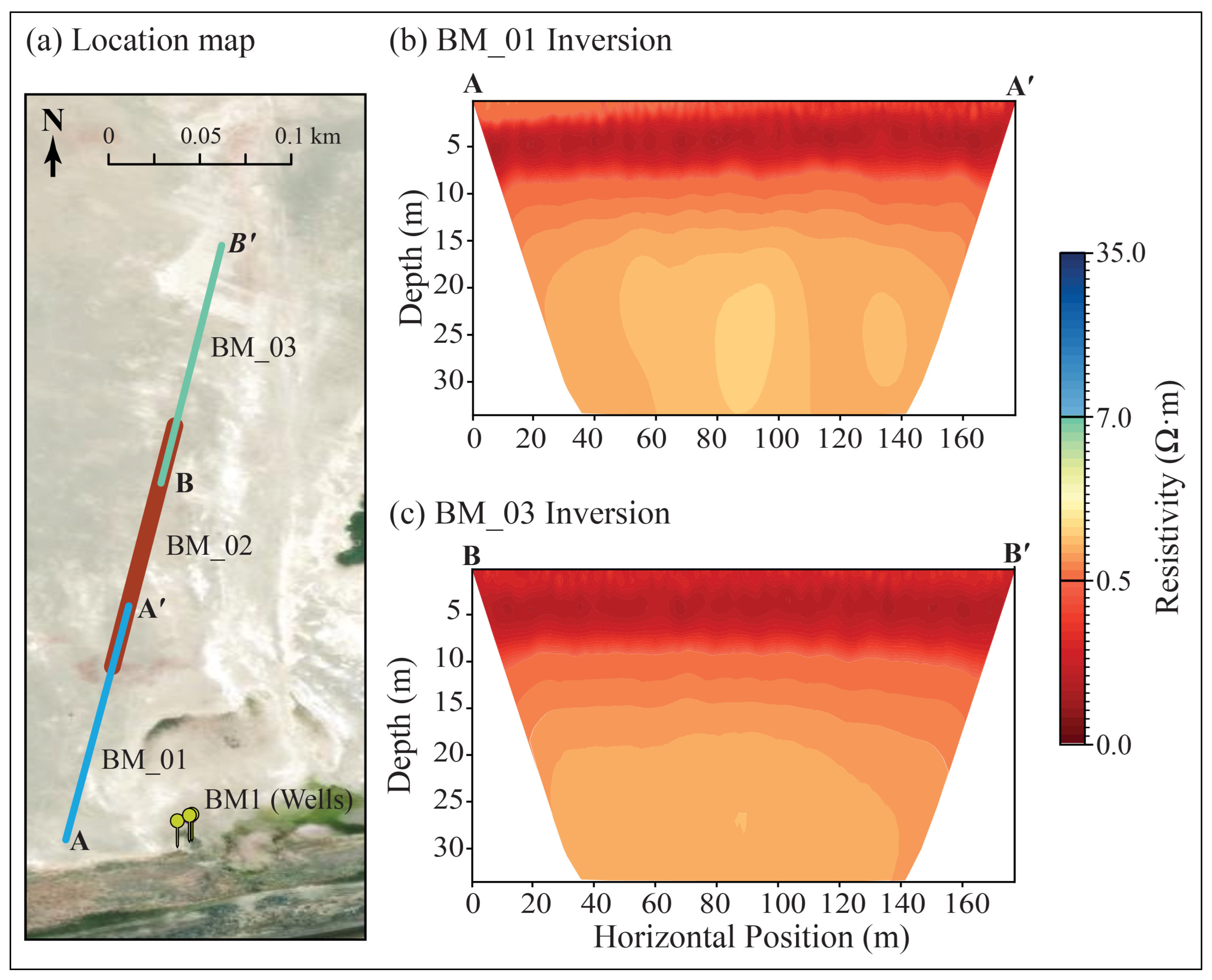
(a) Detailed map showing the location of the three ERT lines (labeled BM_01, BM_02, and BM_03) collected in the Burmester area. The location of well BM1 is shown with yellow markers. (b) and (c) 2D inversion results using the ResIPy package for lines BM_01 and BM_03, respectively.
Table 4.
Pore-water conductivity classification.
3. Methods
3.1. ERT Modeling
Collected ERT data are reported as apparent resistivity and plotted in pseudo-sections. These data are initially inverted to true resistivity values in 2D cross-sections using the ResIPy package (version 3.5.4) [47]. ResIPy is a Python wrapper built around the R2 resistivity software of Binley and Slater [48]. We used a triangular mesh with unit scaling and regularized inversion with linear filtering. Resistivities were inverted in log-space with normal regularization. A tolerance of 1.0 (the desired misfit) was set along with a maximum number of 10 iterations, although none of our inversions reached this maximum value. Weights were adjusted between 0.1 and 0.00001 until normalized errors ranged between ±3%. 2D sensitivity tests are conducted using a bootstrap resampling techniques and are shown in the online supplements (Figures S39–S42). Pseudo-sections and ResIPy inversions for all ERT data collected in this study are shown in the online supplements. Inspection of the inversion results for these data reveals a resistivity structure that primarily varies with depth. For example, 2D inversion results at Burmester are shown in Figure 5. These inversions show a low-resistivity layer centered at an approximately 5 m depth that is over- and underlain by higher-resistivity structures that vary little over the 450 m total line length. Thus, we also inverted for 1D layered structures, as described below.
While 2D inversions provide insights into the lateral variability of the lithological structure, it is challenging to distinguish lateral variability from uncertainty without having rigorous uncertainty estimates, resulting from data noise and modeling errors. Additionally, traditional inversion results are also highly dependent on the tuning parameters, such as damping and smoothing. Here, we develop a 1D Bayesian inversion of electrical resistivity to estimate the 1D layered resistivity structure with uncertainties.
In Bayesian inversion, we calculate the posterior probability distribution (PPD) through Bayes’ theorem, where the PPD is proportional to the product of the prior probability of model parameters m—layer interface depths and resistivity values, , and the probability of data given the model parameters, :
where is the probability of a model vector (m) given the data vector (d—apparent resistivity) and represents the PPD; is also referred to as the likelihood, which incorporates the data information in the PPD. The mathematical formulation of the likelihood function depends on assumptions about the data noise, which is typically unknown. Here, we assume that the data noise has a Gaussian form; therefore, we define the likelihood function to be proportional to the negative exponential of the L2-norm misfit. As data are fixed in the inversion, the likelihood becomes only a function of as
where N is the number of data points, is the standard deviation of noise, represents the L2-norm misfit, and represents the synthetic prediction for the model . The standard deviation of noise, , is one of the unknowns in the inversion. To compute the standard deviation, we take the partial derivative of the likelihood function in Equation (2) and set it equal to zero. This gives us an implicit estimate of the noise standard deviation,
We parameterize our models as 1D layered structures with constant resistivity. The number of layers is fixed between 1 and 5 layers with the requirement that each layer has constant resistivity. Forward models are computed using the R2 package [48]. Data misfit is computed between observed and predicted apparent resistivities for the same electrode positions. We compute the PPD using a numerical sampling approach based on Metropolis–Hastings sampling, as no analytical solution exists for the PPD in Equation (1). This algorithm starts with a randomly drawn model with parameter values for depth and resistivity (current model). The synthetic prediction of apparent resistivity is computed and compared with the observed apparent resistivities to obtain the likelihood value in Equation (2) for the starting model. Then the parameter values for depth and resistivity are randomly drawn (proposed model) within the prior range, followed by the computation of the likelihood. The ratio of likelihood between the current and proposed model is compared with a random number between 0 and 1. If the random number is less (greater) than the likelihood ratio, the proposed model is accepted (rejected). If the model is accepted, we update the current model and proceed to the next iteration. If the model is rejected, we retain the current model and repeat the process. This process is continued to collect an ensemble of models. We used over 100,000 models for each ERT line in this study. We set uniform priors within the range of resistivity values between 0.1 and 25 Ω·m, allowing the layer depth interfaces to occur anywhere between 0 and 80 m. For more details on the Bayesian inversion approach, we refer to Pachhai et al. [49,50]. Tests on a 1D model are provided in the online supplements (Figure S43).
In reality, we also do not know the model complexity (i.e., number of layers), which is also essential to interpret the inversion result. Additional layers can improve the data fit but may not necessarily be required by the data. On the other hand, a lower number of layers can fit only parts of the data, thereby providing a biased result. Finding an optimal model parameterization that justifies the data fit is a challenging problem and is referred to as model selection. Here, we implement the Bayesian Information Criterion (BIC) for model selection [49]. The BIC balances the tradeoff between the fit (represented by likelihood) and model complexity (represented by number of model parameters) and is expressed as
where k is the total number of parameters considered in the inversion, N is the number of data points, and L is the maximum likelihood.
3.2. TEM Modeling
TEM sounding data were screened based on the quality of the recorded signal, which can vary depending on shallow subsurface conditions, local noise and interference, and the user-chosen resistance of the damping resistor in the transmitter loop. Aarhus GeoSoftware (AGS) SPIA [51] was used for processing and inversion of ground-based TEM data in this study. Upon importing the data, noise and spike filtering are performed automatically by SPIA. For the 40 m loops, we observed that using the 330 Ω resistor resulted in better signal recordings on all sounding data channels.
The final TEM soundings for each station were modeled as 1D inversions with AGS SPIA to create smooth, many-layer profiles (20-layer model). The smooth model inversion was chosen over a blocky model (5-layer) to compare more easily with the 2D ResIPy inversion models of the ERT survey data. The stacked input data from the 40 m loops were clean and therefore left at the default error assignment of 5% prior to inversion, resulting in data residuals of less than 1.0 (ideal case). Since the 100 m loops did not utilize the small TEM receiver, the short period data (i.e., shallow signal) needed to model the shallow subsurface was missing. To remedy this, we utilized 40 m loop inversion model results as the “a priori” starting models for the 100 m loop inversions. The 40 m loop inversion models are carefully chosen as being representative of the 100 m loop site according to proximity, surface conditions, and known hydrology. The stacked input data from the 100 m loops were also clean and left at the default error assignment of 5% prior to inversion resulting in data residuals of less than 1.0.
4. Results
4.1. Burmester
To justify the decision to use 1D Bayesian modeling, we showed 2D inversions of BM_01 and BM_03, as shown in Figure 5. Here we describe in detail our process for this 1D modeling using an inversion for ERT line BM_01 as our example. For comparison, we first modeled BM_01 as a half-space, finding a maximum log-likelihood of −8482.7 for a constant resistivity value of ρ0 = 0.63 Ω·m. With 2932 observations (Table 1) and k = 1, this gives a BIC = 16,969. The relative importance of the log-likelihood and BIC values are discussed below.
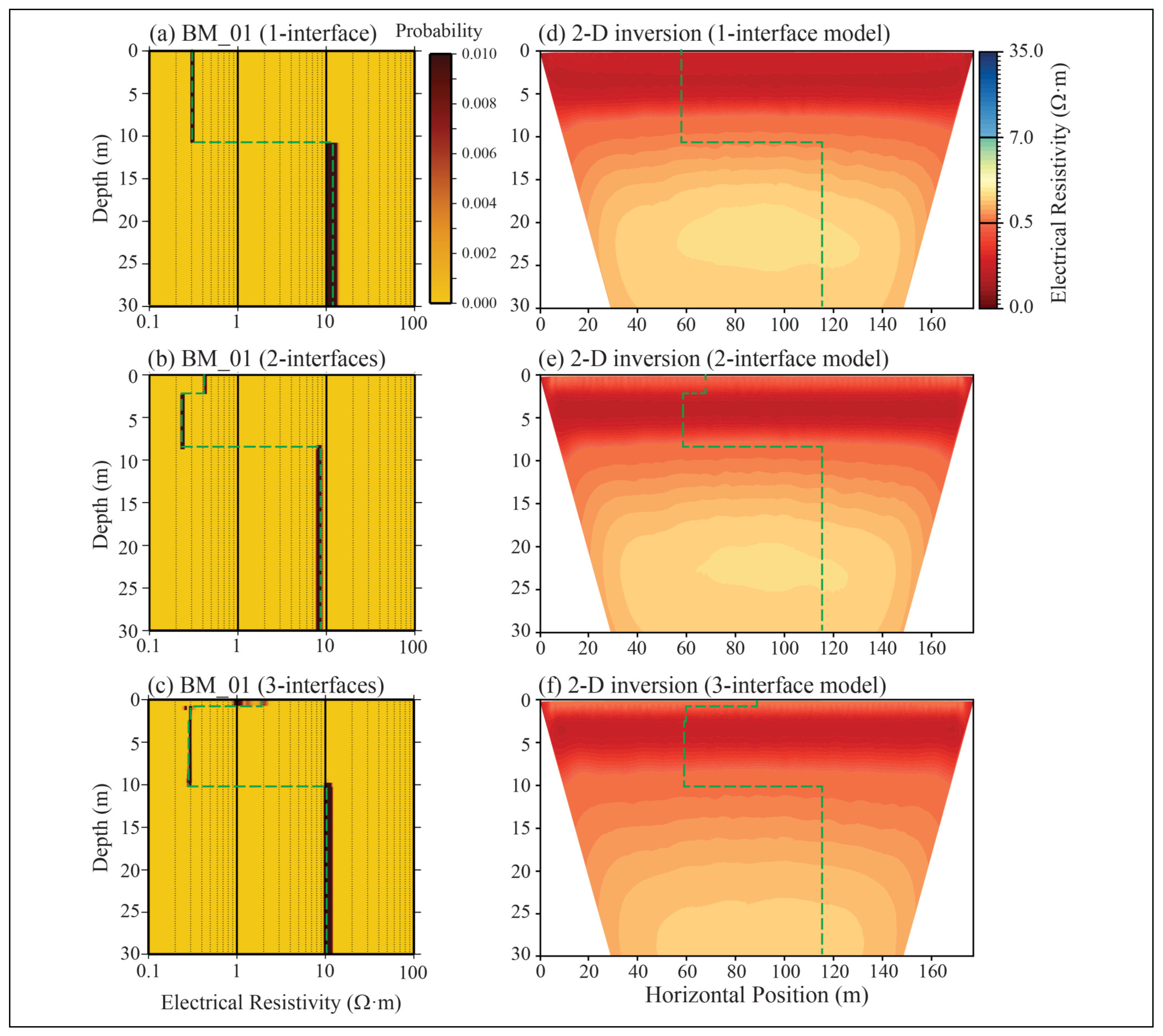
Setting the number of interfaces to be one (n = 1, i.e., k = 3; Figure 6a,b), we see a significant increase in the data fit represented by an increase in log-likelihood to −1978 and a corresponding decrease in BIC to 3965. For two interfaces (n = 2, i.e., k = 5; Figure 6c,d), the log-likelihood further increases to −1524, and the BIC decreases to 3064. For n = 3 (i.e., k = 7; Figure 6e,f) or n = 4 (i.e., k = 9; not shown in Figure 6), the fit no longer improves, and log-likelihood values remain mostly unchanged for this increased number of parameters. In this case we observe a minimum BIC for the two-interface model. We also see for n = 3 or n = 4 that only a minor change in the 1D model is made, and thus n = 2 is taken as the best representation of these data.
Figure 6.
1D Bayesian inversions of the BM_01 ERT line with (a) one, (b) two, or (c) three interfaces respectively. In each plot the background is the posterior probability. The green line shows the maximum likelihood model. 2D inversions of the maximum likelihood models for (d) one, (e) two, or (f) three interfaces. The maximum likelihood model from (a–c) is repeated in panels (d–f) for direct comparison.
Additional 2D inversions are also shown in the online supplements in Figures S20–S23. The primary findings from the ERT are a thin (~1.5 m thick) high-resistivity layer at the surface, which overlays a ~6.5 to 8.5 m thick layer of low-resistivity material that is accompanied by another step increase in resistivity. Comparison of these ERT results with well log and pore-water resistivity measurements is shown in Figure 7.
Figure 7.
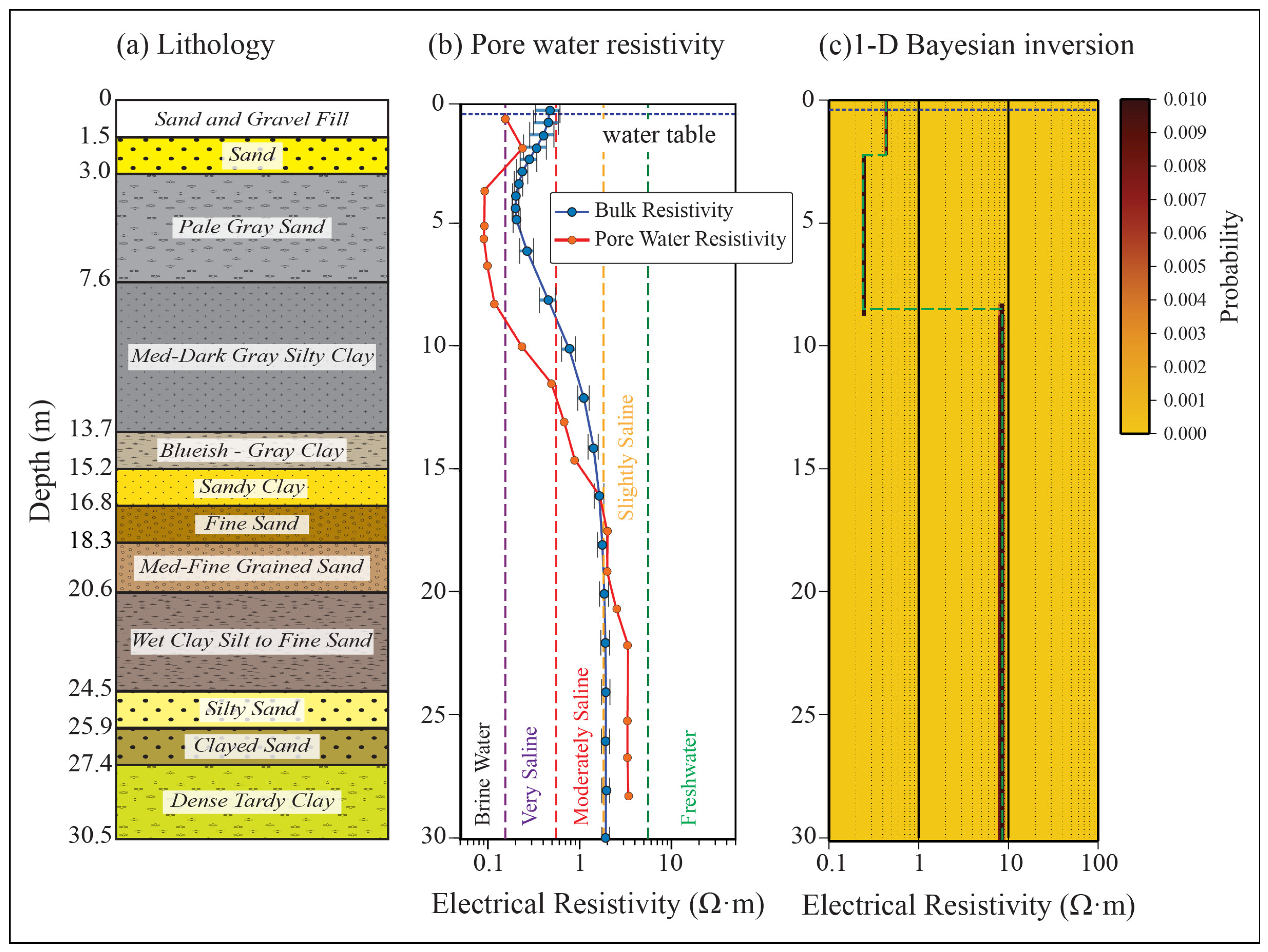
(a) Lithology at the BM1 wells. (b) Pore water resistivity measured in BM1 wells (red lines and circles) and average bulk rock resistivities inferred from the 2D inversion of line BM_01 (blue lines and circles). (c) 1D Bayesian inversion of ERT data at BM_01. Background shows the posterior probability distribution. The green line shows the maximum likelihood model. In panels (b,c), the dashed blue line near the top of the sections shows the location of the water table.
The lithology of the core at BM1 is described in Figure 7a. Here we see that the top 7.6 m is identified as sand and gravel fill. The next 9.2 m consists of different types of clay, which are underlain by more sand until we reach a depth of 27.4 m, where more clay is found.
The pore-water resistivity measured in BM1 borehole is shown in Figure 7b (orange circles and line), which is directly related to the salt content, as described in Section 2.3. We see that the dominant feature is a region between roughly 1.5 and 12.5 m that has a low pore-water resistivity, reaching a minimum value of 0.0904 Ω·m at a depth of 5.5 m. These low pore-water resistivities are consistent with the presence of brine pore-water (Table 4). Below 15 m, the pore-water resistivity increases to a maximum of 3.38 Ω·m at a depth of 28 m. That is, beneath the low-resistivity layer, the pore-water tends towards fresh pore-water. In comparison to the measured pore-water resistivity, the average resistivity from the 2D inversion at BM_01 is also shown (blue circles and lines) in Figure 7b and labeled the inverted resistivity. This inverted resistivity tracks the pore-water resistivity (from the borehole observations) well down to a depth of roughly 15 m. It is unclear if below this depth the 2D inversion just loses resolution or whether the core, which was located at a single location to the southeast of line BM_01, had fresher pore-water than imaged in line BM_01. Here we see that in the 2D inversion a maximum bulk rock resistivity of roughly 2 Ω·m is attained, whereas the 1D Bayesian inversion suggests a larger resistivity, as described in the next section. Comparing the observed and inverted resistivities to the lithology, we do not observe any abrupt changes that might be related to changes in lithology. Rather, we observe that the measured resistivities predominantly track the pore-water resistivity.
The 1D ERT results are shown in Figure 7c for a two-interface model. We see a thin higher-resistivity layer (2.1 ± 0.06 m thick with ) at the surface. This layer corresponds to a dry sandy surface layer. At a depth of 0.45 m, the water table was encountered, below which exists a 6.4 m thick layer of low resistivity ). There is a good correlation between the low-electrical-resistivity layer and the low pore-water resistivity measurements, indicating that these low resistivities are likely due to the high salt concentration of the pore-water, predominantly in the sandy near-surface layers. At a depth of 8.5 m, the electrical resistivity increases. The maximum likelihood model indicates Inversion results for 1D two-interface models at BM_02 and BM_03 are provided in Table 5.
Table 5.
Results for 1D Bayesian two-interface models at Burmester.
The higher resistivity values (e.g., at BM_02) are consistent with pore-water salinities that approach those typically found for fresh pore-water. For example, resistivities on the order of 10 Ω·m are consistent with weakly fresh pore-water in clay [38]. Little variation is observed across the three ERT lines at Burmester, but a combined inversion of all three lines (Figure S23 in the online supplements) suggests a slight increase in the thickness of the low-resistivity layer from south to north, or as one approaches the lake shore. This thickening is also evident in the slight increase of d2 from BM_01 to BM_03 in the 1D inversions from 8.5 to 9.5 m, and a corresponding thinning of d1 from 2.2 to 1.8 m.
4.2. Saltair and Great Salt Lake State Park/Marina
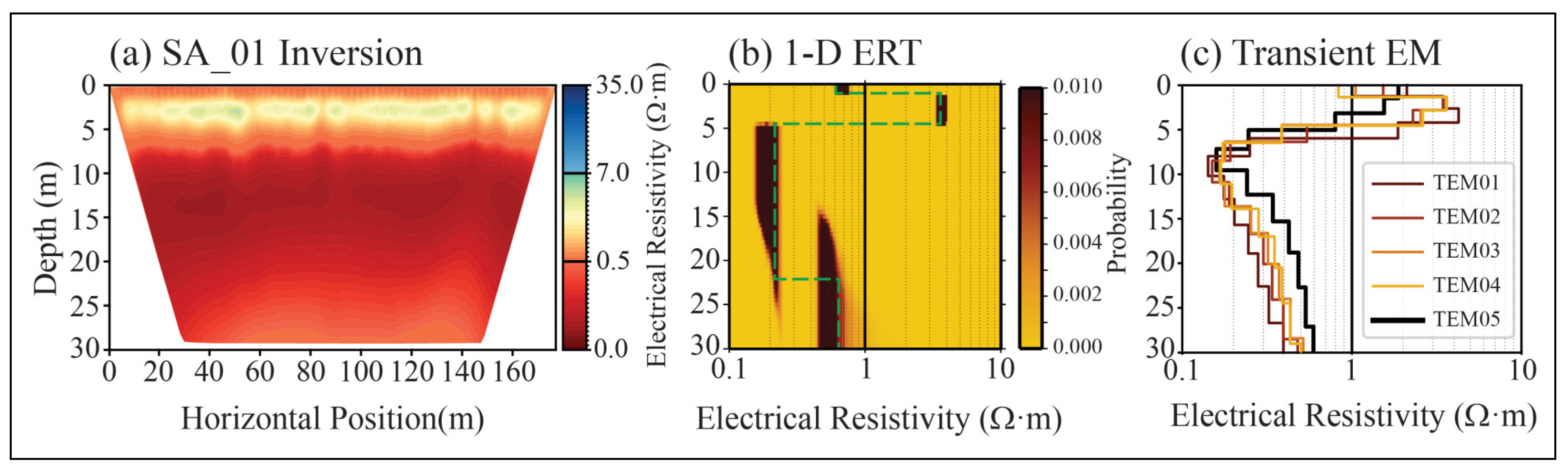
Results for the ERT lines near the Saltair complex and Great Salt Lake State Park show considerable similarity (see Figures S27–S38 in the online supplements). The main features are exemplified in Figure 8 for line SA_01. The 2D inversion is shown in Figure 8a, and the 1D Bayesian inversion for three-interfaces, BIC picked optimal model, is shown in Figure 8b. The 2D inversions show a surface sandy layer that overlies a laterally heterogeneous layer with high resistivities (on the order of 3–4 Ω·m) that is consistent with a mirabilite layer. This mirabilite layer is similar to that observed in the CRP data in Anderson et al. [29]. Similar to Burmester, we observe what appears to be a low-resistivity layer beneath the mirabilite layer. The 1D inversions at Saltair are best-described by models with n = 3 interfaces. At SA_01 (Figure 8b), we observe a low-resistivity layer in the top 1.2 ± 0.07 m (). This corresponds to a dry sandy surface layer. This overlies a higher-resistivity mirabilite layer. At SA_01 the mirabilite layer ends at an average depth of 4.6 0.11 m and has a resistivity of . Beneath the mirabilite layer, we get a low-resistivity layer, similar to Burmester, with a resistivity of . This low-resistivity layer persists to a depth of 18.4 ± 3.6 m, where the maximum likelihood model increases to . The TEM data are shown in Figure 8c and also show the presence of a high-resistivity mirabilite layer (maximum resistivity in TEM is 4.3 ) that overlies a low-resistivity layer (minimum resistivity is 0.14 ). The TEM data are in excellent agreement with the ERT observations.
Figure 8.
Results in the Saltair region. (a) 2D ResIPy inversion of ERT line SA_01. (b) 1D Bayesian inversion of SA_01 data. The posterior probability is shown in the background, and the green line shows the maximum likelihood model. (c) 1D inversions of 40 m TEM loops (TEM01 to TEM04) and the 100 m loop (black line—TEM05).
ERT lines SA_02 through SA_07 were collected in a 900 m total line length (2D inversions shown in Figures S29–S34) with 5 m electrode spacing. 2D inversions show a similar pattern as SA_01 with a thin low-resistivity surface layer overlying a higher-resistivity mirabilite layer that overlies a low-resistivity layer. In some locations along this line, the mirabilite layer came to within a few 10s of cm of the surface. This is directly observable in the field, as the mirabilite layer has exceptional hardness, and we had difficulty inserting and removing electrodes from it. Further evidence for the existence of mirabilite in this region comes from small depressions in the surface that contained mirabilite crystals. Results for all SA lines are shown in Table 6. Here, d1 represents the depth to the top of the mirabilite layer, d2 is the depth to the bottom of the mirabilite layer, and d3 is the depth to the bottom of the low-resistivity layer. The resistivity of the mirabilite layer is given by ρ2, and the resistivity of the low-resistivity layer is given by ρ3. All 1D inversions show a low-resistivity layer that requires a step up in resistivity at depths greater than 10 m.
Table 6.
Summary of 1D Bayesian inversion results at Saltair for models with three interfaces.
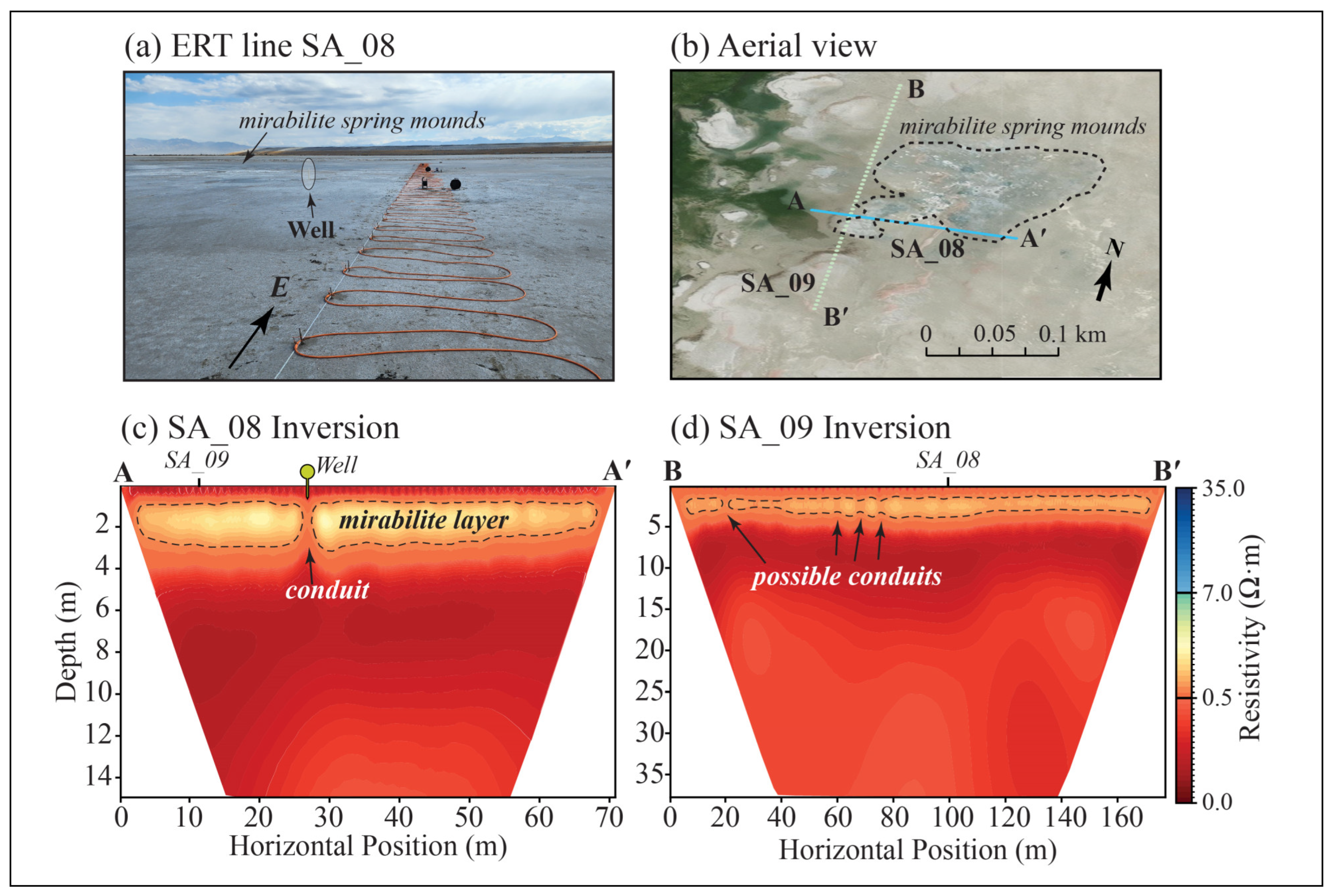
The 2D ERT image in Figure 8a clearly shows the mirabilite layer (3.7 Ω·m) near the surface but shows that this layer may not be laterally continuous. We also collected data for two ERT lines (SA_08-1 m electrode spacing and SA_09-2.5 m electrode spacing, and the results are also summarized in Table 6 for 1D models, next to a mirabilite spring mound with a Utah Geological Survey piezometer placed in the center of the most active part of the spring mound. The location of these lines relative to the spring mound is shown in Figure 9a,b, and the 2D inversions are shown in Figure 9c,d for lines SA_08 and SA_09, respectively. In Figure 9c, a clear break in the mirabilite layer is observed at the location (indicated by the well) where the spring mound upwelling was most active. Saline water from the low-resistivity layer may be upwelling through this conduit, giving rise to the spring mound in this location. Imaging along the perpendicular line (SA_09) also shows possible conduits in the mirabilite layer.
Figure 9.
ERT imaging near a mirabilite spring mound. (a) View looking east along line SA_08. The well and mirabilite spring mounds are on the left of the orange cables for the ERT line. (b) Map view showing lines SA_08 and SA_09 relative to the spring mounds. (c) 2D inversion of line SA_08. The location of the well is indicated by the green pin, and the location where line SA_09 crosses is also indicated. (d) 2D inversion of line SA_09.
4.3. Lee’s Creek
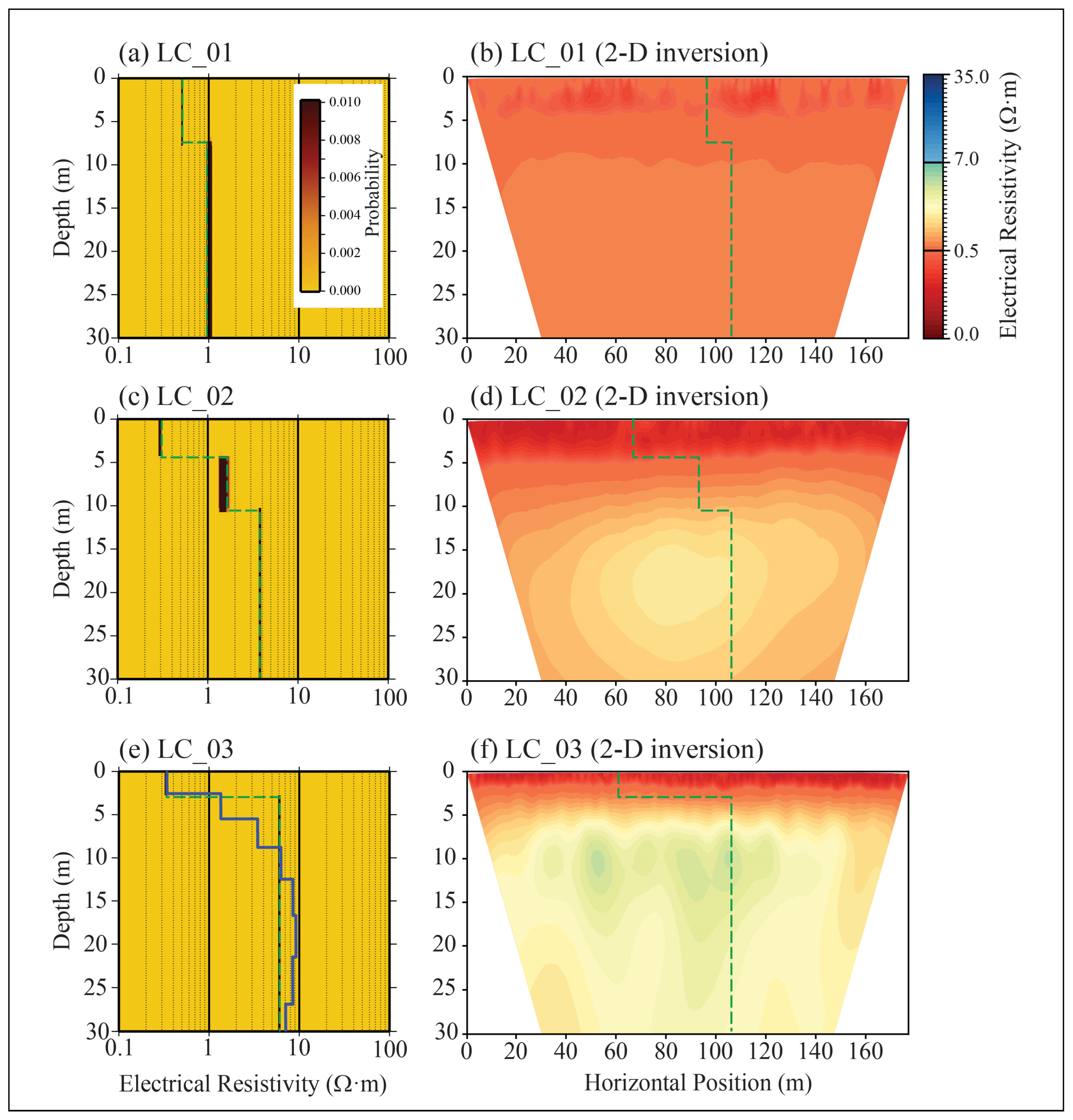
Results in the Lee’s Creek area are summarized in Figure 10. 1D and 2D inversions at LC_01 are shown in Figure 10a,b. There is no mirabilite layer apparent at this location or any of the Lee’s Creek area measurements. This agrees with the auger hole explorations for mirabilite [32], which show that the LC_01 measurements are near the boundary between positive and negative mirabilite detections. Furthermore, LC_01 does not exhibit a low-resistivity layer as observed at Burmester and Saltair to the west. Rather, LC_01 shows a nearly homogeneous electrical resistivity layer with a minimum BIC for n = 1 in the 1D models and with a maximum resistivity of only 0.9 ± 0.009 Ω·m.
Figure 10.
ERT results in the Lee’s Creek area. (a,b) are 1D Bayesian and 2D ResIPy inversions for LC_01, respectively. (c,d) are 1D Bayesian and 2D inversions for LC_02. (e,f) are 1D Bayesian and 2D inversions for LC_03. In each of the 1D Bayesian inversions, the posterior probability is shown in the background, and the maximum likelihood model is drawn with the green line. In panel (e), the blue line corresponds to the 1D inversion for the TEM06 loop.
1D and 2D inversions at LC_02 are shown in Figure 10c,d. The BIC minimum for 1D models occurs at n = 2. Similar to LC_01, we do not observe a mirabilite layer or a low-resistivity layer at LC_02. Instead, we observe a two-step increase in resistivity to a depth of 10.5 ± 0.14 m. Here, the maximum likelihood model shows a resistivity of 3.8 ± 0.03 Ω·m.
Figure 10e,f shows inversions at LC_03, which also shows a minimum BIC for the 1D model with n = 1. LC_03 is described in 1D by a single-interface model with , which steps up to at a depth of 2.8 ± 0.03 m. TEM measurements with a 100 m loop (TEM06) coincide with the center location of the LC_03 ERT line. The 1D inversion for the TEM observation is overlain on Figure 10e (blue line). The TEM inversion (blue line in Figure 10c) is in excellent agreement with the ERT results but displays a more gradual increase in resistivity with depth, which is due primarily to the many-layer 1D inversion method used.
4.4. Summary
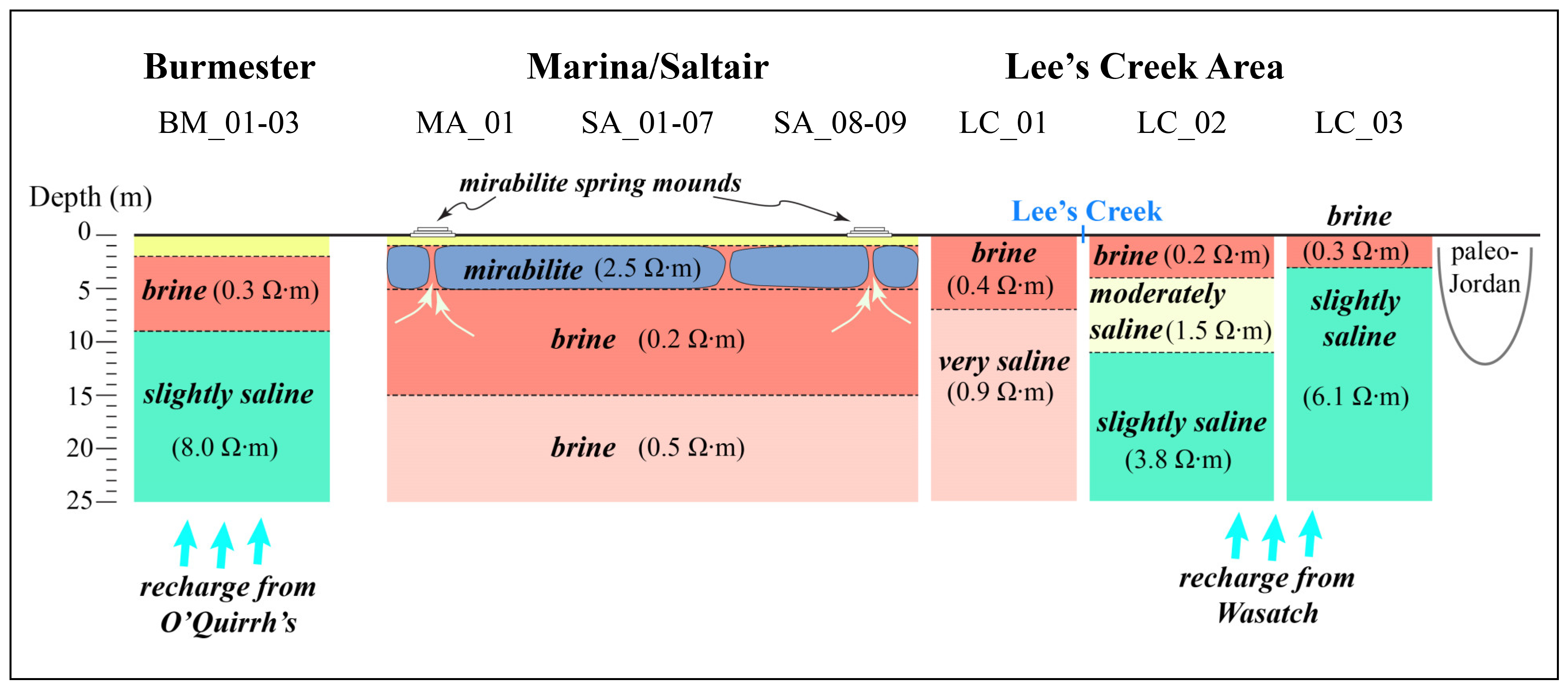
In this paper, we have analyzed ERT and TEM observations for sites on the playa along the southern shore of the GSL. As one moves from west to east across our study area, our observations are summarized as follows and shown in Figure 11.
Figure 11.
Summary of results across the study area from west to east. Generalized results at each study area are shown. The top 10s of m are exaggerated relative to the depth of bedrock, which is not meant to be at scale. Inferred pore-water salinities are shown along with average electrical resistivity values.
- (1)
- At Burmester, we observe a shallow low-resistivity layer starting at a depth of 1.7–2.2 m, with a resistivity of 0.34 Ω·m. This layer is consistent with brine pore-water in both resistivity values and measured pore-water salinities. This layer transitions to higher resistivities ranging from ~6.8 to 9.1 Ω·m at depths from 8.5 to 9.5 m. The resistivities in the lower-most layer are consistent with decreased salinity approaching fresh pore-water. No mirabilite layer is observed in this location.
- (2)
- From the GSL State Park to the Saltair region, we observe a sandy surface layer that overlies a laterally variable mirabilite layer. The top-most sandy surface layer has an average thickness of h1 = 0.82 ± 0.01 m and an average resistivity of . The mirabilite layer has an average thickness of h2 = 4.4 ± 0.05 m and a resistivity of . This is underlain by a low-resistivity layer with and an average thickness of 9.5 ± 0.2 m consistent with brine pore-water. Inversions indicate that a slight increase in higher resistivity () occurs below this but is still consistent with brine pore-water at resolvable depths.
- (3)
- At the Lee’s Creek Nature Area (LC_01), no mirabilite layer was observed. Rather, we observed a nearly homogeneous layer of low resistivity (<1 Ω·m) down to a depth of ~30 m, the limit of our resolution. This is consistent with brine pore-water over this entire range.
- (4)
- At LC_02 we observe low resistivities (<2 Ω·m) down to a depth of 10.5 ± 0.14 m. At this point, the resistivity increases to 3.8 ± 0.03 Ω·m.
- (5)
- At LC_03, we observe a simple structure with an uppermost resistivity of , which steps up to at a depth of 2.8 ± 0.03 m. The higher resistivity value is on the boundary between salt and freshwater and could indicate that fresh pore-water exists as shallow as 3.0 m.
5. Discussion
Only one previous study has investigated the shallow resistivity structure beneath the southern shore of the GSL. This study by Anderson et al. [29] uncovered a 1–2 m thick sandy layer with a resistivity of 0.5 Ω·m, which overlies a 3–4 m thick (4–5 Ω·m) layer of mirabilite. This mirabilite layer in turn overlies a low-resistivity layer of 0.5–1 Ω·m. These results are nearly identical to those we obtained near the Saltair region. However, our average resistivity of the mirabilite layer was slightly lower than that recovered by Anderson et al. [29] at 2.5 Ω·m. This discrepancy could be related to the much larger expanse of area we investigated, where we observed a mirabilite layer that displayed variability in thickness, existence, and inferred resistivities. Nonetheless, we confirm the presence of a mirabilite layer that exists over a much larger region than inferred in either Anderson et al. [29] or Wilson and Wideman [32].
To determine whether the breaks we observed in this mirabilite layer were well-resolved, we conducted a series of sensitivity tests on our 2D inversions using bootstrap resampling [Figures S39–S42]. Here we randomly removed between 30 and 50% of our observations, without replacement, and recomputed the 2D inversions using the same inversion settings previously determined for that ERT line. We used 100 bootstrap samples and then computed both the mean and standard deviations from these bootstrapped inversions. Results for SA_01 and SA_08 are shown in the online supplements (Figures S39–S42). Here we can see that even if we remove 50% of the observations in our inversions, the observed breaks in the mirabilite layer are still resolved with little variation in structure. This case still holds even in the individual inversions (Figures S39–S40), demonstrating that the data density and quality collected in this study are high enough to resolve the inferred structures.
At the Burmester (BM) and LC_02 and LC_03, we observe deep higher resistivities that are consistent with the transition to fresher pore-water at depth, although the measured resistivities are on the boundary between slightly saline and freshwater characterizations. At the BM (Burmester) sites and LC_02 and LC_03, the transition to fresher pore-water appears to occur at ~10 m depth or less. At the Saltair (SA) sites, we observe an increase in resistivity at depths greater than 10 m; however, the increase is small and is not consistent with resistivity values typically associated with fresh pore-water.
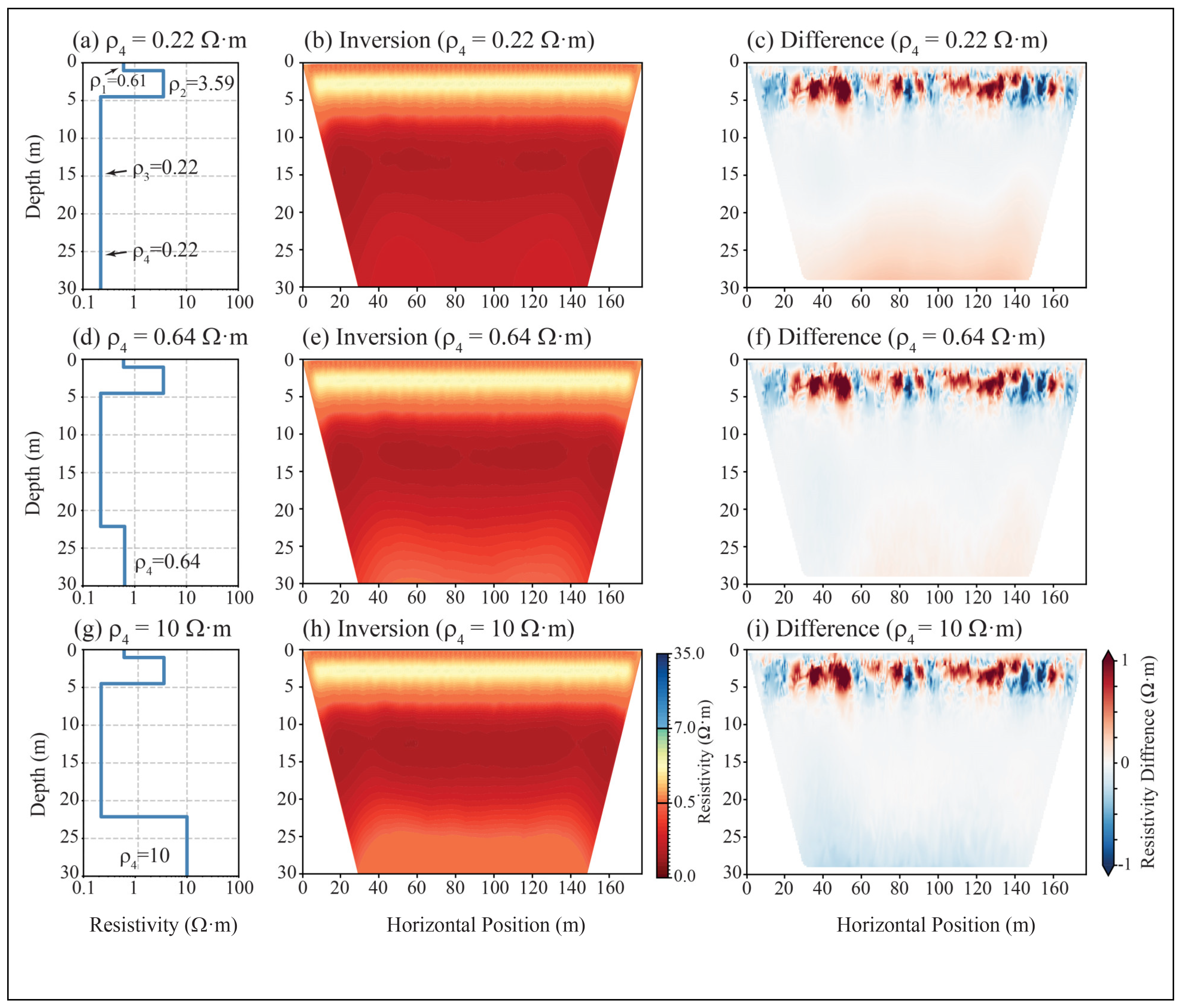
The effect of adding higher resistivities below 20 m in the Saltair sites is explored in Figure 12. In this figure, we use the best-fit 1D model at SA_01 as a base model and perturb the lowermost (ρ4) layer. In the first row, we keep the resistivity of the lowermost layer at ρ3 = ρ4 = 0.22 Ω·m (Figure 12a). The 2D inversion of this model is shown in Figure 12b, and its difference from the observed data at SA_01 shows that this value of resistivity at depth is too low. Alternatively, in the bottom row, we set ρ4 = 10 Ω·m, which is too high (Figure 12h,i). The middle row shows the case where ρ3 = 0.64 Ω·m, which appears to fit these data well. Hence, it appears that these data require an increase in resistivity at depth; however, the inferred increase is not consistent with the existence of fresh pore-water at depth. Installation of a deep (e.g., 30 m) well at the Saltair location could confirm whether freshwater exists in this location. As these sites sit at the northernmost limit of the north–south trending Oquirrh Mountains, it is reasonable to expect relatively less freshwater to recharge into the system at this location, consistent with the lack of higher resistivities at depth.
Figure 12.
Effect of a high-resistivity layer at depth in Saltair, SA_01. In each row, the resistivity of the lowermost layer is changed. In panels (a–c), ρ3 = 0.25 Ω·m, which matches ρ2. In panels (d–f), ρ3 = 1.0 Ω·m. In panels (g–i), ρ3 = 10.0 Ω·m. In all panels, ρ1 = 2.0 Ω·m, and ρ2 = 0.25 Ω·m. The 1D model used in each case is shown in the left-most column (panels (a,d,g)). The middle column shows the 2D inversion for the model (panels (b,e,h)). The right-most column shows the difference between the SA_01, 2D inversion, and the model inversion.
The possible presence of fresher pore-water at depth beneath the BM and LC sites could be due to recharge from the Oquirrh Mountains that exist just south of this region (Figure 1). However, the mountains run north–south and may not contribute a large amount of groundwater into this system at its northernmost terminus. It is also possible that deep fresh groundwater exists beneath these sites as a relic from ancient Lake Bonneville. Lake Bonneville was a freshwater lake that existed over the region from approximately 300,000 to 13,000 years ago [52]. Since Lake Bonneville’s final regression, the Great Salt Lake region has remained a terminal lake, and ancient fresh groundwater from the previous Lake Bonneville stage could persist. However, the absence of freshwater beneath the SA sites argues against this interpretation, as we would expect a constant freshwater layer to be present beneath all of these sites.
The location of sites LC_02 and LC_03 is where the lakeshore starts to turn to the north towards the direction of Farmington Bay (Figure 1). The higher resistivity values at shallower depths, which could be indicative of more fresh groundwater at the near surface at these sites, may reflect increased lakeward mountain-derived groundwater flow from the Salt Lake Valley. The Wasatch Mountains, forming the Salt Lake Valley’s eastern boundary, have higher elevations and greater precipitation than the Oquirrh Mountains that form the Salt Lake Valley’s western boundary. Initial analysis of ERT observations collected in the region to the north of here, in Farmington Bay, shows shallow fresh groundwater in both resistivity surveys and from direct measurements in wells.
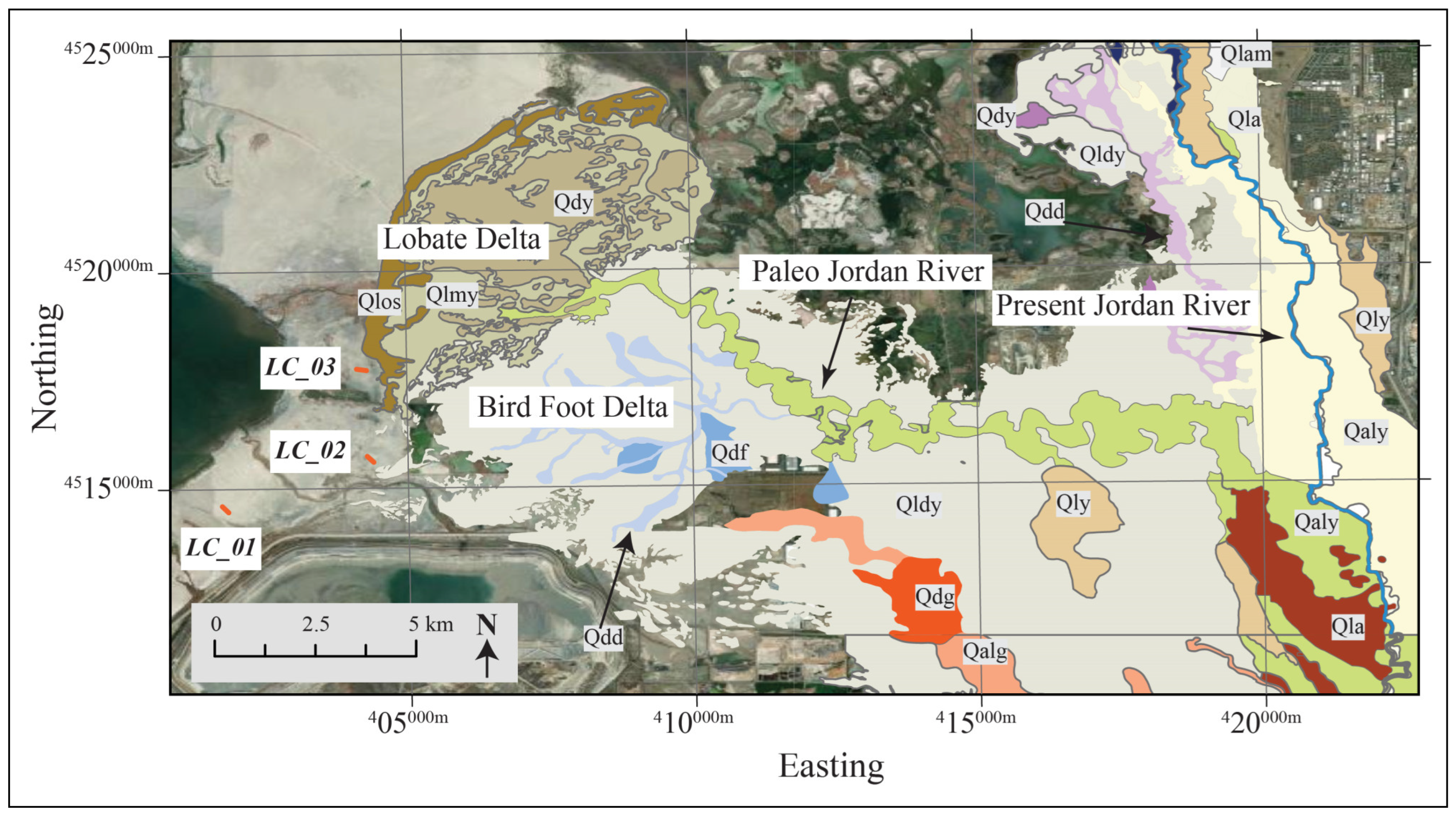
One of the three primary streams that flow into the GSL, the Jordan River, previously emptied into the lake immediately to the east of LC_03 [53]. The paleo-Jordan River is depicted in Figure 13 in relation to the locations of the LC ERT sites. Currently, the Jordan River continues its northward flow to the east of our study area and empties into the GSL in Farmington Bay to the northeast of our study area. The previous course (Figure 13) emptied into a wide delta labeled lobate delta in Figure 13. The absence of similar deltaic deposits at the Jordan River’s current mouth could indicate that the shift was relatively recent [53]. The increased permeability provided by the deltaic sediments of the paleo-Jordan River layer may act as a pathway of preferential flow of fresh groundwater from the Salt Lake Valley to our sites at LC_02 and LC_03.
Figure 13.
Paleo-Jordan River channel, as mapped by McKean and Hylland [53], is shown here. The locations of ERT lines LC_01, LC_02, and LC_03 are drawn with orange lines. Geologic units are described as follows: Qaly (young floodplain and stream deposits showing the paleo-Jordan River channel, Qlos (lacustrine oolitic sand deposits), Qlmy (young lacustrine mud deposits), and Qdy (younger deltaic deposits). Qdy indicates where the paleo-river deposited sediments into the lake. Qlos and Qlmy are lacustrine sand and mud deposits associated with river sediment deposits.
From Burmester (BM sites) to the far eastern Saltair sites (SA_09), there is consistently a low-resistivity layer at shallow depths, with resistivity values consistent with brine pore-water. It is possible that this salty pore-water is semi-confined to exist within more permeable sandy layers in the near surface, as suggested by the lithology at Burmester (Figure 7). This observation of sandy permeable layers beneath the mirabilite region was also recognized by Wilson and Wideman [32] in the Saltair region. Beneath these sandy layers at Burmester, thick layers of clay exist that could impede the downward flow of salt. The brine pore-water could be concentrated in the most permeable layers near the surface.
6. Conclusions
The flow of fresh groundwater into the GSL is unknown and difficult to quantify. Here we investigated the south shore of the GSL using electrical resistivity tomography (ERT) and transient electromagnetic methods (TEM), revealing lateral variations in electrical resistivity consistent with both lithological and pore-water salinity changes. While we expected to observe coherent resistivity structures (e.g., saltwater/freshwater interface), we instead found short-scale-length variations across our study region, indicating variations in both lithology and pore-water salinity content. These measurements were possible due to the decline in the GSL water level since 1989 and subsequent exposure of the playa. As the water has receded, the mirabilite layer in the shallow subsurface between Burmester and the Lee’s Creek Nature Center has become closer to the surface, whereas it would previously have been underwater. This mirabilite layer is underlain by a low-resistivity layer, consistent with brine pore-water under pressure. This brine pore-water may rise to the surface through pre-existing conduits in the overlying hard mirabilite layer and pool on the playa’s dry surface. When the temperature drops in winter, these upwellings form evaporite concentrations, or mirabilite spring mounds, which have recently been observed. The Burmester and northern Lee’s Creek areas show evidence for fresher pore-water at depth. This fresh groundwater could arise as a relic from Lake Bonneville and from current recharge from the Oquirrh and Wasatch Mountains. Recharge at the northeastern section of our study area could be assisted by highly permeable paths left over from the paleo-Jordan River. We confirmed the existence of near surface fresh groundwater beneath the Burmester and Lee’s Creek areas of our study at depths as shallow as 8.5 m and 2.8 m respectively, which is indicative of groundwater recharge beneath the playa. Additional measurements are required to determine if this groundwater is entering the GSL in these locations.
Supplementary Materials
The following supporting information can be downloaded at https://www.mdpi.com/article/10.3390/geosciences16030114/s1, Figures S1–S19: Resistivity pseudo-sections of data collected in this study; Figures S20–S38: Inversion results of data collected in this study; Figures S39–S43: 2D inversion sensitivity tests [54,55,56,57].
Author Contributions
Conceptualization, M.S.T. and W.P.J.; Methodology, M.J., M.S.T., S.P., T.v.D., C.L.H., E.A.-M. and W.P.J.; Software, M.J., M.S.T., S.P. and C.L.H.; Validation, M.J., M.S.T., S.P. and C.L.H.; Formal Analysis, M.J., M.S.T., S.P., C.L.H. and E.A.-M.; Investigation, M.J., M.S.T., S.P., I.T.-H. and C.L.H.; Resources, M.S.T., C.L.H. and W.P.J.; Data Curation, M.J., M.S.T., C.L.H. and E.A.-M.; Writing—Original Draft Preparation, M.J., M.S.T., S.P., T.v.D. and C.L.H.; Writing—Review and Editing, M.J., M.S.T., S.P., I.T.-H., T.v.D., C.L.H., E.A.-M., W.P.J. and L.S.A.; Visualization, M.J., M.S.T., S.P., I.T.-H. and C.L.H.; Supervision, M.S.T., S.P. and T.v.D.; Project Administration, M.S.T. and T.v.D.; Funding Acquisition, M.S.T., S.P., T.v.D., W.P.J. and L.S.A. All authors have read and agreed to the published version of the manuscript.
Funding
Funding for this research was provided by a Great Salt Lake Research Grant (“Tech Team Grant”) from the Utah Department of Natural Resources, Division of Forestry, Fire, and State Lands (FFSL).
Data Availability Statement
All electrical resistivity and transient electromagnetic data collected as a part of this study are available for download from the University of Utah Hive data repository https://doi.org/10.7278/S5d-njpk-856b.
Acknowledgments
The authors acknowledge the University of Utah Center for High Performance Computing (CHPC) for computing resources and support. We thank Adam McKean for providing paleo-Jordan River map data and Elliot Jagniecki for showing us where active mirabilite spring mounds could be located and for discussions that improved this manuscript. Some figures were generated using the Generic Mapping Tools [58]. We thank the academic editor and three anonymous reviewers for suggestions that improved this manuscript.
Conflicts of Interest
The authors declare there are no conflicts of interest for this manuscript.
References
- Arnow, T. Water-Level and Water-Quality Changes in Great Salt Lake, Utah, 1847–1983; U.S. Department of the Interior, Geological Survey: Reston, VA, USA, 1984; p. 913. [Google Scholar]
- Wang, S.-Y.; Gillies, R.R.; Reichler, T. Multidecadal drought cycles in the Great Basin recorded by the Great Salt Lake: Modulation from a transition-phase teleconnection. J. Clim. 2012, 25, 1711–1721. [Google Scholar] [CrossRef]
- Bigalke, S.; Loikith, P.; Siler, N. Explaining the 2022 record low Great Salt Lake volume. Geophys. Res. Lett. 2025, 52, e2024GL112154. [Google Scholar] [CrossRef]
- Wurtsbaugh, W.A.; Miller, C.; Null, S.E.; DeRose, J.; Wilcock, P.; Hahnenberger, M.; Howe, F.; Moore, J. Decline of the world’s saline lakes. Nat. Geosci. 2017, 10, 816–823. [Google Scholar] [CrossRef]
- Null, S.E.; Wurtsbaugh, W.A. Water development, consumptive water uses, and Great Salt Lake. In Great Salt Lake Biology; Baxter, B.K., Butler, J.K., Eds.; Springer: Cham, Switzerland, 2020. [Google Scholar] [CrossRef]
- Loving, B.L.; Waddell, K.M.; Miller, C.W. Water and Salt Balance of Great Salt Lake, Utah, and Simulation of Water and Salt Movement Through the Causeway, 1987–98; Water-Resources Investigations Report 2000-4221; USGS: Reston, VA, USA, 2000. [Google Scholar] [CrossRef]
- Waddell, K.M.; Fields, F.K. Model for evaluating the effects of dikes on the water and salt balance of Great Salt Lake, Utah. Utah Geol. Mineral. Surv. Water-Resour. Bull. 1977, 21, 1–54. [Google Scholar]
- Bunce, L.E. Significance of Spring Inflow to Great Salt Lake; Binghampton University: Binghampton, NY, USA, 2022; p. 57. [Google Scholar]
- Mohammed, I.N.; Tarboton, D.G. An examination of the sensitivity of the Great Salt Lake to changes in inputs. Water Resour. Res. 2012, 48, W11511. [Google Scholar] [CrossRef]
- Zamora, H.A.; Inkenbrandt, P. Estimate of groundwater flow and salinity contribution to Great Salt Lake using groundwater levels and spatial analysis. In Great Salt Lake and Bonneville Basin: Geologic History and Anthropocene Issues; Vanden Berg, M.D., Ford, R.L., Frantz, C., Hurlow, H., Gunderson, K., Atwood, G., Eds.; Utah Geological Association: Salt Lake City, UT, USA, 2024. [Google Scholar] [CrossRef]
- Hall, D.K.; O’Leary, D.S., III; DiGirolamo, N.E.; Miller, W.; Kang, D.H. The role of declining snow cover in the desiccation of the Great Salt Lake, Utah, using MODIS data. Remote Sens. Environ. 2021, 252, 112106. [Google Scholar] [CrossRef]
- Parker, E.; Daniels, B.; Allen, A.; Doerner, C. Great Salt Lake, environmental crises, and securities liability. Environ. Law Rep. 2025, 55, 10186. [Google Scholar] [CrossRef]
- Grineski, S.E.; Mallia, D.V.; Collins, T.W.; Araos, M.; Lin, J.C.; Anderegg, W.R.L.; Perry, K. Harmful dust from drying lakes: Preserving Great Salt Lake (USA) water levels decreases ambient dust and racial disparities in population exposure. One Earth 2024, 7, 1056–1067. [Google Scholar] [CrossRef]
- Caplan, A.J.; Go, D.-H. Measuring the bioeconomic impacts of prolonged drought on a lake ecosystem: The case of the Great Salt Lake, Utah. Nat. Resour. Model. 2018, 33, e12251. [Google Scholar] [CrossRef]
- Finnoff, D.; Caplan, A.J. A bioeconomic model of the Great Salt Lake watershed. Econ. Res. Inst. Study Pap. 2004, 14, 1–47. [Google Scholar]
- Rushforth, S.R.; Felix, E.A. Biotic adjustments to changing salinities in the Great Salt Lake, Utah, USA. Microb. Ecol. 1982, 8, 157–161. [Google Scholar] [CrossRef]
- Gliwicz, Z.M.; Wurtsbaugh, W.; Ward, A. Brine Shrimp Ecology in the Great Salt Lake. In Performance Report to the Utah Division of Wildlife Resources; Utah Division of Wildlife Resources: Salt Lake City, UT, USA, 1995. [Google Scholar]
- Conover, M.R.; Bell, M.E. Importance of Great Salt Lake to pelagic birds. In Great Salt Lake Biology; Baxter, B.K., Butler, J., Eds.; Springer: Cham, Switzerland, 2020. [Google Scholar] [CrossRef]
- Frank, M.G. Migratory Waterbird Ecology at a Critical Staging Area, Great Salt Lake, Utah. Ph.D. Thesis, Utah State University, Logan, UT, USA, 2016; p. 181. [Google Scholar]
- Lindsay, M.R.; Anderson, C.; Fox, N.; Scofield, G.; Allen, J.; Anderson, E.; Bueter, L.; Poudel, S.; Sutherland, K.; Munson-McGee, J.H.; et al. Microbialite response to an anthropogenic salinity gradient in Great Salt Lake, Utah. Geobiology 2016, 15, 131–145. [Google Scholar] [CrossRef] [PubMed]
- Lindsay, M.R.; Johnston, R.E.; Baxter, B.K.; Boyd, E.S. Effects of salinity on microbialite-associated production in Great Salt Lake, Utah. Ecology 2019, 100, e02611. [Google Scholar] [CrossRef] [PubMed]
- Vanden Berg, M.D. Domes, rings, ridges, and polygons: Characteristics of microbialites from Utah’s Great Salt Lake. Sediment. Rec. 2019, 17, 4–10. [Google Scholar] [CrossRef]
- Cook, K.L.; Berg, J.W. Regional gravity survey along the central and southern Wasatch Front, Utah. U.S. Geol. Surv. Prof. Pap. 1961, 316-E, 75–89. [Google Scholar]
- Cook, K.L.; Berg, J.W.; Johnson, W.W.; Novotny, R.T. Some Cenozoic structural basins in the Great Salt Lake area, Utah, indicated by regional gravity surveys. Utah Geol. Soc. Guideb. 1966, 20, 57–75. [Google Scholar]
- Arnow, T.; Mattick, R.E. Thickness of valley fill in the Jordan Valley east of the Great Salt Lake, Utah. Geol. Surv. Res. 1968, B79–B82. [Google Scholar]
- Colman, S.M.; Kelts, K.R.; Dinter, D.A. Depositional history and neotectonics in Great Salt Lake, Utah, from high-resolution seismic stratigraphy. Sediment. Geol. 2002, 148, 61–78. [Google Scholar] [CrossRef]
- Mikulich, M.J.; Smith, R.B. Seismic reflection and aeromagnetic surveys of the Great Salt Lake, Utah. Geol. Soc. Am. Bull. 1974, 85, 991–1002. [Google Scholar] [CrossRef]
- Smith, R.B.; Bruhn, R.L. Intraplate extensional tectonics of the eastern Basin-Range: Inferences on structural style from seismic reflection data, regional tectonics, and thermal mechanical models of brittle–ductile deformation. J. Geophys. Res. 1984, 89, 5733–5762. [Google Scholar] [CrossRef]
- Anderson, R.B.; Naftz, D.L.; Day-Lewis, F.D.; Henderson, R.D.; Rosenberry, D.O.; Stolp, B.J.; Jewell, P. Quantity and quality of groundwater discharge in a hypersaline lake environment. J. Hydrol. 2014, 512, 177–194. [Google Scholar] [CrossRef]
- Mabey, D.R.; Tooker, E.W.; Roberts, R.J. Gravity and magnetic anomalies in the northern Oquirrh Mountains, Utah. U.S. Geol. Surv. Prof. Pap. 1963, 450-E, E28–E31. [Google Scholar]
- Zoback, M.L. Structure and Cenozoic tectonism along the Wasatch fault zone, Utah. Geol. Soc. Am. Mem. 1983, 157, 3–28. [Google Scholar]
- Wilson, S.R.; Wideman, F.L. Sodium Sulfate Deposits Along the Southeast Shore of Great Salt Lake, Salt Lake and Tooele Counties, Utah; U.S. Bureau of Mines Information Circulars: Washington, DC, USA, 1957; p. 7773. [Google Scholar]
- Jagniecki, E.A.; Vanden Berg, M.D.; Boyd, E.S.; Johnston, D.T.; Baxter, B.K. Sulfate-rich spring seeps and seasonal formation of terraced, crystalline mirabilite mounds along the shores of Great Salt Lake, Utah: Hydrologic and chemical expression during declining lake elevation. Chem. Geol. 2023, 636, 121650. [Google Scholar] [CrossRef]
- Rings, J.; Hauck, C. Reliability of resistivity quantification for shallow subsurface water processes. J. Appl. Geophys. 2009, 68, 404–416. [Google Scholar] [CrossRef][Green Version]
- Wahab, S.; Saibi, H.; Mizunaga, H. Groundwater aquifer detection using the electrical resistivity method at Ito Campus, Kyushu University (Fukuoka, Japan). Geosci. Lett. 2021, 8, 15. [Google Scholar] [CrossRef]
- Cong-Thi, D.; Dieu, L.P.; Caterina, D.; De Pauw, X.; Thi, H.D.; Ho, H.H.; Nguyen, F.; Hermans, T. Quantifying salinity in heterogeneous coastal aquifers through ERT and IP: Insights from laboratory and field investigations. J. Contam. Hydrol. 2024, 262, 104322. [Google Scholar] [CrossRef] [PubMed]
- Moulds, M.; Gould, I.; Wright, I.; Webster, D.; Magnone, D. Use of electrical resistivity tomography to reveal the shallow freshwater–saline interface in The Fens coastal groundwater, eastern England (UK). Hydrogeol. J. 2023, 31, 335–349. [Google Scholar] [CrossRef]
- Sarker, M.M.R.; Van Camp, M.; Hermans, T.; Hossain, D.; Islam, M.; Uddin, M.Z.; Ahmed, N.; Bhuiyan, M.A.Q.; Karim, M.M.; Walraevens, K. Geophysical delineation of freshwater–saline water interfaces in coastal area of southwest Bangladesh. Water 2021, 13, 2527. [Google Scholar] [CrossRef]
- Abdalla, O.A.E.; Ali, M.; Khalifa, A.-H.; Al-Zidi, H.; El-Hussain, I.; Al-Hinai, S. Rate of seawater intrusion estimated by geophysical methods in an arid area: Al Khabourah, Oman. Hydrogeol. J. 2010, 18, 1437–1445. [Google Scholar] [CrossRef]
- Attwa, M.; Günther, T.; Grinat, M.; Binot, F. Evaluation of DC, FDEM and IP resistivity methods for imaging perched saltwater and a shallow channel within coastal tidal flat sediments. J. Appl. Geophys. 2011, 75, 656–670. [Google Scholar] [CrossRef]
- Martinez-Moreno, F.J.; Monteiro-Santos, F.A.; Bernardo, I.; Farzamian, M.; Nascimento, C.; Fernandes, J.; Casal, B.; Ribeiro, J.A. Identifying seawater intrusion in coastal areas by means of 1D and quasi-2D joint inversion of TDEM and VES data. J. Hydrol. 2017, 552, 609–619. [Google Scholar] [CrossRef]
- Metwaly, M.; El-Qady, G.; Massoud, U.; El-Kenawy, A.; Matsushima, J.; Al-Arifi, N. Integrated geoelectrical survey for groundwater and shallow subsurface evaluation: Case study at Siliyin spring, El-Fayoum, Egypt. Int. J. Earth Sci. 2010, 99, 1427–1436. [Google Scholar] [CrossRef]
- Adomako-Mensah, E.; Johnson, W.P.; Carter, S.C.; Solomon, D.K.; Mace, W.D.; Hynek, S.A.; Hurlow, H. Significance of ancient artesian fresh groundwater below the playa of a hypersaline terminal lake of hemispheric significance. J. Hydrol. 2026, 668, 134813. [Google Scholar] [CrossRef]
- Spies, B. Depth of investigation in electromagnetic sounding methods. Geophysics 1989, 54, 872–888. [Google Scholar] [CrossRef]
- Christiansen, A.V.; Auken, E. A global measure for depth of investigation. Geophysics 2012, 77, WB171–WB177. [Google Scholar] [CrossRef]
- Heath, R.C. Basic ground-water hydrology. U.S. Geol. Surv. Water-Supply Pap. 1983, 2220, 86. [Google Scholar] [CrossRef]
- Blanchy, G.; Saneiyan, S.; Boyd, J.; McLachlan, P.; Binley, A. ResIPy: An intuitive open-source software for complex geoelectrical inversion/modeling. Comput. Geosci. 2020, 137, 104423. [Google Scholar] [CrossRef]
- Binley, A.; Slater, L. Resistivity and Induced Polarization: Theory and Applications to the Near-Surface Earth; Cambridge University Press: Cambridge, UK, 2020. [Google Scholar]
- Pachhai, S.; Tkalčić, H.; Dettmer, J. Bayesian inference for ultralow velocity zones in the Earth’s lowermost mantle: Complex ULVZ beneath the east of the Philippines. J. Geophys. Res. Solid Earth 2014, 119, 8346–8365. [Google Scholar] [CrossRef]
- Pachhai, S.; Dettmer, J.; Tkalčić, H. Ultra-low velocity zones beneath the Philippine and Tasman Seas revealed by a trans-dimensional Bayesian waveform inversion. Geophys. J. Int. 2015, 203, 1302–1318. [Google Scholar] [CrossRef]
- Auken, E.; Christensen, A.V.; Kirkegaard, C.; Fiandaca, G.; Schamper, C.; Behroozmad, A.A.; Binley, A.; Nielsen, E.; Efferso, F.; Christensen, N.B.; et al. An overview of a highly versatile forward and stable inverse algorithm for airborne, ground-based and borehole electromagnetic and electric data. Explor. Geophys. 2015, 46, 223–235. [Google Scholar] [CrossRef]
- Oviatt, C.G.; Atwood, G.; Thompson, R.S. History of Great Salt Lake, Utah, USA: Since the termination of Lake Bonneville. In Limnogeology: Progress, Challenges and Opportunities; Rosen, M.R., Ed.; Springer Nature: Cham, Switzerland, 2021; pp. 233–271. [Google Scholar] [CrossRef]
- McKean, A.P.; Hylland, M.D. Post-Lake Bonneville migration of the Jordan River, Salt Lake Valley, Utah. In Proceedings of the 2018 Lake Bonneville Geologic Conference and Short Course; Lund, W.R., McKean, A.P., Bowman, S.D., Eds.; Utah Geological Survey Miscellaneous Publication: Salt Lake City, UT, USA, 2019; Volume 170. [Google Scholar]
- Tafaghod Khabaz, Z.; Ghanati, R.; Berubé, C.L. Uncertainty quantification in electrical resistivity tomography inversion: Hybridizing block-wise bootstrapping with geostatistics. Geophys. J. Int. 2024, 239, 1–17. [Google Scholar] [CrossRef]
- Loke, M.H.; Barker, R.D. Least-squares deconvolution of apparent resistivity pseudosections. Geophysics 1995, 60, 1682–1690. [Google Scholar] [CrossRef]
- Loke, M.H.; Barker, R.D. Practical techniques for 3D resistivity surveys and data inversion. Geophys. Prospect. 1996, 44, 499–523. [Google Scholar] [CrossRef]
- Loke, M.H.; Barker, R.D. Rapid least-squares inversion of apparent resistivity pseudosections by a quasi-Newton method. Geophys. Prospect. 1996, 44, 131–152. [Google Scholar] [CrossRef]
- Wessel, P.; Luis, J.F.; Uieda, L.; Scharroo, R.; Wobbe, F.; Smith, W.H.F.; Tian, D. The Generic Mapping Tools Version 6. Geochem. Geophys. Geosyst. 2019, 20, 5556–5564. [Google Scholar] [CrossRef]
Disclaimer/Publisher’s Note: The statements, opinions and data contained in all publications are solely those of the individual author(s) and contributor(s) and not of MDPI and/or the editor(s). MDPI and/or the editor(s) disclaim responsibility for any injury to people or property resulting from any ideas, methods, instructions or products referred to in the content. |
© 2026 by the authors. Licensee MDPI, Basel, Switzerland. This article is an open access article distributed under the terms and conditions of the Creative Commons Attribution (CC BY) license.