Article

Thermal Properties and Geothermal Effects of Magmatic Rocks in Jiangsu Province, China

1
Geological Survey of Jiangsu Province, Nanjing 210018, China
2
Natural Resources Carbon Neutralization Engineering Research Center of Jiangsu Province, Nanjing 210018, China
3
School of Resources and Geosciences, China University of Mining and Technology, Xuzhou 221116, China
4
Key Laboratory of Coalbed Methane Resources and Reservoir Formation Process of the Ministry of Education, China University of Mining and Technology, Xuzhou 221116, China
5
State Key Laboratory of Lithospheric Evolution and Environmental Coevolution, Institute of Geology and Geophysics, Chinese Academy of Sciences, Beijing 100029, China
6
College of Earth and Planetary Sciences, University of Chinese Academy of Sciences, Beijing 100049, China
*
Author to whom correspondence should be addressed.
Geosciences 2026, 16(1), 6; https://doi.org/10.3390/geosciences16010006
Submission received: 24 October 2025 / Revised: 23 November 2025 / Accepted: 10 December 2025 / Published: 20 December 2025
(This article belongs to the Section Geophysics)

Abstract

(1) Background: Geothermal resources are enriched in Jiangsu Province, particularly in its mid-deep geothermal reservoirs. The thermal properties and thermal effects of magmatic rocks, which are largely unknown in Jiangsu Province, are fundamental for analyzing the genetic mechanisms of geothermal resources and evaluating resource potential. (2) Methods: Representative magmatic rock samples from different geological periods and different tectonic settings are collected from the main tectonic units of Jiangsu Province. Key thermophysical parameters such as thermal conductivity, heat production rate, rock density, and porosity are systematically tested. (3) Results: The variation patterns of these thermal property parameters are analyzed, and the sources and spatiotemporal evolution characteristics of radiogenic heat production, and the thermal effects of magmatic rocks, are specifically explored. (4) Conclusions: Magmatic rock lithology from acidic to basic is negatively correlated with thermal conductivity, thermal diffusivity, and radiogenic heat production rate, and positively correlated with volumetric heat capacity. The radiogenic heat production of magmatic rocks is primarily controlled by the contents of U and Th, increasing with the increasing SiO2 content. The formation of geothermal anomalies in areas with thin or absent sedimentary cover is significantly influenced by the thermal effect of magmatic rocks, especially by the high heat-producing granites. The radioactive thermal contribution of the Taolin and Suzhou plutons was calculated.

1. Introduction

Geothermal energy is a clean and renewable energy source characterized by wide distribution and large reserves. Compared with other clean energy sources such as wind and solar, it has the advantage of being unaffected by weather and climate [1]. The development and utilization of geothermal energy are significant for addressing the energy crisis and environmental challenges faced by human society, and have garnered increasing global attention [2,3]. China leads the world in both the total installed capacity and annual energy utilization for direct use of geothermal energy [4]. A notable example is Sinopec’s project in Xiong County, Hebei Province, which has achieved comprehensive geothermal heating coverage and established the nation’s first “smoke-free city” via clean heating. This initiative has realized a dual benefit of economic and social gains. Jiangsu Province, located in the economically developed Yangtze River Delta region of eastern China, has a strong demand for energy and faces substantial pressure for the low-carbon transformation, creating a bottleneck for high-quality socio-economic development. Simultaneously, Jiangsu Province is located on the Eastern China Geothermal Anomaly Belt, with widely distributed and large reserves of mid-deep geothermal resources, indicating broad prospects for development [5,6,7,8]. Geothermal exploration results show that the Subei Basin is the core area of geothermal resource enrichment in the region [9,10,11]. Medium-temperature hydrothermal geothermal fields (with bottom-hole temperatures of 93–113 °C)exist within the basin, such as in Baoying County, Shenju Mountain in Gaoyou County, and Xiaoyangkou in Rudong County where a comprehensive utilization demonstration station integrating drying, heating, cooling, wellness, and planting has been established [12]. Notably, the first high-temperature carbonate rock-type geothermal resource in eastern China was discovered in Xinghua County, Taizhou City. In addition, significant progress has been made in utilizing geothermal energy for building heating in Xuzhou City, northern Jiangsu Province, and the hot spring tourism and wellness industry in southern Jiangsu Province has begun to generate substantial economic benefits. These achievements preliminarily demonstrate the significant development potential and value of geothermal resources in Jiangsu Province. However, previous work has predominantly focused on local geothermal fields, and research on regional geothermal geological conditions and background remains lacking, which constrains the overall planning for resource exploration and development.
Rock thermal properties (including density, thermal conductivity, thermal diffusivity, volumetric heat capacity, and radiogenic heat production rate) are important parameters that characterize the ability of geological bodies to generate, store, and transfer heat [13,14], providing an essential basis for calculating terrestrial heat flow, simulating spatiotemporal distribution of temperature, understanding the thermal structure of the lithosphere, and modeling geothermal systems [15,16,17,18,19]. Magmatic rocks, which are widely distributed in the upper crust, form and emplace through processes that effectively transfer material and energy from the Earth’s deep interior to shallow levels, thereby are capable of controlling geothermal field distribution and the formation of high-temperature geothermal resources [20,21,22]. Particularly, intermediate-acidic magmatic rocks enriched in radioactive heat-producing elements such as U, Th, and K can provide a long-term stable heat source through radioactive decay, which is crucial for the formation of some high-quality geothermal resources [23,24]. Therefore, research on the thermal properties (e.g., thermal conductivity, heat production) and thermal effects of magmatic rocks is essential for elucidating the genesis, distribution patterns, potential assessment, and exploitation of geothermal resources [25].
Previous efforts have been made to understand the thermal properties of sedimentary strata from various periods in Jiangsu Province (including Paleogene-Neogene, Cenozoic, Mesozoic, Paleozoic, and even Neoproterozoic) and thermal property parameter columns were established [8,11,26]. However, research on the thermal properties of magmatic rocks, particularly the widely distributed intermediate-acidic magmatic rocks within the province, remains notably scarce. The available data are limited and lack representativeness, which severely hinders the analysis of regional geothermal genetic mechanisms and the accurate assessment of resource potential.
This study focuses on magmatic rocks in Jiangsu Province, with the core objective of providing indispensable fundamental data for investigating the genetic mechanisms of regional geothermal resources, as well as the exploration, evaluation, and utilization of geothermal resources.
To achieve this objective, the study adopted the following methodologies: (1) systematically collecting representative magmatic rock samples from different geological periods in Jiangsu Province; (2) measuring key thermal property parameters of these samples, including thermal conductivity, specific heat capacity, density, thermal diffusivity, and radiogenic heat production rate; (3) analyzing the characteristics of these thermal properties and their influencing factors; (4) discussing the sources and spatiotemporal evolution patterns of radiogenic heat production in magmatic rocks, as well as the thermal effects of magmatic activities; and (5) calculating the contribution ratios of crust-mantle heat sources for the Taolin and Suzhou plutons.

2. Geological Background

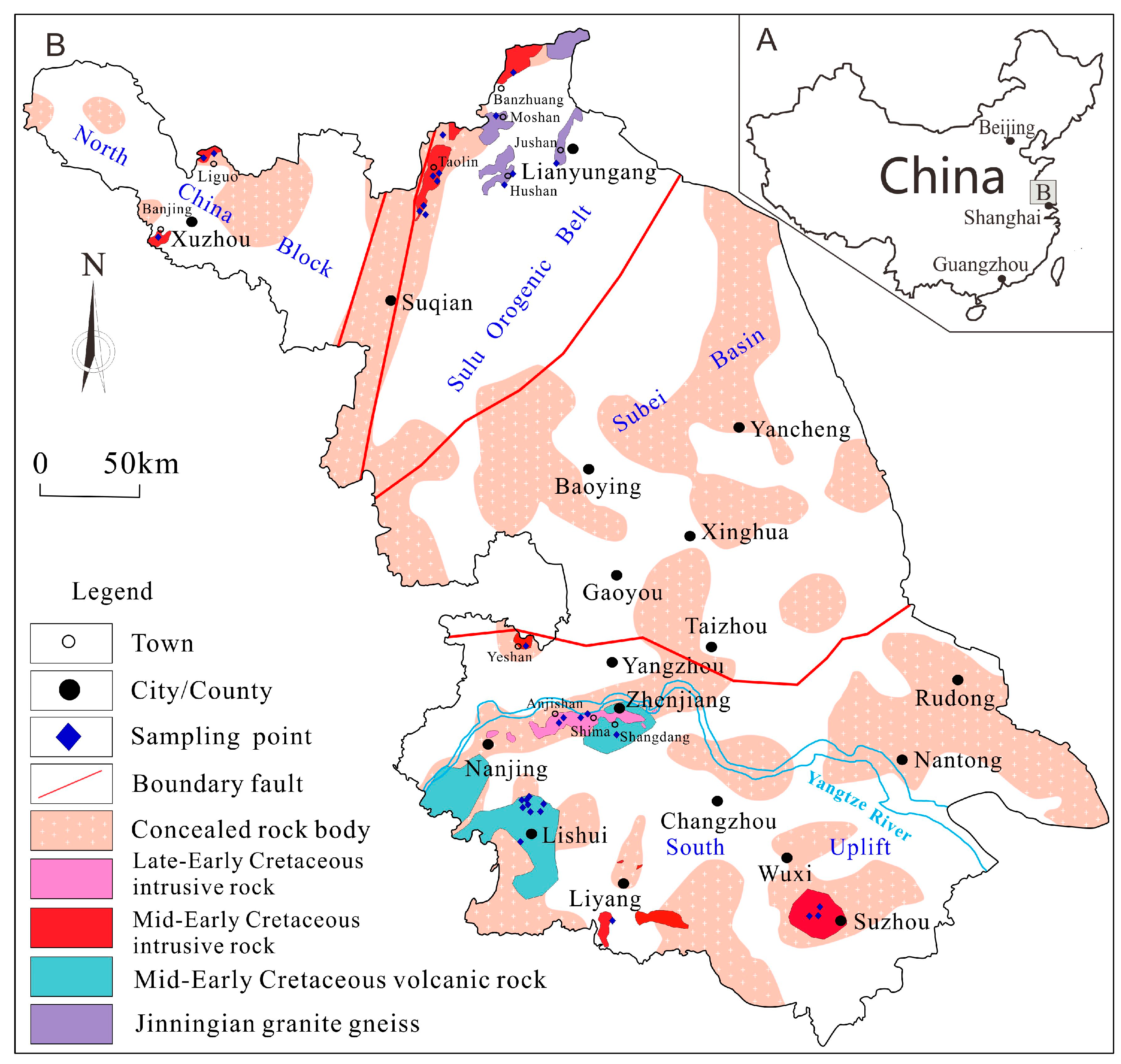
Jiangsu Province, located in eastern China, comprises three major tectonic units with a complex evolutionary history: the North China Block, the Sulu Orogenic Belt, and the Yangtze Block. The Yangtze Block is further subdivided into the Subei Basin and the South Jiangsu Uplift (Figure 1). After the Indosinian orogenic movement, the North China and Yangtze blocks collided and amalgamated along the Sulu Orogenic Belt into a unified whole. Subsequently, the region experienced intense Mesozoic tectono-magmatic-mineralization thermal events and strong Meso-Cenozoic lithospheric stretching and thinning events, both of which are controlled by the Pacific tectonic domain [27]. This process provided the key tectonic-thermal background for the formation of geothermal resources [28].
Magmatic activities in Jiangsu Province are intense and widely distributed (Figure 1), most notably during the Mesozoic Yanshanian period, followed by the Proterozoic Jinning and Cenozoic Himalayan periods. The outcrop area of intrusive rocks is limited due to extensive coverage by Quaternary sediments [29], but geophysical data (regional aeromagnetic, gravity, etc.) infer the presence of numerous concealed to semi-concealed intrusive rock masses [30,31], which are important for studying regional geothermal geological conditions.
Proterozoic Jinningian magmatism is distributed within the Sulu Orogenic Belt, mainly consisting of intermediate-basic to acidic submarine flood volcanic rocks, accompanied by extensive acidic magmatic intrusions. After subsequent ultrahigh-pressure (UHP) metamorphism caused by the collision and amalgamation of the South China and North China blocks in the Triassic period (240–220 Ma), the former formed amphibolite, schist, and leptynite, and the latter formed granitic gneisses, represented by the Niushan, Hushan, Chengtou, and Tuofeng units of the Donghai Group [32,33]. The two together constitute the regional metamorphic basement [27].
Mesozoic magmatic rocks are distributed across various regions (Figure 1B), manifesting as continental volcanic eruptions and intermediate-acidic magmatic intrusions. The former formed intermediate-acidic lavas and subvolcanic rocks, mainly distributed in the Ningwu, Lishui, and Shangdang volcanic basins [34,35,36]. The latter formed intermediate-acidic granites, granodiorites, and diorites, characterized by multi-phase, multi-center activity, often forming larger-scale complex plutons along regional deep faults and their intersections, such as the Taolin, Anjishan, Shima, and Suzhou intrusive complexes [37,38]. These intermediate-acidic intrusive rocks, enriched in U, Th, and K, possess high radiogenic heat production, directly influencing the regional geothermal field [39].
Cenozoic magmatism is relatively weak, with simple rock types, mainly composed of basalt eruptions and basic intrusions of gabbro and diabase dykes. It started in the Paleocene, with intense eruptions during the Miocene to Pliocene, and no activity has been recorded since the Pleistocene [27]. Given their predominantly basic composition and limited scale, these Cenozoic magmatic rocks have a minimal impact on the present-day geothermal field.

3. Sample Collection and Testing

3.1. Sample Collection

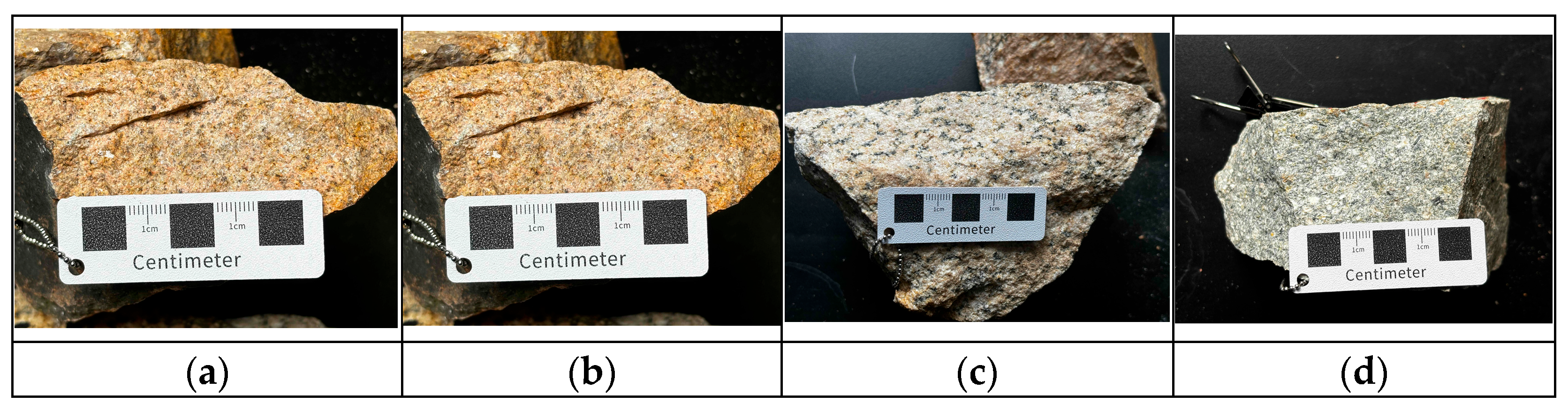
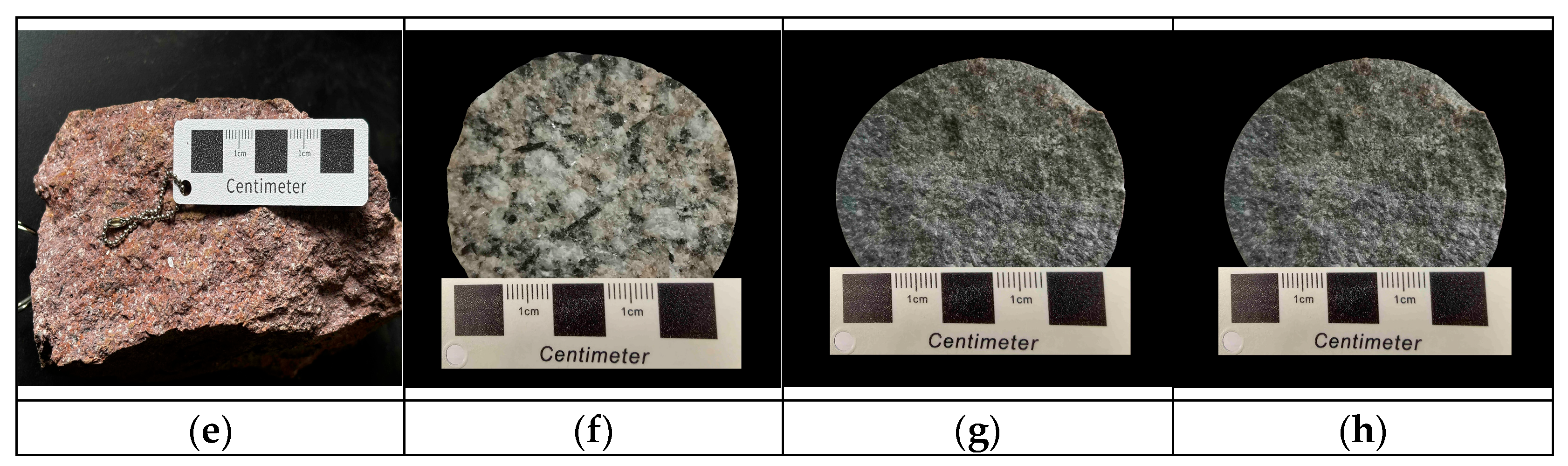
Focusing on the Jinningian and Yanshanian periods, 34 representative magmatic rock samples were collected from different tectonic units in Jiangsu Province via surface outcrops and drill cores. Sampling locations are shown in Figure 1 and Table 1, with some samples illustrated in Figure 2. Lithologies include granite, granitic porphyry, granodiorite, quartz diorite, granitic gneiss, volcaniclastic rocks, dacite, andesite, trachyandesite, and gabbro. All samples showed no significant weathering or alteration, ensuring that the test results reflect the original thermal properties of the rocks.

3.2. Sample Testing

The sample testing was conducted in the Nanjing Mineral Resources Supervision and Testing Center of the Ministry of Land and Resources. The tested items include thermal conductivity, specific heat capacity, density, porosity, and the contents of U, Th, and K elements.

3.2.1. Thermal Conductivity and Specific Heat Capacity Testing

Based on the transient plane source method proposed by Silas Gustafsson [40], the thermal conductivity and thermal diffusivity of natural-state rocks were measured using a thermal constants analyzer (TPS 2500S, Hot Disk AB, Göteborg, Sweden) at room temperature and normal atmospheric pressure. The specific test method is described in Zhao et al. [41]. Then, the specific heat capacity of the samples was calculated using Formula (1).
c = λ α · ρ 0
where c is the specific heat capacity (kJ/(kg·K)); λ is the thermal conductivity (W/(m·K)); α is the thermal diffusivity (mm2/s); ρ 0 is the natural density (g/cm3), which is obtained by Formula (2).

3.2.2. Density Testing

The wax-sealing method was used to measure the bulk density of rocks, based on Archimedes’ principle. Natural density and dry density were calculated using Formulas (2) and (3) respectively.
ρ 0 = m 0 m 1 m 2 ρ w t m 1 m 0 ρ n
ρ d = m d m 1 m 2 ρ w t m 1 m d ρ n
where ρ d is the dry density (g/cm3); m 0 is the mass of the natural rock sample (g); m d is the mass of the dried rock sample (g); m 1   is the mass of the sample coated with paraffin in air (g); m 2 is the mass of the sample coated with paraffin in water (g); ρ w t is the density of water at t °C (g/cm3); ρ n is the density of paraffin (g/cm3).

3.2.3. Porosity Testing

Porosity was calculated from the dry density and grain density using Formula (4).
n = 1 ρ d / ρ s × 100 %
where n is the porosity (%); ρ d is the dry density (g/cm3), which is obtained by Formula (3); ρ s is the particle density of the sample (g/cm3), which is measured by the pycnometer method. The principle involves dispersing a known mass of dry rock powder in water within a pycnometer. After removing air via vacuum extraction, the mass of the pycnometer filled with both rock powder and water is measured, along with the mass of the pycnometer filled solely with water under identical conditions. The grain density of the rock is then calculated.

3.2.4. Radioactive Heat-Producing Elements (U, Th, K) Testing

Major elements were analyzed using X-ray fluorescence spectrometry (XRF), with analysis precision (relative error) better than 1%. The K2O content was determined as part of the major element analysis. Trace elements were analyzed using inductively coupled plasma mass spectrometry (ICP-MS) following acid digestion and sample preparation, with analytical precision and accuracy better than 10% [42].

4. Results

4.1. Density

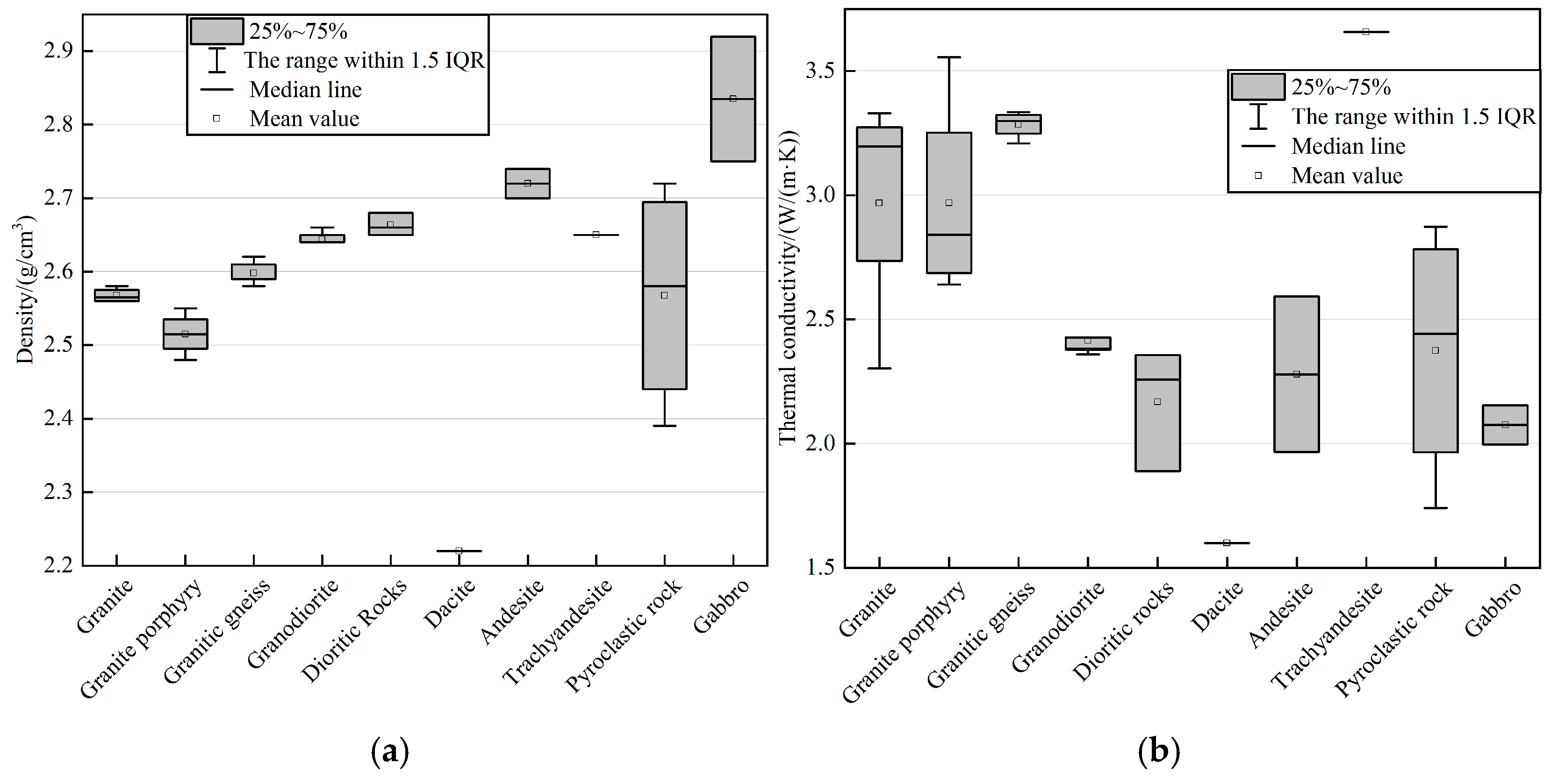
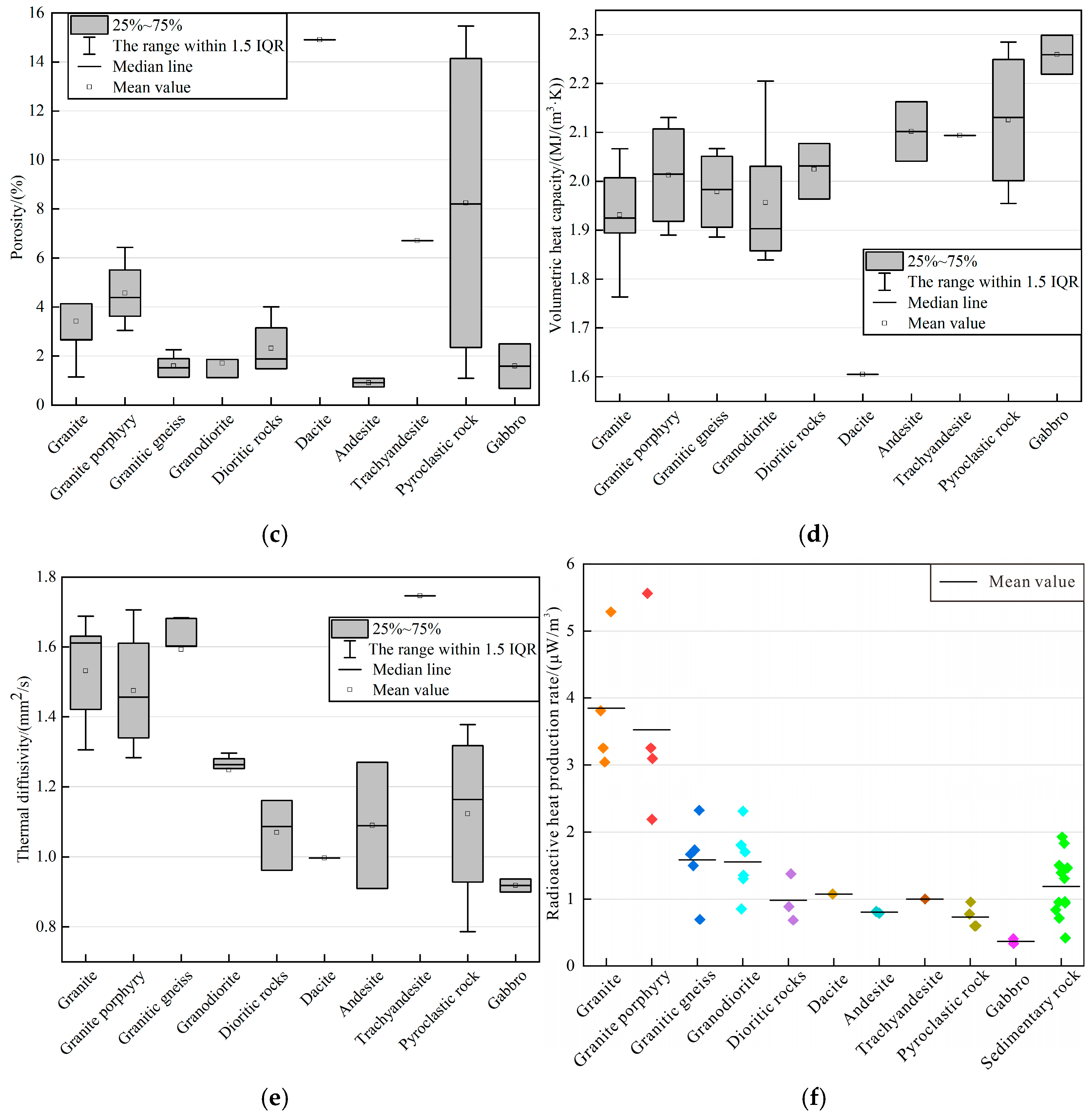
The measured density of magmatic rocks ranges from 2.22 to 2.92 g/cm3. In descending order: Gabbro has the highest density, averaging 2.84 ± 0.12 g/cm3; followed by andesite at 2.72 ± 0.03 g/cm3; diorite averages 2.66 ± 0.09 g/cm3; granodiorite averages 2.64 ± 0.02 g/cm3; granitic gneiss averages 2.60 ± 0.02 g/cm3; volcaniclastic rock averages 2.57 ± 0.16 g/cm3; granite averages 2.57 ± 0.10 g/cm3; granitic porphyry averages 2.52 ± 0.03 g/cm3. Overall, the density of magmatic rocks increases continuously with the evolution of lithology from acidic (granite, granite porphyry) to basic (gabbro) (Figure 3a). The density of volcaniclastic rocks has a large interquartile range (2.39–2.73 g/cm3), reflecting complex mineral composition and variable texture/structure. The average density values of intermediate-acidic magmatic rocks such as granite, granodiorite, diorite, and andesite are close to the median, with symmetric and concentrated data distribution, indicating similar mineral composition and relatively homogeneous texture/structure.

4.2. Thermal Conductivity

The thermal conductivity of magmatic rocks ranges from 1.60 to 3.66 W/(m·K). Granite, granitic porphyry, granitic gneiss. Among them, granitic gneiss have an average value of 3.16 ± 0.30 W/(m·K); granite has an average thermal conductivity of 2.97 ± 0.44 W/(m·K), the same as the granite porphyry which has an average value of 2.97 ± 0.41 W/(m·K). The thermal conductivities of the remaining magmatic rocks are similar, with relatively lower average values (<2.50 W/(m·K)). Among them, granodiorite has an average thermal conductivity of 2.42 ± 0.07 W/(m·K), pyroclastic rock has an average value of 2.37 ± 0.51 W/(m·K), andesite has an average value of 2.28 ± 0.44 W/(m·K), diorite has an average value of 2.17 ± 0.25 W/(m·K), gabbro has an average value of 2.08 ± 0.11 W/(m·K) (Figure 3b).

4.3. Porosity

The porosity of magmatic rocks is influenced by the morphology, size, and intercalation characteristics of mineral grains. The more uniform the mineral grains, the smaller their size, and the tighter their intercalation, the smaller the porosity [14,43]. The porosity of magmatic rocks ranges from 0.68% to 15.47%. Among them, pyroclastic rocks exhibit high porosity characteristics (with an average value of 8.25 ± 6.97%), and their interquartile range is the widest. This is related to the complex mineral composition of pyroclastic rocks and the uneven structure caused by the differential compaction of clastic materials such as volcanic ash and breccia during the diagenetic process [44]. The porosity values of other magmatic rocks are relatively low (<7%) and generally similar. The detailed classification shows the following characteristics: granite and granite porphyry have relatively high porosities, with average values of 3.42 ± 2.00% and 4.57 ± 1.41% respectively; granodiorite, diorite, gabbro, and granitic gneiss have moderate porosities, with average values ranging from 1.59% to 2.31%; andesite exhibits the lowest porosity, averaging 0.92 ± 0.25%, and also has the narrowest interquartile range (Figure 3c). The above variation characteristics may be related to the differences in the mineral structure of magmatic rocks. Granite generally has a medium-to-coarse-grained structure, with a high euhedral degree of mineral crystals and coarse grains; this results in relatively large pores between different grains. Granodiorite, diorite, gabbro, and other rocks generally have a medium-to-fine-grained structure, with subhedral mineral crystals as the main form, and moderately developed pores between grains; while andesite generally has a microcrystalline-cryptocrystalline structure, with anhedral mineral crystals as the main form, the smallest grains, and the lowest porosity between grains (Figure 2).

4.4. Volumetric Heat Capacity

The volumetric heat capacity of rocks is a key parameter characterizing the heat storage capacity per unit volume of rocks, which is calculated from the density and specific heat capacity of rocks [45].
C v = ρ · c
where Cv is the volumetric heat capacity (MJ/(m3·K)), ρ is the rock density (g/cm3), and c is the rock specific heat capacity (MJ/(kg·K)).
The volumetric heat capacity of magmatic rocks in the study area ranges from 1.61 to 2.30 MJ/(m3·K). The average volumetric heat capacity in descending order is: gabbro (2.26 ± 0.06 MJ/(m3·K)), pyroclastic rocks (2.13 ± 0.15 MJ/(m3·K)), andesite (2.10 ± 0.09 MJ/(m3·K)), diorite (2.02 ± 0.06 MJ/(m3·K)), granite porphyry (2.01 ± 0.11 MJ/(m3·K)), granitic gneiss (1.98 ± 0.08 MJ/(m3·K)), granodiorite and granite have similar volumetric heat capacities with average values ranging from 1.96 to 1.93 MJ/(m3·K). The volumetric heat capacity values of magmatic rocks are generally similar and increase slightly as the composition of magmatic rocks evolves from acidic to basic (Figure 3d).

4.5. Thermal Diffusivity

Thermal diffusivity, an important thermophysical parameter characterizing the rate of temperature transfer inside a material, is calculated from thermal conductivity, density, and volumetric heat capacity. It is proportional to thermal conductivity and inversely proportional to the product of density and volumetric heat capacity [46].
α = λ / ( ρ · C p )
where α is the thermal diffusivity of the rock (mm2/s); λ is the thermal conductivity (W/(m·K)); ρ is the rock density (g/cm3); and Cp is the rock specific heat capacity (MJ/(kg·K)).
The thermal diffusivity of magmatic rocks in the study area generally ranges from 0.79 to 1.75 mm2/s, which can be roughly divided into three groups: acidic magmatic rocks (granite, granite porphyry, granitic gneiss) have relatively high thermal diffusivity, with average values ranging from 1.48 to 1.59 mm2/s; intermediate-acidic magmatic rocks (granodiorite, diorite, andesite, etc.) have moderate thermal diffusivity, with average values ranging from 1.07 to 1.25 mm2/s; basic gabbro has the lowest thermal diffusivity, with an average value of 0.92 ± 0.03 mm2/s (Figure 3e).

4.6. Radiogenic Heat Production

The radiogenic heat production was calculated based on the rock density and the contents of U, Th, and K using Formula (7) [47]:
A = 0.01 ρ ( 9.52 C u + 2.56 C T h + 3.48 C k )
where A is the radiogenic heat production (μW/m3); ρ is the rock density (g/cm3); C u   and C T h   are the contents of radioactive heat-producing elements U and Th in the rock (μg/g) respectively; and C k is the weight percentage of K in the rock (%).
The U content in magmatic rocks ranges from 0.48 to 11.90 μg/g, with an average of 2.29 ± 2.22 μg/g; the Th content ranges from 1.53 to 53.8 μg/g, with an average of 14.22 ± 12.59 μg/g; the Th/U ratio ranges from 1.73 to 18.13, with an average of 6.46 ± 4.01; the K2O content ranges from 0.19 to 6.18%, with an average of 3.19 ± 1.45%; and the radiogenic heat production ranges from 0.60 to 5.56 μW/m3, with an average of 1.74 ± 1.32 μW/m3 (Appendix A).
Statistics on the heat production of different types of rocks show (Figure 3f) that the radiogenic heat production of magmatic rocks gradually decreases as the composition of magmatic rocks evolves from acidic to basic. Among them, granite has the highest radiogenic heat production, with an average value of 3.85 ± 1.01 μW/m3 and a maximum value of 5.29 μW/m3; granite porphyry is next, with an average value of 3.52 ± 1.44 μW/m3 and a maximum value of 5.56 μW/m3. Gabbro has the lowest radiogenic heat production, with an average value of 0.37 ± 0.05 μW/m3. The radiogenic heat production of other magmatic rocks is similar, with average values ranging from 0.70 to 1.69 μW/m3, which are basically consistent with the heat production of sedimentary rocks in the Subei Basin [28]. This indicates that, except for acidic granite (porphyry), the contribution of the radiogenic heat production of other magmatic rocks is comparable to that of sedimentary strata and cannot provide an anomalous heat source for the formation of geothermal resources.
High heat-producing granite (HHP) generally refers to granite with a radiogenic heat production greater than 5 μW/m3 [19]. The heat generated by its radioactive decay is significantly higher than other types of rocks, and can provide an important heat source for the formation of geothermal resources, especially in areas lacking modern volcanic or magmatic activities [48,49]. The average heat production of granite (and granite porphyry) in the study area was 3.31 μW/m3. This value is slightly higher than the global average for Mesozoic-Cenozoic granites (3.09 μW/m3 [50]), but comparable to that of granites in the Zhangzhou geothermal field in Fujian Province, China (3.32 μW/m3 [51]) and the granite in the Gonghe hot dry rock geothermal field in Qinghai Province, China (3.20 ± 1.07 μW/m3 [13]). However, it is significantly lower than the high heat-producing granite in the Fogang and Huizhou areas of Guangdong Province, China (6.77 μW/m3 and 5.81 μW/m3 [24,52,53]) and the Cooper Basin in Australia (7.50–10.30 μW/m3 [23]). Notably, however, the radiogenic heat production of two granite samples from the Suzhou pluton (5.22 μW/m3 and 5.56 μW/m3) meets the standard for HHP granite, which may have an important impact on the formation of regional geothermal resources.

5. Discussion

5.1. Influencing Factors on Rock Thermal Conductivity

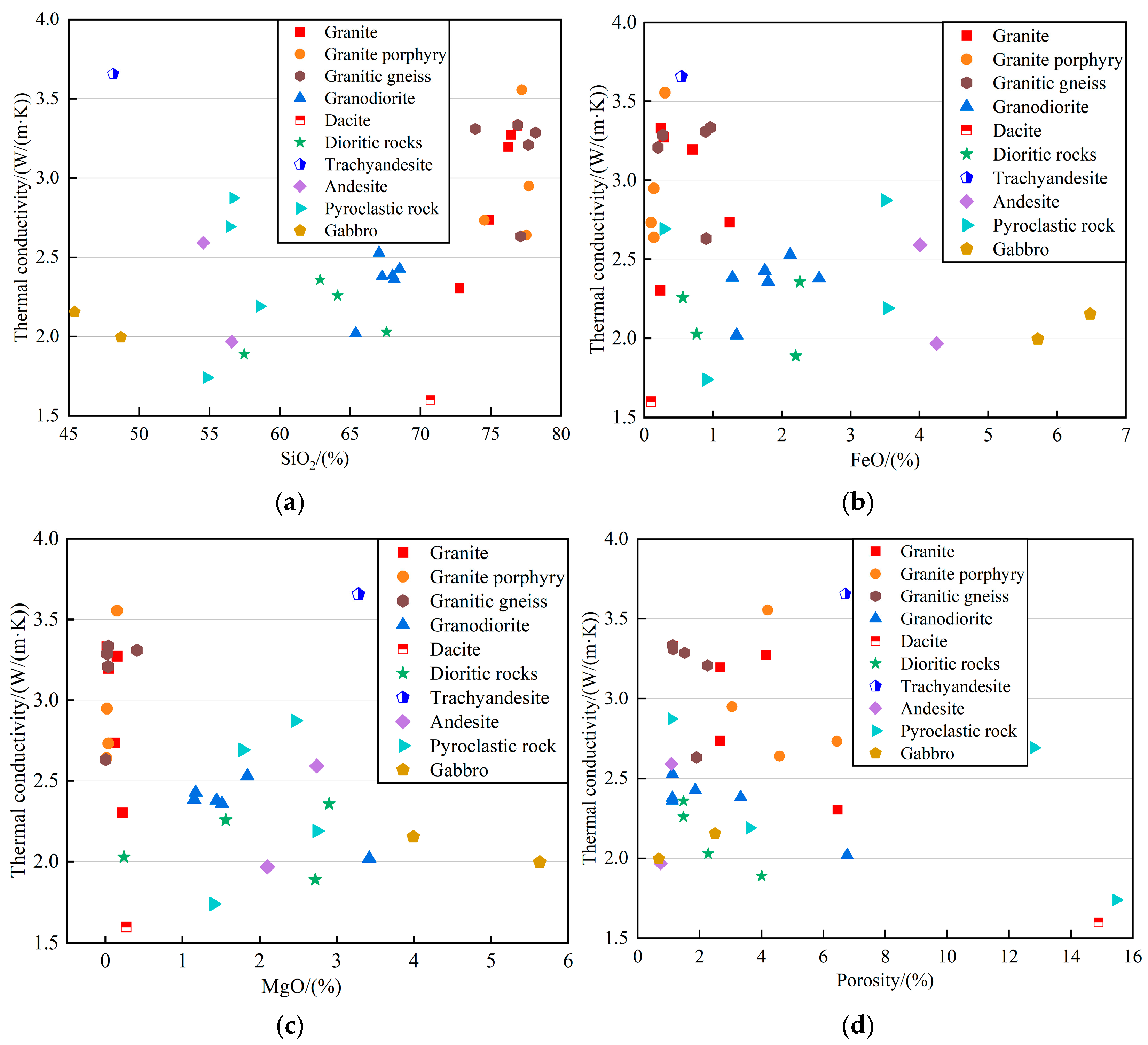
The thermal conductivity of rocks is affected by mineral composition, porosity, water saturation, temperature, pressure, etc. [19,28], but is primarily controlled by mineral composition, porosity, and water saturation [53,54]. The thermal conductivity of magmatic rocks in the study area shows a significant positive correlation with the SiO2 content (Figure 4a), reflecting that the thermal conductivity is mainly controlled by the content of quartz. As the content of minerals with high thermal conductivity (e.g., quartz) in magmatic rocks increases, the thermal conductivity also increases rapidly [14,55,56]; while the contents of FeO and MgO have a negative correlation with thermal conductivity (Figure 4b,c), reflecting that the increase in the content of mafic minerals lead to a continuous decrease in the overall thermal conductivity of the rock [43,57]. Porosity and thermal conductivity show an overall negative correlation (Figure 4d). Increased porosity raises the air proportion in the heat transfer path, forming thermal barriers and reducing rock thermal conductivity. However, when porosity is low (<7%), its relationship with thermal conductivity is not obvious, indicating that mineral composition dominates the influence on thermal conductivity under low-porosity conditions.

5.2. Source of Radiogenic Heat Production

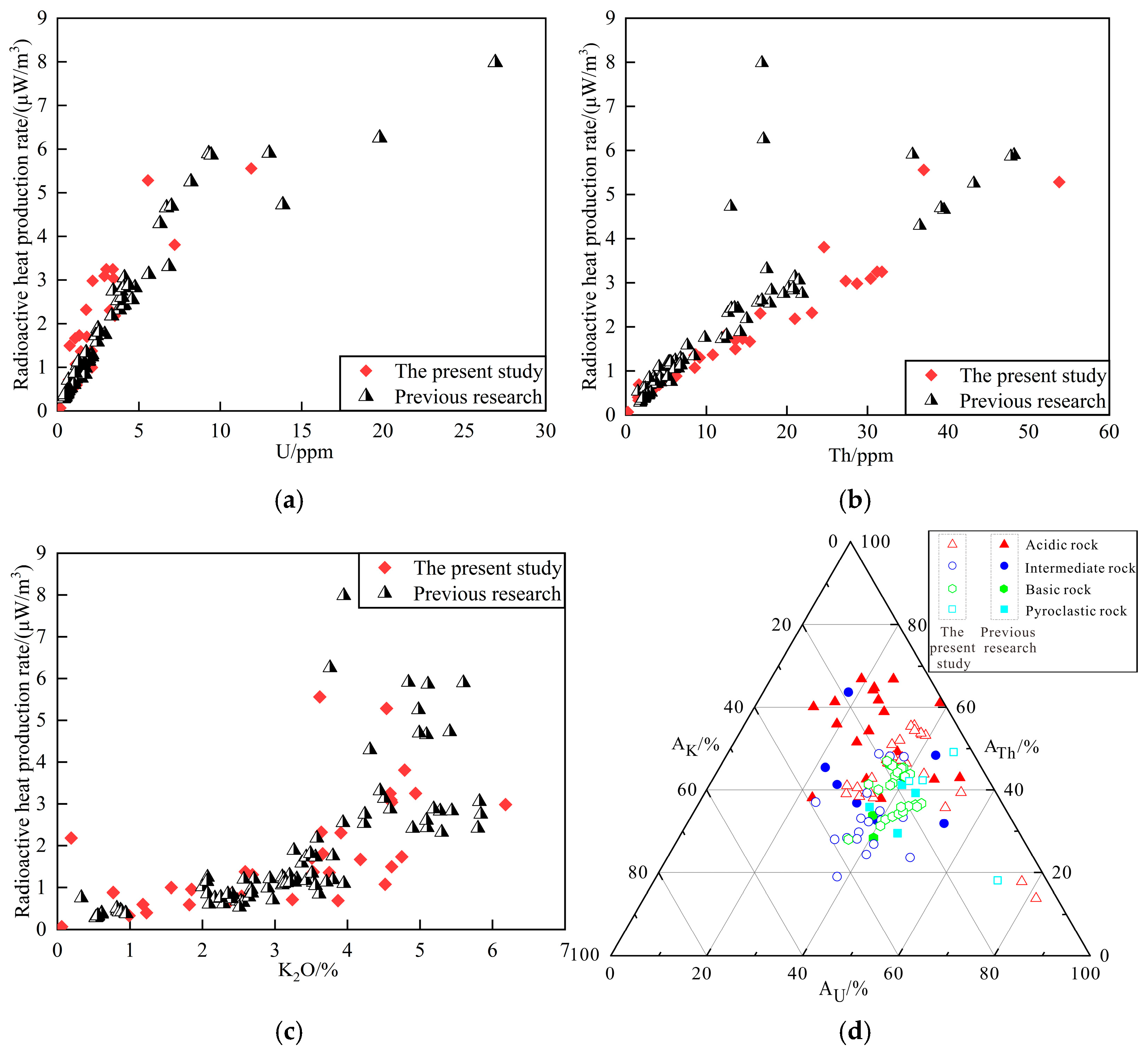
Combining this study with previously published geochemical data of magmatic rocks [58,59,60,61,62,63,64,65], the radiogenic heat production of magmatic rocks is summarized. The results show a clear linear relationship between heat production and U and Th content (Figure 5a,b), indicating that U and Th are the primary elements for radiogenic heat production, with U being slightly more sensitive than Th. The correlation with K2O is weaker and more scattered (Figure 5c), only slightly stronger when K2O < 4.0%. A ternary diagram further shows (Figure 5d) that heat production in magmatic rocks mainly originates from U and Th decay, with K contributing the least.
The contributions of radioactive elements in different types of magmatic rocks are slightly different. From acidic to basic rocks, the average heat production contributions of U and K2O gradually increase. For example, the contributions of U and K2O in acidic rocks are 32% and 16% respectively, and gradually increase to 39% and 30% in basic rocks, while the average contribution of Th significantly decreases.
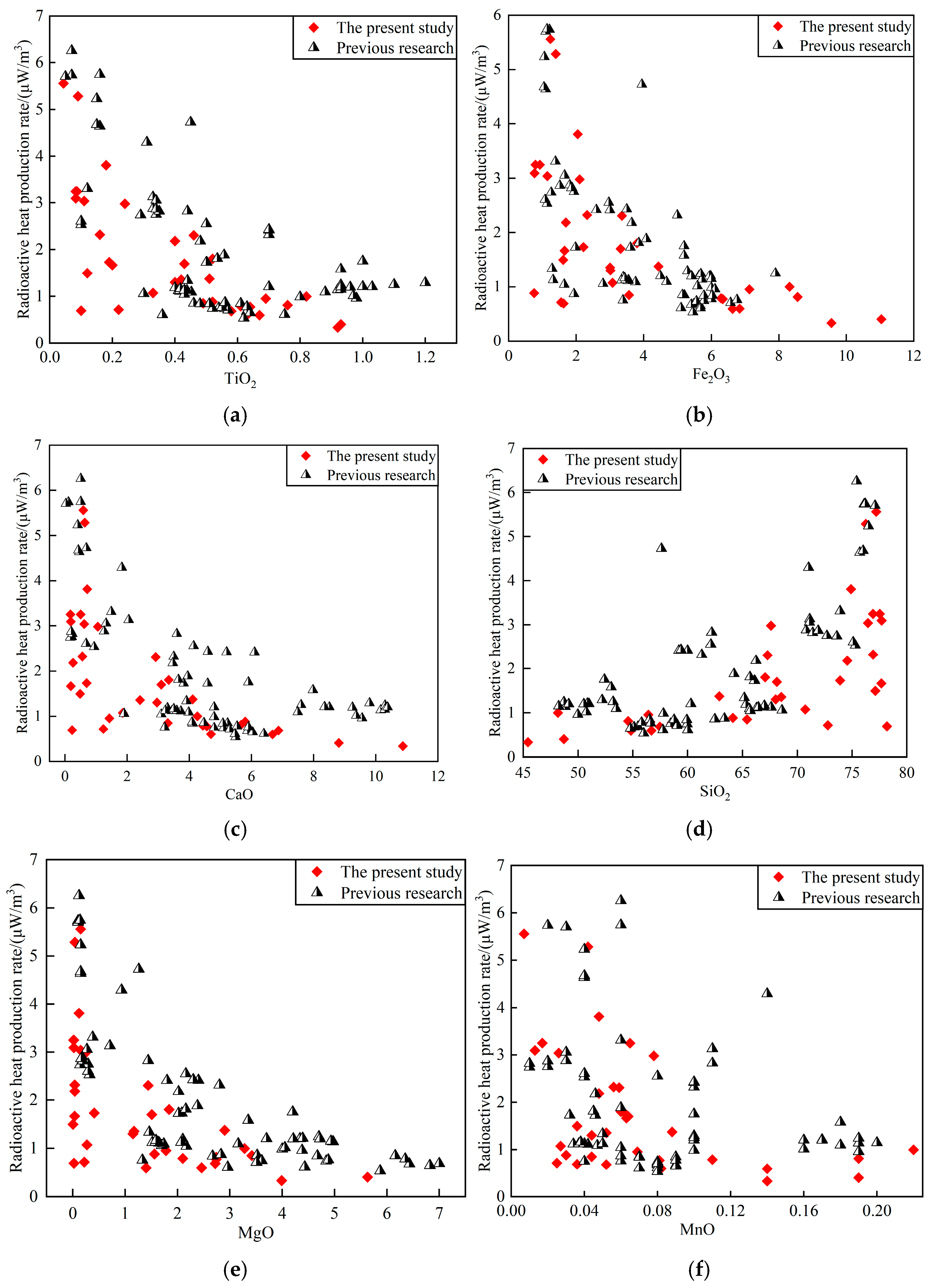
In terms of geochemical correlation, the radiogenic heat production shows significant positive correlations with U, Th, K2O, and SiO2, and negative correlations with CaO, Fe2O3, MnO, MgO, and TiO2 (Figure 6). This indicates that with the increase in SiO2 content, incompatible elements U and Th tend to enrich in felsic melts, leading to higher heat production in intermediate-acidic magmatic rocks compared to intermediate-basic ones [55,66,67]. Notably, Jingning granitic gneiss (~700–800 Ma) distributed within the Sulu orogenic belt and mid-Early Cretaceous granitic rocks (~130 Ma) all have high SiO2 content (>70%), but their heat production rates differ significantly, averaging 1.58 ± 0.52 μW/m3 and 4.21 ± 1.35 μW/m3, respectively (Table 2). During the Sulu orogenic moment in the late Mesozoic, the Jinningian magmatic rocks experienced intense deformation and metamorphism, potentially causing activation and migration of mobile elements like U and Th [68], leading to significantly reduced element content, while K2O content changed little (Appendix A). Loss of radioactive elements is the main reason for the difference in heat production.

5.3. Spatiotemporal Evolution of Radiogenic Heat Production

Samples can be divided into three periods based on diagenetic age: Jinningian magmatic rocks (~700–800 Ma [33,69,70]) are distributed within the Sulu Orogenic Belt; mid-Early Cretaceous (~130 Ma [58,59,63,71]) magmatic rocks exposed in tectonic uplift areas across the province; and late-Early Cretaceous (~105 Ma [38,62]) magmatic rocks are distributed within the Ningzhen (Nanjing-Zhenjiang) tectonic-magmatic belt, located near the northern boundary of the South Jiangsu Uplift (Figure 1, Table 2).
Temporally, radiogenic heat production of Jinningian granitic gneiss averages 1.58 ± 0.52 μW/m3; mid-Early Cretaceous intrusive rocks from different tectonic units average 2.62 ± 1.50 μW/m3, with a large variation range (0.70–3.54 μW/m3); late-Early Cretaceous magmatic rocks average 1.45 ± 0.27 μW/m3. For intrusive rocks over a large age span, there is no consistent trend of heat production change with diagenetic age, likely due to superimposed influences from lithology, genetic mechanisms, and later alteration. However, within the South Jiangsu Uplift, late-Early Cretaceous magmatic rocks (Anjishan, Shima, ~105 Ma) show significantly lower heat production than mid-Early Cretaceous ones (Suzhou pluton, Miaoxi pluton, ~130 Ma), decreasing from 3.54 μW/m3 to 1.45 μW/m3. This may relate to differences in the deep geological processes of magmatic rock formation. Studies suggest that eastern China entered an extensional regime starting around ~135 Ma, divisible into early EW-SE extension (120–135 Ma) and late WE extension (100–120 Ma) stages [72,73]. During early extension, Asthenosphere upwelling heated the lithosphere, and lithospheric extension caused decompression melting, forming abundant bimodal magmatic rocks. Acidic intrusive rocks (SiO2 > 75%) formed by the lower crust are rich in incompatible elements (U, Th, K). With intensified extension, strong crust-mantle interactions like lower crustal delamination and lithospheric thinning occurred, forming abundant crust-mantle mixed magmatic rocks (SiO2 < 70%), typified by adakites in the Ningzhen area [74]. The addition of mantle-derived magma components diluted U, Th, and K content, leading to reduced heat production.
Spatially, mid-Early Cretaceous magmatic rocks (~130 Ma), products of contemporaneous tectonic-magmatic events, are exposed from the North China Block, Sulu Orogenic Belt, to the South Jiangsu Uplift. Their average heat production is 0.75 ± 0.07 μW/m3, 2.75 ± 0.64 μW/m3, and 3.54 ± 1.79 μW/m3, respectively, showing an increasing trend from north to south, possibly related to different formation mechanisms or source materials of magmatic rocks across tectonic units.
By tectonic unit, magmatic rocks in the North China Block have the lowest heat production, consistent with the relatively low geothermal gradient in this area, indicating their small contribution to the regional geothermal field. The Sulu Orogenic Belt contains magmatic activity from two periods. The radiogenic heat production of Jinningian granitic gneiss (~700–800 Ma)is similar to sedimentary rocks (Figure 5b), thus not an indicator for geothermal exploration. Mid-Early Cretaceous magmatic rocks (~130 Ma) formed several large complexes around intrusive centers, represented by the Taolin pluton with relatively high heat production (2.99 μW/m3), providing favorable conditions for geothermal resource formation. Mid-Early Cretaceous magmatic rocks (~130 Ma) in the South Jiangsu Uplift exhibit bimodal characteristics, with large differences in heat production: acidic granitic rocks have high heat production (average 3.54 μW/m3), contrasting sharply with intermediate-basic volcanic-subvolcanic rocks having low heat production (average 0.70 μW/m3). Granitic rocks are sporadically exposed but have large concealed batholiths at depth. Some granites meet HHP standards, providing important heat source conditions for regional geothermal resources.

5.4. Thermal Effect of Magmatic Rocks

The surface outcrop of magmatic rocks in Jiangsu Province is limited, but regional geophysical interpretations indicate numerous concealed plutons. Their impact on the present-day geothermal field and thermal effect merits discussion. Previous studies show that magmatic residual heat of shallow crustal intrusions generally dissipates within 10 Ma [75,76]. Magmatic intrusions in Jiangsu occurred mainly during the Jinningian and Yanshanian periods. Although intrusions are large, their formation age is relatively old; magmatic residual heat has transferred to the country rocks and reached thermal equilibrium, thus not constituting an additional heat source. However, intermediate-acidic intrusive rocks, especially HHP granites, have high radiogenic heat production. Heat accumulated via radioactive decay can serve as a reliable heat source for geothermal resources. In areas overlain by low thermal conductivity cover rocks, they can significantly affect the geothermal field distribution. For example, the high-heat-producing granite (7.50–10.30 μW/m3) in Australia’s Cooper Basin makes important contributions to the formation of high-temperature hot dry rock resources [23,77]. Abundant HHP granites are distributed in south China, which is an important terrestrial heat flow anomaly area [7], and numerous hot springs are closely related to HHP granites, indicating their importance for geothermal resource formation.
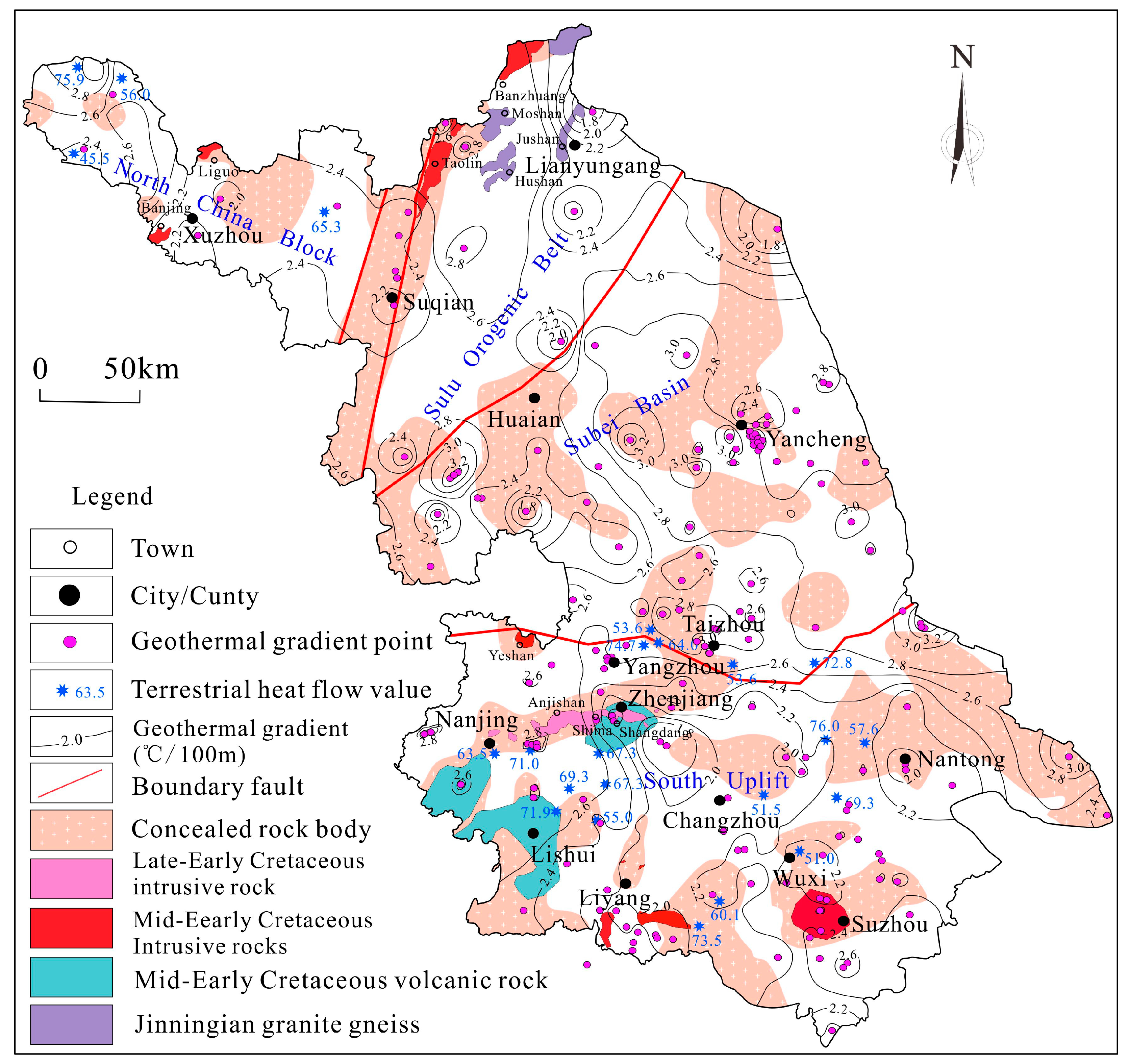
Studies show the Subei Basin is the most geothermal-rich area in Jiangsu Province, with an average geothermal gradient of 30 °C/km, ranking the highest in the province. This is attributed to the thick Cenozoic low thermal conductivity cover (several kilometers), which provides a stable thermal insulation layer [11]. The contribution of concealed plutons to geothermal anomalies is relatively weak, only correlating with geothermal gradient anomalies in a few areas like western Yancheng and Taizhou. In other tectonic uplift areas or shallow cover areas outside the Subei Basin, where Cenozoic sedimentary cover is thin (generally <2 km), the distribution of magmatic rocks exerts a more significant impact on the regional geothermal field, especially in the South Jiangsu Uplift. Geothermal gradient anomaly areas in Nanjing, Suzhou, and southeastern Nantong correspond well with the distributions of concealed magmatic rocks, and high terrestrial heat flow anomalies (>70 mW/m2) are also distributed around plutons, indicating clear control by plutons on regional geothermal anomalies (Figure 7).

5.5. Radioactive Heat Contribution of Granite Plutons

Plutons with heat production > 3 μW/m3 may contribute more than 80% to the crustal heat flow [78]. This study selected the Taolin pluton (2.99 μW/m3) and Suzhou pluton (4.88 μW/m3), which have large surface exposure and relatively high heat production, to calculate their radioactive heat contribution.
The heat production of granite is mainly related to the type of granite, the degree of crystallization differentiation, and alteration intensity [79]. With the enhancement of crystallization differentiation, the granite exposed near the surface shows a high heat production due to the enrichment of radioactive elements. The heat production inside the pluton shows a vertical gradient decrease, decaying exponentially with depth [46,80].
According to the regional tectonic background and geophysical data, the average crustal thickness in Jiangsu Province is ~32 km [81]. Integrated interpretations of regional seismic profiles, combined with drilling data and non-seismic geophysical surveys (including gravity, magnetic, and magnetotelluric methods), indicate that the thickness of some concealed intermediate-felsic intrusive rocks in the Subei Basin attains thicknesses of up to 10 km [82], In previous studies on the crustal thermal structure of southeastern China, the thickness of the radiogenic heat-producing layer was set to 10 km [51], therefore, the average thickness of the Taolin and Suzhou pluton complexes was set at 8–10 km. An exponential decay model was used to calculate the variation of heat production with depth [83]:
A z = A 0 e x p ( Z / D )
where A0 is the heat production of granite at the surface (μW/m3); Az is the heat production of granite at depth Z (km) (μW/m3); and D is the thickness of the granite mass (km).
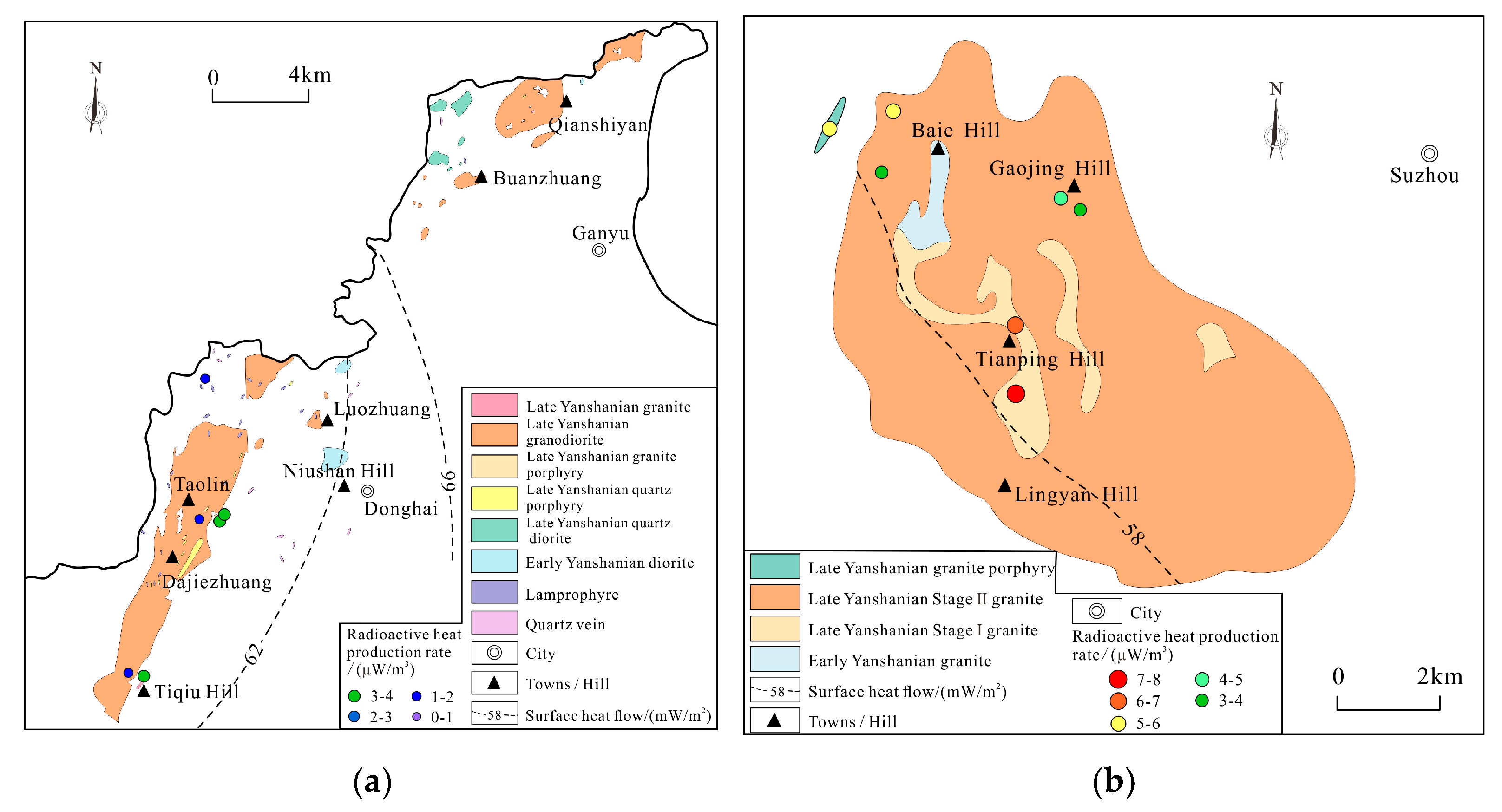
Heat production at depth z (km) was calculated for 4 samples from Taolin and 7 samples from Suzhou (3 samples from this study, 4 samples from previous studies [65]). The average heat production for Taolin is 2.01 ± 0.65 μW/m3 (range 1.12–3.25 μW/m3); for Suzhou is 3.31 ± 1.47 μW/m3 (range 1.15–7.98 μW/m3) (Figure 8).
To quantitatively assess the vertical heat contribution of granite intrusions to the regional heat flow, the radiogenic heat production Az was vertically integrated over the depth intervals 0–8 km and 0–10 km separately. The vertical heat flow is given by:
Q v e r t i c a l = 0 z A ( z ) d z
Combining (8) and (9) gives (10):
Q v e r t i c a l = 0 z A 0 e x p ( z / D ) d z
The calculation results show that the vertical heat flow from the Taolin pluton is 15.97–19.96 mW/m2, and from the Suzhou pluton is 26.24–32.80 mW/m2. The average terrestrial heat flow values for the Taolin and Suzhou areas are 64.00 mW/m2 and 60.20 mW/m2, respectively [5,7]. Thus, the heat flow generated by the Taolin granite accounts for about 25–31% of the terrestrial heat flow, while the heat from the Suzhou pluton accounts for about 44–54%. Therefore, in these areas, mantle-derived heat flow constitutes the primary source of terrestrial heat flow [84], particularly in the Taolin pluton where mantle heat flow plays an even more dominant role, which is consistent with the Tan-Lu Fault Zone being a regional asthenospheric upwelling area. The conclusions are subject to uncertainty due to factors such as sample representativeness, pluton thickness, and the depth-dependent variation model of radiogenic heat production.

6. Conclusions

In this study, the thermophysical parameters of magmatic rocks in Jiangsu Province were tested, the variation laws and influencing factors of the thermophysical parameters were analyzed, the source, controlling factors, spatiotemporal evolution laws, and geothermal effects of the radiogenic heat production were discussed, and the crust-mantle heat contributions of typical rock masses were quantitatively evaluated. The main conclusions are drawn below:
  • The thermal conductivity of magmatic rocks is influenced by mineral composition, porosity, and texture/structure. When porosity is lower than 8%, mineral composition plays a decisive role. Thermal conductivity increases rapidly with higher felsic mineral content.
  • The radiogenic heat production shows a significant positive correlation with U and Th content, with U slightly more sensitive than Th, while its relationship with K2O is weaker. The thermal contribution of radioactive elements varies among rock types; Th dominates in intermediate-acidic rocks, while U dominates in basic rocks. The radiogenic heat production increases with SiO2 content, consistent with the strong incompatibility of U and Th. The later deformation and metamorphism of magmatic rocks significantly reduce the radiogenic heat production, indicating that U and Th elements have active geochemical properties and are prone to migration. The spatiotemporal variation of the radiogenic heat production of magmatic rocks may be related to regional tectonic setting, the formation mechanism, and later deformation/metamorphism.
  • The geothermal effect of magmatic rocks is affected by pluton scale, their thermophysical properties, and the sedimentary cover thickness. When radiogenic heat production is relatively low, thick, low thermal conductivity sedimentary cover plays an important role in geothermal resource formation. In tectonic uplift areas with relatively thin sedimentary cover, magmatic rocks with high heat production significantly influence the geothermal field. Calculations based on the exponential decay model indicate that the terrestrial heat flow is mainly mantle-derived both in the Taolin and Suzhou plutons.
  • The average heat production of granite (and granitic porphyry) in Jiangsu Province is 3.31 μW/m3, comparable to that of granites in the Zhangzhou geothermal field (Fujian Province) and the Gonghe hot dry rock field (Qinghai Province), but lower than that of typical global HHP granites (>5 μW/m3). However, locally occurring HHP granites are significant for the formation and exploration of regional geothermal resources.

Author Contributions

Conceptualization, J.G. and Y.W.; Methodology, J.G. and X.Z. (Xiufeng Zhao); Software, W.W.; Validation, Y.W.; Formal Analysis, Z.Q., X.Z. (Xudong Zhang) and W.W.; Investigation, Q.Z. and J.L.; Writing—Original Draft Preparation, W.W., X.Z. (Xiufeng Zhao), Q.Z. and J.L.; Writing—Review & Editing, J.G., Y.W. and Z.Q.; Visualization, X.Z. (Xudong Zhang); Supervision, J.G.; Project Administration, J.G.; Funding Acquisition, J.G. and Z.Q. All authors have read and agreed to the published version of the manuscript.

Funding

This research was funded by the Carbon Peak and Carbon Neutralization Science and Technology Innovation Special Fund of Jiangsu Province, China (Grant No. BE2022034-1).

Data Availability Statement

Data is contained within the article.

Acknowledgments

We would like to thank Haiou Wang and Dong Chen for their assistance with fieldwork. We also thank Guoqiang Fu for his assistance in fund acquisition, Jun Chen for his support in sample analysis and testing, and Shanxin Yi for his help with data analysis.

Conflicts of Interest

The authors declare no conflicts of interest.

Appendix A

Table A1. Geochemical elements and thermophysical property data of magmatic rocks in Jiangsu Province.
Sample NumberThermal ConductivityDensitySpecific Heat
Capacity
Volumetric Heat CapacityThermal DiffusivityPorositySiO2CaOFeOFe2O3MgOTiO2K2OUThHeat Production
W/(m·K)(g/cm3)kJ/(kg·K)mJ/(m3·K)(mm2/s)(%)(%)(%)(%)(%)(%)(μg/g)(%)(μg/g)(μg/g)(μW/m3)
RWX-11.892.650.741.960.964.0157.476.872.205.602.720.582.380.724.160.68
RWX-22.302.470.711.761.316.4672.781.240.231.560.220.223.240.704.310.72
RWX-32.022.510.812.030.996.7765.403.311.343.573.420.492.401.335.010.85
RWX-43.272.560.782.011.634.1476.450.620.281.150.150.114.613.4427.303.04
RWX-53.332.580.802.071.611.1576.910.510.240.930.020.084.593.0031.803.25
RWX-62.952.550.761.951.523.0577.700.190.140.770.020.084.602.8930.403.09
RWX-72.642.510.751.891.404.5877.530.180.140.800.020.094.943.4031.203.25
RWX-82.382.650.701.861.281.1267.282.922.543.361.440.463.913.2216.702.31
RWX-92.432.640.731.921.261.8668.532.421.753.011.170.423.751.738.541.36
RWX-102.032.580.731.881.082.2867.591.060.762.110.240.246.182.1628.702.98
RWX-112.632.580.731.891.401.977.120.490.901.620.010.124.610.7513.601.50
RWX-123.212.590.741.911.682.2677.670.190.201.660.040.204.181.0915.401.67
RWX-133.342.620.761.981.681.1376.920.560.962.330.040.163.641.7623.102.32
RWX-143.29 2.590.792.051.601.5278.180.230.271.630.020.103.870.951.640.69
RWX-153.312.610.792.071.601.1473.900.700.892.220.410.194.751.3414.501.73
RWX-162.382.620.701.841.303.3368.022.961.283.021.150.402.691.779.181.30
RWX-172.362.680.762.031.161.4862.874.112.264.442.900.512.592.118.681.38
RWX-182.262.660.782.081.091.4864.115.800.560.761.560.520.771.526.260.88
RWX-192.362.650.711.881.251.1268.133.101.803.321.510.433.511.8013.601.70
RWX-202.532.660.832.211.151.1267.063.342.123.811.840.523.662.4812.301.80
RWX-211.602.220.721.611.0014.970.721.860.103.080.270.334.521.128.571.07
RWX-223.202.560.741.891.692.6776.250.640.701.400.040.094.545.5653.805.29
RWX-232.742.570.751.921.422.6674.900.721.242.050.120.184.797.2024.603.81
RWX-243.562.520.832.081.714.277.200.590.301.240.150.043.6211.937.005.56
RWX-252.732.480.862.131.286.4474.560.260.101.700.040.400.193.5321.002.18
RWX-262.192.670.772.051.073.6258.574.573.536.342.740.642.341.104.060.77
RWX-272.872.720.842.281.261.0956.704.703.506.842.460.631.180.933.540.60
RWX-281.742.390.932.210.7915.4754.836.680.906.631.400.671.821.182.870.60
RWX-292.692.490.791.951.3812.8156.421.430.287.131.780.691.851.775.860.95
RWX-303.662.650.792.091.756.7148.164.260.548.323.280.821.572.124.691.00
RWX-311.972.700.802.160.910.7456.594.444.256.292.100.612.541.014.200.79
RWX-322.592.740.752.041.271.0954.585.674.018.562.740.762.411.223.780.81
RWX-332.152.750.842.300.942.545.4210.876.489.563.990.920.990.481.600.33
RWX-342.002.920.762.220.900.6848.718.815.7211.045.630.931.230.591.530.40

References

  1. Li, D.W.; Wang, Y.X. Major Issues of Research and Development of Hot Dry Rock Geothermal Energy. Earth Sci. J. China Univ. Geosci. 2015, 40, 1858–1869, (In Chinese with English Abstract). [Google Scholar]
  2. Nkinyam, C.M.; Ujah, C.O.; Asadu, C.O.; Kallon, D.V.V. Exploring geothermal energy as a sustainable source of energy: A systemic review. Unconv. Resour. 2025, 6, 100149. [Google Scholar] [CrossRef]
  3. Zhang, Y.Y.; Chen, G.X.; Ye, H.L.; Bai, X.M. Integrated application of radon measurement and conventional electrical prospecting in geothermal exploration: A case study of Lantian section, Ningdu, Jiangxi Province. Geosciences 2025, 15, 286. [Google Scholar] [CrossRef]
  4. Lund, J.W.; Toth, A.N. Direct Utilization of Geothermal Energy 2020 Worldwide Review. In Proceedings of the World Geothermal Congress 2020, Reykjavik, Iceland, 4–5 May 2020; pp. 1–25. [Google Scholar]
  5. Wang, Y.B.; Liu, S.W.; Chen, C.Q.; Jiang, G.Z.; Wu, J.H.; Guo, L.Y.; Wang, Y.Q.; Zhang, H.H.; Wang, Z.T.; Jiang, X.X.; et al. Compilation of terrestrial heat flow data in continental China (5th edition). Chin. J. Geophys. 2024, 67, 4233–4265, (In Chinese with English Abstract). [Google Scholar]
  6. Du, J.G.; Yao, W.J.; Fan, D.F. Geoheat resource types and development prospect in Jiangsu Province. J. Geol. 2012, 36, 86–91, (In Chinese with English Abstract). [Google Scholar]
  7. Jiang, G.Z.; Gao, P.; Rao, S.; Zhang, L.Y.; Tang, X.Y.; Huang, F.; Zhao, P.; Pang, Z.H.; He, L.J.; Hu, S.B.; et al. Compilation of heat flow data in the continental area of China (4th edition). Chin. J. Geophys. 2016, 59, 2892–2910, (In Chinese with English Abstract). [Google Scholar]
  8. Wang, L.S.; Li, C.; Shi, Y.S.; Wang, Y.H. Distributions of geotemperature and terrestrial heat flow density in Lower Yangtze area. Chin. J. Geophys. 1995, 38, 469–476, (In Chinese with English Abstract). [Google Scholar]
  9. Yang, F.T.; Pang, Z.H.; Duan, Z.F. Occurrence characteristics the geothermal resources in Jianhu Uplift region of Subei Basin. In Proceedings of the 25th Annual Meeting of Chinese Geophysical Society, Hefei, China, 10–14 October 2009. [Google Scholar]
  10. Xu, L.; Wang, L.S.; Yang, Q. An estimation of Hot-Dry-Rock (HDR) resources in Jiangsu Province. Geol. J. China Univ. 2014, 20, 464–469, (In Chinese with English Abstract). [Google Scholar]
  11. Wang, Y.B.; Wang, L.J.; Hu, D.; Guan, J.P.; Bai, Y.; Wang, Z.T.; Jiang, G.Z.; Hu, J.; Tang, B.N.; Zhu, C.Q.; et al. The present-day geothermal regime of the North Jiangsu Basin, East China. Geothermics 2020, 88, 101829. [Google Scholar] [CrossRef]
  12. Sun, W.; Huang, J.; Wang, X.Q.; Liu, Y.S.; Xu, X.Q.; Guan, Y. Present situation of geothermal resources development and utilization in the Yangtze River Delta region. In Proceedings of the 17th East China Six Provinces and One City Geological Science and Technology Forum, Weihai, China, 1–3 November 2023. (In Chinese). [Google Scholar]
  13. Zhang, C.; Hu, S.B.; Song, R.C.; Zuo, Y.H.; Jiang, G.Z.; Lei, Y.D.; Zhang, S.S.; Wang, Z.T. Genesis of the hot dry rock geothermal resources in the Gonghe basin: Constraints from the radiogenic heat production rate of rocks. Chin. J. Geophys. 2020, 63, 2697–2709, (In Chinese with English Abstract). [Google Scholar]
  14. Zhu, C.Q.; Chen, C.; Yang, Y.B.; Qiu, N.S. Experimental study into the factors influencing rock thermal conductivity and their significance to geothermal resource assessment. Pet. Sci. Bull. 2022, 7, 321–333, (In Chinese with English Abstract). [Google Scholar]
  15. Podugu, N.; Ray, L.; Singh, S.P.; Roy, S. Heat flow, heat production, and crustal temperatures in the Archaean Bundelkhand craton, north-central India: Implications for thermal regime beneath the Indian shield. J. Geophys. Res. Solid Earth 2017, 122, 5766–5788. [Google Scholar] [CrossRef]
  16. Maystrenko, Y.P.; Gernigon, L. 3-D temperature distribution beneath the Mid-Norwegian continental margin (the Vøring and Møre basins). Geophys. J. Int. 2018, 212, 694–724. [Google Scholar] [CrossRef]
  17. Pollett, A.; Hasterok, D.; Raimondo, T.; Halpin, J.A.; Hand, M.; Bendall, B.; McLaren, S. Heat Flow in Southern Australia and Connections With East Antarctica. Geochem. Geophys. Geosyst. 2019, 20, 5352–5370. [Google Scholar] [CrossRef]
  18. Qiu, N.S.; Chang, J.; Zhu, C.Q.; Liu, W.; Zuo, Y.H.; Xu, W.; Li, D. Thermal regime of sedimentary basins in the Tarim, Upper Yangtze and North China Cratons. China. Earth Sci. Rev. 2022, 224, 10384. [Google Scholar] [CrossRef]
  19. Wang, Y.B.; Chen, C.Q.; Zhong, Z.N.; Wang, Y.Q.; Hu, S.B.; Pang, Z.H. Reassessment of heat flow in West--Central China: Implications for the extent of the high heat flow region. Gondwana Res. 2025, 144, 64–76. [Google Scholar] [CrossRef]
  20. Bai, D.H.; Meju, M.A.; Liao, Z.J. Magnetotelluric images of deep crustal structure of the Rehai geothermal field near Tengchong, southern China. Geophys. J. Int. 2001, 147, 677–687. [Google Scholar] [CrossRef]
  21. Pierce, K.L.; Morgan, L.A. Is the track of the Yellowstone hotspot driven by a deep mantle plume?—Review of volcanism, faulting, and uplift in light of new data. J. Volcanol. Geotherm. Res. 2009, 188, 1–25. [Google Scholar] [CrossRef]
  22. Maryanto, S.; Dewi, C.N.; Syahra, V.; Rachmansyah, A.; Foster, J.H.; Nadhir, A.; Santoso, D.R. Magnetotelluric-geochemistry investigations of blawan geothermal field, East Java, Indonesia. Geosciences 2017, 7, 41. [Google Scholar] [CrossRef]
  23. Meixner, A.J.; Kirkby, A.L.; Lescinsky, D.T.; Horspool, N. The Cooper Basin 3D map version 2: Thermal modelling and temperature uncertainty. Geosci. Aust. Rec. 2012, 60, 1–52. [Google Scholar]
  24. Tian, F.; Qi, S.h.; Wang, S.; Xiao, Z.C.; Kuang, J. Characteristics of radioactive heat production rate of rocks in Shiba-Huangshadong area, Huizhou, Guangdong Province. Chin. J. Geol. 2020, 55, 1277–1289, (In Chinese with English Abstract). [Google Scholar]
  25. Weinert, S.; Bär, K.; Scheuvens, D.; Sass, I. Radiogenic heat production of crystalline rocks in the Gonghe Basin Complex (northeastern Qinghai--Tibet plateau, China). Environ. Earth Sci. 2021, 80, 270. [Google Scholar] [CrossRef]
  26. Song, N.; Shi, G.H.; Gao, G.Q.; Xin, R.C.; Fang, N.Q. Thermal conductivity of Paleogene-Upper Cretaceous rocks in Subei Basin. Complex Hydrocarb. Reserv. 2011, 4, 10–13, (In Chinese with English Abstract). [Google Scholar]
  27. Jia, G.; Guo, G.; Xu, S.Y.; Huang, Z.; Huang, J.P.; Jin, Y.N.; Wei, B.S.; Su, Y.M. Study on Metallogenic Geological Background of Jiangsu Province; China University of Geosciences Press: Wuhan, China, 2017; pp. 13–115. [Google Scholar]
  28. Wang, Y.B.; Bai, Y.; Wang, L.J.; Guan, J.P.; Wang, Y.Q.; Wang, Z.T.; Hu, J.; Hu, S.B. Exploration process and genesis mechanism of deep geothermal resources in the North Jiangsu Basin, East China: From nothing to something. Front. Earth Sci. 2021, 9, 784600. [Google Scholar] [CrossRef]
  29. Li, S.Y.; Qu, X.Y. A brief account of the regional geological characteristics of Jiangsu Province. Reg. Geol. China 1990, 03, 193–205, (In Chinese with English Abstract). [Google Scholar]
  30. He, W.H.; Wang, Y.; Zhao, S.; Liu, L.X.; Cui, J.; Wang, D.L.; Liu, H.H. Shale Gas Resources Survey and Evaluation of Jiangsu Province; Jiangsu Shale Gas Exploration Co., Ltd.: Nanjing, China, 2017; pp. 35–38. [Google Scholar]
  31. Wei, B.S.; Sheng, J.; Guan, Y.X.; Zhang, D.L.; Jin, Y.N.; Jia, G.; Lai, Y.D.; Chen, H.H. Application of Magnetic Survey Data of Important Mineral Resources in Jiangsu Province; China University of Geosciences Press: Wuhan, China, 2017; pp. 28–44. [Google Scholar]
  32. Hu, J.; Qiu, J.S.; Wang, R.C.; Jiang, S.Y.; Yu, J.H.; Ni, P. Earliest response of the Neoproterozoic Rodinia break-up in the northeastern Yangtze craton: Constraints from zircon U-Pb geochronology and Nd isotopes of the gneissic alkaline granites in Donghai area. Acta Petrol. Sin. 2007, 23, 321–1333, (In Chinese with English Abstract). [Google Scholar]
  33. Zhang, Q.; Zhou, Q.Z.; Sun, C.; Shi, J.B.; Wang, B.; Hou, Q.; Luo, Y.; Feng, X.R.; Wang, G.Q. Genesis of Neoproterozoic Granite Gneiss in Xinyi Area of Sulu Orogenic Belt and Its Response to the Breakup of Rodinia Supercontinent. J. Jilin Univ. (Earth Sci. Ed.) 2024, 54, 140–159, (In Chinese with English Abstract). [Google Scholar]
  34. Xing, F.M. Petrological and Nd, Sr, Pb Isotopic Evidence for Genesis of Mesozoic Magmatic Rocks in Nanjing–Wuhu Area. Acta Petrol. Mineral. 1996, 15, 126–137, (In Chinese with English Abstract). [Google Scholar]
  35. Zhou, T.F.; Fan, Y.; Yuan, F.; Zhang, L.J.; Qian, B.; Ma, L.; Yang, X.F. Geochronology and significance of volcanic rocks in the Ning-Wu Basin of China. Sci. China Earth Sci. 2011, 41, 960–971, (In Chinese with English Abstract). [Google Scholar] [CrossRef]
  36. Li, J.W.; Chen, J.H.; Zeng, J.N.; Lu, J.P.; Zhang, Y.X.; Li, X.F.; Wu, Y.P.; Lu, S.F. SHRIMP zircon U-Pb dating of gabbro-diorite porphyrite in Jishan iron ore deposit of Ningwu basin and its geological significance. Min. Depos. 2012, 31, 1227–1236, (In Chinese with English Abstract). [Google Scholar]
  37. Wang, X.L.; Zeng, J.N.; Ma, C.Q.; Li, X.F.; Wu, Y.F.; Lu, F.S. Zircon U-Pb dating of Yanshanian intrusive rocks in Ningzhen District, Jiangsu: The chronology evidence for a new stage of petrogenesis and metallogeny in the Middle and Lower Reaches of Yangtze River. Earth Sci. Front. 2014, 21, 289–301, (In Chinese with English Abstract). [Google Scholar]
  38. Guan, J.P.; Wei, F.B.; Sun, G.X.; Huang, J.P.; Wang, L.J. Zircon U-Pb Dating of Intermediate-Acid Intrusive Rocks in the Middle Section of Ningzhen District and Their Metallogenic Implications. Geotecton. Metallog. 2015, 39, 344–354, (In Chinese with English Abstract). [Google Scholar]
  39. Wang, Y.B.; Furlong, K.; Fuchs, S.; He, L.J.; Hu, S.B. Terrestrial heat flow variation with depth caused by anomalously high radiogenic heat production. Geophys. Res. Lett. 2023, 50, e2022GL102312. [Google Scholar] [CrossRef]
  40. Gustafsson, S.E. Transient plane source techniques for thermal conductivity and thermal diffusivity measurements of solid materials. Rev. Sci. Instrum. 1991, 62, 797–804. [Google Scholar] [CrossRef]
  41. Zhao, X.F.; Cao, J.Y.; Luo, H.F. Experimental study on measuring thermal properties of rock and soil with Hot Disk. China Meas. Test 2012, 38, 106–109, (In Chinese with English Abstract). [Google Scholar]
  42. Li, Y.L.; Wei, Y.N.; Xu, B.; An, Z.; Ma, Z.T.; Wang, Y.W. Geochemistry zircon U-Pb ages of Late Ordovician intrusive rocks in the Zaohuohe area, East Kunlun and determination of its extensional structural environment. Min. Explor. 2020, 11, 1583–1591, (In Chinese with English Abstract). [Google Scholar]
  43. Chen, C.; Zhu, C.Q.; Tang, B.N.; Chen, T.G. Progress in the study of the influencing factors of rock thermal conductivity. Prog. Geophys. 2020, 35, 2047–2057, (In Chinese with English Abstract). [Google Scholar]
  44. Guo, T.C. Quantitative Analysis of Volcanic Clastic Compaction: A Case Study of Quaternary Volcanic Ejecta in Eastern Jilin Province. Ph.D. Thesis, Jilin University, Jilin, China, 2023. [Google Scholar]
  45. Li, K.F.; Zhu, C.Q.; Ma, Z.; Yang, J.S.; Su, H.; Xing, S.D. Thermophysical characteristics of rocks in Hainan Island and its influence on the geothermal field. Acta Geol. Sin. 2025, 99, 1755–1772, (In Chinese with English Abstract). [Google Scholar]
  46. Liao, K.Y.; Qiu, N.S.; Yu, T.Y. A comparative study on thermal properties of rocks and their geothermal effects in the Pearl River Delta and surrounding typical areas. Chin. J. Geophys. 2024, 67, 1120–1146, (In Chinese with English Abstract). [Google Scholar]
  47. Rybach, L. Determination of the Heat Production Rate. In Handbook of Terrestrial Heat-Flow Density Determination; Haenel, R., Rybach, L., Stegena, L., Eds.; Kluwer Academic Publishers: Dordrecht, The Netherlands, 1988; pp. 125–142. [Google Scholar]
  48. Gan, H.N.; Wang, G.L.; Lin, W.J.; Wang, X.; Ma, F.; Zhu, X. Research on the occurrence types and genetic models of hot dry rock resources in China. Sci. Technol. Rev. 2015, 33, 22–27, (In Chinese with English Abstract). [Google Scholar]
  49. Liu, F.; Wang, G.L.; Zhang, W.; Yue, C.; Gan, H.N.; Xiao, Z.Y.; Ou, X.K. Terrestrial heat flow and geothermal genesis mechanism of geothermal resources in northern Ningdu County, Jiangxi Province. Geol. Bull. China 2020, 39, 1883–1890, (In Chinese with English Abstract). [Google Scholar]
  50. Artemieva, I.M.; Thybo, H.; Jakobsen, K.; Sørensen, N.K.; Nielsen, L.S. Heat production in granitic rocks: Global analysis based on a new data compilation GRANITE2017. Earth-Sci. Rev. 2017, 172, 1–26. [Google Scholar] [CrossRef]
  51. Lin, L.F. Radioactive Geochemical Characteristics of Granites from Zhangzhou and Contrasting Features of Lithospheric Thermal Regime in SE China. Master’s Thesis, East China University of Technology, Nanchang, China, 2018. [Google Scholar]
  52. Wan, J.J.; Sun, Z.X.; Hu, B.Q.; Wang, A.D.; Liu, J.H.; Liu, C.D.; Chen, G.X.; Li, X.C. Radiogenic geochemistry investigation on granitic rocks from Fogang complex, northern Guangdong province and its implications for hot dry rock resource. J. East China Inst. Technol. (Nat. Sci.) 2015, 38, 398–406, (In Chinese with English Abstract). [Google Scholar]
  53. Lin, W.J.; Wang, G.L.; Gan, H.N.; Wang, A.D.; Yue, G.F.; Long, X.T. Heat generation and accumulation for Hot Dry Rock resources in the igneous rock distribution areas of southeastern China. Lithosphere 2022, 2039112. [Google Scholar] [CrossRef]
  54. Yu, R.Y.; Huang, S.P.; Zhang, J.; Xu, W.; Ke, T.T.; Zuo, Y.H.; Zhou, Y.S. Measurement and analysis of the thermal conductivities of rock samples from the Baiyinchagan Sag and Uliastai Sag, Erlian Basin, northern China. Acta Petrol. Sin. 2020, 36, 621–636, (In Chinese with English Abstract). [Google Scholar]
  55. Jennings, S.; Hasterok, D.; Payne, J. A new compositionally based thermal conductivity model for plutonic rocks. Geophys. J. Int. 2019, 219, 1377–1394. [Google Scholar] [CrossRef]
  56. Kirkby, A.; Mortimer, N.; Funnell, R.; Sagar, M.W.; Seward, A.; Faure, K.; Sanders, F. Composition-based estimates of the thermal properties of New Zealand basement rocks. N. Z. J. Geol. Geophys. 2024, 68, 421–435. [Google Scholar] [CrossRef]
  57. Suft, O.; Hagenauer, H.; Bertermann, D. Relationship between thermal conductivity, mineral composition and major element composition in rocks from central and south Germany. Geosciences 2025, 15, 19. [Google Scholar] [CrossRef]
  58. Li, C.W.; Guo, F.; Li, X.Y. Petrogenesis and geodynamic implications of Late Mesozoic mafic volcanic rocks from the Lishui Basin of the Lower Yangtze region. Geochimica 2004, 33, 361–371, (In Chinese with English Abstract). [Google Scholar]
  59. Zhang, M.C. Research on Metallization of the Qixiashan Lead-Zinc-Silver Polymetallic Deposit, Jiangsu Province. Ph.D. Thesis, China University of Geoscience (Beijing), Beijing, China, 2015; pp. 154–196. [Google Scholar]
  60. Zhang, S.Q.; Wang, L.J.; Yang, Y.H. Geochronology and geochemistry of volcanic rocks in the Lishui Basin in the Middle and Lower Reaches of Yangtze River and its geological implications. Geol. J. China Univ. 2015, 21, 15–30, (In Chinese with English Abstract). [Google Scholar]
  61. Zhang, X. Geochemical Studies on Yanshan Magmatic Rock and Fe (Cu-Au) Deposit in the Southeastern of NCC: Take the Case of Liguo Deposit, Xuhuai Area. Master’s Thesis, University of Science and Technology of China, Hefei, China, 2017. [Google Scholar]
  62. Guo, Y.J. The Geochemistry of Magmatic Rocks in Ningzhen Area. Master’s Thesis, Hefei University of Technology, Hefei, China, 2019. [Google Scholar]
  63. Chen, J.; Zhang, X.; Wang, H.; Liu, Z.H.; Yang, Y.H.; Xie, X. Geochronology, geochemical characteristics and petrogenesis of adakite in Yeshan, Lower Yangtze Region. Geol. Mineral. Resour. South China 2020, 36, 19–32, (In Chinese with English Abstract). [Google Scholar]
  64. Qian, L. Petrogenesis and Geological Significance of Late Mesozoic Granites in Ningwu and Liyang Volcanic Basins. Master’s Thesis, Hefei University of Technology, Hefei, China, 2021. [Google Scholar]
  65. Wang, X. Huangshan movement in SE China and its granitic magmatism and mineralization. Geol. Rev. 2022, 68, 1677–1728, (In Chinese with English Abstract). [Google Scholar]
  66. Vilà, M.; Fernández, M.; Jiménez-Munt, I. Radiogenic heat production variability of some common lithological groups and its significance to lithospheric thermal modeling. Tectonophysics 2010, 490, 152–164. [Google Scholar] [CrossRef]
  67. Fan, Y.L.; Zhang, L.F.; Wang, Y.; Li, Z.H. Role of crustal radiogenic heating in ultra-high temperature metamorphism of the Greater Himalayan Crystalline complex: Phase equilibrium and numerical modelling. Gondwana Res. 2024, 125, 301–316. [Google Scholar] [CrossRef]
  68. Xue, H.M.; Liu, F.L. Geochemical characteristics and genesis of plagiogneiss from the 0–2000 m main hole of the Chinese Continental Scientific Drilling Project. Acta Petrol. Sin. 2005, 21, 355–368, (In Chinese with English Abstract). [Google Scholar]
  69. Xia, B.; Wang, M.; Zhang, Y.Q.; Li, J.F.; Huang, Q.T.; Wang, H.; Liu, L.W.; Li, H.; Dong, C.Y. Geological and geochemical characteristics of the gneissic alkali granite in Donghai, Jiangsu Province, and chronology research: Two examples from the Tuofeng and Niushan regions. Acta Geol. Sin. 2011, 85, 1464–1476, (In Chinese with English Abstract). [Google Scholar]
  70. Li, S.X.; Wang, X.; Zhou, X.D. Zircon U-Pb age and geological significance of the Haizhou-type phosphorite deposit in Jiangsu Province. Acta Geol. Sin. 2022, 96, 1356–1373, (In Chinese with English Abstract). [Google Scholar]
  71. Hong, W.T.; Xu, X.S.; He, Z.Y.; Yan, J. Geochronology and geochemistry of the Jiangmiao intrusion in Nanjing: Its geological significance. Acta Petrol. Sin. 2010, 26, 1577–1588, (In Chinese with English Abstract). [Google Scholar]
  72. Zhang, Y.Q.; Dong, S.W. Mesozoic tectonic evolution history of the Tan-Lu fault zone, China: Advances and new understanding. Geol. Bull. China 2008, 27, 1371–1390, (In Chinese with English Abstract). [Google Scholar]
  73. Xue, H.M.; Dong, S.W.; Ma, F. Zircon SHRIMP U-Pb ages of volcanic rocks in the Luzong Basin, Middle and Lower Yangtze River Reaches: Constraints on the Model of Late Mesozoic lithospheric thinning of the Eastern Yangtze Craton. Acta Geol. Sin. 2012, 86, 1569–1583, (In Chinese with English Abstract). [Google Scholar]
  74. Xu, J.F.; Shinjo, R.; Defant, M.J.; Wang, Q.; Rapp, R.P. Origin of Mesozoic adakitic intrusive rocks in the Ningzhen area of east China: Partial melting of delaminated lower continental crust? Geology 2002, 30, 1111–1114. [Google Scholar] [CrossRef]
  75. Chen, G.; Ding, C.; Xu, L.M.; Zhang, H.R.; Hu, Y.X.; Yang, F.; Li, N.; Mao, X.N. Analysis on the thermal history and uplift process of Zijinshan intrusive complex in the eastern Ordos basin. Chin. J. Geophys. 2012, 55, 3731–3741, (In Chinese with English Abstract). [Google Scholar]
  76. Tang, X.Y.; Zhang, G.C.; Liang, J.S.; Yang, C.S.; Rao, S.; Hu, S.B. Influence of igneous intrusions on the temperature field and organic maturity of the Changchang Sag, Qiongdongnan Basin, South China Sea. Chin. J. Geophys. 2013, 56, 159–169, (In Chinese with English Abstract). [Google Scholar]
  77. Holgate, F.L. Exploration and Evaluation of the Australian Geothermal Resource. Ph.D. Thesis, Australian National University, Canberra, Australian, 2005. [Google Scholar]
  78. Neumann, N.; Sandiford, M.; Foden, J. Regional geochemistry and continental heat flow: Implications for the origin of the South Australian heat flow anomaly. Earth Planet. Sci. Lett. 2000, 183, 107–120. [Google Scholar] [CrossRef]
  79. Förster, A.; Förster, H.J. Crustal composition and mantle heat flow: Implications from surface heat flow and radiogenic heat production in the Variscan Erzgebirge (Germany). J. Geophys. Res. Solid Earth 2000, 105, 27917–27938. [Google Scholar] [CrossRef]
  80. Zhao, P.; Wang, J.Y.; Wang, J.A. A study on the relationship between heat flow and rock heat productivity. Sci. Geol. Sin. 1996, 31, 297–305, (In Chinese with English Abstract). [Google Scholar]
  81. Li, T.T.; Liu, L.; Fan, W.H.; Sun, Y.J. Crustal thickness and Poisson’s ratio of Jiangsu area derived from teleseismic P-wave receiver functions. J. Seismol. Res. 2020, 43, 680–688, (In Chinese with English Abstract). [Google Scholar]
  82. Zeng, P. Integrated Interpretation of Regional Profile G78 and Tectonic Characteristics of Subei Basin. J. JPI 2007, 29, 82–86, (In Chinese with English Abstract). [Google Scholar]
  83. Lachenbruch, A.H. Crustal temperature and heat production: Implications of the linear heat-flow relation. J. Geophys. Res. 1970, 75, 3291–3300. [Google Scholar] [CrossRef]
  84. Wu, J.H.; Wang, Y.B.; He, L.J.; Wang, L.J.; Guan, J.P.; Chen, J.; Wang, Z.T.; Wang, Y.Q.; Hu, S.B. Differences and causal mechanisms in the lithospheric thermal structures in the cratons in East China: Implications for their geothermal resource potential. Energies 2024, 17, 1752. [Google Scholar] [CrossRef]
Figure 1. (A) Regional location map of the study area in China; (B) Schematic map of magmatic rock distribution and sampling locations in Jiangsu Province, China.
Geosciences 16 00006 g001
Figure 2. Representative magmatic rock samples, including (a) Granite, (b) Granitic porphyry, (c) Granitic gneiss, (d) Diorite porphyry, (e) Dacite, (f) Granodiorite, (g) Andesite, (h) Gabbro.
Geosciences 16 00006 g002aGeosciences 16 00006 g002b
Figure 3. Statistics of (a) density, (b) thermal conductivity, (c) porosity, (d) volumetric heat capacity, (e) thermal diffusivity, and (f) radiogenic heat production of magmatic samples.
Geosciences 16 00006 g003aGeosciences 16 00006 g003b
Figure 4. Relationship between thermal conductivity and SiO2 (a), FeO (b), MgO (c), Porosity (d) from this study.
Geosciences 16 00006 g004
Figure 5. Relationship between radiogenic heat production and contents of U (a), Th (b), K2O (c) and the ternary diagram of radioactive thermal contribution of rocks (d) from this study and literature.
Geosciences 16 00006 g005
Figure 6. Relationships between radiogenic heat production and selected major elements: TiO2 (a), Fe2O3 (b), CaO (c), SiO2 (d), MgO (e) and MnO (f).
Geosciences 16 00006 g006
Figure 7. Distribution of magmatic rocks and geothermal gradient in Jiangsu Province.
Geosciences 16 00006 g007
Figure 8. Distribution of magmatic rocks and radiogenic heat production of Taolin (a) and Suzhou (b) plutons (modified after [65]).
Geosciences 16 00006 g008
Table 1. Brief introduction to the magmatic rock samples in Jiangsu Province.
Sample NumberTectonic UnitPluton NameLongitudeLatitudeLithologyGeological AgeSample Type
(°)(°)
RWX-1North
China
Block
Banjing Pluton117.07234.149Gray diorite porphyryCretaceous
(~130 Ma)
Outcrop
RWX-2Liguo Pluton117.29334.563Pale flesh-red granite
RWX-3117.3534.559Gray granodiorite porphyry
RWX-4Sulu
Orogenic
Belt
Taolin Pluton118.42334.273Light gray graniteCretaceous
(~130 Ma)
RWX-5118.42334.293Pale flesh-red granite
RWX-6118.50734.45Flesh-red granite porphyry
RWX-7118.51834.477Pale flesh-red granite porphyry
RWX-8118.50734.449Gray granodiorite
RWX-9Banzhuang Pluton118.86334.878Light gray granodioriteNeoproterozoic
(~700–800 Ma)
RWX-10Taolin Pluton118.52634.683Pale flesh-red quartz monzonite
RWX-11Niushan Gneiss118.44934.289Light gray granitic gneiss
RWX-12Moshan Gneiss118.77634.734Pale flesh-red granitic gneiss
RWX-13Hushan Gneiss118.86534.454Gray granitic gneiss
RWX-14118.89834.491Pale flesh-red granitic gneiss
RWX-15Jushan Gneiss119.14634.530Grayish-green granitic gneiss
RWX-16South Jiangsu
Uplift
Anjishn Pluton119.17032.127Light gray granodioriteCretaceous
(~130–105 Ma)
Outcrop
RWX-17119.17032.127Dark gray quartz diorite porphyry
RWX-18Yeshan Pluton118.93532.526Gray quartz dioriteDrill Core
RWX-19Shima Pluton119.27632.138Light gray granodiorite
RWX-20119.26732.142Light gray porphyritic granodiorite
RWX-21Shangdang
Volcanic Rock
119.45132.074Flesh-red daciteOutcrop
RWX-22Suzhou Pluton120.47731.298Light gray granite
RWX-23120.48231.326Buff-colored granite
RWX-24120.43531.293Pale flesh-red granite porphyry
RWX-25Miaoxi Pluton119.42831.267Flesh-red granite porphyry
RWX-26Lishui
Volcanic
Rock
119.00031.746Grayish-green brecciated tuffDrill Core
RWX-27118.99331.749Grayish-green tuff
RWX-28118.96231.617Grayish-purple brecciated tuff
RWX-29119.06431.739Grayish-white andesitic breccia lava
RWX-30119.06431.739Grayish-white trachyandesite
RWX-31119.05931.745Light gray andesite
RWX-32118.99331.749Light gray andesite
RWX-33118.99531.752Dark gray gabbro
RWX-34118.98531.76Dark gray gabbro
Table 2. Radiogenic heat production of magmatic rocks in different tectonic units, Jiangsu Province.
Tectonic UnitPlutonLithologyGeological PeriodAgeSiO2Heat ProductionAverage Heat Production (μW/m3)
(Ma)(%)(μW/m3)PlutonTectonic Unit
North China BlockBanjing PlutonDiorite PorphyryMid-Early Cretaceous12757.470.680.680.75 ± 0.07
Liguo PlutonGranite13172.780.720.78
Granodiorite Porphyry13065.400.85
Sulu
Orogenic Belt
Taolin PlutonGraniteMid-Early Cretaceous13176.453.042.992.75 ± 0.64
Granite13176.913.25
Granite Porphyry/77.703.09
Granite Porphyry/77.533.25
Granodiorite12967.282.31
Quartz Monzonite13567.592.98
Banzhuang
Pluton
Granodiorite13068.531.361.36
Niushan GneissGranitic GneissJinningian Period700–80077.121.501.501.58 ± 0.52
Moshan Gneiss700–80077.671.671.67
Hushan Gneiss700–80076.922.321.51
700–80078.180.69
Jushan Gneiss700–80073.901.731.73
South Jiangsu UpliftAnjishn PlutonGranodioritelate-Early Cretaceous10468.021.301.341.45 ± 0.27
Quartz Diorite Porphyry10662.871.38
Shima PlutonGranodiorite10968.131.701.75
Porphyritic Granodiorite10367.061.80
Shangdang
Volcanic Rock
Dacite10770.721.071.07
Yeshan PlutonQuartz DioriteMid-Early Cretaceous12464.110.880.883.54 ± 1.78
Suzhou PlutonGranite13076.255.294.88
Granite Porphyry12874.903.81
Granite/77.205.56
Miaoxi PlutonGranite Porphyry/74.562.182.18
Lishui
Volcanic
Rock
Brecciated Tuff12858.570.770.730.70 ± 0.22
Tuff12956.700.60
Brecciated Tuff/54.830.60
Andesitic Breccia Lava/56.420.95
Trachyandesite/48.161.00
Andesite/56.590.79
Andesite12954.580.81
Gabbro12745.420.330.37
Gabbro12848.710.40
Note: The ages of magmatic rocks are cited from references [27,38,58,59,61,62,63,65,69,70,71].
Disclaimer/Publisher’s Note: The statements, opinions and data contained in all publications are solely those of the individual author(s) and contributor(s) and not of MDPI and/or the editor(s). MDPI and/or the editor(s) disclaim responsibility for any injury to people or property resulting from any ideas, methods, instructions or products referred to in the content.