Article

Pegmatite and Fault Spatial Distribution Patterns in Kalba-Narym Zone, East Kazakhstan: Integrated Field Observation, GIS, and Remote Sensing Analysis


by
Azam Soltani Dehnavi
1,*,
Syed Muzyan Shahzad
2,
Piotr Skrzypacz
3 and
Fereshteh Shabani-Sefiddashti
4
1
Independent Researcher, Isfahan 8481818711, Iran
2
Independent Researcher, Haripur 22620, Pakistan
3
Mathematics Department, School of Sciences and Humanities, Nazarbayev University, Astana 010000, Kazakhstan
4
Independent Researcher, Borujen 8871968148, Iran
*
Author to whom correspondence should be addressed.
Geosciences 2025, 15(12), 458; https://doi.org/10.3390/geosciences15120458 (registering DOI)
Submission received: 27 August 2025 / Revised: 13 November 2025 / Accepted: 18 November 2025 / Published: 2 December 2025
(This article belongs to the Section Structural Geology and Tectonics)

Abstract

This study is an attempt to compile and complete structural features of the Kalba-Narym Zone in East Kazakhstan belonging to the western Central Asian Orogenic Belt, which is known to be well-endowed with the occurrence of pegmatite rare-metal mineralization. Remote sensing and GIS-based 2D are utilized to map the geological structural lineaments of faults and granitic pegmatite and pegmatite dikes. This includes lineament extraction on regional and district scales. Then, the spatial relationship between pegmatite dikes and faults is analyzed, including the lineament trends and proximity patterns. The spatial analyses are performed via the geo-computational method of Distance to Nearest Neighbors (DNN), Ripley’s L′ function, and pegmatite orientation families were employed to study the spatial distribution pattern of the pegmatites. The results of this study demonstrate that the occurrence of pegmatite dikes in various Greenfields and Brownfields of the Kalba-Narym Zone follows clustered distributions, the orientation of pegmatite swarms is dominantly NW-SE, and pegmatite emplacement is proximal to the intersection of multiple faulting systems. Extracted fault strikes, demonstrating a pronounced NW–SE to NNW–SSE structural fabric across the zone, show orientation association with the pegmatite dikes. Extraction and demarcation of pegmatites on a regional scale via remote sensing techniques help efficiently narrow down the target areas before conducting geological campaigns. This investigation proposes several new districts of pegmatite occurrence in the Kalba-Narym Zone as potential targets for exploration of critical metals.

1. Introduction

Recent demand for strategic metals such as Li, Be, Nb, Ta, Rb, Cs, Zr, and Hf has brought the related mineralization systems into global attention to meet the requirements of the supply and demand chain [1,2]. Among these, the granitic pegmatites are significant producers of both strategic metals and gem minerals [1,3,4]; therefore, the most research on pegmatite focuses on mineralogy, geochemistry, ore-genesis, and endowments of rare metals, and current studies are mostly being conducted on the known mineralized pegmatite, [3,5,6,7,8,9,10] to name a few. The structural control on pegmatite mineralization is not well documented.
Generally speaking, pegmatite fields occur in the clustered distributions of the pegmatite bodies such as dikes, swarms, veins, and outcrops (Black Hills, South Dakota: [11]; the Barroso–Alvão, Portugal: [12]; Fregenada–Almendra, Salamanca, Spain: [13]; Wolfsberg deposit, Austria: [14]; Sveconorwegian pegmatite province: [15]; Kamativi Area, Zimbabwe: [16]; Western Australia: [17]; Superior Province, Canada: [18]; among others). Another feature of pegmatite occurrence on a global scale is the presence of pegmatite both associated with granitic bodies and those without temporal and chronological relation to a parental granite, see [15], which are formed within the orogenic belts as consequences of large tectonic–magmatic events, including those related to assembly of supercontinents [15,19,20]. Specifically, in regions where large-scale accumulations of terrigenous sediments and subsequent anataxis of such sediments occur within the orogenic belts, peak pegmatite formation is observed during collisional orogeny and in the late-orogenic setting, such as the assembly of Sclavia and Superia, Nuna, Rodinia, Gondwana, and Pangea supercontinents, e.g., [3,16,21,22,23]. The Central Asian Orogenic Belt (CAOB), consisting of different orogenic events, dated approximately from 1.0 Ga to 250 Ma, is known/recognized as a major geotectonic segment extending about 2500 km in an East–West direction.
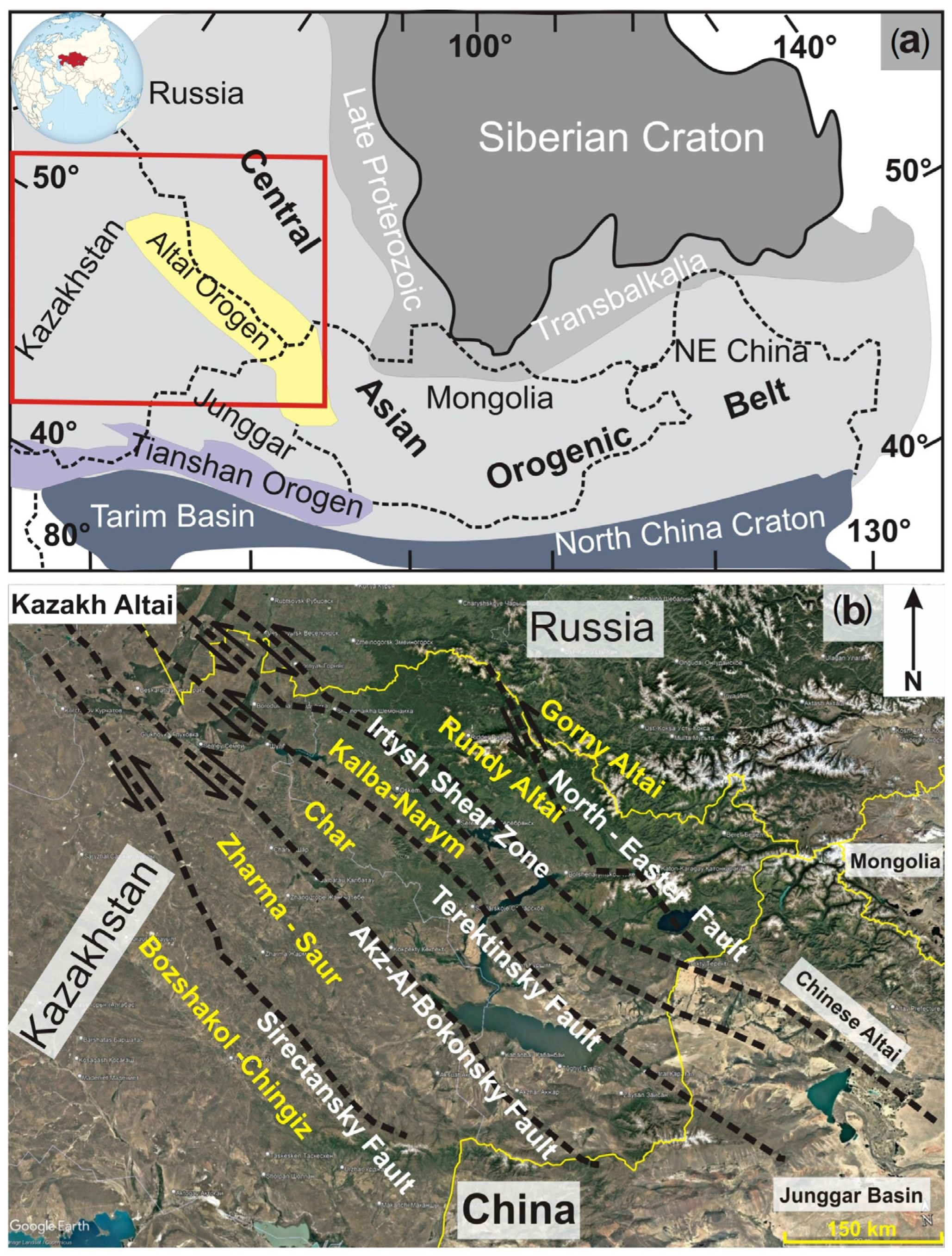
The CAOB, as the largest Phanerozoic accretionary orogen on Earth, is considered a new frontier in the “Green Stone Age”, namely for rare and critical metals [24], (Figure 1a). The CAOB is also referred to as the Central Asian Metallogenic Domain, as it represents one of the largest and most significant metallogenic domains in the world (Figure 1a, see [24]). Specifically, the CAOB is extensively studied for its granitoid occurrences and related mineralization systems, with approximately 60% of the belt exposing granitoid rocks, e.g., [25,26,27,28,29,30,31,32] to name a few. An important part of the Western CAOB is the Altai Accretion-Collision System (AACS) (also known as Altai Orogenic Belt, Altai accretionary wedge, and the Hercynian Altai), which is located in south-western Siberia (Russian Gorny Altai), East Kazakhstan (Kazakh Rudny Altai), western Mongolia (Mongolian Altai), and north-western China (Chinese Altai). The AACS is a fold and thrust belt formed through the collision of Kazakhstan, Siberian, and Tarim continental blocks [33]. The AACS is characterized by the widespread occurrence of granitoids [29,33,34,35,36,37,38,39,40,41,42,43,44], to name a few. Specifically, the Kazakh Altai hosts a major occurrence of granitoids, see [34,35,36,37,40,41,44]. Many of these granitoids are associated with different mineralization systems ([45,46,47,48,49,50,51], among others). In particular, mineralized pegmatites in the Kazakh Altai have recently become the focus of several studies [46,49,50,51,52,53,54,55,56,57,58,59,60,61]. Although hundreds of thousands of pegmatite dikes have been documented in the Altai region, particularly the well-studied pegmatites in the Chinese Altai, which are known for their rare metal and lithium prosperities [62,63,64,65,66,67], to name a few, the granitic pegmatites and pegmatites in the Kazakh Altai remain insufficiently studied and require further investigation for future exploration initiatives. In particular, the spatial–temporal relationship among tectonic evolution, rock formation, and associated metallogenies remains poorly constrained and requires further research [44].
To explore the previously unidentified mineral deposits, two holistic approaches are proposed: (1) mineral deposit models [67] and (2) quantitative models [68]. Regarding the Kazakh Altai pegmatites, mineralization systems have been documented in Brownfields and historical mining sites of the Kalba-Narym Zone. However, the region still requires exploration in Greenfield areas. Therefore, as the quantitative model suggests, the generation of predictive maps, prospective districts, and estimation of metal resources should be strategically implemented. In this regard, computer-based techniques such as Geographic Information Systems (GIS) and remote desktop-based analysis, including remote sensing approaches, have shown robustness in assembling, integrating, and interpreting large-scale datasets from satellite images, field to laboratory results for cost effectiveness, and enhancing success rates in mineral exploration [69,70]. At the regional scale, such as a mineralization belt, geological structures such as faults and fractures play an important role in metal deposition in the Early Permian [58,59,64], as they can either help or limit the movement of mineralizing fluids [71,72,73]. Similarly to other mineralization systems, the structural control on pegmatite emplacement has been verified, see [71,72,73]. In particular, as most granitic pegmatites and pegmatites occur as dikes and veins with linear contact to the host rocks, the lineament analysis can be applied to identify them through lineament density patterns and geo-computational techniques [69,74,75,76,77,78].
This research applied a geospatial methodology, integrating remote sensing and spatial statistics, to support predictive mapping of pegmatite occurrences in the Kalba-Narym Zone, an area previously lacking such analytical approaches. The assessment of the Kalba-Narym Zone at regional and district scales utilizes multiple compiled datasets such as conventional maps, satellite images, structural maps, and field observation in a GIS platform. The outcomes are expected to shed light on the distribution of faults and granitic pegmatites and pegmatite dikes and outcrops, their orientation, and spatial relationships. This work attempts to generate interactive maps for better understanding the localities of pegmatitic mineralization in the extended central sector of the study region. The delineated potential mineral maps (in regional and district scales) are expected to be used as guidelines to narrow down the prospective/predictive areas and enhance the exploration targeting for pegmatite in the Kalba-Narym Zone and Altai region.

2. Regional Geological Overview

As part of the CAOB, the northwest portion of the AACS is referred to as the Hercynian Altai, which is predominantly exposed in East Kazakhstan (Figure 1a). The Kazakhstan segment of the Altai forms the central part of the Ob’-Zaisan folded system (also known as the Zaysan orogenic system), which was formed by accretion and collision between the Siberian and Kazakhstan continental blocks. At the end of the Early Carboniferous, the Ob’-Zaisan oceanic basin was closed [79], followed by orogenic processes during the Middle-Late Carboniferous [80,81,82]. From northeast to southwest, the Great Altai comprises the Rudny Altai Island-Arc Zone, the Irtysh Shear Zone, the Kalba-Narym Collisional Zone, Western Kalba, and the Zharma-Saur belts (Figure 1b). The Great Altai is separated from the Caledonian-aged Gorny Altai Subduction-Accretionary Zone (in the northeast) and the Chingiz-Tarbagatai Zone (in the southwest) by deep major strike-slip faults of Loktevsko-Karairtyshsky and Chingiz-Saursky, respectively [48,83]. Similarly, major deep regional strike-slip faults and/or shear zones separate the remaining zones from each other. The Kalba-Narym Zone is separated from the Rudny Altai by the Irtysh Shear Zone [84,85,86,87,88] and is considered a pre-arc turbidite zone intruded by voluminous late Paleozoic batholitic bodies [36,87,89,90]. The Kalba-Narym granitic rocks were previously interpreted as syn-collisional or late collisional intrusions [91], but more recent chronological data [35,36,89] suggest that they formed during the post-orogenic stage of the Altai Accretion-Collision System, yielding an Early Permian age (297–276 Ma). Most of the granitic rocks in the Great Altai of East Kazakhstan host significant base, precious, and critical metallic mineralization, see [36,38].
The East Kazakhstan metallogenic belts are characterized by distinct, unique mineral occurrences within each belt [45,48,49] including:
(1)
The Rudny-Altai Zone is associated with copper-polymetallic mineralization (Fe, Mn, Cu, Pb, Zn, Au, Ag, etc.). The Rudny-Altai Zone formed along the Siberian active margin as a result of the subduction of the Ob-Zaisan oceanic plate [90];
(2)
The Irtysh Shear Zone (Figure 1b), characterized by high-pressure metamorphism, hosts copper and gold mineralization, with large strike-slip faults related to accretionary and collisional processes [39,87,92,93];
(3)
The Kalba-Narym Zone (Figure 1b) includes rare metal anomalies (Ta, Nb, Be, Li, Cs, Sn, W). The Kalba-Narym Zone corresponds to a continental margin basin filled with continental clastics (turbidites) [35,36,89,91];
(4)
The West Kalba or Char Zone (Figure 1b) contains substantial Au, Ag, As, and Sb ores hosted within the marine sediments and remnants of peridotite, oceanic basalt, chert, and limestone from the Middle Paleozoic oceanic crust [54,92,93,94];
(5)
The Zharma-Saur Zone (Figure 1b) hosts a variety of metals, including Cs, Ni, Co, Cu, Au, Hg, Mo, and W, which are found in basalts and cherts formed through island-arc and felsic volcanism as well as continental deposition on the active margin [95].
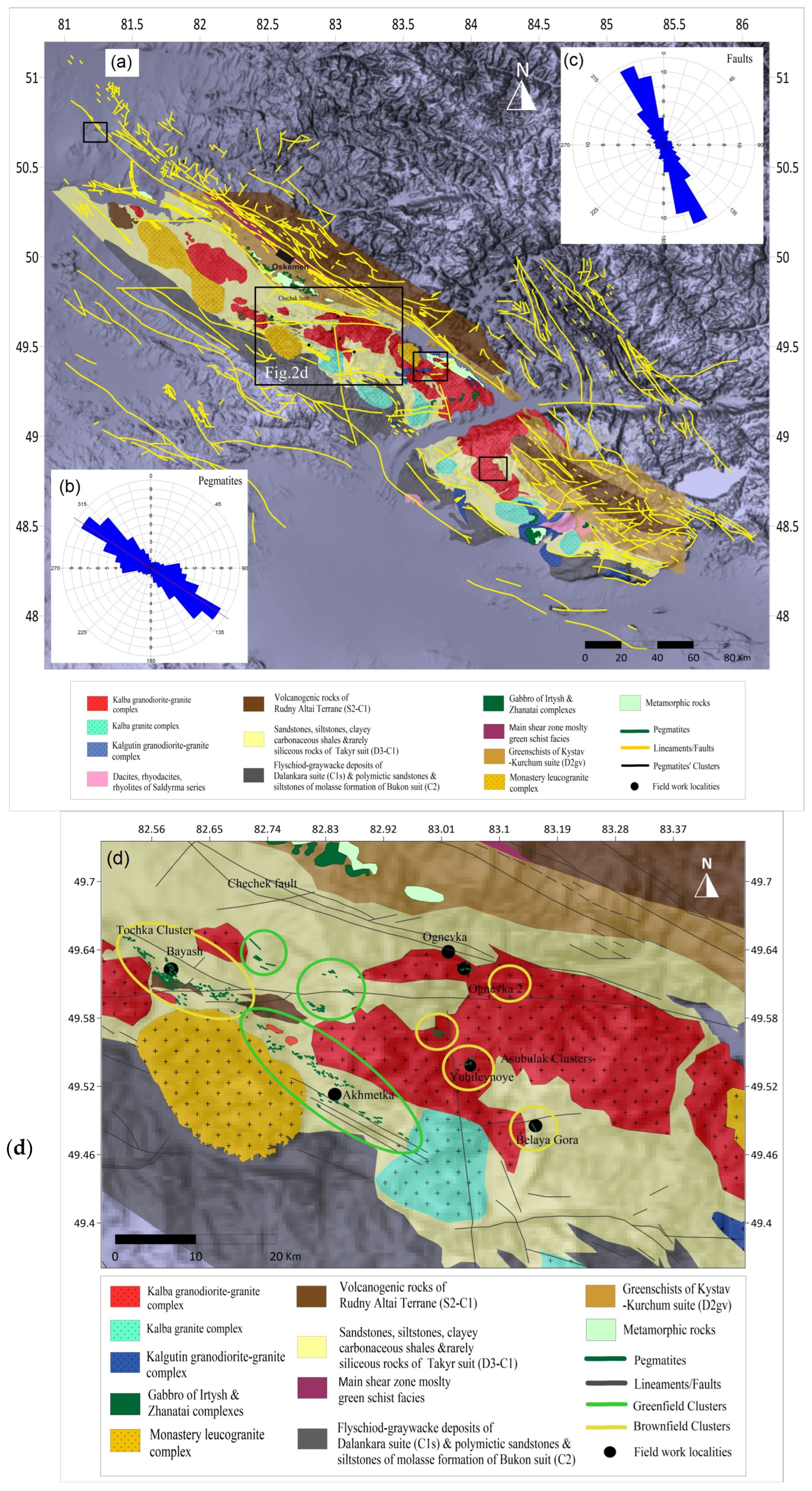
Among these zones, the Kalba-Narym Zone (KNT) (Figure 1b) is particularly prominent for its occurrence of rare-metal mineralization systems. The Kalba-Narym Zone (>10,000 km2) consists of turbidite (10–12 km of metamorphosed clastic sediments after closure of the Ob’-Zaisan paleo-ocean), which are referred to as a relic of a continental margin basin overlying oceanic crust [54,82,89,96,97]. Substantial granitoid intrusions are present within the clastic sedimentary rocks of the Late Devonian–Early Carboniferous Kalba-Narym Zone [48]. The documented granitoids in the Kalba-Narym Zone and Zharma-Saur Zone are primarily characterized into two major types: granite and leucogranite, both of which are dated to the Early Permian [35,36,40,41,44,60,61,89,98]. Additionally, various Kalba batholith dike swarms are documented, including mafic dikes within the Irtysh Shear Zone, granite-porphyry dikes (ongonites) of the Chechek dike swarm, post-batholitic intermediate and mafic dikes in the Mirolyubovka complex, and granitic pegmatite and pegmatite swarms, see [40,44,51,54]. Most of the Kalba granite intrusions, specifically those well-documented in the central and northern part of the zone, are associated with rare-metal mineralization, especially mineralized pegmatite dikes and outcrops [36,45,46,51,54,58,61,91]. The Li-Cs-Ta (LCT) spodumene pegmatite deposits reported in the famous Asubulak Ore Cluster (see Figure 2d) (includes (1) Ungur Zone (northern), including deposits of Carmen-Kuus, Akkesen, Ungursai, and Plachgorl, and (2) Krasnokordonskaya Zone (southern), consisting of the Yubileynoye deposit and occurrences in Krasny Cordon, Rock, and Budo sites) as well as the Ognevka–Bakennoe deposits, and the Belaya Gora–Baymurza deposits (Figure 1b), see [46,51,58]. Some of these pegmatite systems are interpreted spatially to be in association with post-collisional granitic batholiths, in particular, major Ta, Nb, Be, Li, Cs, and Sn deposits are associated with Early Permian (Phase 1—P1) granites of the Kalba complex, which were crosscut by phase 2 granites [51]. Field observation shows that large pegmatite occurrences in the Asubulak Ore Cluster (see Figure 2d) are located at the top of the intrusion (called the Tastyuba intrusion) and proximal to the local faults, which were confirmed by previous studies (Figure 2a,d) [46,51]. The other areas in the zone are potential targets for pegmatite rare-metal mineralization.

3. Materials and Methods

3.1. Study Area and Geological Mapping

The study area is located in the Kalba-Narym Zone in East Kazakhstan, a region recognized for hosting rare-metal mineralization systems. The zone extends approximately 400 km in the Northwest-Southeast (NW–SE) direction and spans about 50 km in width, forming the primary focus of the current study (Figure 1 and Figure 2). It was selected for this research to assess granitic pegmatite and pegmatite occurrence, including both documented and previously unknown dikes, veins, and outcrops. The genetic and spatial association of Kalba granite and pegmatites has been established in several previously studied locations, while other occurrences exhibit less clear granitic association [46,51,57,61]. This variability motivated the selection of the Kalba-Narym Zone for further investigation.
The region is divided into the Brownfield and Greenfield areas [48,49] (Figure 2a,d). The Brownfields include well-documented and previously mined sites such as the Asubulak Pegmatite Cluster, Belaya Gora open pit, and the Ognevka mine. These areas provide valuable insights into mineralization processes. The Greenfield areas, where new granitic pegmatite and pegmatite occurrences are explored, were identified through remote-based techniques and verified through field observations.
Geological maps at a 1:1,000,000 scale, published by the Ministry of Geology of the Kazakh SSR, were used to capture lithological units, faults, lineaments, and dikes. These maps, obtained from the geokniga.org database, were complemented by smaller-scale maps (1:500,000) (M-44 sheet) covering the Kalba-Narym Metallogenic Zone (Figure 2a). By combining data from these geological maps, previous publications, with satellite remote information, the study aims to identify and analyze geological lineaments, such as faults, fractures, and dikes, which play a critical role in pegmatite distribution (Figure 2a,d).

3.2. Pegmatite Localities and Field Observations

Over 743 pegmatite occurrences have been compiled from various publications, including [46,51,57], along with newly identified Greenfield occurrences from the current study (Figure 2a). These occurrences were organized in a GIS database, with coordinates gathered for each pegmatite’s location. The granitic pegmatite and pegmatite occurrences, such as dikes, veins, and outcrops, are grouped into clusters like the Asubulak Ore Cluster and the Tochka Ore Cluster (Figure 2d). This data was further supplemented with field observations that confirmed the locations and mineralization of types of pegmatites in the Greenfield areas. The compiled database of pegmatite locations and clusters illustrates the central sector of the Kalba-Narym Zone, with pegmatite dikes and outcrops projected on a map in relation to the faulting systems (Figure 2d).

3.3. Remote Sensing Lineament Extraction and GIS-Based Data Integration

Lineaments, including faults, fractures, and pegmatite dikes, were extracted from Shuttle Radar Topography Mission (SRTM) Digital Elevation Models (DEMs). The extraction process was carried out in two phases: the first phase involved manual/visual extraction based on existing geological maps and research papers, while the second phase employed remote sensing techniques for automatic lineament extraction. This phase was conducted using PCI Geomatica software (version 2017), applying specific parameters such as filter radius, edge gradient threshold, curve length threshold, and other relevant factors. The extracted lineaments were then verified by overlaying them on Google Earth imagery to correct any errors due to man-made features (Figure 2a).

3.4. DEM Image and Lineaments in Both Manual and Automatic, and Field Observation

The GIS analysis combined raster and vector outputs from visual and automatic lineament extraction data. Using ArcGIS 10.6.1, lithological units and lineaments were integrated into a multi-layer GIS database. Several tasks were performed, including conversion of fault and pegmatite strike data into vector format, assigning coordinates to the midlines of pegmatite dikes, and creating cross-sections for topographic analysis. The spatial relationship between faults, pegmatite dikes, and granitic rocks was further examined by analyzing lineament density patterns, which were constructed from the GIS database. This approach helped identify potential structural controls on pegmatite field genesis and provided insights into how lineaments influence pegmatite occurrences, particularly within the Greenfield areas. The central sector of the Kalba-Narym Zone, with pegmatite dikes and outcrops, was projected on a Google Earth image in relation to the faulting systems (Figure 2a,d).
High-resolution satellite Earth imagery was used to validate the spatial distribution of pegmatites and lineaments. The imagery enabled the confirmation of the location and alignment of detected lineaments and pegmatite occurrences. Field observations (Figure 2a,d) were also conducted to validate the presence of pegmatite swarms and their mineralization types, ensuring that the remote sensing and GIS-based analyses were accurate and reliable. This combination of remote sensing, GIS analysis, and field verification allowed for a robust assessment of pegmatite distribution and structural relationships within the Kalba-Narym Zone.

3.5. Spatial Distribution Analysis of Pegmatites

The spatial distribution of pegmatite occurrences was analyzed using spatial statistical methods, where the Euclidean distance was used to calculate the proximity of pegmatites to faults and granitic rocks. This approach was used to identify areas with higher mineralization potential, particularly for lithium-enriched pegmatites.
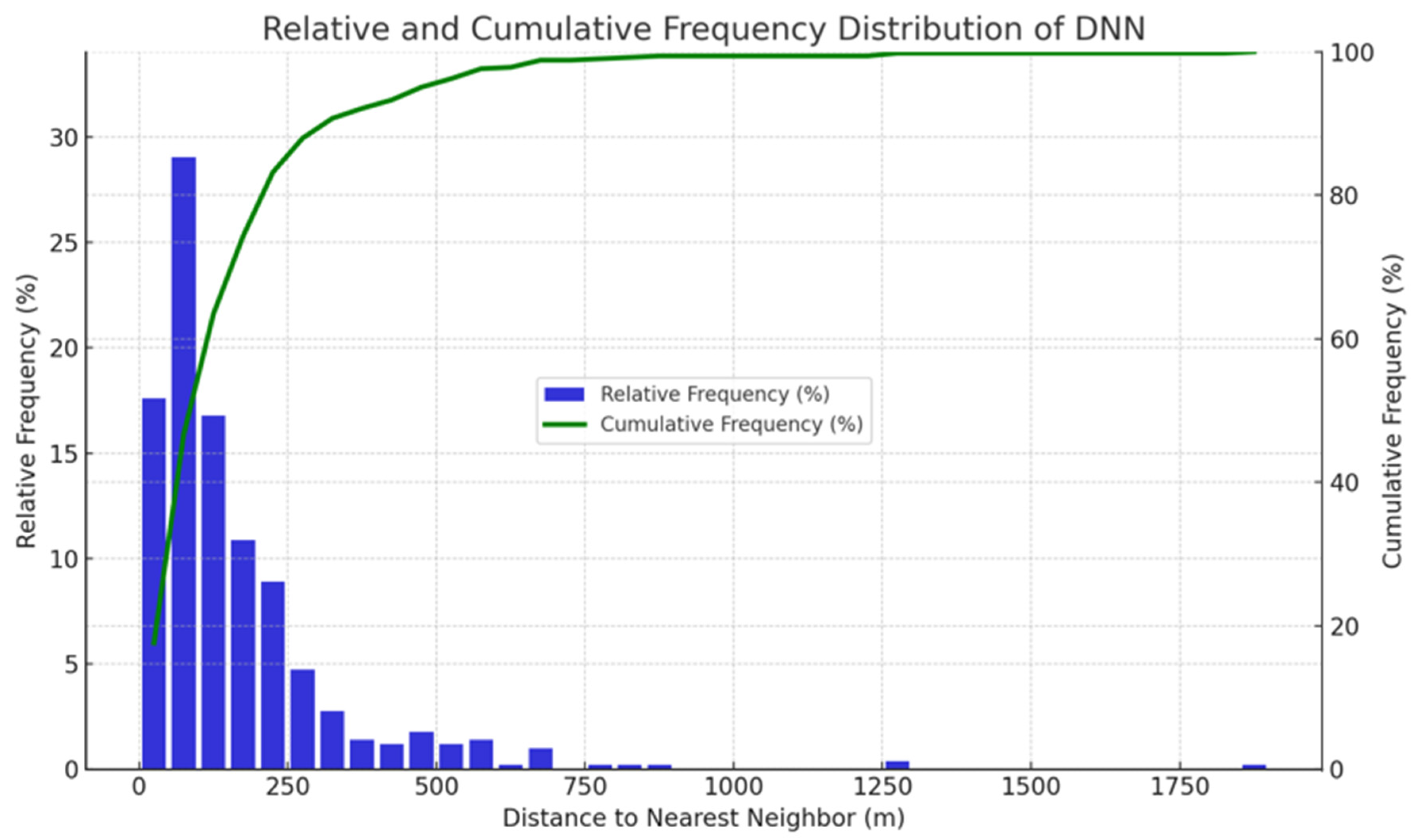
Additionally, we analyzed the frequency distribution of the distance to the nearest neighbor (DNN) for the 743 pegmatite occurrences in the study area. The results show an average DNN of approximately 318 m, with values ranging from a minimum of 20 m to a maximum of 5020 m. The relative and cumulative frequency distributions further illustrate the spatial relationships among these occurrences. This buffer was calculated using the same maximum distance (5020 m), obtained by the frequency distribution of all pegmatites described above, to limit the buffer maximum distance calculation (Figure 3).
The Multi-Distance Spatial Cluster Analysis (Ripley’s K-function) [99] is a statistical tool used in spatial point pattern analysis to assess whether points exhibit clustering, dispersion, or randomness at various spatial scales. It was introduced by Brian D. Ripley in 1976. This statistical tool is used to identify and understand the pattern of map distribution of observations (more precisely, it highlights deviations from the spatial random distribution of objects).
The Ripley’s K-function expresses the average number of neighboring points lying at a maximum distance r from data points divided by the overall point density, as follows:
K r = 1 n i = 1 n N i r ρ ,
where n the total number of points, N i ( r ) the number of points within a neighboring distance r of the i point from the dataset and ρ is the overall point density value. To determine if a point pattern deviates from complete spatial randomness (CSR), we explored various scales with changing r by examining the expected number of points within distance r of a randomly chosen point (Figure 4). The Ripley’s function defined by Equation (1) for a fully random spatial distribution is given by K r = π r 2 . In the case of clustering, we have K r > π r 2 , i.e., there are more points within distance r than expected.
In the case of dispersion, we have K r < π r 2 , i.e., there are fewer points within distance than expected.
Furthermore, the Ripley’s L-function is a commonly used function that transforms the K-function corresponding to a fully random spatial distribution ( K r = π r 2 ) to a straight line L r = r making visual interpretation easier. The Ripley’s L-function is defined as
L ( r ) = K ( r ) / π
The Ripley’s L(r) function defined by Equation (2) used as a second-order spatial statistical method for clustering, randomness, or regularity of the point distribution over varying distance scales to analyze the spatial pattern of pegmatite occurrences complementary to the DNN analysis, this function allows describing the degree of clustering or scattering of elements on various scales and it has been used extensively, for instance in biology [100,101].
To linearize the expected CSR behavior, the L′-function transformation is often employed:
L ( r ) = L ( r ) r
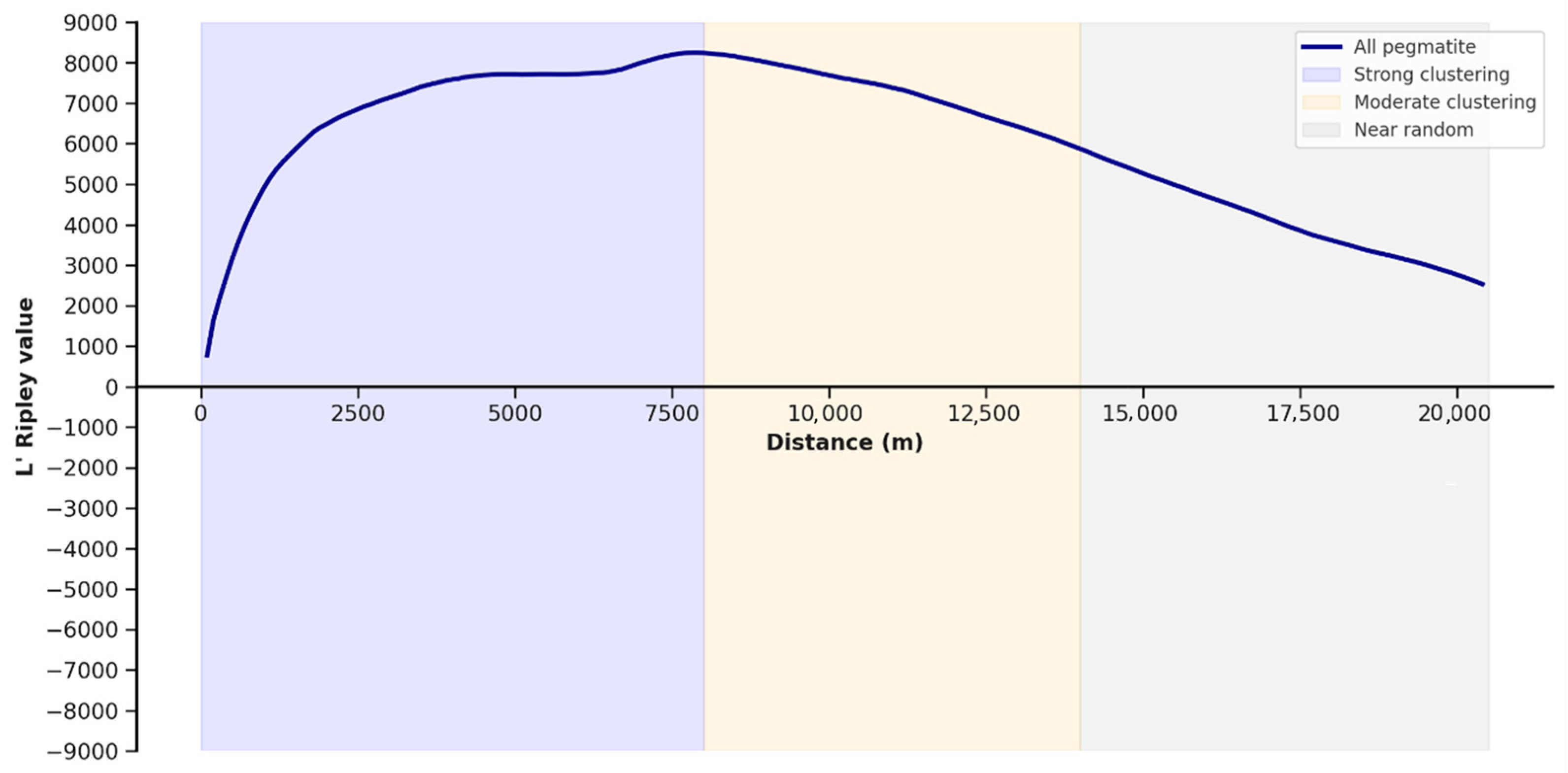
The edge corrected function L′ defined by Equation (3) used to fix a zero value for the reference random distribution (Figure 4 and Figure 5) such that deviations from complete spatial randomness (CSR) are more interpretable. Positive values of L′(r) mean spatial clustering at scale r, negative values mean dispersion, and zero corresponds to CSR. The function was computed over a series of increasing radii from 100 m to 20,000 m, in 100 m increments, to capture both local and regional spatial trends. Edge-effects were mitigated by using the isotropic correction method in the Ripley’s K-function (transforming to L(r)) which weights each inter-point distance by the fraction of the search circle lying inside the study window [102,103]. This approach ensures unbiased estimates of clustering and dispersion across distances by accounting for missing neighborhood area near the boundary of the domain (Figure 4 and Figure 5) [102].
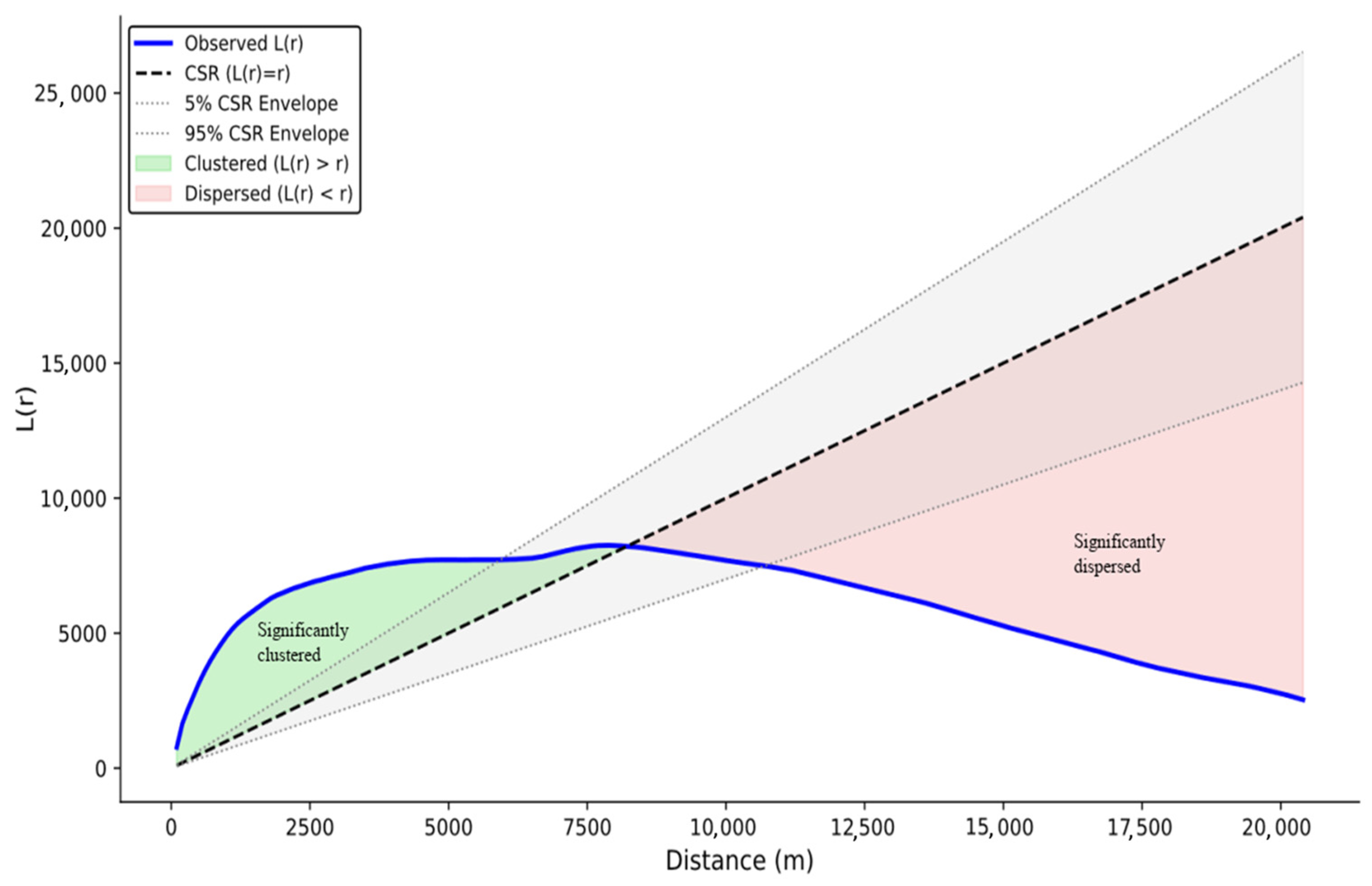
Pairwise distances between all pegmatite occurrences were calculated, and the number of neighboring points within each radius was counted for every point, excluding self-pairs. The total area of the study region was calculated based on the bounding envelope of the pegmatite dataset to estimate point density for normalization. The analysis was conducted in Python (v3.10) using the following core scientific libraries: NumPy (v1.26) for numerical computation, Pandas (v2.1) for data handling, SciPy (v1.11) for spatial analysis including KD-Tree–based simulations, and Matplotlib (v3.8) for graphical visualization. openpyxl (v3.1) was used to read Excel input files. The final Ripley’s L′(r) curve was plotted and marked to show three key areas: strong clustering from 0 to 8000 m, moderate clustering from 8000 to 14,000 m, and a shift to random spacing beyond 14,000 m. We picked these points based on where the curve changed shape and started leveling off. The curve was made clearer with shaded areas and a reference line at L′(r) is equal to 0 in order to help with understanding (Figure 4). The edge-corrected Ripley’s L(r) analysis was performed using 743 Monte Carlo CSR simulations [104] to generate the 5th–95th percentile confidence envelopes, which represent the expected range of spatial randomness. A maximum clustering intensity of 6022 m was detected at a radius of 1900 m, while a maximum dispersion of -17,866.79 m occurred at a radius of 20,400 m. These negative values describe deviation below the CSR line. The observed L(r) curve exceeding the upper envelope indicates significant spatial clustering, whereas its position below the lower envelope indicates significant spatial dispersion relative to the CSR baseline (Figure 5).

4. Results

4.1. Fault Systems

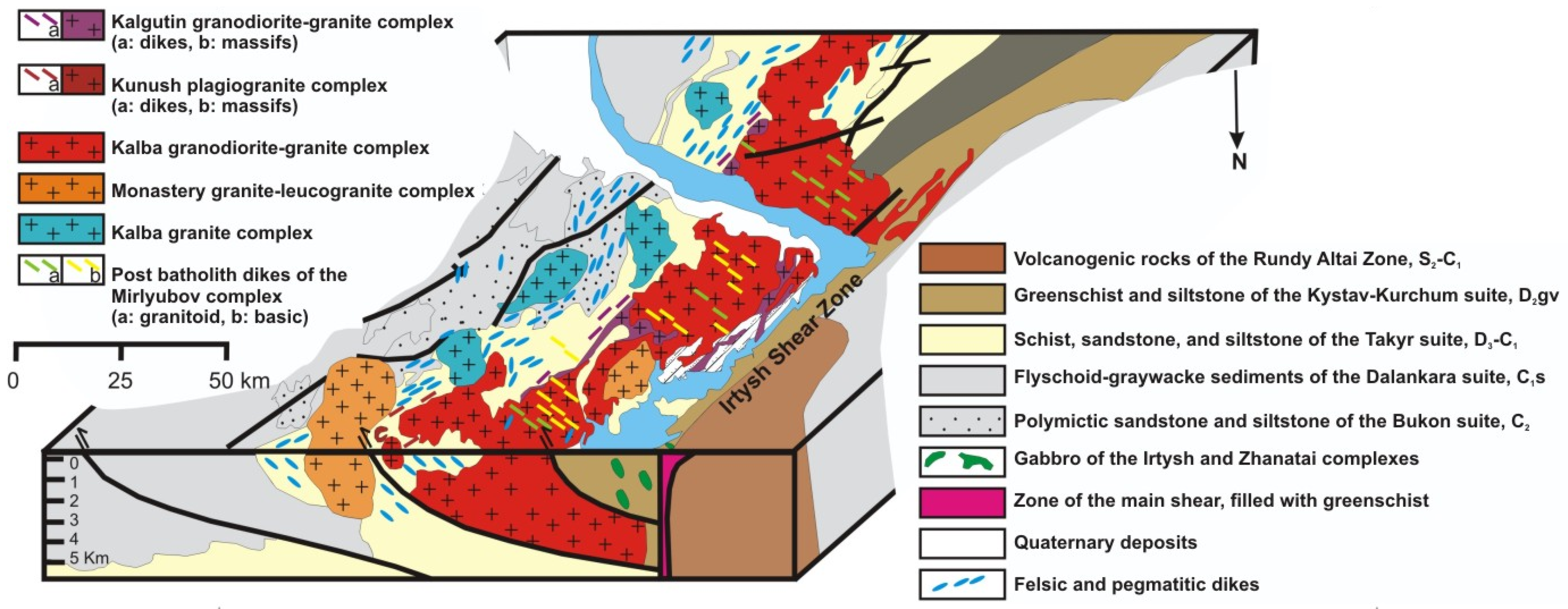
The fault lineament extraction of the extended Kalba-Narym Zone is presented (Figure 2a). The recent analysis on the rose diagram/faults system trends of the Kalba-Narym Zone showed two main fault orientations. Major faults are NNW–SSE (330–340°) about 38% and minor WNW–ESE (300–310°) around 27% faults (Figure 2c). Quantitatively, the rose diagram shows that the most common fault strike lies between 310 and 340° and 140 and 170°, suggesting a prevailing strike of ~330° (NNW–SSE). The 300–310° set acts as a conjugate to the 330–340°. The most prominent faults have strikes ranging between 300° and 340°, with the peak frequency at approximately 330°. The fault exposures vary significantly, with over 200 km of major faults bounding the Kalba-Narym Zone and the Irtysh Shear Zone (Figure 2a). In addition, the E–W striking faults are the next most dominant large-scale faults observed, particularly in the central sector of the zone, where a major fault approximately 100 km in length is exposed (Figure 2a). Notably, several pegmatite swarms are detected proximal to this E–W fault; this is why we primarily focus on this Greenfield in Section 5. Also, in the Asubulak and Belaya Gora Brownfields, several faults of NW-SE, E-W, and N-S strikes were extracted. The location of previously operated mines and outcrops showed that the pegmatites are in close association with Early Permian highly deformed faulted zones (Figure 2a,c,d).

4.2. Pegmatite Orientation and Special Analysis

This includes the pegmatites’ spatial statistical analyses to demonstrate the spatial distribution and extent of pegmatite clustering, the pegmatite density map, and their proximity to the Early Permian Kalba granite and the faulting zones. The rose diagram shown in Figure 2b depicts trends of pegmatite dikes of Kalba-Narym in the region of Eastern Kazakhstan. These two bins collectively represent the most frequent dike orientations. These predominantly pegmatites are most commonly orientated in the NW–SE, WNW to NNW, and ESE to SSE directions. Quantitatively, approximately 70% of the measured pegmatites dikes exhibit strikes within two main ranges, 300–330° and 120–150°, indicating steeply dipping to near vertical dikes striking approximately NW–SE. This suggests that pegmatite intrusion in the Kalba region was not random but was structurally controlled. A subordinate population of orientations is also noted in the NE–SW and ENE- WSW direction, between 20° and 60°, and 220° and 260°, which is found in about 16% of the data. These may correspond to cross-cutting features or late-stage intrusions, potentially controlled by local extensional stress perturbations or fault relay zones (Figure 2b,c).
The prevalence of this NNW–SSE alignment is structurally consistent with the dominant trends of the regional Irtysh Shear Zone and regional-scale faults, which guided both magmatic emplacement and subsequent brittle reactivation. Pegmatite dikes intruding along this trend reflect tectonic–magmatic controls, where magma migrated through pre-existing high-permeability shear zones trending 330–120° (Figure 2b,c). These orientations show the same principal stress field demonstrated by regional fault orientations and suggest synchronous relationships between faulting and dike emplacement. The axial symmetry of the rose diagram, about the 310°/130° (NW–SE) axis, supports our examination of both the steep and/or sub-vertical nature of the dikes, as shown by their dominant SSE–NNW strike orientation. The other most frequent classes are 130–140° (SSE) and 310–320° (NNW), containing 9% of measurements. Additionally, the concentration of pegmatite dikes along NNW–SSE orientations (~300–330° and 120–150°) highlights post-collisional transpressional–extensional tectonic regime which influenced pegmatite emplacement in the Kalba-Narym Zone [30] (Figure 1b and Figure 2b,c).
A total of 743 pegmatite deposits in the Kalba region were analyzed using the DNN (nearest neighbor distance) method (Figure 3). The average distance between a pegmatite body and its nearest neighbor is 318 m. The shortest distance recorded between the two dikes is 20 m, and the longest distance is 5020 m. The relative frequency distribution shows that most pegmatites are in the distance range of 50 to 100 m, accounting for about 29% of all data points. Of these, about 18% are in the distance range of 0 to 50 m, and about 17% are located in the distance range of 100 to 150 m. The range of 150–200 m covers about 11% of the deposits. Above 250 m, the frequency of pegmatite pairs decreases steadily, 8% are in the range of 200–250 m, 6% in the range of 250–300 m, and about 3.5% in the range of 300–350 m (Figure 3).
In terms of cumulative frequency, 70% of all pegmatite occurrences have a nearest neighbor within 250 m of defined pegmatite clusters. This increases to 85% within 400 m, 95% within 600 m, and 99% within 1000 m. These cumulative trends confirm that the majority of pegmatite bodies occur in proximity to one another. To complete the DNN spatial analysis, a buffer radius of 5020 m corresponding to the maximum observed nearest neighbor distance was applied to the full dataset. This ensured a consistent analytical area and allowed for complete inclusion of all spatial interactions among the pegmatite occurrences (Figure 3).
Spatial distribution of pegmatite occurrences was subjected to analysis by Ripley’s L(r) function over a range of distances from 100 to 20,000 m in an attempt to assess deviations that might be exhibited from complete spatial randomness (Figure 4). The resulting curve for L(r) indicates clearly that there is non-random pattern and it is marked by pronounced clustering at multiple spatial scales. At short distances, up to approximately 8000 m, the values for L(r) were strongly positive in reflection of high degrees of spatial aggregation. For example, the value of L(r) was approximately 2800 m at a radius of 1000 m; it rose to about 5200 m at 2000 m and nearly 8700 m around 5000 m before it slightly declined to 7500 m at 8000 m. These values suggest further that pegmatites prefer to form small, tightly grouped clusters at local scales, probably controlled structurally or lithologically by factors that facilitate intrusion but only on a local scale (Figure 2a,d and Figure 3). Between 8000 m and 14,000 m, the curve declined gradually but was still far above the baseline of spatial randomness. At around 10,000 m, it was approximately 6200 m; at 12,000 m, about 4700 m; and at 14,000 m, roughly 3100 m for moderate clustering, which could be the merging of local clusters into wider mineralized areas. Beyond 14,000 m, L(r) values tended to approach zero, indicating a tendency towards spatial independence. At 16,000 m, it was approximately 1800 m; at 18,000 m, about 800 m; and by 20,000 m, just over 2500 m. These low positive values indicate that at regional scales, pegmatite occurrences are near random distributions with diminishing geological structures’ influence (Figure 4). The CSR-based Ripley’s L(r) analysis clearly distinguishes non-random spatial organization within the pegmatite population. Based on 743 Monte Carlo CSR simulations, the resulting 5th–95th percentile confidence envelopes provided a rigorous benchmark for assessing deviations from spatial randomness. At local scales (<2 km), the observed L(r) curve exceeds the CSR envelope, highlighting statistically significant clustering linked to localized structural or magmatic controls. At broader distances (>12 km), it falls below the CSR expectation, revealing marked spatial dispersion that reflects regional structural partitioning or emplacement zoning (Figure 5).

4.3. Fieldwork Observation in the Kalba-Narym Zone

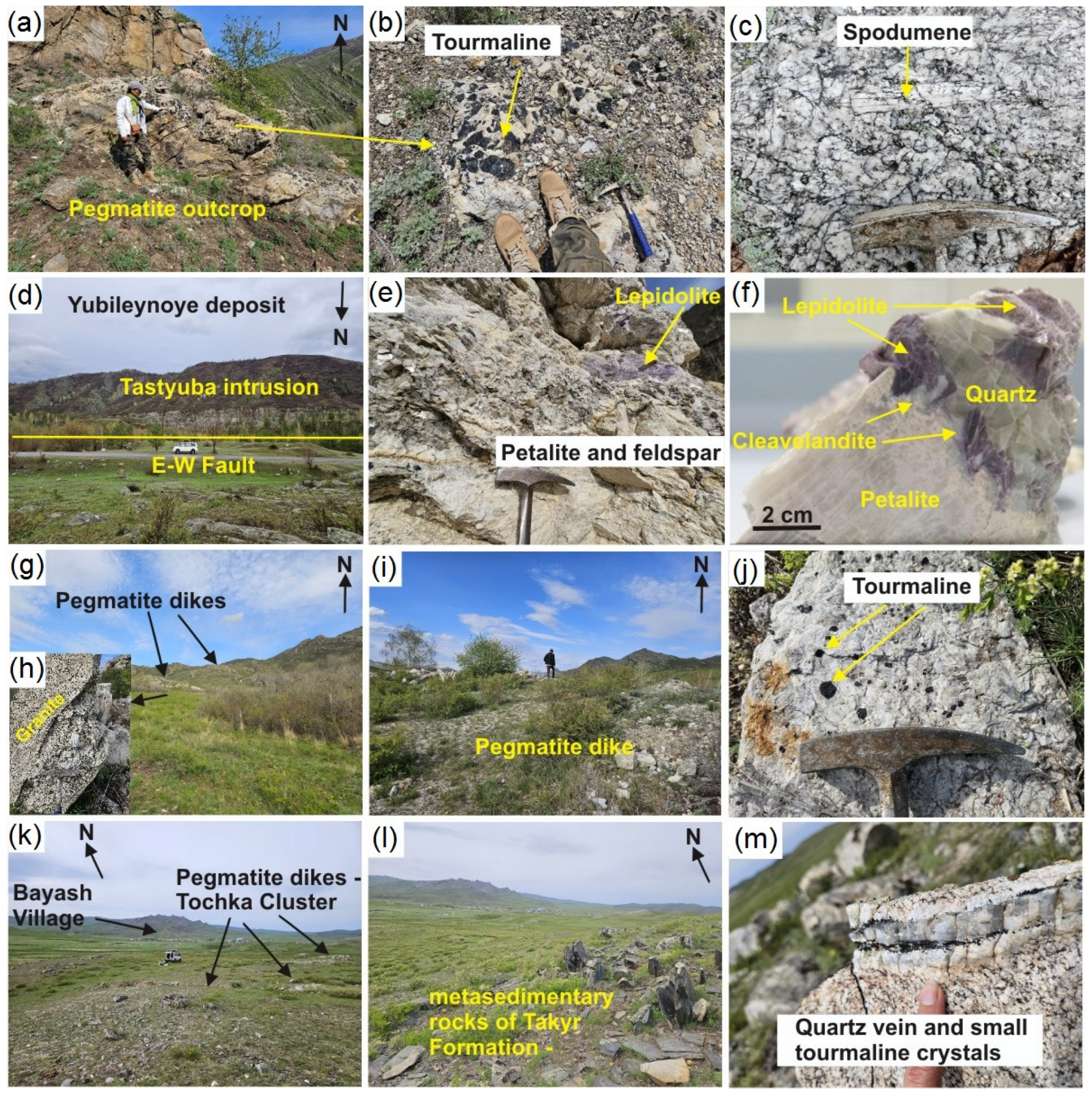
Field observations from the Kalba region included clear pegmatitic mineralization and structural controls of tectonic activity. The pegmatite outcrop near Ognevka exhibits notable mineralogical zonation, including the presence of tourmaline. The observed pegmatite body exhibits coarse-grained textures with abundant tourmaline crystals embedded within quartz and feldspar matrices; tourmaline-rich zones occur within pegmatite outcrops (Figure 6a,b). A hand specimen from the Belaya Gora area was clearly identified as spodumene-rich pegmatite, demonstrating coarse-grained crystalline textures typical of lithium-rich systems (Figure 6c). The spodumene crystals appear elongated and exhibit a characteristic white coloration. Spodumene mineralization within a pegmatitic matrix was documented. The pegmatite texture is coarse-grained with prominent crystals of spodumene embedded in quartz and a feldspar-rich assemblage (Figure 6c). At the Yubileynoye deposit in the Asubulak cluster, prominent mineral zoning, including lepidolite, petalite, cleavelandite, feldspar, and quartz, is closely related to the adjacent Tastytuba granitic intrusion, reinforcing genetic links between evolved granitic magmas and rare-metal pegmatite formation (Figure 6d–f). Also, the pegmatites in the Asubulak cluster are in close association with Early Permian NW-SE trending faults with the E-W and N-S trending faults shown in Figure 2d (Figure 6d), also see [48,51]. Further in the southern part of the Kalba-Narym Zone, several pegmatite dikes are observed, exhibiting structural deformation along fractures in the host source granitic rocks, showing evidence of tectonic control (Figure 6g–i). The pegmatite outcrop and related sample shows medium-sized black tourmaline crystals in feldspar and quartz assemblage (Figure 6j). Near Bayash village in the Tochka pegmatite cluster, there are in proximity sub-parallel dikes which reflect a group of pegmatite dikes among a structurally controlled corridor hosted within Takyr formation metasedimentary rocks (Figure 6k,l). Also, quartz veins are abundant in this region (Figure 6m).

5. Discussion

5.1. Structural Features of the Kalba-Narym Zone in the Altai Accretion-Collision System, East Kazakhstan

Significant to the evolution mechanism of the CAOB, the Altai Accretion-Collision System (AACS) has evolved by the shearing and thrusting of blocks caused by the Hercynian Late Paleozoic collision of continents, which is demarcated by geological structures [81,83,85]. The NW-striking deep shear zones, that separated the East Kazakhstan formed during the latest Devonian–Carboniferous collision (~330–310 Ma), underwent their principal dextral transpressional motion in the Early Permian (~300–280 Ma), and experienced later Mesozoic (Late Triassic–Early Jurassic) and minor Cenozoic reactivations (Figure 1b and Figure 2a) [33,34,92,105,106]. In particular, the Late Carboniferous–Permian faults of the Altai formed because of the collision between the Kazakhstan and Siberian continents when they rotated clockwise relative to each other, after the closure of the Paleo-Asian Ocean parts of Ural-Mongolian and Ob’-Zaysan [85]. Therefore, various zones evolved by the deep faulting systems in the Altai region.
The Char sinistral strike-slip fault (having the Char ophiolitic belt) and also the regional Early Permian Al-Bokonsky fault are the main structures (Figure 1b; Refs. [85,92]). The Early Carboniferous Irtysh Shear Zone is the largest trans-regional tectonic strike-slip displacement in Central Asia [51]. It separated the Kalba-Narym Zone from the Rundy Altai and the North-East shear zone, which bounded the Rundy Altai from the Gorni Altai, are both considered major sinistral strike-slip displacements. The Irtysh Shear Zone (50 km in width) consists of a >10 km-thick shear zone that strikes N45°W, variably scaled the Early Carboniferous sinistral strike-slip faults of various scales, steeply dipping, ductile shear fabric with a regional, well-developed, weakly plunging mineral extension lineation [51,107,108,109,110,111]. The rate of displacement along the strike-slip faults is estimated to be many hundreds of kilometers, [85,112]. The recent analysis indicated two dominant fault-trend clusters in the Late Permian Kalba-Narym Zone [51] (Figure 2a,d): a primary NNW–SSE set at 330–340° comprising ~38% of orientations and a secondary WNW–ESE set at 300–310° accounting for ~27% of measurements (see Figure 1b and Figure 2a,c). These two clusters alone constituted roughly 65% of all fault strikes, demonstrating a pronounced NW–SE to NNW–SSE structural fabric across the zone (this study and [44]). This indicates that the tectonic regime was transpressional during the Late Carboniferous to Permian age [44] when lateral displacement was allowed in bulk along NW–SE to NNW–SSE faults and rotation of blocks plus stress partitioning was accommodated by WNW–ESE conjugate faults. This suggests that strike-slip faults trending NW–SE to NNW–SSE dominate the region, and ~18% of fault segments show inverse direction of the 330° set, reflecting the same planes in the opposite sense. This major structural orientation corresponds to that of the regional stress field during the Late Carboniferous to Early Permian, more precisely, when strong Irtysh Shear Zone growth as a transpressional boundary was established. The 300–310° set acts as a conjugate to the 330–340° (Figure 1b and Figure 2a,c). The most prominent faults have strikes ranging between 300° and 340°, with the peak frequency at approximately 330°. Also, a minor conjugate population at 20–40° (NNE–SSW), representing ~9% of faults, was interpreted as younger extensional or transtensional splays that crosscut the main network during Early Triassic relaxation (Figure 1b and Figure 2a,c; Ref. [44]).
The Late Carboniferous–Early Permian Surov Deformed Zone marked the contact between the Surov gabbro massif and the surrounding turbidites [44]. It runs about 330° and has a steep dip of 40–50°. This fault acted as a path for mafic intrusions that happened around 313 million years ago (Figure 2a) [44]. The Chechek Sheared Zone is on the edge of the Chechek metamorphic dome, striking at about 315°. It shows signs of compression and both ductile and brittle deformation during different time periods, specifically around 312 to 289 million years ago and 285 to 260 million years ago (Figure 1b and Figure 2a,c; Ref. [51]). The Chechek fault bounds the Chechek metamorphic dome with a principal strike near 315°; it records deformation events between 312 and 289 Ma and 285 and 260 Ma (Figure 2a). It reflects complex thrust-related and shear processes. The Terekta fault, also known as the Charysh-Terekta Fault, trending close to 300°, is the boundary between the Kalba-Narym and Char zones; it was reactivated during the Permian under mixed dextral and sinistral movements (Figure 1b and Figure 2a,c; Ref. [48]). A minor set of faults, about 9%, is NNE–SSW (20–40°), younger extensional or transtensional splays that cut across the main strike-slip network. Such structures were probably opened during Early Triassic exhumation and regional relaxation, and they would greatly enhance crustal permeability.
The NW–SE to NNW–SSE-oriented faults reflect a dominant transpressional regime active during the Late Carboniferous–Permian collision of the Kipchak and Tuva–Mongol arcs with the Siberian craton [113]. Thermochronological data from the Irtysh Shear Zone, the region’s principal strike-slip corridor, yield 40Ar/39Ar dating of 275–262 Ma, indicating prolonged shear activity and >50 km of lateral displacement [113]. The 40Ar/39Ar dating of the Irtysh Shear Zone, which refers to two episodes of large-amplitude left-lateral plastic and brittle-plastic deformations with ages of 283–276 and 272–265 Ma, respectively [106,111]. The lateral strike-slip displacements within the Irtysh Shear Zone in the Chechek metamorphic complex are manifested in Z-shaped folds with vertically sinking hinges formed in narrow fault zones represented by greenschist, mylonites, and blastomylonites (see [44]). Partial melting of depleted mantle beneath the collisional orogen occurred in a setting of large-scale strike-slip faulting along the Irtysh Shear Zone, which produced a slab window open for inputs of hot asthenospheric material, see [39]. Khromykh et al. suggested that the gabbro of the Irtysh Shear Zone is formed syncollisionally by partial melting of depleted mantle beneath in a setting of a large-scale strike-slip faulting system with a deformation history that began in the Late Devonian and continued to the Early Permian [87,114]. Conjugate WNW–ESE structures (300–310°) functioned as transfer faults, accommodating block rotations and stress partitioning within the transpressional network (Figure 1b and Figure 2a,c; Ref. [115]). However, ref. [44] argued that thrust and cover-thrust processes played a key role at almost all stages of the formation and evolution of the AACS. During the Late Carboniferous–Early Permian (312–289 Ma), as NE–SW compression phase, the Irtysh Shear Zone formed as a gently dipping thrust system into which gabbro of the Surov massif intruded [44]. Hence, the Irtysh Shear Zone fault kinematics is interpreted differently as left-slip transpressive, left-slip and right-slip shear indicators, and in contrast, the thrust fault, the continuous portion of this fault in the Chinese Altai, has been the subject of much research, see [86]. Also, the faults are considered as a “hot” fault system that developed during continental collision and subsequent post-collisional deformation. While collision between the Kazakhstan and Siberian continents created the principal compressional and transpressional structures, the contemporaneous Tarim and Siberian mantle plumes supplied additional thermal energy, enhancing crustal melting, magmatism, and metamorphism [39,81,82,93].

5.2. Structurally Controlled Granitic Pegmatite and Pegmatite Dike in the Kalba-Narym Zone

The Great Altai rare-metal pegmatites (Kalba-Narym–Altai system) correspond tectonically and chronologically to the Late Paleozoic (Variscan or Hercynian) collisional orogeny, i.e., ~340–280 Ma, related to the closure of the Paleo-Asian Ocean and continental amalgamation of the CAOB, see [116,117], whereas Proterozoic pegmatites are typically related to intracontinental rifting, see [118,119,120,121,122]. As discussed above, the various geological structures and faults of Proterozoic, Caledonian, and Hercynian fault systems developed tectono-magmatic characteristics and consequently metallogenic features of the main epochs of ore formation in the Altai region [123,124,125]. The Kalba-Narym Zone was linked to the Altai during the Hercynian collision, which experienced voluminous post-collisional magmatism in the Early Permian, with crustal melting triggered by heat and fluids from mantle-derived basaltic magmas ascending through deep lithospheric faults [36,39]. The regional Kalba-Narymsky and Terektinsky faults acted as major magma conduits, localizing rare-metal mineralization in structurally favorable areas. Despite the involvement of mafic magmas, the system is not compositionally bimodal, as mafic intrusions are volumetrically minor and mainly restricted to post-batholithic dykes [40]. The batholith is dominated by S- to I-type granodiorites and granites, with evolved leucogranites derived from crustal sources under F-rich fluid influence [36]. Thus, the Kalba-Narym magmatism reflects a crust-dominated, thermally bimodal system rather than a balanced mafic–felsic suite. Steep NNW–SSE strike-slip faults (330–340°) further focused magma transport and emplacement in this post-collisional extensional regime (Figure 1b and Figure 2a–c; Refs. [35,39,40,55,56,57]). Intersection zones between the dominant sets and secondary conjugates localized rare-metal-rich pegmatites and greisen bodies, providing high-permeability conduits for Li–Ta–Nb–W–Sn–rich hydrothermal fluids [55]. The Kalba-Narym structural fabric closely parallels fault-trend patterns documented elsewhere in the Central Asian Orogenic Belt, where major shear zones (e.g., Kurai, Charysh–Terekta) display similar transpressional–transtensional kinematics and multi-phase reactivations [122]. Continuous arc activity from the Ediacaran into the Triassic across the CAOB highlights the persistence of strike-slip-related basins and pull-apart systems that influenced magma genesis and mineralization (Figure 1b and Figure 2a–d; Ref. [110]).
The Kalba pegmatite orientations show the same principal stress field demonstrated by regional fault orientations and suggest synchronous relationships between faulting and pegmatite dike emplacement (Figure 2a,b,d). The analysis of the rose diagram showed that the granitic pegmatites and pegmatite dikes in the Kalba-Narym area mostly align in two main directions: NW–SE, WNW to NNW, and ESE to SSE. These account for more than 70% of the dikes we manually detected. These dikes exhibit steep to near-vertical dips, forming an axial symmetrical pattern around the NW–SE axis, evidence of a subvertical emplacement regime along subparallel structural planes. The NE–SW/ENE–WSW dike set (~16%) likely represents a later, localized stress regime that overprinted the primary SSE–NNW fabric, exploiting secondary fractures under waning magmatic pressure (Figure 2a,b,d). Such orientations are consistent with field observations from previous geological surveys that link pegmatite intrusion to persistent regional stress fields [36,51]. The prevalence of the NNW–SSE-oriented pegmatite dikes closely follows the trend of the Irtysh Shear Zone, a major crustal-scale transpressional structure in Eastern Kazakhstan. The ISZ acted as a long-lived zone of crustal weakness and was repeatedly reactivated during the Paleozoic, especially during the Late Carboniferous–Permian orogenic phases [46]. Basically, it served as a structural guide for magma migration during pegmatite emplacement, as evidenced by the alignment of pegmatite swarms along pre-existing faults trending 350–10° (Figure 2a,b,d). This relationship supports models where tectono–magmatic interactions exploit inherited brittle-ductile structures for sheet-like intrusion, a phenomenon well documented in regional metallogenic studies [55,56,57].
The pegmatite dike formations are within the age range of 291–286 Ma, consistent with two major granite magmatism cycles within the Kalba batholith [51]. The granitic pegmatites appear to belong to the Phase 1 suite, which contains granites that are enriched in rare lithophile elements (Li, Cs, Ta, and Be) and therefore may have had a large source of rare elements available for later pegmatite formation [51]. The dikes are thought to have formed because of the heat and structural contrast existing between the cooling granite plutons and the host rocks above. Their U–Pb zircon ages (ca. 297–276 Ma) correspond to the final stages of granite emplacement and post-collisional deformation in the Kalba-Narym Zone [36,89]. This indicates that dyke formation was contemporaneous with the late Paleozoic transpressional–transtensional regime related to the closure of the Paleo-Asian Ocean [39,40]. Within the Intra-Suture Zone (ISZ), the intersection of several faults produced dilatational stress zones that enabled subvertical dyke ascent, see [39,40,41].
The structural patterns of pegmatite dikes, their temporal overlap with granitic phases, and their spatial alignment with reactivated faults point to a tectonic regime shaped by the collision of the Kipchak arc with the Siberian craton. In the Kalba region, the pronounced clustering of pegmatite dikes along the NW–SE axis (300–330° and 120–150°), encompassing approximately 70% of all measured strikes, indicates that melt ascent was strongly governed by reactivated structural fabrics rather than by random emplacement. This dominant NW–SE, NNW-SSE orientation closely parallels the Kalba-Narym Shear Zone [44] and suggests that late-stage pegmatitic melts exploited steeply dipping, subvertical fractures within this corridor and provided the primary conduits for melt ascent (Figure 2a,b,d and Figure 7). This strongly suggests the subvertical sheet-like intrusions are localized along high-permeability shear corridors associated with the Early Carboniferous Irtysh Shear Zone. The subsidiary dike set striking NE–SW (20–60°) and ENE–WSW (220–260°) likely records a later or more localized stress regime that overprinted the original SSE–NNW fabric. These cross-cutting orientations may represent transient variations in the direction of regional extension or possibly use second-order fractures during subsiding magmatic pressure. Their more dispersed angular distribution compared to the closely clustered SSE–NNW trend further reflects their formation under a more limited tectonic influence than the original SSE-NNW dikes or, more significantly, along “reactivated” pre-existing weaknesses (Figure 1b, Figure 2a–d and Figure 7). The pronounced peaks at 130–140° (SSE) and 310–320° (NNW) emphasize the extremely narrow, subvertical melt pathways controlled by the Kalba-Narym shear fabric, to have been active during the Late Carboniferous–Early Permian [44]. In addition, the near-perfect axial symmetry of the peaks represents a biaxial extensional stress regime, with tensile fractures opening perpendicular to the minimum principal stress (i.e., the axis of least compression, oriented NE–SW) and exploiting pre-existing shear foliations in real time, indicating synchronous deformation and magmatism [48]. This focused clustering demonstrates that pegmatite intrusion was not random, but a highly selective process dictated by late-stage tectono–magmatic interplay within the Altai accretion–collision system. These patterns are consistent with transpressional deformation related to the Late Carboniferous–Permian convergence, leading to the formation of the Kalba-Narym rare-metal belt; a region enriched in Li, Ta, and Nb-bearing pegmatites [44]. Geochronological data place the initial pegmatitic phases between 291 and 286 Ma, temporally associated with Phase 1 granite magmatism [44,48]. Later pegmatite phases, cutting across earlier granite and fault structures, demonstrate that the ISZ acted as a long-lived magmatic and tectonic focus well into the post-collisional stage of the Hercynian orogeny during the Early Permian, when extensional reactivation followed continental collision [36,39]. These results highlight the critical importance of understanding dike orientations and fault interactions for rare-metal exploration strategies in this metallogenic zone.
In addition to melt generation processes, dehydration melting and/or water-fluxed melting, the melt and fluid migration necessitate a favorable tectonic setting and permeable conduits in the crust to assist pegmatite formation. Emplacement of pegmatite needs conduits such as tabular-shaped faults, shear zones, or thrust faults (Figure 7; Refs. [7,126]). In the case of Kalba-Narym pegmatites, some deposits, such as Asubulak Ore Cluster, are in spatial association with the granitic rocks and typically occur near the top of the batholiths. However, at Tochka Ore Cluster and Akhmetka pegmatites, there is no clear spatial relationship between pegmatites with Kalba granitic rocks and the pegmatite dikes that are intruded into the sedimentary rocks (Figure 2a,d), which may support an anatectic model that needs structural conduits to transfer the pegmatite melts from deep crust and place them in shallower crust. Also, pegmatitic melts have much lower viscosity due to high content of incompatible elements and volatiles and can migrate further within high-strain zones [127]. Typically, proximity to high-strain zones and faults and/or at the intersections of multiple fault zones are favorable to pegmatite emplacement. Also, the elongation of pegmatite dikes requires extensional settings, which can be created parallel to the trend of high-strain zones [71,72,128,129]. The elongation patterns of Kalba pegmatites support the trend of pegmatite dikes parallel to the strike of major NW–SE faults on the regional scale (Figure 2a–d and Figure 7). Various districts were examined, which supported the zones of highly faulted proximal to the pegmatite swarm. On a district scale, local faults of various trends also play an important role. For example, the Asubulak Ore Cluster corresponds to intersections of three sets of faults (Gremyachinsko-Kiinsky, Asubulaksky, Belogorsky, Mirolyubovsky, etc.) and the pegmatite occurrence is proximal to faulting systems. The pegmatites of the Asubulak occur over a 1.5 km length and consist of two major ore-bearing dikes of sublatitudinal strike separated by the Asubulak fault. Moreover, the pegmatite dikes and quartz veins, such as Novo-Saryozek, Tochka, Medvedka, Alday, Akhmetka, and Karagoin, within deformed and metamorphosed black shales of the Takyr formation, with distance from the Kalba granite (Figure 7). Ref. [61] discussed that overlapping the 40Ar/39Ar muscovite age of the Tochka pegmatites (~292 Ma) and Kalba granite complex shows that these deposits are derivatives of the granite fractionation occurring around Kalba granite. The current study supports the emplacement location of these pegmatite dikes and quartz veins, which are extended in several other locations detected via remote investigation. Therefore, high-strain zones affected by several intersecting faults surrounding the Kalba granite are also highly prospective regions.
Field observational data collected from this study in the Kalba region have provided strong clarification of the petrogenetic and structural characteristics underlying pegmatite formation and rare-metal mineralization. Some of the pegmatite occurrences are associated with identifiable mineralogical assemblages that include primarily spodumene, tourmaline, lepidolite, and petalite in coarse-grained texture that suggest advanced magmatic differentiation characteristic of highly evolved granitic systems (Figure 6; also see [36,51]).
Field observation of tourmaline-bearing pegmatitic outcrops (Figure 6a,b) suggests that there was significant volatile enrichment and interaction with fluids during the crystallization of the pegmatite. Boron-bearing minerals such as tourmaline are representative of magmatic–hydrothermal transitions, which are thought to occur with volatile-rich granitic melts during more evolved stages of magma cooling [113,130]. Therefore, tourmaline is not only evidence of complex fluid movement but also indicates the potential for rare-metal mineralization related to boron, lithium, and cesium enrichment from volatile saturation within the magmatic-hydrothermal system [48,55].
The spodumene-bearing pegmatites evidently contain abundant coarse-grained spodumene crystals (Figure 6c), indicating lithium enrichment, and likely linked to advanced stages of fractional crystallization of Li-bearing granitic melts. The occurrence of large, well-developed spodumene crystals within quartz and feldspar-rich pegmatite assemblage is consistent with pegmatitic systems described globally, reflecting the advanced stage of magmatic differentiation where incompatible elements like Li become concentrated [48,56,57].
In the Asubulak cluster, the Yubileynoye deposit’s field evidence of well-developed mineral zoning, particularly featuring assemblages of lepidolite, petalite, cleavelandite, feldspar, and quartz (Figure 6d–f), further highlights the strong genetic relationship between rare-metal pegmatites and adjacent evolved granitic intrusions, exemplified by the Tastytuba intrusion. These relationships strongly support a model whereby granitic magmatism drives the development of rare-metal pegmatite fields via fractional crystallization and volatile concentration within evolving magma chambers [36,44,51].
Structural field data from the Kalba pegmatite dikes indicate strong tectonic control, as represented by pegmatite intrusion along well-defined fractures/fractional sets (Figure 6d,g,h). Pegmatite emplacement along fractures and shear zones aligns well with previously described structural regimes, particularly the pervasive influence of the Irtysh Shear Zone, a major tectonic feature known to guide magmatic ascent and hydrothermal fluid migration in the region (Figure 1b, Figure 2a,d and Figure 6; Refs. [44,87,125]).
In addition, based on the current study, a significant number of pegmatite dikes are emplaced in the sedimentary rocks of the Takyr suite, in close association with the Kalba batholith. Thus, pegmatite occurrences in the Kalba-Narym Zone represent a clear linkage between tectonic control, structural localization, advanced magmatic differentiation, and hydrothermal fluid interaction. The spatial concentration and linear arrangement of pegmatite bodies, notably at the Tochka cluster near Bayash village (Figure 2a,d, Figure 6k,l and Figure 7), further support structural models that highlight localized permeability enhancements along fault intersections and structural discontinuities facilitating magma emplacement [46,115].

5.3. Regional-Scale Pegmatite Remote and GIS-Based Exploration Approach

The pegmatite emplacement is reported to be in relation to faults, see [71,72,73]. In regions where superimposed events such as metamorphism or recent active faulting systems have changed the primary features of the pegmatites, relating the pegmatite occurrence to lineaments is a complex task. However, on a regional scale the lineament density patterns using remote techniques highly assist in detecting pegmatite swarms and correlate the pegmatite strikes with regional faulting systems. The current study implies that the assessment of several hundred kilometers of the Kalba-Narym Zone resulted in the detection of Greenfield target districts. This hugely supports the effectiveness of desk-top investigations using geo-computational techniques to strategize exploration campaigns.
The spatial distribution of pegmatite deposits in the Kalba-Narym Zone offers important clues about their structural, lithological, and tectono–magmatic controls. The DNN analysis of 743 pegmatite occurrences reveals distinct spatial clustering, with the average nearest-neighbor distance being approximately 318 m. This reflects a strong local-scale structural or lithological control on pegmatite emplacement, likely related to preferential intrusion pathways associated with brittle deformation zones and fractures, as documented in the Kalba-Narym Zone by previous research, see [46,51]. The majority (~70%) of pegmatites are situated within 250 m of each other, and around 85% within 400 m, clearly demonstrating their tendency to form closely spaced clusters rather than isolated occurrences. Such spatial clustering is consistent with known geological conditions favorable for pegmatite intrusions, including intersection zones of shear fractures and fault systems documented by earlier geological surveys in the region (Figure 2a–d and Figure 7; see [87,130]).
The relative frequency distribution shows that this concentration in space is valid. 29% of pegmatites were located within a distance from the topographic form of 50–100 m, followed closely by the locations of 0–50 (18%) and 100–150 m (17%) distances. The considerable drop-off in frequency at 250 m away, with only ~ 6% of recorded occurrences at 250–300 m distance and even fewer beyond 300 m distance, suggests a drastic reduction in structural permeability or lithological fit for intrusion as distance increases from the primary structural conduits. This indicates that the pegmatite bodies emplaced in the Kalba-Narym Zone preferentially used tectonic structures, primarily the Irtysh Shear Zone (ISZ) and Kalba fault, which overlapped with the predecessor tectonic studies of the Ivanovo and Kurchum regions (Figure 2a,d, Figure 3 and Figure 7; Refs. [36,44,131]). The cumulative frequency data indicate that spatial clustering extends up to regional scales but diminishes significantly beyond local distances. With 95% of pegmatites within 600 m and nearly 99% within 1 km, these results underscore the importance of local to subregional-scale structures as controls for pegmatitic intrusion. Applying a buffer radius of 5020 m—the maximum nearest neighbor distance recorded—ensures a comprehensive analytical area that captures complete spatial interactions and clustering (Figure 4). This methodologically robust spatial approach aligns with previously reported metallogenic models, which emphasize the influence of structurally prepared corridors and lithological controls such as host granite plutons or amphibolite schists on pegmatite emplacement [51,56,57].
Further spatial analysis using Ripley’s L(r) function strongly supports the interpretation of pronounced clustering across multiple spatial scales. High positive L(r) values up to 8700 m at a distance of 5000 m clearly indicate intense local aggregation of pegmatite deposits. The function rises sharply at short distances (e.g., approximately 2800 m at a 1000 m radius), which emphasizes small-scale structural and lithological heterogeneities facilitate pegmatite intrusion. The observed clustering at these scales aligns closely with field observations of pegmatite dikes following steeply dipping structural planes associated with major shear zones (Figure 2d, Figure 4 and Figure 5; also see [61]). This clustering behavior is characteristic of tectono–magmatic processes whereby mineralizing fluids and melts preferentially occupy highly permeable fault intersections and fracture networks.
At intermediate scales (8000–14,000 m), the L(r) curve moderately declines (from about 7500 m at 8000 m to roughly 3100 m at 14,000 m), reflecting a possible transition from tightly grouped clusters to broader mineralized zones. These larger-scale structures may represent tectonically reactivated or reoriented fracture systems, resulting from the oblique Late Carboniferous–Permian tectonic collision between the Kipchak and Siberian continental blocks, which produced transpressional deformation and strike-slip shearing along major fault zones such as the Irtysh and Kalba-Narym systems [36,96,132]. Existing geological interpretations that pegmatite emplacement in the Kalba-Narym Zone is closely associated with tectonic reactivation events within the ISZ are further supported by such transitional spatial patterns (Figure 1b, Figure 2a,d, Figure 4 and Figure 7; Refs. [36,129]). Lastly, Ripley’s L(r) function approaches values that indicate spatial randomness at larger regional scales (>14,000 m) (about 1800 m at 16,000 m and dropping further at longer distances). This trend indicates that pegmatite occurrences exhibit increasingly autonomous distributions at regional scales, which may reflect waning lithological or structural influence. This distribution is consistent with the spatial restriction of known large-scale structural pathways and indicates limited geological control over pegmatite emplacement beyond specific distances [36,56,57].
The edge-corrected Ripley’s L(r) analysis, supported by 743 Monte Carlo CSR simulations, demonstrates that the pegmatite occurrences exhibit a distinctly non-random and hierarchical spatial organization. The significant clustering identified at approximately 1900 m indicates localized zones of pegmatite nucleation and growth, likely controlled by small-scale fracture permeability, compositional heterogeneity, and structural anisotropy within the granitic host (Figure 2d, Figure 5, Figure 6 and Figure 7). These clusters represent areas where melt segregation, volatile enrichment, and deformation-assisted migration concentrated pegmatitic fluids, enhancing the probability of emplacement along structurally favorable conduits [133,134]. At broader spatial scales, beyond 12,000 m and extending up to 20,400 m, the pattern transitions into pronounced dispersion, which may reflect tectonic segmentation or magmatic zoning within the broader granite field. This reflects inter-point spacing greater than random expectation, suggesting structural segmentation or depletion of suitable emplacement zones at broader spatial scales [135]. This large-scale spacing of pegmatite swarms could be attributed to differential uplift, crustal strain partitioning, or variations in the thermal regime of the plutonic complex. The coexistence of clustering and dispersion defines a hierarchical spatial framework, where local emplacement dynamics operate within a regionally constrained magmatic–tectonic system. The identified hierarchical spatial pattern, with local clustering (~1.9 km) and regional dispersion (~20 km), reflects a dual-scale control on pegmatite emplacement involving both localized structural focusing and broader magmatic zoning (Figure 2d, Figure 5, Figure 6 and Figure 7). This suggests that pegmatite formation was driven by volatile-rich granitic differentiation and structurally enhanced melt migration, where fractures, shear zones, and lithological contrasts acted as primary conduits for fluid concentration. Such spatial organization is consistent with rare-metal pegmatite models that link Li–Ta–Nb enrichment to magmatic fractionation and syn- to post-tectonic structural evolution [5,51,52,53,54]. Therefore, exploration strategies in the Kalba-Narym Zone should emphasize structurally favorable local to intermediate scales to effectively target pegmatite-hosted rare-metal mineralization.
On a global scale, reported clustered pegmatite occurrences are among the most favorable targets for exploration, see [10,69]. The effort of various methods is to generate mineral prospectivity maps that accurately locate high-potential areas for pegmatite occurrences. As documented in various locations, see [10,69,71,72,73], the spatial relationships between the pegmatites distribution and faults assists to better constrain the pegmatites–faults–granites model. Such a study, investigated in the Kalba-Narym Zone, is clearly efficient to identify the pegmatite occurrence on a regional scale and narrow down the district- and local-scale targets. Applying this approach and following interpretation requires careful attention to uncertainties or biases in spatial data, depending on the input data and reliance on multiple statistical simulations. Comparisons to other global pegmatite provinces will shed light on the spatial distribution patterns and potential exploration strategies.

6. Conclusions

In this paper, we have highlighted the structural features of the Kalba-Narym Zone as follows:
  • The dominant structural orientation of the Kalba-Narym Zone is NW-SE, which follows the trend of the major faults in the region. Also, several major E-W trend faults, such as the Asubulak fault, are exposed and show spatial relationships with pegmatite occurrences.
  • Most of the detected pegmatite dikes are distributed in a cluster pattern.
  • Pegmatites are emplaced at the top of the Kalba batholith or within the metasedimentary lithology of the Takyr suite with proximal distance from the Kalba batholiths.
  • The Kalba-Narym pegmatite lineaments share the same orientation as the major fault zones, implying a likely common tectonic origin. The pegmatite dikes observed may have ensued as a response to regional deformation propagating through the study area in an approximate NW-SE direction.
  • Upon juxtaposing the structural map of the Kalba-Narym Zone and Pegmatite lineaments, the prospective target area is postulated. In particular, the central sector of the Kalba-Narym Zone demonstrates the highest density of pegmatite dikes occurrence.
  • Pegmatite swarms have been observed in localities that have several fault zones intersecting.
  • Based on the completion of structural features in this zone, on a large regional scale, using a Geographic Information System (GIS) model for structural and pegmatite exploration can make use of such manifestations and measurements with other investigation techniques to identify the location of prospective resources.
  • Uncertainties or biases in spatial data analysis depending on the scale of investigation need to be considered to be able to have a reasonable local and global comparison.

Author Contributions

A.S.D., S.M.S., P.S., and F.S.-S. contributed to conceptualization, writing the draft manuscript, data processing, and software manipulation. A.S.D. obtained and reported funding acquisition. All authors have read and agreed to the published version of the manuscript.

Funding

The current study is part of the Social Policy Grant (SPG 2022-2023) awarded to the first author by Nazarbayev University, which supported the original proposal in 2023. Also, the Faculty Development Competitive Research Grants Program (FDCRGP), SMG2023002, granted to the first Author by Nazarbayev University, supported this investigation. The publication expense has been covered by Azam Soltani Dehnavi.

Data Availability Statement

The original data presented in this study is included in the article. Further inquiries can be directed to the corresponding author.

Acknowledgments

The authors acknowledge the comments by Pavel Kotler from Institute of Geology and Mineralogy of Siberian Branch of Russian Academy of sciences, Novosibirsk, Russia (IGM SB RAS) which immensely improved the manuscript. The authors extend sincere gratitude to the anonymous reviewers for their valuable comments and insights, which significantly enhanced the manuscript.

Conflicts of Interest

The authors declare that the research was conducted in the absence of any commercial or financial relationships that could be construed as a potential conflict of interest.

References

  1. Goodenough, K.M.; Shaw, R.A.; Smith, M.; Estrade, G.; Marqu, E.; Bernard, C.; Nex, P. Economic mineralization in pegmatites: Comparing and contrasting NYF and LCT examples. Can. Mineral. 2019, 57, 753–755. [Google Scholar] [CrossRef]
  2. Steiner, B.M. Tools and Workflows for Grassroots Li–Cs–Ta (LCT) Pegmatite Exploration. Minerals 2019, 9, 499. [Google Scholar] [CrossRef]
  3. London, D. Pegmatites; The Canadian Mineralogist, Special Publication: Greater Sudbury, ON, Canada, 2008; Volume 10, pp. 1–347. [Google Scholar]
  4. Beskin, S.M.; Marin, Y.B. Granite Systems with Rare-Metal Pegmatites. Geol. Ore Depos. 2020, 62, 554–563. [Google Scholar] [CrossRef]
  5. Černý, P.; Ercit, T.S. The classification of granitic pegmatites revisited. Can. Mineral. 2005, 43, 2005–2026. [Google Scholar] [CrossRef]
  6. Simmons, W.B.S.; Webber, K.L. Pegmatite genesis: State of the art. Eur. J. Miner. 2008, 20, 421–438. [Google Scholar] [CrossRef]
  7. Dill, H.G. Geology and chemistry of Variscan-type pegmatite systems (SE Germany)—With special reference to structural and chemical pattern recognition of felsic mobile components in the crust. Ore Geol. Rev. 2018, 92, 205–239. [Google Scholar] [CrossRef]
  8. Müller, A.; Romer, R.L.; Augland, L.E.; Zhou, H.; Rosing-Schow, N.; Spratt, J.; Husdal, T. Two-stage regional rare-element pegmatite formation at Tysfjord, Norway: Implications for the timing of late Svecofennian and late Caledonian high-temperature events. Int. J. Earth Sci. 2022, 111, 987–1007. [Google Scholar] [CrossRef]
  9. Müller, A.; Simmons, W.; Beurlen, H.; Thomas, R.; Ihlen, P.M.; Wise, M.; Roda-Robles, E.; Neiva, A.M.R.; Zagorsky, V. A proposed new mineralogical classification system for granitic pegmatites—Part I: History and the need for a new classification. Can. Mineral. 2022, 60, 203–227. [Google Scholar] [CrossRef]
  10. Müller, A.; Brönner, M.; Menuge, J.; Williamson, B.; Haase, C.; Tassis, G.; Pohl, C.; Brauch, K.; Saalmann, K.; Teodoro, A.; et al. The GREENPEG Project Toolset to Explore for Buried Pegmatites Hosting Lithium, High-Purity Quartz, and Other Critical Raw Materials. Econ. Geol. 2025, 120, 745–778. [Google Scholar] [CrossRef]
  11. Norton, J.J.; Redden, J.A. Relations of zoned pegmatites to other pegmatites, granite, and metamorphic rocks in the southern Black Hills, South Dakota. Am. Min. 1990, 75, 631–655. [Google Scholar]
  12. Martins, T. Multidisciplinary Study of Pegmatites and Associated Li and Sn–Nb–Ta Mineralization from the Barroso–Alvão Region. Ph.D. Thesis, University of Porto, Porto, Portugalia, 2009; pp. 1–196, Unpublished work. [Google Scholar]
  13. Vieira, R. Rare-Elements Aplopegmatites from Al Mandra (V.N. de Foz-Côa) and Barca d’Alva (Figueira Castelo Rodrigo) Regions. Aplopegmatitic Ield of Fre Geneda–ALMENDRA. Ph.D. Thesis, University of Porto, Porto, Portugalia, 2010; pp. 1–274, Unpublished work. [Google Scholar]
  14. Keyser, W.; Müller, A.; Augland, L.E.; Steiner, R. Rare-metal halos of lithium pegmatite at the Wolfsberg deposit, Austria, and their implications for exploration. Ore Geol. Rev. 2024, 171, 106179. [Google Scholar] [CrossRef]
  15. Müller, A.; Romer, R.L.; Pedersen, R.B. The Sveconorwegian Pegmatite Province—Thousands of Pegmatites Without Parental Granites. Can. Mineral. 2017, 55, 283–315. [Google Scholar] [CrossRef]
  16. Shaw, R.A.; Goodenough, K.M.; Deady, E.; Nex, P.; Ruzvidzo, B.; Rushton, J.C.; Mounteney, I. The Magmatic–Hydrothermal Transition in Lithium Pegmatites: Petrographic and Geochemical Characteristics of Pegmatites from the Kamativi Area, Zimbabwe. Can. Mineral. 2022, 60, 957–987. [Google Scholar] [CrossRef]
  17. Phelps-Barber, Z.; Trench, A.; Groves, D.I. Recent pegmatite-hosted spodumene discoveries in Western Australia: Insights for lithium exploration in Australia and globally. Appl. Earth Sci. 2022, 131, 100–113. [Google Scholar] [CrossRef]
  18. Selway, J.B.; Breaks, F.W.; Tindle, A.G. A Review of Rare-Element (Li-Cs-Ta) Pegmatite Exploration Techniques for the Superior Province, Canada, and Large Worldwide Tantalum Deposits. Explor. Min. Geol. 2005, 14, 1–30. [Google Scholar] [CrossRef]
  19. McCauley, A.; Bradley, D.C. The global age distribution of granitic pegmatites. Can. Mineral. 2014, 52, 183–190. [Google Scholar] [CrossRef]
  20. Tkachev, A.V.; Rundqvist, D.V.; Vishnevskaya, N.A. Metallogeny of lithium through geological time. Rus. J. Earth Sci. 2018, 18, ES6002. [Google Scholar] [CrossRef]
  21. Černý, P. Rare-element granitic pegmatites. Part I: Anatomy and internal evolution of pegmatite deposits. Geosci. Can. 1991, 18, 49–67. [Google Scholar]
  22. Shearer, C.K.; Papike, J.J.; Jolliff, B.L. Petrogenetic links among granites and pegmatites in the Harney Peak rare-element granite-pegmatite system, Black Hills, South Dakota. Can. Mineral. 1992, 30, 785–809. [Google Scholar]
  23. Kunz, B.E.; Warren, C.J.; Jenner, F.E.; Harris, N.B.W.; Argles, T.W. Critical metal enrichment in crustal melts: The role of metamorphic mica. Geology 2022, 50, 1219–1223. [Google Scholar] [CrossRef]
  24. Xiao, W.; Song, D.; Windley, B.F.; Li, J.; Han, C.; Wan, B.; Zhang, J.; Ao, S.; Zhang, Z. Accretionary processes and metallogenesis of the Central Asian Orogenic Belt: Advances and perspectives. Sci. China Earth Sci. 2020, 63, 329–361. [Google Scholar] [CrossRef]
  25. Wu, F.Y.; Jahn, B.M.; Wilde, S.; Sun, D.Y. Phanerozoic crustal growth: U–Pb and Sr–Nd isotopic evidence from the granites in northeastern China. Tectonophysics 2000, 328, 89–113. [Google Scholar] [CrossRef]
  26. Jahn, B.M.; Wu, F.; Chen, B. Granitoids of the Central Asian Orogenic Belt and continental growth in the Phanerozoic. Earth Environ. Sci. Trans. R. Soc. Edinb. 2000, 91, 181–193. [Google Scholar] [CrossRef]
  27. Kovalenko, V.I.; Yarmolyuk, V.V.; Kovach, V.P.; Kotov, A.B.; Kozakov, I.K.; Salnikova, E.B.; Larin, A.M. Isotope provinces, mechanisms of generation and sources of the continental crust in the Central Asian mobile belt: Geological and isotopic evidence. J. Asian Earth Sci. 2004, 23, 605–627. [Google Scholar] [CrossRef]
  28. Sun, M.; Yuan, C.; Xiao, W.; Long, X.; Xia, X.; Zhao, G.; Lin, S.; Wu, F.; Kröner, A. Zircon U–Pb and Hf isotopic study of gneissic rocks from the Chinese Altai: Progressive accretionary history in the early to middle Palaeozoic. Chem. Geol. 2008, 247, 352–383. [Google Scholar] [CrossRef]
  29. Wang, T.; Jahn, B.M.; Kovach, V.P.; Tong, Y.; Hong, D.W.; Han, B.F. Nd–Sr isotopic mapping of the Chinese Altai and implications for continental growth in the Central Asian Orogenic Belt. Lithos 2009, 110, 359–372. [Google Scholar] [CrossRef]
  30. Biske, Y.S. Geology and evolution of the Central Asian Orogenic Belt in Kazakhstan and the western Tianshan. The Central Asian Orogenic Belt. Beiträge Zur Reg. Geol. Der Erde 2015, 32, 6–49. [Google Scholar]
  31. Liu, Q.; Zhao, G.; Han, Y.; Li, X.; Zhu, Y.; Eizenhöfer, P.R.; Zhang, X.; Wang, B.; Tsui, R.W. Geochronology and geochemistry of Paleozoic to Mesozoic granitoids in Western Inner Mongolia, China: Implications for the tectonic evolution of the southern Central Asian Orogenic Belt. J. Geol. 2018, 126, 451–471. [Google Scholar] [CrossRef]
  32. Yuan, L.; Zhang, X. Petrogenesis of the Middle Triassic Erenhot granitoid batholith in central Inner Mongolia (northern China) with tectonic implication for the Triassic Mo mineralization in the eastern Central Asian Orogenic Belt. J. Asian Earth Sci. 2018, 165, 37–58. [Google Scholar] [CrossRef]
  33. Windley, B.F.; Kröner, A.; Guo, J.; Qu, G.; Li, Y.; Zhang, C. Neoproterozoic to Paleozoic geology of the Altai orogen, NW China: New Zircon age data and tectonic evolution. J. Geol. 2002, 110, 719–737. [Google Scholar] [CrossRef]
  34. Kuibida, M.L.; Kruk, N.N.; Murzin, O.V.; Shokal’skii, S.P.; Gusev, N.I.; Kirnozova, T.I.; Travin, A.V. Geologic position, age, and petrogenesis of plagiogranites in northern Rudny Altai. Russ. Geol. Geophys. 2013, 54, 1305–1318. [Google Scholar] [CrossRef]
  35. Kotler, P.D.; Khromykh, S.V.; Vladimirov, A.G.; Navozov, O.V.; Travin, A.V.; Karavaeva, G.S.; Kruk, N.N.; Murzintsev, N.G. New data on the age and geodynamic interpretation of the Kalba-Narym granitic batholith, eastern Kazakhstan. Dokl. Earth Sci. 2015, 462, 565–569. [Google Scholar] [CrossRef]
  36. Kotler, P.; Khromykh, S.; Kruk, N.; Sun, M.; Li, P.; Khubanov, V.; Semenova, D.; Vladimirov, A. Granitoids of the Kalba batholith, Eastern Kazakhstan: U–Pb zircon age, petrogenesis and tectonic implications. Lithos 2021, 388–389, 106056. [Google Scholar] [CrossRef]
  37. Kotler, P.D.; Khromykh, S.V.; Zakharova, A.V.; Semenova, D.V.; Kulikova, A.V.; Badretdinov, A.G.; Mikheev, E.I.; Volosov, A.S. Model of the Formation of Monzogabbrodiorite–Syenite–Granitoid Intrusions by the Example of the Akzhailau Massif (Eastern Kazakhstan). Petrology 2024, 32, 179–200. [Google Scholar] [CrossRef]
  38. Suiekpayev, Y.S.; Sapargaliyev, Y.M.; Dolgopolova, A.V.; Pirajno, F.; Seltmann, R.; Khromykh, S.V.; Bekenova, G.K.; Kotler, P.D.; Kravchenko, M.M.; Azelkhanov, A.Z. Mineralogy, geochemistry and U-Pb zircon age of the Karaotkel Ti-Zr placer deposit, Eastern Kazakhstan and its genetic link to the Karaotkel-Preobrazhenka intrusion. Ore Geol. Rev. 2021, 131, 104015. [Google Scholar] [CrossRef]
  39. Khromykh, S.V.; Izokh, A.E.; Gurova, A.V.; Cherdantseva, M.V.; Savinsky, I.A.; Vishnevsky, A.V. Syncollisional gabbro in the Irtysh shear zone, Eastern Kazakhstan: Compositions, geochronology, and geodynamic implications. Lithos 2019, 346–347, 105144. [Google Scholar] [CrossRef]
  40. Khromykh, S.V.; Semenova, D.V.; Kotler, P.D.; Gurova, A.V.; Mikheev, E.I.; Perfilova, A.A. Orogenic volcanism in Eastern Kazakhstan: Composition, age, and geodynamic position. Geotectonics 2020, 54, 510–528. [Google Scholar] [CrossRef]
  41. Khromykh, S.V.; Khokhryakova, O.A.; Kruk, N.N.; Sokolova, E.N.; Kotler, P.D.; Smirnov, S.Z.; Oitseva, T.A.; Semenova, D.V.; Naryzhnova, A.V.; Volosov, A.S.; et al. Petrogenesis of A-type leucocratic granite magmas: An example from Delbegetei massif, Eastern Kazakhstan. Lithos 2024, 482–483, 107696. [Google Scholar] [CrossRef]
  42. Aibai, A.; Chen, X.; Santosh, M.; Wu, Y.; Deng, X.; Wang, Y.; Li, N.; Xiao, W.; Chen, Y. Petrology, geochronology, geochemistry, whole-rock Sr-Nd and zircon Lu-Hf isotopes of the Habahe Intrusion in the Chinese Altai: Implications for petrogenesis and tectono-magmatic significance. Lithos 2024, 478–479, 107646. [Google Scholar] [CrossRef]
  43. Tsygankov, A.A.; Burmakina, G.N.; Kotler, P.D. Petrogenesis of Granitoids from Silicic Large Igneous Provinces (Central and Northeast Asia). Petrology 2024, 32, 772–803. [Google Scholar] [CrossRef]
  44. Travin, A.; Buslov, M.; Murzintsev, N.; Korobkin, V.; Kotler, P.; Khromykh, S.V.; Zindobriy, V.D. Thermochronology of the Kalba–Narym Batholith and the Irtysh Shear Zone (Altai Accretion–Collision System): Geodynamic Implications. Minerals 2025, 15, 243. [Google Scholar] [CrossRef]
  45. D’Yachkov, B.A.; Titov, D.V.; Sapargaliev, E.M. Ore belts of the Greater Altai and their ore resource potential. Geol. Ore Depos. 2009, 51, 197–211. [Google Scholar] [CrossRef]
  46. D’Yachkov, B.; Zimanovskaya, N.; Mataibayeva, I.; Dyachkov, B.; Zimanovskaya, N.; Mataibayeva, I. Rare Metal Deposits of East Kazakhstan: Geologic Position and Prognostic Criteria. Open J. Geol. 2013, 3, 404–409. [Google Scholar] [CrossRef]
  47. D’Yachkov, B.A.; Amralinova, B.B.; Mataybaeva, I.E.; Dolgopolova, A.V.; Mizerny, A.I.; Miroshnikova, A.P. Laws of Formation and Criteria for Predicting Nickel Content in Weathering Crusts of East Kazakhstan. J. Geol. Soc. India 2017, 89, 605–609. [Google Scholar] [CrossRef]
  48. D’Yachkov, B.; Mizernaya, M.; Kuzmina, O.; Zimanovskaya, N.; Oitseva, T. Tectonics and Metallogeny of East Kazakhstan. In Tectonics-Problems of Regional Settings; IntechOpen Limited: London, UK, 2018; p. 68. [Google Scholar]
  49. D′Yachkov, B.A.; Bissatova, A.Y.; Mizernaya, M.A.; Khromykh, S.V.; Oitseva, T.A.; Kuzmina, O.N.; Zimanovskaya, N.A.; Aitbayeva, S.S. Mineralogical Tracers of Gold and Rare-Metal Mineralization in Eastern Kazakhstan. Minerals 2021, 11, 253. [Google Scholar] [CrossRef]
  50. D′Yachkov, B.A.; Mizernaya, M.A.; Khromykh, S.V.; Bissatova, A.Y.; Oitseva, T.A.; Miroshnikova, A.P.; Frolova, O.V.; Kuzmina, O.N.; Zimanovskaya, N.A.; Pyatkova, A.P.; et al. Geological History of the Great Altai: Implications for Mineral Exploration. Minerals 2022, 12, 744. [Google Scholar] [CrossRef]
  51. Khromykh, S.V.; Oitseva, T.A.; Kotler, P.D.; D’Yachkov, B.A.; Smirnov, S.Z.; Travin, A.V.; Vladimirov, A.G.; Sokolova, E.N.; Kuzmina, O.N.; Mizernaya, M.A.; et al. Rare-Metal Pegmatite Deposits of the Kalba Region, Eastern Kazakhstan: Age, Composition and Petrogenetic Implications. Minerals 2020, 10, 1017. [Google Scholar] [CrossRef]
  52. Zharinov, A.A.; Ponomarenko, V.V.; Pekov, I.V. Rocks & Minerals Color-Change Apatite from Kazakhstan. Rocks Miner. 2010, 83, 148–151. [Google Scholar] [CrossRef]
  53. Khromykh, S.V.; Sokolova, E.N.; Smirnov, S.Z.; Travin, A.V.; Annikova, I.Y. Geochemistry and age of rare-metal dike belts in eastern Kazakhstan. Dokl. Earth Sci. 2014, 459, 1587–1591. [Google Scholar] [CrossRef]
  54. Sokolova, E.N.; Smirnov, S.Z.; Khromykh, S.V. Conditions of crystallization, composition, and sources of rare-metal magmas forming ongonites in the Kalba—Narym zone, Eastern Kazakhstan. Petrology 2016, 24, 153–177. [Google Scholar] [CrossRef]
  55. Oitseva, T.A.; Dyachkov, B.A.; Vladimirov, A.G.; Kuzmina, O.N.; Ageeva, O.V. New data on the substantial composition of Kalba rare metal deposits. IOP Conf. Ser. Earth Environ. Sci. 2017, 110, 012018. [Google Scholar] [CrossRef]
  56. Oitseva, T.; Serikbayev, D.; Mizernaya, M.; Zimanovskaya, N. Zoned rare-metal mineralization in the central Kalba area (East Kazakhstan). In Proceedings of the 22nd International Multidisciplinary Scientific GeoConference SGEM, Vienna, Austria, 6–8 December 2022. [Google Scholar] [CrossRef]
  57. Oitseva, T.A.; D’Yachkov, B.A.; Kuzmina, O.N.; Bissatova, A.Y.; Ageyeva, O.V. Li-bearing pegmatites of the Kalba-Narym metallogenic zone (East Kazakhstan): Mineral potential and exploration criteria. Ser. Geol. Tech. Sci. 2022, 1, 83–90. [Google Scholar] [CrossRef]
  58. Oitseva, T.; Serikbayev, D.; Mizernaya, M.; Oitseva, T.; Mizernaya, A.M.; Kuzmina, P.O. Prospects of the Medvedko-Akhmetkinsky ore field for rare metal lithium mineralization (East Kazakhstan). In Proceedings of the 23rd International Multidisciplinary Scientific GeoConference SGEM, Albena, Bulgaria, 3–9 July 2023. [Google Scholar] [CrossRef]
  59. Oitseva, T. Geological structure and mineralogical composition of the Karayak rare meral ore occurrence (East Kazakhstan). In Proceedings of the International Multidisciplinary Scientific GeoConference: SGEM, Albena, Bulgaria, 29 June–8 July 2024; pp. 71–78. [Google Scholar]
  60. Amralinova, B.; Agaliyeva, B.; Lozynskyi, V.; Frolova, O.; Rysbekov, K.; Mataibaeva, I.; Mizernaya, M. Rare-metal mineralization in salt lakes and the linkage with composition of granites: Evidence from Burabay rock mass (Eastern Kazakhstan). Water 2023, 15, 1386. [Google Scholar] [CrossRef]
  61. Zimanovskaya, N.A.; Oitseva, T.A.; Khromykh, S.V.; Travin, A.V.; Bissatova, A.Y.; Annikova, I.Y.; Aitbayeva, S.S. Geology, Mineralogy, and Age of Li-Bearing Pegmatites: Case Study of Tochka Deposit (East Kazakhstan). Minerals 2022, 12, 1478. [Google Scholar] [CrossRef]
  62. Bai, S.; Lei, R.X.; Brzozowski, M.J.; Hao, L.; Zhang, K.; Wu, C.Z. Constraints on the timing of magmatism and rare-metal mineralization in the Fangzheng Rb deposit, Altai, NW China: Implications for the spatiotemporal controls on rare-metal mineralization. Ore Geol. Rev. 2023, 157, 105427. [Google Scholar] [CrossRef]
  63. Liu, S.; Wang, R.; Yang, S.; Zhang, L.; Zhang, Z. Rare-metal Be–Nb–Ta mineralisation by pegmatite remelting: Insights from Dakalasu deposit in the Chinese Altai orogenic belt. Lithos 2023, 454–455, 107243. [Google Scholar] [CrossRef]
  64. Liu, S.; Wang, R.; Botcharnikov, R.E.; Sha, H. Formation of rare-element pegmatites in the Chinese Altai: Contribution of two-stage melting. Geology 2025, 53, 207–211. [Google Scholar] [CrossRef]
  65. Lv, Z.H.; Zhang, H.; Tang, Y.; Liu, Y.L.; Zhang, X. Petrogenesis of syn-orogenic rare metal pegmatites in the Chinese Altai: Evidences from geology, mineralogy, zircon U-Pb age and Hf isotope. Ore Geol. Rev. 2018, 95, 161–181. [Google Scholar] [CrossRef]
  66. Lv, Z.H.; Zhang, H.; Tang, Y. Anatexis origin of rare metal/earth pegmatites: Evidences from the Permian pegmatites in the Chinese Altai. Lithos 2021, 380–381, 105865. [Google Scholar] [CrossRef]
  67. Cox, D.P.; Singer, D.A. Mineral Deposit Models (No. 1693); USGPO: Washington, DC, USA, 1986.
  68. Singer, D.A.; Kouda, R. Application of a feedforward neural network in the search for kuroko deposits in the hokuroku district, Japan. Math. Geol. 1996, 28, 1017–1023. [Google Scholar] [CrossRef]
  69. Santos, D.; Azzalini, A.; Mendes, A.; Cardoso-Fernandes, J.; Lima, A.; Müller, A.; Teodoro, A.C. Optimizing Exploration: Synergistic approaches to minimize false positives in pegmatite prospecting—A comprehensive guide for remote sensing and mineral exploration. Ore Geol. Rev. 2024, 175, 106347. [Google Scholar] [CrossRef]
  70. Han, L.; Liu, Z.; Ning, Y.; Zhao, Z. Extraction and analysis of geological lineaments combining a DEM and remote sensing images from the northern Baoji loess area. Adv. Space Res. 2018, 62, 2480–2493. [Google Scholar] [CrossRef]
  71. Deveaud, S.; Gumiaux, C.; Gloaguen, E.; Branquet, Y. Spatial statistical analysis applied to rare-element LCT-type pegmatite fields: An original approach to constrain faults- pegmatites-granites relationships. J. Geosci. 2013, 58, 163–182. [Google Scholar] [CrossRef]
  72. Silva, D.; Lima, A.; Gloaguen, E.; Gumiaux, C.; Noronha, F.; Deveaud, S.; Teodoro, A.C. Spatial Geostatistical Analysis Applied to the Barroso-Alvão Rare-Elements Pegmatite Field (Northern Portugal). In GIS—An Overview of Applications; Bentham Science Publishers: Sharjah, United Arab Emirates, 2018. [Google Scholar] [CrossRef]
  73. Silva, D.; Groat, L.; Martins, T.; Linnen, R. Structural Controls on the Origin and Emplacement of Lithium-Bearing Pegmatites. Can. J. Mineral. Petrol. 2023, 61, 1053–1062. [Google Scholar] [CrossRef]
  74. Tripp, G.I.; Vearncombe, J.R. Fault/fracture density and mineralization: A contouring method for targeting in gold exploration. J. Struct. Geol. 2004, 26, 1087–1108. [Google Scholar] [CrossRef]
  75. Carranza, E.J.M. Controls on mineral deposit occurrence inferred from analysis of their spatial pattern and spatial association with geological features. Ore Geol. Rev. 2009, 35, 383–400. [Google Scholar] [CrossRef]
  76. Salehi, R.; Saadi, N.M.; Khalil, A.; Watanabe, K. Integrating remote sensing and magnetic data for structural geology investigation in pegmatite areas in eastern Afghanistan. J. App. Remote Sens. 2015, 9, 096097. [Google Scholar] [CrossRef]
  77. Ahmadi, H.; Pekkan, E. Fault-Based Geological Lineaments Extraction Using Remote Sensing and GIS—A Review. Geosciences 2021, 11, 183. [Google Scholar] [CrossRef]
  78. Forson, E.D.; Menyeh, A.; Wemegah, D.D. Mapping lithological units, structural lineaments and alteration zones in the Southern Kibi-Winneba belt of Ghana using integrated geophysical and remote sensing datasets. Ore Geol. Rev. 2021, 137, 104271. [Google Scholar] [CrossRef]
  79. Filippova, I.B.; Bush, V.A.; Didenko, A.N. Middle Paleozoic subduction belts: The leading factor in the formation of the Central Asian fold-and-thrust belt. Russ. J. Earth Sci. 2001, 3, 405–426. Available online: https://rjes.ru/en/nauka/article/47173/view (accessed on 1 May 2025). [CrossRef]
  80. Zonenshain, L.P. Geology of the USSR: A plate-tectonic synthesis. Geodyn. Ser. 1990, 21, 120. [Google Scholar]
  81. Vladimirov, A.G.; Kruk, N.N.; Rudnev, S.N.; Khromykh, S.V. Geodynamics and granitoid magmatism of collisional orogens. Russ. Geol. Geophys. 2003, 44, 1321–1338. [Google Scholar]
  82. Vladimirov, A.G.; Kruk, N.N.; Khromykh, S.V.; Polyansky, O.P.; Chervov, V.V.; Vladimirov, V.G.; Travin, A.V.; Babin, G.A.; Kuibida, M.L.; Vladimirov, V.D. Permian magmatism and lithospheric deformation in the Altai caused by crustal and mantle thermal processes. Russ. Geol. Geophys. 2008, 49, 468–479. [Google Scholar] [CrossRef]
  83. Buslov, M.M.; Saphonova, I.Y.; Watanabe, T.; Obut, O.T.; Fujiwara, Y.; Iwata, K.; Semakov, N.N.; Sugai, Y.; Smirnova, L.V.; Kazansky, A.Y. Evolution of the Paleo-Asian Ocean (Altai-Sayan Region, Central Asia) and collision of possible Gondwana-derived terranes with the southern marginal part of the Siberian continent. Geosci. J. 2001, 5, 203–224. [Google Scholar] [CrossRef]
  84. Şengör, A.M.C.; Natal’In, B.A.; Burtman, V.S. Evolution of the Altaid tectonic collage and Palaeozoic crustal growth in Eurasia. Nature 1993, 364, 299–307. [Google Scholar] [CrossRef]
  85. Buslov, M.M.; Watanabe, T.; Fujiwara, Y.; Iwata, K.; Smirnova, L.V.; Safonova, I.Y.; Semakov, N.N.; Kiryanova, A.P. Late Paleozoic faults of the Altai region, Central Asia: Tectonic pattern and model of formation. J. Asian Earth Sci. 2004, 23, 655–671. [Google Scholar] [CrossRef]
  86. Briggs, S.M.; Yin, A.; Manning, C.E.; Chen, Z.L.; Wang, X.F.; Grove, M. Late Paleozoic tectonic history of the Ertix Fault in the Chinese Altai and its implications for the development of the Central Asian Orogenic System. GSA Bull. 2007, 119, 944–960. [Google Scholar] [CrossRef]
  87. Glorie, S.; de Grave, J.; Delvaux, D.; Buslov, M.M.; Zhimulev, F.I.; Vanhaecke, F.; Elburg, M.A.; Haute, P.V.D. Tectonic history of the Irtysh shear zone (NE Kazakhstan): New constraints from zircon U/Pb dating, apatite fission track dating and palaeostress analysis. J. Asian Earth Sci. 2012, 45, 138–149. [Google Scholar] [CrossRef]
  88. Chen, M.; Sun, M.; Li, P.; Zheng, J.; Cai, K.; Su, Y. Late paleozoic accretionary and collisional processes along the southern peri-siberian orogenic system: New constraints from amphibolites within the irtysh complex of chinese altai. J. Geol. 2019, 127, 241–262. [Google Scholar] [CrossRef]
  89. Khromykh, S.V.; Tsygankov, A.A.; Kotler, P.D.; Navozov, O.V.; Kruk, N.N.; Vladimirov, A.G.; Travin, A.V.; Yudin, D.S.; Burmakina, G.N.; Khubanov, V.B.; et al. Late Paleozoic granitoid magmatism of Eastern Kazakhstan and Western Transbaikalia: Plume model test. Russ. Geol. Geophys. 2016, 57, 773–789. [Google Scholar] [CrossRef]
  90. Kuibida, M.L.; Murzin, O.V.; Kruk, N.N.; Safonova, I.Y.; Sun, M.; Komiya, T.; Wong, J.; Aoki, S.; Murzina, N.M.; Nikolaeva, I.; et al. Whole-rock geochemistry and U-Pb ages of Devonian bimodal-type rhyolites from the Rudny Altai, Russia: Petrogenesis and tectonic settings. Gondwana Res. 2020, 81, 312–338. [Google Scholar] [CrossRef]
  91. Lopatnikov, V.V.; Izokh, E.P.; Ermolov, P.V.; Ponomareva, A.P.; Stepanov, A.S. Magmatism and Metallogeny of the Kalba-Narym Zone, Eastern Kazakhstan; Nauka: Moscow, Russia, 1982; p. 248. (In Russian) [Google Scholar]
  92. Kuibida, M.L.; Safonova, I.Y.; Yermolov, P.V.; Vladimirov, A.G.; Kruk, N.N.; Yamamoto, S. Tonalites and plagiogranites of the Char suture-shear zone in East Kazakhstan: Implications for the Kazakhstan-Siberia collision. Geosci. Front. 2016, 7, 141–150. [Google Scholar] [CrossRef]
  93. Kuibida, M.L.; Kruk, N.N.; Volkova, N.I.; Serov, P.A.; Velivetskaya, T.A. Composition, sources, and genesis of granitoids in the Irtysh Complex, Eastern Kazakhstan. Petrology 2012, 20, 188–203. [Google Scholar] [CrossRef]
  94. Safonova, I.; Komiya, T.; Romer, R.L.; Simonov, V.; Seltmann, R.; Rudnev, S.; Yamamoto, S.; Sun, M. Supra-subduction igneous formations of the Char ophiolite belt, East Kazakhstan. Gondwana Res. 2018, 59, 159–179. [Google Scholar] [CrossRef]
  95. Degtyarev, K.E.; Shatagin, K.N.; Kovach, V.P.; Tretyakov, A.A. The formation processes and isotopic structure of continental crust of the Chingiz Range Caledonides (Eastern Kazakhstan). Geotectonics 2015, 49, 485–514. [Google Scholar] [CrossRef]
  96. Windley, B.F.; Alexeiev, D.; Xiao, W.; Kröner, A.; Badarch, G. Tectonic models for accretion of the Central Asian Orogenic Belt. J. Geol. Soc. 2007, 164, 31–47. [Google Scholar] [CrossRef]
  97. Xiao, W.; Huang, B.; Han, C.; Sun, S.; Li, J. A review of the western part of the Altaids: A key to understanding the architecture of accretionary orogens. Gondwana Res. 2010, 18, 253–273. [Google Scholar] [CrossRef]
  98. Vladimirov, A.G.; Kozlov, M.S.; Shokal’skii, S.P.; Khalilov, V.A.; Rudnev, S.N.; Kruk, N.N.; Vystavnoi, S.A.; Borisov, S.M.; Bereziko, Y.K.; Metsner, A.N.; et al. Major epochs of intrusive magmatism of Kuznetsk Alatau, Altai, and Kalba (from U-Pb isotope dates). Russ. Geol. Geophys. 2001, 42, 1089–1109. [Google Scholar]
  99. Ripley, B.D. Modelling Spatial Patterns. J. R. Stat. Soc. Ser. B 1977, 39, 172–192. [Google Scholar] [CrossRef]
  100. Kiskowski, M.A.; Hancock, J.F.; Kenworthy, A.K. On the use of Ripley’s K-function and its derivatives to analyze domain size. Biophys. J. 2009, 97, 1095–1103. [Google Scholar] [CrossRef]
  101. Rozas, V.; Zas, R.; Solla, A. Spatial structure of deciduous forest stands with contrasting human influence in northwest Spain. Eur. J. For. Res. 2009, 128, 273–285. [Google Scholar] [CrossRef]
  102. Goreaud, F.; Pélissier, R. On explicit formulas of edge effect correction for Ripley’s K--function. J. Veg Sci. 1999, 10, 433–438. [Google Scholar] [CrossRef]
  103. Jafari Mamaghani, M.; Andersson, M.; Krieger, P. Spatial point pattern analysis of neurons using Ripley’s K-function in 3D. Front. Neuroinform. 2010, 4, 1285. [Google Scholar] [CrossRef]
  104. Pélissier, R.; Goreaud, F. Ads package for R: A fast unbiased implementation of the K-function family for studying spatial point patterns in irregular-shaped sampling windows. J. Stat. Softw. 2015, 63, 1–18. [Google Scholar] [CrossRef]
  105. Şengör, A.C.; Natal’In, B.A. Turkic-type orogeny and its role in the making of the continental crust. Annu. Rev. Earth Planet. Sci. 1996, 24, 263–337. [Google Scholar] [CrossRef]
  106. Laurent-Charvet, S.; Charvet, J.; Monié, P.; Shu, L. Late Paleozoic strike-slip shear zones in eastern central Asia (NW China): New structural and geochronological data. Tectonics 2003, 22, 1009–1033. [Google Scholar] [CrossRef]
  107. Melnikov, A.; Delvaux, D.; Travin, A.; Buslov, M.; Vladimirov, A.; Smirnova, L.; Theunissen, K. Late Paleozoic–Early Mesozoic Sinistral Movement Along the Irtysh Shear Zone, NE Kazakhstan. In Proceedings of the Tectonic Studies Group Annual General Meeting, Durham, UK, 17–19 December 1997; pp. 17–19. [Google Scholar]
  108. Melnikov, A.; Travin, A.; Plotnikov, A.; Smirnova, L.; Theunissen, K. Kinematics and Ar/Ar Geochronology of the Irtysh Shear Zone in NE Kazakhstan. In Proceedings of the Continental Growth in the Phanerozoic: Evidence from East-Central Asia, First Workshop, IGCP-420, Urumqi, China, 27 July–3 August 1998; Volume 27, p. 30. [Google Scholar]
  109. Mileyev, V.S.; Rotarash, I.A.; Samygin, S.G. The Irtysh crush belt: Doklady Earth Sciences. Dokl. Adademii Nauk. SSSR 1980, 255, 413–416. [Google Scholar]
  110. Rotarash, A.I.; Samygin, S.G.; Gredyushko, A.Y.; Keyl’man, G.A.; Mileyev, V.S.; Perfil’yev, A.S. The Devonian active continental margin in the southwestern Altay. Geotectonics 1982, 16, 31–41. [Google Scholar]
  111. Travin, A.V.; Boven, A.; Plotnikov, A.V.; Vladimirov, V.G.; Tenissen, K.; Vladimirov, A.G.; Melnikov, A.I.; Titov, A.V. 40Ar/39Ar Dating of Plastic Deformations in the Irtysh Shear Zone (Eastern Kazakhstan). Geochem. Int. 2001, 12, 1–5. (In Russian) [Google Scholar]
  112. Korobkin, V.V.; Buslov, M.M. Tectonics and geodynamics of the western Central Asian Fold Belt (Kazakhstan Paleozoides). Russ. Geol. Geophys. 2011, 52, 1600–1618. [Google Scholar] [CrossRef]
  113. Şengör, A.M.C.; Natal’in, B.A.; Sunal, G.; van der Voo, R. A new look at the Altaids: A superorogenic complex in northern and central Asia as a factory of continental crust. Part I: Geological data compilation (exclusive of palaeomagnetic observations). Austrian J. Earth Sci. 2014, 107, 169–232. [Google Scholar]
  114. Travin, A.V. Thermochronology of Early Paleozoic collisional and subduction–collisional structures of Central Asia. Russ. Geol. Geophys. 2016, 57, 434–450. [Google Scholar] [CrossRef]
  115. Delvaux, D.; Cloetingh, S.; Beekman, F.; Sokoutis, D.; Burov, E.; Buslov, M.M.; Abdrakhmatov, K.E. Basin evolution in a folding lithosphere: Altai–Sayan and Tien Shan belts in Central Asia. Tectonophysics 2013, 602, 194–222. [Google Scholar] [CrossRef]
  116. Zhu, Y.F.; Zeng, Y.; Gu, L. Geochemistry of the rare metal-bearing pegmatite No. 3 vein and related granites in the Keketuohai region, Altay Mountains, northwest China. J. Asian Earth Sci. 2006, 27, 61–77. [Google Scholar] [CrossRef]
  117. Wang, M.; Zhang, X. Petrogenesis of Devonian and Permian Pegmatites in the Chinese Altay: Insights into the Closure of the Irtysh–Zaisan Ocean. Minerals 2023, 13, 1127. [Google Scholar] [CrossRef]
  118. Martin, R.F.; De Vito, C. The patterns of enrichment in felsic pegmatites ultimately depend on tectonic setting. Can. Mineral. 2005, 43, 2027–2048. [Google Scholar] [CrossRef]
  119. London, D. Ore-forming processes within granitic pegmatites. Ore Geol. Rev. 2018, 101, 349–383. [Google Scholar] [CrossRef]
  120. Piilonen, P.C.; McDonald, A.M.; Poirier, G.; Rowe, R.; Larsen, A.O. The mineralogy and crystal chemistry of alkaline pegmatites in the Larvik Plutonic Complex, Oslo rift valley, Norway. Part 1. Magmatic and secondary zircon: Implications for petrogenesis from trace-element geochemistry. Mineral. Mag. 2012, 76, 649–672. [Google Scholar] [CrossRef]
  121. Zagorsky, V.Y.; Vladimirov, A.G.; Makagon, V.M.; Kuznetsova, L.G.; Smirnov, S.Z.; D’yachkov, B.A.; Annikova, I.Y.; Shokalsky, S.P.; Uvarov, A.N. Large fields of spodumene pegmatites in the settings of rifting and postcollisional shear–pull-apart dislocations of continental lithosphere. Russ. Geol. Geophys. 2014, 55, 237–251. [Google Scholar] [CrossRef]
  122. Chakraborty, T.; Kankuzi, C.F.; Glodny, J.; Frei, D.; Büttner, S.H. The timing and tectonic context of Pan-African gem bearing pegmatites in Malawi: Evidence from Rb–Sr and U–Pb geochronology. J. Afr. Earth Sci. 2023, 197, 104750. [Google Scholar] [CrossRef]
  123. Pirajno, F.; Seltmann, R.; Yang, Y. A review of mineral systems and associated tectonic settings of northern Xinjiang, NW China. Geosci. Front. 2011, 2, 157–185. [Google Scholar] [CrossRef]
  124. Safonova, I. The Russian-Kazakh Altai orogen: An overview and main debatable issues. Geosci. Front. 2014, 5, 537–552. [Google Scholar] [CrossRef]
  125. Buslov, M.M. Tectonics and geodynamics of the Central Asian Foldbelt: The role of Late Paleozoic large-amplitude strike-slip faults. Russ. Geol. Geophys. 2011, 52, 52–71. [Google Scholar] [CrossRef]
  126. Fossen, H.; Cavalcante, G.C.G. Shear zones—A review. Earth Sci. Rev. 2017, 171, 434–455. [Google Scholar] [CrossRef]
  127. London, D. Granitic pegmatites: An assessment of current concepts and directions for the future. Lithos 2005, 80, 281–303. [Google Scholar] [CrossRef]
  128. Hulsbosch, N.; van Daele, J.; Reinders, N.; Dewaele, S.; Jacques, D.; Muchez, P. Structural control on the emplacement of contemporaneous Sn-Ta-Nb mineralized LCT pegmatites and Sn bearing quartz veins: Insights from the Musha and Ntunga deposits of the Karagwe-Ankole Belt, Rwanda. J. Afr. Earth Sci. 2017, 134, 24–32. [Google Scholar] [CrossRef]
  129. Ndikumana, J.d.D.; Mupenge, P.M.; Nambaje, C.; Raoelison, I.L.; Bolarinwa, A.T.; Adeyemi, G.O. Structural control on the Sn-Ta-Nb mineralisation and geochemistry of the pegmatites of Gitarama and Gatumba areas (Rwanda), Karagwe–Ankole Belt. Arab. J. Geosci. 2021, 14, 2660. [Google Scholar] [CrossRef]
  130. Liu, G.; Chen, X.H.; Dong, S.W.; Chen, Z.L.; Han, S.Q.; Yang, Y.; Ye, B.Y.; Shi, W. Geochemistry of late Palaeozoic granitoids of the Balkhash metallogenic belt, Kazakhstan: Implications for crustal growth and tectonic evolution of the Central Asian Orogenic Belt. Int. Geol. Rev. 2017, 59, 1053–1081. [Google Scholar] [CrossRef]
  131. Ponomareva, Y.V. Age and geodynamics of the Irtysh shear zone. Natsional’nyi Hirnychyi Universytet Nauk. Visnyk 2018, 6, 13. [Google Scholar]
  132. Sanità, E.; Lardeaux, J.M.; Marroni, M.; Pandolfi, L. Kinematics of the Helminthoid Flysch–Marguareis Unit tectonic coupling: Consequences for the tectonic evolution of Western Ligurian Alps. Comptes Rendus. Géoscience 2022, 354, 141–157. [Google Scholar] [CrossRef]
  133. Jahns, R.H.; Burnham, C.W. Experimental studies of pegmatite genesis; l, A model for the derivation and crystallization of granitic pegmatites. Econ. Geol. 1969, 64, 843–864. [Google Scholar] [CrossRef]
  134. Plunder, A.; Le Pourhiet, L.; Räss, L.; Gloaguen, E.; Pichavant, M.; Gumiaux, C. Pegmatites as geological expressions of spontaneous crustal flow localisation. Lithos 2022, 416, 106652. [Google Scholar] [CrossRef]
  135. Wiegand, T.; Moloney, K.A. Handbook of Spatial Point-Pattern Analysis in Ecology; CRC Press: Boca Raton, FL, USA, 2013. [Google Scholar]
Figure 1. (a) The schematic map of the Central Asian Orogenic Belt (CAOB) showing the location of the Altai Orogeny. The red rectangle is presented in (b). (b) The Altai Accretion-Collision System (AACS) of East Kazakhstan comprises various zones divided by deep-crustal regional left-lateral strike-slip faults having a NW-SE trend. Dashed lines represent strike-slip faults.
Geosciences 15 00458 g001
Figure 2. (a) The regional-scale map of the extended Kalba-Narym Zone showing major lithological units, granitoid complexes, and structurally controlled pegmatite occurrences. Lineaments and faults interpreted from remote sensing data are overlaid to highlight regional structural trends. (b) The rose diagram indicates dominant NW–SE orientation of pegmatite dikes. (c) The rose diagram illustrates the orientation trends of regional faults and lineaments predominantly following NW–SE and WNW–ESE directions. The area marked by the big rectangle is presented in (d). (d) The district-scale map shows fieldwork localities and clustering of pegmatites within the Central Kalba-Narym Zone. Yellow circles represent Brownfields, and green circles show the Greenfields, which are closely associated with granitic intrusions and major fault intersections. According to [36], the ages of lithologies are determined as the Kalba granodiorite-granite complex and the Kalba granite complex: 297–286 Ma; Monastery leucogranite complex: 276 ± 1 Ma; and [39] presented the age of the Gabbro of Irtysh and Zhanatai complexes: 317 and 313 Ma (Bashkirian/Moscovian boundary, Late Carboniferous); Takyr suit: late Devonian–Early Carboniferous; Greenschist of Kystav-Kurchum suite: Middle Devonian; volcanic rocks of Rundy Altai Terrane: Devonian.
Geosciences 15 00458 g002
Figure 3. Relative and cumulative frequency distribution of the distance to nearest neighbor (DNN) for all pegmatite occurrences. The histogram (blue bars) represents the relative frequency (%) of pegmatites based on their spacing, showing that most pegmatites are located within 250 m of their nearest neighbor, indicating strong spatial clustering and the average neighbor distance of approximately 318 m, with a minimum distance of 20 m. The green line depicts the cumulative frequency (%), demonstrating that over 90% of pegmatites are within approximately 500 m of, similar to another pegmatite, which possibly shows regional accumulation of pegmatite dikes. This spatial pattern suggests localized geological controls or structural features influencing pegmatite emplacement.
Geosciences 15 00458 g003
Figure 4. Ripley’s L′ function analysis illustrating the spatial distribution of pegmatites across varying distances/radius (m). The dark blue curve represents the degree of clustering, with strong clustering observed at distances up to ~8000 m (shaded in blue), moderate clustering between ~8000 m and ~14,000 m (shaded in light pink), and near-random distribution beyond ~14,000 m (shaded in gray). The analysis indicates significant spatial clustering of pegmatites at short to intermediate distances, suggesting underlying structural or geological controls influencing their emplacement.
Geosciences 15 00458 g004
Figure 5. Edge-corrected Ripley’s L(r) analysis of all pegmatite occurrences using 743 Monte Carlo CSR (complete spatial randomness) simulations to construct 5th–95th percentile confidence envelopes. The observed L(r) exceeds the CSR envelope at ~1900 m (significant clustering) and falls below it beyond ~12,000 m (significant dispersion), confirming a deviation from spatial randomness in pegmatite distribution. The shaded green, pink, and gray areas in the graph represents clustered, dispersed, and confidence enveloped, respectively.
Geosciences 15 00458 g005
Figure 6. Field observations of pegmatite occurrences and related mineralization in the Kalba-Narym Zone are presented. (a) Tourmaline-bearing pegmatite outcrop near Ognevka. (b) Occurrence of large-sized tourmaline crystals from the outcrop presented in (a). (c) Coarse-grained spodumene within quartz-feldspar pegmatitic sample from the Belaya Gora area. (d) View of artisanal mining at the Yubileynoye deposit in the Asubulak cluster. (e) The outcrop shows pegmatite mineralization at the Yubileynoye deposit. (f) The hand specimen of a zoned mineralization sample from the Yubileynoye deposit exhibits the lepidolite, petalite, and cleavelandite assemblage (collected by Dr. Laurent Richards). (g) View of several pegmatite dikes in the southern Kalba-Narym Zone. (h) Pegmatite dikes intrude along distinct structural fractures within granitic host rocks, emphasizing tectonic control from the outcrop in (g). (i) Occurrence of a NW-SE strike pegmatite dike in the southern Kalba-Narym Zone. (j) Occurrence of tourmaline in the pegmatites of (i) location. (k) View of multiple pegmatite dikes at the Tochka cluster. (l) Occurrence of metasedimentary rocks of the Takyr formation in the Tochka cluster. (m) Hand specimen exhibiting a quartz vein containing small-sized tourmaline crystals from the Tochka cluster.
Geosciences 15 00458 g006
Figure 7. Three-dimensional model of the region showing the extent of pegmatites, various geological units, and intrusive rocks modified after [36,44].
Geosciences 15 00458 g007
Disclaimer/Publisher’s Note: The statements, opinions and data contained in all publications are solely those of the individual author(s) and contributor(s) and not of MDPI and/or the editor(s). MDPI and/or the editor(s) disclaim responsibility for any injury to people or property resulting from any ideas, methods, instructions or products referred to in the content.