


Simple Summary
Cattle farmers are in a dilemma when they have to decide if an animal is fit for continued production and can endure another lactation or a pregnancy, or if slaughtering the animal is a better solution despite the animal being pregnant. We studied the prevalence of pregnant cattle at a Danish abattoir and did follow-up interviews of the farmers, asking the reasons for the slaughter of the specific animals, and queried their ethical deliberations. Many pregnant cattle were slaughtered, and the decision to do so was often health-related in dairy herds and production-related in non-dairy herds. Farmers were often aware of the ethical dilemma and considered it better to slaughter the pregnant cow instead of letting her endure another lactation in a stressful environment.
Abstract
The slaughter of pregnant cattle gives rise to ethical controversy. We estimated the prevalence of pregnant cattle, elucidated the reasons for their slaughter, and in light of our findings, discussed the ethics of sending pregnant cattle for slaughter. Among 825 female cattle >353 days of age admitted to a Danish abattoir, 187 (23%) were found to be pregnant. There was no apparent difference in the proportion of pregnant animals between dairy and non-dairy cattle. “Health”-related slaughter was most frequent in dairy herds (70%), whereas “production”-related slaughter was most frequent in non-dairy herds (63%). While many farmers considered it unethical to slaughter pregnant cows without a good reason for doing so, many dairy farmers identified animal welfare as an important parameter in the decision, which was typically when the general condition of the cow or heifer would make it difficult for her to pass through calving and subsequent lactation. The many pregnant animals sent for slaughter were often the result of deliberate choices. Non-dairy farmers often kept a bull with their female cattle, and in many instances, this resulted in the mating of cattle intended for slaughter. Although considered ethically problematic by many dairy farmers, the slaughter of pregnant dairy cattle was often considered better for the cow compared to a stressful lactation period.
1. Introduction
Reproduction is an essential part of the beef and dairy production cycle. In beef production, this results in calves for veal and beef production, and in dairy production, it results in lactation for the cow, heifers for replacement, as well as calves for veal production. However, in some cases, pregnant animals are slaughtered. The most recent studies were conducted in 2011 and were based on questionnaire data from abattoirs in Germany [1,2]. Studies with specific recordings on the individual level include older studies: a prevalence of 26% pregnant cattle at slaughter (n = 1000) was recorded in the United States before 1954 [3], and in the United Kingdom, prevalences of 30% (n = 1032 dairy cows), 10% (n = 100), 23% (n = 1885), and 23% (n = 2502 cows) pregnant cattle at slaughter were recorded between 1959 and 1961 [4], before 1970 [5], in 1974–1975 [6], and in 1991 [7], respectively. Furthermore, a study in Australia in 1973 has estimated a prevalence of 63% pregnant heifers and cows slaughtered among 7495 extensively farmed beef cattle [8]).
Concerns have been raised regarding the ability of foetuses to experience pain or other negative affect based on hormone values, behaviour, heart rate, and electroencephalograms, in the last trimester of gestation [1,2,9]. However, the general consensus is that these concerns are unfounded [10], since the above-mentioned factors are not seen as indicators of pain, because pain requires actual and not just potential sentience, and according to the state-of-the-art literature, this does not apply to a bovine foetus in an unopened uterus at an abattoir [11,12,13,14,15,16] (see however, Campbell et al., 2014 [17] for a discussion of uncertainties relating to the conclusions of this literature). Nevertheless, in 2017, Germany banned the slaughter of pregnant cattle during the last trimester of gestation to protect the foetus [18]. The transport and slaughter of pregnant cattle during the last 10th of gestation is also prohibited within the European Union to protect the dams against stress and injuries during transportation, and because water and energy requirements increase significantly in late pregnancy [19].
Cattle are pregnant for around 281 days, and in the period from an established pregnancy to calving, the animal can be susceptible to disease, injury, or other unforeseen conditions that makes the farmer decide to slaughter the animal, even when they would not slaughter pregnant cattle. Furthermore, to avoid oestrus-related behaviour, it is common in Denmark to inseminate eligible dairy cows until they become pregnant even though they are designated for slaughter (P. Raundal, SEGES, Aarhus N, Denmark, personal communication).
Reasons for sending pregnant cows for slaughter include presumed infertility (cattle erroneously considered to be non-pregnant), low production, and mastitis [7,20]. However, no recent data are reported, and the two studies mentioned above focused only on dairy cattle rather than cattle kept in an extensive production system, which has a different production cycle. A recent systematic literature review followed by expert knowledge elicitation [21] characterised the main reasons for slaughter of pregnant cattle as economic (e.g., low productivity), management-related (e.g., false-negative pregnancy diagnoses or pregnant cows being calmer than non-pregnant cows and thus resulting in fewer injuries in the herd), and health and welfare related (e.g., lameness, mastitis, disease control) [10].
To our knowledge, there are no studies that reflect the thoughts and deliberations of farmers sending pregnant cattle for slaughter. The scientific and legislative focus has been on protecting the pregnant animals during transportation, human exposure to oestradiol-17β or progesteron [1], and the disputed foetal pain [2,10], but the balance between keeping a pregnant but potentially diseased or injured animal in an intensive production environment versus sending it to slaughter has not been assessed [10].
Therefore, the aims of this study were to assess: (a) the prevalence of pregnant cattle at slaughter in different production systems in Denmark; (b) if the farmers were aware that they send pregnant cattle to slaughter; (c) the reasons farmers give for sending pregnant cattle for slaughter; (d) their ethical considerations when sending pregnant cattle for slaughter; and (e) if the practice of sending pregnant cattle for slaughter reflects a lack of care from Danish farmers or is based on concerns for animal welfare or other ethical reasons.
2. Materials and Methods
2.1. Subsection
A Danish cattle abattoir that receives approximately 20% of the 220,000 cattle slaughtered in Denmark annually was visited from 16 to 19 October 2017. This abattoir has no specific requirements for the cattle admitted for slaughter except for those laid down in the legislation of the European Union, and both sexes of dairy and beef cattle are slaughtered here. Two assessors (a veterinarian (Anne Marie Michelsen) and a final year veterinary student (S.U.K.)) were present at the abattoir for the entire period, and one additional assessor (J.S.A.) was present during the start-up of data collection. All the cattle admitted to the abattoir in the specified period had their gender and pregnancy status assessed. The pregnancy status was assessed by direct visual inspection and palpation of the uterus at the station where meat inspection is performed. Depending on the estimated size of the foetus, the pregnant uterus was either sampled unopened (for small-to-medium-sized foetuses), or the uterus was opened and the foetus was extracted (for large foetuses). We expected to be able to observe pregnancies >21 days into gestation. Foetuses were measured 1–3 h after slaughter of the cow or heifer. The foetometric data recorded included head length (HL, mm), head width (HW, mm), crown-rump length (CRL, cm) and body weight (BW, kg) according to a previously described protocol [22]. In addition, the official animal identification number of the dam was recorded.
2.2. Foetal Age Assessment
The age (in days) of the foetuses was subsequently assessed using an estimator previously described [22], which has an estimated accuracy of +/− 11 days, but stratified by Jersey (J) and non-Jersey (NJ) with the following equations:
2.3. Telephone Survey with Farmers
Ethical approval was obtained from the SCIENCE-SUND Research Ethics Committee, University of Copenhagen (journal no. 504-0037/18-5000). The animal identification number from the official Central Husbandry Register (CHR) of the Danish Veterinary and Food Administration (available at www.chr.fvst.dk) was used to retrieve information about the farmer’s identity, herd type, breed, and parity of the dam. The farmer information was subsequently used to retrieve telephone numbers from official databases with Google search (www.google.dk) using the name of the holding as obtained from the CHR. Then, all the farmers with pregnant animals recorded were contacted via telephone by one of the authors (S.S.N.). Each farmer was contacted for the first time within 1–2 days of the slaughter of the pregnant animal. After a minimum of 10 failed attempts at least 1 h apart, and on at least four different days over the following week, efforts to contact the farmer were abandoned. One farmer was not contacted to avoid interference with a legal process, as the official veterinarian at the abattoir had recorded the dam to be more than the legally permitted 90% threshold into gestation.
The telephone survey was carried out by one person (S.S.N.), and the answers that were provided by the farmers were recorded on paper during the survey—all the questions were in Danish. Each farmer was first provided with background information, including information about the purpose of the study, and was informed that all the information would be kept anonymous and that their given consent could be revoked at any time. The farmers were also informed that they could terminate the interview and state that they did not want to share any further information at any time. Lastly, they were informed that herd-specific information would not be shared with the veterinary authorities.
During the telephone survey, each farmer was asked:
- if he/she knew that the specific animal was pregnant (yes or no);
- if he/she was the one who made the decision about the slaughter (and if not: if he/she could provide details of the relevant person—in these cases, the interview ended and that person was contacted instead);
- if he/she could provide the reason for slaughter of the individual animal within the categories: (1) health problems (such as mastitis or lameness), (2) production-related issues (such as low milk yield, repeated inseminations before the established pregnancy), (3) old age, or (4) acute unplanned slaughter;
- to share his or her attitude towards sending pregnant cattle to slaughter and provide other views on the topic.
The recorded attitudes and views were stratified by herd type (dairy or non-dairy) and estimated month of gestation, and were summarised to reveal the main points for understanding why farmers slaughter pregnant cattle. A dairy herd was defined as a herd from which milk had been delivered to a commercial dairy plant within the study period, and all the remaining herds were classed as non-dairy herds. The non-dairy herds included a mixture of veal and beef producers, producers with suckler cows, and small holders with no commercial cattle production.
2.4. Statistics
The prevalence of pregnant cattle was estimated as the proportion of female cattle recorded as pregnant. The age distribution of the slaughtered female cattle was then described, and parity was recorded as heifers (parity = 0, no previous calving) or cows (parity >0). Furthermore, the age of the youngest recorded pregnant heifer was used to exclude all the females below this age, and a “corrected apparent prevalence” was then estimated. This age-corrected apparent prevalence was estimated overall and stratified by production system (dairy and non-dairy) and parity level. The corrected apparent prevalence was also estimated for different gestation intervals. The stratified prevalences were compared using the Pearson Χ2-test, and the relative risk was calculated for statistically different (p < 0.05) scenarios. Then, the prevalence of farmers stating that they were aware that the animal sent to slaughter was pregnant was estimated. Lastly, the reasons for sending pregnant cattle for slaughtered were calculated, stratified by production system.
3. Results
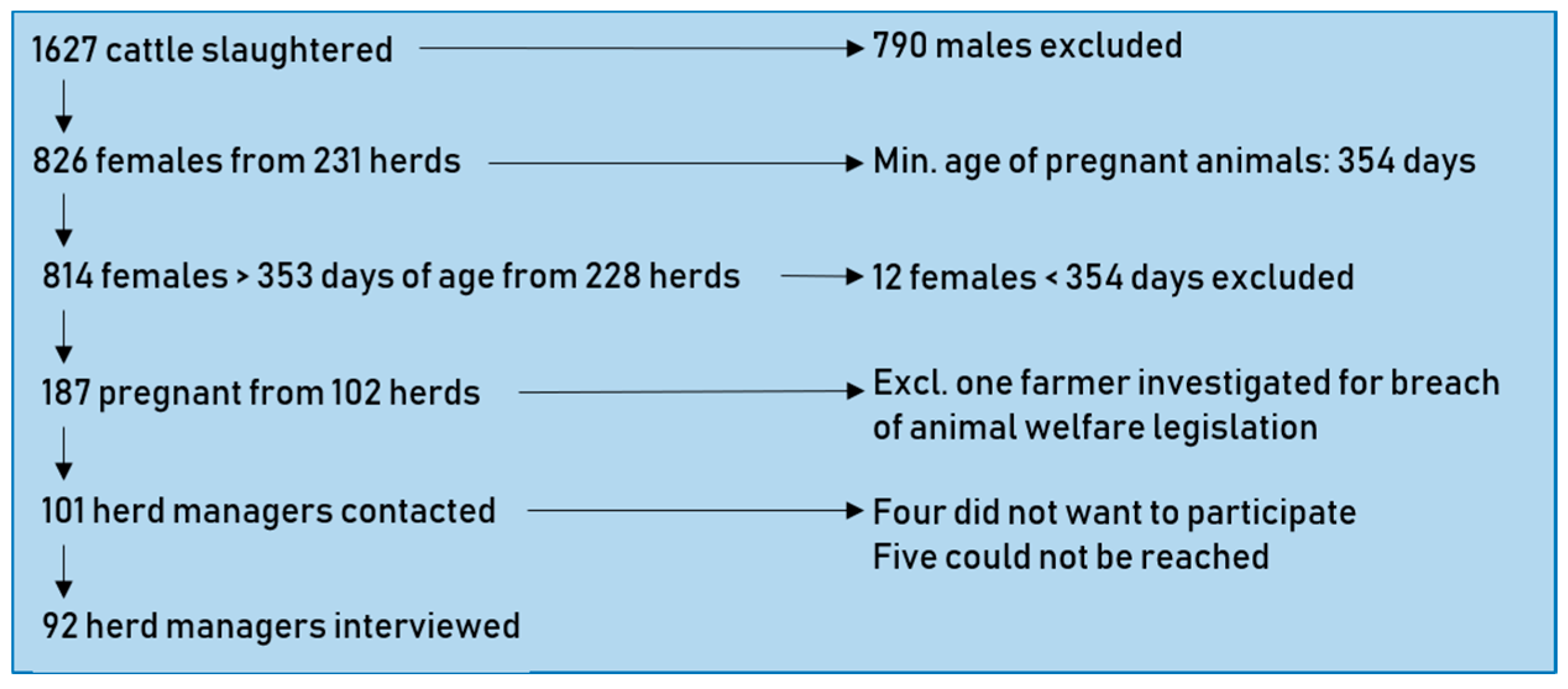
A total of 1627 cattle were slaughtered, including 837 females from 231 herds. Of these, 198 (24%) animals were recorded as pregnant, the youngest of which was 354 days old, while the youngest slaughtered animal was 242 days old. The corrected apparent prevalence was calculated based on animals >353 days of age, thereby excluding 12 females. A summary of the included and excluded subjects is illustrated in Figure 1. A total of 187 (23%; 95% confidence interval (C.I.): 20–26%) female cattle >354 days were pregnant. Among the pregnant cattle, 28% were in the first third of gestation, 49% were in the middle third of gestation, and 22% were in the last third of gestation. Despite the legal ban on the transport of late-term pregnant cattle, 0.4% (95% C.I.: 0.1–1%) were more than 90 (252 days) into gestation. The stratified prevalences are given in Table 1.
Figure 1.
Number of animals, herds, and herd managers resulting from the various assessment steps of cattle slaughtered and assessed for pregnancy at a major Danish abattoir from 16–19 October 2017.
Table 1.
Prevalence of pregnant cattle in different stages of gestation, overall and stratified by production type and parity among all the cattle slaughtered at a major Danish abattoir from 16–19 October 2017.
There was little overall difference between the prevalence of pregnant animals in the production systems (p = 0.36), but in non-dairy herds, the risk of being pregnant was more than two times higher in cows compared to heifers (relative risk: 2.4; 95% C.I.: 1.5–3.9). Heifers were more prevalent among non-dairy cattle, comprising 58% of the slaughtered female non-dairy cattle, and only 16% of the female dairy cattle. We defined heifers as female cattle that had not previously given birth to a calf.
The 187 slaughtered pregnant cattle originated from 102 herds, all but one of which were contacted for inclusion in the telephone survey. A total of 92 herd managers responded—61 from dairy herds and 31 from non-dairy herds—while four did not want to participate, and five could not be contacted (Figure 1), giving a response rate of 91%. Of the dairy managers, 90% (n = 55) said that they knew their cattle were pregnant, whereas only 65% (n = 20) of the non-dairy managers were aware that the cattle sent for slaughter were pregnant.
Reasons for sending pregnant animals for slaughter were provided for 168 of the 187 animals, with 3% (n = 5) slaughtered due to old age, 48% (n = 80) for reasons related to health, and 49% (n = 83) for reasons related to production. When only assessing pregnancy in the last two trimesters of gestation (>93 days pregnant), 30% (n = 17) of dairy managers used “production” as a reason for slaughter, while 70% (n = 39) stated health problems to be the motivation (Table 2). For the 24 non-dairy cattle >93 days pregnant, 15 (63%) were slaughtered for production-related reasons, six (25%) due to health, and one (5%) due to old age. None of the herd managers had sent cattle more than an estimated 186 days into gestation to slaughter; therefore, the data were slightly skewed towards producers sending cattle to slaughter earlier in gestation. No information on the reasons for slaughter was collected from herds sending non-pregnant animals for slaughter.
Table 2.
Distribution of justifications for the 168 slaughtered pregnant cows for which a reason for sending cattle for slaughter was given by the farmer. 1
All the specific comments given by each herd manager are summarised in Table A1 for dairy managers and Table A2 for non-dairy managers. Many dairy cattle farmers identified a dilemma between deciding to send a pregnant animal for slaughter and keeping a cow that was diseased, injured, or deemed unlikely to manage an additional lactation. Several also stated that they did not slaughter pregnant animals, while evidently still doing so, even in late gestation. However, in several of those cases, the pregnancies were estimated to be further progressed based on inspection of the foetuses compared to what the farmers stated. Several farmers were also regretful that they had slaughtered a pregnant animal, but the dilemma mentioned above drove them to choose this option (Table A1). Non-dairy cattle managers mentioned better growth, better body condition, and calmer animals as reasons for inseminating female cattle. However, in many cases, pregnancies were the result of natural mating as heifers, cows, and bulls were kept together—partly because they could not be kept separate, partly because it resulted in a more natural environment for the animals, and partly because it provided a calmer herd. In some cases, the farmers were not aware that the animals were pregnant because the animals were not very old (early yearlings) or because the bulls were not expected to be fertile (pubertal) (Table A2).
4. Discussion
We found a pregnancy prevalence of 23% among heifers and cows, with no apparent difference between dairy and non-dairy cattle. Pregnant non-dairy cattle were mostly cows (38%, compared to 16% of heifers), while pregnant dairy cattle were both cows (23%) and heifers (20%). Dairy cattle managers were mostly aware (90%) that their cattle were pregnant when sent for slaughter, while only 65% of the non-dairy cattle managers were aware. Dairy farmers mostly sent pregnant cattle to slaughter due to disease or injury, while slaughter based on production-related concerns was also common. However, there may be a link between production and health-related concerns, since poor production was often mentioned as a reason to expect future health problems such as ketosis.
Oestrus-related behaviour was also frequently mentioned as a reason for mating cattle designated for slaughter, in order to avoid injuries when cattle in oestrus jump on other animals or vice versa. Many farmers viewed the sending of pregnant cattle for slaughter as an ethical dilemma between sending a pregnant female for slaughter and facing various welfare-related problems.
The observed prevalence of pregnant cattle at slaughter was very similar to those reported in the 1960s and 1970s [4,5,6], although our estimate for non-dairy cattle was lower than that for extensively farmed beef cattle in Australia (63% [8], and higher than the expert-elicited median estimates provided by the European Food Safety Authority [11], with medians of 16% for dairy and 11% for beef cattle in the European Union (EU). A feasible explanation is that there are many large dairy herds in Denmark compared to other EU countries, and managers in larger herds may be more likely than managers of smaller herds to send a pregnant cow for slaughter. However, the reported European data on which the mentioned estimates are based are sparse and of poor quality. Differences in region and production systems may also influence the prevalence, for example, of cows kept in extensive beef production systems. Reasons for slaughtering cattle were also reported for English famers [7], but these farmers mostly did not know that their cattle were pregnant, unlike most of the Danish farmers in the current study. Consequently, the English farmers reported infertility as the most common reason for slaughter, with mastitis and old age following, while we reported that disease was the most important reason for Danish dairy farmers. These reasons are not comparable, because most Danish dairy farmers knew the pregnancy status and because major changes have occurred in the cattle industry over the last decades (e.g., increased herd size).
Although most dairy farmers knew that their animals were pregnant, a few were surprised to learn this because they had had a negative pregnancy test. Many farmers saw the slaughter of pregnant animals as a problem, but a pregnancy period of more than nine months gives ample time for the occurrence of different events that could lead to disease or injury in modern production systems, and therefore deviation from the planned full lactation of a cow. Involuntary slaughter can result from such incidents, where farmers feel that they must react. This challenge has not previously been addressed in the literature. Management options can include treatment (if possible), slaughter, or on-farm euthanasia. One farmer stated that slaughter was equally as good as euthanasia for a lame cow; so if the cow was suitable for transport, slaughter was chosen. Nevertheless, several farmers mentioned that they did not want to slaughter pregnant cows but still did so (with reference to disease or injuries), which highlights the dilemma that farmers face between keeping the pregnant dam and its foetus and protecting the dam against unnecessary suffering and thereby losing the foetus. In more extensive beef production, the farmers may not have deliberately bred the animals, but merely let nature prevail by leaving the bull and female cattle together. Natural living may also be requested by consumers, and keeping bulls, heifers, and cows apart can be seen as a problem from that perspective. Many farmers demonstrated an awareness of the dilemmas they faced. Many also appeared to have ethically founded reasons for sending pregnant cows for slaughter, although some may not have given it much thought. Farmers were not asked about their attitudes to the practice of raising animals, which are eventually going to be slaughtered, but there is reason to think that they accept this practice without any moral qualms and only have ethical concerns when either animals suffer unnecessarily or are killed without a good reason.
We experienced a very high proportion of responders. Most farmers were willing to talk to us, although some animosity was expressed in the beginning of the interviews. However, this was resolved in most cases, although some farmers did not want to participate. The interviewer (S.S.N.) is known to many farmers from his role in the Danish paratuberculosis programme, and therefore, they may have been fine by being interviewed. We did make every effort to use only publicly available information to get to the farmers though, and we made sure that they at all times could retract their consent.
Based on our findings, it is not possible to claim that the slaughter of pregnant cows and heifers in Danish dairy and non-dairy production occurs without ethical thinking and justification by the farmers. Even though the answers to our survey may contain some elements of self-serving retrospective justification, the overall impression that emerges is that most farmers who knowingly send pregnant cows or heifers for slaughter do so with a “heavy heart”, based on a perceived balance of conflicting concerns.
Author Contributions
Conceptualization, S.S.N. and J.S.A.; data curation, S.S.N. and S.U.K.; writing—original draft preparation, S.S.N., S.U.K., J.S.A., and P.S.; writing—review and editing, S.S.N., S.U.K., J.S.A., and P.S.; supervision, S.S.N. and J.S.A.; project administration, S.S.N.; funding acquisition, S.S.N.
Funding
This study was funded by the Knowledge Centre for Animal Welfare, The Danish Veterinary and Food Administration, Glostrup, Denmark.
Acknowledgments
We thank the Danish Crown slaughterhouse, Aalborg, Denmark for allowing access to the material. We also thank scientific assistant, DVM Anne Marie Michelsen for assistance with sampling.
Conflicts of Interest
The authors declare no conflict of interest. The funders had no role in the design of the study; in the collection, analyses, or interpretation of data; in the writing of the manuscript, or in the decision to publish the results.
Appendix A
Table A1.
Comments from 61 dairy cattle farmers sending pregnant animals to slaughter in Denmark in October 2017, sorted by estimated gestation month of the oldest foetus delivered from the herd. Statements in [] are comments from authors. Comments are translated from Danish.
Table A2.
Comments from 31 non-dairy-producing farmers sending pregnant animals to slaughter in Denmark in October 2017, sorted by estimated gestation month of the oldest foetus delivered from the herd. Statements in [] are comments from authors. Comments are translated from Danish.
References
- Riehn, K.; Domel, G.; Einspanier, A.; Gottschalk, J.; Lochmann, G.; Hildebrandt, G.; Luy, J.; Lücker, E. Schlachtung gravider Rinder—Aspekte der Ethik und des gesundheitlichen Verbraucherschutzes. Tierärztl. Umsch. 2011, 66, 391–405, (In German, Abstract in English). [Google Scholar]
- Maurer, P.; Lücker, E.; Riehn, K. Slaughter of pregnant cattle in German abattoirs—Current situation and prevalence: A cross-sectional study. BMC Vet. Res. 2016, 12, 91. [Google Scholar] [CrossRef] [Scilit] [PubMed]
- Perkins, J.R.; Olds, D.; Seath, D.M. A study of 1000 bovine genitalia. J. Dairy Sci. 1954, 37, 1158–1163. [Google Scholar] [CrossRef] [Scilit]
- Edwards, M.J. Observations on the anatomy of the reproductive organs of cows with special reference to those features sought during examination per rectum. N. Z. Vet. J. 1965, 13, 25–37. [Google Scholar] [CrossRef] [Scilit] [PubMed]
- David, J.S.E.; Bishop, M.V.H.; Cembrowicz, H.J. Reproductive expectancy and infertility in cattle. Proc. Int. Conf. Cattle Dis. 1970, 6, 199–205. [Google Scholar] [CrossRef] [Scilit]
- Al-Dahash, S.Y.A.; David, J.S.E. The incidence of ovarian activity, pregnancy and bovine genital abnormalities shown by an abattoir survey. Vet. Rec. 1977, 101, 296–299. [Google Scholar] [CrossRef] [Scilit] [PubMed]
- Singleton, G.H.; Dobson, H. A survey for the reasons for culling pregnant cows. Vet. Rec. 1995, 136, 162–165. [Google Scholar] [CrossRef] [Scilit] [PubMed]
- Ladds, P.W.; Summers, P.M.; Humphrey, J.D. Pregnancy in slaughtered cows in North-Eastern Australia. Aust. Vet. J. 1975, 51, 472–477. [Google Scholar] [CrossRef] [Scilit] [PubMed]
- Bellieni, C.V.; Buonocore, G. Is fetal pain a real evidence? J. Maternal-Fetal. Neonatal. Med 2012, 25, 1203–1208. [Google Scholar] [CrossRef] [Scilit] [PubMed]
- EFSA AHAW Panel (EFSA Panel on Animal Health and Animal Welfare); More, S.; Bicout, D.; Botner, A.; Butterworth, A.; Calistri, P.; Depner, K.; Edwards, S.; Garin-Bastuji, B.; Good, M.; et al. Scientific Opinion on the animal welfare aspects in respect of the slaughter or killing of pregnant livestock animals (cattle, pigs, sheep, goats, horses). EFSA J. 2017, 15, 4782. [Google Scholar] [CrossRef] [Scilit]
- Mellor, D.J. Galloping colts, fetal feelings and reassuring regulations: Putting farm animal welfare science into practice. J. Vet. Med. Educ. 2010, 37, 94–102. [Google Scholar] [CrossRef] [Scilit] [PubMed]
- Mellor, D.J.; Diesch, T.J. Onset of sentience: The potential for suffering in fetal and newborn farm animals. Appl. Anim. Behav. Sci. 2006, 100, 48–57. [Google Scholar] [CrossRef] [Scilit]
- Mellor, D.J.; Diesch, T.J. Birth and hatching: Key events in the onset of awareness in the lamb and chick. N. Z. Vet. J. 2007, 55, 51–60. [Google Scholar] [CrossRef] [Scilit] [PubMed]
- Mellor, D.J.; Gregory, N.G. Responsiveness, behavioural arousal and awareness in fetal and newborn lambs: Experimental, practical and therapeutic implications. N. Z. Vet. J. 2003, 51, 2–13. [Google Scholar] [CrossRef] [Scilit] [PubMed]
- Mellor, D.J.; Stafford, K.J. Animal welfare implications of neonatal mortality and morbidity in farm animals. Vet. J. 2004, 168, 118–133. [Google Scholar] [CrossRef] [Scilit] [PubMed]
- Mellor, D.J.; Diesch, T.J.; Gunn, A.J.; Bennet, L. The importance of ‘awareness’ for understanding fetal pain. Brain Res. Rev. 2005, 49, 455–471. [Google Scholar] [CrossRef] [Scilit] [PubMed]
- Campbell, M.L.; Mellor, D.J.; Sandøe, P. How should the welfare of fetal and neurologically immature postnatal animals be protected? Anim. Welf. 2014, 23, 369–379. [Google Scholar] [CrossRef] [Scilit]
- Deutscher Bundestag. Deutscher Bundestag Gesetzentwurf Drucksach 18/12085. 2017. Available online: http://dip21.bundestag.de/dip21/btd/18/120/1812085.pdf (accessed on 21 May 2019). (In German)
- EU Council. Council Regulation (EC) No 1/2005 of 22 December 2004 on the Protection of Animals during Transport and Related Operations and Amending Directives 64/432/EEC and 93/119/EC and Regulation (EC); No 1255/97; EU Council: Brussels, Belgium, 2004. [Google Scholar]
- Young, G.B.; Lee, G.J.; Waddington, D.; Sales, D.I.; Bradley, J.S.; Spooner, R.L. Culling and wastage in dairy cows in East Anglia. Vet. Rec. 1983, 113, 107–111. [Google Scholar] [CrossRef] [Scilit] [PubMed]
- EFSA (European Food Safety Authority). Guidance on expert knowledge elicitation in food and feed safety risk assessment. EFSA J. 2014, 3734, 278. [Google Scholar] [CrossRef] [Scilit]
- Krog, C.H.; Agerholm, J.S.; Nielsen, S.S. Fetal age assessment for Holstein cattle. PLoS ONE 2018, 13, e0207682. [Google Scholar] [CrossRef] [Scilit] [PubMed]


© 2019 by the authors. Licensee MDPI, Basel, Switzerland. This article is an open access article distributed under the terms and conditions of the Creative Commons Attribution (CC BY) license (http://creativecommons.org/licenses/by/4.0/).