Influence of Different Methionine Sources on Performance and Slaughter Characteristics of Broilers
by
 ,
,
Cristina Ullrich
1, 
Marion Langeheine
2,
Ralph Brehm
2,
Venja Taube
3,
Mercedes Rosillo Galera
4,
Karl Rohn
5,
Johanna Popp
6 and
Christian Visscher
1,* 1
Institute for Animal Nutrition, University of Veterinary Medicine Hannover, Foundation, Bischofsholer Damm 15, D-30173 Hanover, Germany
2
Institute for Anatomy, University of Veterinary Medicine Hannover, Foundation, Bischofsholer Damm 15, D-30173 Hanover, Germany
3
BEST 3 Gefluegelernaehrung GmbH, Ringstrasse 16, D-27239 Twistringen, Germany
4
University of Granada, Avenida del Hospicio s/n, 18010 Granada, Spain
5
Institute for Biometry, Epidemiology and Information Processing, University of Veterinary Medicine Hannover, Foundation, Bünteweg 2, D-30559 Hanover, Germany
6
Institute of Food Quality and Food Safety, University of Veterinary Medicine Hannover, Foundation, Bischofsholer Damm 15, D-30173 Hanover, Germany
*
Author to whom correspondence should be addressed.
Animals 2019, 9(11), 984; https://doi.org/10.3390/ani9110984
Submission received: 29 October 2019
/
Accepted: 15 November 2019
/
Published: 19 November 2019
(This article belongs to the Special Issue Poultry Nutrition)
Simple Summary
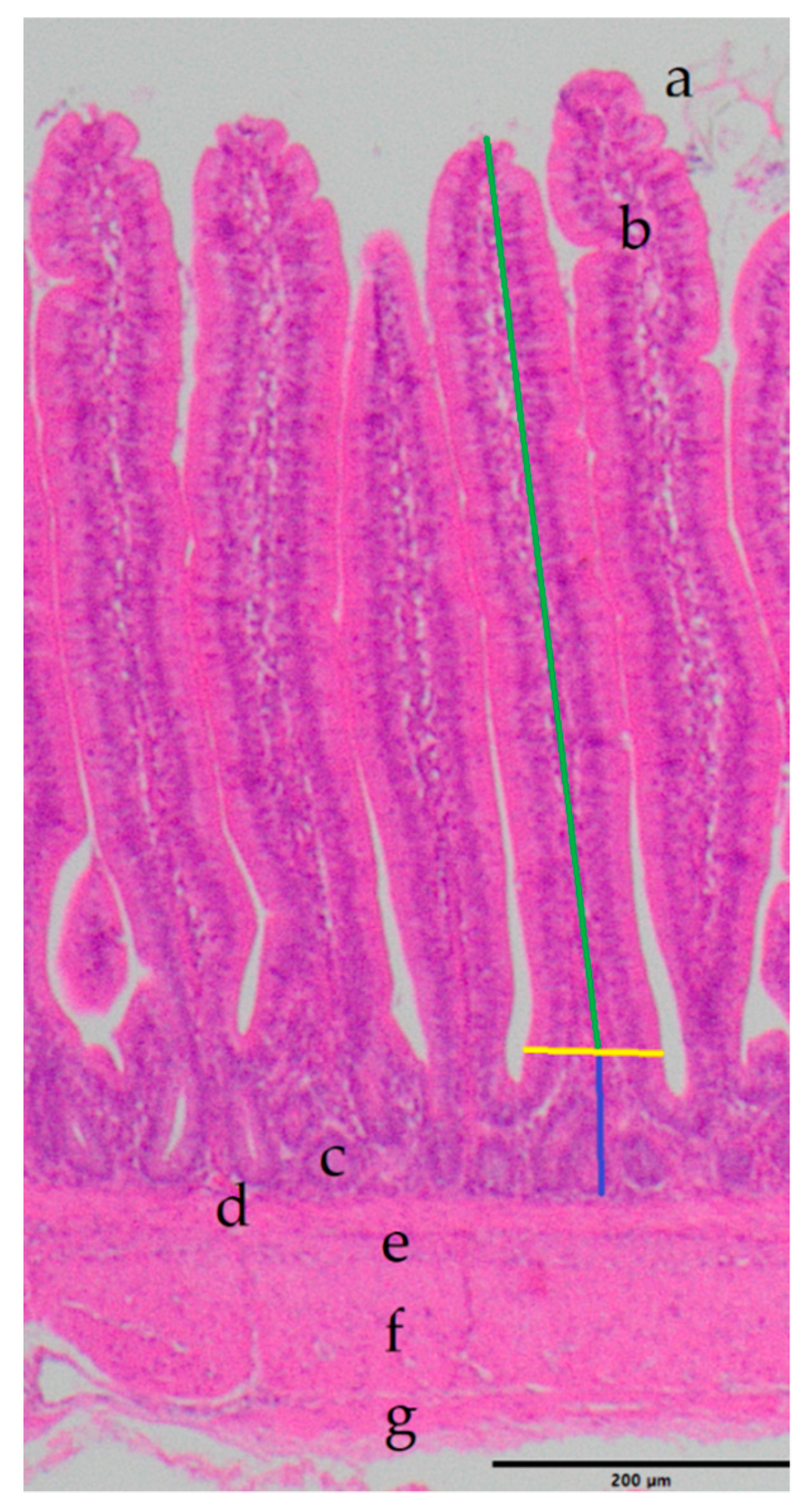
The increasing public demand for efficient, sustainably produced poultry meat with simultaneous optimization of animal welfare is calling for amendments in meat production. A starting point to meet this demand consists of complete diets for broilers with reduced crude protein content, supplemented with higher amounts of crystalline amino acids. This ensures sufficient nutritional supply and decreased nitrogen excretion for environmental relief. To optimize the performance and health, despite the drastically reduced protein content (~17.5% finisher diet), the present study compared different methionine sources (methionine hydroxy analog, DL-methionine, and L-methionine) in slightly higher dosages than found in practice, in comparison to a diet meeting the methionine requirements using methionine hydroxy analog. Methionine is the first limiting amino acid and has a significant influence on the health and growth of the animals. The results of the feeding trial showed no differences concerning general health, ileal histology, and performance data of broilers before slaughter. However, the composition of the breast meat differed significantly (highest protein content and lowest fat content in the L-methionine group), and thus provides the impetus for further research.
Abstract
Sustainably produced poultry meat with consideration of animal health poses a challenge for broiler production. Low protein diets with high amounts of synthetic amino acids (AAs) like methionine (Met) are the consequence. In a five-week feeding trial, 360 broilers (Ross 308) assigned to four feeding groups were offered protein-reduced complete diets (starter: 20% crude protein (CP); grower: 18.5% CP; finisher: 17.5% CP), supplemented with essential AAs. The “MHA” group received DL-2-hydroxy-4-(methylthio) butanoic acid (DL-HMTBA; trade name: MHA®), groups “L” and “DL” the respective Met source in equivalent concentrations each exceeding the nutritional recommendations. “R-MHA” (“R” for “reduced”) received the minimum required level (using MHA as Met source). Performance exceeded performance goals without differences between the groups. The average feed conversion ratio (FCR) amounted to 1.35. The carcass/body weight ratio of R-MHA was significantly lower (0.782) compared to DL (0.808) and L (0.809). Breast meat of R-MHA contained significantly more fat (144 g/kg dry matter (DM)) compared to L (104 g/kg DM) and significantly lower CP content (R-MHA: 838 g/kg DM; L: 875 g/kg DM). The results indicated possible improvement in slaughter yield by protein-reduced diets supplemented with L-Met, thus recommending further research focusing on the Met influence.
Keywords:
methionine; broiler; reduced crude protein; slaughter characteristics