Effect of Immediately-After-Birth Weaning on the Development of Goat Kids Born to Small Ruminant Lentivirus-Positive Dams
by
 , , , and
Tomasz Nalbert
1, 
Michał Czopowicz
1,* ,
,
Olga Szaluś-Jordanow
2,
Agata Moroz
1,
Marcin Mickiewicz
1,
Lucjan Witkowski
1,
Iwona Markowska-Daniel
1,
Ryszard Puchała
3,
Emilia Bagnicka
4 and
Jarosław Kaba
1 1
Division of Veterinary Epidemiology and Economics, Institute of Veterinary Medicine, Warsaw University of Life Sciences, Nowoursynowska 159c, 02-776 Warsaw, Poland
2
Department of Small Animal Diseases with Clinic, Faculty of Veterinary Medicine, Warsaw University of Life Sciences, Nowoursynowska 159c, 02-776 Warsaw, Poland
3
Applied Physiology Unit, Military Institute of Hygiene and Epidemiology, Kozielska 4, 01-001 Warsaw, Poland
4
Institute of Genetics and Animal Breeding, Polish Academy of Sciences, Postępu 36A, Jastrzębiec, 05-552 Magdalenka, Poland
*
Author to whom correspondence should be addressed.
Animals 2019, 9(10), 822; https://doi.org/10.3390/ani9100822
Submission received: 28 August 2019
/
Revised: 9 October 2019
/
Accepted: 16 October 2019
/
Published: 17 October 2019
(This article belongs to the Section Small Ruminants)
Simple Summary
Caprine arthritis-encephalitis (CAE) is one of the most important and devastating viral diseases of small ruminants in developed countries. The disease spreads easily from one goat to another, and neither curative therapy nor preventive vaccinations exist to break the chain of infections. Hence, the only way to suppress the epidemic in a herd is to identify and cull infected goats. However, it is both costly and cruel as most of them remain apparently healthy for many months or even years, yet they constantly shed the virus. Therefore, many farmers decide to wean kids away from their infected mothers as soon as they are born and keep them in separation, feeding them on bovine or artificial colostrum and milk. Even though this approach is quite effective, it may be recommended only if it has no negative impact on kids’ development. Therefore, we conducted the study which compared the development of kids weaned immediately after birth and kids kept with mothers. We showed that early weaning did not seem to have any detrimental effect on kids’ health. On this basis, we conclude that this procedure may be an advisable alternative for those farmers who cannot afford to implement radical eradication program in their herds.
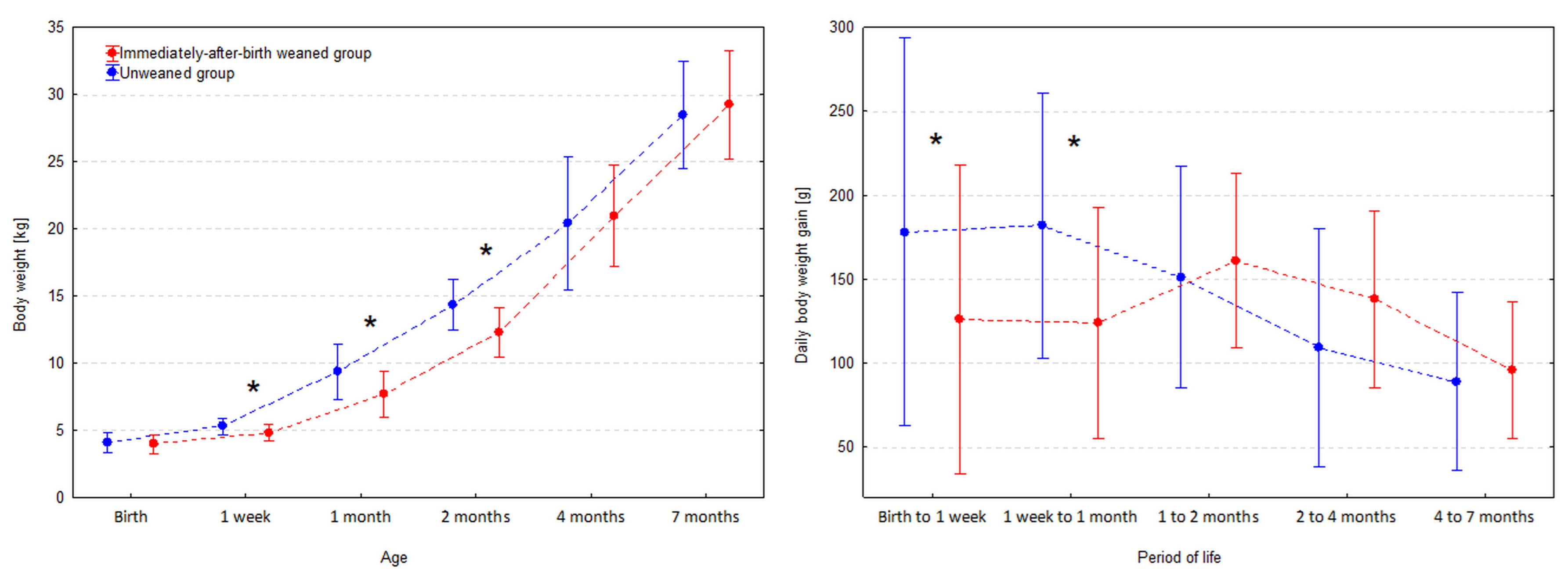
Abstract
A longitudinal study was carried out to investigate the influence of two different rearing systems of young kids on their development to sexual maturity. Kids born to small ruminant lentiviruses-infected (SRLV) female goats were split into two groups: the immediately-after-birth weaned group and the unweaned group. Kids’ body weight (BWT) was measured before the first consumption of colostrum, and then at the age of one week, and one, two, four, and seven months. The relationship between the rearing system and BWT at each age was investigated using mixed linear models adjusted for potential confounders. The mean BWT of kids of the immediately-after-birth weaned group was significantly lower at the age of one week, one month, and two months, and then the difference became insignificant. The mean daily body weight gain (DWG) was significantly lower in the immediately-after-birth weaned group during the whole first month of life, but then DWG in both groups became equal. Crude mortality rate did not differ significantly between groups. This study shows that weaning kids immediately after birth does not appear to have any negative impact on kids’ development except transient growth retardation, which is fully compensated until they reach sexual maturity.