Influence of Liver Condition and Copper on Selective Parameters of Post-Mortem Dog Tissue Samples

1
Department of Grain Science & Industry, Kansas State University, Manhattan, KS 66506, USA
2
Nutrition Innovation, Hill’s Pet Nutrition, Topeka, KS 66601, USA
*
Author to whom correspondence should be addressed.
Animals 2018, 8(12), 237; https://doi.org/10.3390/ani8120237
Submission received: 5 October 2018
/
Revised: 3 December 2018
/
Accepted: 5 December 2018
/
Published: 13 December 2018
(This article belongs to the Section Companion Animals)
Simple Summary
The liver is a vital organ involved in numerous physiological functions. Maintaining its health is vital to the wellbeing of the dog. Copper is a transition metal that can cause cell oxidation when stored in excess. This surplus storage in the liver may happen due to breed genetics, or excess dietary copper consumption. The objective of this work was to determine relationship between hepatic copper and liver pathology severity with plasma metabolites, complete blood count, and blood chemistry. Copper accumulation was not related to either liver pathological condition nor to an increase in liver biomarkers in the selected dog population. However, an increasing copper concentration suggested oxidation and cell membrane stress. Liver pathology severity was related to increased liver enzymes, and some cholestasis. Further, liver neoplasia was correlated with biomarkers that suggest rapid cell division and increased energy metabolism.
Abstract
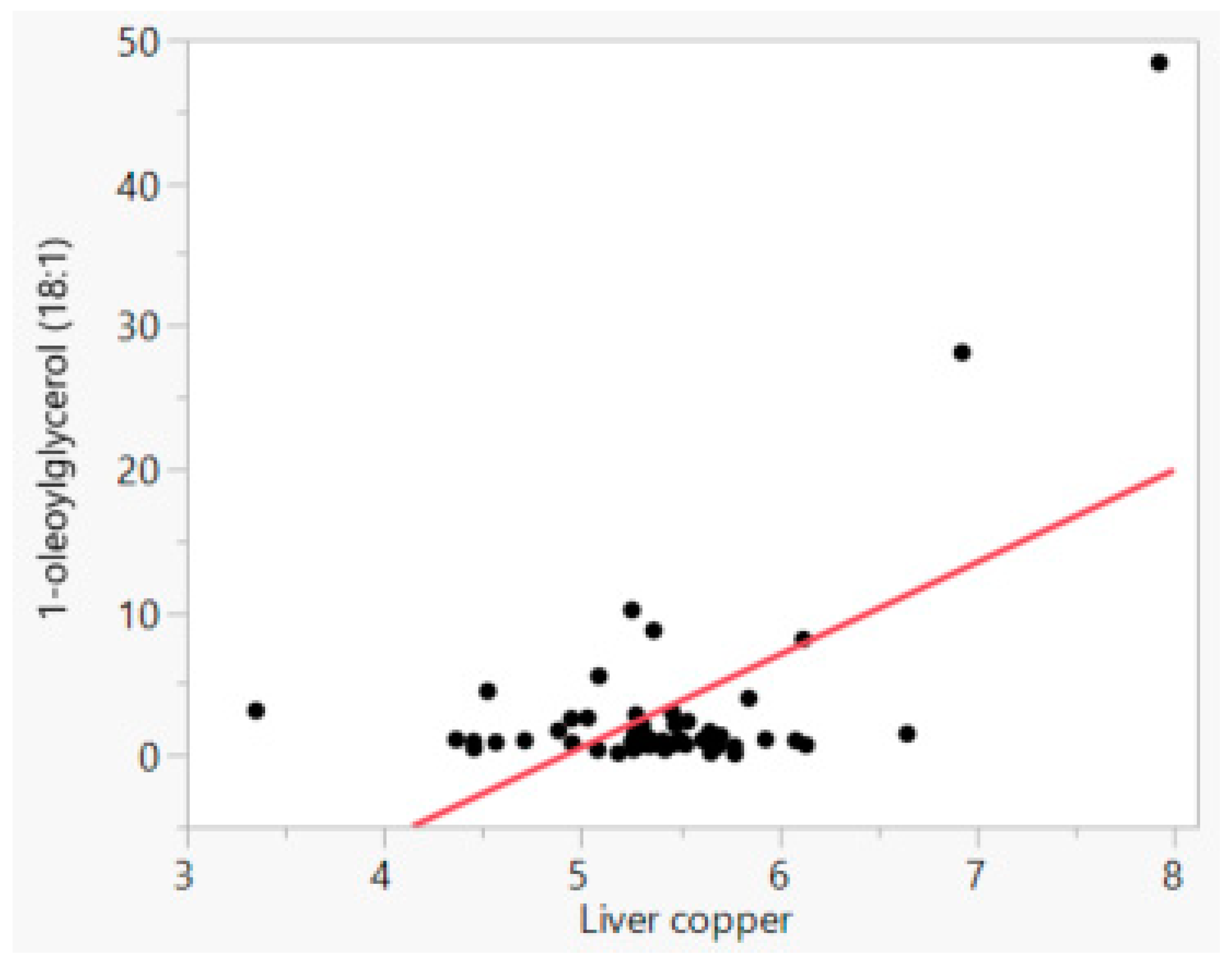
One of the liver functions is copper storage, which can be toxic when in excess. The objective of this retrospective study was to determine the relationship between hepatic copper and pathology conditions in stored samples from 55 post-mortem dogs (37 Beagles, 12 Labrador Retrievers, and 6 Labrador Mixes). The analyses evaluated data from blood chemistry and complete blood count (CBC) that were measured immediately before euthanasia, and liver biopsies which were harvested at necropsy and frozen at −80 °C. Slides for microscopic evaluation were prepared, and liver copper and plasma metabolites were measured. Hepatic copper was correlated (p ≤ 0.001) with monoacylglycerols, 13-HODE + 9-HODE (13-hydroxy-9,11-octadecadienoic acid + 9-hydroxy-10,12-octadecadienoic acid), and stearoyl-arachidonoyl-glycerophosphocholine. This indicates lipid metabolism modification and cell membrane oxidation. However, hepatic copper was not related to liver histopathology severity or altered liver biomarkers. The severity of liver pathology was positively correlated (p ≤ 0.05) with liver enzymes, bile salts, and glycerophosphocholines, suggesting cholestasis and altered lipid and amino acid metabolism. Liver neoplasia had increased (p ≤ 0.05) metabolites derived from nucleotides, along with an increase (p ≤ 0.05) in α-ketoglutarate from the energy and amino acid metabolism (p ≤ 0.05), suggesting rapid cell division. This study offers further insight regarding changes in metabolism due to hepatic tissue damage.
Keywords:
dog; liver; copper; histopathology; cholestasis; oxidation