Effects of Calcareous Marine Algae on Feedlot Performance, Carcass Traits, Nutrient Digestion and Enteric Methane Emissions of Feedlot-Finished Nellore Heifers
by
 , , ,
, , ,
Igor Gomes Fávero
1,
Ana Claudia Degli Exposti
1,
Felipe Martins Fávero
2,
Júlia Mara Campos de Souza
2,
Antonio Pereira de Barros Neto
1 ,
,
Robert Michael Boddey
3,
Bruno Grossi Costa Homem
4,
Lorenna Machado
5,
Daniel Rume Casagrande
2 and
Erick Darlisson Batista
2,* 1
Department of Animal Science, “Luiz de Queiroz” College of Agriculture (ESALQ), University of São Paulo, Piracicaba 13418-900, SP, Brazil
2
Department of Animal Science, Federal University of Lavras (UFLA), Lavras 37200-900, MG, Brazil
3
Department of Soil Science, Federal Rural University of Rio de Janeiro (UFRRJ), Seropédica 23897-000, RJ, Brazil
4
Department of Animal Sciences, Federal University of Viçosa (UFV), Viçosa 36570-900, MG, Brazil
5
College of Marine and Environmental Sciences, James Cook University, Townsville, QLD 4811, Australia
*
Author to whom correspondence should be addressed.
Animals 2026, 16(7), 1024; https://doi.org/10.3390/ani16071024
Submission received: 17 February 2026
/
Revised: 6 March 2026
/
Accepted: 13 March 2026
/
Published: 27 March 2026
(This article belongs to the Special Issue Nutritional Modulation Strategies for Rumen Microbiota Structure and Methane Emissions)
Simple Summary
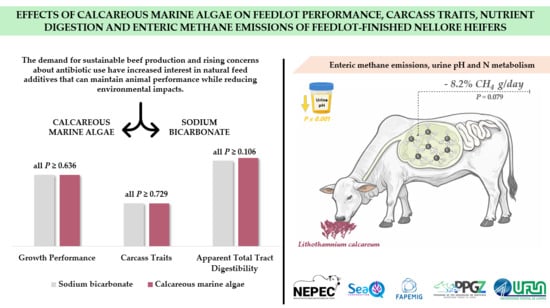
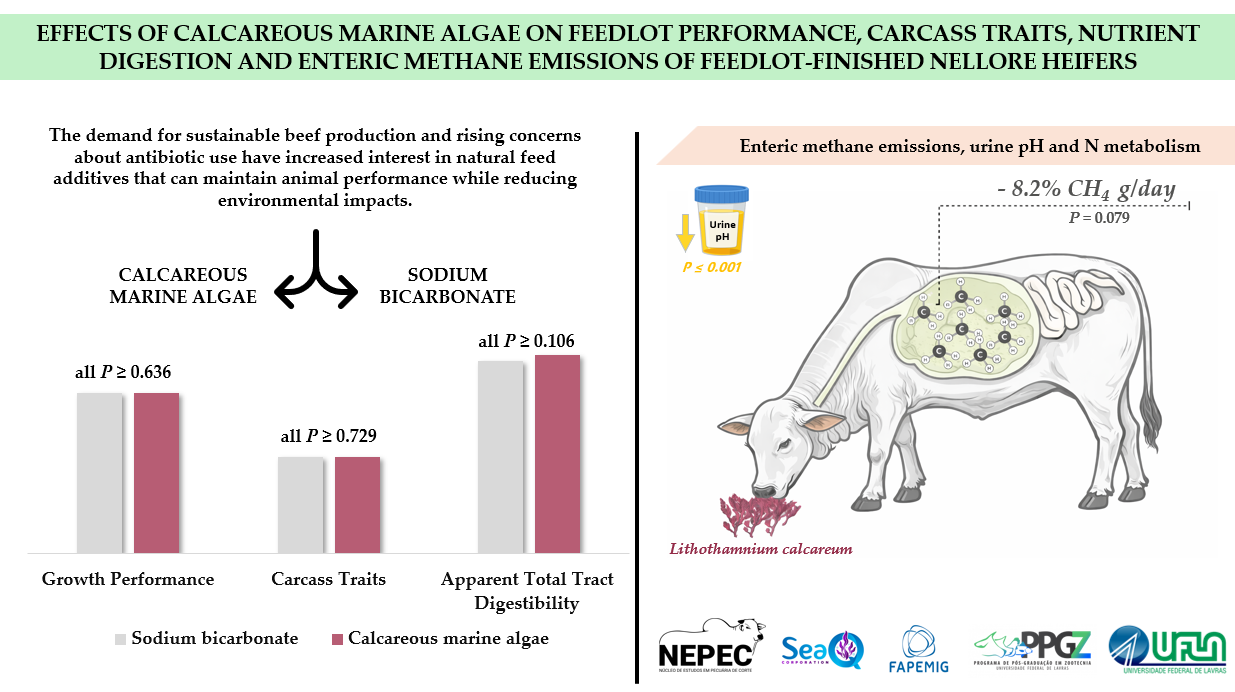
The growing demand for efficient beef production requires new strategies that keep animals productive under high-grain feeding conditions. One of the main concerns in modern cattle feeding is the frequent use of chemical additives and antibiotics, which has increased public interest in natural and environmentally friendly solutions. This study evaluated a calcareous marine algae called Lithothamnium calcareum, a natural source of calcium and other minerals, as a possible replacement for the traditional buffering compound sodium bicarbonate in beef cattle diets. The experiment was conducted with Nellore heifers housed in individual pens for 96 days and fed high-grain diets containing either sodium bicarbonate or the calcareous marine algae. The heifers receiving the algae showed similar feedlot performance compared with those receiving sodium bicarbonate. In addition, methane emissions tended to be 8.2% lower in the calcareous marine algae treatment (p = 0.079). Overall, this natural marine algae is a potential alternative additive that maintains performance and may contribute to more sustainable beef production.
Abstract
Global population growth has intensified the demand for productive and sustainable livestock systems. Lithothamnium calcareum, a calcareous marine alga, has been investigated as a natural feed additive for cattle diets. This study evaluated the effects of L. calcareum supplementation on performance, carcass traits, nutrient digestibility, nitrogen metabolism, urinary and fecal pH, and enteric methane emissions in Nellore heifers during the finishing phase. Thirty-six heifers (BW = 268.8 ± 7.3 kg) were assigned to individual pens in a completely randomized design and fed ad libitum diets (25:75 forage-to-concentrate ratio, DM basis). Treatments were: (1) sodium bicarbonate (110 g/heifer/day) and (2) L. calcareum (60 g/heifer/day). The 96-day trial included 12 days of adaptation and 84 days on the finishing diet. Methane emissions were measured using the sulfur hexafluoride (SF6) tracer technique. L. calcareum did not affect performance, carcass traits, nitrogen metabolism, or apparent total tract digestibility (all p ≥ 0.106), but reduced urine pH (p ≤ 0.001) and tended to lower methane emissions (−8.2%; p = 0.079). Thus, L. calcareum appears to be a viable natural alternative to sodium bicarbonate in finishing diets for Nellore heifers, maintaining productive performance and potentially reducing enteric methane output.
Keywords:
finishing phase; natural additive; ruminants; sustainability