3.1. Morphophysiology of Oreochromis niloticus Liver and Intestine
Although using microalgae in fish feed offers great environmental benefits, it is crucial that this addition does not hinder fish development [
22]. Despite the heterogeneous information reported in the literature regarding feed formulation, microalgae species and inclusion levels, and experimental designs and durations, it is widely accepted that microalgae can improve the zootechnical and physiological performance of fish [
23]. For example, Youssef et al. [
24] showed that the inclusion of up to 10%
Limnospira platensis in
O. niloticus feed for eight weeks improved intestinal immunity by increasing the height and width of intestinal villi, and the number of lymphocytes and goblet cells. Ibrahim et al., [
25] added up to 3% of a microalgae mix containing
Limnospira sp. to
O. niloticus diets for 12 weeks, resulting in enhanced hepatic and digestive enzyme activities, immune response, and disease resistance.
Here, we extend our previous research on the zootechnical performance of juvenile Nile tilapia fed up to 40%
L. maxima-based feed for 85 days [
18] by presenting physiological and metabolic data. We found no significant differences in the IC, number of intestinal villi, villus height, and HSI between treatments (
p > 0.05;
Table 3). To improve the utilization of ingested food, fish can adapt their digestive tracts morphologically and physiologically depending on the offered diet [
26]. As with many teleost fish, the anterior intestine of
O. nilotocus is characterized by four distinct layers: mucosa, submucosa, muscularis, and serosa. The mucosa layer consists of a simple cylindrical epithelium with a brush border and goblet cells containing lamina with intraepithelial lymphocytes. The submucosa is formed by cells, collagen fibers, and blood vessels. The muscular layer consists of smooth muscles arranged in a circular pattern outside the serosa. This layer is characterized by connective tissue and pavimentous cells. These structures showed no difference in
O. niloticus subjected to experimental diets with different levels of
L. maxima biomass (
Figure S1). This indicates that the addition of up to 40%
L. maxima biomass to fish feed did not have a detrimental morphophysiological impact on their digestive tracts. It should be noted that the high variability observed in the number of villi and villus height, which is not uncommon in biological samples, suggests that these parameters should be further investigated in future research.
The fish liver performs several important functions, including the synthesis of certain amino acids, the production of plasma proteins, and protein deamination [
27]. Excessive protein intake requires increased energy levels for metabolism, and the excess is stored as fat after deamination, which can overload liver function. By contrast, suboptimal protein intake leads to an energy demanding condition and causes oxidative stress. Both cases have a negative impact in growth and feed conversion [
28,
29,
30,
31]. Therefore, the liver can serve as an excellent indicator of nutritional constraints. Histological analyses of the hepatic parenchyma revealed hepatocytes with homogeneous cytoplasm and exocrine pancreatic acini dispersed throughout the tissue, with no observable differences between treatments (
Figure S2). This indicates that the addition of up to 40%
L. maxima biomass in fish feed did not have a detrimental morphophysiological impact on their livers.
3.2. Fatty Acid Profiles and Fillet Fat Quality
One of the main goals of using microalgae in fish production is to increase the content of unsaturated fatty acids in fish without relying heavily on fish oils. Many small fish are cultured using microalgae as live prey or by greenwater aquaculture in hatcheries [
23]. In nature, fish PUFAs primarily originate from phytoplankton, which form the basis of the aquatic food web, since de novo PUFA synthesis in animals is limited [
32]. For example, the fatty acid profile of the
L. maxima biomass used in this study contained approximately 10% PUFAs, primarily linoleic acid, γ-linolenic acid, and α-linolenic acid (
Table S2).
The main saturated fatty acid (SFA), MUFA, and PUFA in all tissues were palmitic acid (C16:0), oleic acid (C18:1
n-9), and linoleic acid (C18:2
n-6), respectively. In the liver, the highest concentrations of SFAs were found in the 40%
L. maxima diet, while MUFAs and PUFAs were highest in fish fed 20%
L. maxima (
Table 4). Among the PUFAs,
n-6 fatty acids were highest in the 20% treatment, whereas
n-3 fatty acids were highest in the control group and decreased progressively with the increasing addition of
L. maxima to the feed. The
n-6/
n-3 ratio was highest at 40%
L. maxima inclusion. The intestinal tissue exhibited the highest concentrations of SFAs and PUFAs in the 20% treatment, and no difference in MUFA concentrations across treatments (
Table 5). Similarly, the highest concentrations of
n-6 and
n-3 fatty acids were found in fish fed a 20%
L. maxima diet. The
n-6/
n-3 ratio was essentially the same for all treatments. In the fillet, the highest concentrations of SFAs and MUFAs were found in the control group, whereas the highest concentrations of PUFAs were found in the 30% treatment, although this was not statistically different from the 20% and 40% treatments (
Table 6). Similarly, no statistically significant differences were observed in the concentrations of
n-3 fatty acid concentrations or
n-6/
n-3 ratios among treatments. Moreover, all tissues generally exhibited higher PUFA content in fish fed a 20–30%
L. maxima diet. Interestingly, the same range of
L. maxima addition resulted in optimal weight gain, growth, development, and survival rates for the fish used in this study [
18] (
Table 7).
The analysis of the liver, intestine, and fillet of
O. niloticus fed increasing concentrations of
L. maxima revealed different trends in fatty acid profiles in the different tissues. The selection of these tissues was based on the importance of obtaining a holistic overview of fatty acid metabolism, considering their widely different physiological roles in fish and other animals. For instance, the intestine is the primary site for lipid digestion and fatty acid absorption, muscle (fillet) is a major lipid storage tissue, and the liver is the central regulator of lipid metabolism. The wider variation of SFAs, PUFAs, and
n-3 fatty acids in the liver when compared to the other tissues indicates its regulatory role in synthesizing, secreting, and degrading major lipids. In contrast, the fillet primarily increased the content of PUFAs, some of which are essential for fish physiology and have been shown to support cellular membranes, metabolic regulation, immune function, and steroid biosynthesis [
33]. Different responses on
n-3 and
n-6 fatty acids and the
n-6/
n-3 ratio, which was only affected by diet in the liver, may be explained by the different activities of the elongases and desaturases that are responsible for PUFA synthesis. However, the activity of these enzymes is influenced not only by the tissue and the diet, but also by the environmental conditions and life stage of fish [
34]. Therefore, more targeted research is needed to answer this question.
From a commercial standpoint, the degree of lipid unsaturation in fish fillets is of the utmost importance. High levels of unsaturation significantly affect the sensory properties of fillets by increasing their susceptibility to oxidation. This may reduce shelf-life and introduce negative off-flavors and odors [
35]. On the other hand, from a consumer’s perspective, it is desirable to have more PUFAs in the fish fillets as a dietary protein source. Essential PUFAs, such as docosahexaenoic acid (DHA; C22:6
n-3), for example, are important for brain and cardiovascular health, anti-inflammatory activity, and immune function [
36]. Thus, the quality of dietary fat in
O. niloticus fillets can be assessed based on their fatty acid profiles. In this study, we only examined indices of fat quality in fish fillets as a dietary protein source. Further research should be conducted to thoroughly investigate how different fatty acid profiles affect sensory properties and shelf-life.
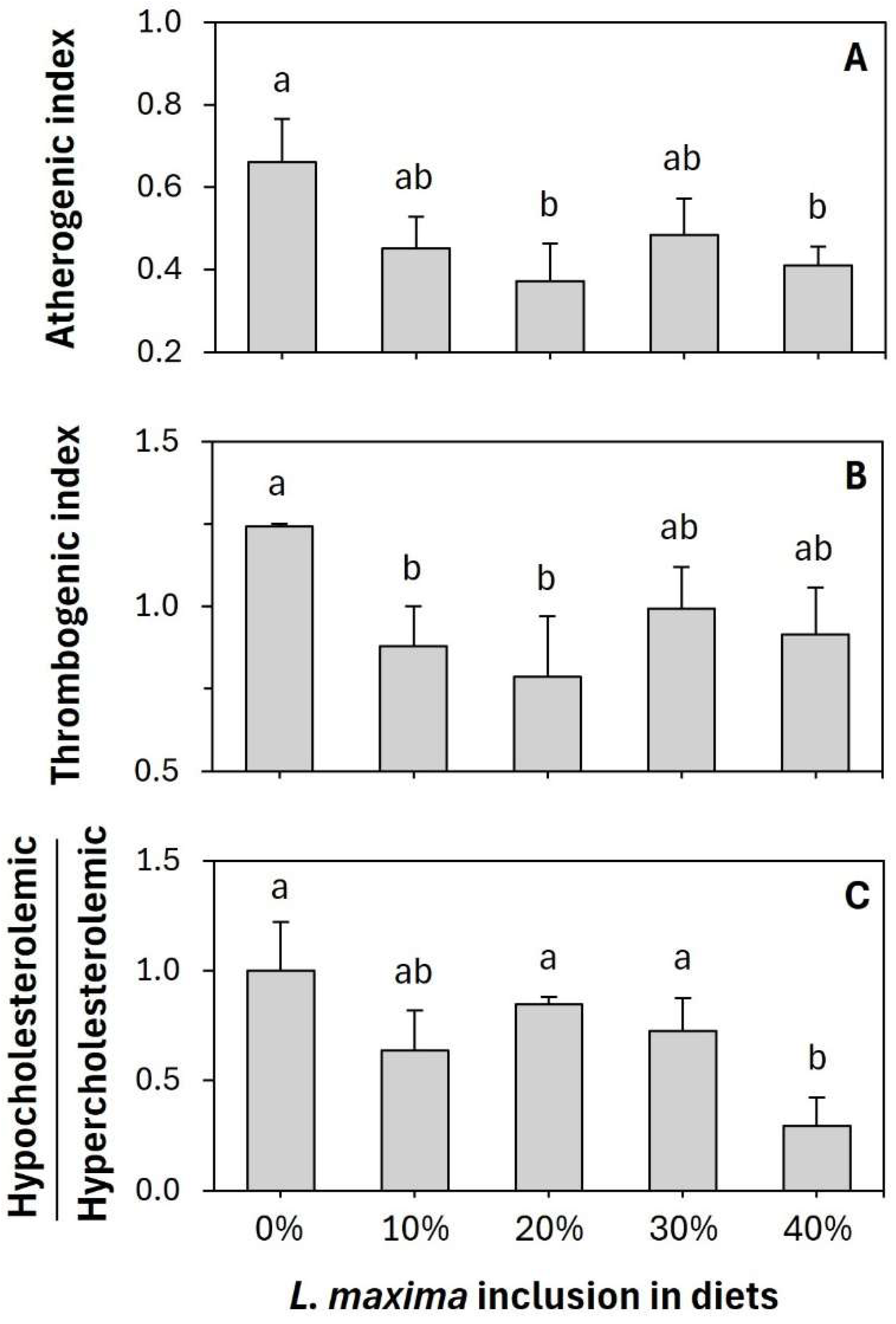
The atherogenic and the thrombogenic indices indicate the potential of a food to contribute to cardiovascular disease by comparing the levels of pro-atherogenic and thrombogenic saturated fatty acid levels to anti-atherogenic and thrombogenic unsaturated fatty acid levels [
37]. Fillets from fish fed the experimental diet with a 20%
L. maxima addition had the lowest AI and TI, significantly different from the control group (
p < 0.05;
Figure 1). Similarly, the hypocholesterolemic/hypercholesterolemic (h/H) index compares the content of unsaturated fatty acids, which lower cholesterolemia, with that of saturated fatty acids, which raise it, to evaluate the effect of dietary fatty acids on cholesterol metabolism. Fillets from fish fed the 40%
L. maxima addition experimental diet had the lowest h/H index, which was statistically different from all other treatments except for the 10% treatment (
Figure 1). A comprehensive comparison of the fatty acid profiles of the liver, intestine, and fillet, as well as the dietary fat quality indices of the fillets, showed that adding
L. maxima to the diet of
O. niloticus was potentially beneficial for both the farmed fish and their consumers. Still, it is essential to conduct sensorial analysis and acceptability tests to validate these results.
3.3. Proteomics, Enzymes, and Metabolism
Despite its massive potential in nutritional research, proteomic analysis remains underutilized in tilapia farming. The few available publications mostly relate to the exposition of fish to environmental stresses, or to the proteomic analysis of bacteria that have negative impacts on aquaculture [
38,
39,
40]. None of the publications are related to tilapia nutrition. This study identified a total of 1758 proteins: 1463 in the liver, 408 in the intestine, and 689 in the fillet of juvenile Nile tilapia that were fed
L. maxima (
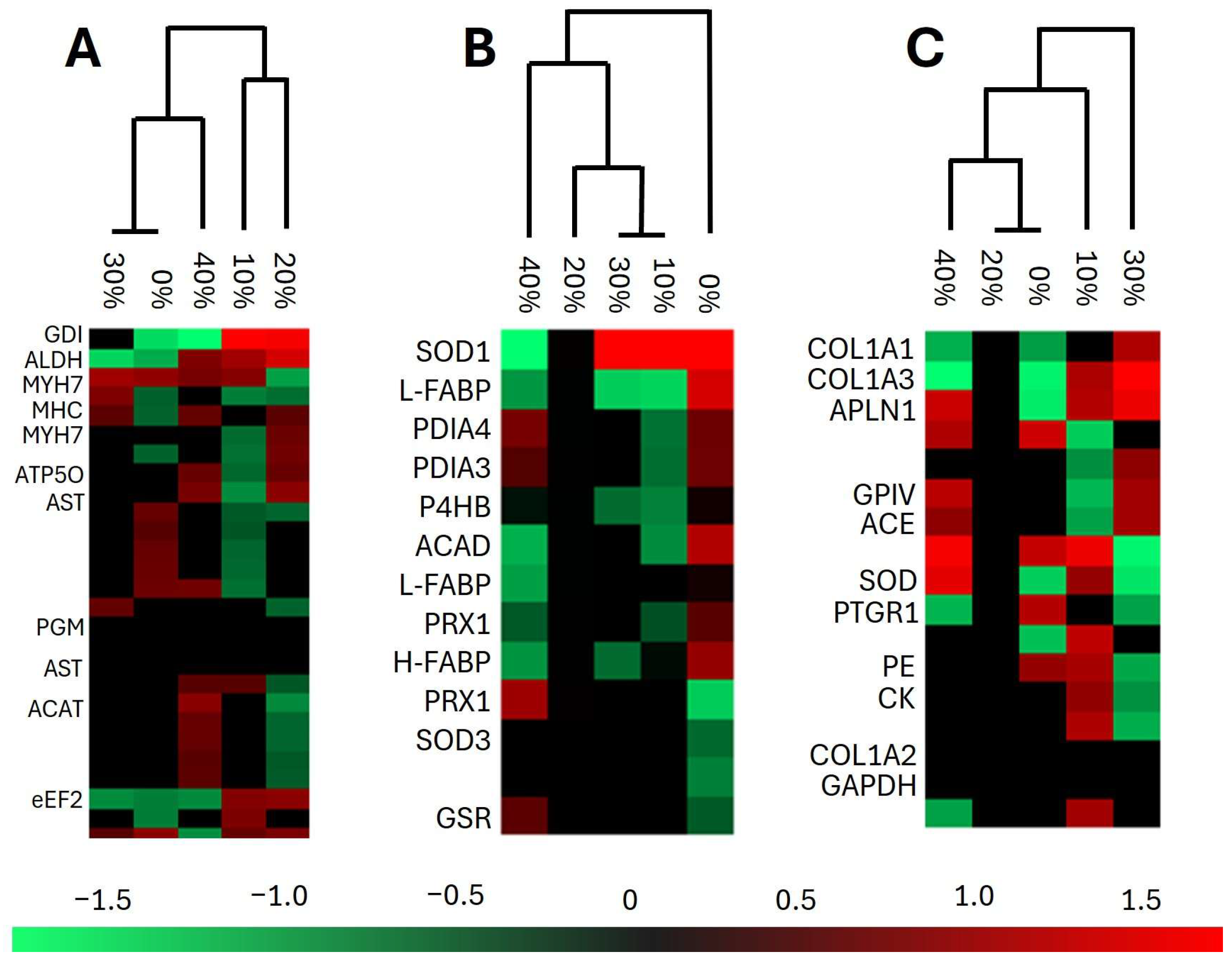
Table S2). Different concentrations of the microalga added to the experimental diets resulted in different protein patterns based on their relative abundance (
Figure 2). One limitation of our investigation is that we did not carry out experimental validation of specific enzymes using methods such as Western blot or enzymatic activity assays. Instead, we relied on relatively robust proteomic analysis to gain an overall view of fish metabolism. Nevertheless, our results should be interpreted as indicative, and further specific analyses of enzymes of interest are encouraged. In line with the other results presented in this study, our assessment focused on antioxidant enzymes, and on enzymes related to fatty acid metabolism.
The antioxidant enzymes superoxide dismutase (SOD1 and SOD3), glutathione disulfide reductase (GSR), peroxiredoxin (PRX1), and phospholipase D3 (PLD3) were more abundant in the treatment groups that received
L. maxima-containing feed than in the control group. Similarly, Hassaan et al. [
41] observed increased SOD, catalase (CAT), and glutathione peroxidase (GSH-Px) activities in Nile tilapia supplemented with
Limnospira platensis extract. Additionally, Ibrahim et al. [
25] reported the upregulation of SOD, CAT, and GSH-Px at the gene expression level in Nile tilapia fed a microalgae mix containing
Limnospira sp. The physiological role of GSR is to reduce glutathione disulfide and work with GSH-Px to combat free radicals in cells. PRX1 is abundant in the cytosol, where it reduces hydrogen peroxide and participates in cell division [
42]. Moreover, PLD3 is a hepatoprotective enzyme, whose deficiency has been associated with hepatic inflammation in rats [
43]. By contrast, disulfide isomerases (P4HB, PDIA3, and PDIA4) were less abundant in treatments containing
L. maxima in the feed than in the control group. These enzymes regulate the activity of NADPH oxidase, which is a source of reactive oxygen species [
44]. Therefore, these results indicate that fish fed a diet containing 20–30%
L. maxima have increased resistance to oxidative stress.
The liver plays a central role in the synthesis, degradation, secretion, and storage of lipids [
45]. Fatty acid-binding proteins (L-FABP, and H-FABP) were found in greater abundance in the control group and in the treatment with 40%
L. maxima addition compared to the other treatments. These enzymes have multiple functions, including the ability to simultaneously bind to two molecules of long-chain fatty acid and to reduce the concentration of potentially toxic-free long-chain fatty acids [
46,
47]. It has been suggested that H-FABP influences intramuscular fat in pigs [
48], which may explain the different trends in SFA concentrations in tissues as a function of
L. maxima concentration in the investigated diets (
Table 4,
Table 5 and
Table 6).
Beta-oxidation of saturated fatty acids mainly occurs in the liver and is catalyzed by three acyl-CoA dehydrogenase isoenzymes: very long-chain acyl-CoA dehydrogenase (VLCAD), medium-chain acyl-CoA dehydrogenase (MCAD), and short-chain acyl-CoA dehydrogenase (SCAD) [
49]. This study found these enzymes to be in greater abundance in experimental diets containing
L. maxima compared to the control group. These results align with the overall increase in lipid unsaturation observed in
O. niloticus fillets (
Table 6), although this trend was not evident in the fatty acid profiles of the liver and intestine (
Table 4 and
Table 5). In principle, the increased abundance of acyl-CoA dehydrogenases enables more efficient use of the lipid content in feed. This may explain the previously reported improvement in weight gain and feed conversion in fish fed
L. maxima-containing feed [
18].
3.4. Microalgae and the Future of Sustainable Aquaculture
It is generally accepted that the inclusion of microalgae in aquaculture feed can improve the sustainability and circularity of the sector. This is mainly due to (i) the partial or complete replacement of environmentally intensive ingredients, such as fishmeal and fish oil; (ii) the improvement of zootechnical performance in several fish species; and (iii) the improvement of meat quality, particularly with regard to unsaturated fatty acids [
50]. In our previous work, we selected
L. maxima as a feed ingredient over other microalgae species due to its growth performance and biochemical composition. We then demonstrated that the growth rate, survival rate, and weight gain of juvenile Nile tilapia were significantly increased with the addition of 20–30%
L. maxima to their feed [
18]. Here, we showed improvements in fatty acid quality with no morphophysiological impairment in the same fish, which, from a fish health perspective, encourages the use of
L. maxima in fish feed. Today, however, there are two major constraints to implementing microalgae in the aquaculture sector: production capacity and price [
51]. Even though cyanobacteria from the genus
Limnospira (Spirulina) are the most widely produced microalga in the world, its production is still in the order of 10,000 tons, which is far below what is needed to supply the aquaculture sector [
52]. For comparison, 4.4 million tons of Nile tilapia were produced in 2022 [
53]. Moreover, the prices of microalgae are not yet competitive. The wholesale price of Spirulina is 5000–6000 USD per ton, whereas that of fishmeal, for example, is 1700–1800 USD per ton [
54].
The future of microalgal biotechnology may hold great improvements, as recent policies and regulations encourage the use of algae as a renewable resource in all sectors, including aquaculture [
55,
56]. For instance, the European Commission recently identified the primary obstacles facing the European algae sector and is allocating resources to strengthen the sector in four key areas: (i) policy, environment, and regulations; (ii) finance and business development; (iii) consumers and value chains; and (iv) science, technology, and innovation [
57]. The objective is to overcome the constraints in the production and pricing of algal biomass. In this sense, the results reported here contribute to strengthening area (iv) and promoting sustainable aquaculture in the future.





 ,
,