Effects of Anthropogenic Disturbance on Mammal Community Diversity and Activity Patterns: Evidence from the Jinfoshan and Jinyunshan National Nature Reserves, China

Simple Summary
Abstract
1. Introduction
2. Materials and Methods
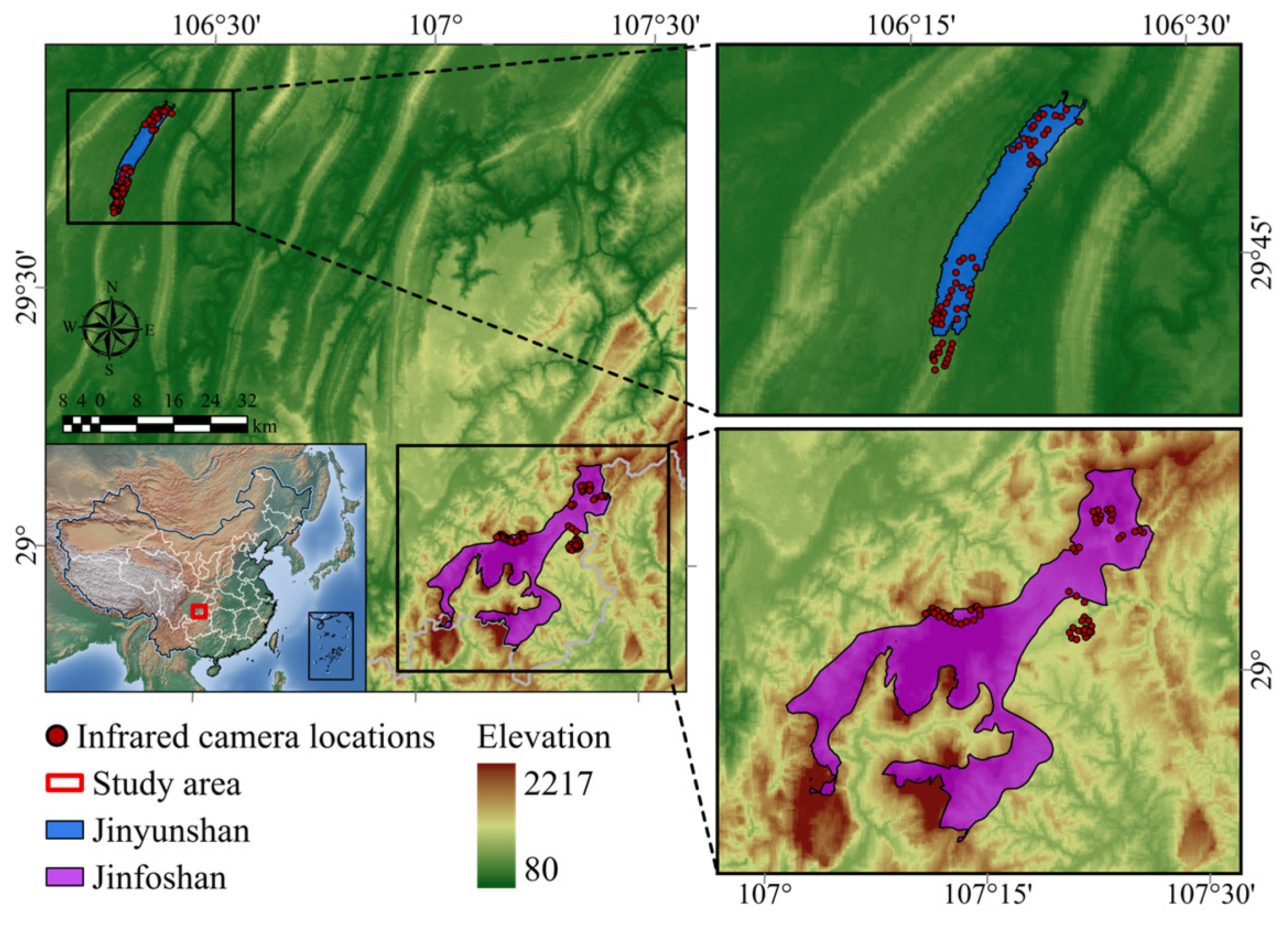
2.1. Camera-Trap Survey Design and Data Processing
2.2. Quantifying Anthropogenic Disturbance
2.3. Taxonomic and Functional Diversity
2.4. Activity Pattern Analysis
3. Results
3.1. Mammal Surveys
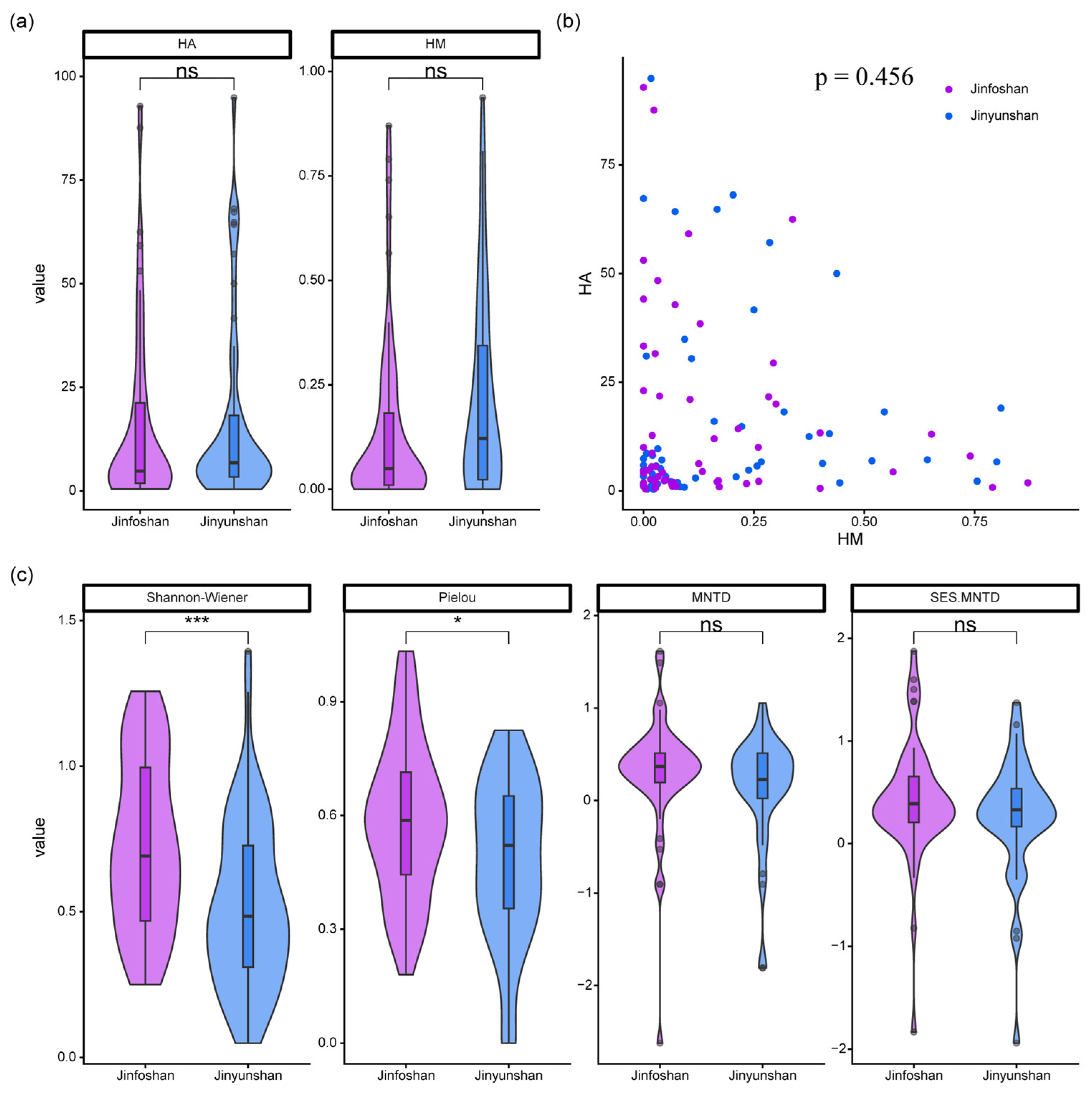
3.2. Diversity and Anthropogenic Disturbance Difference
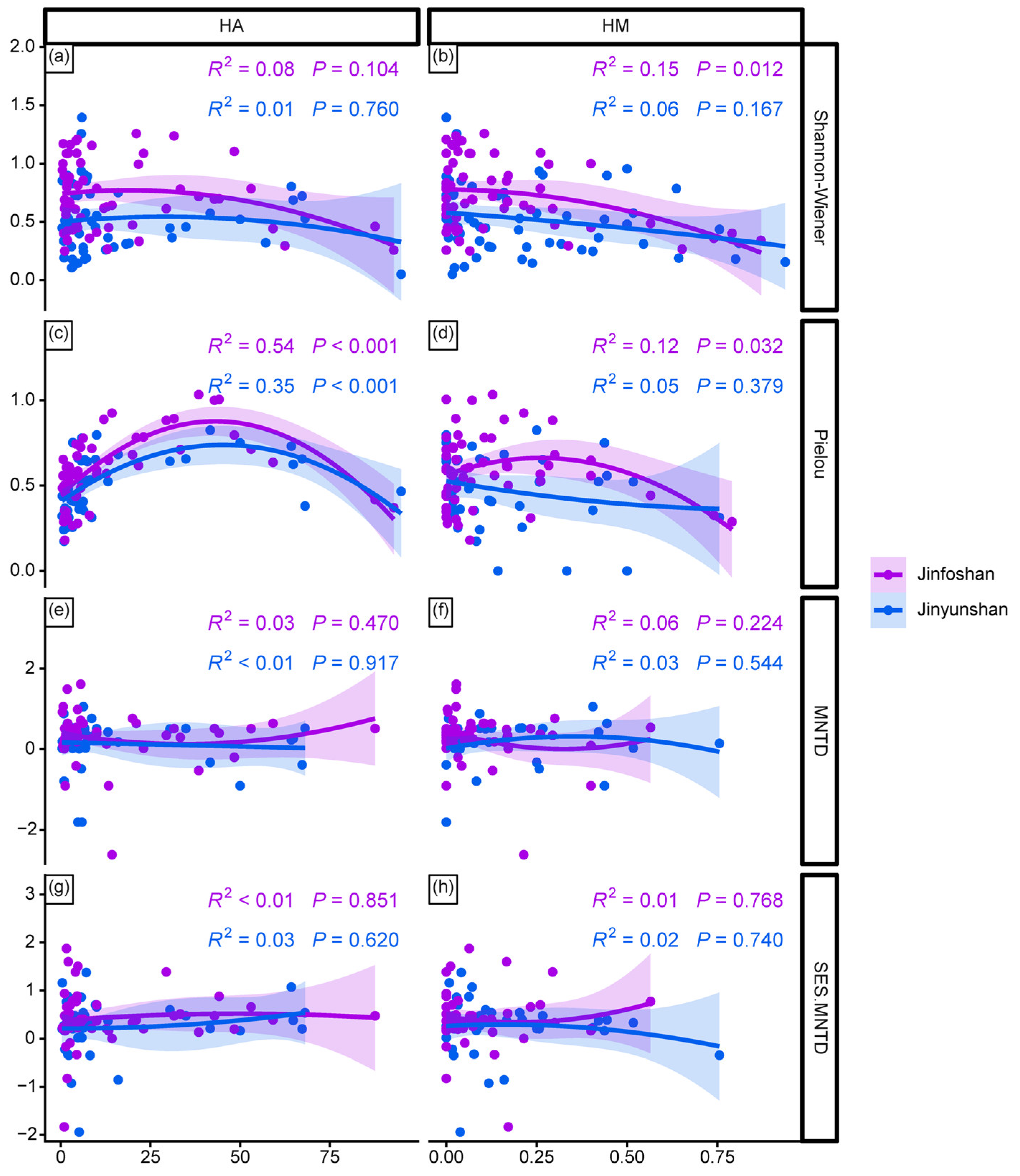
3.3. Effects of Anthropogenic Disturbance on Mammal Biodiversity
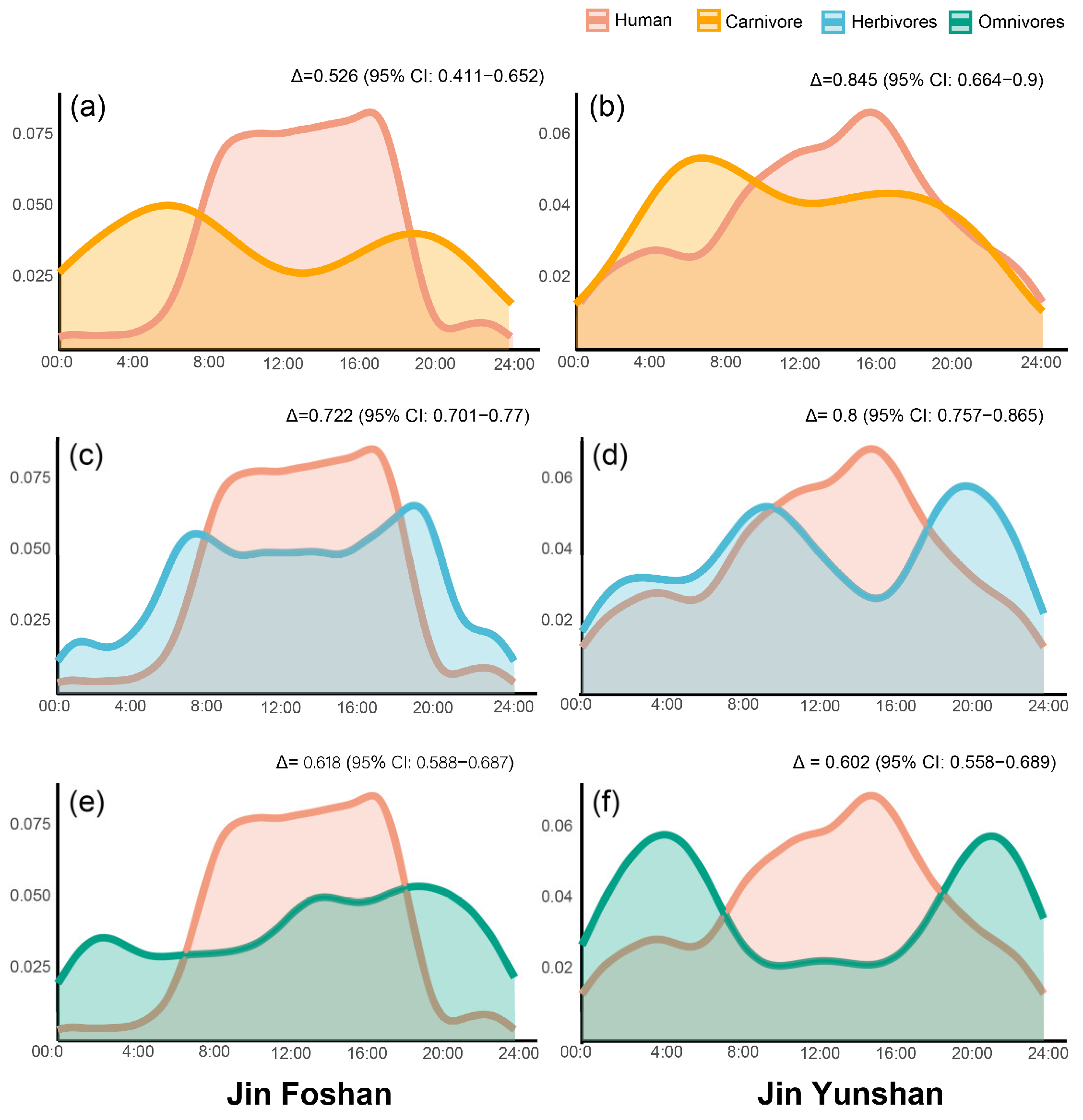
3.4. Effects of Human Disturbance on Diel Activity Patterns of Herbivorous and Omnivorous Mammals
4. Discussion
4.1. Hypothesis 1: Effects of Anthropogenic Disturbance on Multidimensional Biodiversity
4.2. Hypothesis 2: Contrasting Effects of Human Modification and Human Activity
4.3. Hypothesis 3: Guild-Specific Behavioral Responses to Disturbance
4.4. Limitations and Future Directions
5. Conclusions
Author Contributions
Funding
Institutional Review Board Statement
Informed Consent Statement
Data Availability Statement
Conflicts of Interest
References
- Bongaarts, J. Summary for policymakers of the global assessment report on biodiversity and ecosystem services of the Intergovernmental Science policy Platform on Biodiversity and Ecosystem Services. Popul. Dev. Rev. 2019, 45, 680–681. [Google Scholar] [CrossRef]
- Keck, F.; Peller, T.; Alther, R.; Barouillet, C.; Blackman, R.; Capo, E.; Chonova, T.; Couton, M.; Fehlinger, L.; Kirschner, D.; et al. The global human impact on biodiversity. Nature 2025, 641, 395–400. [Google Scholar] [CrossRef]
- Newbold, T.; Hudson, L.N.; Hill, S.L.L.; Contu, S.; Lysenko, I.; Senior, R.A.; Börger, L.; Bennett, D.J.; Choimes, A.; Collen, B.; et al. Global effects of land use on local terrestrial biodiversity. Nature 2015, 520, 45–50. [Google Scholar] [CrossRef]
- Lewis, S.L.; Maslin, M.A. Defining the Anthropocene. Nature 2015, 519, 171–180. [Google Scholar] [CrossRef]
- Kennedy, C.M.; Oakleaf, J.R.; Theobald, D.M.; Baruch-Mordo, S.; Kiesecker, J. Managing the middle: A shift in conservation priorities based on the global human modification gradient. Glob. Change Biol. 2019, 25, 811–826. [Google Scholar] [CrossRef] [PubMed]
- Laurance, W.F.; Carolina Useche, D.; Rendeiro, J.; Kalka, M.; Bradshaw, C.J.A.; Sloan, S.P.; Laurance, S.G.; Campbell, M.; Abernethy, K.; Alvarez, P.; et al. Averting biodiversity collapse in tropical forest protected areas. Nature 2012, 489, 290–294. [Google Scholar] [CrossRef] [PubMed]
- Su, G.; Logez, M.; Xu, J.; Tao, S.; Villéger, S.; Brosse, S. Human impacts on global freshwater fish biodiversity. Science 2021, 371, 835–838. [Google Scholar] [CrossRef] [PubMed]
- Wittische, J.; Heckbert, S.; James, P.M.A.; Burton, A.C.; Fisher, J.T. Community-level modelling of boreal forest mammal distribution in an oil sands landscape. Sci. Total Environ. 2021, 755, 142500. [Google Scholar] [CrossRef]
- Doherty, T.S.; Hays, G.C.; Driscoll, D.A. Human disturbance causes widespread disruption of animal movement. Nat. Ecol. Evol. 2021, 5, 513–519. [Google Scholar] [CrossRef]
- Dirzo, R.; Young, H.S.; Galetti, M.; Ceballos, G.; Isaac, N.J.B.; Collen, B. Defaunation in the Anthropocene. Science 2014, 345, 401–406. [Google Scholar] [CrossRef]
- Li, X.; Hu, W.; Bleisch, W.V.; Li, Q.; Wang, H.; Lu, W.; Sun, J.; Zhang, F.; Ti, B.; Jiang, X. Functional diversity loss and change in nocturnal behavior of mammals under anthropogenic disturbance. Conserv. Biol. 2022, 36, e13839. [Google Scholar] [CrossRef] [PubMed]
- Hooper, D.U.; Chapin, F., III; Ewel, J.J.; Hector, A.; Inchausti, P.; Lavorel, S.; Lawton, J.H.; Lodge, D.M.; Loreau, M.; Naeem, S.; et al. Effects of biodiversity on ecosystem functioning: A consensus of current knowledge. Ecol. Monogr. 2005, 75, 3–35. [Google Scholar] [CrossRef]
- Gibson, L.; Lee, T.M.; Koh, L.P.; Brook, B.W.; Gardner, T.A.; Barlow, J.; Peres, C.A.; Bradshaw, C.J.A.; Laurance, W.F.; Lovejoy, T.E.; et al. Primary forests are irreplaceable for sustaining tropical biodiversity. Nature 2011, 478, 378–381. [Google Scholar] [CrossRef] [PubMed]
- Petchey, O.L.; Gaston, K.J. Functional diversity: Back to basics and looking forward. Ecol. Lett. 2006, 9, 741–758. [Google Scholar] [CrossRef]
- Laméris, D.W.; Tagg, N.; Kuenbou, J.K.; Sterck, E.H.M.; Willie, J. Drivers affecting mammal community structure and functional diversity under varied conservation efforts in a tropical rainforest in Cameroon. Anim. Conserv. 2020, 23, 182–191. [Google Scholar] [CrossRef]
- Weideman, E.A.; Slingsby, J.A.; Thomson, R.L.; Coetzee, B.T.W. Land cover change homogenizes functional and phylogenetic diversity within and among African savanna bird assemblages. Landsc. Ecol. 2020, 35, 145–157. [Google Scholar] [CrossRef]
- Díaz, S.; Fargione, J.; Chapin, F.S., III; Tilman, D. Biodiversity Loss Threatens Human Well-Being. PLoS Biol. 2006, 4, e277. [Google Scholar] [CrossRef]
- Revell, L.J. Phylogenetic signal and linear regression on species data. Methods Ecol. Evol. 2010, 1, 319–329. [Google Scholar] [CrossRef]
- Kembel, S.W.; Cowan, P.D.; Helmus, M.R.; Cornwell, W.K.; Morlon, H.; Ackerly, D.D.; Blomberg, S.P.; Webb, C.O. Picante: R tools for integrating phylogenies and ecology. Bioinformatics 2010, 26, 1463–1464. [Google Scholar] [CrossRef]
- Zhan, C.; Chen, X.; Li, B.; Chen, C.; Wang, Y. Human-Driven Extinctions Rapidly Alter the Island Biodiversity Patterns of Large and Medium-Sized Mammals in the Largest Archipelago of China. Divers. Distrib. 2025, 31, e70060. [Google Scholar] [CrossRef]
- Mori, A.S.; Isbell, F.; Seidl, R. β-Diversity, Community Assembly, and Ecosystem Functioning. Trends Ecol. Evol. 2018, 33, 549–564. [Google Scholar] [CrossRef] [PubMed]
- Lirong, Z.; Ibrahim, M.A.; Yuanyuan, L.; Limin, W.; Shu, F.; Dongming, L. Effects of constant light and dark conditions on the locomotor activity, body mass, and body temperature rhythms of Eurasian Tree Sparrows (Passer montanus). Avian Res. 2023, 14, 100126. [Google Scholar] [CrossRef]
- Gaynor, K.M.; Hojnowski, C.E.; Carter, N.H.; Brashares, J.S. The influence of human disturbance on wildlife nocturnality. Science 2018, 360, 1232–1235. [Google Scholar] [CrossRef] [PubMed]
- Takashi, I.; Daishi, H.; Tomoya, S. Impact of human disturbance in Japan on the distribution and diel activity pattern of terrestrial mammals. J. Nat. Conserv. 2022, 70, 126293. [Google Scholar] [CrossRef]
- O’Connell, A.F.; Nichols, J.D.; Karanth, K.U. Camera Traps in Animal Ecology: Methods and Analyses; Springer: New York, NY, USA, 2010. [Google Scholar]
- Rowcliffe, J.M.; Carbone, C. Surveys using camera traps: Are we looking to a brighter future? Anim. Conserv. 2008, 11, 185–186. [Google Scholar] [CrossRef]
- Ridout, M.S.; Linkie, M. Estimating overlap of daily activity patterns from camera trap data. J. Agric. Biol. Environ. Stat. 2009, 14, 322–337. [Google Scholar] [CrossRef]
- Silverman, B.W. Density estimation for statistics and data analysis. In Monographs on Statistics and Applied Probability; Chapman and Hall: London, UK, 1986. [Google Scholar]
- Rowcliffe, J.M.; Kays, R.; Kranstauber, B.; Carbone, C.; Jansen, P.A. Quantifying levels of animal activity using camera trap data. Methods Ecol. Evol. 2014, 5, 1170–1179. [Google Scholar] [CrossRef]
- Ripple, W.J.; Estes, J.A.; Beschta, R.L.; Wilmers, C.C.; Ritchie, E.G.; Hebblewhite, M.; Berger, J.; Elmhagen, B.; Letnic, M.; Nelson, M.P.; et al. Status and Ecological Effects of the World’s Largest Carnivores. Science 2014, 343, 1241484. [Google Scholar] [CrossRef]
- Estes, J.A.; Terborgh, J.; Brashares, J.S.; Power, M.E.; Berger, J.; Bond, W.J.; Carpenter, S.R.; Essington, T.E.; Holt, R.D.; Jackson, J.B.C.; et al. Trophic Downgrading of Planet Earth. Science 2011, 333, 301–306. [Google Scholar] [CrossRef]
- Austin, J.G.; Scott, C.; Rory, P.W.; Steven, J.C. Energy Landscapes and the Landscape of Fear. Trends Ecol. Evol. 2017, 32, 88–96. [Google Scholar] [CrossRef]
- Gaynor, K.M.; Brown, J.S.; Middleton, A.D.; Power, M.E.; Brashares, J.S. Landscapes of Fear: Spatial Patterns of Risk Perception and Response. Trends Ecol. Evol. 2019, 34, 355–368. [Google Scholar] [CrossRef]
- Suraci, J.P.; Clinchy, M.; Zanette, L.Y.; Wilmers, C.C. Fear of humans as apex predators has landscape-scale impacts from mountain lions to mice. Ecol. Lett. 2019, 22, 1578–1586. [Google Scholar] [CrossRef]
- Clinchy, M.; Zanette, L.Y.; Roberts, D.; Suraci, J.P.; Buesching, C.D.; Newman, C.; Macdonald, D.W. Fear of the human “super predator” far exceeds the fear of large carnivores in a model mesocarnivore. Behav. Ecol. 2016, 27, 1826–1832. [Google Scholar] [CrossRef]
- Gray, C.L.; Hill, S.L.L.; Newbold, T.; Hudson, L.N.; Börger, L.; Contu, S.; Hoskins, A.J.; Ferrier, S.; Purvis, A.; Scharlemann, J.P.W. Local biodiversity is higher inside than outside terrestrial protected areas worldwide. Nat. Commun. 2016, 7, 12306. [Google Scholar] [CrossRef] [PubMed]
- Ewart, H.E.; Pasqualotto, N.; Paolino, R.M.; Jensen, K.; Chiarello, A.G. Effects of anthropogenic disturbance and land cover protection on the behavioural patterns and abundance of Brazilian mammals. Glob. Ecol. Conserv. 2024, 50, e02839. [Google Scholar] [CrossRef]
- Yang, C.; Xu, H.; Li, Q.; Wang, X.; Tang, B.; Chen, J.; Tu, W.; Zhang, Y.; Shi, T.; Chen, M.; et al. Global loss of mountain vegetated landscapes and its impact on biodiversity conservation. Nat. Commun. 2025, 16, 8971. [Google Scholar] [CrossRef] [PubMed]
- Rija, A.A.; Critchlow, R.; Thomas, C.D.; Beale, C.M. Global extent and drivers of mammal population declines in protected areas under illegal hunting pressure. PLoS ONE 2020, 15, e0227163. [Google Scholar] [CrossRef]
- Chen, Y.; Xiang, Z.; Wang, X.; Xiao, W.; Xiao, Z.; Ren, B.; He, C.; Sang, C.; Li, H.; Li, M. Preliminary Study of the Newly Discovered Primate Species Rhinopithecus strykeri at Pianma, Yunnan, China Using Infrared Camera Traps. Int. J. Primatol. 2015, 36, 679–690. [Google Scholar] [CrossRef]
- Zhang, M.; Tang, C.; Zhang, Q.; Zhan, C.; Chen, C.; Wang, Y. Selective extinction and habitat nestedness are the main drivers of lizard nestedness in the Zhoushan Archipelago. Curr. Zool. 2022, 70, 244–252. [Google Scholar] [CrossRef]
- Li, Z.; Tang, Z.; Xu, Y.; Wang, Y.; Duan, Z.; Liu, X.; Wang, P.; Yang, J.; Chen, W.; Prins, H.H.T. Habitat Use and Activity Patterns of Mammals and Birds in Relation to Temperature and Vegetation Cover in the Alpine Ecosystem of Southwestern China with Camera-Trapping Monitoring. Animals 2021, 11, 3377. [Google Scholar] [CrossRef]
- Fida, T.; Ahmad, F.; Bosso, L.; Ali, N.; Din, S.U.; Kabir, M. Distribution, diel activity patterns and human-bear interactions of the Himalayan brown bear (Ursus arctos isabellinus) in the Deosai National Park, Pakistan. Mammal Res. 2024, 69, 493–505. [Google Scholar] [CrossRef]
- Crain, C.M.; Kroeker, K.; Halpern, B.S. Interactive and cumulative effects of multiple human stressors in marine systems. Ecol. Lett. 2008, 11, 1304–1315. [Google Scholar] [CrossRef] [PubMed]
- Carbone, C.; Christie, S.; Conforti, K.; Coulson, T.; Franklin, N.; Ginsberg, J.R.; Griffiths, M.; Holden, J.; Kawanishi, K.; Kinnaird, M.; et al. The use of photographic rates to estimate densities of tigers and other cryptic mammals. Anim. Conserv. 2001, 4, 75–79. [Google Scholar] [CrossRef]
- Magurran, A.E. Ecological Diversity and Its Measurement; Springer: Berlin/Heidelberg, Germany, 1988. [Google Scholar] [CrossRef]
- Fountain-Jones, N.M.; Jordan, G.J.; Burridge, C.P.; Wardlaw, T.J.; Baker, T.P. Trophic position determines functional and phylogenetic recovery after disturbance within a community. Funct. Ecol. 2017, 31, 1441–1451. [Google Scholar] [CrossRef]
- Soria, C.D.; Pacifici, M.; Di Marco, M.; Stephen, S.M.; Rondinini, C. COMBINE: A coalesced mammal database of intrinsic and extrinsic traits. Ecology 2021, 102, e03344. [Google Scholar] [CrossRef]
- Zhu, P.; Liu, W.; Zhang, X.; Li, M.; Liu, G.; Yu, Y.; Li, Z.; Li, X.; Du, J.; Wang, X.; et al. Correlated evolution of social organization and lifespan in mammals. Nat. Commun. 2023, 14, 372. [Google Scholar] [CrossRef]
- Laliberté, E.; Legendre, P. A distance-based framework for measuring functional diversity from multiple traits. Ecology 2010, 91, 299–305. [Google Scholar] [CrossRef]
- Fahrig, L. Effects of Habitat Fragmentation on Biodiversity. Annu. Rev. Ecol. Evol. Syst. 2003, 34, 487–515. [Google Scholar] [CrossRef]
- Wilman, H.; Belmaker, J.; Simpson, J.E.; Rosa, C.D.L.; Rivadeneira, M.M.; Jetz, W. EltonTraits 1.0: Species-level foraging attributes of the world’s birds and mammals. Ecology 2014, 95, 2027. [Google Scholar] [CrossRef]
- Crooks, K.R.; Burdett, C.L.; Theobald, D.M.; King, S.R.B.; Di Marco, M.; Rondinini, C.; Boitani, L. Quantification of habitat fragmentation reveals extinction risk in terrestrial mammals. Proc. Natl. Acad. Sci. USA 2017, 114, 7635–7640. [Google Scholar] [CrossRef]
- Ana, B.-L.; Rob, A.; Pita, A.V. The impacts of roads and other infrastructure on mammal and bird populations: A meta-analysis. Biol. Conserv. 2010, 143, 1307–1316. [Google Scholar] [CrossRef]
- Carter, N.H.; Shrestha, B.K.; Karki, J.B.; Pradhan, N.M.; Liu, J. Coexistence between wildlife and humans at fine spatial scales. Proc. Natl. Acad. Sci. USA 2012, 109, 15360–15365. [Google Scholar] [CrossRef] [PubMed]
- Chapin, F.S., III; Zavaleta, E.S.; Eviner, V.T.; Naylor, R.L.; Vitousek, P.M.; Reynolds, H.L.; Hooper, D.U.; Lavorel, S.; Sala, O.E.; Hobbie, S.E.; et al. Consequences of changing biodiversity. Nature 2000, 405, 234–242. [Google Scholar] [CrossRef]
- Thiel, D.; Jenni-Eiermann, S.; Braunisch, V.; Palme, R.; Jenni, L. Ski Tourism Affects Habitat Use and Evokes a Physiological Stress Response in Capercaillie Tetrao urogallus: A New Methodological Approach. J. Appl. Ecol. 2008, 45, 845–853. [Google Scholar] [CrossRef]
- Wang, Y.; Smith, J.A.; Wilmers, C.C. Residential development alters behavior, movement, and energetics in an apex predator, the puma. PLoS ONE 2017, 12, e0184687. [Google Scholar] [CrossRef]
- Tucker, M.A.; Böhning-Gaese, K.; Fagan, W.F.; Fryxell, J.M.; Van Moorter, B.; Alberts, S.C.; Ali, A.H.; Allen, A.M.; Attias, N.; Avgar, T.; et al. Moving in the Anthropocene: Global reductions in terrestrial mammalian movements. Science 2018, 359, 466–469. [Google Scholar] [CrossRef] [PubMed]
- Ciuti, S.; Northrup, J.M.; Muhly, T.B.; Simi, S.; Musiani, M.; Pitt, J.A.; Boyce, M.S. Effects of Humans on Behaviour of Wildlife Exceed Those of Natural Predators in a Landscape of Fear. PLoS ONE 2012, 7, e50611. [Google Scholar] [CrossRef]
- Li, X.; Bleisch, W.V.; Liu, X.; Hu, W.; Jiang, X. Human disturbance and prey occupancy as predictors of carnivore richness and biomass in a Himalayan hotspot. Anim. Conserv. 2020, 24, 64–72. [Google Scholar] [CrossRef]
- Berger, J. Fear, human shields and the redistribution of prey and predators in protected areas. Biol. Lett. 2007, 3, 620–623. [Google Scholar] [CrossRef]
- Cox, D.T.C.; Gardner, A.S.; Gaston, K.J. Diel niche variation in mammals associated with expanded trait space. Nat. Commun. 2021, 12, 1753. [Google Scholar] [CrossRef]
- Middleton, A.D.; Kauffman, M.J.; McWhirter, D.E.; Cook, J.G.; Cook, R.C.; Nelson, A.A.; Jimenez, M.D.; Klaver, R.W. Animal migration amid shifting patterns of phenology and predation: Lessons from a Yellowstone elk herd. Ecology 2013, 94, 1245–1256. [Google Scholar] [CrossRef]
- Gaynor, K.; Cherry, M.; Gilbert, S.; Kohl, M.; Larson, C.; Newsome, T.; Prugh, L.; Suraci, J.; Young, J.; Smith, J. An applied ecology of fear framework: Linking theory to conservation practice. Anim. Conserv. 2020, 24, 308–321. [Google Scholar] [CrossRef]
- Veech, J.A. A probability-based analysis of temporal and spatial co-occurrence in grassland birds. J. Biogeogr. 2006, 33, 2145–2153. [Google Scholar] [CrossRef]



| Species | Dietary | Jinfoshan | Jinyunshan |
|---|---|---|---|
| Prionodon pardicolor | omnivore | ✓ | |
| Prionailurus bengalensis | carnivore | ✓ | ✓ |
| Meles leucurus | omnivore | ✓ | |
| Trachypithecus francoisi | herbivore | ✓ | |
| Paguma larvata | omnivore | ✓ | ✓ |
| Martes flavigula | carnivore | ✓ | |
| Mustela sibirica | carnivore | ✓ | ✓ |
| Moschus berezovskii | herbivore | ✓ | |
| Elaphodus cephalophus | herbivore | ✓ | ✓ |
| Lepus tolai | herbivore | ✓ | |
| Macaca mulatta | herbivore | ✓ | |
| Muntiacus reevesi | herbivore | ✓ | ✓ |
| Sus scrofa | omnivore | ✓ | ✓ |
| Atherurus macrourus | omnivore | ✓ | |
| Arctonyx collaris | omnivore | ✓ | ✓ |
Disclaimer/Publisher’s Note: The statements, opinions and data contained in all publications are solely those of the individual author(s) and contributor(s) and not of MDPI and/or the editor(s). MDPI and/or the editor(s) disclaim responsibility for any injury to people or property resulting from any ideas, methods, instructions or products referred to in the content. |
© 2026 by the authors. Licensee MDPI, Basel, Switzerland. This article is an open access article distributed under the terms and conditions of the Creative Commons Attribution (CC BY) license.
Share and Cite
Guo, Z.; Zhu, H.; He, J.; Shen, L.; Xia, W. Effects of Anthropogenic Disturbance on Mammal Community Diversity and Activity Patterns: Evidence from the Jinfoshan and Jinyunshan National Nature Reserves, China. Animals 2026, 16, 695. https://doi.org/10.3390/ani16050695
Guo Z, Zhu H, He J, Shen L, Xia W. Effects of Anthropogenic Disturbance on Mammal Community Diversity and Activity Patterns: Evidence from the Jinfoshan and Jinyunshan National Nature Reserves, China. Animals. 2026; 16(5):695. https://doi.org/10.3390/ani16050695
Chicago/Turabian StyleGuo, Zeguang, Hanyu Zhu, Jie He, Ling Shen, and Wancai Xia. 2026. "Effects of Anthropogenic Disturbance on Mammal Community Diversity and Activity Patterns: Evidence from the Jinfoshan and Jinyunshan National Nature Reserves, China" Animals 16, no. 5: 695. https://doi.org/10.3390/ani16050695
APA StyleGuo, Z., Zhu, H., He, J., Shen, L., & Xia, W. (2026). Effects of Anthropogenic Disturbance on Mammal Community Diversity and Activity Patterns: Evidence from the Jinfoshan and Jinyunshan National Nature Reserves, China. Animals, 16(5), 695. https://doi.org/10.3390/ani16050695